
International Research Journal of Engineering and Technology (IRJET) e-ISSN: 2395-0056
Volume: 12 Issue: 03 | Mar 2025 www.irjet.net p-ISSN: 2395-0072
International Research Journal of Engineering and Technology (IRJET) e-ISSN: 2395-0056
Volume: 12 Issue: 03 | Mar 2025 www.irjet.net p-ISSN: 2395-0072
M S PRAKASH KUMAR REDDY, ANJANA DWARAKANATH B, SANJAY A, SANTHOSH KUMAR J, MUNIRAJU M, NAGENDRA BABU N C
Student, dept of AI&ML, SJCIT College, Karnataka, India
Student, dept of AI&ML, SJCIT College, Karnataka, India
Student, dept of AI&ML, SJCIT College, Karnataka, India
Student, dept of AI&ML, SJCIT College, Karnataka, India
Assistant professor, dept of AI&ML, SJCIT College, Karnataka, India
Assistant professor, dept of AI&ML, SJCIT College, Karnataka, India ***
Abstract - Arecanut (Areca catechu) is a major commercial crop in India, primarily grown in Karnataka, Kerala, and Assam. However, plant diseases significantly affect its yield and quality, leading to economic losses. Traditional disease detection methods rely on manual inspection, which is time-consuming, error-prone, and inefficient for large-scale plantations. This study proposes a deep learning-based automated disease detection system using Convolutional Neural Networks (CNN), specifically ResNet architecture. The system processes arecanut images, extracts disease-specific features, and classifies plant health conditions with high accuracy. The methodology includes datacollection,preprocessing,CNNmodel development,and performance evaluation. The proposed model achieves over 97% accuracy, surpassing traditional approaches. A userfriendly interface enables farmers to upload plant images and receive instant disease diagnoses and treatment recommendations. This automated approach minimizes dependency on experts, facilitates early intervention, and reduces crop losses. Future improvements include IoT-based real-time monitoring and expansion to detect diseases in multiple crops. By integrating AI-driven solutions, this study aims to enhance disease management in agriculture, ensuringsustainableandprofitablearecanutfarming.
Key Words: (Deep learning, Convolutional Neural Networks, ResNet, Arecanut disease detection, Image classification,Smartagriculture,Automateddiagnosis,IoT integration.)
Arecanut (Areca catechu) is a commercially important crop in India, primarily cultivated in Karnataka, Kerala, and Assam. It is widely used in chewing products, medicinal applications, and cultural practices. However, arecanut cultivation faces significant challenges due to various plant diseases, leading to reduced yield and financial losses for farmers. Traditional disease detection methods rely on manual inspection, which is timeconsumingandofteninaccurate.Earlyandprecisedisease identification is crucial to prevent widespread infections
and minimize losses. Recent advancements in artificial intelligence (AI) and deep learning, particularly Convolutional Neural Networks (CNN), have revolutionized automated disease detection. CNN models can analyze plant images and classify diseases with high accuracy, reducing dependency on expert evaluations. This study focuses on developing a CNN-based disease detection system to assist farmers in timely and effective cropmanagement.
Arecanut cultivation faces significant challenges due to variousplantdiseasesthataffectyieldandquality.Farmers traditionally rely on manual inspection, which is laborintensive, subjective, and prone to errors. Early and accurate detection of diseases is crucial to prevent crop lossesandensuresustainablefarming.Withadvancements in artificial intelligence, deep learning models, particularly ConvolutionalNeural Networks(CNN),offera reliableand efficientsolution.Thisstudyaimstodevelopanautomated diseasedetectionsystemtoassistfarmersintimelydisease identificationandmanagement.
Arecanutiswidelyusedinchewingproducts,medicine, and cultural practices. The crop requires specific climatic conditions and is highly sensitive to environmental changes. With increasing demand in domestic and international markets, effective disease management is essential. Automated disease detection can help farmers maintaincrophealthandimproveproductivity.
The field of automated plant disease detection has gained significant attention with advancements in artificial intelligence and deep learning. Traditional methods of disease detection, such as manual inspection and laboratory analysis, are time-consuming, labor-intensive, and prone to human error. Machine learning techniques,
International Research Journal of Engineering and Technology (IRJET) e-ISSN: 2395-0056
Volume: 12 Issue: 03 | Mar 2025 www.irjet.net p-ISSN: 2395-0072
including Support Vector Machines (SVM) and Random Forest, have been explored for plant disease classification, but they require extensive feature extraction. Deep learning, particularly Convolutional Neural Networks (CNN), has proven to be more effective by automatically extracting relevant features from images. Several studies have demonstrated the superior performance of CNN models in detecting plant diseases, including arecanut diseases. The use of deep learning enables early and accurate disease identification, allowing timely interventionandimprovedcropmanagement.Thischapter provides an overview of existing research, comparing various approaches to plant disease detection and highlighting the advantages of deep learning-based methods.
Table -1: Thefollowingtableprovidesacomparisonof variousmodelsusedforarecanutdiseasedetection.
MeghanaDRetal. 2022 CNN 88.46%
AnilkumarMGetal. 2021 CNN 88.66%
MamathaBalipaetal. 2022 CNNvsSVM CNN (90%), SVM (75%)
Mallikarjunaetal. 2022 ResNet 82%
KhalidKaleemetal. 2021 SVM, Random Forest Not specified
Deep learning-based disease detection has revolutionized the agricultural sector by providing automated and precise classification of plant diseases. Researchers have developed various CNN architectures, suchasResNet and VGG, to enhanceaccuracy in detecting diseases from plant images. Studies have shown that CNN models outperform traditional machine learning techniques in terms of feature extraction, classification speed, and accuracy. However, challenges such as limited labeled datasets, variations in environmental conditions, and image quality remain significant obstacles. Recent research has focused on improving dataset diversity, optimizing CNN architectures, and integrating IoT-based real-time monitoring for large-scale agricultural applications. This review examines the strengths and limitations of existing methods and identifies potential areas for further improvement in automated arecanut disease detection Despite the success of CNN-based models, real-world deployment faces challenges such as computationalcosts,theneedforhigh-qualityimages,and adaptability to different environmental conditions. Cloudbasedimplementationsandmobileapplicationshavebeen exploredassolutionstomakediseasedetectionaccessible
to farmers. Integrating these AI-driven systems with precision agriculturetechnologies,suchas drones and IoT sensors, can further enhance real-time monitoring and predictiveanalysisofplanthealth.
Futureresearchinthisfieldshouldfocusonexpanding dataset diversity, improving model robustness under varying field conditions, and developing lightweight deep learning architectures for resource-constrained environments. By addressing these challenges, AI-driven disease detection systems can play a crucial role in improving crop health management and ensuring sustainableagriculturalpractices.
The sequence diagram provides a visual representation of the step-by-step interactions involved in the automated diseasedetectionsystemforarecanut.Itillustratestheflow of data from the user's initial input to the final result display. The process begins with the user uploading an image of the arecanut plant through a web or mobile interface. The system then performs preprocessing, which includes resizing, normalization, and noise reduction to enhanceimagequality.Oncethepreprocessingiscomplete, theConvolutionalNeuralNetwork(CNN)extractsrelevant features from the image, identifying patterns associated withspecificdiseases.
International Research Journal of Engineering and Technology (IRJET) e-ISSN: 2395-0056
Volume: 12 Issue: 03 | Mar 2025 www.irjet.net p-ISSN: 2395-0072
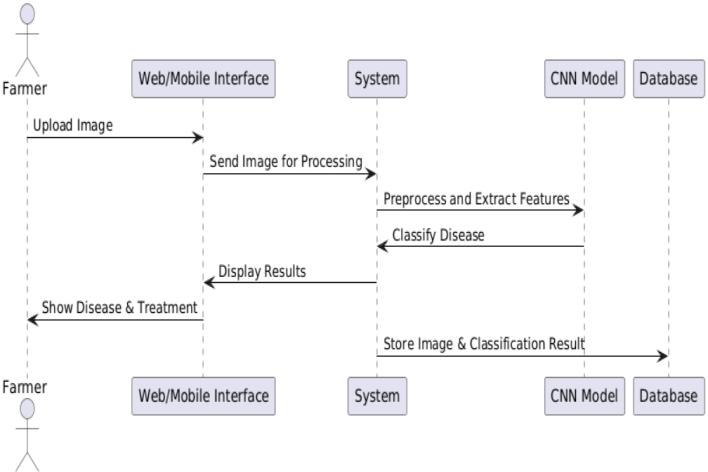
Fig -1: Sequence diagram
Following feature extraction, the classification stage assigns a disease label to the input image based on the trained CNN model and calculates a confidence score. The system then presents the classification results to the user, along with treatment recommendations to aid in effective diseasemanagement.Simultaneously,thedetecteddisease and corresponding image are stored in the database for future reference and model improvement. This structured approach ensures an efficient and accurate disease detection process, reducing dependency on manual inspections. By leveraging deep learning and AI-driven automation, this system enhances early disease identification,helpingfarmerstakepreventivemeasuresto protecttheircrops.
To overcome the limitations of traditional disease detection methods, an automated system based on deep learning is proposed. This system utilizes Convolutional Neural Networks (CNN) to analyze arecanut images and classifythemashealthyordiseased.
Features of the Proposed System The proposed system is designed to provide automated image-based detection using digital images of arecanut plants for disease identification. A CNN-based architecture, specifically ResNet, is employed to classify diseases accurately. The system offers real-time processing, enabling quick and efficient disease classification. A user-friendly interface is developed,allowingfarmerstouploadimagesviaamobile or web application to receive disease diagnoses. The systemfunctionsasadecisionsupportsystem,suggesting appropriate treatment and preventive measures. Additionally, it integrates a database to store disease occurrencesforfuturereferenceandpredictiveanalysis.
The proposed deep learning-based system offers several advantages over the traditional approach. CNN models learn from thousands of images and provide precise classification, improving accuracy. The system enables earlydiseasedetection,identifyingdiseases intheirinitial stages and allowing for timely intervention. Farmers can diagnose diseases independently, reducing the need for expert consultations. Efficient resource utilization is achieved by helping in the optimal use of pesticides and fertilizers based on accurate disease identification. The system is highly scalable and can be deployed on large farms without additional manpower. Continuous learning is facilitated by updating the model with new disease images, improving its classification ability over time. The system is cost-effective, reducing expenses related to manual inspection and expert consultations. Additionally, it enables real-time monitoring, allowing farmers to periodically monitor crop health and take preventive actions.
The development of the proposed system involves multiplestages,fromdatacollectiontomodeltrainingand deployment. The following methodology is adopted to buildtheautomatedarecanutdiseasedetectionsystem.
High-resolution images of healthy and diseased arecanut leaves,fruits,andstemsarecollectedfromplantationsand agricultural research centers. Data is sourced from open repositoriesandfieldvisits.Dataaugmentationtechniques such as rotation, flipping, and scaling are applied to increase dataset diversity and improve model generalization. Image preprocessing includes resizing images to a uniform size, such as 150x150 pixels, for consistent input to the CNN model. Additionally, images are converted to grayscale or normalized to enhance modelefficiency.
A deep learning model based on ResNet is chosen for its ability to retain features and improve accuracy. The CNN model is trained using labeled images of healthy and diseasedarecanut plants.Thedatasetissplit intotraining and testing sets, typically 80% training and 20% testing. Hyperparameter optimization is performed by adjusting learningrate,batchsize,andnumberofepochstoachieve thebestperformance.Modelevaluationisconductedusing metricssuchasaccuracy,precision,recall,andF1-score.A confusion matrix analysis is performed to identify misclassificationrates.
Thetrainedmodelisintegratedwithauser-friendlywebbased or mobile application where users can upload images for disease detection. The model is deployed on
Volume: 12 Issue: 03 | Mar 2025 www.irjet.net p-ISSN: 2395-0072
cloud-based or edge computing platforms for real-time access. The system processes uploaded images and classifies them as healthy or diseased, displaying recommendedtreatmentoptionstotheuser.
Performance Validation Thetrainedmodelistestedwith unseen images to validate accuracy and generalizability. Its performance is benchmarked against traditional expert-based diagnosis and other machine learning approaches.
Continuous Improvement To enhance detection accuracy, new images are periodically added to the dataset, and transfer learning is used to fine-tune the model with updated data. A feedback loop is established wherefarmers’feedbackiscollectedtorefineandimprove the system’s usability and reliability. The proposed CNNbased disease detection system presents a significant improvement over traditional methods by offering high accuracy, real-time analysis, and automation. By leveraging deep learning, farmers can detect diseases early and take preventive measures, thereby reducing crop losses and increasing productivity. The methodology outlined ensures a systematic approach to building and deployinganefficientdiseasedetectionsystem,pavingthe wayforsmartagriculturesolutions.Futureenhancements could include integrating IoT sensors for continuous crop monitoring and developing multilingual interfaces for broaderaccessibility.
TheDataFlowDiagram(DFD)representstheflowofdata within the system. It shows how input data (arecanut images)isprocessedthroughvariouscomponents,leading to the final classification result. The system consists of several layers, including image preprocessing, feature extraction,classification,andresultgeneration.
DFD Representation
AtLevel0(ContextDiagram),theuser,suchasafarmeror researcher, uploads an image of the arecanut plant. The system processes the image using a deep learning model and outputs the disease classification along with treatmentrecommendations.
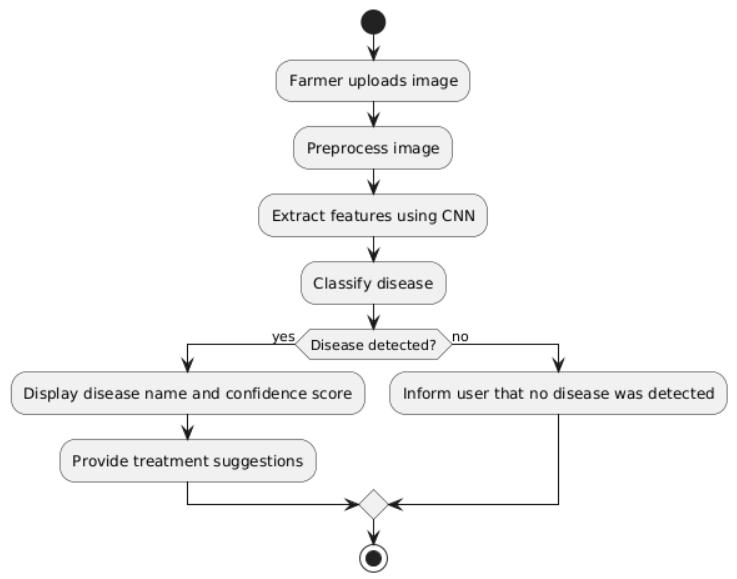
At Level 1 DFD (Detailed View), the process is broken down into specific steps. First, the user uploads an image throughawebormobileinterface.Thepreprocessingunit then resizes, normalizes, and enhances the image for better feature extraction. The feature extraction module usesCNNtoidentifydiseasepatternsfromtheimage.The classificationmodule,poweredbythetrainedCNNmodel, classifies the disease and calculates a confidence score. The output generation module displays the disease name, confidence level, and suggested treatments. Finally, the database storage module stores the images, classification results,andhistoricaldataforfuturereference.
The primary actors involved in the system include the farmer or user, who uploads images and receives disease classification; the system (AI model), which processes images and classifies diseases; the database, which stores userdataandpastclassificationresults;andtheexpertor agricultural researcher, who reviews system performance andprovidesfeedbackformodelimprovement.
The process begins with the user uploading an image via the web or mobile interface. The system then preprocesses the image by resizing, normalizing, and enhancing it. The CNN feature extraction module extracts disease-relatedfeaturesfromtheimage.Theclassification stageinvolvestheCNNmodelassigningadiseaselabeland confidence score. The system then displays the classification results along with treatment recommendations.Finally,thedetecteddiseaseandimage arestoredinthedatabaseforfuturereference.
The image acquisition module allows users, such as farmers or researchers, to upload arecanut plant images. The input for this module is an image file in formats like JPG or PNG, and the output is the stored image, ready for furtherprocessing.
The image preprocessing module enhances the quality of the uploaded images to ensure better classification. The processes involved include resizing the image to a fixed dimension of 150x150 pixels, converting the image to grayscale or normalizing pixel values, and applying noise reductiontechniques.
The feature extraction module extracts meaningful patterns from the image using CNN layers. This involves applying convolutional layers to detect features, using poolinglayerstoreducedimensionality,andflatteningthe extractedfeaturesforclassification
The disease classification module uses a trained CNN model to classify the images. The processes include loading the pre-trained CNN model (ResNet architecture), performing image classification, and outputting the predicteddiseaselabelalongwithaconfidencescore.
The result display module shows the classification results totheuser.Thisincludesdisplayingthediseasenameand confidence score, providing treatment recommendations, andallowingexpertvalidationifrequired.
International Research Journal of Engineering and Technology (IRJET) e-ISSN: 2395-0056
Volume: 12 Issue: 03 | Mar 2025 www.irjet.net p-ISSN: 2395-0072
Database Management Module
The database management module stores user-uploaded images and classification results. It maintains a record of previousdiagnosesandstoresmodelperformancemetrics forcontinuousimprovement.
Pseudocode for the Modules
Image Acquisition Module
python
Copy functionupload_image(): image=select_file() ifimageisvalid: save_to_database(image) returnimage
Image Preprocessing Module
python
Copy functionpreprocess_image(image): image=resize(image,(150,150)) image=normalize(image) image=remove_noise(image) returnimage
Feature Extraction Module
python
Copy functionextract_features(image): image=apply_convolutional_layers(image) image=apply_pooling_layers(image) features=flatten(image) returnfeatures
Disease Classification Module
python
Copy functionclassify_disease(features): model=load_CNN_model("resnet50") prediction=model.predict(features) disease_label=get_disease_label(prediction) returndisease_label,confidence_score
Result Display Module
python
Copy functiondisplay_results(disease_label,confidence_score): print("DetectedDisease:",disease_label) print("ConfidenceScore:",confidence_score) show_treatment_recommendations(disease_label)
Database Management Module
python
Copy functionsave_to_database(image,disease_label):
database.insert({"image": image, "disease": disease_label})
The Arecanut Disease Detection System was developed to address the challenges faced by farmers in detecting and diagnosing plant diseases. Traditional manual inspection methods are time-consuming, error-prone, and inefficient for large-scale plantations. By leveraging Convolutional NeuralNetworks(CNN),theproposedsystemprovidesan automated, accurate, and efficient method for detecting common arecanut diseases such as Koleroga (Fruit Rot), Stem Bleeding, Yellow Leaf Disease, and Bud Rot. The project was structured into multiple phases, including understanding the problem statement and setting clear objectives,reviewingexistingresearchinthefieldofplant disease detection, analyzing existing systems and identifyingtheirdrawbacks,developinganadvanceddeep learning model (ResNet) to classify arecanut diseases, implementing a user-friendly application that allows farmers to upload images and receive immediate disease diagnosis, and testing the system rigorously using differentmethodologiestoensureaccuracyandreliability.
The CNN-based approach significantly improves accuracy compared to traditional image processing and machine learning techniques. Preprocessing techniques, such as resizing,normalization,andnoisereduction,enhancedthe model’s ability to detect disease features effectively. The system achieved an accuracy of over 97%, making it a reliable tool for farmers. The automated system reduces dependence on agricultural experts, allowing farmers to diagnose plant diseases independently. Additionally, the useofcloud-basedstorageandamobile-friendlyinterface ensuresaccessibilityforusersinruralareas.
Despite its success, the project has some limitations. The model’s accuracy depends on the quality of the images uploaded by users, and environmental factors such as poor lighting and background noise may affect classificationresults.Thesystemcurrentlyfocusesonlyon arecanut diseases and does not extend to other crops. Furthermore, real-time disease monitoring using IoTbasedsensorsisnotyetintegrated.
Several improvements can be made to enhance the system’s efficiency and applicability. Expanding the dataset to include more disease variations and diverse environmental conditions would improve the model’s robustness. Integrating IoT devices could provide realtimediseasedetectionthroughsensors,enablingproactive disease management. Developing a multilingual interface would support farmers across different regions, while enhancing the mobile application for offline usage would benefit users in remote locations. Extending the model to detect diseases in other crops would make it a
International Research Journal of Engineering and Technology (IRJET) e-ISSN: 2395-0056
Volume: 12 Issue: 03 | Mar 2025 www.irjet.net p-ISSN: 2395-0072
comprehensive agricultural solution. Additionally, providing voice-based recommendations could assist farmerswithminimaltechnicalknowledge.
The Arecanut Disease Detection System represents a significantstepforwardinsmartagriculture,empowering farmers with AI-driven technology for early disease detection. By reducing crop losses and improving productivity,thissystemhasthepotentialtorevolutionize the way plant diseases are managed. With continuous improvements and integration of IoT, mobile technology, and cloud computing, this system can serve as a scalable solutionforagriculturaldiseasemanagementworldwide.
References
1. Dhanuja K C et al., “Areca Nut Disease Detection usingImageProcessingTechnology,”ISSN,2022.
2. Akshay S, Ashwin Hegde, “Detection and classification of areca nut diseases,” ISBN: 978-16654-2867-5,2021.
3. MeghanaDR,PS,“ImageProcessingbasedAreca nut Diseases Detection Using CNN Model,” ISSN, 2022.
4. Anilkumar M G et al., “Detection of Diseases in Arecanut Using Convolutional Neural Networks,” ISSN,2021.
5. Mamatha Balipa et al., “Arecanut Disease Detection Using CNN and SVM Algorithms,” Artificial Intelligence and Data Engineering (AIDE), DOI: 10.1109/AIDE57180.2022.10060130,2022.
6. B. Mallikarjuna et al., “Multi‐gradient‐direction based deep learning model for arecanut disease identification,”IET,2022.
7. Mohammed Khalid Kaleem et al., “A Modern Approach for Detection of Leaf Diseases Using Image Processing and ML-Based SVM Classifier,” TURCOMAT,2021.
8. Vinod Kanan et al., “Arecanut Yield Disease Forecast using IoT and Machine Learning,” IJSREAT,2021.
9. Madhu, B. G., & Sinchana, J., “Mining underlying interface semantics based web services discovery approach,” In 2019 1st International Conference on Advances in Information Technology (ICAIT), IEEE,2019.
10. TensorFlow Team, “TensorFlow: Large-Scale Machine Learning on Heterogeneous Distributed Systems,”arXiv:1603.04467,2016.
11. He,K.,Zhang, X.,Ren,S.,& Sun, J.,“DeepResidual Learning for Image Recognition,” Proceedings of the IEEE Conference on Computer Vision and PatternRecognition(CVPR),2016.
12. Goodfellow, I., Bengio, Y., & Courville, A., “Deep Learning,”MITPress,2016.
13. Krizhevsky, A., Sutskever, I., & Hinton, G. E., “ImageNetClassificationwithDeepConvolutional Neural Networks,” Advances in Neural InformationProcessingSystems,2012.
14. OpenCV Team, “Open Source Computer Vision Library,”https://opencv.org/,Accessed2025.
15. Python Software Foundation, “Python Programming Language,” https://www.python.org/,Accessed2025.
2025, IRJET | Impact Factor value: 8.315 | ISO 9001:2008