
International Research Journal of Engineering and Technology (IRJET) e-ISSN: 2395-0056
Volume: 13 Issue: 03 | Mar 2026 www.irjet.net p-ISSN: 2395-0072
International Research Journal of Engineering and Technology (IRJET) e-ISSN: 2395-0056
Volume: 13 Issue: 03 | Mar 2026 www.irjet.net p-ISSN: 2395-0072
Nafeesathul Misriya K1, Lakshmi K2, Hisham Mohammed parambil3 , Muhammed Shanif E P4 , Devisree M.K5 , Shyno KG6
1234 Undergraduate students, Dept. of Electronics and Communication Engineering, Eranad Knowledge City Technical Campus, Kerala, India
56 Asst. Professors, Dept. of Electronics and Communication Engineering, Eranad Knowledge City Technical Campus, Kerala, India ***
Abstract - Fish farming is the most underrated business that provides a steady supply of protein-rich food independent of natural water bodies also it gives high yield from a small area. The traditional fish farming faces several problems, such as inconsistent water quality management, increased labour dependency, wasting of food, and thereby reduced productivity due to manual monitoring and feeding management, especially in small-scale or medium-scale aquaculture units. This project proposes a smart solution that improves productivity by automating the entire system and ensuring optimal feeding with minimal human intervention. The system integrates various embedded sensors, control algorithms and actuator modules to perform continuous monitoring and automated regulation of optimum aquaculture conditions along with cleaning and feeding operations. Implementation of the proposed system achieved reliable real-time monitoring and reduced food wastage while minimising manual involvement. This approach contributes to efficient utilisation of resources and the developed framework can be extended to large-scale aquaculture systems with advanced predictive analysis.
Key Words: Smart aquaculture, Internet of Things (IoT), water quality monitoring, closed-loop control, automated feeding.
Aquaculturehasemergedasoneofthefastest-growingfoodproductionsectorsworldwideduetotheincreasingglobal demandforprotein-richaquaticproducts[1].However,maintainingoptimalwaterqualityandfeedingconditionsremains a major challenge in fish farming. Parameters such as pH, total dissolved solids (TDS), turbidity, temperature, and water level significantlyinfluence fishgrowth,metabolism,andsurvival rate.Conventional aquaculturesystemsrelyheavilyon manualmonitoringandperiodicmaintenance,whichoftenleadstoinconsistentenvironmentalcontrol,feedwastage,and increasedfishmortality.Theselimitationshighlighttheneedforintelligentandautomatedmonitoringsystemscapableof ensuring stable aquatic conditions. Recent advancements in the Internet of Things (IoT) and embedded systems have enabled the development of smart agricultural and aquaculture solutions[2]. IoT-based systems allow real-time monitoring of environmental parameters through distributed sensors, cloud connectivity, and remote user interfaces[3] Severalresearchonthistopichavefocusedonthemonitoringofwaterparametersandpredictingfishhealthbasedonthe comparisonwiththresholdvalues.somostoftheexistingsystemsprovidemonitoringandalertingmechanisms.Andhave limitedimplementationofautomaticreal-timecorrectionstrategies.
To address these challenges, this paper presents Aquasense, an IoT based adaptive closed loop control system that integratesmultiple waterqualitysensorswithanESP32microcontrollertocontinuouslymonitorpH,TDS,turbidity,and water level. Based on predefined threshold values, the system automatically activates dosing pumps, water replacement mechanisms, and feeding units through relay-controlled actuators. Along with that the system employs cloud-based IoT connectivitytoenablereal-timemonitoringandremotecontrolthroughamobileinterface.Unlikeconventionalopen-loop systems, the proposed framework implements a feedback-driven control mechanism, ensuring automatic regulation of water parameters without constant human intervention. By combining sensing, processing, actuation, and IoT communication, this system aims for optimum aquaculture environment which enhance the productivity while reducing manualeffortsanderrors.
Theremainingpartofthepaperincludesrelatedworks,methodology,result andconclusion
International Research Journal of Engineering and Technology (IRJET) e-ISSN: 2395-0056
Volume: 13 Issue: 03 | Mar 2026 www.irjet.net p-ISSN: 2395-0072
Abid et al. proposed an IoT-based smart Biofloc monitoring system integrated with machine learning techniques for predictingfishmortality[4].Thesystememploysmultiplewaterqualitysensors,includingpH,turbidity,TDS,temperature, and gas sensors, interfaced with Arduino and NodeMCU modules for cloud-based data transmission and the collected datasetwaspreprocessedusingscalingandADASYNbalancingtechniquesandevaluatedusingvariousclassifierssuchas Decision Tree, Random Forest, SVM, achieving up to 98% accuracy in mortality prediction. Although the study demonstrateshighpredictiveperformance,itprimarilyfocusesonanalyticsratherthanreal-timeadaptivecontrol.
Karim et al. developed an IoT-based smart fish farming monitoring system designed for real-time water quality assessmentusinglow-costsensors[5].ThesystemintegratespH, temperature,turbidity,waterlevel,andmotionsensors withanArduinoplatform,supportedbyalocalserverdatabaseandGSM-basedalertmechanism.Actuatorssuchaspumps and filtration units are activated when parameters exceed predefined thresholds. While the system enables automated responses,itscontrolstrategyisstrictlythreshold-basedandreactiveinnature.
Nguyen Quang Huy et al. presented an IoT-enabled automatic water quality monitoring system for aquaculture ponds[6]. The architecture incorporates temperature, pH, and dissolved oxygen sensors connected to Arduino and Raspberry Pi modules, with data transmitted to the ThingSpeak cloud platform and GSM-based alert notifications. An aeratorisautomaticallyactivatedwhendissolvedoxygenfallsbelowapredefinedlimit.Althoughthesystemdemonstrates reliable sensing accuracy, it is limited to threshold-based dissolved oxygen control. The consideration of only three parametersfurtherrestrictscomprehensiveenvironmentalassessmentandadaptiveregulation.
Nandyalaetal.introducedEcoaquatics,anIoT-basedfeed-efficientfishhealthmonitoringsystemthatintegrateswater qualitysensingwithmachinelearning-basedfeedprediction[7].UsingArduinoandESP8266modules,thesystemcollects pH, turbidity, temperature, and feed weight data, storing them in a MySQL database. A Random Forest regression model predictsoptimalfeedquantity,achievingapproximately86%accuracy.Aweb-basedGUIprovidesuserinteractionforfeed recommendations and threshold alerts. While the system effectively optimises feed management, it does not implement comprehensive environmental closed-loop control. The focus remains on feed prediction rather than dynamic water parameterstabilisation.
Tsaietal.proposedanIoT-BasedSmartAquacultureSystem(ISAS)incorporatingautomaticaerationandwaterquality monitoring using fuzzy inference control[8]. The system integrates temperature, pH, dissolved oxygen, and water hardnesssensorswithArduinoandRaspberryPiplatforms,transmittingdataviaMQTTtoaclouddatabase.Experimental evaluation over 1.5 months demonstrated a 33.3% improvement in shrimp survival rate compared to conventional methods. However, the system relies on predefined fuzzy rules rather than adaptive learning mechanisms, limiting dynamic optimisation under varying environmental conditions. Furthermore, validation was conducted in controlled aquariumsetups,andlarge-scaleaquafarmdeploymentchallengesremainunaddressed.
ThissectiondescribestheproposedsystemmechanismadoptedforthedesignandimplementationoftheAquaSense system.Theoverall system architecture, water qualitymonitoringframework,adaptive closed-loopcontrol strategy,and experimental setup are presented in detail to illustrate the operational mechanism and implementation structure of the proposedsystem.
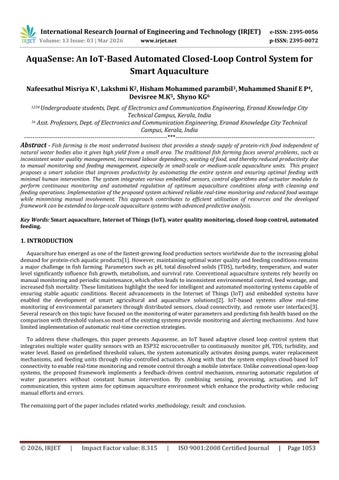
The overall system architecture of AquaSense is designed as an adaptive closed-loop control framework integrating sensing, processing, and actuation layers. The block diagram represents the overall hardware architecture of theproposedAquaSenseadaptiveclosed-loopsmartaquaculturesystem.Thesystemisstructuredintofourmajorlayers: powersupplyunit,sensinglayer,processingunit,andactuationlayer,integratedwithIoTconnectivity.Theblockdiagram oftheproposedAquaSensesystemisshowninFig.1
International Research Journal of Engineering and Technology (IRJET) e-ISSN: 2395-0056
Volume: 13 Issue: 03 | Mar 2026 www.irjet.net p-ISSN: 2395-0072
Thesystemoperatesfroma 12VDCinputsource,whichservesastheprimarypowersupplyfor high-powerdevices suchaspumpsandsolenoidvalves.TheLM2596buckconverterstepsdownthe12Vinputto5V.Thisconverted5voutput powers the components such as the ESP32 microcontroller, sensors(pH, turbidity, TDS and ultrasonic sensor), relay modules and servo motor. This ensures a stable and regulated power supply to all low power components. The ESP32 microcontroller acts as the central control unit of the system. It is suitable for this system due to its salient features includesbuilt-inWi-Ficapability,sufficientGPIOpins,real-timeprocessingabilityandlowpowerconsumption.Itacquires sensor data and processes environmental parameters. then executes the control logic and driving relay modules accordingly AlsocommunicatingthedatawithaIoTcloudplatform.Thesensingpartcontinuouslymonitorscriticalwater quality parameters. The pH sensor measures the acidity/alkalinity of water, the TDS sensor measures dissolved solid concentration,theturbiditysensorisusedfordetectingsuspendedparticlesandwaterclarity,andtheultrasonicsensoris used to monitor water level in the tank. All sensors provide real-time input signals to the ESP32 for environmental evaluation.
AnSG90ServoMotorisconnectedtotheESP32tooperatetheautomaticfooddispenser.TheESP32controlstheservo angle, thus regulating feed quantity. The feeding system supports two operational modes: either manual remote feeding throughwebbasedIoTinterfaceoratimer-basedautomaticfeedingmode.Theactuationlayerofthesystemusesthree5v dual channel relay modules to control high-power devices. One relay module is used for ph levelling, a second relay module for TDS regulation by water dilution and adding minerals, and the remaining is for water management, such as water plumbing and draining. The relays isolate low-voltage control circuitry from high-voltage actuators, ensuring electricalsafety.
The ESP32 transmits real-time sensor data to the IoT cloud platform via Wi-Fi. This system enables remote monitoring, visualization and performance tracking[2]. The proposed architecture integrates sensing, processing, actuation, and cloud connectivity into a unified platform, enabling reliable and automated water quality management in smartaquacultureenvironments[9].
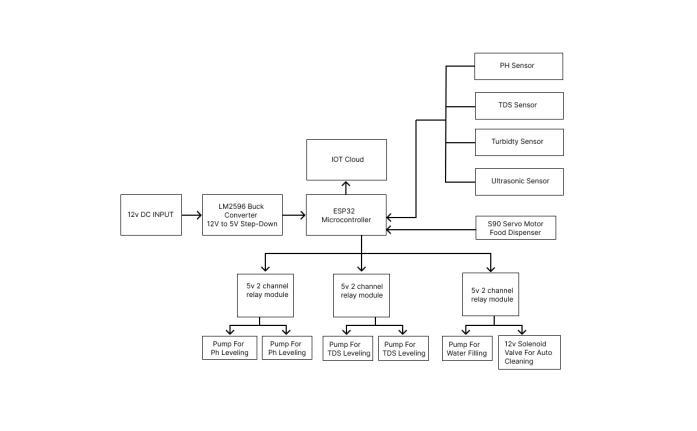
Continuous monitoring of critical water quality parameters is essential for maintaining aquatic health and environmentalstability.IntheproposedAquaSensesystem,pH,totaldissolvedsolids(TDS),turbidity,andwaterlevelare selected as primary monitoring parameters due to their direct influence on fish metabolism, waste accumulation, and overallecosystembalance[10].ThepHsensormeasurestheacidityoralkalinityofwater,whiletheTDSsensorestimates the concentration of dissolved solids. The turbidity sensor detects suspended particles and organic waste, and the ultrasonic sensor monitors tank water level to prevent overflow or dry-run conditions. All sensor outputs are interfaced with the analog-to-digital converter (ADC) channels of the ESP32 microcontroller. The parameters are sampled periodically and processed in real time for deviation analysis. The hardware interfacing circuit between the ESP32 controllerandthesensingmodulesisillustratedinFig.2
Predefined operating threshold ranges are configured within the controller to enable continuous evaluation of environmentalconditions.Theprocessedsensordataserveasfeedbackinputstotheadaptivecontrolmechanism,forming thesensingfoundationoftheclosed-loopregulationframework.
International Research Journal of Engineering and Technology (IRJET) e-ISSN: 2395-0056
Volume: 13 Issue: 03 | Mar 2026 www.irjet.net p-ISSN: 2395-0072

The continuous acquisition and processing of these parameters provide the necessary feedback signals required for adaptiveclosed-loopregulation.
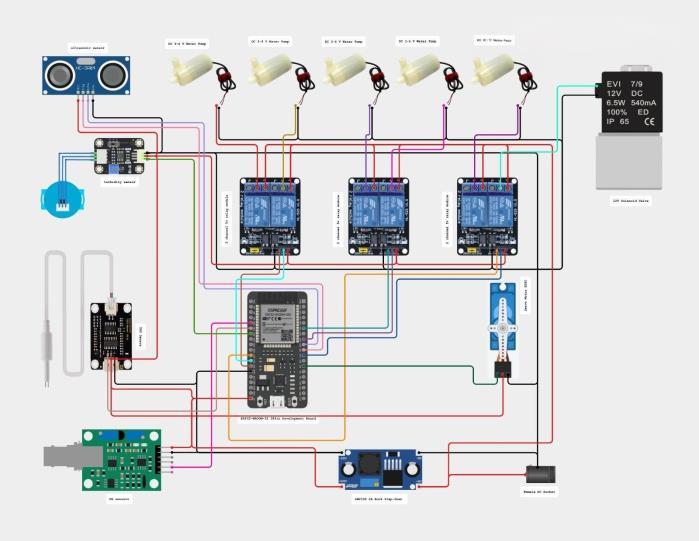
The primary objective of the proposed control mechanism is to maintain all water quality parameters within the optimal threshold ranges through continuous feedback-based regulation. The operational flow of the adaptive control mechanismisshowninfig.3.AsshowninFig.3,thesystemcontinuouslyacquiresreal-timewaterqualityparametersand comparesthemwithpredefinedoptimalvalues.Ifdeviationsaredetected,appropriateactuatorresponsesaretriggered.
The system then re-evaluates the updated environmental conditions, thereby forming a continuous feedback regulation loop.. The operational flow of the adaptive regulation process follows a continuous cycle of sensing, deviation analysis, actuation, and re-evaluation, thereby forming a closed feedback loop. This coordinated multi-actuator strategy ensures environmental stability, reduces manual intervention, and enhances the reliability of smart aquaculture management.
3.4
To validate the performance of the proposed AquaSense system, a laboratory-scale aquaculturesetup was developed under controlled conditions. The system was deployed in a water tank equipped with pH, TDS, turbidity, and ultrasonic
International Research Journal of Engineering and Technology (IRJET) e-ISSN: 2395-0056
Volume: 13 Issue: 03 | Mar 2026 www.irjet.net p-ISSN: 2395-0072
level sensors, along with actuator units including water pumps, solenoid valve, and servo-based feeding mechanism. All sensorswerecalibratedpriortoexperimentationtoensuremeasurementaccuracy. The setupisshowninfig.4
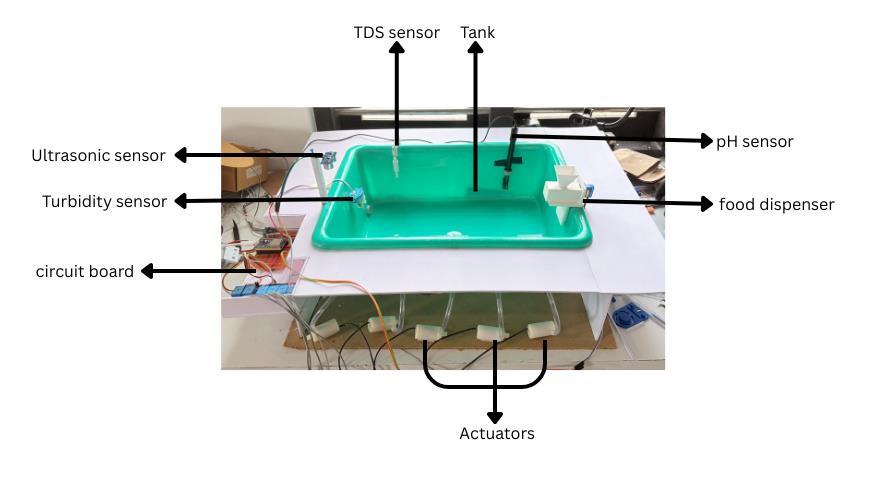
The ESP32 microcontroller was configured to acquire sensor data at predefined sampling intervals and execute the adaptive closed-loop control algorithm in real time. The relays were interfaced with respective pumps and control units to regulate water quality parameters automatically when deviations were detected. The experimental evaluation focused on observing system responsiveness, parameter stabilization behavior, and reliability of actuator coordination under varying environmental conditions. The collected data were transmitted to the IoT cloud platform for remote monitoringandperformanceanalysis.Theresultsoftheseevaluationsarepresentedinthefollowingsection.
Theoverallperformanceofproposedsmartfishfarmingsystemevaluatedsuccessfullybymonitoredthekeywaterquality parameters such as pH, TDS, turbidity. The system measured these parameters in real-time and automatically activated the corresponding actuators whenever variations from the predefined threshold values were detected. The obtained resultsdemonstratetheabilityofthesystemtodetectdeviationsandcorrecttheparameterstotheiroptimalrange.
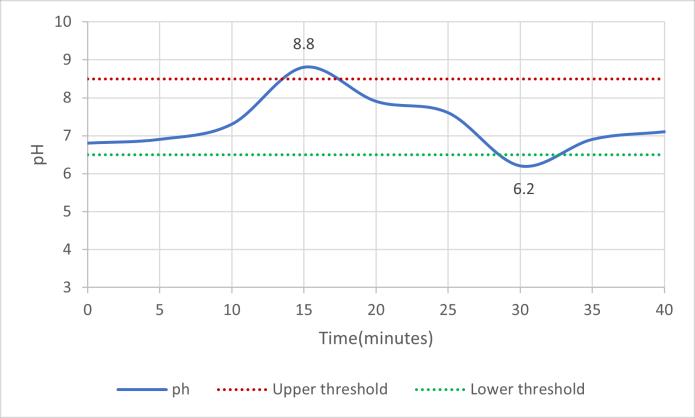
Thegraphspresentedillustratethetypical variationof waterqualityparameters duringsystem operationbased ontheobservedbehavioroftheimplementedprototype.Chart–1showsthevariationinpHovertime.Initially,thevalue remainedwithintheoptimumrangeandatacertaininstantoftime,thepHvalueexceededtheupperthreshold,thatis,the water became more alkaline in nature. The system detected the deviation and activated the corresponding pump, which releasedthesuitablesolutionintothewater,reducingthepHvaluebacktothe optimumrange.Similarly,atanothertime instant, the pH value went below the lower threshold(increased acidity), and the system again worked automatically to adjustthevalueintothenormalrangebyactivatingthepHdownpump.
International Research Journal of Engineering and Technology (IRJET) e-ISSN: 2395-0056
Volume: 13 Issue: 03 | Mar 2026 www.irjet.net p-ISSN: 2395-0072
Chart–2illustratesthevariationsofTDSwithrespecttotime.Atfirst,thevalueisstableasshown,butasudden increaseinTDSvaluewasobserved,whichindicatespoorwaterquality.Upondetection,thesystemactivatedthecontrol mechanismresponsibleforrestoringthevalue,whichsuccessfullyreducedthevaluebacktothestablerange.
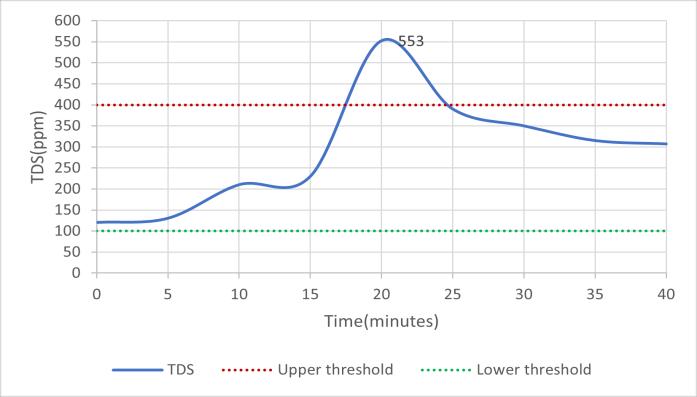
Chart – 2: VariationofTDSovertime
Chart – 3 presents the turbidity level monitored by the system. Once the turbidity level exceeded the threshold value,thesystemdetectedthedeviationandactivatedthesolenoidpumpandrefillpumpfordrainingthedirtywaterand refilling the fresh water, respectively. The results show that the turbidity level reduced and returned to an acceptable rangeinashortperiodoftime.
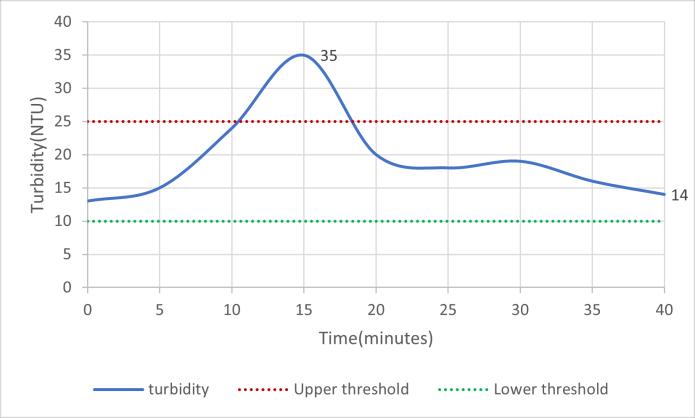
– 3: Variationofturbidityovertime
Variouscorrectiveagentscanbeintroducedintoaquaculturesystemstorestorewaterqualityparameterstotheir optimal ranges. Table–1 lists commonly used materials and solutions for regulating pH, TDS, and turbidity in fish tanks. The materials listed in the table are commonly used to regulate water quality parameters in aquaculture. For instance, limecanbeaddedtoincreasealkalinitywhenthepHvaluefallsbelowtheoptimalrange, andifitgoesabovethethreshold limitwecan addmolassesasitiscommonlyused material inaquaculture, while partial water replacement helpsreduce excessiveTDSlevels.Similarly,thewaterreplacementisperformedtoreduceturbiditylevel.
Table 1: Solutions/materialsusedforwaterqualitystabilization
Action
Parameter Optimum range Below the optimal range Exceeds threshold limit
pH 6.5–8.5
Add lime (CaCO3) Add molasses
International Research Journal of Engineering and Technology (IRJET) e-ISSN: 2395-0056
Volume: 13 Issue: 03 | Mar 2026 www.irjet.net p-ISSN: 2395-0072
TDS 100 – 400 ppm Add minerals Water dilution
Turbidity 10-25NTU Addalum Water replacemen t
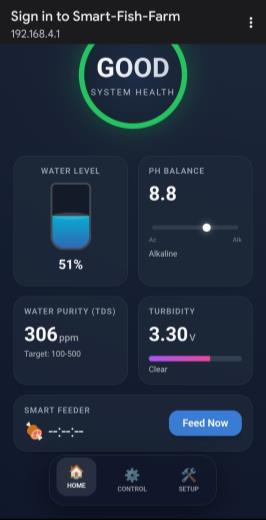
Intheproposedsystem,the controllercanactivatecorrespondingpumpstointroducethesecorrectivesolutions whendeviationsfromthethresholdvaluesaredetected. Theultrasonicsensorcontinuouslymonitorsthewaterlevel,and whenthewaterlevelgoesbelowoptimallevelthesystemactivatedtherefillingpumpandrestoredstabletankcondition. The feeding mechanism has successfully incorporated with this system which operated through preset time intervals to ensureregularfeedingwhileamanualswitchingoptionwasalsoprovidedforuser-controlledfeeddispensing.
Therealtimemonitoringvaluesofwaterparametersandthewaterlevelaredisplayedintheuser webinterface usingIoTcloudplatformasshowninfig.5
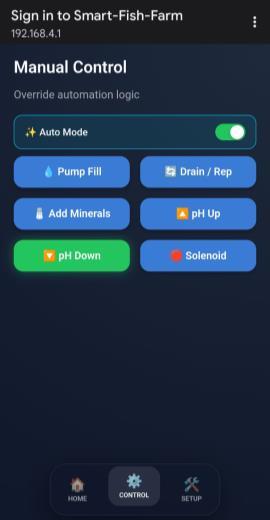
The subsequent interface window displays the real-time actuation status of all pumps in the system. It also includesanAutoModecontrolbuttonwhichisenableforautomodeanddisableformanualcontrolofpumps.
ThispaperpresentedAquaSense,anIoT-basedadaptiveclosed-loopsystemforsmartaquaculturemonitoringand management. The proposed system integrates multiple water quality sensors, an ESP32 microcontroller, automated actuation mechanisms, and a web-based monitoring interface to ensure continuous supervision of aquaculture environments. The parameters such as pH, turbidity, total dissolved solids, and water level are monitored in real time which enables the system to detect deviations from optimal ranges and initiates appropriate corrective actions through relay-controlledpumpsandvalves.
The implemented prototype demonstrated here has reliable real-time data acquisition, automatic actuator response, and remote monitoring capability through the IoT platform. Along with that an addition of the dual-mode feeding mechanism allows both timer-based automatic feeding and manual feed dispensing via the web interface, providing flexibility in aquaculture management. The coordinated operation of sensing, processing, and actuation components confirms the effectiveness of the proposed closed-loop control framework for maintaining stable environmentalconditionswithminimalmanualintervention.
Future work will focus on expanding the system with additional sensing parameters like dissolved oxygen and temperature for more comprehensive environmental monitoring. Further improvements may include large-scale
International Research Journal of Engineering and Technology (IRJET) e-ISSN: 2395-0056
Volume: 13 Issue: 03 | Mar 2026 www.irjet.net p-ISSN: 2395-0072
deployment,enhanceddataanalytics,andoptimizationofcontrolstrategiestoimprovesystemefficiencyandadaptability incommercialaquacultureenvironments.
[1]A.Zuhaer,A.Khandoker,N.Enayet,P.K.P.Partha,andM.A.Awal,“Sustainableaquaculture:AnIoT-integratedsystem forreal-timewaterqualitymonitoringfeaturingadvancedDOandammoniasensors,” Aquacultural Engineering,vol.112, p.102620,Jan.2026.
[2]C.-H.Chen,Y.-C.Wu,J.-X.Zhang,andY.-H.Chen,“IoT-BasedFishFarmWaterQualityMonitoringSystem,” Sensors,vol. 22,no.17,2022.
[3]M.M. Islam,M.A. Kashem,S. A.Alyami,andM. A.Moni, “Monitoring water qualitymetrics of pondswithIoTsensors andmachinelearningtopredictfishspeciessurvival,” Microprocessors and Microsystems,vol.102,p.104930,Oct.2023.
[4] A. Abid et al., “IoT-Based Smart Biofloc Monitoring System for Fish Farming Using Machine Learning,” IEEE Access, 2024.
[5] S. Karim, I. Hussain, A. Hussain, K. Hassan, and S. Iqbal, “IoT Based Smart Fish Farming Aquaculture Monitoring System,” International Journal on Emerging Technologies,vol.12,no.2,pp.45–53,2021.
[6] N. Q. Huy, V. T. T. Giang, L. V. Quan, and H. T. V. Cuong, “Application of the Internet of Things Technology (IoT) in DesigninganAutomaticWaterQualityMonitoringSystemforAquaculturePonds,” Vietnam Journal of Agricultural Sciences, vol.3,no.2,pp.624–635,2020,doi:10.31817/vjas.2020.3.2.06.
[7] P. K. P. Nandyala et al., “ECOAQUATICS: Feed Efficient Fish Health Monitoring System,” in Proc. IEEE International Conference on Knowledge Engineering and Communication Systems (ICKECS),2024.
[8] K.-L. Tsai, L.-W. Chen, L.-J. Yang, H.-J. Shiu, and H.-W. Chen, “IoT Based Smart Aquaculture System with Automatic AeratingandWaterQualityMonitoring,” Journal of Internet Technology,vol.23,no.4,pp.1–10,2022.
[9] N. M. Abdikadir, A. S. Abdullah, H. O. Abdullahi, and A. A. Hassan, “Smart Aquaculture: IoT-Enabled Monitoring and Management of Water Quality for Mahseer Fish Farming,” SSRG International Journal of Electrical and Electronics Engineering,vol.11,no.11,pp.84–92,Nov.2024,doi:10.14445/23488379/IJEEE-V11I11P109.
[10] Danial Mohammad Ghazali et al., “Smart IoT Based Monitoring System for Fish Breeding,” Journal of Advanced ResearchinAppliedMechanics,vol.104,no.1,pp.1–11,2023.[CrossRef][GoogleScholar][PublisherLink]