
International Research Journal of Engineering and Technology (IRJET) e-ISSN: 2395-0056
Volume: 12 Issue: 04 | Apr 2025 www.irjet.net p-ISSN: 2395-0072
International Research Journal of Engineering and Technology (IRJET) e-ISSN: 2395-0056
Volume: 12 Issue: 04 | Apr 2025 www.irjet.net p-ISSN: 2395-0072
Famina TS1 , Muhammed Nihal PS2 , Shifas MS3 , Suranya G4
123UG Student, Dept. of Electronics and Communication Engineering, Ilahia College of Engineering and Technology, Kerala, India
4Assistant Professor, Dept. of Electronics and Communication Engineering, Ilahia College of Engineering and Technology, Kerala, India
Abstract - The dumping of waste into water bodies has increased in recent times. The maintenance of water bodies must be done regularly. This paper presents an unmanned surface vehicle (USV) to collect garbage like plastic bottles and algae from the water surface. The system consists of conveyor belt and waste storage tank for waste collection. The system incorporates obstacle avoidance, live-streaming video and movement control. The USV uses camera and YOLOv8 algorithm to detect waste. An Android application is created using MIT App Inventor to operate the robot remotely. The app provides a simple interface for directional control (forward, left, right). A level detection system is also integrated to monitor the fill level of the waste storage tank and gave notification when it reaches its limit.
Key Words: Unmanned Surface Vehicle, Obstacle Avoidance, YOLOv8 algorithm, MIT App Inventor, Waste Storage Tank, Level Detection System.
1.INTRODUCTION
The amount of waste that is dumped into water bodies has on rise. Currently, the availability of clean water is limited due to the increase in dumping of waste in water bodies.Theregularmaintenanceofwaterbodiesiscrucial. Current methods of cleaning water surfaces are mainly based on manual labor or traditional boats, which are often inefficient, expensive, and time-consuming. These methods require substantial human resources and cannot keep up with the continuous flow of waste, especially in large or remote water bodies. Furthermore, manual cleaning processes expose workers to potentially hazardous materials and polluted environments. Traditional waste collection methods, such as manual cleanup, are labor intensive, time consuming and inefficient for large areas. As a result, there is a pressing need for an automated and scalable solution that can address these challenges efficiently and sustainably. To address these challenges, an innovative and automated solution is needed that can efficiently collect and remove floating debris. “Aquarover” aims to overcome this situation by developing an unmanned surface vehicle for collectingfloatingplasticbottlesandalgaefromthewater. The water surface cleaner robot is designed with chain conveyor system to collect the solid wastes from the surface of water and a waste storage tank for waste collection.Theunmannedsurfacevehicleusescameraand
machine learning algorithms to detect waste. Aquarover employsaleveldetectionsystemtomonitorthefilllevelof thewastestoragetankandgivealertwhenthebinreaches itslimittounloadthebin.Auserinterfaceisalsousedfor controlling and monitoring the movement of the robot remotely.
In2022,“AzmanIsmail”,et.aldevelopedanUnmanned Surface Vehicle for water wastes collection, to clean Malaysianriversandreducefloodriskscausedbywasteac cumulation.TheUSVisdesignedtooperateinbothremotecontrolled and autonomous modes, ensuring efficient and flexible cleaning operations. The system consists of four keysubsystems:ObstacleAvoidance(SS1):Usessensorsto detect and avoid obstacles, ensuring smooth navigation. CoordinateDetection(SS2):DeterminestheUSV’slocation for precise movement and guided navigation. LiveStreaming Video (SS3): Provides real time visuals to monitor operations and assist in manual control. MovementControl(SS4):Managespropulsionandsteering to collect waste effectively. The USV is integrated with Internet of Things (IoT) technology, allowing users to monitor and control it remotely via the Blynk app. The system is powered by a Raspberry Pi and programmed usingPythontoenableautomation.Byefficientlyremoving waste from rivers, this project helps to prevent blockages, reducefloodrisks,andimprovewaterquality,contributing toacleanerandmoresustainableenvironmentinMalaysia [1].
In 2022, “Joy Jacqueline Pereira”, et.al. This study assessestheeconomicimpactofsmall-scaleflashfloodsin Kuala Lumpur, Malaysia, from 2010 to 2016. Unlike largescale disasters, the cumulative effects of frequent small floodsareoftenoverlooked.Thestudyestimatesthedirect andindirectdamagecostsof204flashfloodevents,usinga heuristicapproachduetolimiteddata.Thefindingsreveal that total damages reached RM48.7 million, representing 0.04% of Kuala Lumpur’s GDP in 2016. Indirect costs, mainly from disrupted road networks and lost productivity, were up to four times higher than direct damages, which included damage to roads, commercial, andresidentialareas.Thepaperhighlightsthatflashflood damagesareexpectedtoriseduetorapidurbanizationand climate change, emphasizing the need for risk reduction
International Research Journal of Engineering and Technology (IRJET) e-ISSN: 2395-0056
Volume: 12 Issue: 04 | Apr 2025 www.irjet.net p-ISSN: 2395-0072
strategies, particularly in the transportation sector. The study serves as baseline information for future research andpolicymakingtomitigateflood-relatedeconomiclosses inKualaLumpur[2].
In 2022, “Shahaziya Parvez M”, et.al developed a Surface Water Garbage Collector and Quality Monitoring System designed to clean floating garbage from water bodieswhilealsomonitoringthewaterqualityinreal-time. The authors propose an intelligent robotic solution that autonomously locates and collects floating waste using a roboticarmandstoresitinadedicatedcompartment.The system utilizes a Raspberry Pi microprocessor to control operations, including the garbage collection process and the monitoring of water quality parameters such as turbidity,conductivity,andtemperature.Theseparameters are measured using various sensors and can be accessed through a web server, allowing for real-time monitoring. The movement of the robotis powered by a motor-driven propellersystem,andanultrasonicsensorisusedtoavoid obstacles. The proposed system is an improvement over earlier garbage collection methods, which either relied on manual labor or simple mechanical systems like pedaloperated machines. This system, however, minimizes manual intervention and can autonomously cover a large area for waste collection. It also addresses environmental concerns by preventing further pollution in water bodies that have been cleaned. One of the key advantages of this design is its ability to continuously monitor water quality while collecting garbage, thus serving as both a cleaning and monitoring tool. However, a notable limitation is that the system requires periodic recharging to maintain its operation[3].
In 2022, “Jiannan Zhu”, et.al developed a SMRUF; A FullyAutonomousWaterSurfaceCleanerRobot,thispaper focuses on the design and implementation of SMURF, a fully autonomous water surfacecleaning robot. Theaimis to address the inefficiencies and dangers of traditional, manual waste-cleaning methods on water bodies. SMURF incorpo rates a novel coverage path planning (CPP) technique that adapts to irregular boundaries and obstacles, and an improved nonlinear model predictive controller (NMPC) for better tracking of the planned path. The robot’s hull is designed for stability and resistance to corrosion, and its trash collection system includes an efficientgatheringandtrappingmechanism.Thehardware features advanced sensors and processors for precise navigationandenvironmentalperception.SMURFoperates autonomously, requiring only an initial boundary setup, and it effectively detects and collects waste in various waterbodies.Real-worldtestsdemonstrateitssignificantly higherefficiencycomparedtotraditionalcleaningmethods [4].
In 2021, “P. N. F. M. Shamsuddina”, et.al. developed a Water Trash Collector (WTC), an Unmanned Surface Vehicle(USV)aimedatcleaningfloatingwastefromwater
bodies like lakes and rivers. The catamaran hull design is chosen for its stability and capacity to hold a trash collection system. The WTC is constructed using highquality stainless steel for durability and corrosion resistance. The system is remotely controlled using a FlySkycontrollerand powered by SmartDrive Duo-30and Duo-10 motor drivers, along with high-torque electric scooter motors and DC gear worm motors. The WTC successfully operates on water without leakage, efficiently collecting floating waste. For future improvements, the paper suggests making the WTC autonomous by integrating navigation, control, and guidance (NGC) systemsusingneuralnetworks.Additionalsensorssuchas GPS,accelerometer,gyroscope,anddistancesensorscould enable the vehicle to detect and navigate towards waste autonomously, reducing human intervention. The project aims to minimize water pollution and prevent drain clogging, promoting an environmentally friendly waste managementsolution[5].
AquaRover:AnIoT-BasedWaterSurfaceCleanerRobot,is designed as an autonomous and remotely controlled solutionforefficientwastecollectionfromwatersurfaces. Thesystemconsistsofanunmannedsurfacevehicle(USV) equippedwithachainconveyorandawastebintocollect floating debris such as plastic bottles and algae. A camera module integrated with the YOLOv8 object detection algorithm enables real-time waste identification, ensuring targeted and efficient waste collection. The robot is controlled via a Wi-Fi-enabled Android application called WAT BOT, developed using MIT App Inventor, which allows users to navigate Aquarover in multiple directions (forward,left,andright).Additionally,afill-leveldetection systemis implemented tomonitorthe wastestoragetank and alert the user when it reaches its capacity, ensuring timelywastedisposal.
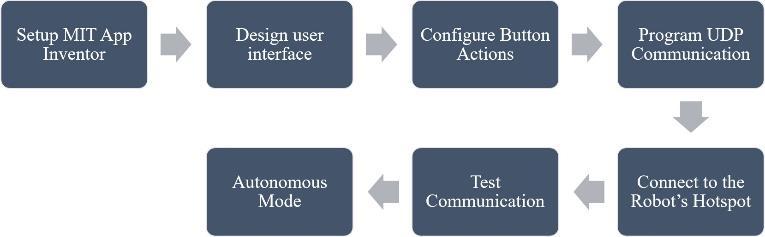
TheAndroidAppisbuiltusingMITappinventorwiththe help of block codes. The Android app sends movement commands (left, right and forward) via Wi-Fi to the NodeMCU. NodeMCU decodes the received command and signals the ESC to adjust the BLDC motor’s speed and direction.Theultrasonicsensorcontinuouslymonitorsthe surroundings for obstacles. If an obstacle is detected, the NodeMCUredirectsitsmovement.
International Research Journal of Engineering and Technology (IRJET) e-ISSN: 2395-0056
Volume: 12 Issue: 04 | Apr 2025 www.irjet.net p-ISSN: 2395-0072
Identify the functions the app needs to perform, such as controlling the robot’s movement (forward, left, right). Sketchtheuserinterface(UI)layout,including buttonsfor navigationandspeedcontrol.
• Control Logic: Define the behavior for each button. For example, when the “Forward” button is clicked, send a signal to the NodeMCU to move therobotforward.
• Communication: Set up Bluetooth or Wi-Fi modules to send and receive commands between theappandNodeMCU.
• Testing and Debugging: Connect the Android app to the NodeMCU. Test each button to ensure the robotmovescorrectly.
• For autonomous operation, raspberry Pi camera captures real time video for waste detection. A pre-traineddeeplearningmodelYOLOisusedfor detecting waste in the water. By analyzing the positionofdetectedwaste,ifthewasteisdetected ontherighttheleftpropellerrotatestomovethe robot towards the waste and vice-versa. If the waste is at the center, both propellers guide the robotforward.
4.1 Project flow
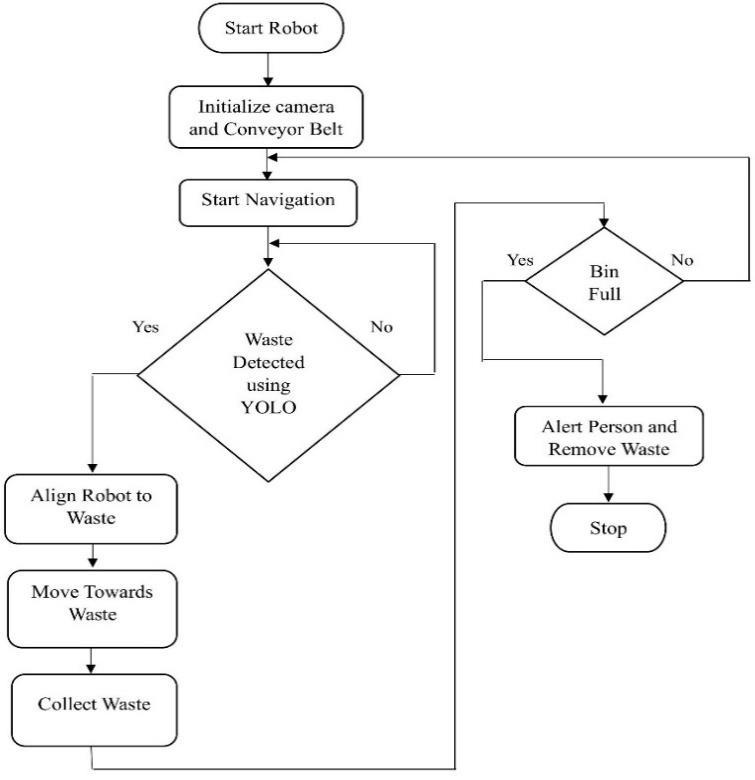
TheoperationstartswithinitializingAquarover,activating the camera module for waste detection and the chain conveyorforwastecollection.Aquaroverstartsnavigating whilecontinuouslyscanningthewatersurfaceforwaste.If no wasteis detected,itcontinues navigation. When waste is detected, Aquarover identifies its type using YOLO algorithm, aligns the robot towards the waste and moves initsdirectionforcollection. Thechainconveyorpicksup the waste and stores it in a waste collection bin. An ultrasonicsensorisusedtomonitorthebin’scapacity,and if it becomes full, a notification is sent to the operator to remove the collected waste. After waste disposal, the operator decides whether to continue navigation or stop. By leveraging IoT and automation, Aquarover offers an efficient and scalable alternative to conventional water cleaning methods, reducing manual effort and enhancing wastecollectioninwaterbodies.
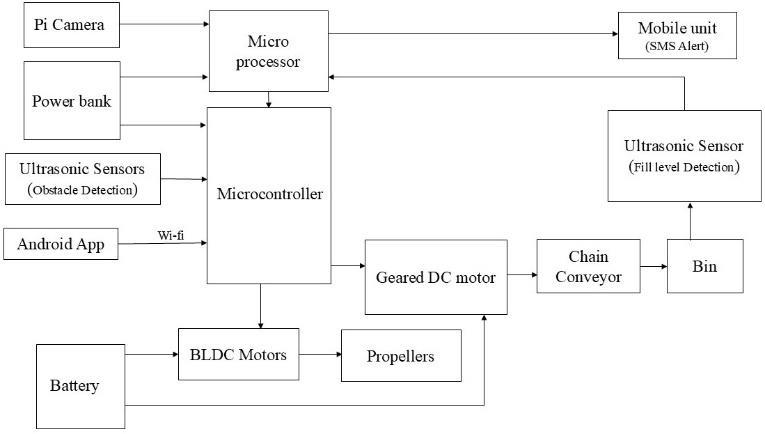
Fig -3:BlockDiagram
• The camera captures real-time images of the water surface and sends the data to the microprocessor, which processes the image for waste detection using YOLO, an object detection algorithm. The processed information is then communicated to the microcontroller, which acts as the central control unit.
• The battery provides power to all the electronic components, including the microcontroller, motors, andultrasonic sensors. The ultrasonicsensors detect obstaclesinthepathandassistinnavigation,sending datatothemicrocontrollerfordecision-making.
• For movement, the motors receive signals from the microcontroller to control the cleaning robot navigation. The geared DC motor drives the chain conveyor,whichhelpstocollectwastefromthewater surfaceandtransferittothewastecollectionbin.
• An Android app is integrated for remote monitoring and control of the robot. The app receives data from the microcontroller via a wireless communication
International Research Journal of Engineering and Technology (IRJET) e-ISSN: 2395-0056
Volume: 12 Issue: 04 | Apr 2025 www.irjet.net p-ISSN: 2395-0072
module, allowing users to track the operation of the cleaner. Additionally, a notification system informs theuseraboutthebincapacity.
• NodeMCU(ESP32): Actsasthecentral controller. It receives commands from the Android app and processessignalsfromsensors.
• Ultrasonic Sensors: These sensors detect obstacles in the water and measure distances. An ultra sonic sensor is placed in waste storage bin forfilldetection.
• BLDC Motors and ESC (Electronic Speed Controllers): Two BLDC motors are used for propulsion. ESCs control the motors’ speed and direction based on PWM signals from the NodeMCU.
• Raspberry Pi: Connected to the NodeMCU, it handles the YOLO-based waste detection algorithmusingacamerafeed.
YOLO algorithm identifies and classifies waste like plasticbottlesandalgaeinrealtime.TheRaspberryPi camera captures images of the water surface, and YOLOprocessesthemtodetectwaste.IfYOLOdetects wasteontherightside,itsendssignalstoactivatethe propeller ontheleftside.Andifthewasteisdetected on the left side, the propeller on the right side turns andAquarovermovestowardthewaste.
5.1 Confusion Matrix
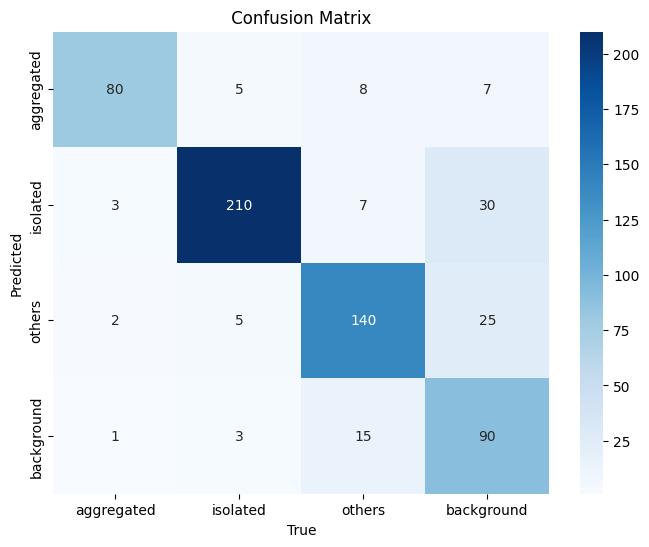
• True Positive (TP): 80timesthemodelcorrectly predictedClass0.
• False Positive (FP): 5 samples were actually Class0,butthemodelpredictedthemasClass1.
• True Negative (TN): For Class 0, TN includes all samplescorrectly predicted asClasses1,2, and 3 whentheactualclasswasnot0.
• False Negative (FN): 30 samples of Class 1 were wronglypredictedasClass3.
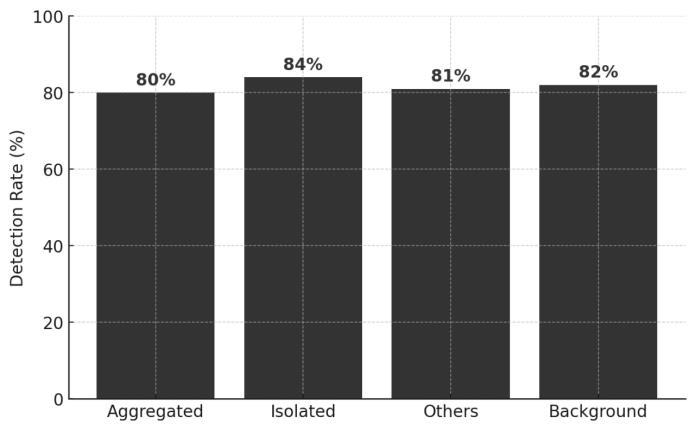
5.2 Evaluation matrices
• Accuracy:
• Precision:
• Recall: Where:
• True Positives (����) = The model accurately predictsapositivecase.
• True Negatives(����) =The model accurately predictsanegativecase.
• False Positives (����) = The model predicts a positive case when it is not (also referred to as a Type1error).
International Research Journal of Engineering and Technology (IRJET) e-ISSN: 2395-0056
Volume: 12 Issue: 04 | Apr 2025 www.irjet.net p-ISSN: 2395-0072
• FalseNegatives(����)=Themodelfalselypredicts a negative instance when it is indeed positive (alsoreferredtoasaType2error).
5.3 Precision curve
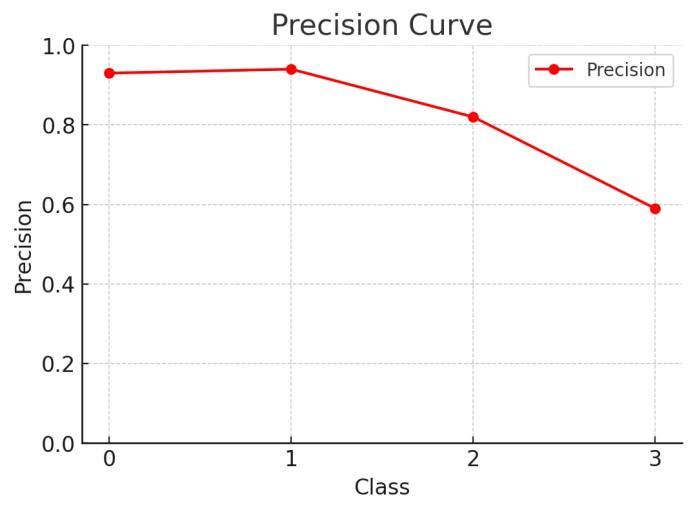
Chart-2: Precisioncurve
5.4 Recall curve
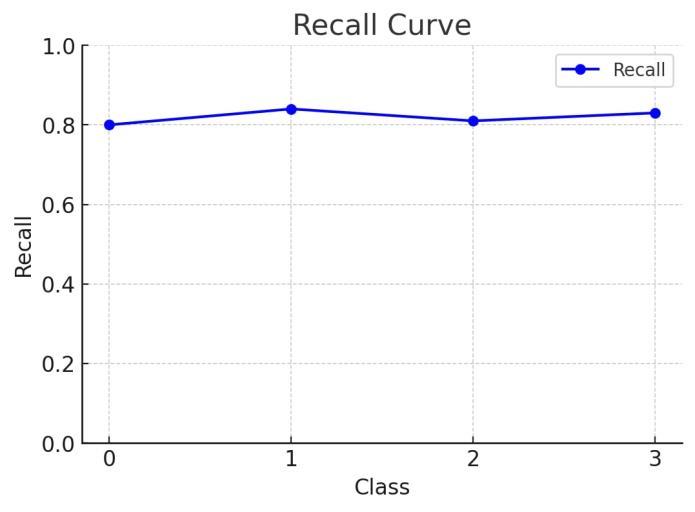
Chart-3: Recallcurve
6. CONCLUSION
In today’s world, where environmental pollution has becomeaseriousglobalissue,particularlyinwaterbodies, it is crucial to develop advanced technological solutions that can address these challenges effectively and sustainably. The AQUAROVER represents a forwardthinkingapproachtotacklingwaterpollutionbyproviding an automated, IoT-based robotic system that can clean water surfaces without the help of human beings. By designing and developing an unmanned surface vehicle (USV), we have taken significant steps towards creating a
hands-off, efficient, and scalable solution to the persistent problem of floating waste in water bodies. The AQUAROVER,throughitscombinationofmodernsensors, IoT technology, and energy-efficient motors, presents an innovative solution to one of the most serious environmental challenges. By integrating key components suchasultrasonicsensorsforobstacledetection,theNode MCU ESP8266 for wireless control, and a BLDC motor for propulsion, an autonomously navigate, avoiding obstacles whilecollectingfloatingdebrisrobothavedeveloped.The useoftheAndroidapplicationWATBOTfurtherenhances the user’s ability to monitor and control the robot remotely,providingaseamlessanduser-friendlyinterface tooperatethesystem.
ForfuturephasesofAQUAROVER,wecanintegratewater quality sensors (such as pH, turbidity, and temperature sensors) to collect data about the water’s health while cleaning. This information could be sent to the cloud in real-time for monitoring and analysis, allowing users to track waterqualityover timeandadditional features,like scheduling, real-time status updates, and failure alerts. Using cloud platforms, you could enable remote monitoring and control of the robot from anywhere. One ofthe keycontributionsoftheAQUAROVER project isthe reduction of human labor and manual intervention in cleaningwaterbodies.
[1] T. R. Bhuiyan, A. C. Er, N. Muhamad, and J. J. Pereira, “Evaluating the cumulative costs of small scale flash floods in kuala lumpur, malaysia,” Journal of Hydrology,vol.612,p.128181,2022.
[2] I. Dubois, “The impact of the ocean cleanup’s plastic removalsysteminthegpgponmigratingneustonand thepelagicecosystem,”Ph.D.dissertation,2022.
[3] S. H. Fauziah, M. Rizman-Idid, W. Cheah, K.-H. Loh, S. Sharma, M. NoorMaiza, M. Bordt, T. Praphotjanaporn, A.A.Samah, J.S. bin Sabaruddin et al.,“Marine debris in malaysia: A review on the pollution intensity and mitigating measures,” Marine pollution bulletin, vol. 167,p.112258,2021.
[4] S.N.Hasany,S.S.Zaidi,S.A.Sohail,andM.Farhan,“An autonomous robotic system for collecting garbage over small water bodies,” in 2021 6th International Conference on Automation, Control and Robotics Engineering(CACRE).IEEE,2021,pp.81–86
[5] P. Shamsuddin, M. Mansor, M. Hadi, N. Abidin, and R. Ibrahim, “Development of water trash collector,” Journal of Advanced Industrial Electronics Research andApplications,vol.1,no.1,pp.01–05,2020.
International Research Journal of Engineering and Technology (IRJET) e-ISSN: 2395-0056
Volume: 12 Issue: 04 | Apr 2025 www.irjet.net p-ISSN: 2395-0072
[6] A. Sinha, P. Bhardwaj, B. Vaibhav, and N.Mohommad, “Research and development of Ro-boat: an autonomous river cleaning robot, NASA/ADS. [Online]. Avail able:https://ui.adsabs.harvard.edu/abs/2013SPIE.90 25E..0QS/abstract Chen L, Kumar R. IoT-based traffic management using dynamic road dividers. IoT Syst Appl. 2020;8(4):200–210. doi: 10.1016/j.iot.2020.04.015
[7] Bhatkhande, Ankita. “Mumbai Students BuildRobot to Help Clean Surface Water.” DNA India,23 Mar. 2017,https://www.dnaindia.com/india/reportmumbai-students-build-robot-to-help clean-surfacewater-2364246.
[8] “Trashskimming CleantecInfra,”Cleantecinfra.com.[Online].Available:ht tps://www.cleantecinfra.com/trashskimming.
[9] “Water Surface Cleaning Robot”, R. Raghavi1, K. Varshini2,L.KembaDevi3.
[10] ERahmawatietal2019J.Phys.:Conf.Ser.1417.
2025, IRJET | Impact Factor value: 8.315 |