
International Research Journal of Engineering and Technology (IRJET) e-ISSN: 2395-0056
Volume: 13 Issue: 04 | Apr 2026 www.irjet.net p-ISSN: 2395-0072

International Research Journal of Engineering and Technology (IRJET) e-ISSN: 2395-0056
Volume: 13 Issue: 04 | Apr 2026 www.irjet.net p-ISSN: 2395-0072
Aniket Sonawane1 , Akshay Bhagat2 , Dinesh Barde3 , Pravin Chandure4, Abhijit Mankar5 , Dr. S. B. Dhoot6
12345Polytechnic Student, Department of Electronics & Telecommunication, Government Polytechnic, Chh. Sambhajinagar, Maharashtra, India
6 Professor, Department of Electronics & Telecommunication, Government Polytechnic, Chh. Sambhajinagar, Maharashtra, India
Abstract – The Escalating global crisis of riverine plastic pollution represents a profound ecological emergency, necessitating a paradigm shift from conventional, laborintensive cleaning methodologies toward intelligent, automated remediation platforms. This paper details the systematic engineering and implementation of Aquaboat, a high agility, semi-autonomous robot designed to bridge the technological chasm between hazardous manual collection andcost-prohibitiveindustrial dredging. The robot’s hardware architecturefeaturesarobustquad-propulsionconfiguration utilizing high-torque DC motors to maintain operational stability and precise maneuverability within unpredictable urbanriverdynamics.Waste retrievalisfacilitatedbyafrontmounted,motorizedconveyor mechanismthatsystematically harvestssurface-levelanthropogenicdebris.At thecoreofthe system’s intelligence is an ESP32 microcontroller, enabling real-time sensor data fusion and seamless remote operation viaacustomIoTwebinterface. Looking forward,theresearch establishes a roadmap for transitioning the platform into a fully autonomous, self-sustaining system by integrating RaspberryPi-based EdgeAI forreal-timecomputervisionand object detection. To achieve continuous round-the-clock operation, the next iteration will incorporate high-efficiency solar harvesting modules for energy independence and an automated waste collection bin mechanism to allow for uninterrupted cleaning cycles. By combining precision mechanical engineering with scalableembeddedsystemsand future-ready autonomous capabilities, the robot platform offers a proactive and economically viable framework for the continuous restoration of aquatic ecosystems.
Key Words: ESP32, Web based Monitoring, Quad Propulsion, Conveyor Mechanism, Aquatic Ecosystem Sustainability, IoT, Sensor Data Fusion, Smart Waterway Management.
Rivers serve as indispensable freshwater resources that sustain ecological stability, agricultural productivity, and human survival. However, accelerated urbanization and
inefficientsolidwastemanagementhavetransformedthese vital waterways into primary transit points for anthropogenicdebris.Everyyear,millionsoftonsofplastic waste transition from urban drainage systems into the oceans, creating a global ecological emergency. Once introduced into the aquatic environment, these pollutants degrade water quality and decompose into microplastics that lethally compromise local wildlife and downstream ecosystems. Despite the escalating severity of water contamination,currentremediationmethodologiesremain fundamentally outdated. Conventional cleaning predominantlyreliesonmanuallabor,whichisinherently slow, economically inefficient, and subjects workers to hazardous,pollutedenvironments.Conversely,large-scale industrial dredgers are often prohibitively expensive for smaller municipalities and lack the agility required to navigateonnarroworshallowriversegments.Thiscreatesa critical "technological gap" for an affordable, agile, and intelligent system capable of continuous surface-level remediationwithouthumanrisk.Toaddressthischallenge, this project presents the implementation of Aquaboat, a semi-autonomousrobotdesignedfortargetedaquaticwaste management.Bridgingthegapbetweenmanual laborand heavymachinery,itutilizesahigh-torquequad-propulsion systemtomaintainprecisemaneuverabilityundervariable river currents. The system features a customized floating chassis design with front-mounted motorized conveyor mechanism engineered to systematically retrieve floating debrisandtransferitintoasecureonboardcontainmentbin. Theoperationalintelligenceofthesystemispoweredbyan integrated control architecture specifically utilizing the ESP32microcontrollerforreal-timenavigationandsensor datafusion.Byleveragingdualcoreprocessing,thesystem manages simultaneous tasks including debris level monitoring and remote communication via a custom IoT interface.Thisallowsoperatorstomonitorperformanceand controltherobotfromasafedistancethroughaweb-based dashboard. By combining robust mechanical design with modern IoT capabilities, this paper details the design and experimentalvalidationofAquaboatasascalable,low-cost solutionforsmartwaterwaymanagement.
International Research Journal of Engineering and Technology (IRJET) e-ISSN: 2395-0056
Volume: 13 Issue: 04 | Apr 2026 www.irjet.net p-ISSN: 2395-0072
The research paper “Various Methods of River Water Cleaning” presents a comprehensive review of modern techniquesusedtoreduceriverwaterpollutionandrestore aquaticecosystems.Rivers area major sourceofdrinking water, yet they are increasingly polluted due to industrial discharge, urban waste, agricultural runoff, and improper solidwastedisposal.Thispollutionthreatenspublichealth, biodiversity, and environmental sustainability, making effective river cleaning methods essential. The paper discussesremote-controlledunmannedrivercleaningbots as an efficient mechanical solution for removing floating wastesuchasplastics,garbage,anddebris.Theseautomated systems reduce human labor, risk, and operational costs whileimprovingcleaningefficiency,especiallyinlargerivercleaningprograms.Biologicaltreatmentmethodssuchasthe MovingBedBiofilmReactor (MBBR)andIntegratedFixed Activated Sludge (IFAS) systems are analyzed in detail. These technologies rely on microbial biofilms attached to carrier media to remove organic pollutants, nitrogen, and phosphorus. MBBR is highlighted for its compact design, high pollutant removal efficiency, and low maintenance requirements, while IFAS improves sludge settling and enhancesnutrientremoval.
Thepaperalsoemphasizesaquaticphytoremediation,which uses aquatic plants to absorb and degrade contaminants from water and sediments. This eco-friendly method not only improves water quality but also provides additional benefitssuchashabitatcreation,biodiversitysupport,and aestheticenhancement.Additionally,aerationtechniquesare discussedforincreasingdissolvedoxygenlevelstosupport microbialactivityandreduceBOD,COD,odor,andcolorin polluted rivers.Finally,the studyreviewsbioremediation, whichusesmicroorganismstodetoxifypollutantsinsituor ex situ. The paper concludes that an integrated approach, combiningmechanical,biological,andecologicalmethods,is themosteffectiveandsustainablesolutionforriverwater cleaning.(1)
Theresearchpapertitled“RiverCleanerBoat”presentsthe design and development of a low-cost, motorized river cleaningsystemaimedatreducingwaterpollutioncausedby floatingsolidwaste.Riversandpondsareessentialnatural resources,butrapidurbanization,improperwastedisposal, and lack of effective waste management systems have resulted in the accumulation of plastic, bottles, and other garbage in water bodies. This pollution adversely affects waterquality,aquaticlife,publichealth,andthesurrounding environment.Theproposedrivercleanerboatisdesignedto collect and remove floating waste from rivers, ponds, and lakesefficiently.Thesystemisdevelopedusingsimpleand easily available components such as an Arduino Uno microcontroller,L298Nmotordriver,DCgearmotors,HC-05 Bluetoothmodule,andarechargeablelithium-ionbattery.
Theboatoperateswiththehelpofmotorsformovementand waste collection, while Bluetooth technology enables wireless control using a smartphone, making the system user-friendlyandeasytooperate.
The paper highlights the practical motivation behind the project, which was inspired by observing polluted local waterbodiessuchastemplepondsandnearbyrivers.The designfocusesonreducingmanuallabor,minimizinghealth riskstoworkers,andprovidingafasterandsaferalternative to traditional cleaning methods. The system is environmentallyfriendly,cost-effective,andsafeforaquatic organisms.Thestudyconcludesthattherivercleanerboatis an effective solution for routine cleaning of water bodies, especially in tourism areas, agricultural regions, and near industrial zones. With future enhancements such as solar power,automation,andsensorintegration,thesystemhas strong potential for large-scale implementation and sustainablerivermanagement.(2)
Thedocument“AHolisticApproachforCleanlinessofRiver Ganga”presentsanoverviewoftheGovernmentofIndia’s flagshipinitiative,theNamamiGangeProgramme,aimedat pollutionabatement,conservation,andrejuvenationofthe RiverGanga.Launchedin2014bytheMinistryofJalShakti, the programme adopts an integrated river basin managementapproachtorestoretheecologicalandcultural significance of the Ganga, which supports nearly 47% of India’s population and spans 11 states. The programme focuses on ensuring Nirmal Dhara (unpolluted flow) and AviralDhara(continuousflow)whilemaintainingtheriver’s ecological integrity. A comprehensive Ganga River Basin Management Plan (GRBMP), prepared by a consortium of IITs,guidesmultisectoralandmulti-agencyinterventions. Key areas of intervention include pollution abatement through sewage infrastructure development, ecological restoration,publicparticipation(JanGanga),andresearch andpolicysupport(GyanGanga).
Significant progress has been achieved, with over 492 projectslaunchedandmorethan300completedbyJanuary 2025. These include large-scale sewage treatment plants, interception and diversion of drains, industrial effluent control,biodiversityconservation,afforestation,andwetland development. The programme has substantially increased sewage treatment capacity and reduced the discharge of untreated wastewater into the river. Recent initiatives emphasize sustainable wastewater reuse, long-term operationoftreatmentfacilities,andenhancementofaquatic biodiversity, including fish conservation. The document concludesthattheNamami GangeProgrammerepresentsa comprehensiveandsustainablemodelforriverrejuvenation, combining infrastructure development, ecological restoration,policyreforms,andcommunityengagementto ensure a clean and healthy River Ganga for future generations.(3)
International Research Journal of Engineering and Technology (IRJET) e-ISSN: 2395-0056
Volume: 13 Issue: 04 | Apr 2026 www.irjet.net p-ISSN: 2395-0072
Theresearchpapertitled“RemoteControlledRiverSurface Cleaning Robot” presents the design, development, and testing of an automated system aimed at addressing the growing problem of floating waste pollution in rivers and otherwaterbodies.Rapidurbanization,industrialactivities, and improper waste disposal have resulted in the accumulationofplasticdebris,bottles,andorganicwasteon watersurfaces,whichseverelyimpactsaquaticecosystems, waterquality,andpublichealth.Traditionalmanualcleaning methods are labor-intensive, time-consuming, and hazardous, highlighting the need for a safer and more efficient alternative. The proposed system is a remotecontrolledriversurfacecleaningrobotthatutilizesanESP32 Wi-Fimicrocontrollerasthecentralcontrolunit.Therobot is equipped with geared DC motors for navigation and a conveyor belt mechanism for continuous collection of floating debris into an onboard storage bin. Wireless communicationthroughWi-Fiallowsreal-timecontroland monitoringoftherobotusingamobileapplication,ensuring safeoperationwithoutdirecthumancontactwithpolluted water.
Theentiresystemispoweredbya12Vlithium-ionbattery, supported by a voltage regulation circuit to ensure stable operation of electronic components. The robot’s compact andlightweightdesignenablesdeploymentinrivers,lakes, canals, and narrow water bodies where conventional cleaning equipment is ineffective. Experimental results demonstratestablenavigation,reliabledebriscollection,and effective remote operation under various conditions. The study concludes that the proposed robot offers a costeffective,scalable,andenvironmentallyfriendlysolutionfor surfacewatercleaning.Withfurtherenhancementssuchas automationandrenewable energyintegration,thesystem has strong potential for large-scale implementation in sustainablewaterpollutionmanagement.(4)
Theresearchpapertitled“AutomatedRiverCleaningRobot for Plastic Waste Segregation Using AI” presents an intelligentandautonomoussolutiontoaddressthegrowing problem of plastic pollution in rivers and water bodies. Plastic waste poses severe threats to aquatic ecosystems, biodiversity, and human health. To overcome these limitations,theauthorsproposeanAI-basedfloatingriver cleaning robot capable of detecting, collecting, and segregatingplasticwastewithminimalhumanintervention. Theproposedsystemutilizescomputervisionandmachine learning techniques for plastic-only detection, ensuring selective and efficient waste collection. A Raspberry Pi servesasthecoreprocessingunit,runningTensorFlowLite basedobjectdetectionmodelssuchasYOLOandMobileNet. Real-time video input is captured using a Pi Camera, and plasticobjectsareidentifiedwithaconfidencethresholdof morethan80%.Oncedetected,aservo-controlledloading mechanism transfers the plastic waste into an onboard storagecontainer.
Toenhancetraceabilityandmonitoring,therobotlogsGPS locationdataandtimestampsusingaNEO-6MGPSmodule andstoresimageevidenceofcollectedwaste.Thesystemis designed to be energy-efficient, with the potential integrationofsolarpowertoextendoperationalduration. Additional sensors support obstacle detection and safe navigationonwatersurfaces.ThestudyhighlightsthatAIdriven river cleaning robots significantly outperform traditionalcleaningmethodsintermsofaccuracy,efficiency, scalability, and environmental sustainability. The paper concludesthattheproposed systemoffersa cost-effective and reliable solution for large-scale plastic waste management in rivers, with future scope for multi-robot coordinationandreal-worlddeployment.(5)
Theresearchpapertitled“RiverCleaningRobotUsingSolar Power” presents the design and development of an ecofriendly robotic system aimed at removing floating waste from river surfaces. Increasing river pollution caused by plastic waste, leaves, and industrial debris has become a serious environmental issue, while traditional manual cleaning methods are inefficient, costly, and hazardous to workers.Theproposedsystemaddressesthesechallenges by combining robotics with renewable energy to achieve sustainablewatersurfacecleaning.Therivercleaningrobot ispoweredbysolarenergy,usingan11.1Vlithium-polymer battery charged through a solar panel integrated with a Battery Management System (BMS). This ensures safe charging, efficient power usage, and extended operational time. The system is controlled by an Arduino Uno, which managespropulsionmotorsandaconveyorbeltmechanism used to collect floating debris into a storage bin. L298N motordriversandBODCmotorsenablesmoothmovement andeffectivewastecollection.
Forremoteoperation,therobotemploysanHC-05Bluetooth module,allowinguserstocontrolmovementandcleaning actions via a mobile device. Additionally, an ESP32-CAM module provides live video streaming, enabling real-time monitoringandaccuratenavigationduringoperation.This featureimprovessafetyandefficiencybyreducingtheneed for direct human involvement in polluted water bodies. Experimental testing in a controlled water environment demonstrated reliable performance, with continuous operation exceeding two hours and effective collection of various floating wastes. The study concludes that the proposed system is a low-cost, energy-efficient, and environmentally sustainable solution for river cleaning. Futureenhancementssuchasautonomousnavigationand AI-based waste classification could further improve scalability and effectiveness for large-scale river and lake cleaningapplications.(6)
The research paper titled “SMURF: A Fully Autonomous WaterSurfaceCleaningRobotwithaNovelCoveragePath Planning Method” presents the design, development, and
International Research Journal of Engineering and Technology (IRJET) e-ISSN: 2395-0056
Volume: 13 Issue: 04 | Apr 2026 www.irjet.net p-ISSN: 2395-0072
validation of an autonomous robotic system for efficient removaloffloatingwastefromwatersurfaces.Manualriver andwaterbodycleaningishazardous,labourintensive,and inefficient, especially over large areas. To overcome these challenges,theauthorsproposeSMURF,afullyautonomous watersurfacecleaningrobotcapableofoperatingindiverse real-worldenvironmentssuchasrivers,lakes,coastalareas, andmarinas.SMURFisdesignedwitha dual-pontoonhull for stability, a front-mounted trash collection mechanism, and an onboard container for waste storage. The robot integratesadvancedhardwareincludinganNVIDIAXavier NXprocessor,RTK-GNSS,IMU,RGBcamera,andmillimeterwaveradartoenableaccuratelocalization,perception,and navigation. The system operates without human interventiononcethecleaningboundaryisdefined.
A key contribution of the paper is a novel Water Surface Coverage Path Planning (WSCPP) algorithm, specifically developedforirregularwaterboundariesandobstacle-rich environments. Unlike traditional coverage methods, the proposedapproachminimizesbothpathlengthandturning time, thereby improving overall cleaning efficiency. Additionally, an improved Nonlinear Model Predictive Controller (NMPC) with feed-forward compensation is introduced to handle dynamic changes in robot mass and environmental disturbances during operation. Extensive real-worldexperimentsdemonstratethatSMURFachieves completesurfacecoveragewithhighstabilityandaccuracy. Performance evaluations show that SMURF significantly reducescleaningtimecomparedtomanualmethodswhile maintainingrobustoperationundervaryingconditions.The study concludes that SMURF is an effective, scalable, and practical solution for autonomous water surface cleaning andenvironmentalprotection.(7)
The research paper titled “Artificial Intelligence Enabled RoboticTrashBoattoDriveandHarvestFloatingTrashfrom Urban Drain” presents the development of a semiautonomousroboticsystemengineeredfortheremovalof floating solid waste from urban drainage channels and narrowwaterbodies.Urbandrainsfrequentlysufferfrom blockagescausedbyplasticdebrisandwasteaccumulation, leading to water stagnation, health hazards, and infrastructure damage. Conventional manual cleaning practicesexposeworkerstotoxicgases,biologicalrisks,and physicalinjuries,necessitatinganautomatedalternative.The proposedrobotictrashboatisbuiltaroundanArduinoUNO microcontroller,whichcoordinatessensing,actuation,and navigationtasks.Anultrasonicsensorisemployedforrealtimeobstacleanddebrisdetection,enablingadaptivepath correction andselective wastecollection.Locomotionand collection mechanisms are powered using BO DC geared motors,interfacedthroughL298DandL293Dmotordriver modules, providing bidirectional motorcontrol andspeed regulation. The waste collection unit consists of a frontmountedhylemsheetassembly,whichmechanicallyguides floatingdebrisintoanonboardstoragebin.
Powerissuppliedusinga rechargeable18650lithium-ion battery, with provisions for solar backup to enhance operational endurance. The system is designed to autonomously navigate confined drainage paths, detect obstructions such as riverbanks, and reroute without external control. Experimental evaluation demonstrated reliablewastedetectionupto40cmandtheabilitytocarry loadsofapproximately7kg,validatingmechanicalstability andcontrolaccuracy.Thestudyconcludesthattheproposed robotic platform offers a low-cost, modular, and energyefficient solution for urban drainage maintenance. The architecture allows future upgrades such as waste classification, improved perception algorithms, and enhanced autonomy, making it suitable for scalable deploymentinsmartcitysanitationsystems.(8)
Thepaper"AIBasedRiverCleaningRobot"(2025)addresses thecriticalenvironmentalissueofwatercontaminationby developing an autonomous solution to replace laborintensive and hazardous manual cleaning methods.The researchersdevelopedafloatingroboticplatformcentered around aRaspberry Pi 5processing unit, which utilizes artificialintelligenceandcomputervisiontoidentifydebris likeplasticbottlesandorganicwasteinreal-time.Forvisual recognition,thesystememploysacameramoduleanddeeplearning models such asYOLOor Mobile Net to generate bounding boxes around detected waste.Once the AI identifies debris, control commands are sent to anL298N motor driver, which regulates four gear motors for propulsionandaconveyorbeltmechanismtoliftandstore thewaste.
During testing, the robot demonstrated high detection accuracy under normal daylight, successfully identifying objectswithinarangeof1to1.5meters.Theintegrationof anultrasonicsensorfurtherallowsthesystemtonavigate safelybyavoidingobstacles.Whilethestudyhighlightsthe system’s efficiency and low operational cost, the authors notethatperformancecanbechallengedbyenvironmental factors like heavy water reflections, ripples, or partially submerged debris.Ultimately, the paper validates that combininglow-costembeddedhardwarewithvision-based AI provides a scalable and environmentally friendly approachtomaintainingthehealthofriversandlakes.(9)
The research paper presents a comprehensive technical analysis of autonomous robotic systems developed for environmental remediation and hazardous waste management, addressing the growing limitations of conventionalmanualandmechanizedcleanuptechniques. Thestudyemphasizestheintegrationofadvancedsensing architectures, intelligent navigation frameworks, and artificial intelligence–driven control strategiesthatenable robots to operate reliably in contaminated and high-risk environments. The paper systematically evaluates robotic platforms across terrestrial, aquatic, and aerial domains, including ground-based remediation robots, autonomous
International Research Journal of Engineering and Technology (IRJET) e-ISSN: 2395-0056
Volume: 13 Issue: 04 | Apr 2026 www.irjet.net p-ISSN: 2395-0072
surface vehicles (ASVs), and autonomous underwater vehicles (AUVs). These systems employ multispectral imaging,chemicalandgassensors,SLAM-basedlocalization, and adaptive path-planning algorithms to detect, classify, and remove pollutants from soil, water bodies, and urban environments.Machinelearningmodelsenhanceperception accuracy, anomaly detection, and decision-making under dynamicenvironmentalconditions.
Asignificantcontributionofthestudyliesinitsassessment of technological maturity, reporting measurable improvementsinsensoraccuracy,navigationreliabilityin GPS-deniedzones,andenergymanagementefficiency.The paperhighlightsreal-worlddeployments,suchasroboticsoil remediation in radioactive zones, automated oil spill recovery, and intelligent waste segregation in recycling facilities, demonstrating superior operational safety and efficiencycomparedtohuman-dependentmethods.Despite these advancements, the authors identify persistent challenges, including sensor degradation in harsh environments, limited battery endurance, system maintenancecomplexity,andregulatoryfragmentation.The study concludes by outlining future research directions focused on hybrid robotic systems, sensor fusion, swarm robotics,andsustainableenergysolutions.Overall,thepaper establishes autonomous robotics as a scalable and technically viable solution for next-generation environmentalprotectionandhazardouswasteremediation. (10)
Intheresearchpapertitled"AquaDredgerRiverCleaning Machine" (2020), authors Kaushal Patwardhan, Shivraj Hagawane,andAshishKalokheaddresstheescalatingcrisis of river pollution and the high costs associated with government initiatives like "Namami Ganga". The study detailsthedesignandfabricationofaneconomical,remoteoperatedmachinespecificallyengineeredtoremovesurface debris,sewage,andtoxicmaterialsfromwaterbodies.The mechanicalsystemutilizesaconveyorbeltandchaindrive arrangementpoweredbyamotortoautomatethecollection process, thereby reducing the time and manual labor traditionally required for river maintenance. Constructed witha focusoncost-effectivenessandtheuse ofavailable local resources, the "Aqua Dredger" is presented as a sustainable tool for urban and rural pond cleaning. The authors conclude that by automating these cleaning operations,themachineprovidesasafer,faster,andmore affordablesolutionforsocietytoimprovewaterhygieneand protectaquaticecosystems.(11)
In the research paper titled "River Cleaning Machine" (2021), authors Mr. G. G. Rathod, Suraj Varpe, Sanket Pawase, and Vikas Sahane propose a remote-operated mechanicalsystemdesignedtoaddresstheinefficienciesand risks associated with manual water cleaning. The system utilizes a conventional conveyor belt mechanism to scoop floatingsolidwastefromthewatersurface,butintroducesa
significant modification: an Air Tube Piping Guider mechanism. This innovation is designed to improve the collection efficiency by guiding floating debris toward the conveyor more effectively than standard models. The machineiscontrolledviaaremote-controlsystem,allowing operatorstocleanriversandpondsfromtheshore,thereby eliminatingtheneedforalargeworkforceandreducingthe physical risks to workers. By focusing on a design that is effective, efficient, and eco-friendly, the authors conclude thatthismodifiedmechanicalapproachprovidesasuperior alternative to traditional boat-based or manual collection methods, offering a practical solution for the ongoing maintenanceofnationalwaterbodies.(12)
The paper "Aqua-Cleaner using Raspberry Pi, ESP32 and LoRa" (2025) presents an advanced semi-autonomous system designed to overcome the communication and autonomy limitations of traditional Arduino-based water cleaningrobots.Thearchitectureutilizesatieredprocessing approachwhereaRaspberryPihandleshigh-levelcomputer visionanddecision-making,whileanESP32manageslowlevel motor and conveyor belt operations. A significant innovationinthisresearchistheintegrationofLoRa(Long Range)technology,whichenablesreal-timemonitoring of therobot’sparametersoverdistancesofseveralkilometers, makingitsuitableforlarge-scalesmartcityapplications.In practicalevaluations,thesystemdemonstratedahighwaste collection efficiency of 88% in calm water, though this performancedecreasedto65%instrongercurrentsdueto mechanicalchallengessuchasconveyormisalignment.The robot uses computer vision to detect and identify floating waste, such as plastic bottles and leaves, though it faced difficultiesidentifyingsmallerorpartiallysubmergeditems. The study concludes that this multi-controller and longrange communication approach offers a more sustainable andscalablesolutionforenvironmentalmaintenance,witha total power consumption of approximately 15W and a batterylifeof4hourspercharge.(13)
The previous research paper titled RIVENTO: “Aquaboat” presents the design and development of an autonomous river surface cleaning system aimed at addressing the growingissueofwaterpollutioncausedbyfloatingwaste. ThesystemutilizesaRaspberryPi–basedembeddedcontrol architecture integrated with multiple sensors such as ultrasonic bin-level sensors, infrared obstacle detection sensors, water-level sensors, and temperature sensors to enableintelligentoperationandsafety.Itemploysamotordriven conveyor mechanism to efficiently collect floating debris and transfer it into an onboard storage unit, while quad DC motors provide stable propulsion and maneuverabilityinvaryingwaterconditions.Thesystemis capable of real-time data processing to optimize cleaning performanceandensuresafeoperation.Akeyfeatureofthe systemisitsabilitytoreducehumaninterventionthrough autonomous navigation and continuous monitoring. The proposedsolutionisenergy-efficient,modular,andscalable,
International Research Journal of Engineering and Technology (IRJET) e-ISSN: 2395-0056
Volume: 13 Issue: 04 | Apr 2026 www.irjet.net p-ISSN: 2395-0072
makingitsuitableforpracticaldeploymentinrivercleaning andenvironmentalmanagementapplications.(14)
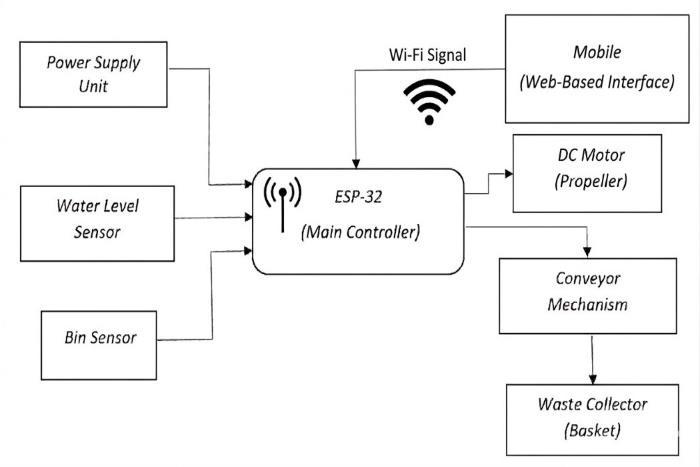
The Aquaboat is an innovative, semi-autonomous robotic platformdesignedtoaddressthecriticalchallengeoffloating solidwasteinurbanandinlandwaterbodies.Atitscore,the systemutilizesahigh-efficiencyconveyorbeltmechanism drivenbyadedicatedDCgearmotor,whichsystematically scoopsdebrisfromthewatersurfaceanddepositsitintoan integratedstoragebin.Thismechanicalrecoveryprocessis supportedbyauniquequad-propulsionsystem,wherefour independent propellers provide the high-torque maneuverability required to navigate unpredictable river currentsandstagnantpondenvironmentswithprecision.By replacing traditional manual cleaning methods with this mechanizedapproach,theprojectsignificantlyreducesthe safetyrisksassociatedwithhumanexposuretopollutedor hazardouswater.
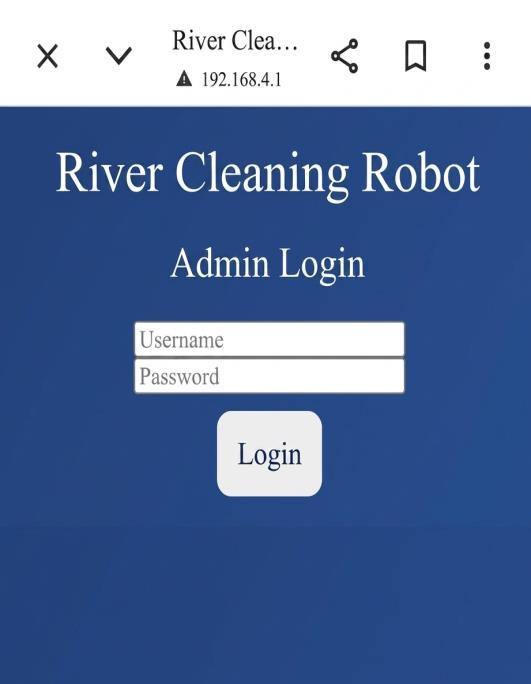
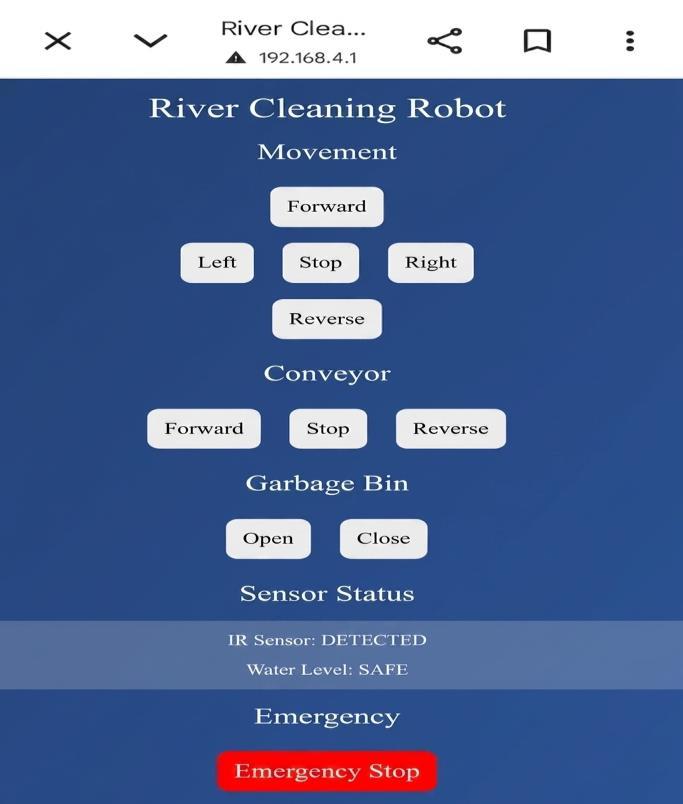
The "intelligence" of the robot is powered by an ESP32 microcontroller, leveraging its dual-core architecture to manage simultaneous tasks of real-time navigation and sensor data processing. The boat features a custom IoT enabledweb-basedinterface,allowingoperatorstomonitor and control the robot remotely from any smartphone or laptopviaadedicatedWi-Fihotspot.Uponconnectingtothe onboard Wi-Fi hotspot, the operator must first provide a validusernameandpasswordthroughasecureloginportal. Only after successful authentication is the user granted access to the primary control dashboard, where they can monitortherobotandmanageitsmovementsremotelyvia anysmartphoneorlaptop.Toensureoperationalreliability, the system integrates intelligent sensors, including an ultrasonicbin-levelmonitortopreventwasteoverflowanda water level sensor to track the robot’s buoyancy and structuralintegrity.PoweredbyhighcapacityLithium-Ion
batteries, the Aquaboat prototype offers zero carbon emissionoperation,makingitascalableandcost-effective solutionforsustainableenvironmentalremediation.
International Research Journal of Engineering and Technology (IRJET) e-ISSN: 2395-0056
Volume: 13 Issue: 04 | Apr 2026 www.irjet.net p-ISSN: 2395-0072
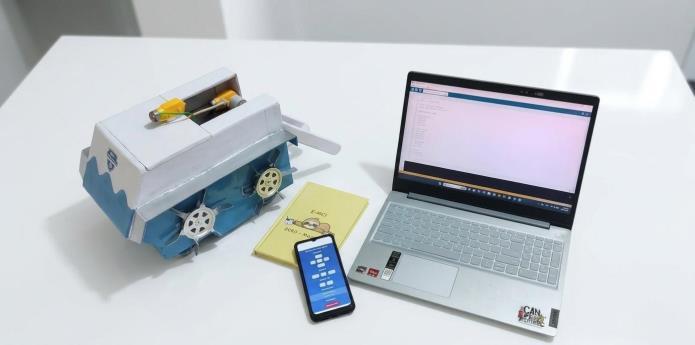
– 4: Prototypemodelofthesystem
II. Operational Algorithm & Logic Sequence
The operational framework of the developed prototype is governed by a structured control logic integrated into the ESP32 microcontroller. The system follows a sequential executionpath,transitioningfromhardwareinitializationto real-timemanualinterventionviaadedicatedGraphicalUser Interface(GUI).
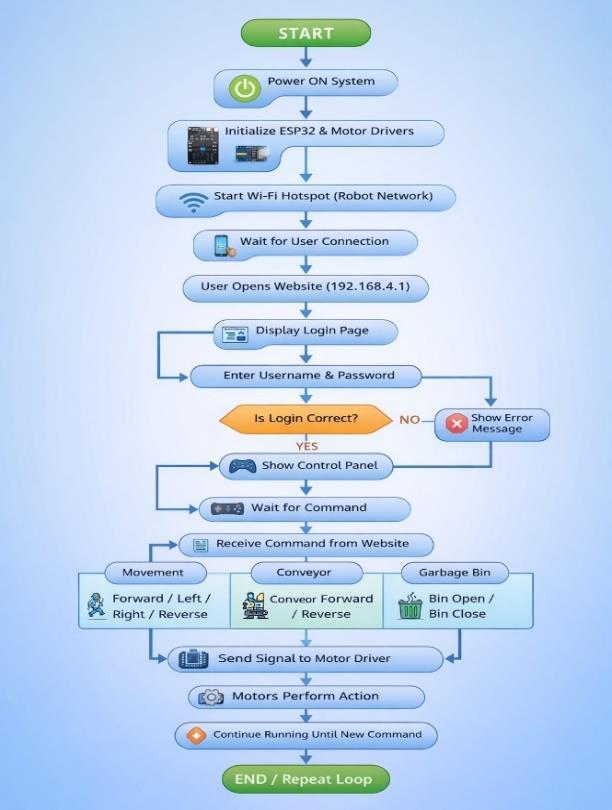
Fig - 5: Basicworkflowofsystem
1.InitializationandNetworkEstablishment
Uponsystemactivation,thefirmwareexecutesaself-testto initialize the ESP32 and the integrated motor drivers. To ensureindependencefromexternalnetworkinfrastructure,
the ESP32 is configured in Access Point (AP) Mode. This createsalocalizedWi-Fihotspot,allowingtheoperatorto establish a direct peer-to-peer connection. The control interfaceishostedonalocalwebserver,accessibleviathe staticIPaddress192.168.4.1
2.AuthenticationandSecurityLayer
To prevent unauthorized access and ensure operational safety, a security handshake is implemented. The system serves a login page requiring credential verification. The logicutilizesaconditionalgateway:iftheinputsmatchthe predefined parameters, the web-based control panel is initialized;otherwise,anexceptionishandledviaanerror message,andaccessremainsrestricted.
3.CommandExecutionandActuation
The core functional logic is divided into three primary subsystems,managedthroughacontinuouslisteningloop:
NavigationSubsystem:Processesdirectionalinputs (Forward, Reverse, Left, Right) to coordinate the quad-propulsionorsteeringmotors.
Collection Subsystem (Conveyor): Manages the front-mounted conveyor mechanism. The logic supports bi-directional rotation to facilitate both the intake of floating debris and to discharge the accumulated garbage from the bin through conveyoratadesignatedcollectionpoint.
Storage Subsystem (Garbage Bin): Controls the actuation of the bin collect/discharge modes, allowingforthecontainmentofcollectedwasteor thedischargeofmaterialsatadesignatedcollection point.
Onceacommandisreceivedviathewebinterface,theESP32 translates the digital instruction into Pulse Width Modulation(PWM)signals.Thesesignalsaretransmittedto themotordrivers,whichregulatethecurrentflowtotheDC motors.Thesystemisdesignedtomaintainthecurrentstate ofoperationsuchascontinuousconveyormovementuntila subsequent"Stop"or"NewCommand"signalisregistered, ensuring efficient power management and smooth mechanicaloperation.
The proposed Aquaboat system was successfully implementedandexperimentallyevaluatedundercontrolled aquaticconditionstoassessitsoperationalperformancein termsofnavigationstability,wastecollectionefficiency,and communication reliability. The system demonstrated
International Research Journal of Engineering and Technology (IRJET) e-ISSN: 2395-0056
Volume: 13 Issue: 04 | Apr 2026 www.irjet.net p-ISSN: 2395-0072
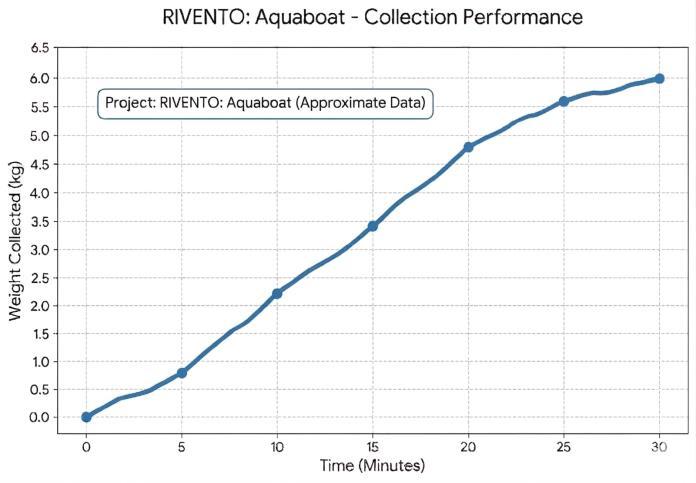
consistent and stable locomotion using a propeller-driven propulsionmechanism,enablingprecisedirectionalcontrol with minimal drift under low-flow water conditions. The ESP32-based control architecture exhibited reliable realtimecommunicationwiththeweb-basedinterfaceoverWiFi, with an average command-response latency of approximately1to2seconds.Thisensuredeffectiveremote operation and synchronization between user inputs and systemactuation.Themotorcontrolsubsystem,interfaced throughtheL298Ndrivermodule,providedadequatetorque and speed regulation for both propulsion and conveyor operations.Theconveyor-basedwastecollectionmechanism achievedcontinuousandeffectiveremovaloffloatingdebris, includingplasticmaterialsandorganicwaste.Experimental analysisindicatesthatthesystemattainedawastecollection capacity of approximately 6 kg within 30 minutes, corresponding to an average collection rate of 0.2 kg per minuteundertestconditions.
This research presents the successful design and implementation of the Aquaboat, an IoT-enabled remotecontrolled river cleaning robot developed to address the growingchallengeofwatersurfacepollution.Theproposed system integrates embedded control, wireless communication, and electromechanical actuation into a unifiedarchitecture,enablingefficientandreal-timewaste collectionwithminimalhumanintervention.Theuseofthe ESP32microcontrollerensureslow-latencycommunication andseamlessweb-basedcontrol,whiletheconveyor-driven collection mechanism enhances debris retrieval efficiency underdynamicaquaticconditions.Experimentalevaluation confirmsthatthesystemachievesreliablenavigation,stable operation, and effective waste collection performance, demonstrating a measurable improvement over conventionalmanualcleaningapproachesintermsofsafety, efficiency, and cost-effectiveness. The incorporation of sensor-based monitoring further strengthens system robustnessbyenablingreal-timefeedbackandpreventive safetymechanisms.
From a broader perspective, the Aquaboat establishes a scalable and adaptable framework for intelligent water surfacecleaningsystems.Itsmodulardesignallowsseamless integration of advanced technologies such as Edge AI, computervision,andrenewableenergysystems,pavingthe way toward fully autonomous and self-sustaining environmentalrobotics.Thus,theproposedsystemnotonly addresses immediate pollution challenges but also contributes to the evolution of smart, sustainable, and technology-drivenwatermanagementsolutions.
The mechanical design ensured smooth transfer of debris intotheonboardstoragebinwithoutsignificantblockageor loss.Sensorintegrationfurtherenhancedsystemreliability andsafety.Thebin-levelmonitoringsystemprovidedrealtime feedback on storage capacity, enabling timely intervention, while the water-level sensor effectively detectedabnormalconditionssuchasleakageorexcessive submersion. The overall system operated in a closed-loop manner, continuously processing sensor inputs and executing control commands. The experimental results validate that the proposed system achieves improved efficiency, reduced human intervention, and enhanced operational safety compared to conventional manual cleaning methods. The integration of IoT-based communication, embedded control, and mechanical waste collection establishes the system as a scalable and costeffectivesolutionforwatersurfacecleaningapplications.
The future evolution of the Aquaboat will focus on transitioningtoafullyautonomous,self-sustainingsystem through the integration of a Raspberry Pi and solar harvesting modules. By leveraging Raspberry Pi’s computationalpower,thenextiterationwillimplementEdge AI and Computer Vision for real-time object detection, enablingthesystemtoautonomouslydistinguishbetween hazardous debris and aquatic life. To ensure operational independence,high-efficiencysolarpanelswillbeintegrated to recharge the Lithium-Ion batteries during deployment, significantlyextendingthe missiondurationforlong-term clean-up operations. Furthermore, the Raspberry Pi will facilitateGPSbasednavigation,intelligentpathplanning,and advancedenvironmentalsensingforcontinuousmonitoring ofwaterqualityparameters.Inaddition,thesystemcanbe further enhanced to support continuous round-the-clock operationbyincorporatingaremovableorautomatedwaste collectionbinmechanism,allowinguninterruptedcleaning without frequent manual intervention. This technological roadmapwilltransformAquaboatfromaremotelyoperated
International Research Journal of Engineering and Technology (IRJET) e-ISSN: 2395-0056
Volume: 13 Issue: 04 | Apr 2026 www.irjet.net p-ISSN: 2395-0072
system into a fully autonomous, pro-active solar powered intelligentplatform.
Iwouldliketoexpressmysinceregratitudetomyproject guide, Dr. S. B. Dhoot, Department of Electronics & Telecommunication, Government Polytechnic College, Chhatrapati Sambhajinagar for his invaluable guidance, constantencouragement,andtechnicalinsightsthroughout the development of this research. His expertise was instrumentalinshapingthemethodologyandfinaloutcome of this paper. I am also grateful to the Head of the Departmentandtheinstitutionforprovidingthenecessary facilitiesandaconduciveenvironmentforresearch.Finally,I would like to thank my family and friends for their unwaveringsupportandmotivation.
i. Pravin Punamchand Chandure – Polytechnic Student, Electronics and Telecommunication, GovernmentPolytechnicofChh.Sambhajinagar.
ii. AniketKakasahebSonawane–PolytechnicStudent, Electronics and Telecommunication, Government PolytechnicofChh.Sambhajinagar.
iii. Dinesh Vishnu Barde – Polytechnic Student, Electronics and Telecommunication, Government PolytechnicofChh.Sambhajinagar.
iv. Akshay Sunil Bhagat – Polytechnic Student, Electronics and Telecommunication, Government PolytechnicofChh.Sambhajinagar.
v. Abhijit Sanjay Mankar – Polytechnic Student, Electronics and Telecommunication, Government PolytechnicofChh.Sambhajinagar.
vi. Dr. S. B. Dhoot – Professor, Electronics and Telecommunication, Government Polytechnic of Chh.Sambhajinagar.
[1] Karmannye Om Chaudhary, Sachin Gupta, Pragye Om Chaudhary, "Various Methods of River Water Cleaning," InternationalJournalofAdvancedResearchinComputerand CommunicationEngineering(IJARCCE),Volume11,Issue8, August2022,DOI:10.17148/IJARCCE.2022.11812.
[2]KanyakumariR.Kann,Aishwarya,Bindushree,&KavyaS. H. (2025). River Cleaner Boat: Autonomous Cleaner for Rivers. IJRASET – Journal for Research in Applied Science and Engineering Technology. DOI: 10.22214/ijraset.2025.72486
[3] Ministry of Jal Shakti, Government of India. A Holistic ApproachforCleanlinessofRiverGanga,March7,2025
official policy document summarizing the integrated conservationmission,objectives,pillars,andachievements ofNamamiGange.
[4] Sakshi Vijay Awari, Sudarshan Vijay Pulate, Saurabh Dattu Gadakh, Prof. Bhoir N. V., "Remote Controlled River SurfaceCleaningRobot,"InternationalJournalofAdvanced Research in Science, Communication and Technology (IJARSCT),Volume5,Issue6,June2025.
[5] Mahfooz Ahmad, Tasleem Jamal, "Automated River Cleaning Robot for Plastic Waste Segragation Using AI," Journal of Information Systems Engineering and Management(JISEM),Volume10,Issue555,2025.
[6]PavitraM.Badiger,Ms.SaipoojaS.Sunagar,Ms.Vaishnavi B.Wadageri,Ms.SwatiR.Patil,Ms.Veronica,"RiverCleaning RobotUsingSolarPower,"InternationalJournalofScience, Engineering and Technology (IJSET), Volume 13, Issue 3, 2025.
[7]JiannanZhu,YixinYang,YuweiCheng,"SMURF:AFully Autonomous Water Surface Cleaning Robot with A Novel CoveragePathPlanningMethod,"JournalofMarineScience and Engineering (JMSE), Volume 10, Issue 11, 2022, DOI: 10.3390/jmse10111620.
[8]TanviVemulapalli,SaiTejaJuluru,SatvikaSuryapally,V. Seetharama Rao, "Artificial Intelligence Enabled Robotic TrashBoattoDriveandHarvestFloatingTrashfromUrban Drain,"InternationalJournalofCreativeResearchThoughts (IJCRT),Volume11,Issue5,May2023.
[9]ChetanKudale,AkshataSamay,Ms.SahanaDupadali,Ms. Veena Pitagi,Mr.TarunKilledar,"AIBasedRiverCleaning Robot," International Journal of Scientific Research in Engineering and Management (IJSREM), Volume 09, Issue 12,December20
[10] RamMohan Reddy Kundavaram, Abhishek Reddy Onteddu, Krishna Devarapu, Deekshith Narsina, Md. Nizamuddin, "Advances in Autonomous Robotics for EnvironmentalCleanupandHazardousWasteManagement," AsiaPacificJournalofEnergyandEnvironment,Volume12, Issue1,2025,DOI:10.18034/apjee.v12i1.788.
[11] Kaushal Patwardhan, Shivraj Hagawane, Ashish Kalokhe, "Aqua Dredger – River Cleaning Machine," InternationalJournalofEngineeringResearch&Technology (IJERT), Volume 9, Issue 04, April 2020. DOI: 10.17577/IJERTV9IS040620.
[12] Mr. G. G. Rathod, Suraj Varpe, Sanket Pawase, Vikas Sahane, "RIVER CLEANING MACHINE," International
International Research Journal of Engineering and Technology (IRJET) e-ISSN: 2395-0056
Volume: 13 Issue: 04 | Apr 2026 www.irjet.net p-ISSN: 2395-0072
Research Journal of Engineering and Technology (IRJET), Volume08,Issue02,February2021.
[13]SrujitYennam,SnehaYadav,ShivamWankhade,Rohini Chavan,"Aqua-CleanerusingRaspberryPi,ESP32andLoRa," InternationalJournalofScientificDevelopmentandResearch (IJSDR),Volume10,Issue12,December2025.
[14]PravinChandure,DineshBarde,AkshayBhagat,Aniket Sonawane, Abhijit Mankar, and Dr. S. B. Dhoot, RIVENTO: “Aquaboat" , International Journal of Engineering DevelopmentandResearch(IJEDR),vol.14,no.1,pp.204208,March2026.
© 2026, IRJET | Impact Factor value: 8.315 | ISO 9001:2008 Certified Journal | Page624