
International Research Journal of Engineering and Technology (IRJET) e-ISSN: 2395-0056
Volume: 13 Issue: 04 | Apr 2026 www.irjet.net p-ISSN: 2395-0072

International Research Journal of Engineering and Technology (IRJET) e-ISSN: 2395-0056
Volume: 13 Issue: 04 | Apr 2026 www.irjet.net p-ISSN: 2395-0072
Mrs. Sushma M P1 , Punith kumar S2, Rohan N3, Thippeswamy H R4 ,Pratham H A5
1Assistant Professor, Department of ECE. PES College of Engineering Mandya, Karantaka, India 2345Students of ECE, PES College Of Engineering Mandya, Karnataka, India
Abstract - This project proposes an advanced anti-theft protection system for vehicles using the ESP32 microcontroller. The system prevents unauthorized motor activationbyrequiringapasswordenteredthroughakeypad. Usershavethreeattemptstoenterthecorrectpassword.After threefailedattempts,thesystemlocksitselfandsendsanalert message with the GPS location to the vehicle owner via Telegram. The owner can remotely update the password through Telegram, restoring secure access. This method enhances vehicle security through IoT integration, real time alerts, location tracking, and remote password management
Key Words: ESP32, Vehicles Protection, GPS Location, KeypadVerification,Microcontroller
Vehicletheftremainsaseriousissueinbothcitiesandrural regions. Conventional security methods such as locks, alarms, and immobilizers are often not enough to stop unauthorized access or provide immediate alerts to the owner. With the development of IoT technologies, microcontrollers,andreal-timecommunicationsystems,it hasbecomepossibletobuildsmarterandmoreautomated securitysolutions.Inthisproject,theESP32,aWi-Fi-enabled microcontroller,isusedalongwithGPSandTelegram API integrationtodevelopanadvancedvehicleanti-theftsystem.
Numerousresearchworkshavebeencarriedoutinthefield ofsmartvehiclesecuritysystemsusingIoTandembedded technologies.Thesesystemstypicallyrelyonreal-timedata collected from sensors and microcontrollers to identify unauthorizedaccessandenhanceoverallvehiclesafety.The ESP32 microcontroller is widely adopted in such applications due to its integrated Wi-Fi and Bluetooth capabilities,whichsupportefficientwirelesscommunication and remote monitoring.In many proposed solutions, GPS modules are incorporated to enable real-time vehicle tracking, which assists in quick recovery in case of theft. Additionally,technologiessuchasRFID-basedauthentication, GSMalertsystems,andmobileapplicationsarecommonly usedtostrengthensecurityandprovideinstantnotifications to vehicle owners. Recent advancements have further exploredcloud-basedmonitoringandmobileappintegration toimproveaccessibilityandcontrol.Althoughseveralantitheft systems have been proposed, integrating hardware-
based security with IoT-enabled communication offers a morereliableandpracticalsolution.
The proposed anti-theft system integrates password authentication, attempt monitoring, GPS tracking, and Telegram-basedremotecontroltoenhancevehiclesecurity. AkeypadinterfacedwiththeESP32enablestheusertoinput apassword,whichisverifiedagainstavaluestoredinthe microcontroller’s non-volatile memory. Each incorrect attemptincrementsacounter,andafterthreeconsecutive failures, the system disables the motor to prevent unauthorizedaccess.Oncethesystem islocked,theESP32 obtainsthecurrentlocationfromtheNeo-6MGPSmodule and sends an alert message to the vehicle owner via the Telegram Bot API using a secure HTTPS connection. The alert includes real-time coordinates along with a Google Mapslinkforeasytracking.Thesystemalsoallowsremote recovery, where the owner can reset the password by sendingapredefinedcommandthroughtheTelegrambot. The ESP32 continuously checks for such commands and, upon verifying the authorized user’s chat ID, updates the stored password securely. After a successful reset, the systemunlocksandresumesnormaloperation.
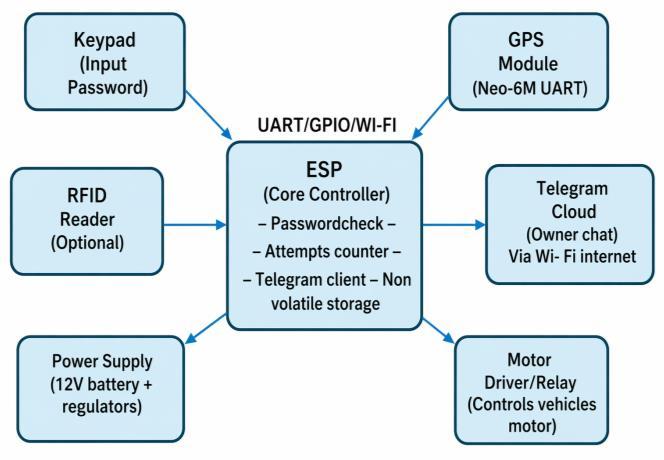
Fig-1: BlockdiagramofAnti-theftvehiclesprotection sytemusingESP32
Volume: 13 Issue: 04 | Apr 2026 www.irjet.net p-ISSN: 2395-0072
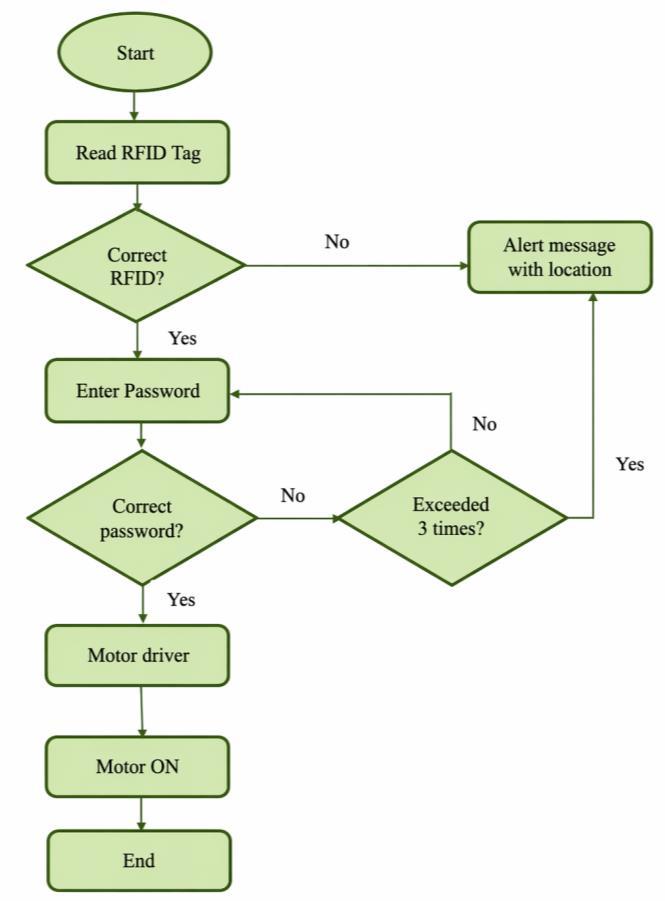
Fig-2: FlowchartforAnti-theftvehiclesprotectionsystem usingESP32
The system begins by initializing and retrieving the previouslystoredpasswordfromtheESP32’snon-volatile memory. The user then enters the password through a keypadinterface,whichisverifiedagainstthestoredvalue.If the entered password is correct, the motor is activated (unlocked)andtheattemptcounterisresettozero.Incase ofanincorrectpassword,thesystemincrementstheattempt counter.Ifthenumberofattemptsremainsbelowthree,the userisallowedtoretrypasswordentry.However,oncethe attemptlimitreachesthree,thesystementersLOCKmode and disables motor operation to prevent unauthorized access.
Afterlocking,theESP32retrievesthecurrentgeographical coordinates(latitudeandlongitude)fromtheGPSmodule.A theft alert message, along with a Google Maps link of the vehiclelocation,isthensenttotheownerviaTelegram.The systemsubsequentlywaitsforaremotecommandfromthe owner,suchas“newpassword,”throughtheTelegrambot. Whenavalidcommandisreceivedfromanauthorizeduser, the ESP32 updates the stored password and unlocks the system.Finally,normalsystemoperationisrestored.
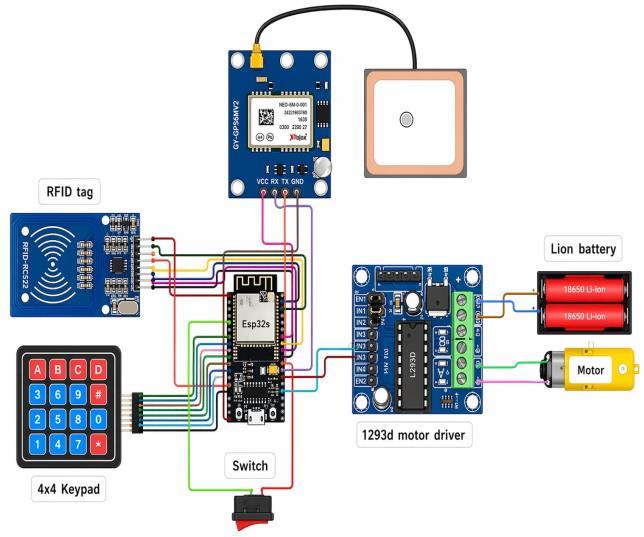
The circuit shown in Figure 3 consists of an ESP32 microcontroller acting as the central processing unit, interfaced with a keypad, GPS module (NEO-6M), buzzer, LED,andaWi-Fi-basedTelegramcommunicationsystem. ThekeypadisconnectedtotheESP32throughdigitalGPIO pins and is used for entering the security PIN. The ESP32 continuously scans the keypad input and compares the enteredPINwiththestoredpassword.
If the entered password is correct, access is granted; otherwise, the system increments the count of incorrect attempts.TheGPSmoduleisinterfacedwiththeESP32using UARTcommunication,wheretheTXpinoftheGPSmoduleis connectedtotheRXpin(GPIO16)oftheESP32,andtheRX pinoftheGPSmoduleisconnectedtotheTXpin(GPIO17). The module is powered through the 5Vsupply to ensure stableperformance.
Onceasatellitefixisestablished,theGPSmoduleprovides real-timelocationdataintermsoflatitudeandlongitude.A buzzerandanLEDareconnectedtotheGPIOpinstoprovide audio and visual indications during incorrect password attemptsorsecuritybreaches.
The ESP32 utilizes its built-in Wi-Fi capability to communicate with the Telegram Bot API. After three consecutiveincorrectpasswordentries,thesystemsendsan alert message to the user via Telegram, including the vehicle’s current location in the form of a Google Maps link.TheusercanthenrespondthroughTelegramtosecurely resetthePIN.Thisintegrationofhardwarecomponentsand wireless communication ensures enhanced security and real-time monitoring in the proposed anti-theft vehicle protectionsystem.
Volume: 13 Issue: 04 | Apr 2026 www.irjet.net p-ISSN: 2395-0072
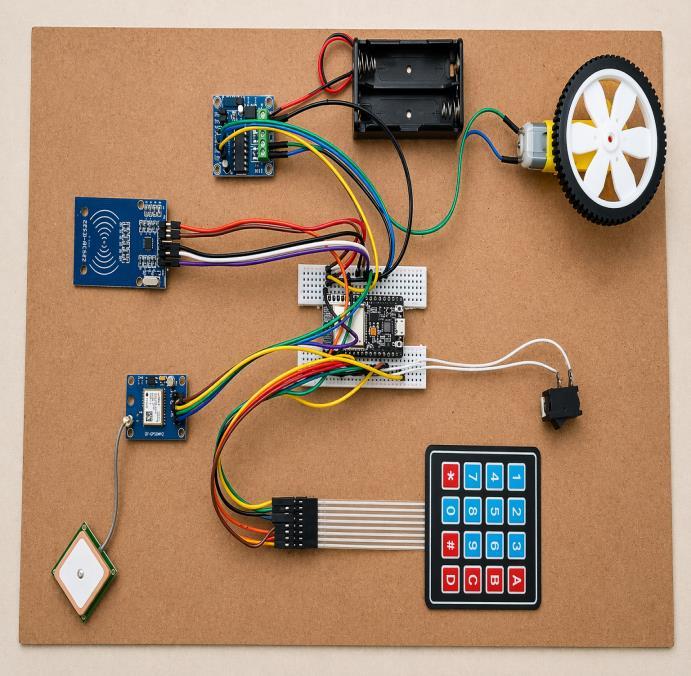
Fig 4: Systemmodel
Theimplementedsystem,asshowninFigure4,successfully demonstratesreal-timevehiclesecuritymonitoringandalert generation.Duringtesting,thekeypadaccuratelydetected user inputs and validated the entered PIN with minimal delay.Whenthreeconsecutiveincorrectpasswordattempts weremade,the systemreliablytriggeredanalertthrough Telegram,confirmingeffectiveintrusiondetection.
The integration of the GPS module enabled the system to obtain real-time location data; however, initial satellite acquisition required outdoor conditions and a short stabilizationperiod.TheTelegramcommunicationsystem, asshowninFigure4,functionedefficiently,allowingusersto receivealertsandremotelyresetthePINwithoutdelay. The system also handled edge cases effectively, such as notifying the user when GPS signals were unavailable. Additionally,theimplementationofacooldownmechanism after reset cancellation improved security by preventing repeatedunauthorizedattempts. Overall, the system proved to be robust, responsive, and suitable for real-world vehicle security applications, effectively combining embedded system design with IoTbasedcommunicationcapabilities.
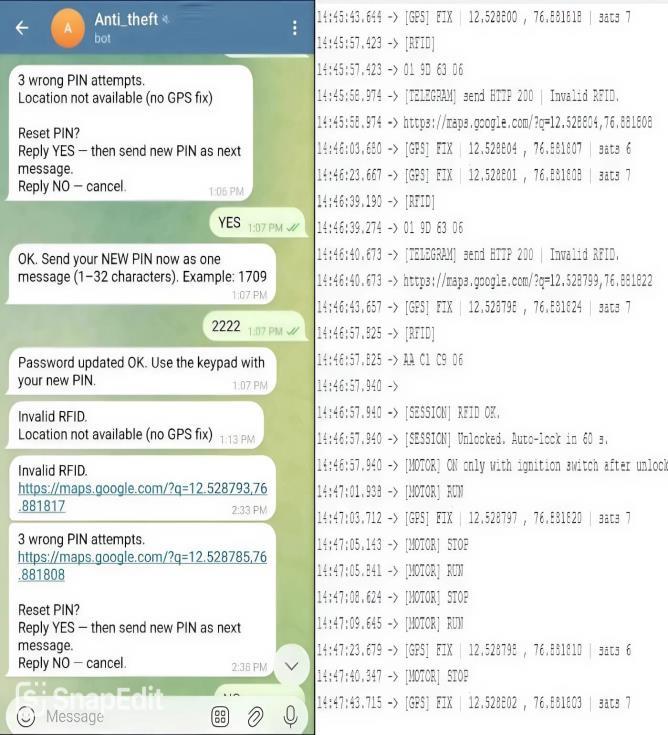
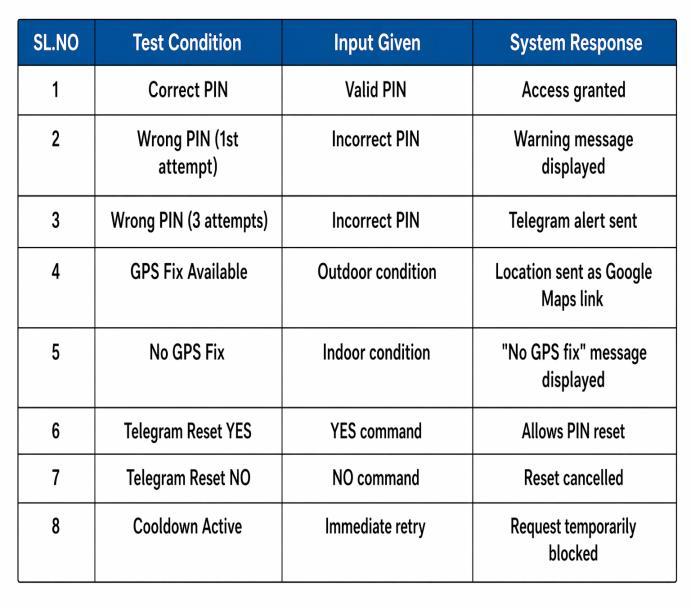
Table 8.1 presents various test conditions applied to the systemalongwiththecorrespondinginputsandobserved responses. It illustrates the system’s behavior under both normal and abnormal scenarios, including correct and incorrectpasswordentries,GPSavailability,andTelegrambaseduserinteractions.Theresultsconfirmthatthesystem operates as intended by granting access for valid inputs, generatingwarningsforincorrectattempts,andtriggering alertnotificationsaftermultiplefailedentries.Thetablealso demonstrates the system’s ability to function effectively under real-world conditions, such as the absence of GPS signals, while still maintaining core functionality. Additionally, it highlights the implementation of security featuressuchascooldownperiodsandcontrolledpassword reset through Telegram, which further improve the reliabilityandrobustnessofthesystem.
International Research Journal of Engineering and Technology (IRJET) e-ISSN: 2395-0056
Volume: 13 Issue: 04 | Apr 2026 www.irjet.net p-ISSN: 2395-0072
Table 1: ObservationTable
Theprimaryobjectiveofdevelopingasmartvehiclesecurity system using ESP32 and IoT technologies has been successfully achieved. The system ensures secure access throughkeypad-basedpasswordauthentication,effectively preventing unauthorized usage. The integration of GPS technologyenablesreal-timetrackingofthevehicle,thereby enhancingsafetyandmonitoringcapabilities.
Furthermore, the implementation of Telegram-based communication provides instant alert notifications and supportsremotecontrolfeatures,makingthesystemboth efficientanduser-friendly.Theprojectincorporatesmultiple layers of security, including password verification, alert generationafterrepeatedincorrectattempts,andasecure passwordresetmechanism.
Inaddition,theinclusionofacooldownmechanismfurther strengthensprotectionagainstrepeatedunauthorizedaccess attempts. Overall, the developed system demonstrates a reliable, cost-effective, and scalable solution for modern vehiclesecuritybyeffectivelyintegratingembeddedsystems withIoT-basedcommunicationtechnologies.
The proposed ESP32-based anti-theft vehicle protection system provides a cost-effective and reliable solution for vehicle security, with significant scope for future enhancements.Adedicatedmobileapplicationcanreplace orcomplementTelegramforimproveduserexperienceand real-time monitoring. Security can be strengthened using advancedbiometricssuchasfaceoririsrecognition.Cloud storageanddataanalyticscanenablehistoricaltrackingand intelligentalerts,whilegeofencingcannotifyuserswhena
vehicleexitssafezones.IntegrationwithOBD-IIsystemsand camera modules can further enhance functionality. LowpoweroptimizationandAI-basedthreatdetectioncanalso beincorporatedforbetterefficiency.Overall,thesystemcan evolve into an intelligent, scalable, and fully automated vehiclesecuritysolution.
The developed ESP32-based anti-theft vehicle protection system successfully achieves its primary objective of enhancingvehiclesecuritythroughreal-timemonitoringand intelligent control. The system integrates keypad-based passwordauthentication,GPStracking,andTelegram-based communicationtoprovidea reliableandefficientsecurity solution. It effectively prevents unauthorized access by monitoring password attempts and triggering alerts after repeatedfailures.Theintegrationof GPS enablesreal-time location tracking, which improves the chances of quick vehicle recovery in case of theft. Additionally, Telegrambasednotificationsallowinstantalertsandremotecontrol features, making the system user-friendly and accessible fromanywhere.
Overall,theprojectdemonstratesapracticalimplementation ofIoTandembeddedtechnologies,offeringacost-effective and scalable solution for modern vehicle security. It also showsstrong potential forfuture enhancementsand realworldapplications.
[1] PawaskarM,SamantM,andHardasA,“Microcontroller BasedAnti-theftVehicleSystem”,InternationalJournal ofComputerSciencesandEngineering,Vol.7,Issue:5, pp.765–768,2019.
[2] YakubuYakubuMusaandJinWang,“VehicleTracking and Anti-theft System using GPS-GSM”, International Journal of Engineering Research & Technology, ISSN: 2278-0181,Vol.1,Issue:10,pp.1–5,2012.
[3] Kadiri Kamoru and O. Adekoya Adegoke, “Design of a GPS/GSMBasedAnti-theftCarTrackerSystem”,Current Journal of Applied Science and Technology, Vol. 34, Issue:3,pp.1–8,2019.
[4] VaibhavV.Gijare,AnandSapkal,PratikRengade,Atharv Kulkarni, and Pratik Bangar, “Smart Vehicle Theft DetectionSystemwithReal-timeMonitoring”,Research &Review:ElectronicsandCommunicationEngineering, 2025.
[5] G.N.SandhyaDevi,B.Rakesh,Ch.NagaGopi,Ch.Anusha, andB.LakshmanKumar, “Biometric-BasedAnti-Theft Vehicle Security System with Fingerprint and Face Recognition”, International Journal of Scientific Research in Science and Technology, Vol. 5, Issue: 24, 2024.