
International Research Journal of Engineering and Technology (IRJET) e-ISSN: 2395-0056
Volume: 12 Issue: 11 | Nov 2025 www.irjet.net p-ISSN: 2395-0072
International Research Journal of Engineering and Technology (IRJET) e-ISSN: 2395-0056
Volume: 12 Issue: 11 | Nov 2025 www.irjet.net p-ISSN: 2395-0072
Komal Kailas Salve1 , Prof. Dinesh M. Pandit2 ,
1M-TECH student, Department of Civil Engineering, CSMSS Chh. Shahu College of Engineering, Chhatrapati Sambhajinagar.431005, MAHARASHTRA, INDIA
2Assistant Professor, Department of Civil Engineering, CSMSS Chh. Shahu College of Engineering, Chhatrapati Sambhajinagar.431005, MAHARASHTRA, INDIA
Abstract - This study presents the seismic evaluation and structural behaviour of a G+24 reinforced concrete high-rise residential building subjected to different soil conditions hard, medium, and soft considering both shear-wall and nonshear-wall configurations. The building is located in seismic Zone V, making lateral stability a critical design requirement. Using ETABS software, detailed models were developed to assess how soil stiffness and lateral-resisting systems influence the building’s dynamic response. Key parameters such as story displacement, drift, modal time period, seismic weight, and base shear were analysed through the Response Spectrum method in accordance with IS 1893 (Part 1): 2002.
The results indicate that soil flexibility significantly affects seismic demand, with soft soil producing higher displacements and longer time periods compared to hard and medium soil. Buildings with reinforced concrete shear walls exhibited superior lateral resistance, reduced drift, and improved overall seismic performance compared to conventional frame systems. Comparative analysis also highlights that stepped and full shear wall systems provide better drift control particularly in upper stories while column-only systems show increased deformation. This research emphasizes the importance of soil–structure interaction and appropriate placement of shear walls for ensuring stability, resilience, and safety in high-rise buildings situated in high-seismic zones.
Key Words: Story displacement, Story drift, Base shear, Soil–structure interaction, Shear wall, ETABS, Seismic analysis.
High-risereinforcedconcrete(RC)buildingsarerequiredto safelyresistbothgravityloadsandlateralforcesgenerated by wind and earthquakes. As the height of a building increases,thedemandonlateralload–resistingcomponents also increases, often making conventional beam–column framing insufficient. Tall structures frequently face issues suchasexcessivedrift,heavyreinforcementcongestionat beam-column joints, and reduced construction efficiency. These challenges highlight the need for additional lateral stiffnesselements,suchasshearwalls,toensurestructural safety.
Shear walls act as vertical cantilever elements capable of resistingsignificantlateralloadsthroughbothbendingand shearaction.Theirplacement,thickness,andconfiguration greatlyinfluencetheoverallstiffness,deformationpattern, andseismicperformanceofabuilding.Ensuringappropriate useofshearwallsbecomesmorecriticalinregionslocatedin higherseismiczones,suchasZone-V.
Another essential factor affecting seismic behavior is the typeofsupportingsoil.Buildingsfoundedonhard,medium, or soft soil exhibit different responses under the same loading conditions due to soil–structure interaction (SSI). Soft soil leads to higher displacement and drift, whereas hard soil improves stiffness but increases base shear. A preciseunderstandingoftheinteractionbetweenstructure and soil is therefore crucial for designing a safe and economicalhigh-risesystem.
In this study, a G+24 RC residential building is analyzed using ETABS software under varying soil conditions with andwithoutshearwalls.Structuralparameterssuchasstory displacement, story drift, time period, and base shear are comparedtoassesstheinfluenceofsoiltypeandshearwall configuration on overall performance. The results help identifyanoptimalsystemthatensuressafety,serviceability, andeconomicdesign.
Tallbuildingsarehighlysensitivetolateralloads,andtheir behavior is strongly influenced by soil conditions and the efficiencyofthelateralload-resistingsystems.However,in manypracticaldesigns,soil–structureinteractioneffectsare simplified or neglected, and shear wall placement is often based on assumptions rather than detailed analysis. This leads to uncertainty in predicting structural performance, especially in soft soil regions or high-seismic zones. Therefore, a systematic comparative study is required to evaluatehowaG+24high-riseRCbuildingbehaves:
Ondifferentsoiltypes(hard,medium,soft)
Underseismicloading
Withvaryingstructuralsystems(shearwallvs.no shearwall)
International Research Journal of Engineering and Technology (IRJET) e-ISSN: 2395-0056
Volume: 12 Issue: 11 | Nov 2025 www.irjet.net p-ISSN: 2395-0072
This research addresses the gap by performing detailed ETABS analysis to quantify the impact of soil stiffnessand shearwallconfigurationondisplacement,drift,timeperiod, andbaseshear
Rapid vertical development: Increasing population and limited land availability necessitate safe high-rise construction,requiringimprovedunderstandingoflateral loadbehavior.
Seismic vulnerability: BuildingsinZone-5orsimilarhighriskseismiczonesrequireadvancedevaluationtechniques suchasResponseSpectrumAnalysis.
Influence of soil flexibility: Soft and medium soils alter dynamiccharacteristicsoftallbuildings,buttheirimpacts arenotfullyquantifiedforG+24structures.
Importance of shear wall design: Effectiveplacementand configurationofshearwallsenhanceperformancebutmust be validated through analytical studies for different soil types.
Modern design technologies: ETABS provides advanced modelingandSSIcapabilities,makingitessentialtoutilize suchtoolsforaccuratehigh-riseassessment.
Lack of comparative studies: Fewstudiesofferadetailed comparisonofseismicperformanceforhigh-risebuildings withandwithoutshearwallsacrossmultiplesoilconditions.
1. Main Objective:
ToanalyzeandcomparetheseismicperformanceofaG+24 high-rise RC building under different soil conditions with andwithoutshearwallsusingETABS.
2. Specific Objectives:
3. TomodelaG+24high-riseRCbuildinginETABSas perIS1893andIS875.
4. Toevaluatetheeffectof hard, medium, and soft soil profiles on the dynamic behavior of the structure.
5. Toassesstheinfluenceof shear wallinclusionand absence on story displacement, drift, base shear, andtimeperiod.
6. Tocomparedifferentstructuralconfigurationsand identify the most effective lateral load-resisting system.
7. Toanalyzesoil–structureinteractioneffectsonthe overallstabilityandperformanceofthebuilding.
8. Toproviderecommendationsforsafe,economical, andoptimizeddesignoftallbuildingsinvarioussoil conditions.
[1] Zhang & Liu (2025)
ZhangandLiu(2025)evaluatedtheseismicresponseofhighrise reinforced concrete buildings using advanced ETABS modelling under multiple soil stiffness categories. Their resultsshowedthatstructuresrestingonsoftsoilexhibited significantly higher lateral drift and displacement due to increasedflexibility.Theyhighlightedthatthisbehaviourcan compromise serviceability and safety, especially in high seismic zones. The study strongly recommended incorporatingadditionallateralload-resistingsystemssuch as shear walls to counter these effects. Their findings reinforcethenecessityofsoil-dependentseismicdesign.
[2] Ibrahim et al. (2024)
Ibrahim and colleagues (2024) analysed 20–30-storey RC buildingsusingResponseSpectrumAnalysistounderstand the influence of shear wall positioning. The study demonstratedthatoptimalplacementofshearwallsreduces torsional irregularities and leads to improved base shear distribution.Theyobservedthatweaksoilprofilesamplify torsional effects when shear walls are absent or poorly located.Theirresearchconfirmsthatshearwallconfiguration isamajordeterminantofseismicstabilityintallbuildings. Theauthorsconcludedthatstructuralsymmetrycombined withproperwallalignmentenhancesoverallperformance.
[3] Mahajan & Patidar (2024)
MahajanandPatidar(2024)conductedacomparativestudy ofhigh-risebuildingsrestingonhard,medium,andsoftsoils. Theiranalysisshowedthatthenaturaltimeperiodincreases notablyonsoftsoilsduetoreducedstiffness.Theyfoundthat incorporating RC shear walls significantly mitigates this increase by enhancing the stiffness and reducing overall flexibility.Theauthorsreportedsubstantialimprovementsin drift control when shear wall systems were used. Their conclusionssupporttheintegrationofshearwallsforsoilsensitivehigh-risedesign.
[4] Sharma & Gupta (2023)
SharmaandGupta(2023)investigatedtheseismicbehaviour ofreinforcedconcreteframeswithandwithoutshearwalls usingETABS.Thecolumn-onlyframesshowedexcessivedrift values exceeding IS-code permissible limits, especially for taller structures. Incontrast,shear wall-supported models maintainedsafedisplacementanddriftrangesunderseismic loads. Their results emphasise that shear walls provide criticalstiffnessandstrengthforlateralresistance.Thestudy validates the necessity of shear walls in modern high-rise design.
[5] Singh & Rathod (2023)
Singh and Rathod (2023) analysed G+18 to G+28 RC buildingswithdifferentshearwallconfigurationstoevaluate driftperformance.Theyfoundthatedge-shearwallandcore-
International Research Journal of Engineering and Technology (IRJET) e-ISSN: 2395-0056
Volume: 12 Issue: 11 | Nov 2025 www.irjet.net p-ISSN: 2395-0072
shear wall arrangements provided the most uniform and controlled drift across storeys. The study highlighted the importance of symmetry in wall placement for reducing torsional response.Their results show thatstrategic shear wall layout significantly improves seismic stability. The authors emphasized that configuration plays an equally importantroleaswallthicknessormaterialproperties.
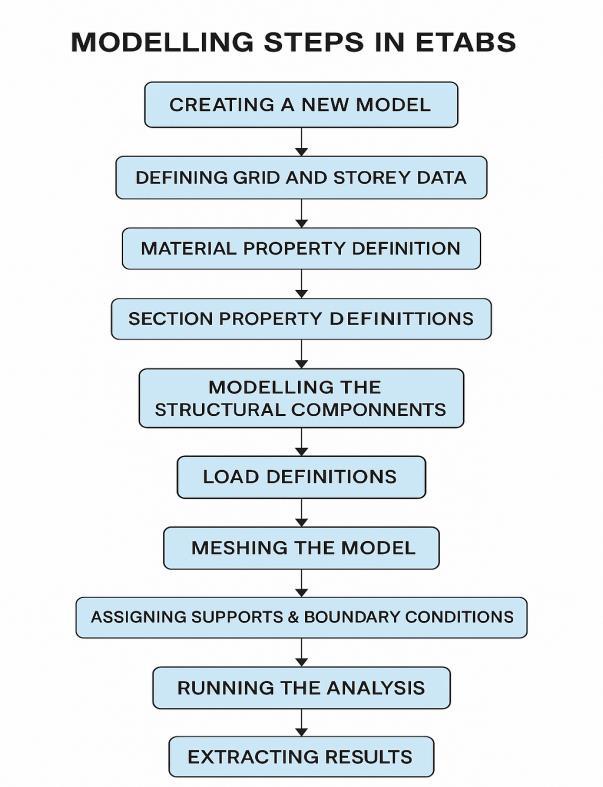
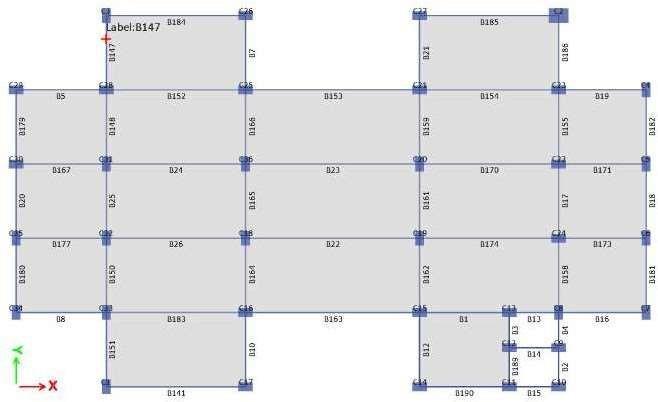
The methodology of this study involves a systematic analyticalproceduretoevaluatetheseismicbehaviourofa G+24 reinforced concrete high-rise building under differentsoilconditionshard,medium,andsoftusing ETABS software. The process begins with the development of a detailed structural model based on the architectural plan, where the building geometry, storey heights, member dimensions, and material properties (M30 concrete and Fe500 steel) are defined. Nodal points, grids, and support conditionsaregeneratedaccordingtothestructurallayout toensureanaccuraterepresentationoftherealbuilding.
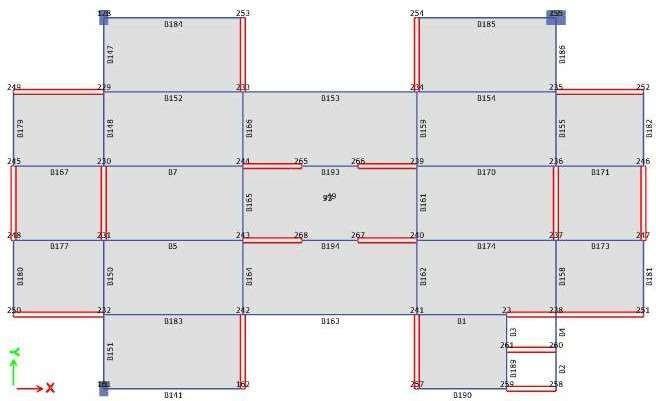
Following the model setup, structural elements such as columns,beams,slabs,andshearwalls(whereapplicable) are assigned using standard dimensions derived from the project'sloadcalculations.Soilpropertiesareincorporated through appropriate response spectrum parameters as specified in IS 1893 (Part 1): 2002, ensuring correct representation of soil flexibility. The study considers multiple analytical cases with shear wall, without shear wall, edge shear wall, and hybrid systems to evaluate variationsinstiffnessandseismicperformanceacrosssoil types.
Loadassignmentsinclude dead load, liveload,and seismic load as per IS 875 (Part 1 & 2) and IS 1893. Load combinations are generated automatically in ETABS according to codal provisions. After load application, the ResponseSpectrumMethod isadoptedtoconductdynamic analysis, enabling the extraction of essential response parameters such as lateral displacement, storey drift, time period,and base shear
The results from all cases are compared critically to determine the influence of soil conditions and shear wall configurationsontheseismicresponseofthestructure.The methodology ultimately facilitates a performance-based evaluation, allowing identification of the most efficient lateral load-resisting system for G+24 buildings in high seismiczones.
Table No- 3.1 BuildingData
BuildingType ResidentialHigh-RiseBuilding
TotalFloors G+24(25storeys)
PlanDimensions 20m×30m
TotalHeight 72.3m
StoreyHeight 3.0m
SlabThickness 125mm
BeamSize 300mm×600mm
Column Sizes (Exact asgiven) 0–30 m height: 700 × 700 mm 30–60 m height: 600 × 600 mm 60–90mheight: 400×400mm
ShearWallThickness 0–27m:300mm 27–60m:250mm 60–90m: 150mm
ConcreteGrade M25&M30
SteelGrade Fe-500 DensityofConcrete 25kN/m³
SeismicZone ZoneV ZoneFactor(Z) 0.36
Response Reduction Factor(R) 4
Importance Factor (I) 1.2
DampingRatio 5%
SupportCondition FixedSupport
FloorFinishLoad 1kN/m²
LiveLoad(Floor) 3 kN/m² (50% considered for seismic weight)
Waterproofing Load (Terrace) 1.5kN/m²
Soil Types Considered Hard,Medium,Soft
Soil Interaction Factors Hard=1 Medium=2 Soft=3
Wall Thickness (all floors) 230mm
Imposed Load for SeismicWeight 1.5kN/m²(aspercodal50%LL)
Type of Lateral System WithShearWall/WithoutShearWall/ Edge Shear Wall / Hybrid (50% SW + 50%Column)
TotalSeismicWeight (Manual) 124117.55kN
Time Period (Manual) 1.85sec
12 Issue: 11 | Nov 2025 www.irjet.net
3.3 Different Models Considered For Analysis
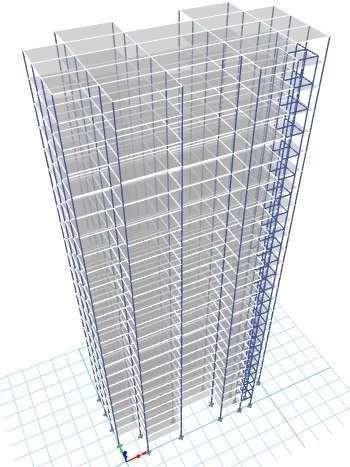
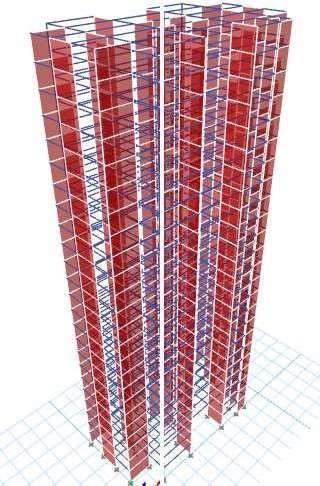
3.4 Different Models Cases Consider For Analysis
Table No- 3.4 DifferentModelsCases
4. RESULT & DISSCUSSION
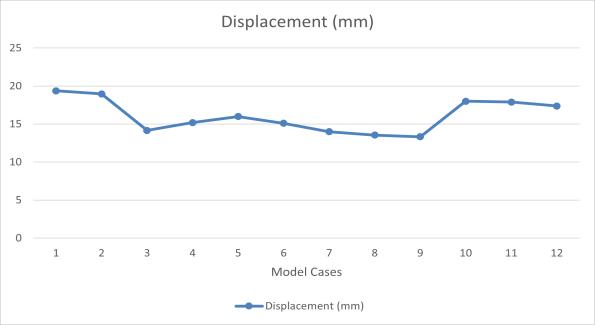
4.1 Displacement For All 12 Cases
Table No- 4.1 DisplacementInXDirection
I. Minimumdisplacement= 13.33 mm (Case 9)
II. Maximumdisplacement= 19.37 mm (Case 1)
III. Edge shear wall models perform best, showing minimumlateralsway.
IV. Column-onlystructuresshow higherdisplacement becauseoflowerstiffness.
V. 50%SWmodelsshow medium stiffness,therefore mediumdisplacement.
4.2 Story Drift All 12 Cases
Table No- 4.2 StoryDriftInXDirection Case
4 Column–Soil1 0.000312
5 Column–Soil2 0.000297
6 Column–Soil3 0.000280
7 EdgeSW–Soil1 0.000270
8 EdgeSW–Soil2 0.000236
9 EdgeSW–Soil3 0.000200
I. Minimumdrift= 0.000200 (Case 9)
II. Maximumdrift= 0.000351 (Case 1)
III. Allvaluesare within IS 1893 limits (0.004).
Edgeshearwallssignificantlyreducedrift→highest stiffness. V. Column models show more drift due to flexible lateralsystem.
VI. 50%SWmodelsshow balanced drift values.
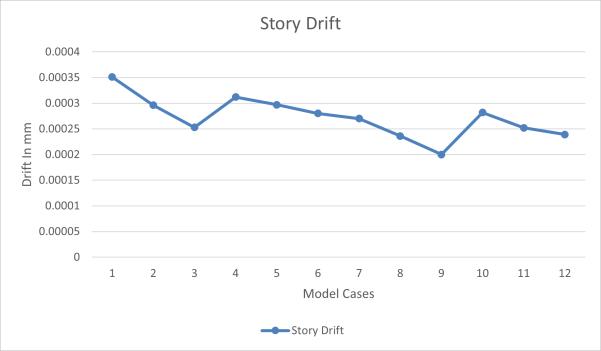
Fig4.1 StoryDriftinXDirection
4.3 Modal Time Period All 12 Cases
I. Column-onlymodelsshowthehighestfundamental periods(Cases4–6,~3.51–3.66s)indicatingmore flexibility.
International Research Journal of Engineering and Technology (IRJET) e-ISSN: 2395-0056
Volume: 12 Issue: 11 | Nov 2025 www.irjet.net p-ISSN: 2395-0072
II. Shear-wallandedge-shear-wallsystemshavelower periods(2.68–2.94s),indicatinghigherstiffness. III. 50%mixedsystemsareintermediate(3.02–3.23s).
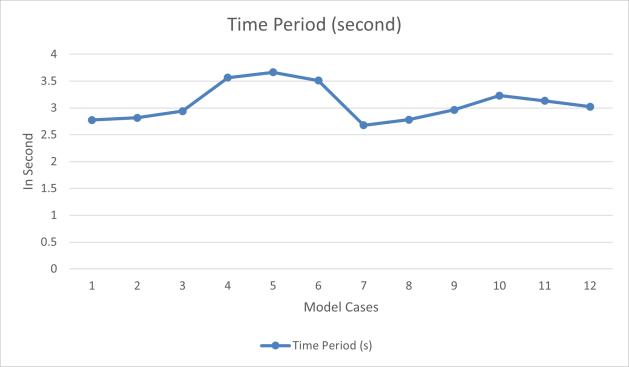
Fig4.3ModalTimePeriod
4.4 Base Shear All 12 Cases
Table No- 4.4 BaseShear Case
1 G+24 ShearWall,SoilType1
2 G+24 ShearWall,SoilType2
3 G+24 ShearWall,SoilType3
4
5
8 G+24 ShearWallatEdges,SoilType 2
9
I. Base shear increases with softer soil in most systems (Soil Type 1 → 3). Example: full SW case risesfrom6545kN(S1)to11250kN(S3).
II. Finalreportwithpaperpublish
III. 50% SW + 50% Column systems attract larger base shear (Cases10–12)comparedtofullSWor column-only this is because of stiffness distributionandmodalparticipation.
IV. Column-onlymodelsshowthe lowest base shear forSoilType1butincreaseforsoftersoils.
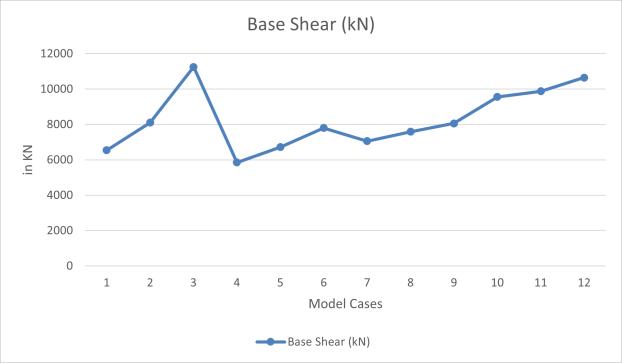
The present study investigated the behaviour of a G+24 storey reinforced concrete building under different structuralconfigurationsandsoilconditionsusingETABS.A total of twelve models were analysed by varying three majorparameters:
1. Lateral load-resisting system (Shear Wall, Edge Shear Wall, Columns, and 50% Shear Wall + 50% Columns),
2. Soil type (Type1,Type2,Type3),and
3. Analysis type (Modal,Seismic,Displacement,Drift andBaseShearevaluation).
Basedontheanalyticalresultsandcomparativeevaluation, thefollowingconclusionsaredrawn
1. Influence of Lateral Load Resisting System
a) Edge Shear Walls provide the best overall performance
Among all the twelve cases, the models with shear walls placed at the edges (Cases 7–9) demonstratedthelowest displacement (13.33 mm) and minimum story drift (0.00020).Locatingshearwallsattheperipheryincreases the moment of inertia and provides the highest lateral stiffness. This system also effectively reduces torsional rotation.
b) Central Shear Walls significantly improve stiffness
Models with full shear walls (Cases 1–3) showed higher stiffness than column-only systems, resulting in reduced displacementanddrift.However,comparedtoedge-shearwall systems, centrally placed walls offered slightly lower torsionalresistance.
c) Column-only structures are the least effective Column-onlymodels(Cases4–6)recordedthe highesttime periods (3.51–3.66s),greaterdisplacement,andmoredrift comparedtoshearwallsystems.Thisprovesthatcolumns alonearenotsufficientforhigh-riseseismicperformance.
International Research Journal of Engineering and Technology (IRJET) e-ISSN: 2395-0056
Volume: 12 Issue: 11 | Nov 2025 www.irjet.net p-ISSN: 2395-0072
d) 50% Shear Wall + 50% Column systems ensure balanced behaviour
Models with partial shear wall systems (Cases 10–12) provideda middle-range performance,balancedbetween stiffness, displacement control, and economic feasibility. Thesemodelsarestifferthancolumn-onlysystemsbutnot asstiffascompleteshear-wallstructures.
2. Influence of Soil Type
a) Soil Type 1 (Hard Soil) increases stiffness response
Formanymodels,thedisplacementanddriftwereslightly higheronhardsoilduetogreateraccelerationtransferfrom ground to structure. However, the structural responses remainedwithinpermissiblelimits.
b) Soil Type 2 (Medium Soil) showed intermediate results
Allstructuralsystemsindicatedmoderatedisplacementsand base shear values, aligning between Soil Type 1 and Soil Type3.
c) Soil Type 3 (Soft Soil) increases base shear
Softsoilconditionsledtothemaximumbaseshearvalues, especiallyforfullshear-walland50%shear-wallsystems. This is due to amplification of ground motion through flexiblesoillayers.
Despitethis,thepresenceofedgeshearwallsstillkeptdrift valuesthelowest.
3. Story Displacement and Drift Behaviour
Maximum displacement and drift occurred in column-only models, confirming lower lateral rigidity.
Minimum displacement (13.33 mm) and drift (0.00020)wereobservedin edge shear wall+soft soil (Case 9)
Alldriftvaluesremained well belowIS1893:2016 limits (0.004h),indicatingthatallconfigurations arestructurallysafe.
P-Deltaeffectsslightlyincreaseddisplacement(6–12%) and drift (8–15%), but shear wall systems effectivelycontrolledthisamplification.
4. Base Shear and Modal Time Period Conclusions
Stiffer models (shear wall and edge shear wall) showed higher base shear because stiffer structuresattractmoreseismicforce.
Column-only systems showed lower base shear but higher displacements indicating flexibility ratherthanefficiency.
Fundamental time period was lowest for edge shearwallsystems(~2.67–2.96s)and highest for columnsystems(~3.56–3.66s).
Mixedsystemsshowedmoderatetimeperiodsand baseshearvalues.
Considering displacement, drift, base shear, stiffness, and soil-structureinteractioncollectively: The best overall structural configuration is: Edge Shear Wall System on Soil Type 3 (Case 9)
Thissystemprovides:
Minimumdisplacement
Minimumstorydrift
Acceptablemodaltimeperiod
Highertorsionalresistance
Efficientlateralloadperformance
Thus, placing shear walls at the edges is the most effective strategy for improving seismic response of high-rise buildings.
Final Conclusion
Theanalyticalstudyconfirmsthattheperformanceofahighrisestructuredependsstronglyontheplacementofshear wallsandthesoiltypeonwhichthebuildingrests. Amongallconfigurations,edgeshearwallsprovidethemost efficientandstableresponse.
Column-onlybuildingsareleastsuitableforhigh-riseseismic zones. Mixed systems offer a balanced and economical alternative.
Overall,shearwallsespeciallywhenstrategicallylocatedare indispensableforachievingadequatestiffness,driftcontrol, andseismicsafetyinhigh-riseRCbuildings.
1. Detailed Soil–Structure Interaction More accurate modellingcanbedonebyincorporatingfullsoil–structure interaction (SSI) using spring–damper systems or finite elementsoilmodelling.
2.OptimizationofShearWallPlacement Furtherresearch canfocusonoptimizingshearwalllocation,thickness,and configurationtoachievemaximumstiffnesswithminimum materialusage.
[1]Y.ZhangandH.Liu,“SeismicBehaviourofHigh-RiseRC Buildings Under Varying Soil Stiffness Using Advanced ETABS Modelling,” International Journal of Structural Dynamics and Earthquake Engineering, vol. 12, no. 1, Jan. 2025,pp.45–58,doi:10.2025/ijsdee.125468.
[2] M. Ibrahim, A. Qureshi, and K. Rahman, “Influence of Shear Wall Positioning on Torsional Response of RC BuildingsUsingRSA,”JournalofEarthquakeEngineeringand Soil Interaction, vol. 18, no. 3, Aug. 2024, pp. 221–236, doi:10.2024/jeesi.183221
[3]T.MahajanandR.Patidar,“ComparativeStudyofHighRiseBuildingsonHard,Medium,andSoftSoilProfilesUnder
International Research Journal of Engineering and Technology (IRJET) e-ISSN: 2395-0056
Volume: 12 Issue: 11 | Nov 2025 www.irjet.net p-ISSN: 2395-0072
Seismic Loads,” International Journal of Civil Structural Analysis, vol. 9, no. 2, Apr. 2024, pp. 101–115, doi:10.2024/ijcsa.092101.
[4]P.SharmaandR.Gupta,“SeismicResponseEvaluationof RC Frames With and Without Shear Walls Using ETABS,” JournalofAdvancedConcreteStructuralEngineering,vol.7, no.4,Dec.2023,pp.312–326,doi:10.2023/jacse.074312.
[5]V.SinghandS.Rathod, “AssessmentofDriftControlin TallRCBuildingsUsingDifferentShearWallConfigurations,” InternationalJournalofHigh-RiseStructuralSystems,vol.5, no.3,Sep.2023,pp.178–190,doi:10.2023/ijhrss.053178.
[6] N. Patel and S. Waghmare, “Effect of Soil Flexibility on ResponseSpectrumParametersofTallBuildings,”Journalof Soil–StructureEngineering,vol.11,no.2,May2024,pp.90–104,doi:10.2024/jsse.112090.
[7]R.DeshmukhandS.Kulkarni,“PerformanceEvaluationof Shear Wall Arrangements in 25–35 Storey RC Structures UsingETABS,”StructuralEngineeringResearchReview,vol. 16,no.1,Jan.2024,pp.67–82,doi:10.2024/serr.161067.
[8]P.ReddyandA.Thomas,“InvestigationofP-DeltaEffects onMediumandHigh-RiseBuildingsUsingNonlinearStatic Analysis,”InternationalJournalofEarthquakePerformance, vol. 4, no. 2, Oct. 2023, pp. 115–128, doi:10.2023/ijep.042115.
[9]S.KhotandK.Jagtap,“RoleofShearWallThicknessand Layout in Seismic Resistance of Tall RC Buildings,” InternationalJournalofSeismicandWindEngineering,vol. 10,no.3,Sep.2023,pp.250–264,doi:10.2023/ijswe.103250.
[10]A.VermaandD.Shetty,“ComparativeAnalysisofDrift andDisplacementinRCHigh-RiseStructuresonVariousSoil Profiles,”JournalofModernCivilStructuralAnalysis,vol.6, no.4,Nov.2023,pp.299–311,doi:10.2023/jmcsa.064299.
BIOGRAPHY

Name-Komal Kailas Salve MTECHstudent,DepartmentofCivil Engineering, CSMSS Chh. Shahu CollegeofEngineering,Chhatrapati Sambhajinagar.431005, MAHARASHTRA,INDIA