
International Research Journal of Engineering and Technology (IRJET) e-ISSN: 2395-0056
Volume: 12 Issue: 11 | Nov 2025 www.irjet.net p-ISSN: 2395-0072
International Research Journal of Engineering and Technology (IRJET) e-ISSN: 2395-0056
Volume: 12 Issue: 11 | Nov 2025 www.irjet.net p-ISSN: 2395-0072
Prafull B. Dhule 1, Satish S. Manal2
1 P.G. Student, Civil Engineering Department, CSMSS College, Chhatrapati Sambhajinagar (Aurangabad)
2 Assistant Prof, Civil Engineering Department, CSMSS College, Chhatrapati Sambhajinagar (Aurangabad)
Abstract - The rapid global trend of urbanization has necessitated the construction of multi-story and high-rise buildings to optimize limited urban land space. Structural design in such tall buildings is critically focused on ensuring safety, serviceability, and economicviability,particularlywhen subjected to severe lateral forces like wind and seismic ground motion. This projectreportpresentsthestructuralanalysisand design of a G+20 (Ground + 20 stories) twin-tower high-rise building complex featuring an integrated skywalk system, performed using the finite element analysis software, STAAD.Pro V8i. The structuralmodel consists of twin towersof a circular cross-sectional geometry (30 meters in diameter, 45 meters center-to-center spacing) with a height of 63 meters. The towers are connected by four separate skywalks, strategically located at the 4th, 9th, 14th, and 19th floor levels, which function as critical safety escapes and pedestrian connectors.The design utilized M40 grade concrete andFe500 grade steel. The key findings confirmed the robust structural integrity and excellent serviceability of the design. The Story Drift Analysis Report indicated that all calculated story drift ratios successfully "PASS" the prescribed code limits. The maximum observed story drift was 0.5747 cm (at the 8th story), which is well within theallowable driftlimit(L/40).The seismic analysis showed a fundamental time periodof 1.61687 seconds. In conclusion, the structural analysis and design process, leveraged by the advanced capabilities of STAAD.Pro, resulted in a safe, cost-efficient, and compliant design for a complex high-rise structure with connecting skywalks.
Key Words: G+20, High Rise, Skywalk, STAAD Pro, Drift Analysis.
Now a days tall or multi-story buildings has gain importance very much, because in tier-1 cities there is a rapidincreaseinpopulationwithlimitedspaceforbuilding. Allpeoplerequiregoodaccommodation,aesthetics,comfort andsafety.Thatisthereasonforincreaseinconstructionof multi-story buildings. Structural design of multi-story buildings is basically worried with safety during ground motion, serviceability what’s more, and potential for monetarymisfortune.DesignofstructuresusingLimitState methodDesignThemembersaredesignedforthelimiting bending moment and serviceability limits, hence the structures are left with minimum reserve energy. Earthquakeswillcausemoresevereeffectontallbuildings comparedtosmallbuildings.
A high-rise building is a tall, multi-story structure generally defined as being significantly taller than surrounding buildings and requiring mechanical vertical transportation,likeelevators,toaccessitsupperlevels.They areprimarilybuilttomaximizeusablespaceonexpensiveor limitedurbanland,servingasresidences,offices,ormixeduse facilities. This strategy is known as vertical urban expansion. It is a structure consisting of many structures connectedbyconnectingstructuressuchasskygardensand skybridges.Therefore,therearemanytypesofconnections: fixed,semi-fixed,articulated,etc.Therearetwobigsymbols that show this trend: Petronas Towers in Malaysia and MarinaBaySandsinSingapore.Thesehomeconnectionsare often too developed to be effective. More importantly, seismicresponseisanimportantconsiderationinstructural design, as the response of the main structure depends on manyparameterssuchasseismicproperties,soiltypeand materials.FEMisamathematicaltechniquethatcanbeused to analyze many engineering problems under static, dynamic,linearornonlinearconditions.
The shape of a high-rise building's cross-section is a criticaldesignchoice,dictatedbyacombinationofstructural integrity(especiallylateralloadresistance),aerodynamics, functionality,andaesthetics.
(i)
Rectangularandsquarehigh-risebuildingsarecommondue totheirstructuralsimplicity,whichmakesthemeasierand moreefficienttodesignandconstruct.Theirstraightforward geometryallowsforsimplifiedcalculationsforself-weight, windloads,andseismicloads,andprovidesregular,easy-todividefloorplans.
(ii)
Circular and cylindrical high-rise buildings are impressive architectural structures, with famous examples including theGuangzhou Circle in China, which is the world's tallest circularbuilding,theAldarHQinAbuDhabi,andtheWestin BonaventureHotelinLosAngeles.Thesedesignsofferunique benefits such as reduced wind resistance and aesthetic appealandaresometimesinspiredbyculturalsymbolism
International Research Journal of Engineering and Technology (IRJET) e-ISSN: 2395-0056
Volume: 12 Issue: 11 | Nov 2025 www.irjet.net p-ISSN: 2395-0072
(iii) Triangular/Three-Lobed (Y-Shape):
High-risebuildingswithatriangular,three-lobed(Y-shape) design are a significant architectural and engineering solution, primarily used to enhance structural stability againstwindforcesandmaximizespaceefficiencyandviews. Three wings or lobes branching from a central core. Often seeninsupertallsliketheBurjKhalifa(three-lobedplan).
(iv) Tapered/Setback:
Buildingsthatreducetheircross-sectionalareaastheyrisein height.Tapered/setbackhigh-risebuildingsaredesignedto bewideratthebaseandgraduallynarrowertowardsthetop, whichimprovesstructuralstabilityandreduceswindloads byminimizingaerodynamicforcesandvortexshedding.This design approach also leads to structural efficiency, as less materialisneededatthetop,whichcanlowerconstruction costs, and the design can also create iconic architectural landmarks.
1.3 Skywalk:
A skywalk in high-rise buildings is an elevated bridge or passagewaythatconnectstwoormoretallbuildingsabove groundlevel.Itallowssafeanddirectmovementofpeople betweentowerswithoutneedingtogotothegroundfloor. Thesestructuresareoftenmadeofsteel,concrete,andglass, and are designed to withstand wind loads, vibrations, and temperaturechangesathighaltitudes.Theyarecommonly found in modern skyscrapers, commercial complexes, hotels,andhospitals
1.4 Types of Skywalks in High-Rise Buildings
(i) Enclosed Skywalk
An enclosed skywalk is a fully covered elevated passagethatconnectstwoormorehigh-risebuildings.Itis builtusingglasspanels,aluminumcladding,orsteelframing, providingaclimate-controlledandsecureenvironmentfor pedestrians.Theseareoftenfoundincommercialcomplexes, hospitals, airports, and office towers where comfort and safetyarepriorities.
(ii) Open Skywalk:
An open skywalk isan elevated pedestrian bridge withoutfull enclosure.Ittypicallyhasguardrailsorpartial side protection, allowing free airflow and visibility. It is suitableforareaswithmildclimatesandlowerpedestrian volume, often used for maintenance or low-traffic connections.
(iii) Glass Skywalk:
Aglassskywalkisatransparentpedestrianbridge mademostlyoftemperedorlaminatedglasspanels.Itallows userstoviewthesurroundingsorthegroundbelow,givinga sense of openness and excitement. Common in tourist attractions, observation towers, and luxury buildings, it combinesstructuralengineeringwithaesthetics
(iv) Suspended (Cable-Supported) Skywalk:
A suspended or cable-supported skywalk uses tensioncables,hangers,orsuspensionsystemstosupportthe walkway between buildings. It provides flexibility and reducesthestructuralloadonthemaintowers.Thisdesignis preferred when connecting towers that may move slightly duetowindorseismicactivity.
(v) Structural Steel Skywalk:
Astructuralsteelskywalkisarobustbridgemadeof steel beams, trusses, and decks, designed to carry heavy pedestrianorserviceloads.Itisstrong,durable,andcanbe eitheropenorencloseddependingondesignneeds.
1.5 Truss for Skywalk:
Trussstructuresareverycommonandeffectivefor skywalks (elevated pedestrian bridges) because they are efficientforspanninglongdistances while beingrelatively lightweightandprovidinggoodstructuralstability.
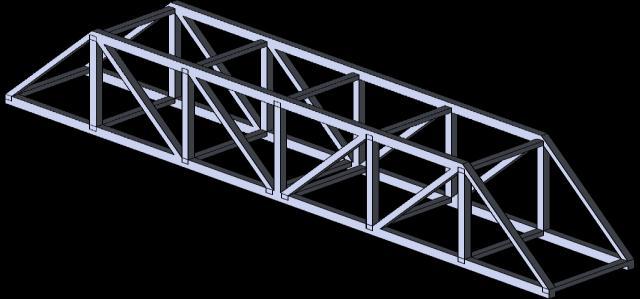
(i) Pratt Truss:
Features vertical members in compression and diagonal members in tension. It's often considered costeffective and efficient for common vertical load scenarios (liketheweightofthestructureandpedestrians).
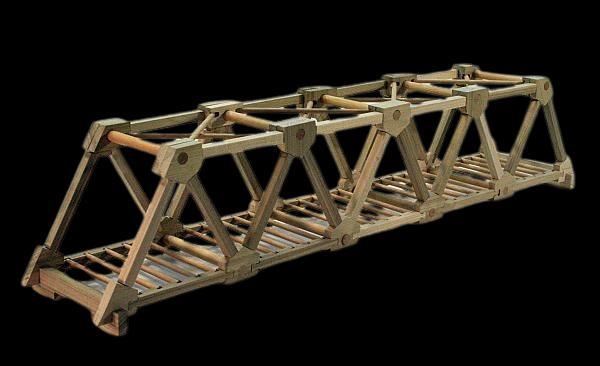
(ii) Warren Truss:
Characterized by a series of equilateral triangles, withdiagonalmembersthatalternatebetweentensionand compression. It's often the most cost-effective due to its simplicityandreducednumberofmembers,makingitideal formoderate.
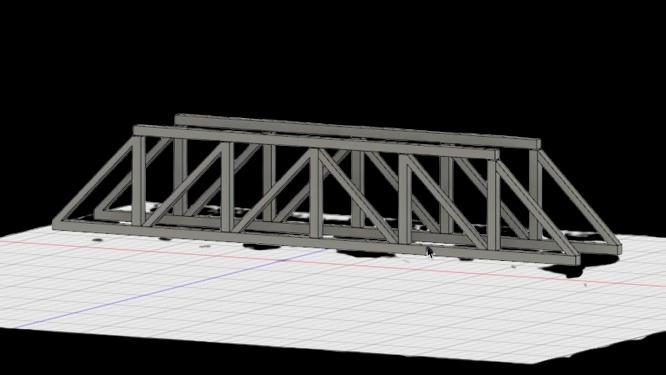
(iii) Howe Truss:
Essentially the opposite of the Pratt truss, with vertical members in tension and diagonal members in compression. Why it's used: While less common than the
International Research Journal of Engineering and Technology (IRJET) e-ISSN: 2395-0056
Volume: 12 Issue: 11 | Nov 2025 www.irjet.net p-ISSN: 2395-0072
Pratttrussforsteel,timberHowetrussesaresometimesused inenvironmentslikenaturetrailstoblendin.
2.1 Design and Analysis of G+20 Multi-storey Building with Sky walk by using STAAD Pro:
DesigningandanalyzingaG+20(Ground+20floors) multistorey building with a skywalk using STAAD Pro involvesseveralkeysteps,rangingfromthemodelingofthe building to the analysis of structural loads and the final designofcomponents.
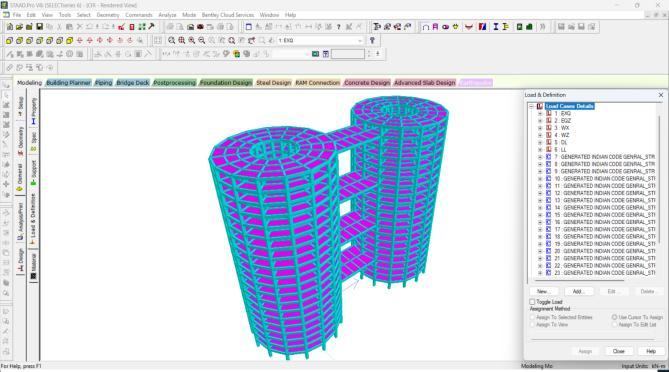
Fig. 1.G+20Multi-StoryBuildingwithSkywalk
BUILDING DETAILS:
Detail Description
Structure Type High-risetwintowersof circulargeometry.
Software Used STAADProV8i
Key Feature FourSkywalksconnectingthe twotowers.
Height/Stories 20-storybuilding.
Skywalk Locations Floors:4th,9th,14th,and 19th.
Tower Diameter 30metersforeachcircular tower.
Floor Height 3m
Stories 20
Tower Height 63m
Plan Dia 30m
Space B/W Towers Centre to Centre 45m
Slab Thickness 0.18m
Column Size 0.7X0.7m
Beam Size in Tower 0.7X0.4m
Steel Grade Fe500
Concrete Grade M40
Load Codes IS875(Dead,LiveLoadand WindLoad) andIS1893(SeismicDesign).
Live Load upto5kN/m²
Seismic Zone: Zone3
Response reduction factor (R) 5 SpecialMomentResisting Frame(SMRF)
Seismic zone factor 0.16(Zone3)
Soil Type 2 MediumSoil
Damping Ratio 0.05 (5%isthestandardvalueused forthemajorityofReinforced Concrete(RC) Fundamental Natural Period (T) 0.09seconds (Verystiffstructure)
Importance factor (I) (e.g.,commercialbuildings withanoccupancyofmore than200people).
Wind Zone Zone3
2.2
(i) Connection with Main Building: Model the skywalk's connection to the building carefully, ensuringproperloadtransfer
(ii) Structural System: Skywalksofteninvolveamixofbeamsandcablesoramore rigidframe,dependingonthearchitecturaldesign
International Research Journal of Engineering and Technology (IRJET) e-ISSN: 2395-0056
Volume: 12 Issue: 11 | Nov 2025 www.irjet.net p-ISSN: 2395-0072
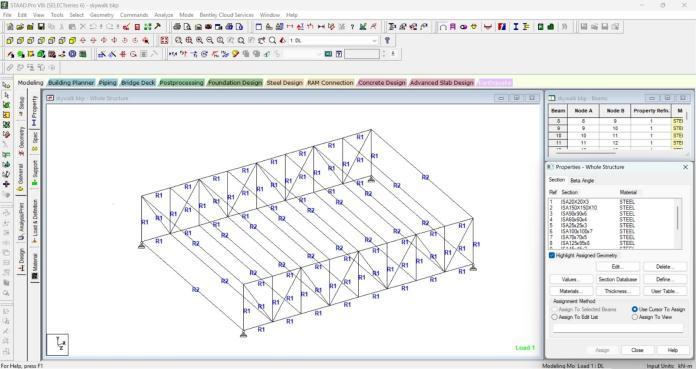
2.SkywalkModel SKYWALK DETAILS:
Detail Description
Truss Type Howe
Length Of Skywalk Bridge 15m
Width Of Skywalk Bridge 11.48m
Height Of Skywalk Bridge 3m
Structure Location GeneralMetropolitan Area
Seismic Zone (Z factor) ZoneIII
Basic Wind Speed (Vb) Vb=44m/s
Truss Material Steel(Fe410/E250)
3. RESULTS:
1. Story Drift Analysis:
Themaximumdriftoccursat: Story: 8 Height: 21.00meters Direction: Z-direction
Thestorydriftvalueof0.5747cmistheinter-storydriftfor the 8th story, meaning it is the difference in lateral displacementbetweenthe8thand7thfloors. Thisvalueis checkedagainsttheallowabledriftratio,whichisindicated asL/40(Lbeingthestoryheight,whichistypically3.00min thisreportsincetheheightincrementis3.00mperstory).
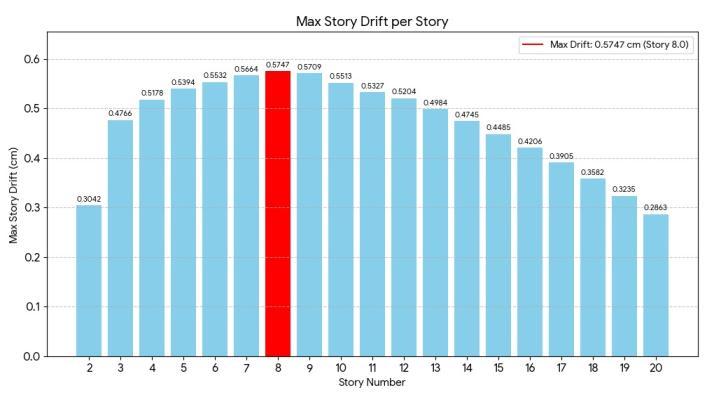
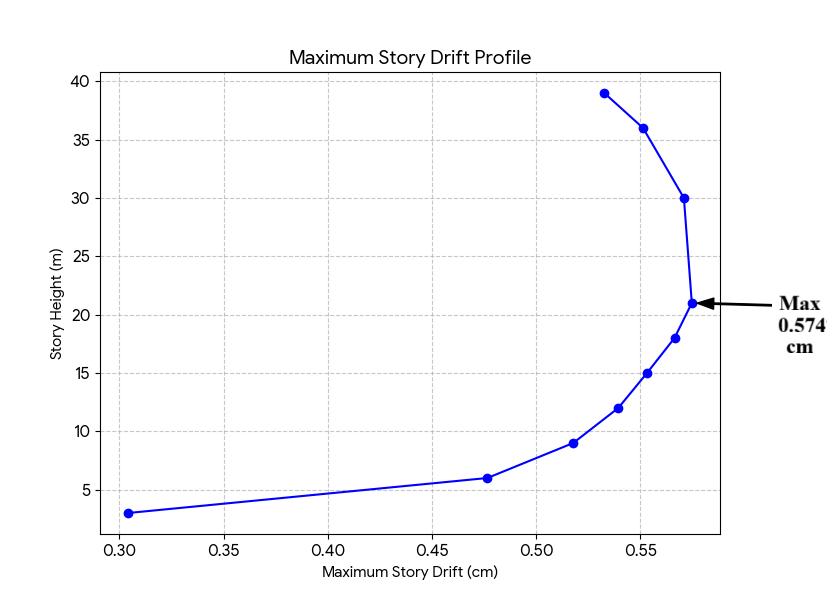
Fig. 4. MaximumStoryDriftProfile
In all cases presented, the drift ratio is much higher (e.g., L/522forthismaximumdriftvalue),indicatingthatthedrift iswellwithinthecodelimits,andthestatusis"PASS"
2. Time Period and Sa/G:
TheTimePeriodisameasureofthestructure'sflexibility.A higherperiodindicatesamoreflexiblestructure.Theseismic code uses this period to determine the design's Spectral Acceleration Coefficient (S/G), which represents the structure'sresponsetoearthquakegroundmotion.Thevalue ofSa/G=0.841isrelativelyhigh,indicatingastrongseismic demandforthecalculatedperiodof1.61687seconds
ThestructuralanalysisanddesignoftheG+20multi-story building and its integrated skywalk, performed using STAAD.ProandadheringtoIndianStandardIScodessuchas IS 456:2000, IS 875, and IS 1893, led to the following principalfindings.
Structural Integrity:
Theanalysiswasexecutedsuccessfully,andthemodelwas confirmedtohavezeroerrors
Serviceability (Story Drift):
Thestructuredemonstratedexcellentperformanceagainst lateralloads(windandseismic)intermsofstorydrift.The StoryDriftAnalysisReportindicatedthatforalltestedloads andstories,thecalculateddriftratios"PASS"therequired codelimits.Themaximumstorydriftobservedwas0.5747 cm(atthe8thstory),whichwaswellwithintheallowable limits(L/40).
International Research Journal of Engineering and Technology (IRJET) e-ISSN: 2395-0056
Volume: 12 Issue: 11 | Nov 2025 www.irjet.net p-ISSN: 2395-0072
Seismic Analysis:
(TimePeriod=1.61687seconds)isthetimeforwhichthe structurewillrequireswingbackandforthonecycle.This valuesuggestsarelativelyflexiblestructure,whichistypical foratall(G+20)building.
Spectral Acceleration Coeff. (0.841) This is the key factor from the seismic zone (responsespectrum)thatdictatesthedesignforce.Avalue of 0.841 means the ground acceleration is amplified significantly (84.1% of gravity) at this structure's natural periodtodeterminethedesignseismicforce
[1] Rishabh Singh (2023) "Analysis and Design of G+15 Building with Connecting Skywalk in Gorakhpur" by International Journal for Research in Applied Science & EngineeringTechnology(IJRASET)Volume11IssueVIIJul 2023.
[2]PushplataArmoandBhaveshKumarJha(2022)"Seismic AnalysisandDesignofMulti–StoryBuildinginSTAADPro forZoneII”byInternationalJournalofEngineeringResearch &Technology(IJERT)Vol.11Issue05,May-2022.
[3]SakibSalamSofiandErAshishKumar(2022)"Analysis and Design of Multistorey Building by Using Staad Pro Software"byInternationalJournalofInnovativeResearchin Engineering & Management (IJIREM) Volume-9, Issue-2, April2022,Pages403-407.
[4]C.VenkataSivaRamaPrasad,J.AjayGoud,P.Manoj,and I. Ganesh (2021) "Analysis and Design of Multi-Story Building by Using STAAD Pro" by Proceedings of First National Conference On Sustainable Innovative Trends In CivilEngineering
[5]MayankEshwarSinghandHemantSinghParihar(2020) "Structural Analysis of Skywalk with Light Gauge Steel Material"byInternationalJournalofAdvancedScienceand Technology,29(7),3771-3777.
[6] A. K. Sharma and R. K. Gupta (2019) "Seismic Performance Evaluation of Multi-Story Building with FloatingColumnsUsingSTAAD.Pro"byInternationalJournal ofEngineeringResearch&Technology,Vol.10Issue07,July2021.
[7]Dr.S.G.Makarande,VikasV.Agrawal,Prof.G.D.Dhawale, Prof.A.B.Dehane,andProf.M.R.Nikhar(2019"Analysisand Design of Multi Storeyed Building Using STAAD Pro and ManuallyforTwoSeismicZones")byIconicResearchAnd Engineering Journals published by IRE Journals, Volume/Issue:Volume3Issue3September-2019.
[8]G.SantoshandV.Bhargavi(2019)"AnalysisandDesign of Shear Wall for High Rise Building (G+10) Using STAAD Pro" by Novateur Publications International Journal of Innovations in Engineering Research and Technology [IJIERT]volume6,issue11,Nov.2019.
[9] Siddharth Pralhad Jadhav, Suraj M Shirsat, Akshay S Bankar, Dhanawan G Rupanawar, and Prof. Yogesh Deshmukh (2018): "A Review on Seismic Analysis of Multistorey Building with Floating Column using Staad.ProV8i" by International Journal of Engineering Research&Technology(IJERT)
[10]S.R.SatishandM.S.Kumar(2018"DesignandAnalysis ofMulti-StoryBuildingwithGridSlabUsingSTAAD.Pro"by InternationalResearchJournalofEducationandTechnology PeerReviewedJournal
[11]M.S.KulkarniandS.S.Kumbhar(2017)"Comparative StudyonDesignandAnalysisofMulti-StoryBuilding(G+10) by STAAD.Pro and ETABS" by International Journal of EngineeringSciences&ResearchTechnology[Ramya,4(10): October,2015]
[12] S. K. Gupta and R. K. Sharma (2017) "Analysis and Design of Multi-Story Building with Flat Slab Using STAAD.Pro"


Mr. Prafull B. Dhule
P.G. Student, Civil Engineering Department, CSMSS, Chh. Shahu CollegeofEngineering,Kanchanwadi, Chhatrapati Sambhajinagar (Aurangabad),Maharashtra,India
Mr. Satish S. Manal
Assistant Professor, Department of CivilEngineering,CSMSS,Chh.Shahu CollegeofEngineering,Kanchanwadi, Chhatrapati Sambhajinagar (Aurangabad),Maharashtra,India