
International Research Journal of Engineering and Technology (IRJET) e-ISSN: 2395-0056
Volume: 12 Issue: 10 | Oct 2025 www.irjet.net p-ISSN: 2395-0072
International Research Journal of Engineering and Technology (IRJET) e-ISSN: 2395-0056
Volume: 12 Issue: 10 | Oct 2025 www.irjet.net p-ISSN: 2395-0072
Tejas D Patil1 , Shradha Hiremath2
1Post graduate student, Department of Civil Engineering, SGBIT College, Belagavi, Karnataka, India
2Assistant Professor, Department of Civil Engineering, SGBIT College, Karnataka, India ***
Abstract - An A major trend away from conventional steel buildings (CSB) and toward pre-engineered building (PEB) systems has resulted from the increased demand for economical, environmentally friendly, and effective constructionmethods.PEBbuildingsareproducedinfactories and then delivered to the construction site for assembly, reducing material waste and expediting the building process while higher accuracy. They are perfect for a variety of settings, such as business centers, warehouses, industrial sheds, and airplane hangars, due to their adaptability, robustness, and low maintenance requirements. This study focuses on the design and evaluation of PEB structures using ETABS software Models with spans of 10 m, 15 m, and 20 m were developed and assessed under different loading conditions, including dead, live, wind, and seismic loads, in compliance withIS800:2007, IS875-2015,andIS1893-2016 standards.
Key Words: Shear Force, Bending Moment, Axial Load, Torsion
High-rise buildings, defined as structures that exceed 35 metersinheightortypicallyconsistof12ormorestories, havesignificantlyalteredurbanlandscapesacrosstheglobe, becomingfundamentaltocontemporarycityplanning.These towering structures tackle the urgent issues of rapid urbanization, population increase, and land scarcity by facilitatingverticalgrowth,allowingthousandsofresidents, workers, or visitors to be accommodated within minimal ground space. The development of high-rise construction commencedinthelate19thcentury,drivenbytechnological innovationsinsteelframeworks,reinforcedconcrete(RCC), and elevator systems, which surpassed earlier height restrictionsandtransformedarchitecturalpotential.From renownedgloballandmarkssuchastheBurjKhalifainDubai to densely populated urban areas in India, high-rises function as residential complexes, commercial centers, hotels, and institutional buildings, representing economic advancement, engineering creativity, and architectural aspiration.InIndia,whereurbanpopulationsareanticipated to reach 600 million by 2031, high-rises are essential for sustainableurban growth, reconcilinghousingneedswith environmentalconservation.Nevertheless,theirdesignand construction require stringent engineering to guarantee structuralintegrity,occupantsafety,andresilienceagainst environmental forces, especiallyinseismic zonesorareas
pronetohighwinds.ToolssuchasETABSarecrucialinthis endeavor, allowing for accurate modeling of gravity loads (bothdeadandlive)forstructureslikeaG+12RCCbuilding, as seen in your project, where static analysis without consideringseismicorwindloadsiscontrastedwithmanual calculationsaccordingtoIS456:2000.
1.Kartheeketal.(2025)Theauthorinvestigatetheanalysis anddesignofaground-plusfifteen-story(G+15)residential building in Hyderabad, India, using ETABS to address populationgrowthandlandscarcitychallenges.Theproject defines a residential building as one providing accommodation like apartments or hotels, aiming for efficientdesignandestimationperIS456:2000,IS800:2007, IS 875 (Parts 1-3), and IS 1893: 2016. Objectives involve draftinglayoutswithAutoCAD,analyzingthestructurewith ETABS, and generating reinforcement details via CSI Detailing. The methodology starts with planning using AutoCAD, followed by ETABS modeling for seismic and gravityloadanalysis,incorporatingtoolslikeCSIDetailing for bills of materials and quantities. Findings emphasize ETABS' power in enhancing analysis capabilities through user-friendlyoptions,resultinginastablestructureunder combined loads. The authors highlight software's role in quickmodificationsandaccurateoutputs.Thisworkaligns with the current MTech project by demonstrating ETABS' applicationinhigh-riseresidentialcontexts,MTechoffering practical guidance on integrating AutoCAD and detailing toolsforcomprehensivedesign,thoughitcouldbenefitfrom moredetailedseismiccomparisons.
2. Hameeduddin and Srikanth's (2024) The author used paper,fromanengineeringjournal,totacklethechallenges of traditional concrete mixes by advocating for selfcompactingvariantsthatflowfreelywithoutvibration,ideal for congested reinforcements. The study examines cost mitigationthroughsupplementarymaterialslikeflyashand silica fume, which refine microstructures and enhance strength/durability. Hybrid blends combining these additives are tested to overcome individual limitations, while glass fibers address tensile weaknesses and brittleness. The research evaluates fresh, mechanical, and durabilityproperties,identifyingoptimalcompositionsfor constructionapplications.Themethodologyisexperimental, testing ternary blends with varying ratios (e.g., 70% OPC, 20%flyash,10%silicafume)forworkability(slumpflow,V-
International Research Journal of Engineering and Technology (IRJET) e-ISSN: 2395-0056
Volume: 12 Issue: 10 | Oct 2025 www.irjet.net p-ISSN: 2395-0072
funnel, L-box tests per EFNARC guidelines) and hardened properties(compressive,tensile,flexuralstrengthsat7,28, 56days).Durabilityassessmentsincludewaterabsorption, acidresistance,andchloridepenetration.Fibersareaddedat 0.5-1.5%tothebestblend,evaluatingimpactsonstrength and crack resistance. Literature references detail SCC's origins in Japan (1980s) and SCM benefits, with figures showing mix proportions and test setups. Findings reveal TBC9assuperior
3. Mallikarjuna et al. (2024) The authors conduct a static analysisanddesignofagroundplus-ten-story(G+10)RCC framed structure using ETABS, aiming to assess stability, strength,anddeformationsunderdeadandliveloadsperIS 875. The study models the structure, applies loads, and ensurescodecompliance.Objectivesencompassanalyzing forces,moments,stresses,anddeflectionsforslabs,beams, andcolumns.Methodologyfollowsfiniteelementprinciples inETABS,withliteraturefromSaiGopalandLingeshwaran (2017)onstressanalysisandMittalandKad(undated)on software comparisons. Results indicate even stress distributionandcompliancewithsafetyfactors,withETABS optimizing material use for cost-effectiveness. Displacements remain minimal, confirming structural integrity.
4.Shajahanetal.(2024)Theauthorconductedtheanalysis anddesign ofa ground-plus ten-story(G+10)RCCframed residential building using ETABS Version 21, addressing population-driven vertical expansions amid land scarcity. Aimsincludemodelingforlive,dead,seismic,andwindloads toensuresafetyandcompliance.ETABShandlesintegrated modeling, analysis, and reporting, with results visualized throughmomentforcediagramsforaxial,shear,torsion,and moments. Story drifts and displacements are assessed, alongside beam and column reinforcements. Findings confirm structural stability, with drifts and displacements meeting code limits. Reinforcement detailing optimizes materialuse,reducingcostswhilemaintainingearthquake resistance.thestudyshowcasesETABS'advancedfeatures for urban high-rises, providing guidelines for load applicationsanddiagraminterpretations.Ithighlightstimesavingbenefits,recommendingfurtherstudiesonaperture effectsinshearwallsforirregularplans.
3. OBJECTIVES
To Model and Analyses Structural Behavior Under GravityLoads
ToEnsureCompliancewithIndianStandards
ToCompareETABSResultswithManualCalculations
ToOptimizeStructuralDesignforCostEfficiency
4. METHODOLOGY
Dissertationoftopic
LiteratureReview
ManualCalculationofStructuralcomponents
ETABSModellingandAnalysis
Comparisonofresults
ConclusionandReporting
FutureScope
5. PRELIMINARY DATA REQUIRED FOR ANALYSIS
Table -1: Designparameter
Parameters Values
Floorheight 3.3m
Dimensionbuilding 25.91mx30.48m
Beamdimensions 300mm x 600mm 300mm x 450mm
Columndimensions 450mm x 750mm 450mm x 600mm300mmx600mm
Thicknessofslab 150mm
Earthquakezone IV
Numberofstory 14
Soiltype Terrain3
Importancefactor 1.2
Responsereductionfactor 5
Liveload 3
Codesused IS456:2000 IS800:2007 IS1893 IS875
5.1 Architectural plan
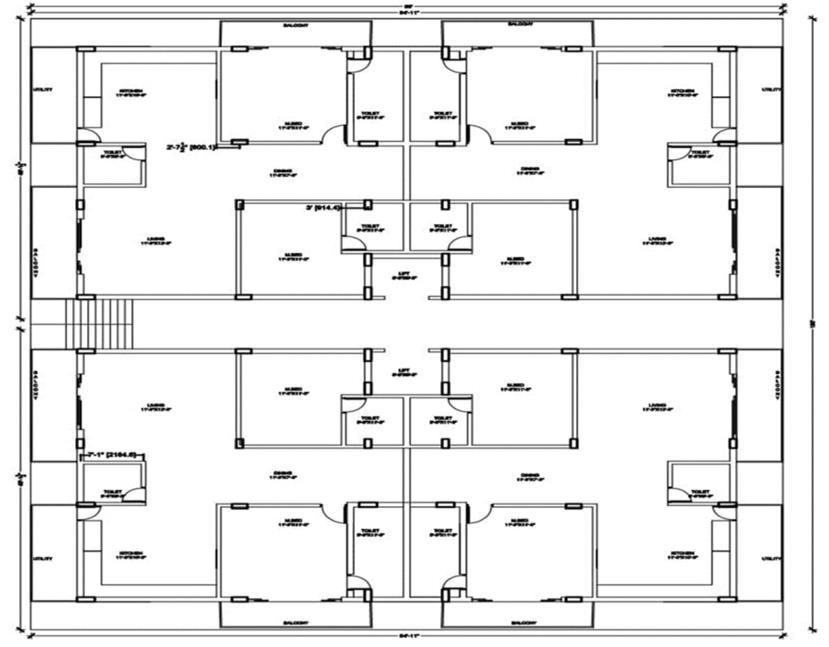
Fig -1: Planeofbuilding
International Research Journal of Engineering and Technology (IRJET) e-ISSN: 2395-0056
Volume: 12 Issue: 10 | Oct 2025 www.irjet.net p-ISSN: 2395-0072
6. RESULTS
TheG+12residentialbuilding'sstructuralanalysisatteststo the design's stability, serviceability, and safety under all specifiedloadcombinations.Accordingtotheanalysis,which is usually carried out with software such as ETABS or STAAD.Pro,allRCmembers beams,columns,andslabs havebeensuitablysizedandstrengthenedtowithstandthe highestpossibleshearforcesandbendingmoments.
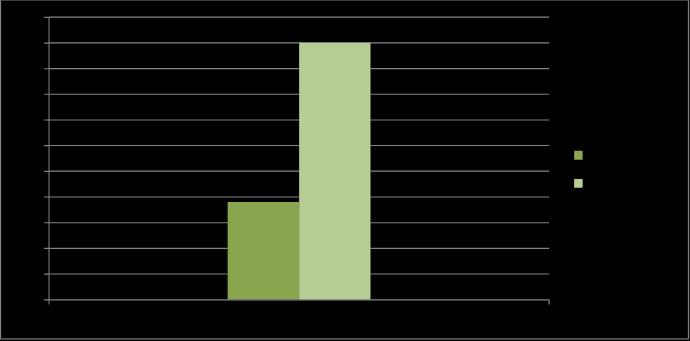
Table -2: Comparisonofsoftwareresultswithmanual calculations
Thisstudysuccessfullyconcludesthestructuraldesignand analysisoftheG+12residentialbuilding,confirmingthatall initialprojectobjectivesweremetandtheresultingdesignis bothsafeandstructurallysound.TheutilizationofETABS proved to be an indispensable and highly efficient methodology, allowing for the precise and rapid computation of all internal forces, moments, and displacements under critical gravity and lateral load conditions. The final detailing and optimization of all structuralmembers includingbeams,columns,andslabs strictly comply with the safety and serviceability requirements mandated by IS 456:2000, validating the design's integrity. Ultimately, this research delivers an engineeredsolutionthatisnotonlyrobustandsafeagainst environmentalforcesbutalsohighlyeconomical,confirming the essential role of advanced computational tools in the designandstreamliningofmodern,code-compliant,mid-rise constructionprojects.
International Research Journal of Engineering and Technology (IRJET) e-ISSN: 2395-0056
Volume: 12 Issue: 10 | Oct 2025 www.irjet.net p-ISSN: 2395-0072
IwanttoexpressmygratitudetoMs.ShradhaHiremath,an assistant professor in the S.G. Balekundri Institute of Technology's Department of Civil Engineering, for her unwaveringsupportanddirectionduringthisprojectreport. Additionally, I appreciate the helpful advice and support provided by Dr. Santosh Chikkabagewadi, Head of Department,andMr.ParasharamSawant,PGCoordinator. Mysinceregratitudetotheprincipal,Dr.B.R.Patagundi,for his unwavering encouragement. I also want to thank my parents, teachers, and friends for their encouragement throughoutthisproject.
IS456:2000,IndianStandardCodeforpracticeofplain and reinforced concrete (Fourth revision), Bureau of Indianstandards,NewDelhi,July2000.
IS 875(Part 2), Indian Standard Code for practice for designloads(otherthanearthquake)forbuildingsand structures,Imposedload(Secondrevision),Bureauof Indianstandards,NewDelhi,1989.