
International Research Journal of Engineering and Technology (IRJET) e-ISSN:2395-0056 p-ISSN:2395-0072

Volume:13Issue:02|Feb2026 www.irjet.net
International Research Journal of Engineering and Technology (IRJET) e-ISSN:2395-0056 p-ISSN:2395-0072
Volume:13Issue:02|Feb2026 www.irjet.net
Kalpesh Bharambe

E&TCHardwareEngineer,AE(Electronics&AutomotiveSystems),MaharashtraIndia
Abstract - Roadway air pollution remains a critical environmental and public health challenge due to the high concentration of particulate matter and gaseous pollutants in near-road environments. Conventional mitigation strategies largely focus on emission control at the source or large-scale infrastructure-based solutions, for dynamically polluted traffic corridors. This paper proposes an Integrated On-Vehicle EFiltration System for Roadway Air Quality Enhancement. The proposed system utilizes vehicle-induced airflow through an aerodynamic intake duct positioned in the frontal stagnation zone, enabling passive air capture without additional propulsion energy. Particulate matter (PM₂.₅ and PM₁₀) is removed using a electrostatic filtration module, where electrically charged plates capture suspended particles with low pressure drop. The filtered air is subsequently routed through a photocatalytic neutralization chamber activated by UV-LEDs, facilitating the breakdown of selected gaseous pollutants into less harmful compounds. An ACU is integrated with vehicle electronics, regulates system operation based on real-time air quality, vehicle speed, and power availability. Purified air is discharged through an angled outlet located near the upper region of the front wheel arch, strategically designed to prevent re-entrainment with tire-generated dust. The system is modular, scalable for four-wheelers, and compatible with existing automotive architectures. The system demonstrates the feasibility of a vehicle-integrated, motionassistedapproachforroadwayair qualityenhancement.
Key Words: On-Vehicle Air Pollution Control, Roadway Air Quality Enhancement, Electrostatic Particle Filtration, Photocatalytic Air Neutralization, PM₂.₅ and PM₁₀ Mitigation, Adaptive Control Unit (ACU), VehicleInduced Airflow, Smart E-Filtration System, Near-Road Pollution Mitigation, Automotive Environmental Systems
Rapid urbanization and the continuous growth of vehicular traffic have significantly deteriorated air quality in roadway environments. Traffic corridors are characterized by elevated concentrations of particulate matter (PM₂. ₅ and PM₁₀) and gaseous pollutants, primarily due to vehicle exhaustemissions,tireandbrakewear,andresuspensionof roaddust.
Prolongedexposuretosuchpollutantsposesseriousrisksto public health, particularly for pedestrians, cyclists, roadside residents, and traffic personnel Despite advancements in

emission regulations and cleaner propulsion technologies, near-road air pollution remains a persistent challenge in denselypopulatedurbanregions.
Conventionalairpollutionmitigationstrategieslargelyfocus on controlling emissions at the source or deploying stationary air purification infrastructure. While emission control technologieshaveachievednotablesuccess,theydo not address pollutants generated from non-exhaust sources or the accumulation of contaminants in dynamic traffic environments. Similarly, fixed roadside air purification systems are limited by high installation costs, space constraints, and restricted spatial coverage. These limitations highlight the need for innovative, mobile, and decentralized approaches capable of interacting directly withpollutedroadwayair.
Inrecentyears,growingattentionhasbeendirectedtoward non-exhaustemissionsourcessuchastirewear,brakewear, and resuspended road dust, which contribute substantially toparticulatematterconcentrationsinurbantrafficsettings. These sources are largely unaffected by powertrain electrification and tightening emission norms, indicating that improvements in propulsion technology alone are insufficient to achieve meaningful reductions in near-road particulate pollution. Furthermore, pollutant accumulation in the immediate vicinity of moving vehicles creates highly localizedexposurezones thatare not adequatelyaddressed bycity-scalemonitoringorcentralizedmitigationstrategies. This context underscores the necessity for localized, adaptive,andmobility-awarepollutioncontrolsolutions.
Recent research has explored advanced air filtration and photocatalytic techniques for pollutant removal in roadside environment applications. However, the integration of such technologies into moving vehicles for active treatment of roadwayairremainslargelyunexplored.Vehiclesinherently interactwithlargevolumesofairduringmotion,presenting an untapped opportunity to utilize vehicle-induced airflow for environmental mitigation without substantial additional energy consumption. Motivated by this gap, this system proposes an Integrated On-Vehicle E-Filtration System for RoadwayAirQualityEnhancement.
The primary objective of this work is to design and assess the feasibility of a vehicle-mounted system that combines electrostatic particle filtration, UV-assisted photocatalytic neutralization,andadaptiveelectroniccontroltotreatnearroad ambient air during normal vehicle operation. The proposed approach aims to complement existing emission

International Research Journal of Engineering and Technology (IRJET) e-ISSN:2395-0056 p-ISSN:2395-0072
Volume:13Issue:02|Feb2026 www.irjet.net
reduction strategies by introducing a practical, scalable, and motion-assisted solution for localized air quality improvementintrafficenvironments.
Roadway air pollution remains a critical concern in urban transportationenvironmentsduetothehighconcentration of particulate matter and gaseous pollutants in the immediate vicinity of moving vehicles. While regulatory efforts and advances in vehicle emission control technologieshave significantlyreducedtailpipe emissions, they do not address pollutants generated from nonexhaust sources such as tire wear, brake wear, and resuspended road dust. These non-exhaust emissions contribute substantially to PM₂.₅ and PM₁₀ levels along traffic corridors and continue to impact near-road air qualityregardlessofvehicleelectrificationorfueltype.
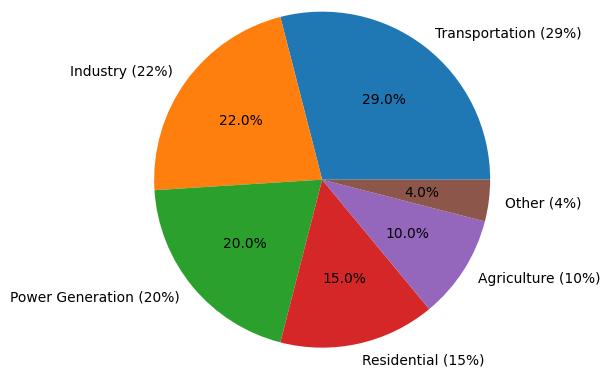
FIG-1.: Sourcesofairpollution:2025(EstimatedValues)
Existing mitigation strategies predominantly rely on stationary air purification systems or large-scale urban infrastructure, which are limited by high implementation costs, space constraints, and restricted spatial effectiveness. Such approaches are inherently unable to adapt to the dynamic nature of traffic-induced pollution, where pollutant concentration varies with vehicle density, speed, and road conditions. Consequently, localized exposure zones persist around vehicles and along roadways,particularlyincongestedurbanareas
Furthermore, current vehicle-based technologies focus primarily on protecting the cabin air quality or reducing emissions at the source, offering little to no capability for treating ambient roadway air. The potential of utilizing vehicle-induced airflow for active air purification during normal driving operation remains largely unexploited. There is a lack of practical, vehicle-integrated systems capableofcapturing,treating,andredistributingnear-road air without imposing significant aerodynamic penalties or energyconsumption
Therefore, the core problem addressed in this study is the absenceofafeasible,mobile,anddecentralizedsolutionthat can actively mitigate near-road air pollution by leveraging existing vehicle motion and onboard electronic control. Addressing this gap is essential for developing complementarystrategiesthatenhance roadwayair quality beyondconventionalemissioncontrolmeasures.
Air pollution in transportation corridors has been extensively studied due to its strong correlation with adverse health outcomes and environmental degradation. Numerous studies have established that near-road environments exhibit significantly higher concentrations of particulate matter (PM₂.₅ and PM₁₀) compared to urban background levels, primarily due to vehicular activity. Traditional mitigation efforts have therefore focused on reducing emissions at the source through stricter emission norms, advanced combustion control, and the adoption of alternative propulsion technologies such as electric and hybridvehicles.
Vehicle emission control technologies, including catalytic converters, diesel particulate filters, and exhaust gas recirculation systems, have proven effective in lowering tailpipeemissions.However,recentresearchhighlights that non-exhaust sources such as tire wear, brake wear, and resuspended road dust now represent a dominant contribution to particulate pollution in urban traffic environments. These emissions persist irrespective of fuel typeorpowertraintechnologyandareexpectedtoincrease with vehicle mass and traffic density, thereby limiting the effectivenessofemission-onlymitigationstrategies.
To address ambient air pollution, several stationary and semi-stationary air purification approaches have been proposed, including roadside filtration units, photocatalytic surfaces, and urban-scale air-cleaning installations. While such systems demonstrate pollutant reduction under controlled conditions, their practical deployment is constrained by high infrastructure costs, limited coverage, maintenance challenges, and reduced adaptability to changing traffic patterns. As a result, their impact on localizedroadwayairqualityremainslimited.
Electrostatic particle filtration and photocatalytic oxidation techniques have been widely investigated for indoor air purification and industrial emission treatment due to their ability to remove fine particulates and degrade gaseous pollutants. Recent studies have explored compact electrostatic filters and UV-assisted photocatalytic systems withlowpressuredropandmoderateenergyrequirements. However, the application of these technologies in moving vehicleshaslargelybeenrestrictedtocabinairpurification, withminimalfocusontreatingexternalambientair.
International Research Journal of Engineering and Technology (IRJET) e-ISSN:2395-0056 p-ISSN:2395-0072
Volume:13Issue:02|Feb2026 www.irjet.net
Alimitednumberofconceptualstudieshavesuggestedthe use of mobile platforms for environmental monitoring or pollution sensing; however, the integration of active air treatment mechanisms into vehicles for near-road pollutionmitigationremainsinsufficientlyexplored.
Inparticular,thecombined useofvehicle-inducedairflow, electrostatic filtration, photocatalytic neutralization, and adaptive electronic control within a single on-vehicle system has not been comprehensively addressed in existingliterature.
it is evident that there is a lack of vehicle-integrated, motion-assistedsystemsdesignedtoactivelytreatambient roadway air. Existing solutions either focus on emission reduction, cabin air quality, or stationary purification, leavingagapforadecentralized,adaptive,andfeasibleonvehicleroadsideairfiltrationandneutralizationapproach. This gap motivates the development of the proposed IntegratedOn-VehicleE-FiltrationSystem.
ThissectiondescribestheproposedIntegratedOn-Vehicle E-Filtration System, including its overall architecture, operating principle, electronic control strategy, and technical feasibility considerations. The methodology focuses on the integration of mechanical air-handling components with electronic control to enable active treatment of near-road ambient air during normal vehicle operation.
The proposed system is designed as a modular unit integrated into the vehicle body structure. It utilizes vehicle-induced airflow generated during motion to captureambientroadwayairwithouttheuseofadditional blowers. An aerodynamic intake duct is positioned in the frontalstagnationzoneofthevehicle,whereairpressureis naturally elevated, enabling passive air ingestion with minimalaerodynamicpenalty.
Captured air first passes through an electrostatic particle filtration module, where suspended particulate matter (PM₂.₅ and PM₁₀) is removed using electrically charged collection plates. The electrostatic filtration approach is selectedduetoitshighparticlecapture efficiencyandlow pressuredropcomparedtoconventionalmechanicalfilters Collectedparticulatesaredirectedtowardadedicateddust collectionchamberdesignedforperiodicmaintenance.
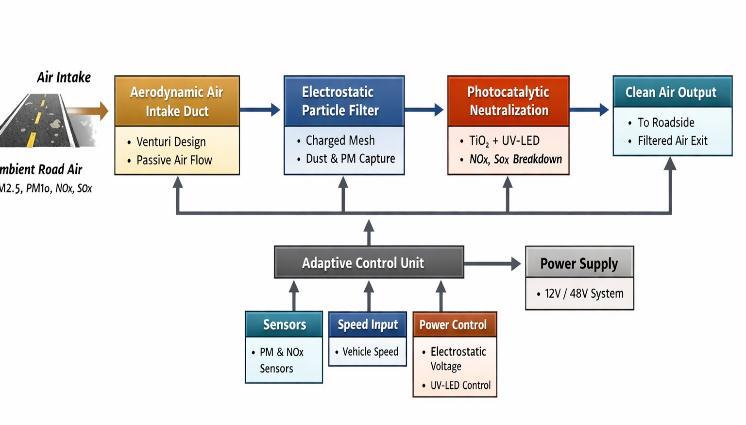
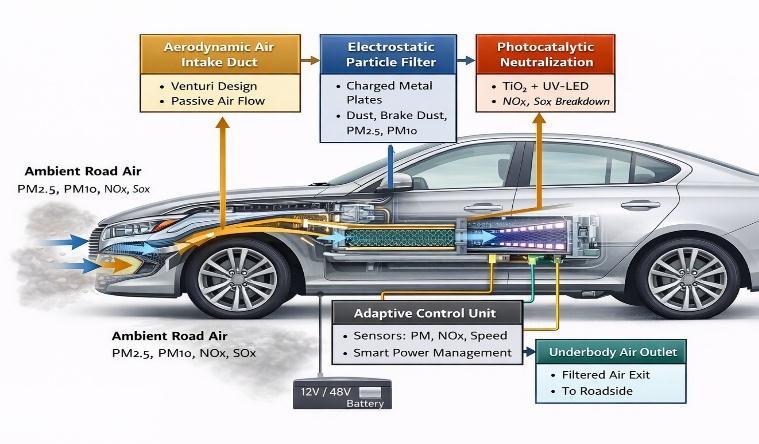
Following particulate removal, the air flows into a UVassistedphotocatalyticneutralizationchamber.Inthisstage, ultravioletlightactivatesaphotocatalystsurface,facilitating the degradation of selected gaseous pollutants into less harmful compounds. The treated air is then routed toward an angled discharge outlet located near the upper region of the front wheel arch, close to the headlamp assembly. This outlet orientation is deliberately designed to promote outward dispersion while preventing re-entrainment with tire-generateddust
4.2
AnAdaptiveControlUnit(ACU)governstheoperationofthe proposed system. The ACU interfaces with onboard vehicle networks using standard automotive communication protocols such as CAN or LIN. Input signals include vehicle speed, ambient air quality indicators, system voltage, and filter status. Based on these inputs, the ACU dynamically regulates the activation of the electrostatic filter and UVLED array to balance purification effectiveness and power consumption.
International Research Journal of Engineering and Technology (IRJET) e-ISSN:2395-0056 p-ISSN:2395-0072
Volume:13Issue:02|Feb2026 www.irjet.net
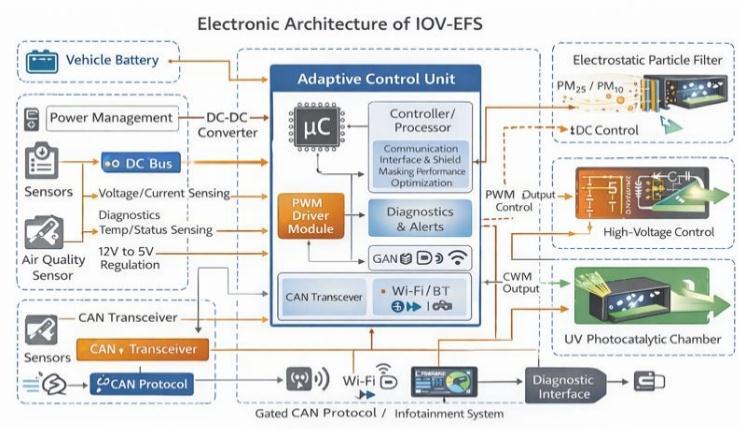
Thecontrolstrategyenablesconditionalsystemoperation, ensuring that the E-filtration system is active primarily during suitable driving conditions, such as moderate vehicle speeds where airflow is sufficient for effective treatment. This adaptive approach enhances system efficiencywhileminimizingelectricalloadonthevehicle.
The proposed system is powered by the vehicle’s existing electrical supply, operating from either a 12 V or 48 V battery depending on the vehicle platform. A dedicated Power Management Unit (PMU) conditions the input voltage and provides regulated power levels required by the control electronics, sensors, and actuator driver circuits. The PMU incorporates DC–DC conversion, overcurrent protection, and thermal safeguards to ensure reliable and safe operation under automotive environmental conditions. This approach eliminates the need for external power sources and supports scalable deploymentacrossdifferentvehiclecategories.
A distributed sensor module is employed to monitor both environmental and system-level parameters. The sensing unit includes particulate matter sensors for PM₂.₅ and PM₁₀concentrationmeasurement,temperaturesensorsfor thermal monitoring, and electrical sensors for voltage and currentdiagnostics.Inaddition,vehiclespeedandignition status are acquired via the vehicle communication network. These inputs provide real-time feedback to the control unit, enabling adaptive system behavior based on drivingconditionsandpollutionlevels.
To enable coordinated operation with existing vehicle systems, the IOV-EFS incorporates a Controller Area Network(CAN)interface,withoptionalLocalInterconnect Network (LIN) support for low-speed communication. Through this interface, the system receives essential vehicleparameterssuchasspeed,batterystate,and
operationalstatus,whilealsotransmittingofdiagnosticand healthinformation.Thiscommunicationframeworkensures compatibility with modern automotive electronic control architectures.
The Adaptive Control Unit (ACU) serves as the central processinganddecision-makingcomponentoftheproposed system. It is implemented using an automotive-grade microcontroller capable of real-time signal processing and communication handling. The ACU continuously processes sensor data and vehicle parameters to determine appropriate operating modes for the filtration system. Control algorithms embedded within the ACU dynamically adjust actuation intensity to balance filtration effectiveness and energy consumption. Fault detection and diagnostic routinesarealsointegratedtoensuresystemreliabilityand safety.
A dedicated Pulse Width Modulation (PWM) driver module interfacesbetweentheACUandthefiltrationactuators.The PWMsignalsregulatethevoltageappliedtotheelectrostatic particle filter and control the intensity of the UV-LEDs within the photocatalytic chamber. This approach allows fine-grained control over filtration performance while minimizing power usage, particularly under varying vehicle speedsandpollutionlevels.
The electrostatic particle filtration module removes suspended particulate matter such as PM₂.₅, PM₁₀, brake dust, and road dust through charged collection plates. Captured particles are directed into a dedicated dust collection chamber for periodic maintenance. Downstream of the particulate filter, a UV-assisted photocatalytic chamber employs ultraviolet LEDs and a titanium dioxidecoated surface to facilitate the neutralization of selected gaseous pollutants, including nitrogen oxides and volatile organic compounds. Positioning the photocatalytic stage after particulate removal reduces catalyst fouling and improvesoperationallongevity.
System diagnostics and operational status are communicated to the vehicle infotainment system or an external service interface through the CAN network. This enables condition monitoring, maintenance alerts, and fault reporting without requiring additional standalone displays. Such integration supports ease of use and aligns with existingautomotiveservicepractices.
International Research Journal of Engineering and Technology (IRJET) e-ISSN:2395-0056 p-ISSN:2395-0072
Volume:13Issue:02|Feb2026 www.irjet.net
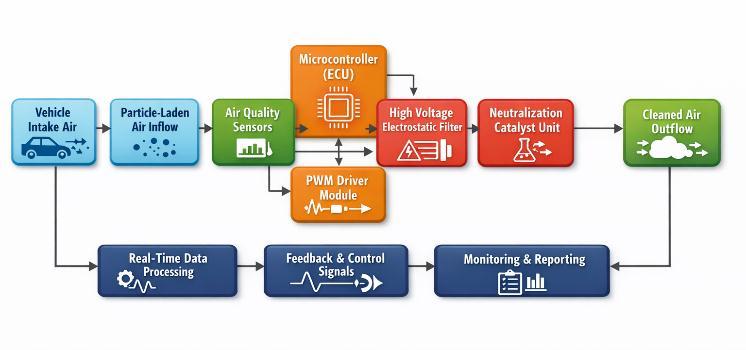
FIG-3.B: SignalflowofIOV-EFS
The signal flow starts from environmental sensing which include Particulate matter & Gaseous pollutants (PM₂.₅,PM₁₀,NOₓ,CO,VOCs) passes through conditioning and digital processing in the controller. Parallel to sensor inputs,vehicledataarrivesdigitally.ACUComparesvalues with thresholds, after Microcontroller generates PWM signals uses vehicle CAN data for context-aware decisions, and ends with PWM-controlled actuation. PWM duty cycle represents Filtration intensity and UV intensity level of electrostatic and photocatalytic modules in a closed-loop architecture.
In Electrostatic Particle Filter High voltage creates electrostaticfieldafterChargedparticlesareattractedand trapped next UV-LEDs activate TiO₂ coating and Chemical neutralization of gaseous pollutants occurs The ACU generates a PWM-based control waveform to regulate UV LED intensity inside the photocatalytic neutralization chamber, enabling adaptive pollutant treatment with optimized power consumption Feedback Signals confirms operation and Diagnostic Signals continuously selfcorrects.attheenddatadisplayedonvehicleinfotainment.
The key contributions of the proposed methodology are summarizedasfollows:
a. Utilizationofvehicle-inducedairflowforambient air treatmentwithoutauxiliarypropulsiondevices
b. Integration of electrostatic filtration and photocatalytic neutralization in a moving vehicle platform
c. Angleddischargestrategytopreventinteractionwith tire-generatedparticulatematter
d. Adaptive electronic control enabling intelligent, condition-basedoperation
The proposed system is designed to operate within the constraints of existing automotive electrical and mechanical architectures. The electrostatic filter and UVLEDmodulesrequirerelativelylowpower,makingthe
system suitable for conventional internal combustion, hybrid,andelectricvehicles.Maintenancerequirements are addressed through a removable dust collection unit and durable photocatalytic surfaces with extended service life. Overall, the methodology emphasizes practical implementation, scalability, and minimal impact on vehicle performance.
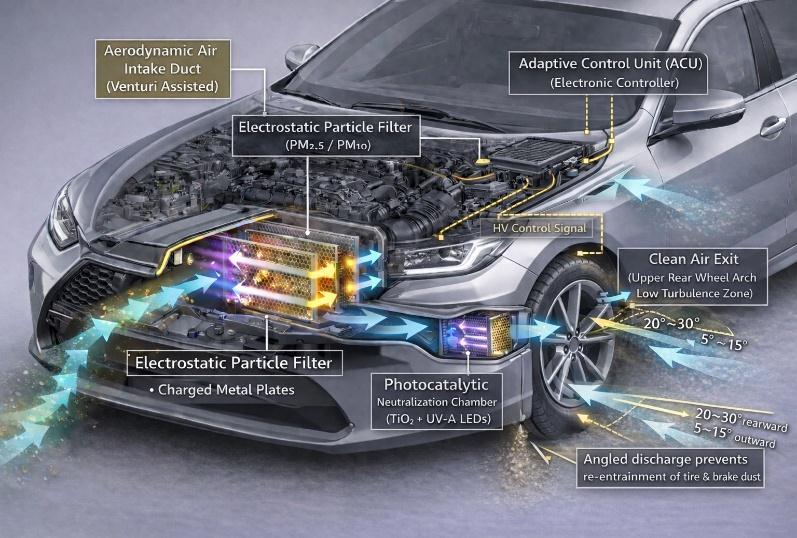
FIG-4.A: ImplementationofIOV-EFS
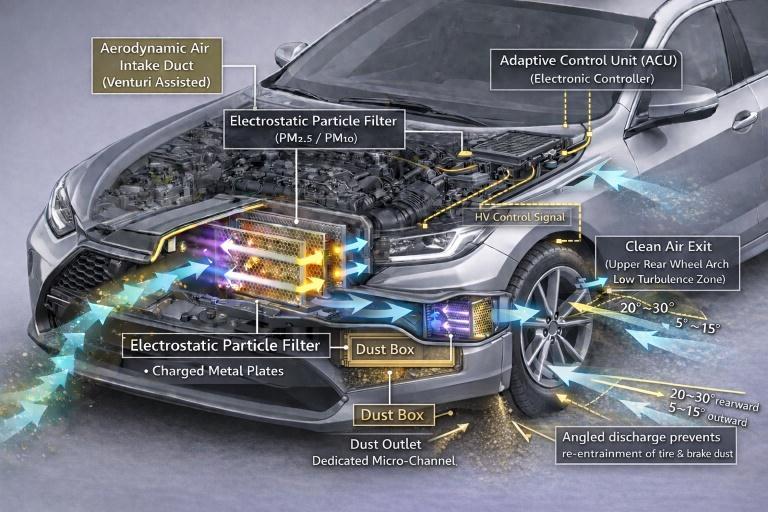
FIG-4.B: ImplementationofIOV-EFS
This section presents a conceptual performance evaluation and feasibility-based discussion of the proposed Integrated On-Vehicle E-Filtration System. Since the study focuses on system design and technical feasibility, the results are derived from analytical reasoning, component-level characteristics reported in existing literature, and operationalconstraintsofautomotiveplatforms.
Electrostatic particle filtration has been widely reported to achieve high capture efficiency for fine particulate matter, particularly in the PM₂.₅ and PM₁₀ size ranges, while maintainingalowpressuredrop.Intheproposedsystem,
International Research Journal of Engineering and Technology (IRJET) e-ISSN:2395-0056 p-ISSN:2395-0072
Volume:13Issue:02|Feb2026 www.irjet.net
the electrostatic filtration module is positioned immediately downstream of the aerodynamic intake duct, enabling effective interception of suspended particles presentinnearroadair.
Based on the reported performance of compact electrostaticfilters,theproposedconfigurationisexpected to provide meaningful reduction of particulate concentrations within the treated airflow volume. While absolute removal efficiency depends on factors such as particle charge density, airflow velocity, and plate geometry, the use of vehicle-induced airflow allows continuous interaction with ambient roadway air during normaldrivingoperation.
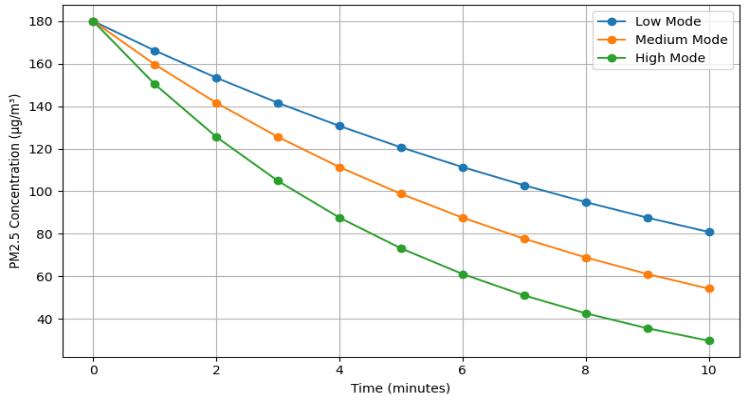
FIG-5.A: PredictedPM2.5ReductionvsTime(IOV-EFS)
ACU implement with 3 operating modes based on sensor readings + vehicle speed. Modes come from control thresholds value. The system is evaluated under three PWM duty cycle settings representing low, medium and highactuationintensities
The UV-assisted photocatalytic chamber is intended to complement particulate filtration by targeting selected gaseous pollutants commonly found in traffic environments.Photocatalytic oxidationhasbeenshown to degrade compounds such as nitrogen oxides and volatile organic compounds under ultraviolet activation. In the proposed methodology, the photocatalytic stage is positioned after particulate removal to prevent catalyst surface fouling, thereby enhancing operational effectiveness.
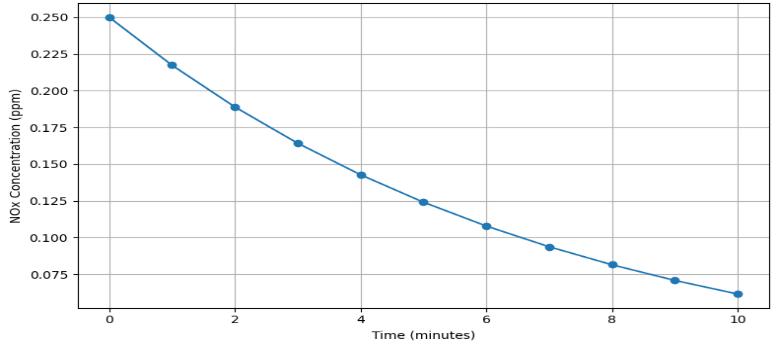
FIG-5.B: NOxReductionvsTimegraph
Although the system is not designed for complete gas removalitscontributiontolocalizedpollutantneutralization supports incremental roadway air quality enhancement. These results are obtained through analytical modeling based on exponential decay approximation and assumed airflow/filtration parameters derived from typical automotivefiltrationperformance.
InitialNOx=0.25ppm(typicalroadsidelevel) NOxreducesfrom0.25ppmto0.062ppmafter10min. Approx.Reduction:(0.25–0.062/0.25)*100=75.2%
The analytical model predicts approximately 75% NOx reduction within 10 minutes of continuous photocatalytic operation
Theangleddischargeoutletlocatedneartheupperregionof the front wheel arch plays a critical role in system effectiveness. By orienting the outlet away from the tire road interaction zone, the design minimizes the risk of reentrainmentoftire-generateddustintothepurifiedairflow. This discharge configuration promotes outward dispersion of treated air into the surrounding roadway environment while maintaining compatibility with vehicle body packaging constraints. The placement near the headlamp fenderregionorneartheOVRMregionasmentionedinthe fig4.Bassistsindirectingairflowawayfromturbulentwake zonestomechanicalgrillprovision.
From an electrical perspective, the electrostatic filtration module and UV-LED array are characterized by relatively low power demand, making the system compatible with existing automotive electrical architectures. Adaptive operationthroughtheACUensuresthatsystemactivationis aligned with favorable driving conditions, thereby reducing unnecessaryenergyconsumption.Integrationwithstandard vehicle communication protocols enables scalable deployment across different vehicle categories without significantmodificationtoonboardsystems.
Compared to stationary roadside air purification systems, the proposed on-vehicle approach offers improved spatial coverageanddynamicinteractionwithpollutedairintraffic
International Research Journal of Engineering and Technology (IRJET) e-ISSN:2395-0056 p-ISSN:2395-0072
Volume:13Issue:02|Feb2026 www.irjet.net
corridors. Unlike cabin air purification systems, the proposed design directly targets ambient roadway air, addressing an often-overlooked pollution domain. While thesystemdoesnotreplaceemissioncontroltechnologies, itprovidesacomplementary,decentralizedmechanismfor localized air quality enhancement. The results of this analysis suggest that vehicle-integrated air treatment systems can play a supporting role in broader urban air pollutionmitigationstrategies.
TheproposedIntegratedOn-VehicleE-FiltrationSystemis subjecttoseverallimitationsandassumptionsthatshould beconsideredwheninterpretingtheresultsofthisstudy. thesystemisintendedtoprovidelocalizedenhancementof roadway air quality rather than large-scale or city-wide pollution reduction. Its effectiveness is inherently dependent on traffic density, vehicle speed, and ambient pollutant concentration, which vary across different driving environments. Excessive intake airflow does not inherently damage the system, but it reduces pollutant residence time and may increase particulate loading and blowerpowerdemand;therefore,adaptiveflowregulation isrequiredforsafeandefficientoperation
The methodology assumes the availability of sufficient vehicle-inducedairflowforpassiveaircapture.Atverylow vehicle speeds or during stationary conditions, airflow through the system may be reduced, limiting filtration performance. Additionally, the electrostatic filtration efficiency is influenced by particle size distribution, humidity, and electrode condition, while photocatalytic performance dependsonUVintensityand catalystsurface cleanliness.
Maintenance-related limitations include the requirement for periodic removal of accumulated particulate matter from the dust collection chamber and long-term degradation of photocatalytic surfaces. The study assumes regularmaintenanceinlinewithvehicleserviceschedules. Furthermore, the proposed system does not address all classesofgaseouspollutantsandisnotdesignedtoreplace conventionalemissioncontroltechnologies.
As such, quantitative performance metrics are indicative rather than definitive and should be once validated through future experimental on real time vehicle with dynamicdifferentcondition&scenarios.
ThispaperpresentedanIntegratedOn-VehicleE-Filtration System designed to enhance roadway air quality through active treatment of ambient near-road air during vehicle operation. By leveraging vehicle-induced airflow, electrostatic particle filtration, UV-assisted photocatalytic neutralization, and adaptive electronic control, the proposed system introduces a novel, decentralized
approach to complement existing air pollution mitigation strategies. analysis demonstrates that integrating air treatment mechanisms into moving vehicles is technically achievable within current automotive mechanical and electrical constraints. The modular and scalable design enables applicability for four-wheelers without significant impactonvehicleaerodynamicsorenergyconsumption.the proposedsystemhasthepotentialtocontributetolocalized airqualityenhancementinhigh-trafficcorridors,
particularly in dense urban environments where nonexhaust emissions remain a dominant concern. While further experimental validation is required on different no of vehicles as mentioned in limitation. this system establishesafoundationalframeworkforfutureresearchon vehicle-integrated for air pollution mitigation factors and supports the development of smart, mobility-assisted solutionsforsustainabletransportationecosystems.
8.References
[1] X.-S. Luo et al., “Source differences in PM₂.₅ components and cytotoxicity from automobile exhaust, coal combustion, and biomass burning,” Atmos. Chem. Phys., vol. 24, pp. 1345–1360,2024,doi:10.5194/acp-24-1345-2024.
[2] “Biomass-burning sources control PM, while traffic and industry control VOC emissions during extreme pollution eventsinDelhi,”Atmos.Chem.Phys.,2024.
[3] “Source apportionment of PM₂.₅ in Delhi, India using PMFmodel,”PMID:27209541,2014.
[4] “Elemental composition and sources of fine particulate matter(PM₂.₅)inDelhi,India,”PubMedCentral,2025.
[5] H.Ma,Y.Li,C. Wang,Y.Li and X.Zhang, “TiO₂-based photocatalysts for removal of low-concentration NOx,” Catalysts,vol.15,no.2,Art.no.103,2025,doi:10.3390/catal150 20103.
[6] Photo-catalytic and thermal-assisted air purification of VOC and NOx simultaneously by pilot-scale photo-reactor,” Appl.Catal.A: Gen., 2024, doi: 10.1016/j.apcato.2024.206945.
[7] S. Held, C. Hjortenkrans, and J. Schott, “Study on the effect of vehicular pollution on ambient concentrations of particulate matter and carbon dioxide in Srinagar City,” PMC,2025.
[8] S. D. Tomlinson et al., “Modelling laminar flow in Vshaped filters integrated with catalyst technologies for atmosphericpollutantremoval,”arXiv,May2025.
[9] Freudenberg Filtration Technologies, “eMobility –Innovative air treatment solutions for vehicles,” Freudenberg-filter.com.
International Research Journal of Engineering and Technology (IRJET) e-ISSN:2395-0056 p-ISSN:2395-0072
Volume:13Issue:02|Feb2026 www.irjet.net
[10] DRIIV, “Shudhvayu vehicle-mounted filters – making movingvehicleeco-friendly,”driiv.co.in.
[11] Clean Air Research Initiative (CARI), Department of Science&Technology(DST),dst.gov.in
[12] The effects of filter coating approaches on photocatalytic abatement of formaldehyde in indoor environmentusingaTiO2-basedairpurifiersystem:Sherif yonis,HyejinShin.