
International Research Journal of Engineering and Technology (IRJET) e-ISSN:2395-0056
Volume:13Issue:03|Mar2026 www.irjet.net p-ISSN:2395-0072

International Research Journal of Engineering and Technology (IRJET) e-ISSN:2395-0056
Volume:13Issue:03|Mar2026 www.irjet.net p-ISSN:2395-0072
Mr B.Narsingham1 , D.Karthik2 , J.karthik3 , K.Ashwitha4
1 Assistant Professor, Department of Computer Science and Engineering 2,3,4 B.Tech Students, Department of Computer Science and Engineering Teegala Krishna Reddy Engineering College , Telangana, India
Abstract - Digital forensic evidence management requires high levels of security, integrity, and reliability due to the sensitivenature oflegaldata. Traditionalsystemssuffer from weak encryption mechanisms, centralized storage, and vulnerabilitytodatatampering.Thispaperproposesasecure digital forensic architecture integrating blockchain technology with advanced encryption techniques, namely AuthenticationwithOptimalKeyGenerationEncryption(DFAAOKGE). The system employs Multikey Homomorphic Encryption to ensure confidentiality while enabling secure data processing. A Secure Block Verification Mechanism is used to maintain data integrity across distributed nodes. The architecture supports multiple stakeholders, including users, administrators, and judicial authorities, enabling controlled access and secure evidence sharing. Experimental analysis demonstrates improved security, scalability, and efficiency compared to existing approaches. The proposed system providesarobustandtrustworthysolutionformoderndigital forensic investigations.
Key Words: Digital Forensics, Blockchain, Data Security, Encryption, Multikey Homomorphic Encryption, DFA-AOKGE, Cloud Forensics, Evidence Management,DataIntegrity,Cybersecurity.
Inrecentyears,therapidgrowthofdigitaltechnologiesand cybercrime has significantly increased the importance of secure digital forensic evidence management. Digital evidenceplaysacriticalroleincriminalinvestigations,legal proceedings, and cybersecurity analysis. However, maintainingtheconfidentiality,integrity,andavailabilityof such sensitive data remains a major challenge due to evolvingcyberthreatsandsystemvulnerabilities[9],[10].
Traditionalforensicsystemsrelyoncentralizedstorageand outdated encryption techniques such as Data Encryption Standard(DES),whicharehighlyvulnerabletobrute-force attacksandunauthorizedaccess[5].Theselimitationsraise serious concerns regarding data tampering, evidence authenticity, and trustworthiness in legal scenarios. Furthermore,centralizedarchitecturesincreasetheriskof singlepointsoffailure,makingsystemsmoresusceptibleto cyberattacksanddatabreaches[7].
Blockchaintechnologyhasemergedasapromisingsolution forensuringsecureandtamper-proofdatamanagement.Its decentralized and immutable nature enables transparent andverifiablerecord-keeping,makingithighlysuitablefor digitalforensicapplications[1],[2].Blockchainensuresthat once data is recorded, it cannot be altered without consensus, thereby preserving the integrity of digital evidence[3].
In addition to blockchain, advanced cryptographic techniques such as homomorphic encryption provide enhancedsecuritybyallowingcomputationsonencrypted data without exposing the original content [4]. This is particularlyusefulinforensicinvestigationswheresensitive data must be processed securely. Modern cryptographic frameworks further strengthen data protection by incorporating secure key generation and distribution mechanisms[8].
Cloudcomputinghasalsobecomeanintegralpartofdigital forensicsystemsduetoitsscalability,flexibility,andstorage capabilities.However,itintroducesnewsecuritychallenges, includingdataprivacyrisksandunauthorizedaccess[14]. Therefore, integrating blockchain with secure encryption techniquesinacloudenvironmentcansignificantlyimprove thereliabilityandsecurityofforensicevidencemanagement systems.
Toaddressthesechallenges,thispaper proposesa secure digital forensic architecture that combines blockchain technologywithadvancedencryptionmechanismssuchas Authentication with Optimal Key Generation Encryption (DFA-AOKGE). The system ensures secure storage, controlled access, and reliable sharing of digital evidence among multiple stakeholders, including investigators, administrators, and judicial authorities. By leveraging decentralized storage, strong encryption, and secure verification mechanisms, the proposed system enhances datasecurity,integrity,andoperationalefficiencyinmodern digitalforensicinvestigations.
TThe proposed system introduces a secure and efficient digital forensic evidence management framework by integratingblockchaintechnologywithadvancedencryption mechanisms. The system is designed to overcome the
International Research Journal of Engineering and Technology (IRJET) e-ISSN:2395-0056
Volume:13Issue:03|Mar2026 www.irjet.net p-ISSN:2395-0072
limitations of traditional forensic systems such as weak encryption,centralizedstorage,andlackofdataintegrity.
The core of the proposed model is the Digital Forensic Architecture using Authentication with Optimal Key Generation Encryption (DFA-AOKGE). This architecture ensuressecurestorage,transmission,andaccessofforensic evidence in a distributed cloud environment. The system utilizesblockchaintechnologytomaintainanimmutableand tamper-proof record of all evidence transactions, thereby enhancing trust and transparency. To strengthen data confidentiality,thesystememploysMultikeyHomomorphic Encryption (MHE), which allows secure operations on encrypted data without exposing the original content. Additionally,anEnhancedEquilibriumOptimizer(EEO)is used for optimal key generation, ensuring stronger encryptionkeysandimprovedresistanceagainstattacks.A SecureBlockVerificationMechanism(SBVM)isintegratedto validate all transactions within the blockchain network, ensuringdataintegrityandauthenticity.
Theproposedsystemisdesignedwiththreemajormodules: User(ForensicInvestigator),Admin,andCourt.Eachmodule operates independently with role-based access control. Users can upload encrypted evidence, request access permissions, and share data securely with the court. The admin manages user authentication, monitors encryption processes,andcontrolsaccesspermissions.Thecourtcan requestevidencefilesanddecryptthemonlyafterreceiving authorizedkeysfromusers,ensuringcontrolledandsecure data sharing.The integration of blockchain with cloud forensicsprovidesdecentralizedstorage,reducingtherisks associated with single-point failures and unauthorized modifications. The system also supports secure communicationthroughemailnotificationsandkey-based decryption,ensuringthatonlyauthorizedentitiescanaccess sensitiveinformation.
Thesystemarchitectureillustratestheinteractionbetween different modules and the flow of encrypted forensic data acrosstheplatform.Itconsistsofusersuploadingencrypted evidence to the cloud, blockchain maintaining transaction records,andtheadmincontrollingauthenticationandkey distribution. The court interacts with the system by requesting access to evidence and decrypting it using authorizedkeys.
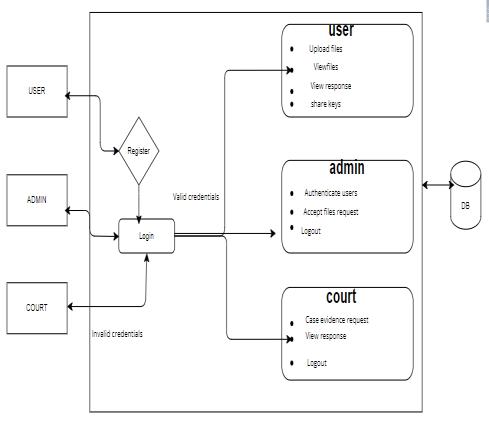
Fig1:SystemArchitectureofProposedDigital ForensicSystem
Enhanced Security: Uses DFA-AOKGE with Multikey Homomorphic Encryption for strong data protection. Decentralization: Blockchain-based distributed storage preventsdatatampering.
SecureAccessControl:Role-basedmodulesforUser,Admin, andCourt.
DataIntegrity:SecureBlockVerificationMechanismensures authenticityofevidence.
EfficientKeyManagement:Optimalkeygenerationimproves encryptionstrength.
Scalability:Cloudintegrationsupportslarge-scaleforensic datastorageandaccess.
The implementation of the proposed digital forensic evidence management system is carried out using a combination of web technologies, cloud storage, and advanced cryptographic techniques. The system is developedusingPythonandtheDjangoframework,ensuring ascalableandsecureweb-basedapplication.Thesystemis implemented with the following hardware and software requirements:
Component Specification
Processor Inteli3orhigher
RAM Minimum8GB
Storage 128GBHardDisk
OperatingSystem Windows10
ProgrammingLanguagePython
Framework Django
Frontend HTML,CSS,Bootstrap,JavaScript
Database MySQL
IDE
VisualStudioCode
International Research Journal of Engineering and Technology (IRJET) e-ISSN:2395-0056
Volume:13Issue:03|Mar2026 www.irjet.net p-ISSN:2395-0072
The system is divided into three primary modules: User, Admin,andCourt.Eachmoduleisimplementedwithspecific functionalitiestoensuresecureandcontrolledaccess.
UserModule(ForensicInvestigator)
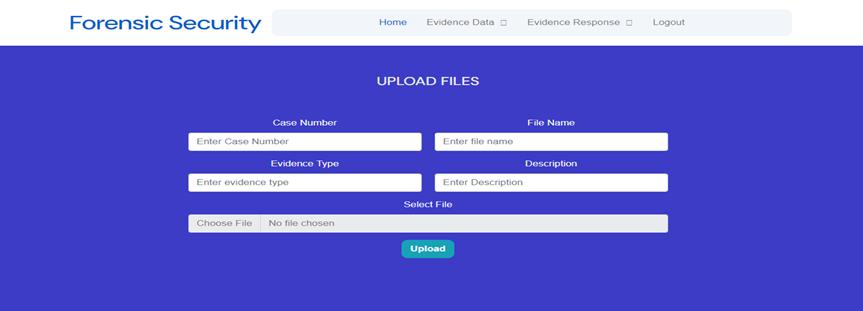
Theusermoduleallowsinvestigatorstoregisterandloginto thesystemafteradminapproval.Userscanuploadforensic evidence in encrypted format using secure encryption techniques.Theuploadeddataisstoredinthecloud,andits transactiondetailsarerecordedintheblockchain.Userscan requestpermissionfromtheadmintoshareevidencewith the court. Upon approval, users receive decryption keys, whichcanbesecurelysharedwithauthorizedentities.
AdminModule
The admin module acts as the central authority for monitoring and controlling system operations. Admins authenticateusers,manageuploadedevidence,andoversee encryption and key generation processes. The admin also handlesrequestsfordatasharingandprovidesdecryption keys to authorized users. This ensures that only verified userscanaccessorsharesensitiveforensicdata.
CourtModule
The court module enables judicial authorities to securely access forensic evidence. Courts can request specific case files from users through the system. Once the request is approved and the decryption key is shared, the court can decrypt and view the evidence. This module ensures that legalauthoritiescanaccessdatainasecureandcontrolled manner.
Theproposeddigitalforensicevidencemanagementsystem wasimplementedandtestedtoevaluateitsperformancein termsofsecurity,functionality,andefficiency.Thesystem integratesblockchaintechnologywithadvancedencryption techniques, ensuring secure handling of sensitive forensic data. The system successfully demonstrates all major functionalitiesthroughdifferentmodules.Theusermodule enablesregistration,login,andsecureuploadingofevidence datainencryptedform.Theuploadeddataisstoredsecurely andcanbeviewedordownloadedonlyinencryptedformat. Theadminmoduleefficientlymanagesuserauthentication, monitors evidence data, and controls access permissions. Thecourtmoduleallowsauthorizedlegalentitiestorequest andaccessevidencefilessecurely.
The system ensures high-level security using Multikey Homomorphic Encryption and optimal key generation techniques. All evidence data is encrypted before storage, preventing unauthorized access. Blockchain technology guarantees immutability, ensuring that once evidence is stored, it cannot be altered. The Secure Block Verification Mechanism validates all transactions, maintaining data integrity.
Additionally, role-based access control ensures that only authorized users, admins, and courts can access specific functionalities.Theuseofdecryptionkeysfurtherenhances security, as evidence can only be accessed after proper authorization.
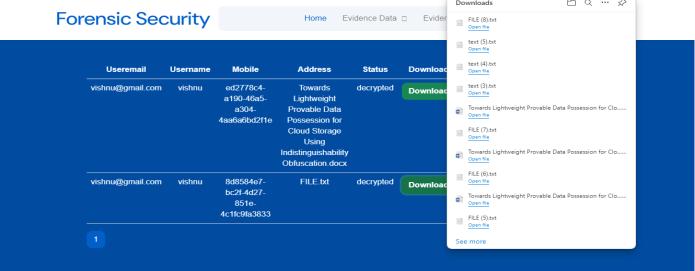
Thesystemdemonstratesefficientperformanceintermsof responsetimeanddatahandling.Encryptionanddecryption processesareexecutedwithminimaldelay,ensuringsmooth userinteraction.Theintegrationofcloudstorageimproves scalability,allowingthesystemtohandlelargevolumesof forensicdata.
ComparedtotraditionalsystemsusingDESencryption,the proposedsystemprovidessignificantlyimprovedsecurity and reliability. The decentralized nature of blockchain reducesrisksofdatalossandenhancessystemrobustness.
SecurityLevel Low High
DataIntegrity Limited Strong (Blockchainbased)
International Research Journal of Engineering and Technology (IRJET) e-ISSN:2395-0056
Volume:13Issue:03|Mar2026 www.irjet.net p-ISSN:2395-0072
Parameter Existing System (DES) Proposed System (DFA-AOKGE)
Storage Centralized Decentralized
Encryption Strength Weak Advanced (MHE + OptimalKey)
Scalability Limited High(Cloud-based)
Thispaperpresentedasecureandefficientdigitalforensic evidence management system by integrating blockchain technology with advanced encryption techniques. The proposedDFA-AOKGEarchitectureeffectivelyaddressesthe limitationsoftraditionalsystems,suchasweakencryption, centralizedstorage,andvulnerabilitytodatatampering.By utilizingMultikeyHomomorphicEncryptionandoptimalkey generation,thesystemensuresstrongdataconfidentiality andsecureprocessingofforensicevidence.
The incorporation of blockchain technology provides a decentralized and immutable environment, ensuring data integrity and transparency. The role-based modules for users, administrators, and judicial authorities enable controlled and secure access to sensitive information. Experimentalresultsdemonstratethattheproposedsystem significantly improves security, reliability, and scalability comparedtoexistingapproaches.Overall,thesystemoffers arobustsolutionformoderndigitalforensicinvestigations, ensuringtrustworthyevidencemanagementandsecuredata sharingincloud-basedenvironments.
Although the proposed system provides a secure and efficient framework for digital forensic evidence management, there are several areas for further enhancement. Future work can focus on improving scalability by integrating advanced distributed storage techniques such as InterPlanetary File System (IPFS) for fasterandmoreefficientdataretrieval.Thesystemcanalso be enhanced by incorporating Artificial Intelligence and MachineLearningalgorithmstoautomateevidenceanalysis andanomalydetection.
Additionally, implementing more advanced consensus mechanismsinblockchaincanfurtherimprovetransaction speedandreducecomputationaloverhead.Theintegration ofbiometricauthenticationcanstrengthenuserverification andaccesscontrol.Futureresearchmayalsoexplorecrossplatformcompatibilityand mobile-basedaccessforbetter usability. Furthermore, real-time monitoring and auditing mechanismscanbedevelopedtoenhancetransparencyand systemperformanceinlarge-scaleforensicenvironments.
[1] S. Nakamoto, “Bitcoin: A Peer-to-Peer Electronic Cash System,”2008.
[2]M.Crosby,P.Pattanayak,S.Verma,andV.Kalyanaraman, “BlockchainTechnology:BeyondBitcoin,” AppliedInnovation Review,vol.2,pp.6–19,2016.
[3] A. Dorri, S. S. Kanhere, and R. Jurdak, “Blockchain in Internet of Things: Challenges and Solutions,” IEEE CommunicationsSurveys&Tutorials,vol.19,no.3,pp.2003–2026,2017.
[4]C.Gentry,“FullyHomomorphicEncryptionUsingIdeal Lattices,”in Proc. ACM Symposium on Theory of Computing, 2009,pp.169–178.
[5] W. Stallings, Cryptography and Network Security: Principles and Practice,7thed.Pearson,2017.
[6] N. Kshetri, “Blockchain’s Roles in Meeting Key Supply Chain Management Objectives,” International Journal of Information Management,vol.39,pp.80–89,2018.
[7] M. Conti, S. Kumar, C. Lal, and S. Ruj, “A Survey on SecurityandPrivacyIssuesofBlockchainTechnology,” IEEE CommunicationsSurveys&Tutorials,vol.20,no.4,pp.3416–3452,2018.
[8] J. Katz and Y. Lindell, Introduction to Modern Cryptography,2nded.CRCPress,2014.
[9] E. Casey, Digital Evidence and Computer Crime, 3rd ed. AcademicPress,2011.
[10] K. R. Choo, “The Cyber Threat Landscape: Challenges andFutureResearchDirections,” Computers & Security,vol. 30,no.8,pp.719–731,2011.
[11]A.Shamir,“HowtoShareaSecret,” Communications of the ACM,vol.22,no.11,pp.612–613,1979.
[12] R. C. Merkle, “A Digital Signature Based on a Conventional Encryption Function,” in Advances in Cryptology (CRYPTO),1987,pp.369–378.
[13] D. Boneh and V. Shoup, A Graduate Course in Applied Cryptography,2020.
[14] P. Mell and T. Grance, “The NIST Definition of Cloud Computing,”NISTSpecialPublication800-145,2011.
[15] G. Wood, “Ethereum: A Secure Decentralised GeneralisedTransactionLedger,”EthereumProjectYellow Paper,2014.