
International Research Journal of Engineering and Technology (IRJET) e-ISSN: 2395-0056
Volume: 12 Issue: 06 | Jun 2025 www.irjet.net p-ISSN: 2395-0072
International Research Journal of Engineering and Technology (IRJET) e-ISSN: 2395-0056
Volume: 12 Issue: 06 | Jun 2025 www.irjet.net p-ISSN: 2395-0072
Pragathi R1, S Bhavanishankar2 ,
1M-tech Dept of Civil Engineering, UVCE, Bengaluru, Karnataka, India-560056
2Associate Professor, Dept of Civil Engineering, UVCE, Bengaluru, Karnataka, India-560056
Abstract - Despite the availabilityofvariousconcretetypes, self-compacting concrete (SCC) is favoured by architects and designers due to its vibration-free flowability and excellent compactibility. This experimental study evaluates the influence of mineral admixtures flyash(FA), silicafume(SF), and ground granulated blast furnace slag (GGBS) on the fresh, mechanical, and drying shrinkage properties of SCC, both with and without polypropylene fibers (PPF). Eight concrete mixes were prepared:thefirst four withoutfibers and the remaining four with 0.2% PPF (by binder weight). Mix 1 served as the control with only OPC. In mixes 2–4, 50% of OPC was replaced with SF (10% fixed), and combinations of GGBS and FA at varying ratios (30%-10%, 20%-20%, 10%-30%). The same trend was followed in fiber-reinforced mixes (5–8). Fresh properties were evaluated using slump flow, J-ring, Vfunnel, and U-box tests in line with EFNARC guidelines. Mechanical properties, includingcompressive, splittensile, and flexural strength, were tested at 7, 28, and 56 days. Drying shrinkage was measured at 3-, 7-, 28-, and 56-days using ASTM C157. All mixes satisfied EFNARC criteria and exhibited adequate strength. Among fiber-free mixes, Mix 4 (10% SF, 30% GGBS, 10% FA) showed the best performance in strength and shrinkage. Similarly, the fiber-reinforcedcounterpart, Mix 8, demonstrated the highest strength and lowest shrinkage. Results indicate that higher GGBS and the addition of PPF significantly enhance both mechanical properties and shrinkage resistance in SCC.
KeyWords:-Compactibilty1,Drying-Shrinkage2, polypropyleneFiber3,Architects4,GroundGranulatedBlast FurnaceSlag(GGBS)5
1.Introduction
Self-compacting concrete (SCC) represents a major advancement in concrete technology, designed to address labourshortagesanddurabilityconcerns.Characterizedby its ability to flow and fill formworks without external vibration,SCCenhancesplacementefficiency,especiallyin congested reinforcement zones. Itiscomposed ofcement, aggregates, water, mineral admixtures (e.g., fly ash, GGBS, silica fume, metakaolin), chemical admixtures (superplasticizers,viscosity-modifyingagents),andfibers. To improve sustainability and reduce the environmental
impact of cement production, mineral admixtures are incorporated as partial cement replacements, offering benefitslikeimproveddurabilityandlowerCO₂emissions. Polypropylenefibers,knownforenhancingtoughnessand controllingshrinkagecracking,areusedtofurtherincrease SCC durability. This thesis investigates the influence of varying proportions of mineral admixtures and polypropylenefibersonthefreshandhardenedproperties ofSCC,withafocusonshort-termdryingshrinkagerelative toacontrolmix
2.Objectives
ToarriveatproperdesignmixasperOKAMURAmethod.
TotestfreshpropertiesofSCCasperEFNARCguidelines
TotestthemechanicalpropertiesofhardenedSCC.
To determine the impact of adding supplemental cementitiousmaterials(SCMs)andpolypropylenefibersto concrete.
ToconductdryingshrinkagetestforalleightmixesofSCC accordingtoASTM-157C
Finally, the results of this experimental investigation are reviewed, to conclude the shrinkage characteristics of different SCC mixes using mineral admixture with and withoutpolypropylenefibers
Cement: -
Ordinary Portland Cement (OPC) Grade 43 (Ramco) was used, conforming to IS: 269-2015. It acts as a hydraulic binder, gaining strength through hydration. Tests per IS: 4031-1988 confirmed compliance in terms of specific gravity,consistency,andsettingtime.
Fine Aggregate: - Fineaggregatesarenaturalorcrushed sand particles used in concrete. Manufactured sand (M sand), produced by crushing hard rocks under controlled conditions, offers consistent quality and gradation. As natural river sand becomes scarce due to environmental concerns, M sand has emerged as a sustainable, reliable alternativeforproducinghighqualityconcrete,
International Research Journal of Engineering and Technology (IRJET) e-ISSN: 2395-0056
Volume: 12 Issue: 06 | Jun 2025 www.irjet.net p-ISSN: 2395-0072
Coarse Aggregate: -Coarse aggregates-such as gravel, crushed stone, or recycled concrete-provide strength and structural integrity in concrete, especially in SCC, where sizes typically range from 5 mm to 20 mm. In this study, locally available crushed granite aggregates (20 mm and 12.5mm)conformingtoIndianstandardswereused.
Water: - Water is crucial in concrete, initiating cement hydrationandbindingallcomponents.Itmustbecleanand freefromharmfulsubstancestoensurequality.
Mineral-Admixture: -Mineral-admixtures (supplementary cementitious material) improve concrete's strength, durability, and workability while reducingcostandpermeability.
Silica-fume (SF): -Silica fume, a by-product of silicon or ferrosiliconproduction,isultra-fine,non-crystallinesilicon dioxide.Withparticles<1micron,itenhancesstrengthand densitywhenaddedtoconcrete.
Fly-Ash (FA): - Fly ash is a fine byproduct from thermal power plants burning pulverized coal, collected from flue gases using dust control systems. It is a siliceous or aluminosilicate pozzolan, finer than cement particles and typicallyspherical inshape.ASTMclassifiesitintoClassF (from bituminous coal) and Class C (from lignite/subbituminouscoal).ThisstudyusesflyashfromRMCplants conformingtoIS:3812(Part1):2003.
GGBS (Ground GranulatedBlastFurnaceSlag):- GGBSisa byproductofironproductioninblastfurnaces,formedfrom moltenslagrichinCaO,SiO₂,Al₂O₃,andMgO.Itisdriedand groundintoafinepowdertoenhanceconcrete'sworkability, strength,anddurability.ThisstudyusesGGBSfromnearest RMCplants.
Chemical-Admixture: - Chemicaladmixturesareaddedto concretetoenhanceworkability,settingtime,strength,and durability. In this study, Glenium SKY 8233 (BASF) superplasticizer is used for producing self-compacting concrete.
Polypropylene fibers (PPF): - are synthetic, corrosionresistantfiberswithhightensilestrength,usedtoenhance SCC’stoughness,crackresistance,andshrinkagecontrol.In this study, RECRON-3S fibers (0.04 mm diameter, 12 mm length)areused.
3.1 Mix -Design and Mix-Proportions: -
ThemixdesignapproachproposedbyOkamuraandOzawa is used in this study, the strength of SCC is not targeted priortomixdesign,InsteadW/pratioisfixed(forwhich self-compactibilitypropertiesgetssatisfied)andthenthe strengthisnotedafter28dayscuring.
3.2 Okamura mix design key Proportioning: -
Coarse aggregate: 50–60% of solid volume or 700–900 kg/m³.
Fineaggregate:40–50%ofmortarvolume.
W/p ratio: 0.9–1.0 by volume, depending on powder properties(<0.125mm).
Superplasticizer dosage and final W/p ratio finalized via trialmixesusingU-flow,slump-flow,andV-funneltests.
Basedontheaboveproportioning,fromvarioustrailsEight mixtypeswereprepared(fourwithoutfibersandfourwith 0.2%polypropylenefibers)bybinderweight.
Fine-aggregate (sand)
Contentbalancesthevolumeoftheother constituents, typically48-55%oftotalaggregateweight
Water/Powderratio byVolume 0.85–1.10
Table :1 TypicalRangeofcompositionforSCC (EFNARC)
Nine cubes,cylindersandprismswerecastforeachmix, curedandtestedfor7,28 and56daysrespectively
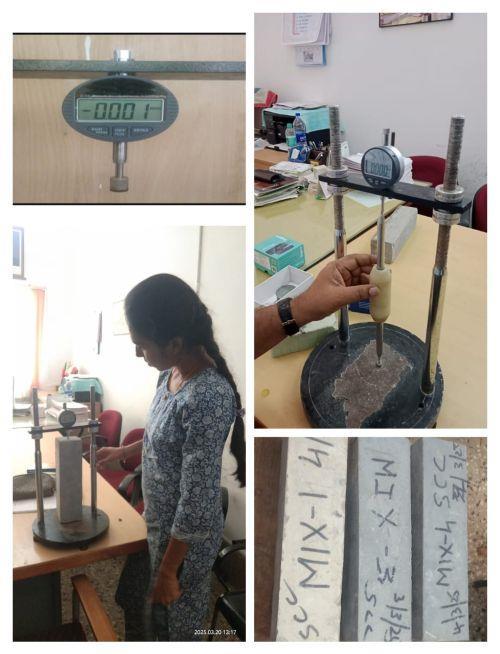
3.3 Drying Shrinkage Test:-The drying shrinkage test is carriedoutaccordingtoASTM157C/157MandC490/C490 M.Inthisstudyprismmoldofsize75X75X285mmwith one compartment were used for casting of specimens. Length Comparator(fig-2)are used for determining length change of specimens. The Comparator for determining length changes of the specimen is provided with dial micrometertoallowmeasurementofsmallvariationsinthe actuallengthofvariousspecimens.Dialgaugeisaninchand metric digital indicator with LCD for measuring surface variations that has measurement range 0-12.7 mm and a resolution0.001mm.showninfigure:-02
Thespecimensforalleightmixeswerecastanddemolded after24-hoursandwatercuredfor28days.Thenfromthe 29thday change in length of the specimens kept for air dryingwererecordeddailyfor56days.Thelengthchangeat anyageofconcreteaccordingtothiscanbecalculatedusing followingformula: L =(Lx-Li/G)x100,wereL =changein lengthatxage,%,Lx=comparatorreadingofspecimenatx age, Li = initial comparator reading of specimen and G = nominal gauge length, 250 mm [for 285 mm specimen]. Fromtherecordedvaluesdryingshrinkagewhichexpressed inmicrostrainscanbecalculated.
International Research
Volume: 12 Issue: 06 | Jun 2025 www.irjet.net
4.Results and Discussions
4.1 Fresh Properties of Self Compacting Concrete:; Thesepropertiesweredeterminedthroughstandardized testslikeSlumpFlowtest,V-funneltest,L-boxtest,U-box test, J -ring test. The aim of these tests are to assess the workability ofconcreteforhighconstructionworkthese tests were performed as per the European Federation of National Associations Representingfor Concrete (EFNARC) specifications2002and2005.Theresultsobtainedfromthe testareanalysedaccordingto(EFNARC)Guidelines.
ThetestresultsforMix-1toMix-4andMix-1PPF toMix4PPF of Blended Self-Compacting Concrete (BSCC), with and without fibers, show notable variations in key parameterssuchasslumpflow,T500time,V-funneltime,Lboxratio,U-box,andJ-ringtest.whicharetabulateinthe table below. Based on the results obtained their fresh propertiescanbeclassifiedintodifferentclassfordifferent applications.(EFNARC)
Slumpflowclasses:-SF1,SF2and SF3
Viscosityflow/v-funnelclasses:-VS1/VF1andVS2/VF2
Passingabilityclasses:-PA1andPA2
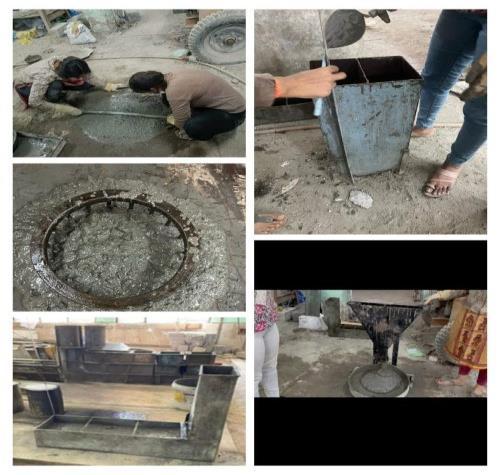
Table :2 FreshPropertiesofSCC
1.Slump Flow and T500 time Test:- Theslumpflowtest, classifiedunderEFNARC(2005)asSF1–SF3,assessesSCC flowability, with T500 time indicating viscosity. Cement replacementwithmineraladmixturesenhancedworkability, whilePPFinclusionreducedit.Mix-2(50%OPC+10%SF+ 30%FA+10%GGBS)achievedthehighestflowability(720 mm;690mmwithPPF)andshortestT500times(3.3sand 3.7s), classifying it as SF2. Mixes 3 and 4 also met SF2 criteria but with slightly lower performance. Fibercontaining mixes generally shifted to SF1 due to reduced flow. Based on EFNARC, Mixes 2, 3, 4, and 2PPF are SF2; Mixes1,1PPF,3PPF,and4PPFfallunderSF1.Allmixesare classifiedasVS2inviscosity..
2.J-ring Test:- Table-2 presents J-Ring test results, highlightingvariationsinblockingresistanceacrossmixes. whereMix-2andMix-2PPFhadtheleastblocking,whileMix-
International Research Journal of Engineering and Technology (IRJET) e-ISSN: 2395-0056
Volume: 12 Issue: 06 | Jun 2025 www.irjet.net p-ISSN: 2395-0072
1 and Mix-1PPF showed the highest due to high viscosity from100%OPCandPPF.Fiberadditionincreasedblocking in all mixes by reducing flow. Mix-3 and Mix-4 showed moderateresults,withSCMsimprovingpassingabilityand helpingoffsetfibereffects.
3. V-funnel Test:- Table 2 shows V-funnel test results rangingfrom8.2–14.5sec(withoutfibers)and7–12.1sec (withfibers),allwithinEFNARC’s24-seclimit.Mix-2hadthe best flowability, while Mix-1PPF performed the worst. All PPF mixes showed longer times due to increased internal resistance.FAenhancedflowthemost,whileGGBSandsilica fumeincreasedviscosity.
4. U-box Test:- TheU-boxtestresults(Table-2)assessSCC’s fillingandpassingability.Alowerheightdifferenceindicates betterflow.Mix-2,withhighflyashcontent,showedthebest performance,whileMix-1PPFhadtheworstduetothestiff OPCmatrixandaddedfibers.IncreasedFAimprovedpassing ability,eveninfiber-reinforcedmixes.
5. L-box Test :- Table-2presentstheL-boxblockingratios, rangingfrom0.83–0.91withoutfibersand0.78–0.89with fibers, all within EFNARC limits. Polypropylene fibers consistentlyreducetheratiobyabout0.02–0.05,withMix1PPFshowingthepoorestpassingability.However,mixes withhighflyashcontent,likeMix-2,effectivelyminimizethis reduction,highlightingthebalancingeffectofSCMs.Finally, all mixes ≥ 0.80 → pass L-Box requirement per EFNARC standards.MIX-2 and MIX-3 (both with and without PPF) offerthebestcombinationofflowandpassingability. Adding fibres decreases L-Box ratio, but the effect is less severewhenmineraladmixtureslikeflyashandGGBSare well-balanced.
4.2 Strength properties of SCC:- In this study, the fundamentalmechanicalpropertiesofSCCwereinvestigated withafocusoncompressivestrength,splittensilestrength, andflexuralstrength
1.Compressive Strength Test :- Compressive strength assessmentsforeachSCCmixwereconductedonstandard cubespecimens(150×150×150mm)after7-day28-dayand 56daysofcuringperiods.Thecompressivestrengthvalues foralltheSCCmixesobtainedareplottedinthechart-1
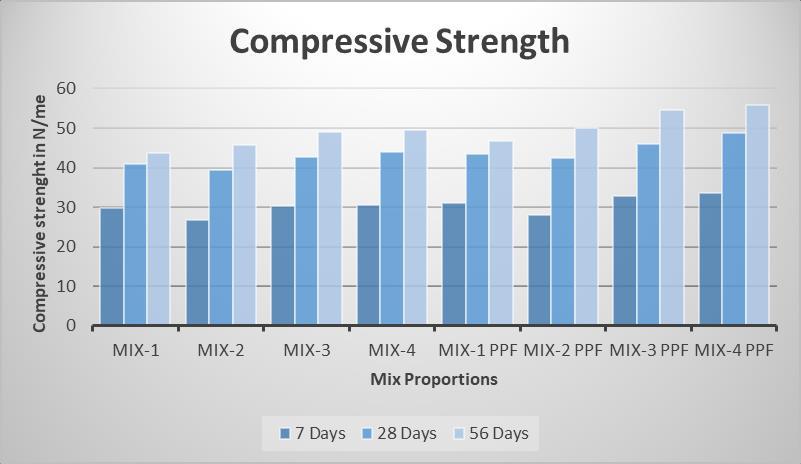
Inthestudy,MIX-2showedslightlylowerearlycompressive strengththanMIX-1butsurpasseditat56days.MIX-3and MIX-4consistentlyperformedbetterthanMIX-1,withupto 13% higher strength at 56 days, owing to higher GGBS content and the synergistic effect of SCMs. MIX-2 PPF followedasimilartrend,withdelayedstrengthgain,while MIX-3PPFandMIX-4PPFshowedsignificantimprovements acrossallages.MIX-4PPFachievedthehigheststrength about19%morethanMIX-1PPFat56days indicatingthat PPF enhanced microcrack resistance and long-term durability. The compressive strength of QBSCC mixes improved with SCMs like GGBS, silica fume, and fly ash. ThoughPPFhadminimaldirectimpact,itsupportedlongterm strength by reducing shrinkage cracks. MIX-4 PPF (50% OPC, 10% SF, 10% FA, 30% GGBS, 0.2% PPF) consistently outperformed others with a 12.42% strength gain at 56 days. Even MIX-1 PPF showed a 7% gain, highlightingtheoverallbenefitsoffiberandSCMinclusionin producingadenser,strongermatrix.
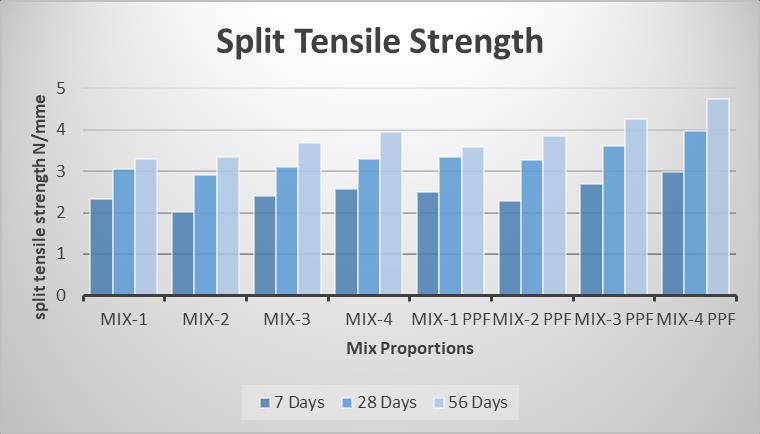
2. Split Tensile Strength Test:-The tensile strength of concretewasdeterminedusingthecylindersofsize150mm ×300m.ThistestwasperformedasperIS516:2021for7 days28daysand56days
International Research Journal of Engineering and Technology (IRJET) e-ISSN: 2395-0056
Volume: 12 Issue: 06 | Jun 2025 www.irjet.net p-ISSN: 2395-0072
The split tensile strength of quaternary blended selfcompactingconcrete(QBSCC)mixeswasevaluatedat7,28, and 56 days. Mixes with supplementary cementitious materials (SCMs) and 0.2% polypropylene fibers (PPF) consistentlyoutperformednon-fibermixes.SCM-onlymixes showed strengths ranging from 2.02–2.58 MPa (7 days), 2.90–3.30 MPa (28 days), and 3.30–3.90 MPa (56 days), whilePPFmixesreached2.27–2.98MPa,3.28–3.96MPa,and 3.58–4.75MPa,respectively.Mixes withflyashhadlower earlystrengthduetoitsslowreactivitybutimprovedover time. Mix-3 and Mix-4, with more reactive SCMs, showed notablestrengthgainsfromenhancedC–S–Hformation.At 56days,Mix-4outperformedMix-1by19.70%,andMix-4 PPFsurpassedMix-1PPFby32.68%.PPFadditionimproved tensilestrengthbyupto20.25%,mainlyduetoitsabilityto bridge micro-cracks and delay crack propagation, complementingthedensificationeffectofSCMs.
3.Flexural Strength Test:- The flexural strength examination involves testing specimens measuring 100 × 100×500mm.Thesespecimenswerecarefully placedand alignedwiththeaxisoftheloadingdevice.Theloadwasthen graduallyincreaseduntilthespecimenfailed.Themaximum applied load was noted, and the flexural strength was calculated
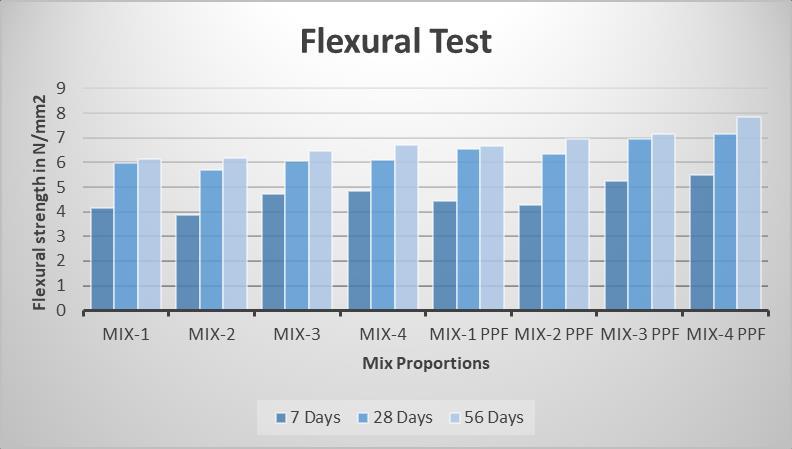
Flexuralstrengthresultsat7,28,and56daysshowedthat QBSCC mixes with SCMs achieved strengths ranging from 4.15–6.69 MPa, while the addition of 0.2% PPF further enhanced values to 4.28–7.85 MPa. Mix-3 and Mix-4 surpassed Mix-1, with up to 16.14% and 8.78% improvementsat7and56days,respectively.Similarly,Mix3PPFandMix-4PPFoutperformedMix-1PPF,showinggains ofupto23.98%at7daysand17.51%at56days.Intra-mix comparisons confirmed that PPF addition consistently improved performance,withMix-4PPF showinga 13.69% increaseoverMix-4at7days.Thehighestflexuralstrength was observed in Mix-4PPF, owing to enhanced crack resistance and fiber bridging. Flexural strength remained
higherthansplittensilestrengthduetothedistributionof stressesalongtheouterfibersduringbending.
4.3 Drying Shrinkage Test Results: - Drying shrinkage tests were performed on all SCC mixes as per ASTM C157/C157M and C490/C490M, which measure length changes in hardened concrete due to moisture and temperaturevariations.Agraph(Chart9)plotsshrinkage (mm) over 56 days for all eight mixes. Mix 1 (control) showedthehighestshrinkageduetotheabsenceofSCMs and fibers. Shrinkage progressively decreased with the additionofSCMs(Mixes2–4)suchasflyash,silicafume, and GGBS. Further reduction was observed in Mixes 5–8 withtheinclusionofPPF,withMix8(containingallthree SCMs and PPF) exhibiting the lowest shrinkage. These findingshighlighttheeffectivenessofcombinedSCMsand PPF in minimizing drying shrinkage and improving dimensional stability. Relevant data is presented in the followingtable3.
Shrinkage graph with Age (no of days) at abscissa and shrinkageinmmatordinateofallthe mixes combinedin oneplotcomparingvariationsintheshrinkageofalleight mix are asfollows.
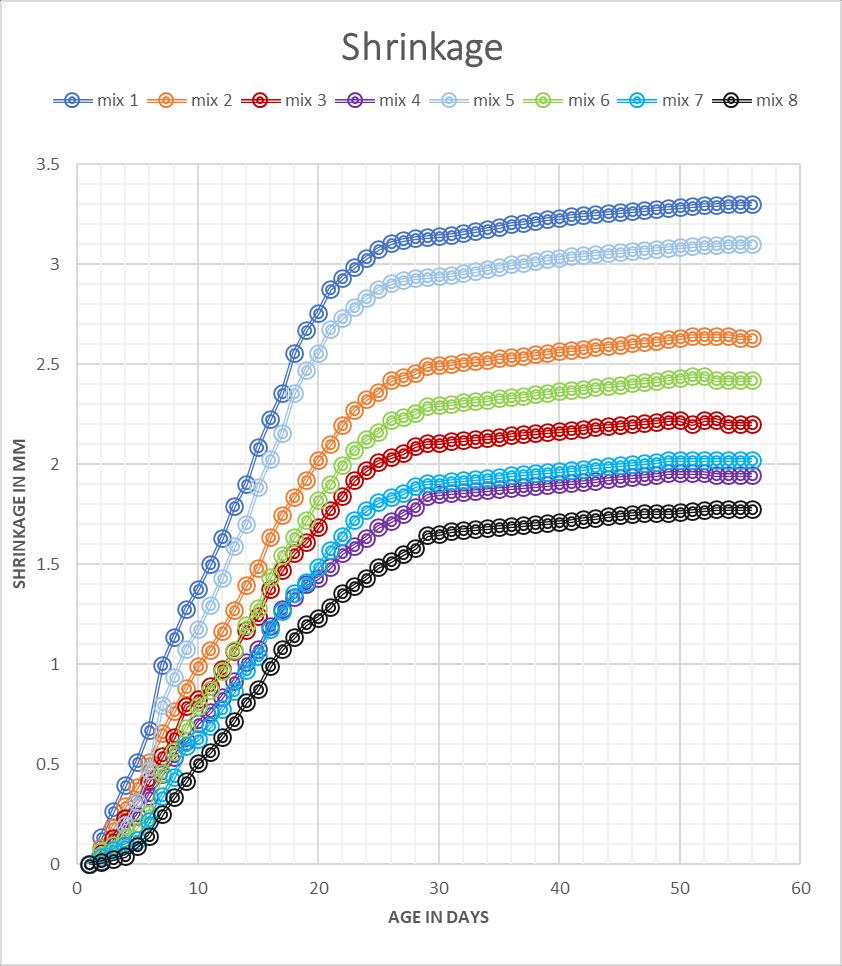
:4CombinedshrinkagevaluesofalleightSCCmixes
International Research Journal of Engineering and Technology (IRJET) e-ISSN: 2395-0056
Volume: 12 Issue: 06 | Jun 2025 www.irjet.net p-ISSN: 2395-0072
Thecombinedgraphcomparesshrinkagebehaviour ofeightmixes Mixes1–4withoutfibersandMixes 5–8withfibres.Allmixesshowgradualshrinkage over time, stabilizing after ~50 days. Maximum shrinkageoccursbetweenDays14and28,typicalof SCCaftermoistcuring.
Mix-1 (control) has the highest shrinkage (~3.3 ×10⁻⁴mm/mmat56days),whileMixes2–4show reduced shrinkage due to mineral admixtures enhancing dimensional stability. Mixes 5–8 (with PPF)exhibitstheleastshrinkage,withMix-8(GGBS +PPF)showingthelowest(~1.77×10⁻⁴mm/mm). TherapidshrinkagerateuptoDay14followedbya plateauischaracteristicofdryingshrinkage.
Mineral admixtures (FA, SF, GGBS) reduce shrinkagebyimprovingpackingandlimitingwater movement. Polypropylene fibers provide internal restraint, reducing microcracks and overall shrinkage.GGBSprovesmoreeffectivethanFAin shrinkage control. The quaternary blend (FA+GGBS+SF) with PPF achieves over 45% shrinkagereduction,makingitidealforsustainable constructionbyreplacing50%OPCandminimizing shrinkage-induceddeterioration.
Mix Final Shrinkageat 56Days (×10⁻⁴ mm/mm Shrinkag e Ranking
Mix1 3.301 1st (Highest)
Mix2 2.742 2nd
Mix3 2.200 3rd
Mix4 1.945 4th
Mix5 3.101 2nd Highest
Mix6 2.556 Moderate
KeyObservation
Control mix; highest shrinkageduetolackof mineral admixtures/fibers.
Fly-ash inclusion lowers shrinkage comparedtoMix1
Fly ash + silica fume combination furtherreducesshrinkage
Addition of GGBS furtherreducesdrying shrinkage.
Mix 1 + PPF: Fibers reducecrackwidthbut not total shrinkage significantly.
Mix 2 PPF: Slightly lower shrinkage than Mix2.
Mix7 2.018 Low Mix 3+fibers help restrainshrinkage.
Mix8 1.774 Lowest
Mix 4 + PPF: Best resistance-to drying shrinkage due to combined effect of GGBS + silica fume + PPF
Table: 3 ShrinkagePropertiesofSCC
o ThemixdesignapproachproposedbyOkamuraand Ozawa has proven effective in producing selfcompacting concrete (SCC) with excellent workabilitycharacteristics
o AllmixesmetSCCcriteria;Mix-2(highFA)hadthe bestflowability(slumpflow:720mm,T500:3.3s).
o Fibers (0.2% PPF) reduced flowability and increased viscosity (T500, V-funnel values increased).
o Passingabilityandsegregationresistanceslightly reducedwithPPFbutremainedwithinSCClimits.
o Classification(EFNARC2005)areasfollows;Mix-2 and Mix-2PPF fall under SF2; others and all PPF mixesfallunderSF1.Mix-1,3,4areVS2.
o V-Funnel: Mix-2, 2PPF, and 3 met VF1 (low viscosity); others are VF2 (better segregation resistance). U-box and L-box confirm acceptable passingability.
o GGBSandfibersenhancedlong-termcompressive strength,withsignificantstrengthgainat56days.
o EarlystrengthofSCMmixeswasslightlylowerdue toslowerpozzolanicreaction,butSFhelpedearly gain
o PPF addition consistently improved strength, especiallytensileandflexural,viabridgingaction.
o Mix-4PPF (30% GGBS, 10% FA, 10% SF) had the higheststrengthamongblendedmixes.
o The drying shrinkage test showed that all mixes containing SCMs and fibers exhibited reduced shrinkage compared to Mix-1 (control), which recordedthehighestshrinkage.
o Mix-8 (GGBS + PPF) showed the least shrinkage, bestfordimensionalstability.
o Mineral admixtures reduce shrinkage via better packing and low water demand and fibers limit microcracks
o Combined use of SCMs and PPF showed >45% shrinkagereductionvs.control.
o SCC with SCMs and PPF is mechanically superior, durable,shrinkage-resistant,andsustainable
International Research Journal of Engineering and Technology (IRJET) e-ISSN: 2395-0056
Volume: 12 Issue: 06 | Jun 2025 www.irjet.net p-ISSN: 2395-0072
References
[1] H Okamura and M Ouchi “Self-compacting highperformance concrete”, Progress in Structural EngineeringandMaterialsVolI(4):378-383(I998)
[2] MehmetGesoğluandErdoğanÖzbay“Effectsofmineral admixtures on fresh and hardened properties of selfcompactingconcretes:binary,ternaryandquaternary systems”,RILEM(2007)
[3] Osama Ahmed Mohamed and Omar Fawwaz Najm “Compressivestrengthandstabilityofsustainableselfconsolidating concrete containing fly ash, silica fume, andGGBS”,HigherEducationPressandSpringer-Verlag BerlinHeidelberg(2016)
[4] Saber Fallah and Mahdi Nematzadeh “Mechanical properties and durability of high-strength concrete containingmacro-polymericandpolypropylenefibers with nano-silica and silica fume”, Construction and BuildingMaterials(ElsevierLtd.)(2016).
[5] S.S.Vivek,G.Dhinakaran“Durabilitycharacteristicsof binary blend high strength SCC”, Construction and BuildingMaterials(ElsevierLtd.)(2017).
[6] O.M. Ofuyatan “Incorporation of Silica Fume and MetakaolinonSelfCompactingConcrete”,International Conference on Engineering for Sustainable World JournalofPhysics:ConferenceSeries1378(2019)
[7] AbuSayedMohammadAkid“Assessingtheinfluenceof flyashandpolypropylenefiberonfresh,mechanicaland durability properties of concrete”, Elsevier B.V. on behalfofKingSaudUniversity(2021).
[8] Aseel Madallah Mohammed “Experimental and statistical evaluation of rheological properties of selfcompacting concrete containing fly ash and ground granulatedblastfurnaceslag”,ElsevierB.V.onbehalfof KingSaudUniversity.(2021)
[9] DaqiangQin,ChunruDongZhenyuZong,ZhanggenGuo ,YuqiangXiong andJiang “Shrinkage and Creep of Sustainable Self-Compacting Concrete with Recycled Concrete Aggregates, Fly Ash, Slag, and Silica Fume’’ Journal of Materials in Civil Engineering, vol-34, https://doi.org/10.1061/(ASCE)MT.19435533.000439 (2022).
[10] PiotrSmarzewski“FreshandMechanicalPropertiesof High-PerformanceSelf-CompactingConcreteContaining Ground Granulated Blast Furnace Slag and PolypropyleneFibres’’Appl.Sci,(2023)
[11] Yamuna Bhagwat, Gopinatha Nayak, Poornachandra Pandit&AishwaryaLakshmi“Effectofpolypropylene
fibresonstrengthanddurabilityperformanceofM-sand self compacting concrete’’ Civil and Environmental Engineering,Taylor&FrancisGroup(2023).
[12] Yuvaraj LBhirud, Om V Vaidya, Satish More, Pradeep Yeol “Shrinkage behavior of self-compacting concrete with higher binder content: experimental results and predictiveEquations’’ volume-5,Springer(2025).
[13] ASTM C157/ 157M Standard Test Method for Length Change of Hardened Hydraulic-Cement Mortar and Concrete
[14] C490/C490MUseofApparatusfortheDetermination of Length Change of Hardened Cement Paste, Mortar, andConcrete
[15] EFNARC (2005), the European Guidelines for SelfCompactingConcreteSpecification,ProductionandUse
[16] IS 383:2016 “Coarse and fine aggregate for concretespecification”
[17] IS: 516 (Part 1/sec1):2021 “Hardened concretemethodsoftest,Part-1:testingofstrengthofhardened concrete, Section-1: compressive, flexural and split tensilestrength”.
[18] IS:2386(Part-I)-1963(reaffirmed2021)“Methodsof test for aggregates for concrete, Part-1: Particles size andshape”.
[19] IS:2386(PartIII)-1963(reaffirmed2021)“Methodsof testforaggregatesforconcrete,Part-III:Specificgravity, density,voids,absorptionandbulking”
[20] IS:4031(Part4)-1988(reaffirmed2019)“Methodsof physicaltestforhydrauliccement,Part-4Determination ofconsistencyofstandardcementpaste”
[21] IS:2386(PartIII)-1963(reaffirmed2021)“Methodsof testforaggregatesforconcrete,Part-III:Specificgravity, density,voids,absorptionandbulking”
[22] IS:4031(Part4)-1988(reaffirmed2019)“Methodsof physicaltestforhydrauliccement,Part-4Determination ofconsistencyofstandardcementpaste”.
[23] IS:4031(Part5)-1988(reaffirmed2019)“Methodsof physicaltestforhydrauliccement,Part-5Determination ofinitialandfinalsettingtimes”.