
International Research Journal of Engineering and Technology (IRJET) e-ISSN: 2395-0056
Volume: 13 Issue: 04 | Apr 2026 www.irjet.net p-ISSN: 2395-0072

International Research Journal of Engineering and Technology (IRJET) e-ISSN: 2395-0056
Volume: 13 Issue: 04 | Apr 2026 www.irjet.net p-ISSN: 2395-0072
Atla Somila Varshitha Reddy1 , Chintala Akhila2 , Galeti Nandu3 , Athota Hema Rayudu4,K.Ramesh5
1,2,3,4 Undergraduate Students, Department of Electrical & Electronics Engineering, Bapatla Engineering college, Andhra Pradesh, India
5Associate Professor, Department of Electrical & Electronics Engineering, Bapatla Engineering college, Andhra Pradesh, India
Abstract - This paper presents an enhanced protection scheme for transformers using the alpha-plane method to improve the reliability of differential protection. A three-phase transformer model is developed to analyse both steady-state full-load operation and transient energization conditions. Particular focus is given to magnetizing inrush current, which occurs during transformer energization due to core saturation and residual flux. Conventional differential protection schemes often fail to distinguish between inrush current and internal faults, leading to incorrect tripping. The proposed alpha-plane technique addresses this limitation by comparing differential and restraint currents in a two-dimensional plane, enabling clear discrimination between fault and non-fault conditions. The method is evaluated under various operating scenarios, including normal operation, inrush conditions, and internal faults. Simulation results demonstrate that the alpha-plane approach effectively prevents false tripping while maintaining high sensitivity to actual faults. This improves both the security and dependability of transformer protection systems. The study confirms that the integration of alpha-plane analysis enhances overall protection performance and ensures reliable operation of power transformers under both steadystate and transient conditions.
Key Words: Transformer Protection, Alpha-Plane Method, Differential Protection, Magnetizing Inrush Current, Internal Fault Detection, Power Transformer, Protection Reliability, Transient Conditions
Transformersplayacrucialroleinelectricalpowersystems by facilitating the transfer of electrical energy between networksoperatingatdifferentvoltagelevels.Duetotheir high cost and importance, reliable protection of transformersagainstfaultsisessentialtoensurecontinuous andstablepowersystemoperation.Transformerfaultssuch as internal winding faults, ground faults, and turn-to-turn faultscanleadtoseveredamageifnotdetectedandisolated quickly.
Themostcommonlyusedprotectiontechniqueispercentage differential (PD) protection, which compares the currents entering and leaving the transformer. Although PD
protectioniswidelyused,itfacesseveralchallengessuchas incorrect operation during current transformer (CT) saturation,difficultyindetectinghigh-resistancefaults,and inabilitytoclearlydistinguishbetweenmagnetizinginrush currents and internal faults These limitations can lead to maloperationorfailureinfaultdetection.
Toovercometheseissues,advancedprotectiontechniques havebeendeveloped.Onesuchmethodisalphaplane(AP) analysis, which represents the relationship between transformercurrentsinthecomplexplane.Byanalyzingthe complexratioofcurrents,theAPmethodprovidesimproved discrimination between normal operating conditions, internalfaults,andexternalfaults.Thisapproachenhances boththesensitivityandstabilityoftransformerprotection systems.
Inthiswork,anenhancedtransformerprotectionschemeis proposed by integrating alpha plane analysis with differential protection principles. Unlike conventional approachesthatrelyonMATLAB/SIMULINK,theproposed method is implemented using Python. The use of Python offers flexibility in numerical computation, efficient data handling, and powerful visualization capabilities through librariessuchasNumPyandMatplotlib.
Theproposedsystemmodelstransformerbehaviourunder various operating and fault conditions, including internal faults, external faults, and CT saturation. The alpha-plane characteristics are analyzed to identify fault conditions accurately.Thisapproachprovidesacost-effectiveandopensourcealternativefortransformerprotectionstudieswhile maintaininghighaccuracyandreliability.
Many researchers have proposed different techniques for transformer protection to improve reliability and fault detectionaccuracy.TheconventionalPercentageDifferential (PD)protectionmethodiswidelyusedinpowersystemsdue toitssimplicityandeffectivenessindetectinginternalfaults. However, this method faces several challenges such as difficulty in distinguishing between inrush current and
International Research Journal of Engineering and Technology (IRJET) e-ISSN: 2395-0056
Volume: 13 Issue: 04 | Apr 2026 www.irjet.net p-ISSN: 2395-0072
internalfaults,andmaloperationduringcurrenttransformer (CT)saturationunderexternalfaultconditions. Toovercometheseissues,advancedmethodslikeArtificial NeuralNetworks(ANN),FuzzyLogic,andDiscreteWavelet Transform(DWT)havebeenintroduced.Thesetechniques improvefaultclassificationandhelpinseparatinginrushand faultcurrentsmoreaccurately.Somestudiesalsousevoltage and current signals together for better fault detection. Althoughthesemethodsenhanceperformance,theyincrease systemcomplexityandrequiremorecomputationaleffort. Recently,theAlphaPlane(AP)concepthasbeenappliedin transmissionline protection due to its ability to represent currentrelationshipsinacomplexplaneandimprovefault detectionsensitivity.However,itsapplicationintransformer protectionisstilllimited.Therefore,thispaperproposesan enhanced transformer protection scheme using the Alpha Planeapproachintegratedwithdifferentialprotection.This methodaimstoimprovesensitivity,reducetheimpactofCT saturation,andprovidemorereliableoperationcomparedto existingtechniques.
The proposed methodology enhances transformer protectionbyintegratingthealphaplane(AP)conceptwith conventionaldifferentialprotectiontechniques.Traditional percentagedifferentialprotectionfaceschallengessuchas misoperation during current transformer (CT) saturation and reduced sensitivity to high-resistance faults. To overcome these limitations, the alpha plane approach is used,whichanalyzestherelationshipbetweentransformer currents in the complex plane to accurately distinguish betweennormalandfaultconditions.
In this method, the transformer currents from different windings are first measured and converted into per-unit valuesbyconsideringCTratiosandtransformerparameters. These currents are then used to calculate differential and restraintcurrents.Thedifferentialandrestraintcomponents arefurthertransformedintotwoequivalentcurrents,and theircomplexratioiscomputed.Thisratioisplottedonthe alpha plane, where predefined operating and restraint regionshelpinidentifyingthesystemcondition.
During normal operation and external faults, the complex ratioremainswithintherestraintregion,ensuringsystem stability.Incontrast,duringinternalfaults,theratioshiftsto the operating region, triggering a trip signal. The entire methodologyisimplementedusingPython,wherenumerical computations and visualization are performed efficiently. Theproposedapproachimprovesfaultdetectionaccuracy, enhances stability during CT saturation, and provides a reliablesolutionfortransformerprotection.
The mathematical modelling of the proposed transformer protection scheme is based on the relationship between current magnitude and phase angle, represented as M(θ) These equations are used to characterize different transformeroperatingandfaultconditions.Byanalyzingthe variationofcurrentmagnitudewithrespecttophaseangle, the protection system can effectively distinguish between inrushcurrentandinternalfaultconditions.
Theinrushcurrentconditionismodelledusinganonlinear expressiongivenby:
M(θ)=960(1−e 1.95θ)+480e 1.95θsin(2.85θ−1.35) (1)
This equation represents the transient behaviour of magnetizing inrush current, where the exponential term modelstheriseincurrentandthesinusoidaltermcaptures theoscillatorynatureofthewaveformduringtransformer energization.
Forinternalfaultconditions,differentmathematicalmodels are derived based on fault type. The single line-to-ground (SLG)faultisexpressedas:
M(θ)=200+600e 13.6(1.571−θ) (2)
Thedoubleline-to-ground(LLG)faultisgivenby:
M(θ)=120+480e 15.1(1.571−θ) (3)
Thethreeline-to-line-to-ground(LLLG)faultisrepresented as:
M(θ)=700e 19.3(1.571−θ) (4)
These equations describe the exponential variation of current magnitude under different fault conditions. Each fault type exhibits a unique response, enabling accurate classificationanddetectionwithintheproposedprotection scheme.
The mathematical modelling of the proposed transformer protection scheme is based on the relationship between current magnitude and phase angle, represented as M(θ). The flowchart of the proposed transformer protection schemeillustratesthesequentialdecision-makingprocess usedforfaultidentificationbasedonthecomputedcurrent magnitudefunctionM(θ).
The process begins by collecting current data points from thetransformerunderdifferentoperatingconditions.These data points are used to compute the magnitude function M(θ),whichrepresentsthevariationofcurrentwithrespect tophaseangle.
International Research Journal of Engineering and Technology (IRJET) e-ISSN: 2395-0056
Volume: 13 Issue: 04 | Apr 2026 www.irjet.net p-ISSN: 2395-0072
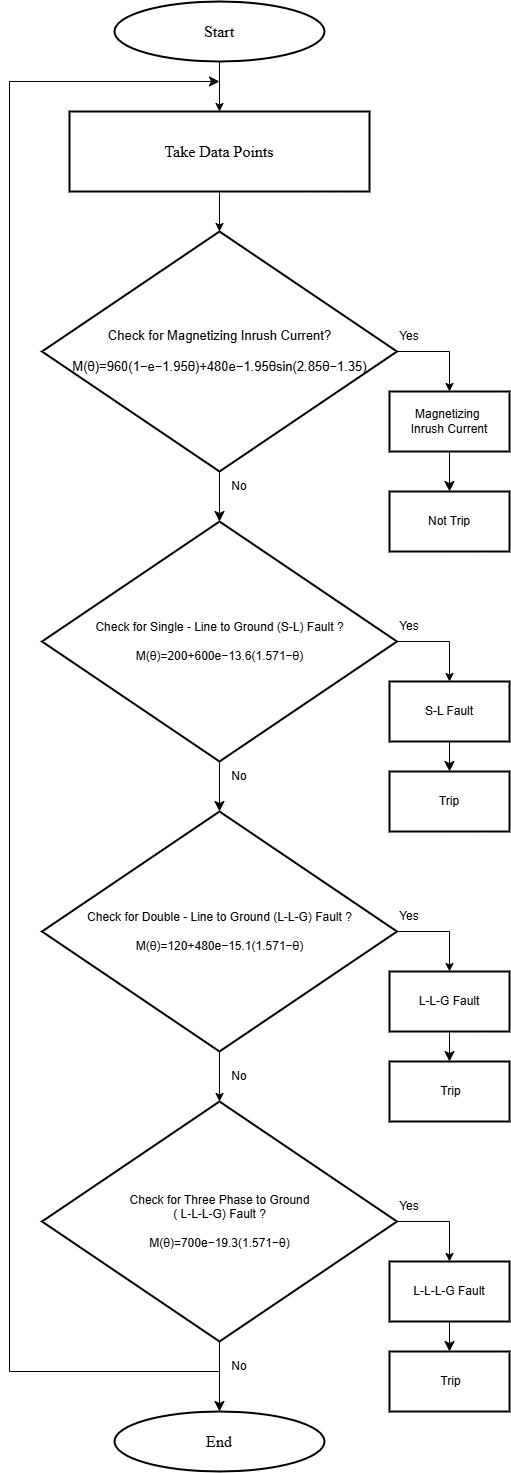
Initially, the algorithm checks for the presence of magnetizinginrushcurrentusingthepredefinednonlinear equation. If the computed M(θ) satisfies the inrush condition, the system identifies it as a non-fault condition and blocks the tripping signal to ensure stability. If the conditionisnotsatisfied,thealgorithmproceedstoevaluate faultconditionsinastep-by-stepmanner.
The next stage involves checking for different types of internalfaultsusingtheirrespectivemathematicalmodels. The algorithm first evaluates the Single Line-to-Ground (SLG)faultcondition.Ifthecalculatedresponsematchesthe SLG characteristics, a trip signal is generated. If not, the systemproceedstocheckforDoubleLine-to-Ground(LLG) fault,followedbyThreeLine-to-Ground(LLLG)fault.Each fault condition is identified based on the corresponding exponentialbehaviorofM(θ)
If none of the fault conditions are satisfied, the system concludesthatthetransformerisoperatingunder normal conditionsandnotripsignalisissued.Thus,theproposed algorithmensuresaccurateclassificationofinrushandfault conditions while avoiding false tripping. The flowchart clearlyrepresentsthissequentialdecision-makingprocess, enablingefficientimplementationinPython.
The proposed transformer protection scheme is implemented using Python to simulate various operating and fault conditions and to visualize their behavior effectively. The implementation utilizes NumPy for numerical computations and Matplotlib for generating graphical representations. A helper function is defined to createuniformpolarplotswithproperaxisorientation,grid structure, and formatting, ensuring consistency across all figures. The transformer current behavior is modeled mathematicallybygeneratingatimevectorandcomputing current magnitude and phase angle using exponential, sinusoidal,andpiecewisefunctions.Thisapproachenables accuratesimulationofmagnetizinginrushanddifferentfault conditionswithoutrequiringreal-timehardwaredata.
The computed current values are plotted using polar coordinates,wherethephaseangleisrepresentedalongthe angular axis and current magnitude along the radial axis. Distinctcolors,markers,andlabelsareusedtodifferentiate between pre-fault, fault, and steady-state conditions. Additionally, a two-slope percentage differential relay characteristic is plotted to analyze the tripping behavior under different operating conditions. The implementation clearlydemonstratesthevariationincurrenttrajectoriesfor inrush and fault conditions, thereby validating the effectivenessoftheproposedprotectionscheme.
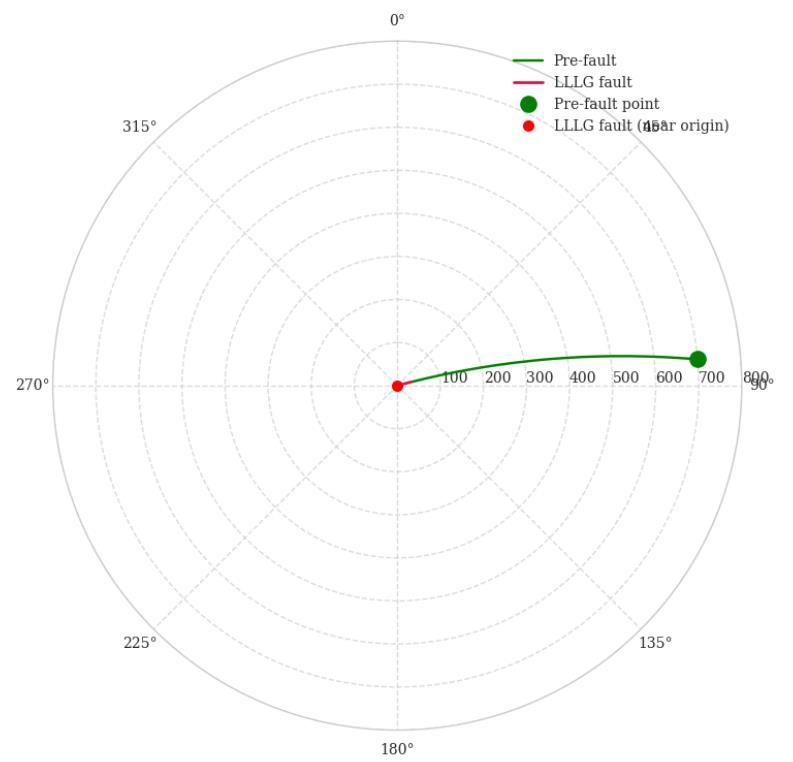
The obtained results demonstrate the effectiveness of the proposed transformer protection scheme under different operating and fault conditions. The polar plots generated using Python provide a clear visualization of current magnitude variation with respect to phase angle θ. These plots help in distinguishing between magnetizing inrush currentandvariousfaultconditionssuchasSLG,LLG,and LLLGfaults.
International Research Journal of Engineering and Technology (IRJET) e-ISSN: 2395-0056
Volume: 13 Issue: 04 | Apr 2026 www.irjet.net p-ISSN: 2395-0072
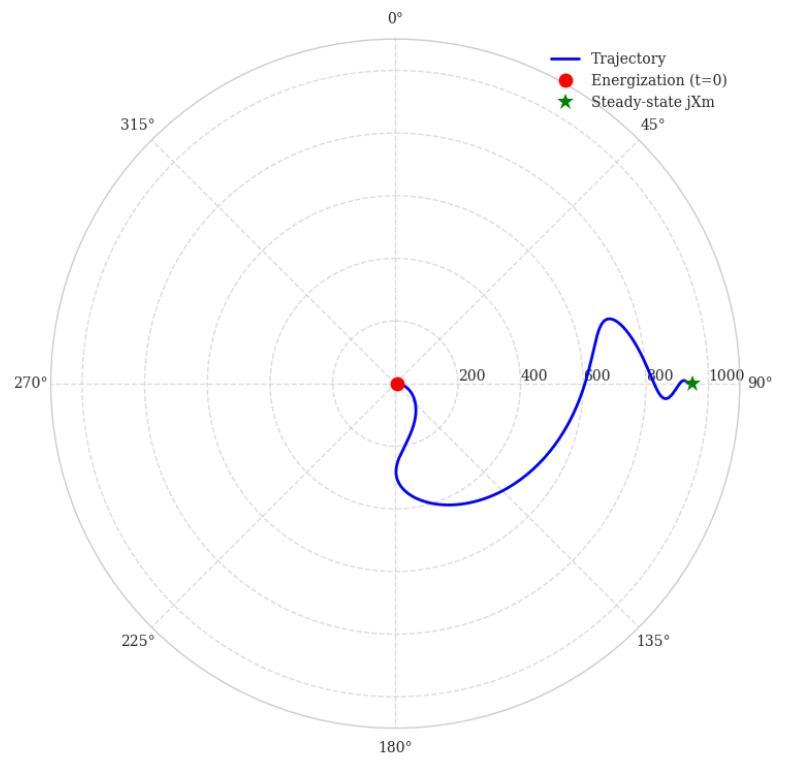
Thepolarplotrepresentsthetransientmagnetizinginrush current during transformer energization. The red point indicates the starting instant of energization, while the trajectory shows the variation of current magnitude with phase angle. The steady-state point represents the magnetizingreactance.Itcanbeobservedthatthecurrent initially starts from a low value and gradually rises with oscillatory behavior before reaching steady state. This characteristic confirms that inrush current is a non-fault conditionandshouldnotresultintripping
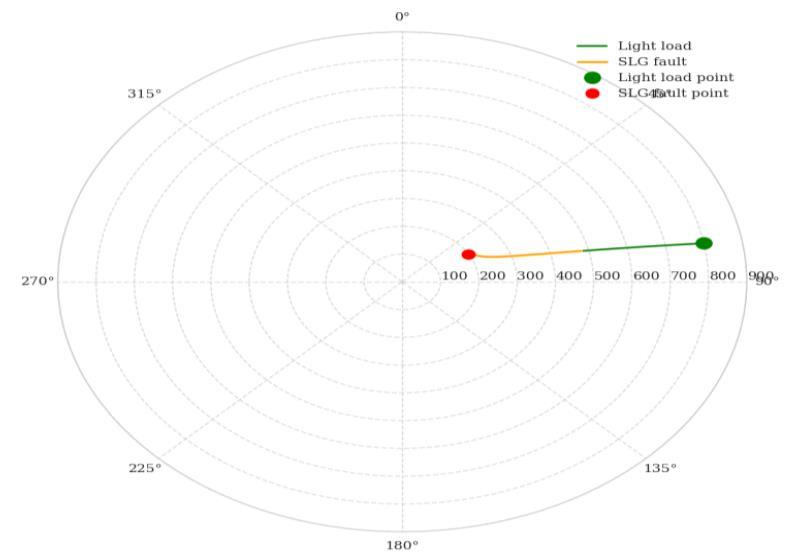
Thisplotshowsthetransitionfromlight-loadoperationtoa single line-to-ground fault. The initial point represents normal operating condition, while the trajectory shifts toward the fault point after fault occurrence. A significant changeinmagnitudeisobserved,indicatingthepresenceof a fault. The distinct variation in radial position helps in identifyingtheSLGfaultcondition.
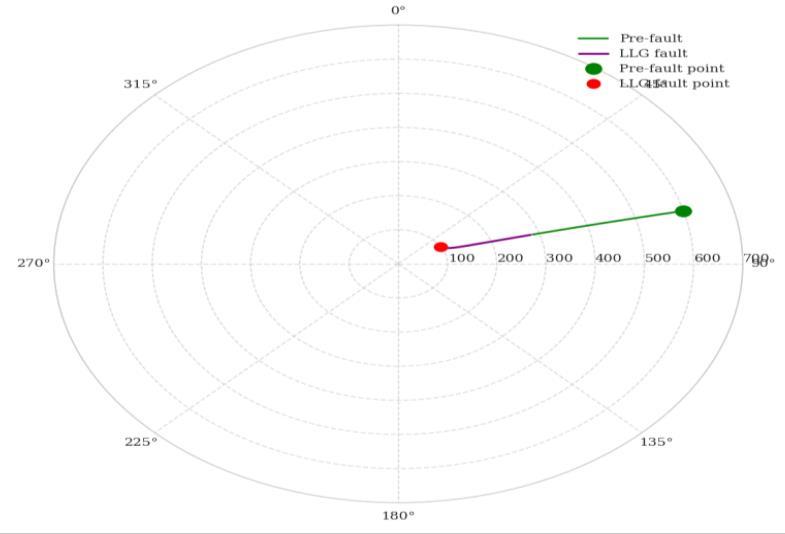
Theplotillustratesthetransitionfrompre-faultconditionto a double line-to-ground fault. Compared to SLG fault, the magnitudereductionismorepronounced,andthetrajectory shows a sharper deviation. The fault point is clearly distinguishablefromthenormal operatingpoint, enabling accuratedetectionofLLGfaults.
This plot represents the most severe fault condition. The trajectory moves rapidly toward the origin, indicating a drastic reduction in current magnitude. This behavior signifies a strong internal fault condition, which requires immediatetripping.Theclearseparationbetweenpre-fault andfaultpointsensuresreliablefaultidentification.
International Research Journal of Engineering and Technology (IRJET) e-ISSN: 2395-0056
Volume: 13 Issue: 04 | Apr 2026 www.irjet.net
7.5 Discussion
Fromtheobtainedresults,itisevidentthateachoperating condition produces a unique polar trajectory. The magnetizing inrush current exhibits a gradual oscillatory pattern, whereas fault conditions show sharp and distinct changesinmagnitudeanddirection.Amongthefaults,the severityincreasesfromSLG toLLGandishighestinLLLG fault, as observed from the magnitude variation. These differences enable accurate classification of transformer conditionsandreducethechancesoffalsetripping.Thus,the proposed method demonstrates improved reliability and effectivenessintransformerprotection.
8. COMPARISON AND ADVANTAGES
A comparison between the conventional Percentage Differential(PD)protectionmethodandtheproposedAlpha Plane-based protection implemented using Python is presented to evaluate the effectiveness of the proposed approach.
8.1 Comparison with Existing Method
Parameter Conventional PD Method Proposed Alpha Plane + Python Method
Accuracy Moderateaccuracy; affectedbyCTerrors andoperating conditions
Speed Slowerresponsedue torelianceon thresholdcomparison
High accuracy due to complex plane analysis and distinct trajectorypatterns
Faster detection through direct patternrecognitionof current characteristics
FaultDetection Capability Limitedindetecting high-resistanceand minorfaults
p-ISSN: 2395-0072
Improveddetectionof SLG, LLG, and LLLG faults with clear distinction
Inrush Discrimination Difficultyin distinguishinginrush frominternalfaults Effective separation using characteristic trajectorybehavior
Stability Susceptibleto misoperationduring abnormalconditions
Cost Requireslicensed software(e.g., MATLAB)
More stable due to clear operating and restraint region separation
Cost-effective using open-source Python tools
The proposed Alpha Plane-based transformer protection scheme offers several advantages over conventional methods:
8.2.1 Improved Accuracy The proposed method utilizes current magnitude trajectories in the polar plane, which allows precise differentiation between normal and fault conditions.Thisreducesthechancesofmisclassificationand improvesoverallprotectionaccuracy.
8.2.2 Faster Response Themethodidentifiesfaultsbased onpatternvariationincurrentcharacteristicsratherthan relying only on threshold comparison, enabling faster detectionandquickerrelayoperation.
8.2.3 Enhanced Fault Detection Capability Theproposed approach effectively detects various fault types such as SingleLine-to-Ground(SLG),DoubleLine-to-Ground(LLG), and Three Line-to-Ground (LLLG) faults with clear distinctionbetweeneachcondition.
8.2.4 Reliable Inrush Discrimination The method accurately distinguishes magnetizing inrush current from internalfaultsbyanalyzingitsuniqueoscillatorybehavior, therebypreventingunnecessarytripping.
8.2.5 Improved Stability Thesystemremainsstableduring normaloperatingconditionsandavoidsfalseoperation,as the trajectories for non-fault conditions remain clearly separatedfromfaultregions.
8.2.6 Robust Performance Theproposedmethodperforms consistentlyunderdifferentoperatingconditions,ensuring reliabletransformerprotectionevenundervaryingsystem scenarios.
8.2.7 Clear Visualization Theuseofpolarplotsprovidesa cleargraphicalrepresentationofcurrentbehavior,makingit
International Research Journal of Engineering and Technology (IRJET) e-ISSN: 2395-0056
Volume: 13 Issue: 04 | Apr 2026 www.irjet.net p-ISSN: 2395-0072
easier to analyze and understand different operating and faultconditions.
8.2.8 Cost-Effective Implementation TheuseofPythonas an open-source tool eliminates the need for expensive licensedsoftware,makingtheproposedmethodeconomical andaccessibleforpracticalapplications.
In this work, an enhanced transformer protection scheme based on alpha plane analysis has been presented and implemented using Python. The proposed method overcomes the limitations of conventional percentage differential protection by utilizing current magnitude characteristics to accurately distinguish between normal operating conditions and various fault types. The mathematical modeling of inrush current, SLG, LLG, and LLLG faults enables clear identification of each condition basedonitsuniquetrajectorybehavior.
The Python-based implementation successfully simulates transformercurrentbehaviorandgeneratespolarplotsthat provide intuitive visualization of different operating scenarios.Theresultsdemonstratethatmagnetizinginrush currentcanbeeffectivelydifferentiatedfrominternalfaults, therebypreventingfalsetripping.Additionally,theproposed method shows improved capability in detecting different faultconditionswithhigheraccuracyandfasterresponse.
Overall,theproposedalphaplane-basedprotectionscheme offers a reliable, efficient, and cost-effective solution for transformerprotection.TheuseofPythonfurtherenhances flexibilityandaccessibility,makingtheapproachsuitablefor modern power system applications and future research developments.
[1] A.S.Sayed,E.M.Nabil,A.Y.Abdelaziz,M.Bajaj,andI. Zaitsev, “An enhanced protection scheme for power transformersintegratingalphaplaneanalysis,”Scientific Reports, vol. 15, 2025, Art. no. 92595, doi: 10.1038/s41598-025-92595-4.
[2] S.Afrasiabietal.,“Acomparativeanalysisofartificial intelligence for power transformer differential protection,”inProc.2021IEEEInt.Conf.Environment and Electrical Engineering and IEEE Industrial and Commercial Power Systems Europe (EEEIC/I&CPS Europe), 2021, pp. 1–6, doi: 10.1109/EEEIC/ICPSEurope51590.2021.9611033.
[3] V.Barhate,K.L.Thakre,andM.Deshmukh,“Adaptable differentialrelayusingfuzzylogiccodeindigitalsignal controllerfortransformerprotection,”inProc.57thInt.
ScientificConf.PowerandElectricalEngineeringofRiga Technical University (RTUCON), 2016, pp. 1–6, doi: 10.1109/RTUCON.2016.7763097.
[4] S. M. Moosavi, Y. Damchi, and M. Assili, “A new fast method for improvement of power transformer differential protection based on discrete energy separationalgorithm,”Int.J.ElectricalPower&Energy Systems, vol. 136, p. 107759, 2022, doi: 10.1016/j.ijepes.2021.107759.
[5] S. A. Hosseini et al., “Proposing a new approach to generate the differential trajectory of the differential relaysusingCOMTRADEfiles,”Sustainability,vol.14,p. 13953,2022,doi:10.3390/su142113953.
[6] N.N.Shangase,M.Ratshitanga,andM.Mnguni,“Parallel power transformer current differential protection scheme based on IEC61850 standard,” in Proc. IEEE PES/IAS PowerAfrica, 2023, pp. 1–5, doi: 10.1109/PowerAfrica57932.2023.10363286.
[7] A.M.Shahetal.,“Quartilebaseddifferentialprotection ofpowertransformer,”IEEETrans.PowerDelivery,vol. 35, pp. 2447–2458, 2020, doi: 10.1109/TPWRD.2020.2968725.
[8] M.Dashtdaretal.,“Improvingthedifferentialprotection ofpowertransformersbasedonfuzzysystems,”inProc. IEEE 2nd KhPI Week on Advanced Technology(KhPIWeek), 2021, pp. 16–21, doi: 10.1109/KhPIWeek53812.2021.9570102.
[9] C.Ghodrati,“Anewmethodtoidentifyandblockinrush currentintransformer,”inProc.13thInt.Conf.Power EnergyElectricalEngineering(CPEEE),2023,pp.311–315,doi:10.1109/CPEEE56777.2023.10217729.
[10]N. Stipetic, B. F. Grcic, and M. Perkovic, “Impact of autotransformer inrush currents on differential protectionoperation,”ElectricPowerSystemsResearch, vol. 220, p. 109309, 2023, doi: 10.1016/j.epsr.2023.109309.
[11]E.S.Ahmad,H.A.A.el-Ghany,andA.Y.Abdelaziz,“An integratedpowerdifferentialschemefortertiarypower transformerprotection,”inProc.Int.MiddleEastPower Systems Conf. (MEPCON), 2019, pp. 26–33, doi: 10.1109/MEPCON47431.2019.9007947.
[12]P.ChiradejaandA.Ngaopitakkul,“Winding-to-ground fault location in power transformer windings using combination of discrete wavelet transform and backpropagationneuralnetwork,”ScientificReports,vol.12, p.20157,2022,doi:10.1038/s41598-022-24434-9.
[13]E.M.Shalbyetal.,“Acomprehensiveguidetoselecting suitable wavelet decompositionlevel andfunctions in discrete wavelet transform for fault detection in
International Research Journal of Engineering and Technology (IRJET) e-ISSN: 2395-0056
Volume: 13 Issue: 04 | Apr 2026 www.irjet.net p-ISSN: 2395-0072
distribution networks,” Scientific Reports, vol. 15, p. 1160,2025,doi:10.1038/s41598-024-82025-2.
[14]R.J.N.deAlencarandU.H.Bezerra,“Powertransformer differential protection through gradient of the differential current,” J. Control, Automation and Electrical Systems, vol. 24, pp. 162–173, 2013, doi: 10.1007/s40313-013-0021-6.
[15]S.Ananwattanapornetal.,“Developmentofovercurrent relaybasedonwavelettransformforfaultdetectionin transmissionline,”ScientificReports,vol.14,p.14933, 2024,doi:10.1038/s41598-024-65596-y.
[16]A. B. Hasudungan et al., “Determining alpha plane characteristicsoflinecurrentdifferentialprotectionin two-terminal highvoltagetransmissionwithdifferent currenttransformerratios,”Int.J.SmartGridandClean Energy,vol.10,no.3,2021.
[17]M. Hossain, I. Leevongwat, and P. Rastgoufard, “Revisions on alpha plane for enhanced sensitivity of linedifferentialprotection,”IEEETrans.PowerDelivery, vol. 33, pp. 3260–3262, 2018, doi: 10.1109/TPWRD.2018.2840964.
[18]K.M.SilvaandR.G.Bainy,“Generalizedalphaplanefor numerical differential protection applications,” IEEE Trans. Power Delivery, vol. 31, pp. 2565–2566, 2016, doi:10.1109/TPWRD.2016.2581987.
[19]F. A. M. Vásquez and K. M. Silva, “Busbar differential protectionusinganalternativegeneralizedalphaplane,” ElectricPowerSystemsResearch,vol.196,p.107284, 2021,doi:10.1016/j.epsr.2021.107284.
[20]M. Almeida, L. Peres, and K. M. Silva, “On applying an enhanced generalized alpha plane to shunt reactor protection,”ElectricPowerSystemsResearch,vol.212, p.108387,2022,doi:10.1016/j.epsr.2022.108387.
[21]I.F.Prado,R.P.Medeiros,F.B.Costa,andK.M.Silva,“A performance analysis of transmission line differential protection,”inSimpósioBrasileirodeSistemasElétricos (SBSE),2020.
[22]SEL, SEL-411L Instruction Manual: Advanced Line DifferentialProtection,Automation,andControlSystem, SchweitzerEngineeringLaboratories,2023.
[23]S. Gangolu and S. Sarangi, “Additional logic for alpha planealgorithmundergroundfaults,”inProc.Int.Conf. Computer,Electronics&ElectricalEngineering&their Applications (IC2E3), 2023, pp. 1–6, doi: 10.1109/IC2E357697.2023.10262729.
[24]B.Kasztenny,G.Benmouyal,H.Altuve,andN.Fischer, “Tutorial on operating characteristics of microprocessor-based multiterminal line current
differentialrelays,”PresentProblemsofPowerSystem Control,2013.
[25]SEL, SEL-487E-3/-4 Instruction Manual: Transformer ProtectionRelay,SchweitzerEngineeringLaboratories, 2022.
2026, IRJET | Impact Factor value: 8.315 | ISO 9001:2008