
International Research Journal of Engineering and Technology (IRJET) e-ISSN: 2395-0056
Volume: 13 Issue: 04 | Apr 2026 www.irjet.net p-ISSN: 2395-0072

International Research Journal of Engineering and Technology (IRJET) e-ISSN: 2395-0056
Volume: 13 Issue: 04 | Apr 2026 www.irjet.net p-ISSN: 2395-0072
Mandala Bhavani1 , Pooja Birajdar2 , Sarapu Varshini Guptha3,Shanigarapu Manasa4 , Mr.Bijaya Kumar Muni5
1234B.tech Final Year Students,Department of Electronics and Communication Engineering. 5Second Assistant Professor,ECE Department,JBIET,Hyderabad,Telangana ,J.B Institute of Engineering and technology.
Abstract -Driver drowsiness and lack of focus while operating their vehicle are leading causes of many road accidents. These incidents cause physical injury, fatalities, and financial losses worldwide. Drowsiness and sleep deprivation can cause delayed reactions from drivers and lead to various accidents. This paper discusses the development of a drowsiness detecting accidentprevention system that uses smart glasses as a wearable device on the driver.
A smart pair of glasses with an MPU6050 accelerometer andsensor installed helps detect driver drowsiness based on headposturechanges.Anoptionaleyeblinkdetectorhelpsin determining drowsiness more accurately by tracking eye closure times. Data obtained by sensors is analyzed by the microcontroller (Arduino Nano) and used to define the currentstateofthedriver,namelyhisalertnesslevel.
In addition, there is a possibility of using a GSM module to notify the driver's pre-defined contacts about an emergency situation through a text message. A proposed accident prevention device is compact, affordable, and comfortable for the wearer. Experiments have shown that sucha device is capable of timelyand accurate detection of driver drowsiness.
KeyWords:ArduinoNano,SmartGlasses,DrowsinessDetecti on, Driver Fatigue Monitoring, MPU6050 Accelerometer, Eye Blink Sensor, GSM Module, Real-Time Alert System, Road Accident Prevention, Driver Safety Technology, Sensor-BasedMonitoring).
Road safety is now a major global issue, considering the sharpriseinaccidentsassociatedwithhumanerrorssuch as fatigue, distractions, and loss of alertness. Of these, driver fatigue stands out as the key culprit for road accidents, especially during long distance travels, driving atnighttimeandwhendrivingonboringroads.Assoonas a driver fallshas been established through several studies on safety issues that a relatively high number of road accidents happen because of driver fatigue, hence the urgentneedforpreventionmeasures.
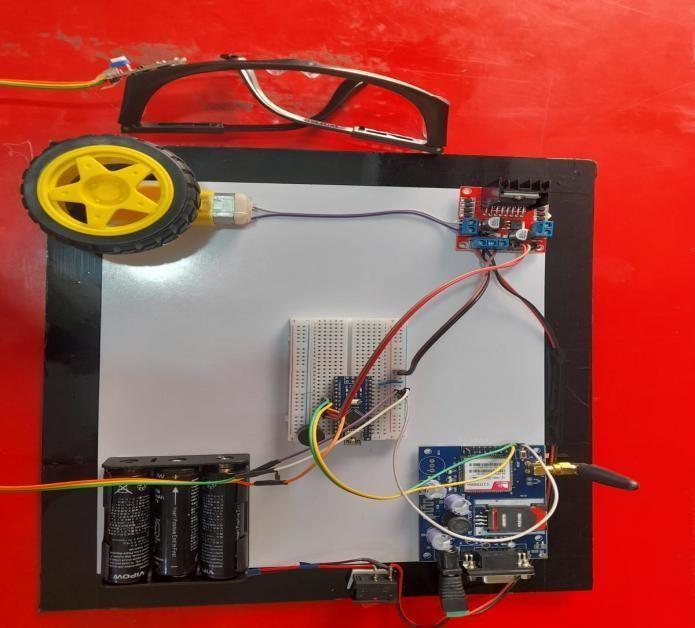
Automobilecrashesareconsideredamongtheprimary causes of injury and death around the world. It has been noted that driver fatigue is one of the major factors contributing to road crashes. Driving for long periods of time,particularlyduringnighttime,makesdriverslessalert and increases their chances of making mistakes. For this reason,therehasbeenanincreaseddemandfortechnology thatcanpredictaccidents.
Theprimaryobjectiveofthisprojectistoincreaseroad safetybydetectingfatigueamongdriversthroughtheuse of real-time systems that provide instant warnings. This project strives to reduce accidents through early alerting of drivers regarding their level of fatigue. It is also designed to create an inexpensive and mobile technology thatcanbeappliedinpractice.
In the present-day world, road accidents due to driver fatigue and inattentiveness have emerged as a major concernintransportationtechnology.Driverfatigue,which may arise from long hours of driving without adequate
International Research Journal of Engineering and Technology (IRJET) e-ISSN: 2395-0056
Volume: 13 Issue: 04 | Apr 2026 www.irjet.net p-ISSN: 2395-0072
sleep, results in reduced alertness. As a result, the driver becomes less responsive, making it hard for them to respondappropriatelywhenfaced withsuddensituations. Road accidents are therefore more likely during nighttime drivesandlong-distancedrives.Modern-daysafetysystems inautomobiles,suchasairbagsandbrakes,arereactionary and only minimize the damage once the accident takes place.
While sophisticated technology in some safety systems, such as the use of cameras and artificial intelligence in drowsiness detection, may work well, they may be very costlyandcomplextoapply,andarenotreadilyavailableto the general consumer. At the same time, basic drowsiness detection systems tend to be inaccurate and unreliable, thusfailingtoidentifysignsoffatigueearlyenough.
Itisthereforeimperativethatthereisneedforasystem that will detect driver fatigue reliably and cost-effectively andingoodtime.Sucha deviceoughttobe portable,easy towear,andoperateautonomouslywithoutrelyingentirelyon theautomobile.
In recent times, driver drowsiness detection has been a topic of major concern, owing to the growing number of accidents taking place on the road. Various technologies have been invented for monitoring the activities of the drivers,andthus,predictingtheirsleepinesslevelsintime. [6]
3.2
There have been several approaches taken up for eye blinkdetectionusinganIRsensorandmicrocontrollerlike Arduino.Theyrelyondetectinghowlongtheeyesare closed. If they stay shut for more than a specified duration, the system sounds an alarm. However, such methods are vulnerable to errors, considering normal blinks and inappropriatesensorpositioning.[4][5][9]
This shows how wearable technology can be beneficial because it allows for instantaneous feedback, portability, and ease of use as compared to the use of vehicle-based systems. The systems may still face some difficulties includinglow batterylife, limitations in processingpower, andlessaccuratereadingsindifficultconditions.[3]
3.4
GSM-based research in accident prevention and detection systems emphasizes that GSM is critical to enable communication in the caseof emergencies duringanyroad
accident. Such systems include GSM modules embedded with sensors and microcontrollers that detect accidents and then send messages or alarms along with GPS coordinatesautomaticallytocontacts..[8][11]
Thoughtherehavebeen significantdevelopments,a major flaw in thesystems developed includes highcost,complex structure, portability issues, and being dependent upon systems installed in vehicles. Moreover, some of the available systems do not have the facility for real-time emergencies. The current system developed using the Arduino platform resolves these issues by offering an affordable,portable,andefficientsystem.
The existing accident prevention systems mainly utilize vehicle-based safety technologies as well as simple alert technologies that work toward minimizing the damages that can occur when an accidenthappens.Traditional vehicle technologies such as airbags, seat belts, and ABS play a significant role in helping minimize the extent of damages from accidents; however, these solutions do not monitor the status of drivers and thus cannot help avoid accidentscausedbyfactorslikedriverfatigue.[4]
Most of the current technologies used for accident preventionareinstalledintothevehicles;hence,theyhave limited flexibility and cannot be used on all kinds of vehicles. [8] In addition, these technologies fail to incorporate the real-time monitoring of the driver's behavior which is vital in detecting the occurrence of fatigue before an accident occurs. Some modern solutions employ advanced technologies like artificial intelligence andcamerastohelpdetectandpredictaccidents;however, theseoptionsarecomplicatedandexpensive.[7]
5.1
Thesuggesteddrowsinessmonitoringmechanismismade up of small-sized hardware parts combined in one wearablegadgetintheshapeofsmartglasses,whichhave various sensors for sensing, analyzing, alarming, and transmittingpossibledangers.Theinputstagehassensors like the MPU6050 sensor that has both an accelerometer andagyroscopetosensethemovementandpositioningof the head of the driver. The IR sensor senses the blinking rateoftheeyes.
International Research Journal of Engineering and Technology (IRJET) e-ISSN: 2395-0056
Volume: 13 Issue: 04 | Apr 2026 www.irjet.net p-ISSN: 2395-0072
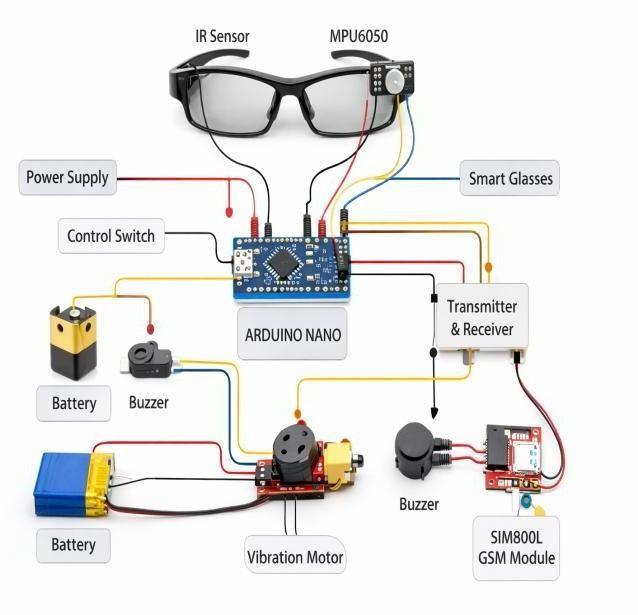
Fig-:5.1: ArchitectureOfSystem
Smartglasseswillhavethesesensorsincorporatedinto them for real-time monitoring. Alerts will be given via a buzzer and vibration motor so that the wearer is alerted immediately.Forquickeraction,atransmitterandreceiver component allows wireless connectivity between these components.Itoperatesusingaregulatedpowersupply.
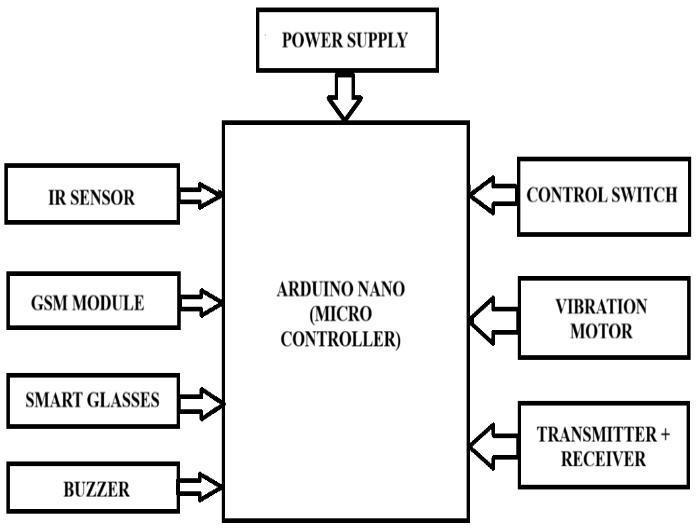
Fig -5.2: BlockDiagram
BlockDiagramoftheSmartAccidentPreventionSystem UsingArduino-BasedSmartGlasses
Theblockdiagramshowsthewholeworkingprocessof the proposed system. This system has been developed in sucha waythatitworkstogetherasanembeddedsystem
with all parts connected and controlled through the ArduinoNanomicrocontroller.
Thefirstmoduleinvolvedinthissystemistheeye-blink detector.ArduinoNanofunctionsasthemaincontrollerfor thesystem.Thecontrollerreceivestheinputdatafromthe sensorsanddetermineswhetherthereisadetectionofeye closureabovethethresholdlevel.TheArduinowilltrigger theoutputmodulesifdrowsinessisdetected.
Firstly,thebuzzerwillbesetoffasaninitialalerttothe driver. Should the driver continue to sleep without any response, then the motor driver module will be used to control the speed of the car to slow it down. Simultaneously,theGSMmoduleisemployedtosendouta distress signal to selected contacts. The GPS module helps intrackingthecurrentpositionofthevehicle,whichforms partofthesignal.
Thedevelopmentoftheaccidentpreventionsystembased onsmartglassescontrolledbyArduinowascompletedand subjected to tests in order to analyze the efficiency of the system in detecting drowsiness of the driver and preventing accidents. The eye blink sensor detected and measured eye movement of the driver and was successful indifferentiatingbetweenregularblinkingofeyesandeye movements that indicate drowsiness. During the tests, it wasobservedthatthereactiontimeofthesystemwasfast, detecting drowsiness in a split second after crossing the threshold value. The buzz sound activated immediately afterdetection,whichwasusefulinalertingthedriver
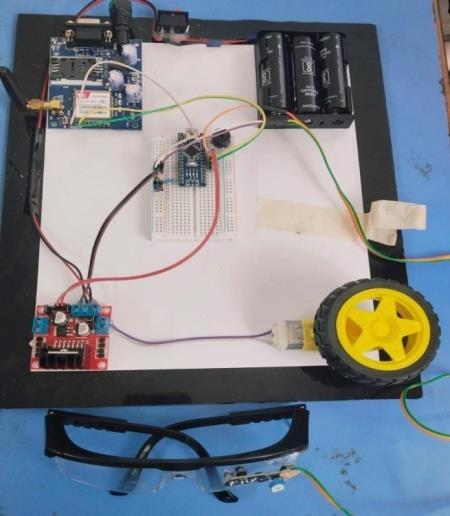
The use of the dual alert system with a buzzer and a vibration motor makes the alert system more reliable by using two methods of giving warnings to the user. It is easier for the user to recognize the alert by hearing the sound of the buzzer or through the vibration motor, thus makingsurethewarningwasnotmissedouton.
Volume: 13 Issue: 04 | Apr 2026 www.irjet.net
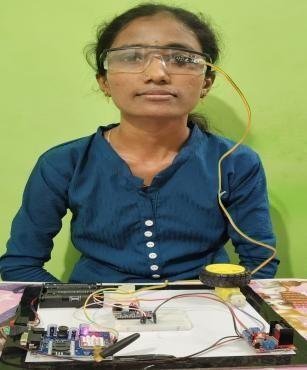
The system was able to activate the motor driver module in situations where the driver did not react to the alarm, thusslowingdownthecaruntilitstopped.Itwasusefulin ensuring the safety of the user particularly when simulated to be tired. The inclusion of the GSM module in thesystemmadeitpossibletotransmitemergencySMSto pre-defined recipients promptly. The messages contained reliableinformationaboutthestateofthedriver.
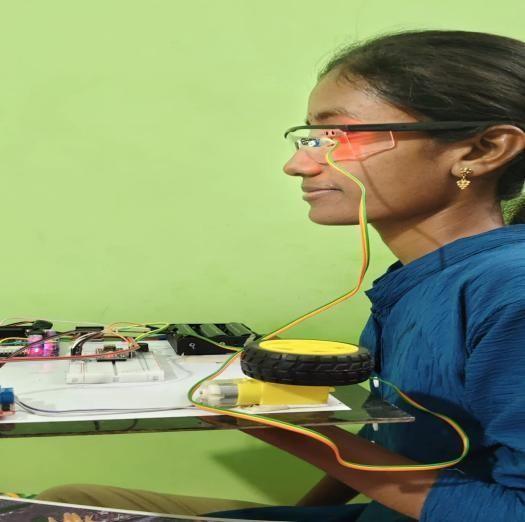
The system is more reliable because if one method failed, another would compensate for it. If the driver did not hear the buzzer, he/she would still receive a signal throughthevibrationmotor.
The GSM module (Global System for Mobile Communication) is an important component that will be incorporated in the proposed accident prevention system for allowing wireless connectivity. This helps in sending instant data to the preprogrammed mobile numbers in caseofanemergencysituation.
The GSM Module is connected to the Arduino Nano via serial communication (UART). Commands are sent from the Arduino to the GSM Module via AT commands, which arecommoncommandsusedforcontrollingGSMdevices.
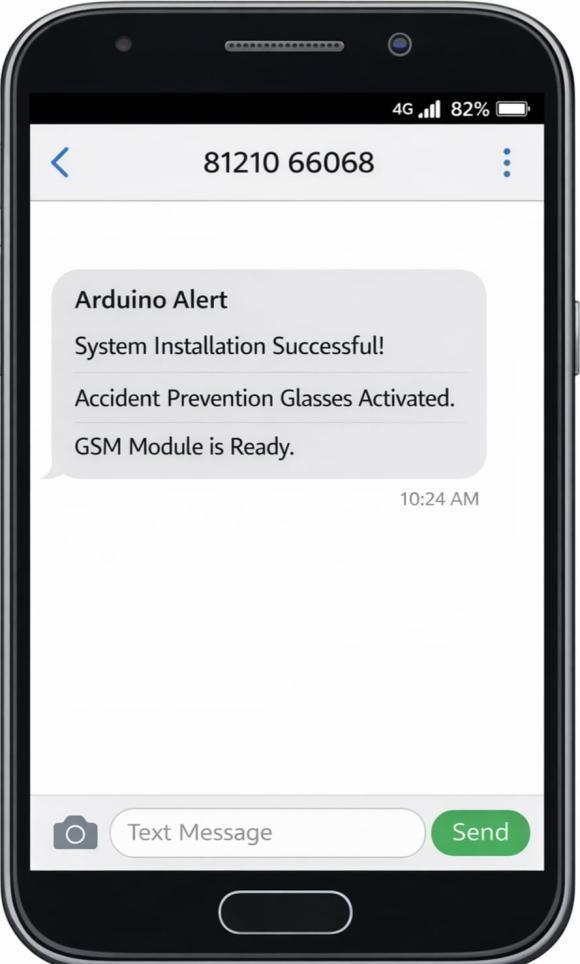
TheGSMmodule(SIM800L)sendsalertmessagesthrough SMS to designated contacts if drowsiness is detected. The SMS is sent instantly without any delay, allowing for a rapid response in case of emergencies. It works in an automated manner and does not require any manual operation.
The proposed accident prevention system based on Arduinosmartglasses is efficient, reliable,andlow-costin tackling road accidents caused by drowsiness among drivers. With constant monitoring of the driver's head movementsand the stateofhis eyes,thesystem isableto detect the signs of fatigue in real-time and send out alerts throughauditoryaswellastactilesensations,thushelping preventaccidentsfromhappening.
WiththeincorporationofaGSMmoduleinthesystem,the ability to contact other people in case of an emergency situation is made possible, which further increases safety. The portability naturemakes it convenient for users since itdoesnotrequireattachmenttoanyparticularvehicle.
Accordingtotheexperimental testsconducted,thesystem operates effectively with high efficiency and fast reaction time. Despite certain limitations like the need to align
International Research Journal of Engineering and Technology (IRJET) e-ISSN: 2395-0056
Volume: 13 Issue: 04 | Apr 2026 www.irjet.net p-ISSN: 2395-0072
sensors, its overall performance is satisfactory. There is great potential for implementation of the system, which can benefit greatly from new technological developments such as machine learning, internet of things technology, andmoresensors.
[1] Sharaaf,N.A. Crash Free-A Smart System to Detect, Prevent Drowsiness and Locate Accidents. Diss. 2022.
[2] Pathak, A. K., Singh, A. K., Kumar, P., Bhatia, V., & Krejcar, O. (2025). Real-time anti-sleep alert algorithm to prevent road accidents to ensure road safety. Frontiers in Future Transportation, 6, 1545411.
[3] amuda, Prathima, et al. "Arduino based Customized Smart Glasses for the Blind People." 2022 Second International Conference on Artificial IntelligenceandSmartEnergy(ICAIS).IEEE,2022.
[4] Upender, P., G. Nikhil Reddy, and G. Santoshini. "Arduino based accident prevention system with eye twitch and alcohol sensor." 2020 12th International Conference on Computational Intelligence and Communication Networks (CICN). IEEE,2020.
[5] Divyank, Singh. EYE BLINK SENSOR (ACCIDENT PREVENTION).2017.
[6] Damian, Słapatek, et al. "Driver drowsiness detection systems." Zeszyty Naukowe Instytutu Pojazdów 112.3(2017).
[7] Hirve, Ashvini. "Vision safe using ESP32-CAM." AvailableatSSRN4867417 (2023).
[8] Jadhav,S.,Nair,S.,Vidhrani,S.,&Roychowdhury,S. (2020). IOT based accident prevention and detection system using GSM-GPS, eye blink, and alcohol sensor. Int. J. Res. Appl. Sci. Eng. Technol, 8(5),771-776.
[9] Kumar, Abhishek, et al. "Enhanced Driver Safety: IoT Based Anti-Sleep Alarm and Automatic Braking System Using Eye Blink Sensor." 2024 IEEE 21st India Council International Conference (INDICON).IEEE,2024.
[10] Barani, S., Harini, L., Sangeetha, R., & James, K. (2019). ACCIDENT PREVENTION AND EMERGENCY AWARENESS USING AUGMENTED REALITY. ACCIDENTPREVENTION, 6(02).
[11] Akkalkot,Afsha,etal."Asmartaccidentdetection, prevention and reporting system using arduino." ArtificialIntelligenceandInformationTechnologies CRCPress,2024.294-298.
[12] Zadeh, Nastaran Reza Nazar, et al. "DEVELOPMENT OF ANTI-DROWSINESS AND
ALERT SYSTEM FORAUTOMOBILE DRIVERS." Proceedings on Engineering 6.4 (2024): 16631672.