
International Research Journal of Engineering and Technology (IRJET) e-ISSN: 2395-0056
Volume: 13 Issue: 03 | Mar 2026 www.irjet.net p-ISSN: 2395-0072
International Research Journal of Engineering and Technology (IRJET) e-ISSN: 2395-0056
Volume: 13 Issue: 03 | Mar 2026 www.irjet.net p-ISSN: 2395-0072
Ankush Tiwari1 , Vivek Kumar2
1FResearch Scholar, Department of Civil Engineering, Mewar University, Chittorgarh, Rajasthan
2SAssisatnt Professor, Department of Civil Engineering, Mewar University, Chittorgarh, Rajasthan
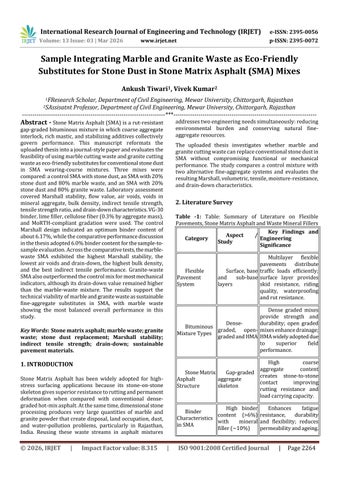
Abstract - StoneMatrixAsphalt(SMA)isarut-resistant gap-gradedbituminousmixtureinwhichcoarseaggregate interlock,richmastic,andstabilizingadditivescollectively govern performance. This manuscript reformats the uploadedthesisintoajournal-stylepaperandevaluatesthe feasibilityofusingmarblecuttingwasteandgranitecutting wasteaseco-friendlysubstitutesforconventionalstonedust in SMA wearing-course mixtures. Three mixes were compared:acontrolSMAwithstonedust,anSMAwith20% stone dust and 80% marble waste, and an SMA with 20% stonedustand80%granitewaste.Laboratoryassessment covered Marshall stability, flow value, air voids, voids in mineral aggregate, bulk density, indirect tensile strength, tensilestrengthratio,anddrain-downcharacteristics.VG-30 binder,limefiller,cellulosefiber(0.3%byaggregatemass), and MoRTH-compliant gradation were used. The control Marshall design indicated an optimum binder content of about6.17%,whilethecomparativeperformancediscussion inthethesisadopted6.0%bindercontentforthesample-tosampleevaluation.Acrossthecomparativetests,themarblewaste SMA exhibited the highest Marshall stability, the lowestairvoidsanddrain-down,thehighestbulkdensity, and the best indirect tensile performance. Granite-waste SMAalsooutperformedthecontrolmixformostmechanical indicators,althoughitsdrain-downvalueremainedhigher than the marble-waste mixture. The results support the technicalviabilityofmarbleandgranitewasteassustainable fine-aggregate substitutes in SMA, with marble waste showing the most balanced overall performance in this study.
Key Words: Stonematrixasphalt;marblewaste;granite waste; stone dust replacement; Marshall stability; indirect tensile strength; drain-down; sustainable pavement materials
Stone Matrix Asphalt has been widely adopted for highstress surfacing applications because its stone-on-stone skeletongivessuperiorresistancetoruttingandpermanent deformation when compared with conventional densegradedhot-mixasphalt.Atthesametime,dimensionalstone processing produces very large quantities of marble and granitepowderthatcreatedisposal,landoccupation,dust, and water-pollution problems, particularly in Rajasthan, India. Reusing these waste streams in asphalt mixtures
addressestwoengineeringneedssimultaneously:reducing environmental burden and conserving natural fineaggregateresources.
The uploaded thesis investigates whether marble and granitecuttingwastecanreplaceconventionalstonedustin SMA without compromising functional or mechanical performance. The study compares a control mixture with two alternative fine-aggregate systems and evaluates the resultingMarshall,volumetric,tensile,moisture-resistance, anddrain-downcharacteristics.
Table -1: Table: Summary of Literature on Flexible Pavements,StoneMatrixAsphaltandWasteMineralFillers
Category Aspect / Study
Flexible Pavement System
Surface,base and sub-base layers
Key Findings and Engineering Significance
Multilayer flexible pavements distribute traffic loads efficiently; surface layer provides skid resistance, riding quality, waterproofing andrutresistance.
Bituminous MixtureTypes
Densegraded, opengradedandHMA
Dense graded mixes provide strength and durability; open graded mixesenhancedrainage; HMAwidelyadopteddue to superior field performance.
StoneMatrix Asphalt Structure
Gap-graded aggregate skeleton
Binder Characteristics inSMA
High binder content (>6%) with mineral filler(~10%)
High coarse aggregate content creates stone-to-stone contact improving rutting resistance and loadcarryingcapacity.
Enhances fatigue resistance, durability and flexibility; reduces permeabilityandageing.
International Research Journal of Engineering and Technology (IRJET) e-ISSN: 2395-0056
Volume: 13 Issue: 03 | Mar 2026 www.irjet.net p-ISSN: 2395-0072
Category Aspect / Study
Key Findings and Engineering Significance
Air Void Characteristics
Lowairvoids (3–4%)
Improves waterproofing and increases pavement servicelife.
Surface Texture
Advantages ofSMA
Rough macrotexture of SMA
Improves skid resistance, surface drainage, safety and reduces tyre–pavement noise.
Category Aspect / Study
Key Findings and Engineering Significance
Limitations ofSMA
Rut resistance, fatigue life and durability
Higherinitial cost and binder drain-down
Studies report 30–40% lower permanent deformation and 3–5 times higher fatigue life than dense graded asphaltmixtures.
Requires stabilizing additives and strict quality control during production and construction.
Misra Marbleslurry stabilization
Improvescompaction and load bearing capacity of subgrade soils.
Life Cycle CostStudies
Georgia DOT and Alaska DOT analyses
Higher initial cost offset by longer service life (5–10 years additionalperformance).
Mishraetal. Granite dust stabilization
Significantreduction in plasticity index and swelling of expansive soils.
Althoughnumerousstudieshaveexaminedmarblewaste, quarrydust,andotherindustrialby-productsinpavement applications, relatively fewer investigations have focused specifically on the combined use of Kota stone waste and marblewasteacrossmultiplepavementlayerssuchasGSB, WMM, and BM under a uniform testing framework. In particular,thereremainsaneedforsystematiccomparisonof their influence on MDD, OMC, CBR, Marshall stability, and strengthparametersatvarying replacementlevels.Recent studiesconfirmthebroadfeasibilityofstone-wastereuse,but they also show that optimum performance is highly dependentondosageandapplicationlayer,whichjustifies furtherexperimentalinvestigationofthesematerialsinthe contextofflexiblepavementconstruction.
Field Performance Studies
Industrial WasteFillers
USA and Indian trial sections
SMA performs effectively under heavy traffic and varying climaticconditions.
Marble dust andgranitedust usage
Ishaietal. Filler–bitumen mastic study
Improves soil gradation,density,shear strength and swelling resistance; promotes sustainableconstruction.
Optimum filler proportion improves mechanicalperformance ofasphaltmixtures.
ThreeSMAmixtureswereexaminedintheunderlyingthesis: a control mixture using stone dust as the fine aggregate fraction,a mixture using 20% stone dustand 80% marble cuttingwaste,andamixtureusing20%stonedustand80% granitecuttingwaste.Crushedcoarseaggregateswereused todevelopthestoneskeleton.VG-30bitumenwasusedasthe binder,limewasusedasmineralfiller,andcellulosefiberat 0.3% by aggregate mass was incorporated as a stabilizing additivetolimitdrain-downandimprovemasticstability.
Table 2. Constituent materials used in the SMA mixtures.
Material
Karasahin andTerzi
Marble dust filler
Performance comparabletolimestone filler;suitableforlowto mediumtrafficroads.
Coarse aggregates
Specification / source Role in SMA mixture
Sharmaetal. Flyashfiller
Upto7%fillercanbe incorporated without performance deterioration.
Crushed aggregates meeting SMArequirements
Provide stoneon-stone skeleton andrutresistance
International Research Journal of Engineering and Technology (IRJET) e-ISSN: 2395-0056
Volume: 13 Issue: 03 | Mar 2026 www.irjet.net p-ISSN: 2395-0072
Material Specification / source
Fine aggregate system
Stone dust / marble waste / granitewaste
Binder VG-30bitumen
Mineral filler
Stabilizer
Lime
Cellulose fiber at 0.3% by aggregate mass
Role in SMA mixture
Fillinter-particle voids and influence mortarbehavior
Coat aggregates and provide cohesion
Increase mortar stiffness and improvestability
Control draindown and improve masticstability
3.2 Material characterization and test standards
The thesis reports that the marble cutting waste had a specificgravityof2.84andthegranitecuttingwastehada specific gravity of 2.66; both were non-plastic. Aggregate characterizationincludedimpactvalue,LosAngelesabrasion, flakinessandelongationindex,waterabsorption,andspecific gravity. Binder characterization included penetration, softeningpoint,ductility,andspecificgravityinaccordance withrelevantIndianstandards.Thereportedpropertiesof the aggregate and binder satisfied the acceptance limits adoptedforthestudy.
Table 2. Key material characterization results reported in the thesis.
Testitem Reported result Adoptedlimit/
Bitumen softening point (°C)
Meets study requirement
3.3 Mix design and experimental program
TheaggregategradationwasselectedaccordingtotheSMA requirementsadoptedinthethesisandconsistentwithIRC: SP-79.Marshallmixdesignwasconductedbyvaryingbinder contentfrom5.0%to7.0%.Thecontrolmixturewasusedto establish the optimum binder content based on maximum stability, maximum bulk density, and the 4% air-void criterion.
TheexperimentalevaluationincludedMarshallstability,flow value, air voids, voids in mineral aggregate (VMA), bulk density,indirecttensilestrength(ITS),tensilestrengthratio (TSR),anddrain-down.Forcomparisonacrossthethreefineaggregate systems, the thesis discussed the mixture performanceat6.0%bindercontent.
Table 3. Experimental program adopted for the SMA mixtures.
Parameter Testing/basis Purpose
Marshallstability andflow
Airvoidsandbulk density
VMAandVFB trend
Indirecttensile strength
Marshallmethod
Volumetricanalysis
Marshalldesign evaluation
Unconditionedand conditioned specimens
Assessstrengthand deformation behavior
Assesscompactness andmixstructure
Supportoptimum bindercontent selection
Assesstensile resistanceand moisturesensitivity
Volume: 13 Issue: 03 | Mar 2026 www.irjet.net p-ISSN: 2395-0072
Parameter Testing/basis Purpose
TSR
Ratioofconditioned tounconditionedITS
Drain-down Wirebasket/catch platemethod
Assessretained strengthafter conditioning
Assessmastic stabilityatelevated temperature
TheMarshalldesigntrendsofthecontrolSMAshowedthe expectedbehaviorwithincreasingbindercontent.Flowvalue and voids filled with bitumen increased as binder content increased,whileairvoidsdecreasedbecausetheadditional binderoccupiedinternalvoidspace.Stabilitypeakedinthe medium-to-highbinder-contentrange,andbulkdensityrose toamaximumbeforedecreasingwithexcessbinder.Based on the average of the binder content corresponding to maximum stability (6.5%), maximum bulk density (5.5%), and4%airvoids(6.5%),theoptimumbindercontentofthe controlSMAwascalculatedas6.17%.
4.2ComparativeperformanceofthethreeSMAmixtures
Table 4 summarizes the key comparative performance indicators of the control, marble-waste, and granite-waste SMAmixturesatthebindercontentusedforthecomparative discussioninthethesis.Themarble-wasteSMAshowedthe strongest overall performance across the measured properties.
Table4.Comparativeperformanceofthecontroland waste-modifiedSMAmixtures.
granit e waste
The marble-waste SMA achieved the highest Marshall stability (1280 kg), indicating the greatest load-carrying capacity and resistance to deformation among the three mixtures. Its lower flow value and lower air void content suggest a denser and more stable internal structure. The samemixturealsoproducedthehighestbulkdensity,which supportstheinferenceofimprovedcompactness.
Thetensileperformanceresultsreinforcethisobservation. Themarble-wasteSMArecordedthehighestunconditioned ITS (836.35 kPa) as well as the highest conditioned ITS (712.10kPa),leadingtothehighestTSRvalueof0.88.This indicates better retained strength under moisture conditioningandimpliesimprovedresistancetomoistureinduceddamage.Granite-wasteSMAalsooutperformedthe controlmixtureinbothunconditionedandconditionedITS, although its response remained intermediate between the controlandmarble-wastemixtures.
Drain-down behavior is particularly important in SMA becausetherichmortarandgap-gradedstructureincrease the risk of binder migration during mixing, transport, and placement. The marble-waste mixture showed the lowest drain-downvalue(0.13%),whilethegranite-wastemixture recorded the highest drain-down value (0.21%). These resultssuggestthatmarblewasteprovidedamorefavorable balance between fine-particle packing and mortar stabilizationundertheconditionsofthestudy.
Overall, the results indicate that replacing most of the conventional stone dust fraction with marble waste or granitewastedidnotdegradetheessentialSMAperformance parameters.Instead,bothwaste-derivedmixturesimproved severalcriticalindicatorsrelativetothecontrol.Thelikely explanation,asdiscussedinthethesis,isthatthefinerwaste particles contributed to improved filling of voids, better internalpacking,andstrongerinteractionwithinthebinder–fillermortar.
Fromasustainabilityperspective,thefindingsaresignificant becausetheyconvertamajorindustrialwastestreamintoa functionalpavementmaterial.Thisreusestrategycanreduce reliance on virgin fine aggregate and lower the environmentalburdenassociatedwithwastedisposal.Within the investigated range, marble waste delivered the most
International Research Journal of Engineering and Technology (IRJET) e-ISSN: 2395-0056
Volume: 13 Issue: 03 | Mar 2026 www.irjet.net p-ISSN: 2395-0072
balanced performance in terms of stability, compactness, tensile resistance, moisture retention, and drain-down control.
Thestudydemonstratesthatstone-processingwastescanbe considered technically viable materials for SMA wearing courses, particularly in regions where marble and granite industries produce large quantities of powder waste. The results are relevant to pavement engineers seeking both improved surface-course performance and sustainable materialalternatives.
Akeylimitationacknowledgedinthethesisisthatthesame binder content was used for comparative evaluation of all replacement mixtures. Because marble waste and granite wastedifferinparticlesizedistribution,texture,surfacearea, andabsorptionbehavior,theoptimumbindercontentmay differ for each mixture. Consequently, the comparative resultsshouldbeinterpretedastechnicallyindicativerather than as a fully optimized mixture design for every replacementsystem.
Future work should therefore include separate optimumbinder-content determination for each replacement mix, broader replacement percentages, rutting and fatigue performance under repeated loading, long-term moisture susceptibility, and field-scale validation. Cost analysis and life-cycleassessmentwouldalsostrengthenthepracticalcase forlarge-scaleimplementation.
6. Conclusions
• Both marble-waste and granite-waste SMA mixtures improvedkeyperformanceindicatorsrelativetothecontrol stone-dustSMA.
• The marble-waste SMA produced the highest Marshall stability, lowest air voids, highest bulk density, highest indirecttensilestrengthinconditionedandunconditioned states,highestTSR,andlowestdrain-downamongthetested mixtures.
• Granite-waste SMA also improved stability and tensile responsecomparedwiththecontrolmixture,confirmingits suitabilityasanalternativefineaggregateinSMA.
• The control Marshall design yielded an optimum binder content of 6.17%; however, the thesis notes that separate optimumbindercontentdeterminationforeachreplacement systemremainsanimportantnextstep.
• The study supports the technical feasibility of reusing marbleandgranitecuttingwastesinSMAwearingcourses, with marble waste showing the most favorable overall balanceofpropertiesintheinvestigatedrange.
[1] Brown, E. R., Haddock, J. E., and Mallick, R. B., Stone Matrix Asphalt: Design and Construction, National Asphalt Pavement Association (NAPA), Lanham, Maryland,USA,1997.
[2] National Asphalt Pavement Association (NAPA), Designing and Constructing Stone Matrix Asphalt Mixtures,InformationSeries122,Maryland,USA,1999.
[3] Austroads, Stone Mastic Asphalt Guide, Sydney, Australia,1993.
[4] Michaut,M.,“StoneMasticAsphaltinEurope,”European Asphalt Pavement Association Report, Brussels, Belgium,1995.
[5] AustralianStandardAS2150,HotMixAsphalt–AGuide toGoodPractice,StandardsAustralia,Sydney,1995.
[6] Brown,E.R.,andCooley,L.A.,“DesignofStoneMatrix AsphaltMixtures,”TransportationResearchRecord,No. 1789,pp.15–22,2003.
[7] Ibrahim, M. R., “Performance Characteristics of Stone MatrixAsphaltPavements,”JournalofMaterialsinCivil Engineering,ASCE,Vol.17,No.3,pp.256–262,2005.
[8] Schmiedlin, R. B., and Bischoff, D. L., “Performance EvaluationofStoneMatrixAsphaltintheUnitedStates,” TransportationResearchRecord,No.1813,pp.44–52, 2002.
[9] Nunn,M.E.,“Long-TermPerformanceofSMASurfacing,” TRL Report, Transportation Research Laboratory, UK, 1994.
[10]Watson,D.E.,andJared,D.M.,“PerformanceEvaluation of Stone Matrix Asphalt,” Transportation Research Record,No.1492,pp.1–8,1995.
[11]Huang,Y.H.,PavementAnalysisandDesign,2ndEdition, PearsonEducation,NewDelhi,2004.
[12]Tayfur, S., Ozen, H., and Aksoy, A., “Investigation of RuttingPerformanceofAsphaltMixturesUsingIndirect Tensile Strength Test,” Construction and Building Materials,Vol.21,No.2,pp.286–291,2007.
[13]Zhang, J., Cooley, L. A., and Kandhal, P. S., “Fatigue Performance of Asphalt Mixtures,” Journal of TransportationEngineering,ASCE,Vol.127,No.5,pp. 373–381,2001.
[14]Behbahani, H., Ayazi, A., and Moniri, A., “Laboratory EvaluationofFatigueandRuttingResistanceofAsphalt Mixtures,”ConstructionandBuildingMaterials,Vol.23, No.8,pp.2821–2827,2009.
International Research Journal of Engineering and Technology (IRJET) e-ISSN: 2395-0056
Volume: 13 Issue: 03 | Mar 2026 www.irjet.net p-ISSN: 2395-0072
[15]Ishai, I., Livneh, M., and Shklarsky, E., “Effect of Filler TypeandContentonAsphaltMixProperties,”Journalof theAssociationofAsphaltPavingTechnologists,Vol.49, pp.34–56,1980.
[16]Karasahin,M.,andTerzi,S.,“EvaluationofMarbleWaste Dust in Asphalt Mixtures,” Construction and Building Materials,Vol.21,No.3,pp.616–620,2007.
[17]Sharma,A.,Yadav,R.K.,andJain,P.K.,“UtilizationofFly AshinBituminousConcreteMixes,”JournalofMaterials inCivilEngineering,ASCE,Vol.22,No.5,pp.480–486, 2010.
[18]Misra, A. K., “Use of Marble Slurry Dust in Road Construction,”CentralRoadResearchInstitute(CRRI) Report,NewDelhi,India,2010.
[19]Arora, K. R., “Effect of Marble Powder on Engineering Properties of Soil,” International Journal of Civil EngineeringResearch,Vol.5,No.2,pp.151–160,2014.
[20]Mishra, J., Gupta, A., and Kumar, S., “Stabilization of ExpansiveSoilUsingGraniteDust,”InternationalJournal of Pavement Engineering, Vol. 15, No. 4, pp. 321–330, 2014.
[21]Chen,J.S.,andHuang,C.C.,“EngineeringPropertiesof Stone Matrix Asphalt Containing Fibers,” Journal of MaterialsinCivilEngineering,ASCE,Vol.20,No.2,pp. 123–130,2008.
[22]Indian Roads Congress, Tentative Specifications for StoneMatrixAsphalt,IRC:SP-79,NewDelhi,India,2008.
[23]Ministry of Road Transport and Highways (MoRTH), SpecificationsforRoadandBridgeWorks,5thRevision, NewDelhi,India,2001.