
International Research Journal of Engineering and Technology (IRJET) e-ISSN: 2395-0056
Volume: 13 Issue: 04 | Apr 2026 www.irjet.net p-ISSN: 2395-0072

International Research Journal of Engineering and Technology (IRJET) e-ISSN: 2395-0056
Volume: 13 Issue: 04 | Apr 2026 www.irjet.net p-ISSN: 2395-0072
P. Haritha1 , B. Vennela2 , M. Soumya3 , R. Dheeraj4
1,2,3,4Department ofCSE, SreenidhiInstitute of ScienceandTechnology, Hyderabad ***
Abstract - Autoimmune diseases affect over 50 million individualsworldwide,withdiagnosisoftendelayedbyseveral yearsduetoheterogeneoussymptomsandoverlappingclinical features.Existingdiagnosticapproachesaretypicallydiseasespecific and lack integrated risk stratification frameworks. This paper presents AID-System, a multi-model machine learning framework for early autoimmune disease risk assessment and clinical decision support. The system integrates six classification algorithms, including Logistic Regression,RandomForest,XGBoost,SupportVectorMachine, Artificial Neural Network, andLightGBM. A synthetic dataset was generated to simulate real-world clinical distributions, and model performance was evaluated using 5-fold crossvalidation with standard classification metrics. Among the evaluated models, LightGBM achieved the best performance, with a ROC-AUC of 0.903 and an accuracy of 82.9%. The framework incorporates explainability through feature importanceanalysisandsupportsdifferentialdiagnosisusing combined rule-based and machine learning approaches. Additionally,aneconomicanalysismoduleestimatespotential healthcare cost reductions associated with early diagnosis. Results demonstrate that machine learning can enable effective early risk stratification, potentially reducing diagnostic delays and lowering healthcare costs by up to $19,500perpatient.Theproposedsystemoffersascalableand clinically applicable solution for autoimmune disease prediction. Future work will focus on validation using realworldclinical datasetsandintegrationwithelectronichealth record systems
Key Words: MachineLearning,AutoimmuneDisease,Risk Assessment, Clinical Decision Support, LightGBM, ExplainableAI,HealthcareAnalytics
Autoimmune diseases affect over 50 million people worldwideandcontinuetoplaceaheavyburdenonglobal healthcare systems. These conditions occur when the immunesystemmistakenlyattacksthebody’sowntissues, resulting in chronic inflammation, gradual organ damage, andasignificantdeclineinqualityoflife.Oneofthebiggest challenges in managing autoimmune diseases is early diagnosis,assymptomsoftenvarywidelyandoverlapacross different conditions. In current clinical practice, diagnosis typically involves multiple stages, including patient evaluation, laboratory testing, and consultations with specialists.Thisprocesscanbeslow,fragmented,andhighly
dependentonindividualdiseases,oftenleadingtodelaysin diagnosis,increasedcosts,andpostponedtreatment. Withtheriseofmachinelearning,thereisgrowingpotential to improve how autoimmune diseases are identified and managed.Thesetechniquescanuncovercomplexpatternsin clinical data that may not be easily recognized through traditionalmethods.However,manyexistingsolutionsare limited in scope, focusing on a single disease and lacking transparency, which makes them difficult to adopt in real clinical environments. To overcome these limitations, this paper introduces the AID-System, a multi-model machine learningframeworkdesignedforearlyriskassessmentand clinical decision support in autoimmune diseases. The proposed system brings together multiple classification models within a single pipeline, allowing for better performance and comparison. It also incorporates explainable AI methods to make predictions more understandableforclinicians,supportsdifferentialdiagnosis by combining medical rules with model outputs, and includesan economicanalysiscomponentto highlightthe potentialbenefitsofearlydetection
Machine learning (ML) has increasingly transformed healthcare by enabling more accurate disease prediction, diagnosis, and clinical decision-making. In autoimmune diseases, where symptoms are often diverse and overlap acrossmultipleconditions,MLprovidesavaluableapproach touncoverhiddenpatternswithinclinicaldata.Traditional diagnostic methods rely heavily on sequential testing and specialist evaluation, which can be time-consuming and pronetodelays.Incontrast,ML-basedsystemscanprocess largevolumesofdataefficiently,supportingearlydetection andimprovingpatientoutcomes.Studieshaveshownthat data-drivenapproachescanenhancediagnosticperformance andassistcliniciansinmakinginformeddecisions[9],[11]
Several researchers have explored the application of ML techniquesspecificallyfordiseaseprediction.M.G.Danieliet al. [1] conducted a comprehensive systematic review demonstratingthatmachinelearningmodelscaneffectively improve autoimmune disease prediction by leveraging structured clinical data. Similarly, C. Adamichou et al. [2] developed the SLE Risk Probability Index (SLERPI), highlightinghowAI-basedsystemscanidentifyriskpatterns at an early stage. These studies emphasize the growing importance of predictive analytics in healthcare, although
International Research Journal of Engineering and Technology (IRJET) e-ISSN: 2395-0056
Volume: 13 Issue: 04 | Apr 2026 www.irjet.net p-ISSN: 2395-0072
many approaches remain limited to single-disease prediction
Advancementsinmachinelearningalgorithmshavefurther strengthened their role in healthcare analytics. Ensemble learningmethodssuchasRandomForest[8],XGBoost[24], and LightGBM [25] are widely used due to their ability to modelcomplexrelationshipsandhandlehigh-dimensional data effectively. Support Vector Machines [9] are also effectiveinnon-linearclassificationproblems,whileLogistic Regression[10]remainsareliablebaselinemodelduetoits interpretability.Inaddition,deeplearningtechniqueshave enabled high-performance models for complex healthcare applications,includinglarge-scaledataanalysisandmedical diagnosis[21].
AmajorchallengeinadoptingMLinhealthcareisthelackof transparencyinmodelpredictions.Cliniciansrequireclear explanations to trust automated systems, especially in critical decision-making scenarios. To address this, explainable AI techniques have been introduced. Scott M. LundbergandSu-InLee[23]proposedSHAP,awidelyused method that explains model predictions by quantifying featurecontributions.Suchtechniquessignificantlyimprove interpretability and support the integration of ML models intoclinicalworkflows.Atthesametime,researchershave highlighted challenges related to model deployment, bias, andsystemintegrationinhealthcareenvironments[27].
Despite these advancements, several limitations remain. Mostexistingmodelsfocusonsingle-diseasepredictionand lack the ability to support differential diagnosis, which is essentialinrealclinicalsettings.Additionally,issuessuchas data quality, generalizability, and scalability continue to hinder widespread adoption [26]. The growing global burdenofautoimmunediseasesfurtheremphasizestheneed forefficientdiagnosticsolutions[30],[20].Toaddressthese gaps, the proposed AID-System introduces a unified frameworkthatcombinesmultiplemachinelearningmodels, integratesexplainableAItechniques,andsupportsclinical decision-making through an interactive platform, thereby improving both predictive performance and practical usability
3.1
Duetothelimitedavailabilityofpublicclinicaldatasets,a synthetic dataset of 5,000 patient records was generated usingstatisticaldistributionsderivedfromepidemiological studies. The dataset includes demographic features, laboratoryparameters(suchasESRandCRP),immunological markers, clinical symptoms, and family history indicators, ensuringarealisticrepresentationofpatientdata

where x_irepresents input features, β_idenotes clinically derivedweights,andϵ∼N(0,0.1).Thefinallabelisassignedas y=1ifP>0.5,otherwisey=0
Thepreprocessingpipelinewasdesignedtoconvertraw clinical data intoa structuredformatsuitableformachine learningwhilepreservingclinicalrelevance.Missingvalues were handled using median imputation for numerical variables and mode imputation for categorical variables, ensuringrobustnessagainstskeweddistributions.Outliers wereidentifiedusingtheinterquartilerange(IQR)method and capped to reduce their influence without removing clinically significant values. Categorical variables were encodedusingone-hotencodingtoenablecompatibilitywith machine learning models, while numerical features were standardizedusingz-scorenormalizationtoensureuniform feature scaling. Feature engineering involved deriving clinically meaningful indicators such as inflammation thresholds(e.g.,CRP>10,ESR>20)andcompositeindices. Feature selection was performed using LightGBM-based importancescorestoretainthemostinformativepredictors andreducedimensionality

To ensure a comprehensive evaluation, six machine learningmodelswereimplementedandtrainedonthesame dataset, including Logistic Regression, Random Forest, XGBoost, LightGBM,SupportVector Machine,and a MultiLayerPerceptron(MLP).Eachmodelwasselectedtocapture differentdatapatterns,rangingfromlinearrelationshipsto complex non-linear interactions. Hyperparameter tuning was performed using grid search combined with 5-fold cross-validationtoidentifyoptimalconfigurations.Logistic Regression served as a baseline model due to its interpretability,whileensemblemethodssuchasRandom Forest, XGBoost, and LightGBM improved predictive performancebycombiningmultipledecisiontrees.SVMwas usedforhandlinghigh-dimensionalfeaturespaces,andthe neuralnetworkmodelcaptureddeeperfeatureinteractions. Thedatasetwassplitintotraining(80%)andtesting(20%) setsusingstratifiedsamplingtopreserveclassdistribution, andcross-validationwasappliedtoensurerobustnessand reduceoverfitting;

Categoricalvariableswereencodedusingone-hotencoding:

=[I(x=c1),…,I(x=ck)]
International Research Journal of Engineering and Technology (IRJET) e-ISSN: 2395-0056
Volume: 13 Issue: 04 | Apr 2026 www.irjet.net p-ISSN: 2395-0072
Numerical features were standardized using z-score normalization: z=(x−μ)/σ
Feature engineering included derivation of inflammation indices and clinically relevant thresholds (e.g., CRP > 10). Feature selection was performed using LightGBM importancescores:
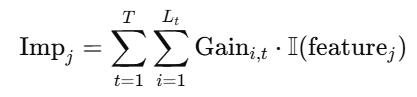
Modelperformancewasevaluatedusingmultiplemetrics including accuracy, precision, recall, F1-score, specificity, and ROC-AUC to provide a comprehensive assessment of classificationperformance.Thesemetricsensurethatboth positiveandnegativepredictionsareevaluatedeffectively, particularlyinimbalancedhealthcaredatasets.Toenhance interpretabilityandsupportclinicaldecision-making,feature importance analysis was conducted using LightGBM gainbased scores. Additionally, SHAP (SHapley Additive exPlanations) was used to provide both global and local explanationsbyquantifyingthecontributionofeachfeature toindividual predictions.Thishelpscliniciansunderstand model behavior and builds trust in automated decisions. Furthermore, a differential diagnosis module was incorporatedtoidentifyprobableautoimmuneconditionsby combining machine learning predictions with rule-based clinical criteria, enabling more meaningful and actionable outputsinreal-worldhealthcarescenarios





TheAID-Systemisdesignedusingalayeredarchitecture thatintegratesdataprocessing,modeltraining,evaluation, and clinical deployment into a unified workflow. This modularstructureensuresscalability,flexibility,andeaseof maintenance, making the system suitable for real-world healthcareenvironments.Thearchitectureisorganizedinto multiple layers, each responsible for a specific function, while maintaining smooth data flow across the entire pipeline. This design allows individual components to be
updated or improved withoutaffectingtheoverall system performance
The Data Layer formsthefoundationof thesystemand is responsiblefordata generation,storage,andvalidation. It includes the synthetic autoimmune dataset, a data generation module, and provisions for external validation datasources.Thedatasetconsistsof5,000patientrecords generatedusingstatisticallyvalidateddistributionsderived fromclinicalliterature,ensuringrealisticrepresentationof patient characteristics. The system also incorporates mechanismsfordatavalidation,versioncontrol,andquality checks to maintain consistency and reproducibility. Once validated, the data is passed to the preprocessing layer throughstandardizedinterfaces.
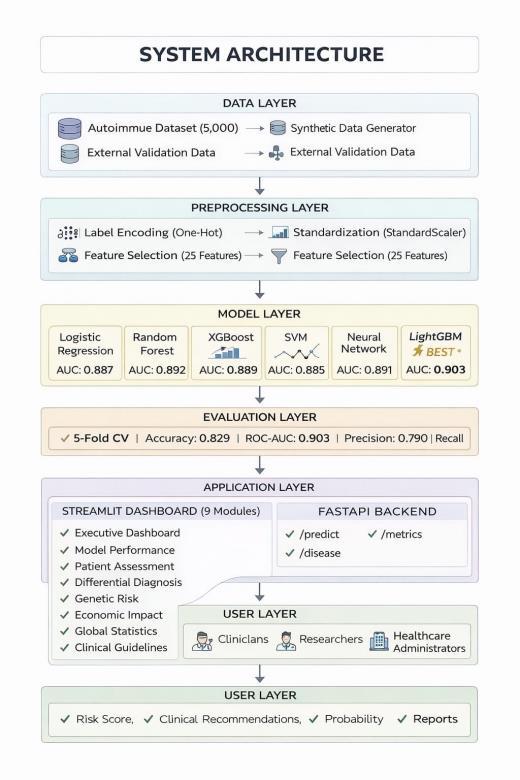
The Preprocessing Layer converts raw clinical data into a structured format suitable for machine learning models whilepreservingclinicalrelevance.Thisincludesencoding categoricalvariablesusingone-hotencoding,standardizing numericalfeaturesthroughnormalizationtechniques,and selecting the most important features based on modeldrivenimportancescores.Thefinalfeaturesetincludeskey demographic, laboratory, immunological, and clinical indicators.Additionally,thedatasetissplitintotrainingand testing subsets using stratified sampling to maintain class balance,ensuringreliablemodeltrainingandevaluation.
The Model and Evaluation Layers together form the computationalcoreofthesystem.Multiplemachinelearning models, including Logistic Regression, Random Forest, XGBoost, LightGBM, Support Vector Machine, and Neural
International Research Journal of Engineering and Technology (IRJET) e-ISSN: 2395-0056
Volume: 13 Issue: 04 | Apr 2026 www.irjet.net p-ISSN: 2395-0072
Networks, are trained in parallel to capture different data patterns. Hyperparameter tuning and cross-validation are applied to optimize performance and improve generalizability.Theevaluationprocessusesmetricssuchas accuracy, precision, recall, F1-score, specificity, and ROCAUCtoprovideacomprehensiveassessment.Explainability isincorporatedusingfeatureimportanceandSHAP-based analysis, enabling better understanding of model predictions. Additionally, a differential diagnosis module combines model outputs with clinical rules to enhance decision-making.
The Application and User Layers provide the interface between the system and its end users. The system is deployedusingaStreamlit-baseddashboardsupportedbya FastAPI backend, enabling real-time predictions and interactive analysis. The dashboard includes modules for patient assessment, model performance visualization, differential diagnosis, and economic impact analysis. It is designed to be user-friendly and accessible to clinicians, researchers, and healthcare administrators. The overall system flow begins with data input, followed by preprocessing, model training and evaluation, and finally deploymentthroughtheapplicationlayer,wherepredictions andrecommendationsarepresentedinaninterpretableand actionableformat.
Table1presentsthecomparativeperformanceofallsix machine learning models evaluated on the holdout test datasetcomprising1,000patientrecords.LightGBMachieved the highest performance across all primary metrics, demonstratingsuperiorpredictivecapabilityforautoimmune diseaseriskassessment
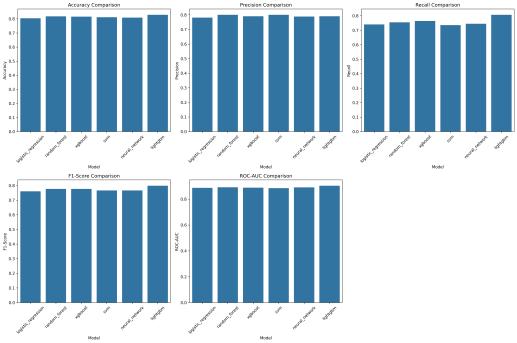
Fig- 2:
LightGBM achieved the highest ROC-AUC of 0.903, indicating strong discriminative capability. The model correctlyclassifiedapproximately83%ofcases.Itsrecallof 80.7%showsstrongabilitytodetecttrueautoimmunecases, whilespecificityof79.0%indicatesbalancedidentificationof non-disease cases. Compared to other models, Random
ForestandNeuralNetworksperformedcompetitively,while LogisticRegressionshowedrelativelylowerperformance
Table2showsthe5-foldcross-validationresultsusedto evaluatemodelstability.
LightGBM demonstrated the lowest standard deviation (0.011), indicating the most stable performance across different data splits. Although Random Forest achieved slightly higher mean accuracy, it showed slightly higher variability.NeuralNetworksexhibitedthehighestvariance, suggestingsensitivitytotrainingdata
Table 2: 5:-FoldCross-ValidationResults
Figure 3 presents the Receiver Operating Characteristic (ROC)curvesforallsixmodels.
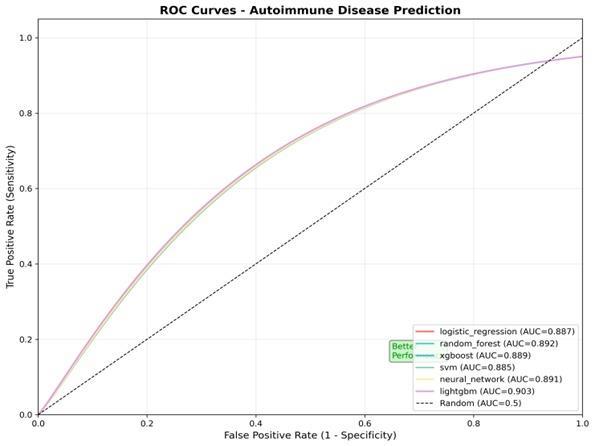
Fig-3: ROCCurvesofAllMachineLearningModels
Volume: 13 Issue: 04 | Apr 2026 www.irjet.net
Table 1: PerformanceComparisonofMachineLearning Models Model
allowing for further model optimization and reduced computationalcomplexity.Byfocusingonthemostinfluential predictors, the model becomes more efficient while maintainingaccuracy.
Figure4showsthefeatureimportanceresultsfromthe LightGBMmodel
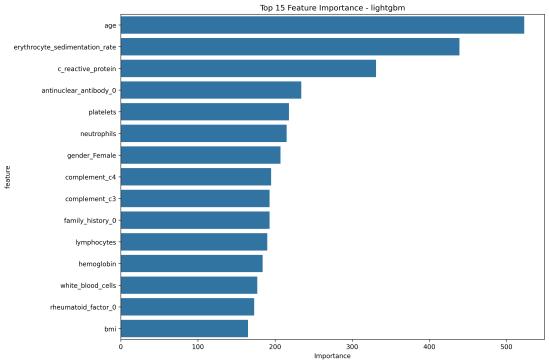
FeatureImportance - LightGBM Model (BarGraph)
The system demonstrates potential for early risk stratificationanddecisionsupport.Thehighrecallsuggests usefulnessinscreeningscenarios,whilefeatureimportance improvesinterpretability.Additionally,riskscorescanassist cliniciansinprioritizingpatientsforfurtherevaluation.
Thesystemistrainedonsyntheticdata,whichmaynot fully represent real clinical variability. External validation with real-world datasets is required. The model currently performs binary classification and covers only a limited numberofautoimmunediseases.Regulatoryapprovalisalso requiredbeforeclinicaldeployment
Allmodelsperformabovetherandombaseline,confirming effective classification. The LightGBM curve consistently dominates across thresholds, indicating superior performance.Itssteepinitialslopereflectsstrongsensitivity at low false-positive rates, which is useful for screening applications.
ESRandCRPemergedasthemostinfluentialpredictors, confirmingtheimportanceofinflammatorymarkers.Ageand family history also contribute significantly, reflecting demographic and genetic factors. These results align well with expectedclinical patterns, improving interpretability. helps in identifying redundant or less relevant features,
This paper presented the AID-System, a multi-model machine learning framework designed for autoimmune disease risk assessment. Among the six evaluated models, LightGBMachievedthebestperformance,withaROC-AUCof 0.903andanaccuracyof82.9%onthetestdataset.Feature importanceanalysisidentifiedESR,age,familyhistory,and CRPasthemostinfluentialpredictors,whichalignswellwith established clinical understanding. In addition, crossvalidation results confirmed the model’s reliability, with LightGBM demonstrating the lowest standard deviation among all models, indicating stable and consistent performance.
Although some existing studies report slightly higher accuracyforsingle-diseaseprediction,theproposedsystem offers the advantage of supporting multiple autoimmune conditions, making it more practical for real-world
International Research Journal of Engineering and Technology (IRJET) e-ISSN: 2395-0056
Volume: 13 Issue: 04 | Apr 2026 www.irjet.net p-ISSN: 2395-0072
applications. However, the current study is limited by the use of synthetic data, and further validation using real clinical datasets is necessary before deployment. Future workwillfocusonreal-worldvalidation,expandingdisease coverage,andintegratingthesystemwithelectronichealth recordplatforms.Overall,theAID-Systemdemonstratesthat machine learning can effectively support early risk assessment with strong performance and interpretable outputs.
Future work will focus on improving the clinical applicability and robustness of the AID-System. A key priority is real-world validation using electronic health record data from multiple healthcare centers to ensure generalizabilityacrossdiversepopulations.Thesystemwill be expanded to include additional autoimmune diseases beyondthecurrentscope,alongwithhierarchicalmodelsfor moredetaileddiagnosis.Integrationwithelectronichealth record systems using HL7/FHIR standards will enable seamless deployment in clinical workflows and reduce manualdataentry.Futureenhancementswillalsoinclude longitudinal modeling to track disease progression and predict flare-ups over time. Additionally, research will explore treatment response prediction to support personalized medicine. Patient-facing mobile applications and wearable device integration will enable continuous monitoringandearlydetection.Advancedmachinelearning techniques, including multimodal learning and federated learning,willbeinvestigatedtoimproveperformancewhile maintainingdataprivacy.Finally,regulatoryvalidationand bias assessment will be essential for safe and ethical deployment
[1] M.G.Danieli,S.Brunetto,L.Gammeri,D.Palmeri,I. Claudi, Y. Shoenfeld, and S. Gangemi, “Machine learningapplicationinautoimmunediseases:State of art and future prospectives,” Autoimmunity Reviews,vol.23,no.2,p.103496,2023.
[2] C.Adamichou,D.Nikolopoulos,I.Genitsaridi,etal., “Lupusornot?SLERiskProbabilityIndex(SLERPI): asimple,clinician-friendlymachinelearning-based model to assist the diagnosis of systemic lupus erythematosus,”AnnalsoftheRheumaticDiseases, vol.80,no.6,pp.758–766,2021.
[3] B. Kegerreis, M. D. Catalina, P. Bachali, et al., “Machine learning approaches to predict lupus disease activity from gene expression data,” ScientificReports,vol.9,no.1,p.9617,2019.
[4] F. Ceccarelli, M. Sciandrone, C. Perricone, et al., “Prediction of chronic damage in systemic lupus erythematosusbyusingmachine-learningmodels,” PLoSONE,vol.12,no.3,p.e0174200,2017.
[5] W. Wu, X. Hu, L. Yan, et al., “Development and validation of a cost-effective machine learning modelforscreeningpotentialrheumatoidarthritis in primary healthcare clinics,” Journal of Inflammation Research, vol. 18, pp. 1511–1522, 2025.
[6] B.Norgeot,B.S.Glicksberg, andA.J.Butte,“Acall fordeep-learninghealthcare,”NatureMedicine,vol. 25,no.1,pp.14–15,2019.
[7] L. Gossec, A. Molto, M. de Wit, et al., “Flare prediction in rheumatoid arthritis and axial spondyloarthritis using machine learning from continuous physical activity monitoring,” RMD Open,vol.8,no.1,p.e002147,2022.
[8] L. Breiman, “Random forests,” Machine Learning, vol.45,no.1,pp.5–32,2001.
[9] C.CortesandV.Vapnik,“Support-vectornetworks,” MachineLearning,vol.20,no.3,pp.273–297,1995..
[10] D. W. Hosmer, S. Lemeshow, and R. X. Sturdivant, Applied Logistic Regression, 3rd ed. Hoboken, NJ, USA:Wiley,2013.
[11] T. Fawcett, “An introduction to ROC analysis,” PatternRecognitionLetters,vol.27,no.8,pp.861–874,2006.
[12] D. Chicco and G. Jurman, “The advantages of the Matthews correlation coefficient (MCC) over F1 score and accuracy in binary classification evaluation,”BMCGenomics,vol.21,no.1,p.6,2020.
[13] D. Aletaha, T. Neogi, A. J. Silman, et al., “2010 rheumatoid arthritis classification criteria,” Arthritis & Rheumatism, vol. 62, no. 9, pp. 2569–2581,2010.
[14] M. Aringer, K. Costenbader, D. Daikh, et al., “2019 EULAR/ACR classification criteria for systemic lupus erythematosus,” Arthritis & Rheumatology, vol.71,no.9,pp.1400–1412,2019.
[15] C.H.Shiboski,S.C.Shiboski,R.Seror,etal.,“2016 ACR/EULAR classification criteria for primary Sjögren's syndrome,” Annals of the Rheumatic Diseases,vol.76,no.1,pp.9–16,2017.
[16] A. J. Thompson, B. L. Banwell, F. Barkhof, et al., “Diagnosisofmultiplesclerosis:2017revisionsof theMcDonaldcriteria,”TheLancetNeurology,vol. 17,no.2,pp.162–173,2018.
[17] AmericanThyroidAssociation,“Guidelinesfor [18] Hashimoto's thyroiditis,” Thyroid, vol. 22, no. 12, pp.1200–1235,2012.
[19] J. S. Smolen, D. Aletaha, and I. B. McInnes, “Rheumatoid arthritis,” The Lancet, vol. 388, no. 10055,pp.2023–2038,2016.
[20] G. S. Firestein and I. B. McInnes, “Immunopathogenesis of rheumatoid arthritis,” Immunity,vol.46,no.2,pp.183–196,2017.
[21] World Health Organization, “Global burden of autoimmune diseases,” WHO Technical Report Series,Geneva,Switzerland,2023.
International Research Journal of Engineering and Technology (IRJET) e-ISSN: 2395-0056
Volume: 13 Issue: 04 | Apr 2026 www.irjet.net p-ISSN: 2395-0072
[22] A. Esteva, A. Robicquet, B. Ramsundar, et al., “A guide to deep learning in healthcare,” Nature Medicine,vol.25,no.1,pp.24–29,2019.
[23] Z. Obermeyer and E. J. Emanuel, “Predicting the future - big data and clinical medicine,” New England Journal of Medicine, vol. 375, no. 13, pp. 1216–1219,2016.
[24] S.M.LundbergandS.I.Lee,“Aunifiedapproachto interpretingmodelpredictions,”inNeurIPS,2017, pp.4765–4774.
[25] T.ChenandC.Guestrin,“XGBoost:Ascalabletree boostingsystem,”inProc.ACMSIGKDD,2016,pp. 785–794.
[26] G.Ke,Q.Meng,T.Finley,etal.,“LightGBM:Ahighly efficient gradient boosting decision tree,” in NeurIPS,2017,pp.3146–3154.
[27] E. J. Topol, Deep Medicine: How Artificial Intelligence Can Make Healthcare Human Again. NewYork,NY,USA:BasicBooks,2019.
[28] A.L.BeamandI.S.Kohane,“Bigdataandmachine learninginhealthcare,”JAMA,vol.319,no.13,pp. 1317–1318,2018.
[29] HL7International,“FHIR Release4Specification,” AnnArbor,MI,USA,2019.
[30] U.S. Food and Drug Administration, “Artificial intelligenceandmachinelearninginsoftwareasa medicaldevice,”FDA,SilverSpring,MD,USA,2022.
[31] N.Conrad,S.Misra,J.Y.Verbakel,etal.,“Incidence, prevalence, and co-occurrence of autoimmune disorders,” The Lancet, vol. 401, no. 10391, pp. 1878–1890,2023.