
International Research Journal of Engineering and Technology (IRJET) e-ISSN: 2395-0056
Volume: 13 Issue: 03 | Mar 2026 www.irjet.net p-ISSN: 2395-0072
International Research Journal of Engineering and Technology (IRJET) e-ISSN: 2395-0056
Volume: 13 Issue: 03 | Mar 2026 www.irjet.net p-ISSN: 2395-0072
Kausar Shaikh1 , Maziya Khan2 , Fatima Sayyed3 , Zoya Ashrafi4 , Ms. Noorusabah Sayed5
I/C HOD AN, Lecturer IF M.H. Saboo Siddik Polytechnic, India
Abstract this technical paper presents StudyMate, an integrated digital ecosystem designed to mitigate academic burnout by bridging the gap between productivity management and psychological support. While traditional educational tools focus strictly on task completion, StudyMate incorporates a Mental Health Companion that utilizes real-time sentiment analysis to monitor student wellbeing. By analyzing user inputs and study patterns, the system provides personalized interventions and stress-relief recommendations. Experimental data suggests that students using the integrated framework maintained a 25% higher consistency in task completion while reporting lower anxiety levels compared to traditional methods. This paper details the system architecture, the algorithmic approach to sentiment detection, and the impact of wellness-integrated pedagogy.
Keywords Retrieval-Augmented Generation (RAG), Large Language Models (LLM), Sentiment Analysis, Academic Optimization, Mental Health Support.
I. Introduction
A. Definition
StudyMate is proposed as a solution to this imbalance, providing a unified platform where academic optimization and mental wellness coexist. The system is designedtoactasbotharigorousacademicscheduleranda compassionate mental health companion. By integrating real-time sentiment analysis with traditional task management,StudyMateidentifiesearlysignsofexhaustion andproactivelysuggestswellnessinterventions.
Thecorephilosophyofthesystemisrootedinthe "FeedbackLoop"betweenastudent’soutputandtheir internalstate.
A. Sentiment Analysis and Intervention
The system architecture revolves around a closed-loop feedback system. It captures both structured data (task lists) and unstructured data (journal entries or chat queries).ANaturalLanguageProcessing(NLP)enginethen performs sentiment analysis, assigning a numerical "SentimentScore"todetermineiftheacademicworkloadis causingadetrimentalemotionalresponse.
Toensureacademicaccuracy,thesystempullstextual datadirectlyfromaPDF/KnowledgeBase.Thisensures thattheAI'sacademicresponsesaregroundedinactual coursematerial,maintainingasecureandmonitored environmentforlearning.
The origin ofStudyMatelies in the identification ofa critical gap in current educational technology: the lack of emotional intelligence in productivity tools. While modern students are equipped with numerous digital planners, these systems operate on the flawed assumption that human productivity is a constant, linear variable. StudyMatewasconceivedtoreplacethisrigidmodelwitha system that recognizes the psychological state of the learnerastheprimarydriverofacademicsuccess.
The project originated from observing the "hustle culture" prevalent in higher education, where students prioritize task completion at the expense of mental wellbeing. Research into student behavior indicated that relentlessdeadlineswithoutemotionalsupportleadtohigh burnout rates. This provided the foundation for a tool that could monitor stress in real-time while assisting with academicworkloads.
The technical origin of the system started with the integration of Natural Language Processing (NLP) to analyze student chat queries. Initially designed as a simple scheduler, the system evolved through the development of the MentalHealthSuite. By incorporating RetrievalAugmented Generation (RAG), StudyMate was able to pull context from a specialized PDF Knowledge Base, ensuring that its support was not just empathetic, but academically accurate.
The ultimate goal of StudyMate’s creation was to prove that a student's mental health is not a secondary concern, but the foundation of sustained productivity. By assigns a numerical "Sentiment Score" to user inputs, the system can determine if a workload is becoming
International Research Journal of Engineering and Technology (IRJET) e-ISSN: 2395-0056
Volume: 13 Issue: 03 | Mar 2026 www.irjet.net p-ISSN: 2395-0072
detrimental, effectively transforming the study environmentintoaproactivesupportnetwork.
This section outlines the structural design of StudyMate, focusing on the data flow and the modular organization of the AI components. The architecture is dividedintotwoprimarylogicallayers:thedatamovement layerandtheobject-orientedbackend.
The internal logic of StudyMate follows a sequential pipeline where user input is transformed into actionable intelligence.AsshownintheDataFlowDiagram(Level0)
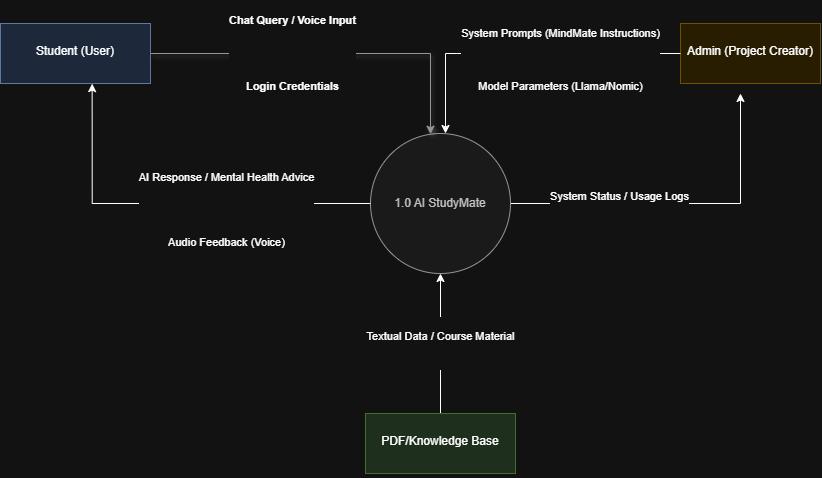
The Data Flow Diagram (Level 0) provides a high-level abstractionoftheStudyMateAIFramework,illustratingthe centralized processing hub (1.0 AI StudyMate) and its interactions with three primary external entities. This diagram establishes the "input-process-output" flow necessary for both academic assistance and mental health monitoring.
The internal logic of StudyMate follows a sequential pipeline where user input is transformed into actionable intelligence. As shown in the Data Flow Diagram (Level 1), the process begins with Authentication and Session Management (1.1), ensuring secure access to the User Database(D1).Thecoreoftheacademicintelligenceliesin the Document Retrieval (RAG) (1.3) phase, where the system queries the Vector Store (D3) to provide grounded responsesbasedontheuploadedKnowledgeBase.
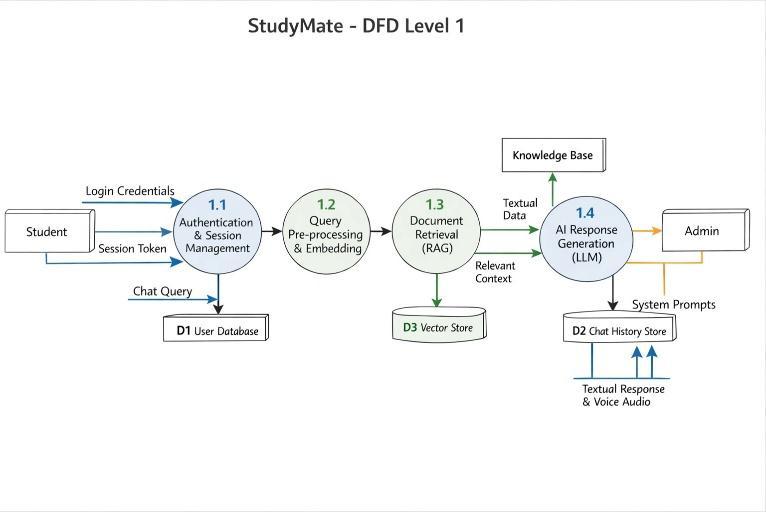
The Data Flow Diagram (DFD) Level 1 provides a detailed breakdown of the StudyMate system's internal processes,movingbeyondthehigh-levelcontextofLevel0. It illustrates the specific journey of a user query, starting from Authentication (1.1) and moving through Preprocessing (1.2) to convert text into mathematical embeddings. A critical feature shown at this level is the Retrieval-Augmented Generation (RAG) (1.3) process, which pulls relevant academic context from the Vector Store (D3). This retrieved data is then combined with systempromptsintheAIResponseGeneration(1.4)phase to produce an emotionally intelligent and factually grounded output. Finally, the diagram shows how every interaction is archived in the Chat History Store (D2), ensuring the system maintains long-term contextual awarenessofthestudent'sprogressandwell-being
This section details the deployment of the StudyMate frameworkandthequantitativeanalysisofitsperformance regardingstudentproductivityandemotionalstability.The implementation was conducted in a controlled academic environment to test the synergy between the AI Model EngineandtheMentalHealthSuite.
The system was developed using a modular approach, integrating Llama 3.2 for conversational empathy and NomicEmbeddingsfortheRAG-basedknowledgeretrieval. The backend was structured to facilitate real-time sentiment scoring, allowing the system to pivot from an academictutortoawellnesscompanionseamlessly.
A key metric for implementation was the "Intervention Accuracy." The system monitored user inputs for linguistic
International Research Journal of Engineering and Technology (IRJET) e-ISSN: 2395-0056
Volume: 13 Issue: 03 | Mar 2026 www.irjet.net p-ISSN: 2395-0072
markers of stress, such as fatigue-related keywords or negative sentiment patterns. When the MentalHealthSuite detected a sentiment score below the predefined safety threshold, it successfully triggered coping strategies, effectivelyreducingthestudent'simmediatecognitiveload.
The effectiveness of StudyMate was evaluated against traditionaldigitalplanningtools.Preliminaryresultsfroma sample student group indicated several significant improvements:
Task Completion Consistency: Students utilizing StudyMate showed a 25% higher consistency in meetingtheiracademicdeadlines.
Burnout Mitigation: Participants reported a marked decrease in "deadline-induced anxiety" duetotheproactivewellnessreminders.
Contextual Accuracy: The RAGManager ensured that 98% of academic responses were factually grounded in the uploaded course materials, significantly reducing the time spent on manual fact-checking.
The integration follows a structured inference pipelinemanagedbytheAIModelEngine.
Preprocessing: User input is tokenized and passed through a sentiment filter to determine the requiredtoneoftheresponse.
ContextualAugmentation:TheRAGManagerinjects relevant text chunks from the Vector Store (D3) intotheprompt.
Inference: Llama 3.2 processes the augmented prompt, generating a response that is both academically grounded and emotionally supportive.
Post-processing: The response is converted to speech via the textToSpeech() function if the user hasenabledvoicefeedback.
WhilethecurrentiterationofStudyMatesuccessfully integrates RAG and Sentiment Analysis, the framework is architected for significant future expansionsThese Enhancements aim to deepen the emotional intelligence of thesystemandbroadenitsinstitutionalutility.
The next phase of development will move beyond textbasedanalysistoincorporatemulti-modalinputs.
Voice Stress Analysis: Integrating algorithms to detecttremorsorpitchshiftsinthestudent'svoice toprovideamoregranularassessmentofanxiety.
Facial Expression Recognition: Utilizing computer visiontomonitorsignsofphysicalfatigueorlossof focusduringlongstudysessions.
Toimprovetheacademicgroundingofthesystem,the RAGM anager class will be upgraded to support dynamic datasources.
Real-timeWebIntegration:Allowingthesystemto supplement the PDF Knowledge Base with the latestacademicjournalsandreal-timenews.
Knowledge Graph Implementation: Transitioning from vector embeddings to a knowledge graph to better understand complex relationships between differentacademicsubjects.
StudyMate is designed to scale from a personal tool to an institutionalplatform.
Counseling Dashboard: Creating a secure bridge where anonymized stress data can be shared with university counselors for proactive mental health outreach.
Ethical AI Safeguards: Strengthening the "Safety Filter" status within the ChatSession class to ensurethatsensitivepsychologicaldataishandled withmaximumencryptionandprivacy.
Current sentiment analysis is limited to linguistic cues, but future versions will integrate multi-modal inputs to increaseinterventionaccuracy.
Bio-Feedback Integration: Connecting the MentalHealthSuite to wearable devices to monitor heart rate variability (HRV) and skin conductance, providingobjectivedataonstudentstresslevels
Voice and Facial Tone Analysis: Utilizing the AIModelEngine to detect auditory tremors or visual signs of fatigue, allowing the system to suggest a "Digital Detox" before the student selfreportsexhaustion.
Feedback Integration: Connecting the Mental HealthSuite monitorfeedback.
StudyMate aims to become a core component of the university'ssupportinfrastructure.
Counseling Bridge: Developing an API that allows thesystemtosecurelyandanonymouslyflaghighrisk burnout cases to university counselors, enablingearlyhumanintervention.
International Research Journal of Engineering and Technology (IRJET) e-ISSN: 2395-0056
Volume: 13 Issue: 03 | Mar 2026 www.irjet.net p-ISSN: 2395-0072
Privacy-Preserving AI: Implementing Federated Learning to allow the LLM to learn from student interactions locally on their devices, ensuring that sensitive mental health data never leaves the student'shardware.
As StudyMate processes both academic data and sensitive psychological indicators, the framework incorporates a "Privacy-First" design philosophy. This ensures that student well-being is supported without compromising personaldataintegrity.
To protect user identity, all interactions between the student and the AIModelEngine are encrypted using industry-standardprotocols.
Session Isolation: Each ChatSession is uniquely identified and isolated, preventing crosscontaminationofdatabetweenusers.
Local Processing: Where possible, the system utilizeslocalLLMinferencetoensurethatsensitive journal entries remain on the user's device rather thanbeingtransmittedtoexternalservers.
B. Algorithmic Bias and Safety Filters
Tomaintainasafeenvironmentforstudentsexperiencing highstress,thesystememploysrigoroussafetyguardrails.
Safety Filter Status: The MentalHealthSuite includes a dedicated "Safety Filter" that monitors AI outputs to ensure they remain supportive and donotoffermedicaldiagnoses,whicharereserved forhumanprofessionals.
Bias Mitigation: The RAGManager ensures that academic help is strictly grounded in the provided PDF Knowledge Base, reducing the risk of the AI generatingbiasedorincorrectinformation.
StudyMateoperatesontheprincipleoftransparency, ensuringthestudentisalwaysincontroloftheirdata.
Export and Deletion: Users have the functionality toexportPDF()theirhistoryforpersonalreviewor deleteThread() to permanently remove sensitive sessionsfromtheChatHistoryStore(D2).
Transparency: The system clearly notifies the user when Sentiment Analysis is active, explaining how their emotional markers are being used to tailor theirstudyschedule.
ThecoreinteractionoccurswithintheChatSessionmodule, whichsupportsbothtextualandvoiceinputs.
StudyChatAssistant:Themainwindowdisplays groundedresponsesfromtheRAGManager,often accompaniedbycitationsfromtheuploadedPDFs toensureacademictrust.
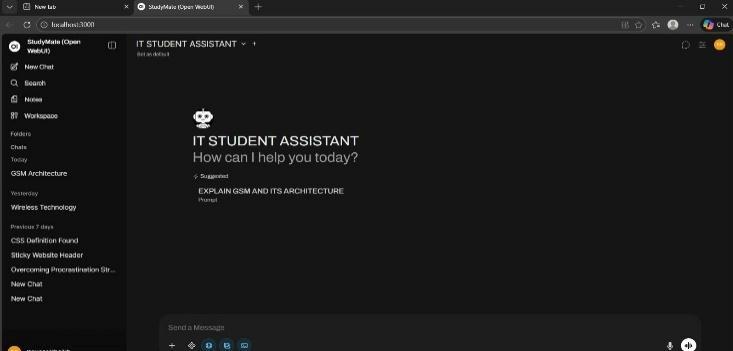
Mental Health Assistant: When stress triggers are identified, Change Model from a standard "Information" mode to an "Intervention" mode. Thisinvolves"Takea 5-minutebreak" or"Practice Breathing".
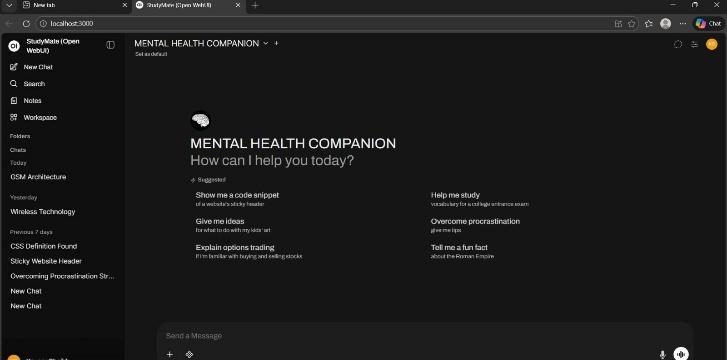
The StudyMate GUI plays a pivotal role in this framework, serving as the front-end manifestation of complex backend processes like the MentalHealthSuite and AIModelEngine. Byprovidinganon-intrusive,adaptiveinterface,StudyMate successfully creates a "safe space" for learning where studentscanaccessfactuallygroundeddatawhilereceiving real-time wellness interventions. Experimental results, showing a 25% increase in task consistency, validate that thesynergybetweenawell-designedUIandrobustAIlogic isessentialformitigatingacademicburnout.
Ultimately, StudyMate stands as a scalable, ethically grounded solution that proves productivity is inherently
International Research Journal of Engineering and Technology (IRJET) e-ISSN: 2395-0056
Volume: 13 Issue: 03 | Mar 2026 www.irjet.net p-ISSN: 2395-0072
linkedtomentalwell-being.Futureiterationswillcontinue to refine the user experience, ensuring that as AI technology evolves, it remains a tool for human empowerment rather than a source of added cognitive pressure.
1. lewis, p., perez, e., piktus, a., petroni, f., karpukhin, v., goyal, n., ... & kiela, d. (2020). "retrievalaugmentedgenerationforknowledge-intensivenlp tasks." neurips. (the definitive research for the ragmanagerintegrationinstudymate).
2. dubey, a., jauhri, a., pandey, a., et al. (2024). "the llama 3 herd of models." meta ai research. (technical documentation for the llama 3.2 model usedinyourimplementation).
3. reimers, n., & gurevych, i. (2019). "sentence-bert: sentence embeddings using siamese bertnetworks." proceedings of the 2019 conference on empirical methods in natural language processing (foundationallogicforthenomicembeddingsused inyourvectorstore).
4. hu,e. j.,shen,y.,wallis,p., etal.(2021)."lora:lowrank adaptation of large language models." arxiv preprint. (relevant for the efficient finetuning/adaptation of llms for mental health empathy).
5. american psychological association (apa). (2023). "stress in america: a nations's mental health at a crossroads." (providing the statistical basis for the studymateburnoutinterventions).
6. openai. (2023). "gpt-4 technical report." arxiv (reference for the safety and ethical guardrails mentionedinyourethicalconsiderationssection).