
International Research Journal of Engineering and Technology (IRJET) e-ISSN: 2395-0056
Volume: 13 Issue: 03 | Mar 2026 www.irjet.net p-ISSN: 2395-0072
International Research Journal of Engineering and Technology (IRJET) e-ISSN: 2395-0056
Volume: 13 Issue: 03 | Mar 2026 www.irjet.net p-ISSN: 2395-0072
Nayab Ansari1 , Rozina Ansari2 , Samiya Patel3, Zia Shaikh4, Ms. Sameera Khan5
1,2,3,4Department of Information Technology
5Project Guide & HOD I/C HOD IF, Lecturer IF, MHSSP Department of Information Technology M. H. Saboo Siddik Polytechnic, Mumbai, India
Abstract - In today’s digital era, people face increasing skin-related problems due to pollution,unhealthylifestyle,and lack of proper dermatological guidance. Manyindividualsrely on online advice or expensive consultations that may not provide personalized solutions. This paper presents the AI Skincare Advisor System, an intelligentweb-basedapplication that analyzes facial skin images and user inputs to provide personalized skincare recommendations. The system uses Image Processing and Machine Learning algorithms to detect skin type and common conditions such as acne, pigmentation, dryness, and sensitivity. Based on analysis, the system recommends suitable skincare routines and products. The proposed system aims to make dermatological guidance affordable, accessible, and efficient for everyone.
Key Words: Artificial Intelligence, Image Processing, Machine Learning, Skin Analysis, Personalized Recommendation, Healthcare Technology
A. Definition
Skincareplaysavitalroleinmaintaininghealthyskin and overall personal well-being. However, identifying the correctskincareroutineischallengingduetovariationsin skintypes,environmentalconditions,andindividuallifestyle habits.Traditionaldermatologyservicesofteninvolvehigh consultation costs, long waiting times, and limited accessibility,especiallyinremoteareas.
Toovercometheseissues,theAISkincareAdvisorSystemis proposedasasmartdigitalsolutionthatprovidesautomated and personalized skincare guidance. The system creates a bridgebetweenusersandintelligenthealthcaretechnology by offering instant skin analysis through facial image scanninganduser-providedinformation.
The system uses Image Processing techniques to extract facialskinfeaturesandMachineLearningmodelstoclassify skin type and detect common skin issues. Based on the analysis,thesystemgeneratescustomizedskincareroutines andproductrecommendations.Thisintelligentautomation improves accessibility, reduces cost, and saves time while ensuringreliableskincareguidance.
ThecoreconceptoftheAISkincareAdvisorSystemisbased onanalyzing userskin conditions digitallyand generating personalizedskincaresolutionsusingartificialintelligence.
Thesystemallowsuserstouploadfacialimagesthrougha web interface. The uploaded images are processed using image preprocessing techniques such as noise reduction, resizing, and contrast enhancement. Feature extraction methodsidentifyimportantskincharacteristicsliketexture, pores,acnespots,pigmentation,andwrinkles.
Machine Learning models are trained on dermatological datasetstoclassify:
• Skin Type (Oily, Dry, Normal, Combination, Sensitive)
•SkinConditions(Acne,Pigmentation,DarkSpots,Wrinkles, Dehydration)
This automated detection eliminates the need for manual diagnosis.
Based on the detected skin type and identified skin conditions,theintelligentrecommendationenginegenerates customized skincare guidance for each user. The system analyses concerns such as acne, pigmentation, dark spots, dryness,oiliness,sensitivity,wrinkles,andunevenskintone usingmachinelearningmodels.
Afteranalysingtheuser’sskinprofile,thesystemprovides:
•Thesystemperformsdetectionofspecificskinconcernsby analysingfacialfeaturesandidentifyingconditionssuchas acne,pigmentation,dryness,oiliness,sensitivity,wrinkles, andunevenskintone.
• The system generates personalized skincare routines tailored to individual needs, including daily care, daytime protection, nighttime treatment, and weekly maintenance routinestoensurecomprehensiveskinhealthmanagement.
•Suitableskincareproductrecommendationsbasedonskin type
Therecommendationengineusesdermatology-basedrules combinedwithAI-drivenpredictionmodelstoensurethat
International Research Journal of Engineering and Technology (IRJET) e-ISSN: 2395-0056
Volume: 13 Issue: 03 | Mar 2026 www.irjet.net p-ISSN: 2395-0072
suggestionsaresafe,relevant,andpersonalizedaccordingto individualskinrequirements.
TheoriginoftheAISkincareAdvisorSystemcomesfromthe growing need for affordable and personalized skincare guidance.Manypeoplestruggletochooseproperskincare products due to misleading advertisements, lack of knowledge,andexpensivedermatologicalconsultations.
Theprojectwasdevelopedtoreplaceguess-basedskincare decisions with data-driven intelligent recommendations usingArtificialIntelligence.
A. Problem Identification
Traditional skincare consultation systems face several issues:
•Dermatologyconsultationsarecostlyandunaffordablefor many.
• Personalized skincare guidance is often unavailable.
• Online product promotions can mislead users.
• Identifying the correct skin type is difficult.
•Consultationprocessesaretime-consuming.
ThesechallengescreatetheneedforanautomatedAI-based skincareadvisorysystem.
B. Technological Evolution
Initially, skincare advice was limited to beauty blogs and cosmetic advertisements. With advancements in Artificial IntelligenceandComputerVision,automatedskinanalysis systemsbecamepossible.
TheAISkincareAdvisorevolvedfromsimplequestionnairebasedsystemstointelligentplatformsincorporating:
•Thesystemevolvedtoincorporatefacialimageprocessing techniques for extracting important skin features.
•Advancementsindeeplearningenabledaccuratedetection and classification of various skin conditions.
•Personalizedrecommendationengineswereintroducedto generatecustomizedskincareguidancebasedonindividual skin profiles.
•User-friendlywebinterfacesweredevelopedtoimprove accessibility and user interaction.
• Integration of automated report generation improved analysispresentationanduserunderstanding.
C. Aim and Objectives
Aim:
TodevelopanintelligentAI-basedskincareadvisorysystem thatprovidespersonalizedskincarerecommendationsusing facialimageanalysis.
Objectives:
•Toallowusers touploadfacial imagesfor skinscanning
• To detect skin type using machine learning algorithms
•Toidentifycommonskinproblemsusingimageprocessing
• To provide personalized skincare routines
•Todesignauser-friendlywebinterface
ThissectiondescribesthestructuraldesignoftheAI Skincare Advisor System, focusing on overall system workflow, data flow mechanisms, and architectural organizationofvariousfunctionalmodules.Thearchitecture illustrateshowuserinputsandfacialimagesareprocessed through multiple intelligent components to perform skin analysis and generate personalized skincare recommendationsefficiently.
The AI Skincare Advisor follows a structured workflow whereuserinputsandfacialimagesareprocessedthrough intelligentmodulestogenerateskincarerecommendations.
Process Flow:
User → Image Upload → Image Processing → Feature Extraction→MLModel→SkinAnalysis→Recommendation Engine→ResultDisplay
Thiscentralizedprocessensuresfastandaccurateskincare analysis.
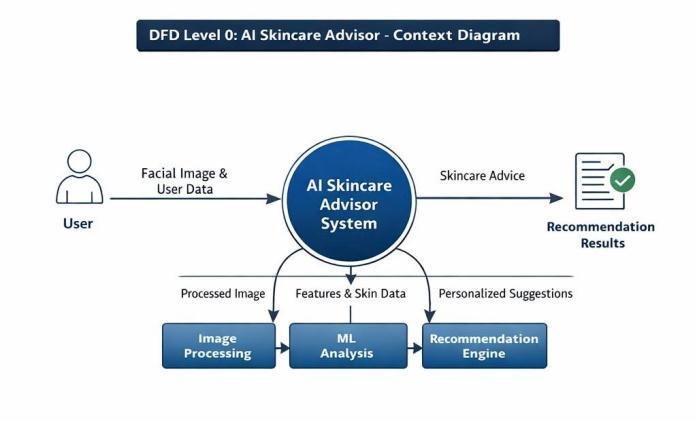
The DFD Level 0 provides a high-level overview of the AI Skincare Advisor System. It shows the system as a single processthatinteractswiththeuser.Theuseruploadsfacial images and provides basic skin information as input. The systemprocessesthisdatausingimageanalysisandmachine learningtechniquestodetectskintypeandconcerns.After processing, the system generates personalized skincare recommendationsanddisplaystheresultstotheuser.
2395-0056
Volume: 13 Issue: 03 | Mar 2026 www.irjet.net p-ISSN: 2395-0072
The internal workflow of the AI Skincare Advisor System followsastructuredprocesswhereuserskininformationis collected, analyzed, and used to generate personalized skincarerecommendations.AsillustratedintheDataFlow Diagram (Level 1), the process begins with Capture User SkinData(1.0),wheretheuserprovidesafacialimage,skin type,andskinconcernsthroughthesysteminterface.This information is captured and stored in the User Profile Database (D1) for record keeping and further processing. ThesystemthenmovestoImageProcessing(2.0),wherethe uploadedfacialimageispreparedforanalysis.Duringthis stage,thesystemperformstaskssuchasfacedetection,skin regionidentification,andimageenhancementtoensurethe image quality is suitable for accurate machine learning analysis. This preprocessing step helps remove noise and improvesthereliabilityoftheanalysis.
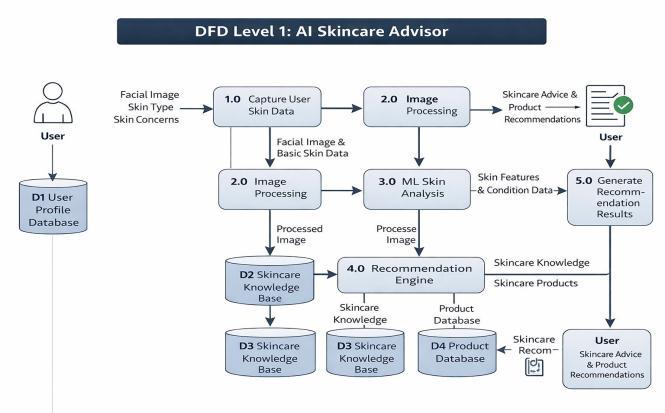
After preprocessing, the system proceeds with ML Skin Analysis(3.0),wheremachinelearningalgorithmsanalyze theprocessedimagetodetectdifferentskinconditionssuch asacne,wrinkles,pigmentation,andotherskinfeatures.The extracted skin data is then forwarded to the RecommendationEngine(4.0),whichcomparestheanalyzed results with the information available in the Skincare KnowledgeBase(D3)andtheProductDatabase(D4).Based on this comparison, the system generates personalized skincare routines and suitable product recommendations that match the user’s skin condition. Finally, the Generate RecommendationResults(5.0)modulecompilestheanalysis resultsandsuggestionsintoaclearoutputthatisdelivered totheuser.Thisorganizedworkflowensuresaccurateskin analysis, efficient processing of user data, and effective delivery of personalized skincare advice through the AIpoweredsystem.
This section describes the implementation of the AI Skincare Advisor System and the technologies used to developtheplatform.
Thesystemwasdevelopedusingamodulararchitecturethat separatesthe frontendinterfacefrom backend processing andAI-basedanalysismodules.
• HTML5 & CSS3 –Usedfordesigningthestructurallayout and visual styling of the web interface.
• Vanilla JavaScript – Enables interactivity, camera handling, file uploads, and communication with backend APIs.
• Tailwind CSS –Autility-firstCSSframeworkusedforrapid and responsive user interface development.
• Lucide Icons – A lightweight SVG icon library used to enhance visual elements of the interface.
• AOS (Animate On Scroll) –AJavaScriptanimationlibrary usedtocreatesmoothscroll-basedentranceeffects.
These technologies were used to build a responsive and user-friendly interface for image uploading, live camera capture,andskincarereportvisualization.
Backend Technologies:
• Python – Used as the core programming language for server-side logic and AI integration.
• Flask Framework –AlightweightPythonwebframework usedtobuildRESTAPIendpointsthathandlerequestsfrom the frontend.
• Flask-CORS – Enables secure Cross-Origin Resource Sharing,allowingcommunicationbetweenseparatelyhosted frontendandbackendservers.
Thebackendmanagesimageprocessingrequests,AImodel execution,andresponsegeneration.
• YOLOv8 (Ultralytics) –Astate-of-the-artcomputervision model used to analyze uploaded facial images. A customtrained YOLO model detects skin conditions such as acne, redness, dark spots, eyebags, wrinkles, and visible pores, along with identifying skin type and tone.
• PyTorch (CPU-only version) –Deeplearningframework used to run YOLOv8 efficiently during deployment while minimizing heavy GPU dependencies.
• OpenRouter API – Utilized during the data preparation phase to generate skincare routines and analyze skincare productingredientsusinglargelanguagemodels.
International Research Journal of Engineering and Technology (IRJET) e-ISSN: 2395-0056
Volume: 13 Issue: 03 | Mar 2026 www.irjet.net p-ISSN: 2395-0072
•Processedimagesanduserreportsaremanagedthrough secureserverstorageandclouddeploymentenvironments.
• Netlify –Hoststhestaticfrontendfilesandprovidesfast global content delivery with continuous deployment support.
• Render –HoststheFlaskbackendAPIserverresponsible for AI processing and image analysis.
• GitHub – Used for version control and codebase management,enablingautomaticdeploymentpipelinesfor bothfrontendandbackendservices.
Thesystemworkflowincludesthefollowingsteps:
• The user registers and logs into the system securely.
•The useruploadsa facial imageorcaptures a live photo using the device camera.
•ThefrontendsendstheimagesecurelytothebackendAPI.
• The backend processes the image and runs the trained YOLOv8 model for skin analysis.
•TheAImodeldetectsskintypeandidentifiesvariousskin conditions.
• The system generates a detailed skin analysis report.
•Personalizedskincareroutines(daily,night,andweekly) and suitable product recommendations are generated.
• The analysis results are sent back to the frontend and displayedtotheuserthroughaninteractivedashboard.
ThisworkflowensuresaccurateAI-drivenskinanalysis,fast processing,andpersonalizedskincareguidancethroughan efficientanduser-friendlysystem.
While the AI Skincare Advisor System effectively performsautomatedskinanalysisandpersonalizedskincare recommendation, the system architecture is modular and scalable, allowing several advanced enhancements in the future. These improvements can significantly increase diagnostic accuracy, user convenience, and system intelligence
One dedicated mobile application for Android and iOS platforms can be developed to improve accessibility and portability.Themobileversionwouldallowuserstocapture facialimagesdirectlyusingsmartphonecamerasandreceive instantskinanalysisresults.Mobileintegrationwouldalso enable real-time notifications, skincare reminders, and progresstracking.Sincesmartphonesarewidelyused,this enhancementwouldexpandthesystem’sreachandimprove userengagement.
Futureversionsofthesystemcanincorporatereal-timeskin analysisusinglivecamerafeeds.Thisfeaturewouldallow continuous monitoring of skin conditions and immediate feedback without requiring manual image uploads. Advancedcomputervisionalgorithmscantrackskintexture changes over time and alert users about worsening skin conditions.Thisenhancementwouldbeespeciallyusefulfor usersundergoinglong-termdermatologicaltreatments.
An AI-powered chatbot can be integrated to provide interactiveskincareconsultation.Thechatbotwouldassist users by answering skincare-related queries, suggesting productusagemethods, providing routine reminders,and educatingusersaboutskincarepractices.NaturalLanguage Processing (NLP) techniques would enable the chatbot to understanduserconcernsandprovideintelligentresponses, therebyimprovinguserexperience.
The system can be integrated with online shopping platformstoallowuserstodirectlypurchaserecommended skincareproducts.Smartproductcomparisonfeaturescould beaddedtodisplayingredientdetails,dermatologistratings, andpricecomparisons.This enhancementwouldincrease convenience and ensure users select safe and suitable skincareproducts.
Future improvements may involve training deep learning modelsonlargedermatologicaldatasetstodetectcomplex skin diseases such as eczema, psoriasis, rosacea, fungal infections, and early-stage skin cancer. Incorporating medicalimagingdatasetswouldtransformthesystemintoa supportivedermatologicaldiagnostictool.
Askinprogress tracking modulecan beadded to monitor improvements over time. The system could compare past andcurrentimagestoevaluatetreatmenteffectivenessand generateprogressreportsusingvisualanalytics.Thiswould helpusersunderstandhowtheirskincareroutineisaffecting theirskinhealth.
Futuresystemsmayusecloud-basedAIservicestoimprove processingspeedandenableautomaticmodelupdates.This would allow large-scale data handling and continuous improvement in detection accuracy through model retraining.
International Research Journal of Engineering and Technology (IRJET) e-ISSN: 2395-0056
Volume: 13 Issue: 03 | Mar 2026 www.irjet.net p-ISSN: 2395-0072
TheAISkincareAdvisorSystemhandlessensitivepersonal dataincludingfacialimagesandhealth-relatedinformation. Therefore, ethical considerations and data protection mechanismsareessentialtomaintainusertrustandsystem reliability.
All user information, including uploaded images and personaldetails,isstoredinencrypteddatabasestoprevent unauthorizedaccess.Advancedencryptionstandardsensure secure storage and transmission of sensitive data. Secure Socket Layer (SSL) protocols can be implemented to safeguardcommunicationbetweenusersandservers.
B. User Privacy Protection
Thesystemstrictlymaintainsuserprivacybyensuringthat facialimagesandanalysisreportsarenotsharedwiththird parties without explicit user consent. Data anonymization techniques may be used when datasets are required for researchormodeltrainingpurposes.
C. Role-Based Access Control
Role-basedauthenticationmechanismsareimplementedto restrictsystemaccess.Regularuserscanuploadimagesand viewanalysisresults,whileadministrativeprivilegessuchas databaseaccess,datasetmanagement,andmodelretraining arerestrictedtoauthorizedpersonnelonly.
AIsystemsmayproducebiasedresultsiftrainedonlimited datasets.Therefore,themodelshouldbetrainedondiverse skin tone and condition datasets to ensure fairness and accuracyacrossdifferentdemographicgroups
8. USER INTERFACE DESIGN AND INTERACTION EXPERIENCE
TheUserInterface(UI)oftheAISkincareAdvisor(Skin Aura)systemisdesignedwithastrongfocusonsimplicity, accessibility, and user engagement. The interface allows userstoeasilyanalysetheirskinandreceivepersonalized skincarerecommendationsusingartificialintelligence.The designemphasizesacleanlayout,intuitivenavigation,and visuallyappealingelements,enablinguserstointeractwith thesystemwithoutrequiringtechnicalknowledge.Through acombinationofAI-poweredanalysistoolsandinteractive features,theplatform ensuresa smoothanduser-friendly skincareconsultationexperience.
Fig. 3 SplashScreen
A. User Interface Features
Theuser-sideinterfaceprovidesanintuitive environment whereindividualscaneasilyanalysetheirskinandreceive customizedskincareroutines.Keyfeaturesinclude:
• Home Interface and Navigation:
The homepage provides users with a welcoming interface that introduces the AI skincare platform. It includes navigation options such as Home, Skin Analysis, Routine Generator, and Popular Products, allowing users to move between different sections of the system easily. The homepage also highlights the core functionality of the systemwithactionbuttonssuchas“AnalyseMySkin”and “CreateRoutine.”
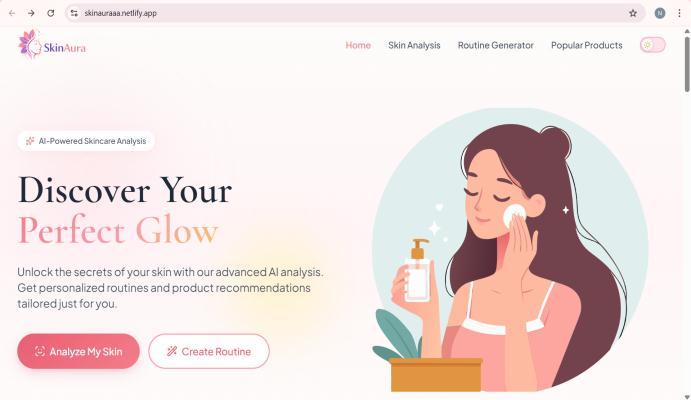
Fig 4: SkinAuraHomepageInterface
• AI Skin Analysis Upload Interface:
UserscanuploadaclearphotooftheirfacetostarttheAIbasedskinanalysis.Theinterfaceallowsuserstoeitherdrag anddropanimage,browseafilefromtheirdevice,orusethe cameraforinstantcapture.Thisfeatureensuresflexibility andeaseofusefordifferentusers.
International Research Journal of Engineering and Technology (IRJET) e-ISSN: 2395-0056
Volume: 13 Issue: 03 | Mar 2026 www.irjet.net p-ISSN: 2395-0072
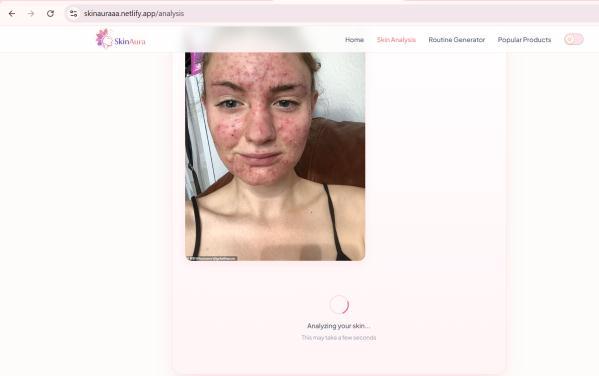
• Skin Analysis Processing Screen:
Once an image is uploaded, the system preprocesses it to enhancequalitythroughresizing,normalization,andnoise reductiontechniques.Theprocessedimageisthenanalysed using advanced machine learning and computer vision algorithms to detect various skin conditions such as acne, pigmentation,darkspots,wrinkles,porevisibility,andskin tone irregularities. Feature extraction methods identify important facial characteristics required for accurate classification. This interactive feedback improves user experiencebyprovidingreal-timeprocessingupdatesand ensuringtransparencyintheanalysisprocedure.
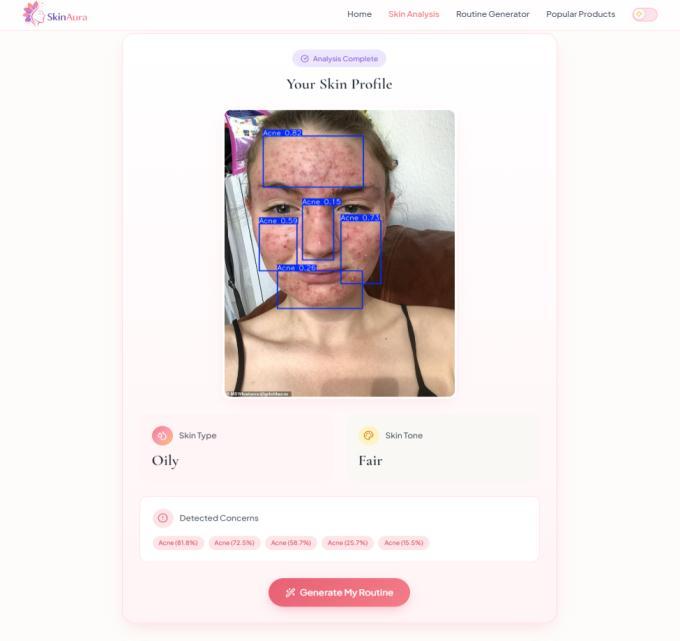
Thesefeaturesprovideuserswithaneasyandinteractive way to upload their images and receive automated skin analysisresults.
B. Recommendation and Product Interface Features
The recommendation interface provides users with personalized skincare routines and product suggestions basedontheAI-drivenskinanalysisresults.Theinterfaceis designedtopresentguidanceinaclear,structured,anduserfriendly manner, enabling users to easily follow the suggestedskincareplan.
• Routine Generator Interface:
Afteranalysingtheuser’sskinprofile,thesystemgeneratesa customized skincare routine tailored to the detected skin typeandspecificskinconcerns.Theroutineincludesstepby-stepguidancefordailyskincaremanagement,covering essentialprocessessuchascleansing,toning,moisturizing, sunprotection,andtargetedtreatments.Thesystemfurther categorizesroutinesintodaytimecare,nighttimecare,and weekly maintenance plans to ensure comprehensive skin healthmanagement.Eachstepisaccompaniedbybriefusage instructions to help users apply products correctly and effectively.
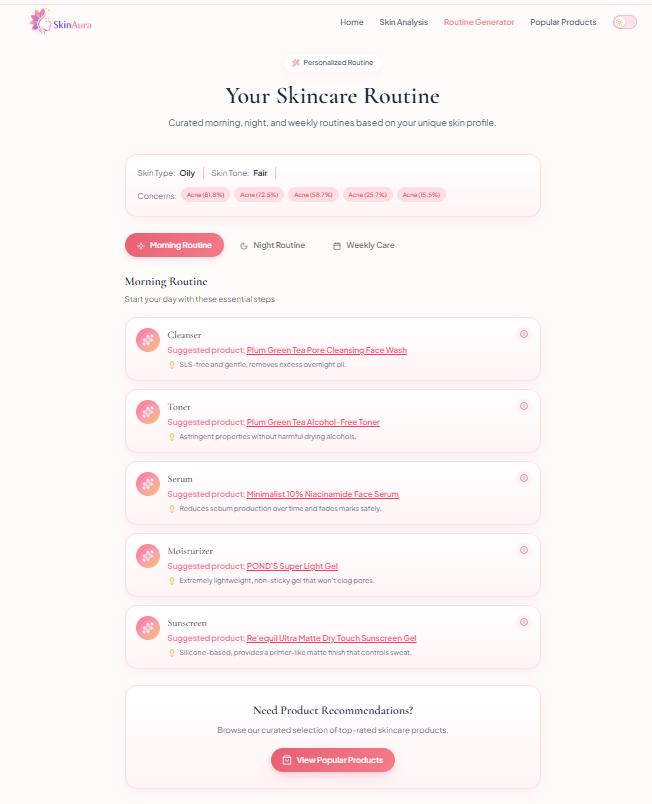
• Popular Products Section:
Thesystemalsoprovidesa PopularProductspage, where users can explore skincare products commonly recommendedfordifferent skinconcerns.Theseproducts help users choose appropriate skincare solutions aligned withtheirAI-generatedskinanalysis.
International Research Journal of Engineering and Technology (IRJET) e-ISSN: 2395-0056
Volume: 13 Issue: 03 | Mar 2026 www.irjet.net p-ISSN: 2395-0072
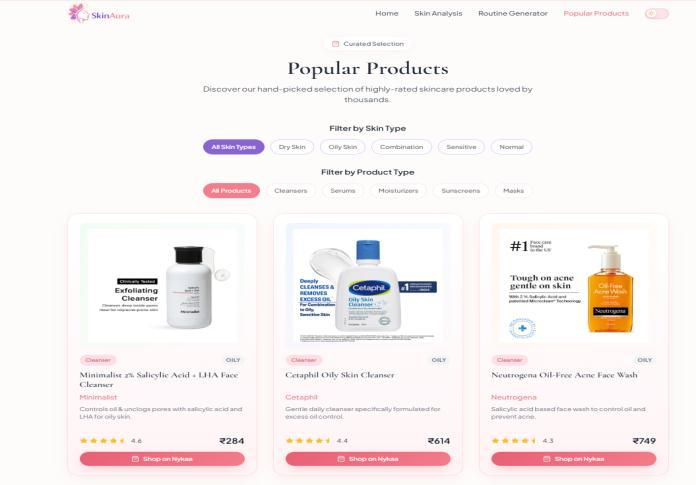
Fig 8: PopularProductScreen
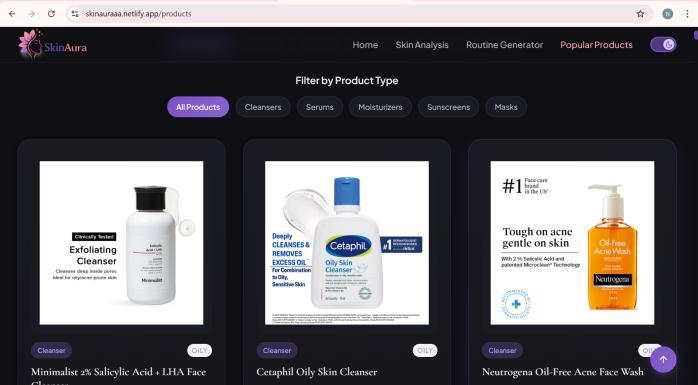
• Interactive Navigation and Theme Controls:
Theinterfaceincludesanavigationmenuandthemetoggle option,allowinguserstoswitchbetweendifferentviewing modesandeasilyaccessvariousfeaturesofthesystem.This improves the overall accessibility and enhances the user experience.
9. CONCLUSION
TheAISkincareAdvisorSystempresentsanintelligent, automated,andaccessiblesolutionforpersonalizedskincare management. By integrating advanced image processing, artificialintelligence,andmachinelearningtechniques,the system accurately analyses facial skin conditions and generates customized skincare routines tailored to individualuserneeds.
The proposed system minimizes dependence on costly dermatologicalconsultationsbyprovidingfast,reliable,and data-driven skincare guidance. Its user-friendly interface, automatedrecommendationengine,andintelligentanalysis modulesensuresmoothinteractionandmaketheplatform suitableforeverydayuse.
Moreover,thescalableandmodulararchitecturesupports future enhancements such as real-time skin monitoring, mobileapplicationintegration,andadvancedskindisease detection using deep learning models. The AI Skincare Advisor System demonstrates the potential of AI-driven healthcaretechnologiestoimprovepersonalwellnessand represents a significant advancement toward smart and intelligentdigitalskincareassistance.
Thesystemalsopromotesawarenessaboutproperskincare practices through personalized guidance and routine management.WithcontinuousimprovementsinAImodels and dataset expansion, the system can achieve higher accuracy and broader dermatological applicability in the future.
[1]I.Goodfellow,Y.BengioandA.Courville,DeepLearning MITPress,2016.
[2]R.C.GonzalezandR.E.Woods,DigitalImageProcessing, 4thed.Pearson,2018.
[3]S.RussellandP.Norvig,ArtificialIntelligence:AModern Approach,4thed.Pearson,2021.
[4]TensorFlow Documentation. [Online]. Available: https://www.tensorflow.org
[5]OpenCV Documentation. [Online]. Available: https://docs.opencv.org
[6]Scikit-learn Documentation. [Online]. Available: https://scikit-learn.org
[7] Python Software Foundation, Python Documentation. [Online]. Available: https://docs.python.org/3/
[8]Flask Documentation. [Online]. Available: https://flask.palletsprojects.com/
[9]Keras Documentation. [Online]. Available: https://keras.io
[10] M. Abadi et al., “TensorFlow: Large-scale machine learning on heterogeneous systems,” 2015. [Online]. Available:https://tensorflow.org