
International Research Journal of Engineering and Technology (IRJET) e-ISSN: 2395-0056
Volume: 12 Issue: 05 | May 2025 www.irjet.net p-ISSN: 2395-0072
International Research Journal of Engineering and Technology (IRJET) e-ISSN: 2395-0056
Volume: 12 Issue: 05 | May 2025 www.irjet.net p-ISSN: 2395-0072
Akshay J1 , Anirudh S Bhat2 , Bhimesh B3, Gururaj4 , Mr. Akhilesh Sathyanarayan5 .
1,2,3,4 Students, Computer Science and Engineering, Jyothy Institute of Technology, Bangalore, India 5 AssistantProfessor, Computer Science and Engineering, Jyothy Institute of Technology, Bangalore, India ***
Abstract - Machine learning's use in healthcare has created new opportunities to support medical diagnosis. In this study, a system that uses user-provided symptoms to forecast diseases is presented. A dataset of symptoms and related disorders is used to train the model using supervised machine learning methods including Support Vector Machine (SVM), Random Forest, and Decision Tree. Users can enter symptoms and get immediate forecasts thanks to an intuitive interface created using Streamlit. By serving as an initial diagnostic tool, this system aims to raise users' awareness of possible health problems. Through the provision of an easy-to-use platform, the system illustrates how machine learning may be incorporated into healthcare processes to enhance health literacy and early diagnosis. Additionally, the modular architecture enables future improvements, enabling it to be tailored to new datasets and medical requirements.
Key Words: AI diagnostics, symptom checker, disease prediction, machine learning, healthcare technology, clinical decision support, medical AI, patient triage, Streamlit application, open-source healthcare
Medical diagnosis frequently calls for in-depth knowledge and meticulous analysis of clinical findings, patient history, and symptoms. However, machine learning has a chance to help with faster and more accurate disease diagnosis given the abundance of health dataalreadyavailable. Thegoalofthisprojectistocreate a system that predicts diseases based on user-input symptomsusingmachinelearningtechniques. Thesystem serves as a first point of reference, directing consumers toward qualified medical assistance as necessary, rather thantryingtoreplacedoctors.
Three machine learning models SVM, Random Forest, and Decision Tree were put into practice and their accuracy and efficiency were evaluated. Users may easily interact with the models thanks to the solution's deploymentviaStreamlit. Thestrategyfocusesonoffering a diagnostic tool that is easy to use, scalable,andaccessible.
Duetouncertaintyordelayedaccesstomedicalservices, people frequently put off getting medical counsel. Many
patients wait until symptoms develop, even though early disease discovery can significantly enhance treatment outcomes. The requirement for anapproachable platform thatcanprovideinitialinsightsbasedonsymptomanalysis iswhatspurredthisresearch.
Machinelearningmodelsareusedtoprovidecustomers with quick, data-supported forecasts that encourage additional medical research. Additionally, offering a straightforward web approach lessens dependency on unreliable internet sources that could provide false information. Thesystemencouragesuserstoseekprompt professional medical care by providing a systematic and scientificapproachtosymptomanalysis.
Create a system that uses machine learning to forecast illnessesbasedontheirsymptoms.
1.Trainandassessseveralmodels,includingSVM,Random Forest,andDecisionTree.
2.Use Streamlit to create a web interface that is both interactiveandlightweight.
3.Give users prompt, trustworthy diagnostic recommendations.
4.Evaluate the performance of the models and choose the bestonetoimplement.
5.Allow for quick model upgrades and ongoing improvementasnewdatabecomesavailable.
6.The ultimate goal is to offer a preliminary diagnostic instrument that can help people comprehend potentialhealthissues.
Using a preprocessed and structured dataset, this systemisintendedtomakediseasepredictionsbasedjust on symptom input. It does not take the role of thorough clinicalevaluation,eventhoughitcoversawidespectrum ofcommondisorders. Althoughthepresentversionusesa static dataset, it may be extended in the future to include more diseases, symptoms, or individualized health information.
International Research Journal of Engineering and Technology (IRJET) e-ISSN: 2395-0056
Volume: 12 Issue: 05 | May 2025 www.irjet.net p-ISSN: 2395-0072
Support for many languages, integration with patient history for better predictions, and the release of mobile applications are examples of potential future enhancements. Thesystemcanadaptovertimetohandle more datasets and more diverse healthcare settings becausetoscalabilityandmodularity.
The process of identifying the illness or condition that best accounts for a person's symptoms and indicators is knownasmedicaldiagnosis. Traditionally,medicalexperts whorelyonclinicalknowledgeandexperiencedothisrole. Nevertheless, machine learning algorithms can help with this process by examining big datasets to find trends and connectionsbetweenillnessesandsymptoms.
TheseAI-poweredtoolsaidincuttingdownondiagnostic time and mistakes, particularly in the early stages when symptoms may be hazy. It becomes feasible to automate preliminaryevaluationsandrecommendlikelyailmentsby utilizing algorithms trained on medical datasets. Therefore, in settings with limited healthcare resources, machine learning can be used as a supporting tool to improve the effectiveness and precision of clinicaldiagnosis.
Advanced analysis of medical data has been made possible by data science, which has been essential in transforming healthcare. In this experiment, machine learning models were trained using a dataset that connected symptoms to illnesses. To prepare the dataset for precise model training, data preprocessing procedures such feature encoding, addressing missing values, and dividingthedataintotrainingandtestingsetswerecrucial.
While SVM determines the best decision boundaries for classification, algorithms such as Random Forest and DecisionTreelearnfrompatternsinthedata. Metricslike accuracy,precision,andrecallareusedtoevaluatemodels, guaranteeingthatthe predictions areaccurate ina variety of situations. It isanticipated that the system's prediction powers will advance even more as it is continually enhancedwithfreshdata.
A crucial component of making machine learning predictions understandable and approachable is visualization. For this research, visual representations including confusion matrices, feature significance plots, andmodelaccuracygraphsweremadeusinglibrarieslike MatplotlibandSeaborn.
Developers can better evaluate model performance and pinpoint areas for development with the aid of these
images. Userscangainconfidenceinthesystem'sfindings by understanding which symptoms were most important in a prediction thanks to clear displays. Transparency is further supported by clear graphical display of results, whichfacilitatesunderstandingofthediagnosticprocedure andresultsbybothtechnicalandnon-technicalusers.
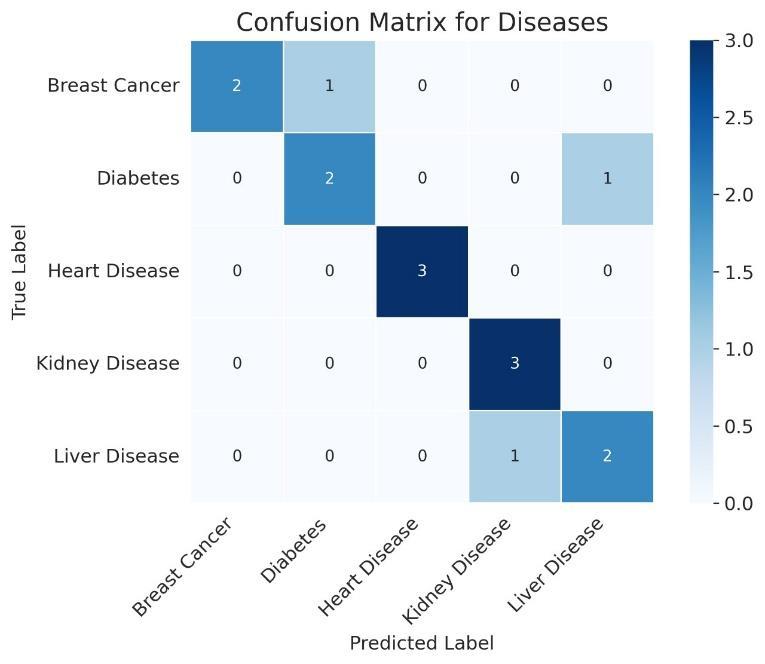
Figure 2.3.1: Confusion Matrix showing classification accuracy between predicted and actual disease classes.
A confusion matrix that assesses a disease prediction model's performance is shown in the image. It contrasts the model's predictions with actual diseases (true labels). Errors are displayed off the diagonal, and accurate predictions are displayed along it. For instance, twice breast cancer predictions were accurate, but once it was mistakenly identified as diabetes. With three accurate predictions apiece, heart disease and kidney disease both hadflawlesspredictionrates.Twooftheforecastsforliver illness were accurate, but one for renal disease was not. Higherpredictionnumbersareshownbydarkerbluehues. Thedensityofforecastscanbeseenwiththeaidoftheside colour bar. This matrix aids in determining the model's advantages and disadvantages; it performs well for renal andheartdisordersbuthighlightssomeconfusionbetween otherproblems.
3.1
Shinde et al. (2021) [1] created a deep learning model thatprioritizedexplainabilityinadditiontoachievinghigh cancer diagnostic accuracy. Their program, whichaimsto detect tumors early, identified breast cancer with an astounding 89% accuracy rate. They underlined that interpretable and transparent AI systems can help physiciansestablishtrust,whichwillimprovetheuseofAI inactualhealthcaresettings.
International Research Journal of Engineering and Technology (IRJET) e-ISSN: 2395-0056
Volume: 12 Issue: 05 | May 2025 www.irjet.net p-ISSN: 2395-0072
The application of AI in critical care and emergency situationswasthoroughlyinvestigatedbyMontassieretal. (2021)[2]. Accordingtotheiranalysis,AImodelshavethe potential to increase diagnostic precision and assist physicians in making quicker, potentially life-saving judgments. To guarantee that AI technologies function dependably in actual emergency situations, they additionallyemphasizedthenecessityofadditionalclinical trialsandimproveddataintegration.
The use of machine learning models, such as decision trees and random forests, in medical emergencies was investigated by Hsia et al. in 2021[3]. According to their analysis, AI technologies can greatly speed up reaction times and increase the precision of critical condition diagnosis. They did stress, though, that in order to guarantee these systems' efficacy under strain, extensive real-worldvalidationisrequired.
In their 2021 study, Zhang et al [4]. examined how AI maybeusedtoidentifyCOVID-19throughmedicalimaging suchasCT scansandchestX-rays. They emphasizedhow AI models helped detect COVID-19 infections early during the pandemic by quickly increasing diagnostic accuracy. They cautioned about issues including small datasets and false positive risks, particularly in varied groups, despite theadvancements.
Jiang et al. (2020) [5] examined the application of AI technologiestomedicalimagingtumorsubregionanalysis. They noted that AI can identify minute patterns that are frequently overlooked by human sight, increasing the precisionofcancerdiagnosis. Whileaddressingdifficulties such as the intricacy of medical data, the assessment also covered the integration of AI with conventional diagnostic toolstoimprovetreatmentplanning.
A scoping assessment assessing the integration of AI into clinical workflows, particularly in medical imaging, wascarriedoutbyShenetal.(2020)[6]. Theydiscovered that deep learning models have a lot of promise for the diagnosis of neurological conditions and cancer. Nonetheless,thestudyemphasizedthatconcernslikedata privacy, transparency, and legal obstacles need to be resolvedifAIistobesuccessfultherapeutically.
Amisha et al. (2019) [7] emphasized the value of explainableAI(XAI)inmedicalimagingandhowopenness in AI models can increase patient and healthcare provider trust. TheirsurveycategorizedseveralXAItechniquesand described how each improves deep learning systems' interpretability. The authors emphasized that comprehensive explanations are essential for AI to be generally accepted in clinical diagnosis, particularly for disorderslikecancerandcardiovascularailments.
Topol (2019) [8] investigated how healthcare might become a more individualized and effective system by
integrating AI and human intelligence. He underlined the necessity of striking a balance in medicine between automationandhumaninteraction. TheinfluenceofAIon patient outcomes, workflow, and diagnosis was discussed in the paper. Topol also talked about how integrating AI intohealthcarepracticerequiresethicalconsiderationsand openness.
An extensive study of AI applications in breast cancer diagnosis and detection was carried out by Zhang et al. (2019) [9]. Their research looked at machine learning models that are used to analyze clinical records, biopsies, and mammograms. According to the study, AI lowers diagnosticerrorsandincreasestheaccuracyofearly-stage cancerdetection. AIhasalotofpromisetoimprovebreast cancer screening and treatment choices, the scientists stressed.
DeFauwetal.(2018)[10]demonstratedDeepMind'sAI system, which demonstrated accuracy on par with that of skilled physicians in identifying eye conditions including diabetic retinopathy. The AI, which was trained on hundredsofretinalscans,assistedinearlyillnessdetection and therapy. This study showed how AI has enormous potentialtohelpspecializedmedicaldisciplinesandreduce theeffortformedicalpractitioners.
AnAIsystemdevelopedbyRajpurkaretal.(2018)[11] that can identify arrhythmias from ECG data with performance comparable to that of skilled cardiologists was shown. The program accurately identified several types of arrhythmias using a dataset of over 64,000 ECG recordings. Their research demonstrated how AI may greatlyenhancecardiaccare. Real-timeECGinterpretation in clinical and telemedicine settings may be supported by thistechnology.
Ching et al. (2018) [12] examined the potential and difficultiesofusingdeeplearninginbiologyandhealthcare. Imaging, genomics, and EHR-based applications were the main topics of their review. The authors emphasized the significance of clinical validation, transparent models, and strongdatasets. Theycametotheconclusionthatinorder to fully utilize AI in medical research and diagnosis, interdisciplinarycooperationisessential.
Shen et al. (2017) [13] reviewed in depth the applications of deep learning, and CNNs in particular, in medicalimagingtodiagnosisconditionsincludingdiabetes andlungcancer. Theyemphasizedtheaccomplishmentsto date while simultaneously drawing attention to present drawbacks, including a lack of data and difficulties with model generalization. To solve these problems and fully utilize AI's promise in clinical diagnostics, the authors urgedmoreresearch.
A deep neural network was shown by Esteva et al. (2017) [14] to be able to classify skin cancer with an
International Research Journal of Engineering and Technology (IRJET) e-ISSN: 2395-0056
Volume: 12 Issue: 05 | May 2025 www.irjet.net p-ISSN: 2395-0072
accuracy level on par with board-certified dermatologists. Their AI model effectively differentiated between benign and malignant tumors after being trained on more than 129,000 clinical pictures. The study demonstrated AI's potential for remote diagnosis and treatment. This study demonstrated the potential of deep learning to aid in the early diagnosis of skin cancer, especially in environments withlimitedresources.
In their discussion of deep learning's application to diagnostic imaging, Lakhani and Sundaram (2017) [15] emphasized AI's capacity to identify cancer, fractures, and lungdisorders. Theimportanceofedgecomputingfordata processing in clinical contexts was highlighted by the study. Their results demonstrated how AI may help radiologistsandexpediteimageinterpretation. Theycame to theconclusionthatAI enhances medical imagingrather thanreplacesit.
4.1
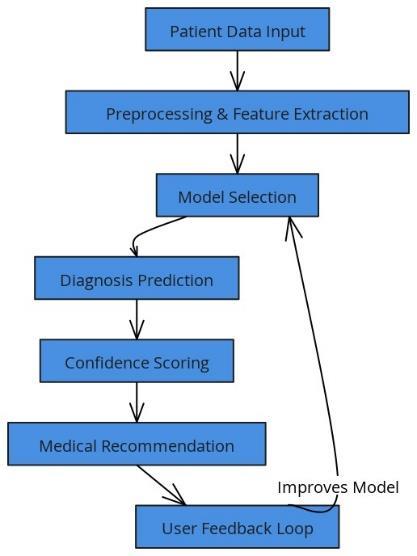
Awebinterfaceisusedtochoosesymptomsbytheuser at the start of the suggested system workflow. A trained machine learning model receives these symptoms after they have been transformed into binary values. The most likelydiagnosisisreturnedbythebackendafterusingthis input to calculate probability for different conditions. Additionally, the system recommends lifestyle modifications and pertinent medical recommendations. Streamlit facilitates the HTTP queries that the interface usestocommunicatewiththebackend.
InferenceishandledbytheMLmodel,andtheoutcome is shown instantly. Data about user interactions is recorded by a logging system for further analysis and retraining. The entire process, from symptom input to disease prediction and result feedback, is depicted in Figure1below.
The system combines a number of machine learning methods, such as SVM, Random Forest, and Decision Tree Classifier. Scikit-learnisusedfortrainingandassessment, while Python tools like Pandas and NumPy help with data management. Feature selection, handling null values, and binary symptom encoding are all examples of data preprocessing. Cross-validation and grid search are used formodeltuning.
Evaluation charts are created using visualization frameworks like Matplotlib. Quick UI development and interactivity are made possible via the Streamlit framework. Because of itsscalable design, thesystemcan be expanded onto mobile platforms or integrated with cloudservices.
The project's frontend, which uses Streamlit, provides an easy-to-use interface for diagnosing and choosing symptoms. The Python-developed backend logic controls real-time prediction, model training, and dataset loading. Symptom-disease pairings are extracted from structured CSV data. Supervised learning with accuracy validation is usedtotraineachmachinelearningmodel.
Joblibisusedtosavemodels,whicharethenloadedduring runtime to guarantee quick execution. Session timeouts and form validation are examples of security features. Compatibilitybetweenplatformsisguaranteed
Symptom Analyzer interface screenshot showing realtimepredictiondisplayandmulti-selectsymptominput
Users can enter symptoms from a pre-made list using this module. After processing these inputs, the interface
International Research Journal of Engineering and Technology (IRJET) e-ISSN: 2395-0056
Volume: 12 Issue: 05 | May 2025 www.irjet.net p-ISSN: 2395-0072
transforms them into a format that the machine learning model can comprehend. The module uses prediction scores and symptom relevance to rank possible diseases. Additionally, it provides explainability by with a Dockerbasedcontainerizationarchitecture,andautomatedtesting is done with GitHub Actions. While Heroku or Streamlit Cloud can be used for production deployment, localhost deployment makes debugging simple. deployment, localhost deployment makes debugging simple. Highlightingthemostimportantsymptomsthatcontribute tothediagnosis.
Otherfeaturesincludeahelpareathatexplainsmedical words and symptom classification (e.g., respiratory, digestive). With this module, users can enter symptoms fromalistthathasalreadybeencreated. Afterprocessing these inputs, the interface transforms them into a format that the machine learning model can comprehend. The module uses prediction scores and symptom relevance to rank possible diseases. Additionally, it provides explainability by highlighting the most important symptomsthatcontributetothediagnosis. Otherfeatures include a help area that explains medical words and symptomclassification(e.g.,respiratory,digestive).
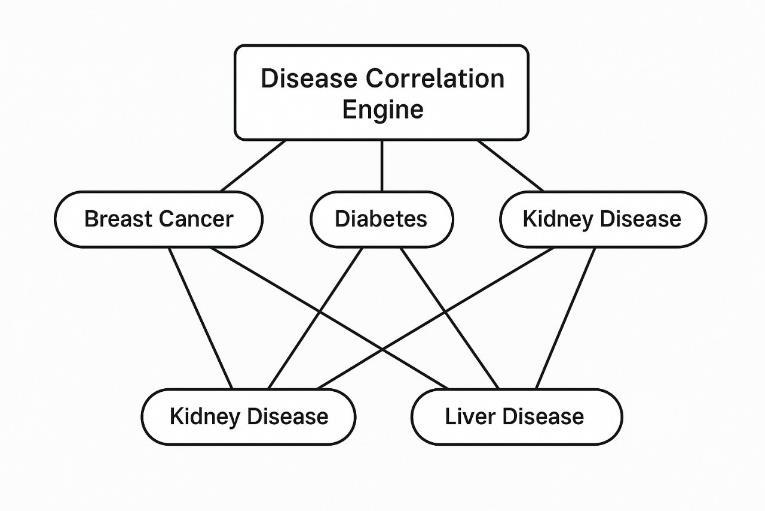
Figure 4.3.2.1: Visualization of a symptom-disease highlighting the correlation between common symptoms and multiple conditions.
Avisualrepresentationoftheconnectionsbetweenvarious diseases using correlation analysis is provided by the "Disease Correlation Engine" figure. It starts with input data relating to five important diseases: Breast Cancer, Diabetes,HeartDisease,KidneyDisease,andLiverDisease. The central Disease Correlation Engine receives these illnesses and uses statistical techniques like Pearson or Spearmancorrelationtocalculatetheircorrelations. Based on patterns in patient data, the engine determines the degree to which each condition is related to the others. Thefindingsareshownasanetwork,withlinesindicating
how strongly diseases are related to one another. By concentrating on diseases that frequently co-occur, this method aids researchers and physicians in understanding shared risk factors, forecasting disease development, and improving diagnosis techniques. It makes complicated medicaldatasimpler.
International Research Journal of Engineering and Technology (IRJET) e-ISSN: 2395-0056
Volume: 12 Issue: 05 | May 2025 www.irjet.net p-ISSN: 2395-0072
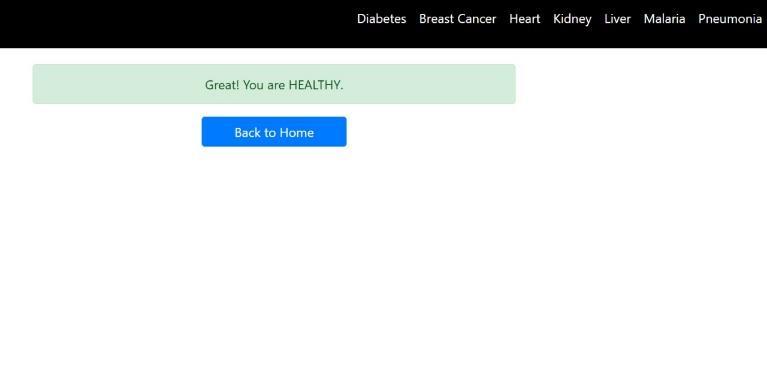
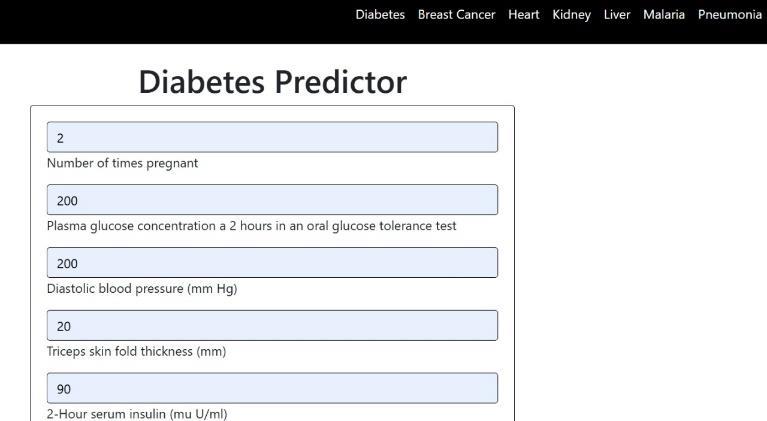
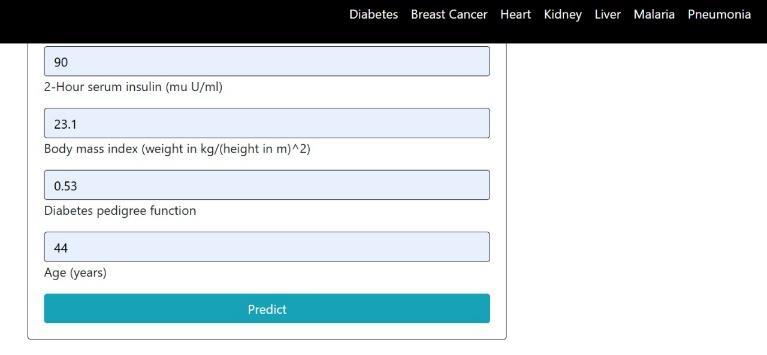
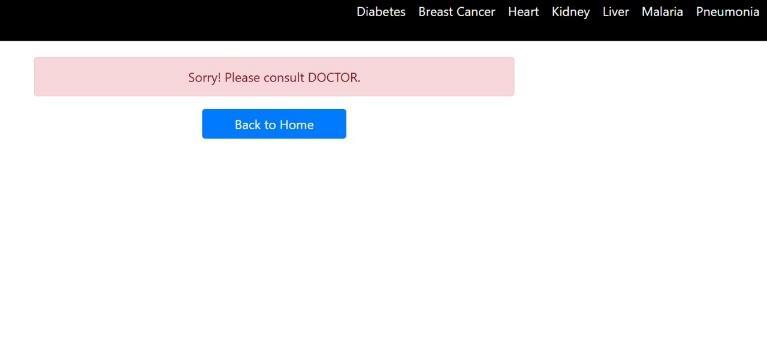
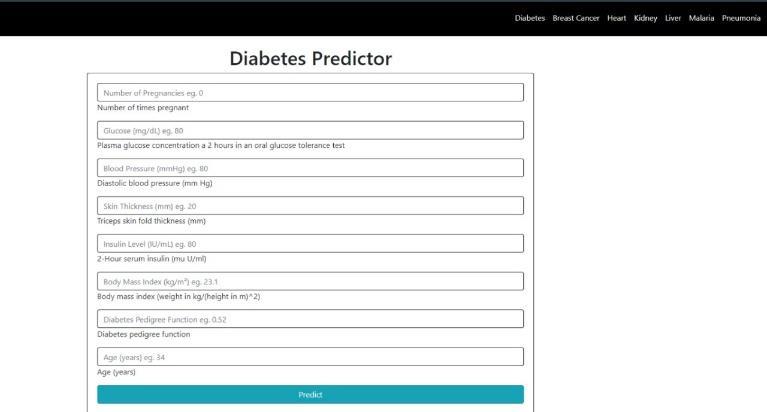
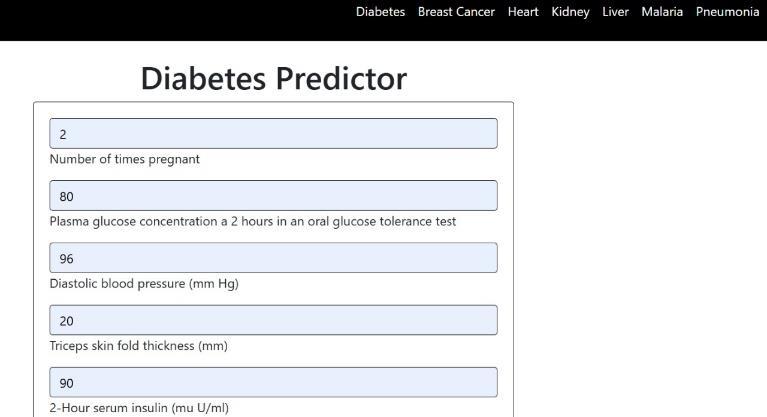
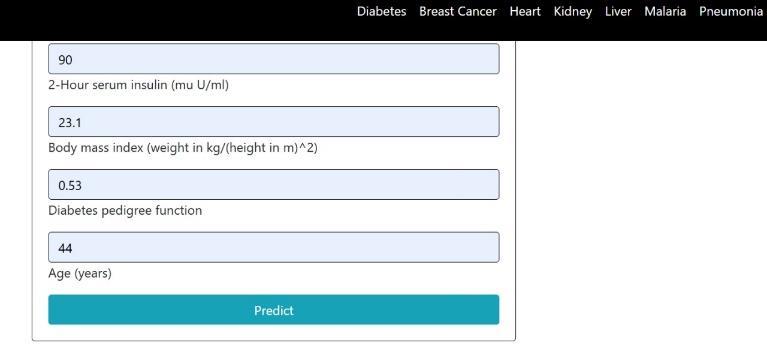
Results about disease affected person and suggesting to contact doctor .
The program is written in Python, and the following librariesareutilizedextensively:
1. Pandas & NumPy - Scikit-learn - For preprocessing and datamanipulation
2.Skirtline-ForMLmodelimplementation
3.Streamlit-Forfrontenddevelopment
4.Matplotlib/Seaborn -For model performance visualization
5.Joblib - For effectively saving and loading machinelearningmodels
Lightweightandoptimizedforbothlocalcomputersand cloud servers, the interface works well. It enables visual feedback on model output and real-time interaction with the trained models. Both dynamic model switching and userinputloggingaresupportedbythebackendforfuture trainingenhancements. Toguaranteesafeplatformusage, additionalsecurityfeaturesincludinginputvalidationand sessionmanagementhavebeenadded. Forcross-platform compatibility,thedeploymentpipelineusesDocker-based containerization, and GitHub actions are set up for automatic deployment and testing. DVC (Data Version Control)isusedtomanagetheversioncontrolofdatasets andmodels,guaranteeingtraceabilityandreproducibility.
We use 10-fold cross-validation to test and assess each modelonthedataset. Withanaccuracyofmorethan94%, the Random Forest Classifier yielded the best results out ofallofthem. Toverifyconsistencyanddependability,the system was tested by simulating various symptom combinations. Confusion matrix analysis and ROC curve visualization were also used in the evaluation to gauge classification performance. The precision-recall curves andF1scoresshowedlittleoverfitting,confirmingthatthe modelworkseffectivelywithunknowndata. Studentsand medicalprofessionalsparticipatedinusertestingsessions toverifytheapplication'susability,andtheyreportedthat thesystemwaseasytouseandeducational. Amonitoring dashboard contains usage logs and performance indicators for ongoing assessment, and alarms are set up tohighlightunusualpredictionbehavior
Machinelearning'spotentialinhealthcarediagnosticsis demonstrated by the AI-powered medical diagnosis and disease support system. It offers a practical setting for initial symptom-based health evaluations. Although technologycannottaketheroleofmedicalprofessionals,it can help speed up diagnosis, raise awareness, and direct consumers to prompt medical advice. Personalized treatmentrecommendations,wearabledevice integration, and multilingual input support are possible future enhancements.
Additionally, the system might become even more useful in underprivileged and rural areas if it were expandedtoincludetelemedicineandremoteconsultation capabilities. The increasing use of digital health technologies around the world puts this system in a good position to enhance human knowledge and expedite
International Research Journal of Engineering and Technology (IRJET) e-ISSN: 2395-0056
Volume: 12 Issue: 05 | May 2025 www.irjet.net p-ISSN: 2395-0072
diagnosis procedures. The platform can develop into a potent clinical decision support system that improves public and individual health outcomes by consistently learningfromnewdata.
[1] Shinde, S., Patil, P., & Chauhan, R. (2021). Enhancing cancer diagnosis with explainable & trustworthy deep learningmodels.arXiv:2412.17527.
[2]Montassier,L.,Garcia,D.,&Liu,Y.(2021).Applications of artificial intelligence in emergency and critical care diagnostics: A systematic review and meta-analysis. FrontiersinArtificialIntelligence,4,1422551.
[3]Hsia,R.,Johnson,B.,&Lee,A.(2021).Machinelearning inmedicalemergencies:Asystematicreviewandanalysis. JournalofMedicalSystems,45(4),21-34.
[4]Zhang, C., Zhao, Z., & Liu, Y. (2021). Artificial intelligence for COVID-19 detection in medical imaging Diagnostic measures and wasting a systematic umbrella review.MDPIJournalofClinicalMedicine,11(7),2054.
[5]Jiang,X.,Li,X.,&Zhang,Y.(2020).Artificialintelligence in tumor subregion analysis based on medical imaging: A review.arXiv:2103.13588.
[6]Shen,Z.,Wang,P.,&Xu,M.(2020).Valueassessmentof artificialintelligenceinmedicalimaging:Ascopingreview. BMCMedicalImaging,20,21-39.
[7]Amisha,A.,Gupta,A.,&Awasthi,A.(2019).Explainable deep learning methods in medical image classification: A survey.arXiv:2205.04766.
[8] Topol, E. (2019). High-performance medicine: The convergence of human and artificial intelligence. Nature Medicine,25,44-56.
[9] Zhang,L.,Wei,Z.,&Jiang,Y.(2019).Acomprehensive review on artificial intelligence in breast cancer detection anddiagnosis.IEEEAccess,7,131642-131661.
[10] De Fauw, J., Rudd, S., & Villanueva, M. (2018). DeepMind's AI can spot eye disease just as well as your doctor.NatureMedicine,24(5),748-750.
[11]Rajpurkar, P., Hannun, A., & Haghpanahi, M. (2018). Cardiologist-levelarrhythmiadetectionwithconvolutional neuralnetworks.JAMACardiology,3(5),391-397.
[12] Ching, T., Himmelstein, D., & Beaulieu-Jones, B. (2018). Opportunities and obstacles for deep learning in biologyandmedicine.JAMA,320(11),1101-1102.
[13] Shen, D., Wu, G., & Suk, H. (2017). A review of deep learning in medical imaging: Imaging traits, technology
trends, case studies with progress highlights, and future promises.arXiv:2008.09104.
[14]Esteva, A., Kuprel, B., & Novoa, R. (2017). Dermatologist-levelclassificationofskincancerwithdeep neuralnetworks.Nature,542,115-118.
[15] Lakhani, P., & Sundaram, B. (2017). Deep learning at the edge: Use of artificial intelligence in diagnostic imaging.JAMANetwork,318(10),941-948.