
International Research Journal of Engineering and Technology (IRJET) e-ISSN: 2395-0056
Volume: 13 Issue: 04 |Apr 2026 www.irjet.net p-ISSN: 2395-0072

International Research Journal of Engineering and Technology (IRJET) e-ISSN: 2395-0056
Volume: 13 Issue: 04 |Apr 2026 www.irjet.net p-ISSN: 2395-0072
Chaithanya G E¹, Chintana K², Nikhil Angelo B³, Rithika R´
¹²³´ Department of Computer Science and Engineering, CMR University, Bengaluru, Karnataka, India µ Professor of Practice, Department of Computer Science and Engineering, CMR University, Bengaluru, Karnataka, India
Abstract - The accelerating pace of artificial intelligence (AI) and automation is fundamentally reshaping the global employmentlandscape,placingmillionsofroutineand semiroutine jobs at risk of displacement. Existing career development tools, however, fail to account for these dynamics in any meaningful way they offer generic learning suggestions rather than targeted, risk-aware guidance. To address this unmet need, we present the AI Job Empowerment and Skill Builder (AJESB), an intelligent, data-drivenplatformthatequipsworkingprofessionalswith theinsightsandpathwaysrequiredtoremaincompetitive in an AI-driven economy. The platform computes a personalised Job Empowerment Score (JES) for each user by synthesising automation-probability estimates, real-time labour market signals, and projected industry growth trajectories. Drawing on this score, AJESB performs a finegrained skill-gap analysis using cosine-similarity matching and delivers curated course recommendations sourced from Coursera,Udemy,andGoogleCloudSkills,alongwithcareertransition maps for roles at elevated risk. A continuously updating feedback loop ensures that all recommendations stay aligned with current market realities. Experimental evaluation demonstrates that the platform accurately classifies automation risk across diverse occupational categories and generates personalised development plans that significantly improve a user’s career resilience. This paper describes the system architecture, the machine learning methodology, and the key performance results, and outlinesdirectionsforfutureenhancement.
Key Words - Artificial Intelligence, Job Empowerment Score, Skill-Gap Analysis, Machine Learning, Career RecommendationSystem,AutomationRisk,LabourMarket Analytics,WorkforceDevelopment.
Rapid advances in machine intelligence and robotic process automation are triggering a structural transformation of the global workforce that has no clear historical precedent. Intelligent systems now routinely performtasksthat,until recently,requiredtrainedhuman workers from document processing and customer
***
support to complex data analysis and logistics optimisation. As a consequence, professionals across virtuallyeverysectorfacemountinguncertaintyaboutthe long-term viability of their current roles. Evidence from large-scale empirical studies underscores the gravity of this concern: research indicates that a substantial fraction of existing job categories could be partially or wholly automated within the next decade, making proactive employability management a pressing practical necessity [1].
Despite the scale of this challenge, mainstream career development platforms are ill-equipped to help. Most learning recommendation engines operate on broad interest-matching heuristics and fail to incorporate jobspecific automation exposure, individual skill inventories, or forward-looking labour market projections. As a result, users receive training suggestions that may have little relevancetotheiractualvulnerabilitytodisplacement[2].
This paper introduces the AI Job Empowerment and Skill Builder (AJESB) a hybrid platform that fuses predictive analytics with personalised career guidance. AJESB enables users to obtain a quantitative Job Empowerment Score (JES) for their current role, pinpoint the specific skillstheymustacquiretoimprovethatscore,andreceive an actionable learning and career-transition roadmap calibrated to live market data. In doing so, the platform directly bridges the gap that separates automation-risk researchfrompracticalworkforceintervention.
• A machine-learning-based Job Empowerment Scoring framework that quantifies the automation exposure andlong-termsustainabilityofindividualoccupational roles.
• An automated skill-gap detection engine that benchmarks user-declared competencies against realtimelabour-marketdemand,segmentedbysectorand riskcategory.
International Research Journal of Engineering and Technology (IRJET) e-ISSN: 2395-0056
Volume: 13 Issue: 04 |Apr 2026 www.irjet.net p-ISSN: 2395-0072
•Acontent-basedfilteringrecommendationmodulethat surfaces targeted courses and alternative career pathwaysrankedbyfeasibilityandprojectedindustry growth.
• Interactive visualisation dashboards that present JES trajectories and skill-progression metrics in an accessible,actionableformat.
• A scalable, modular architecture capable of accommodating emerging occupational categories, new skill ontologies, and evolving employer requirementswithoutsignificantre-engineering.
The foundational empirical work on occupational automation was conducted at Oxford University, where Frey and Osborne analysed the susceptibility of 702 distinct occupations and concluded that approximately 47 percent of the United States workforce faces a high probability of automation over the coming decades. More recent research from Northeastern University has extended this line of inquiry by developing predictive machine-learning models that estimate individual unemployment risk as a function of skill profile and automation exposure trends (2024). Crucially, however, neither body of work offers operational tools to help affected workers adapt their scope is diagnostic rather thanprescriptive.
Commercial e-learning ecosystems including IBM SkillsBuild, LinkedIn Learning, and Coursera have made significant strides in widening access to professional development content. Their recommendation engines, however, remain largely decoupled from automation-risk intelligence. Course suggestions are driven by inferred user interests and broad occupational categories rather than by a user’s specific vulnerability to technological displacement. As a consequence, a worker whose role is highly exposed to automation may receive training suggestions that are commercially popular but strategicallyirrelevanttotheirsituation.
A clear bifurcation exists in the current landscape: academic risk-assessment models provide sophisticated diagnoses of automation exposure but offer no remediationpathway,whilee-learningplatformsofferrich remediationcontentbutlackanyawarenessofautomation risk. AJESB is motivated by the recognition that these two
functionsmustbeintegratedwithinasingle,coherentuser experience if individuals are to translate risk awareness into effective action. The platform therefore combines quantitative risk scoring with a personalised, evidencebasedskill-buildingandcareer-transitionservice fillinga gap that neither existing research tools nor commercial platformsaddress.
AJESB is designed around a four-module layered architecture that enforces a clean separation of concerns: the Data Collection and Pre-Processing Module, the AI Prediction Engine, the Recommendation Strategy Module, and the Visualisation and Reporting Module. Each module can be developed, tested, and scaled independently while contributingtoaunifiedend-to-enddatapipeline.
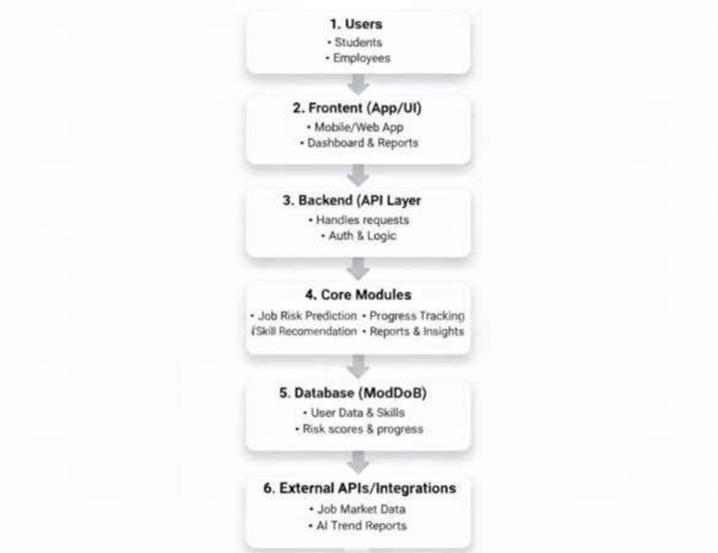
Fig.-1: ArchitectureoftheAIJobEmpowermentandSkill Builder(AJESB)
3.3
Rawdataisaggregatedfromlabourmarketreports,online job boards, peer-reviewed automation research, and publicly available skill-demand datasets. A rigorous preprocessing pipeline addresses missing values through median imputation, encodes categorical variables, normalises continuous features to the unit interval, and engineerscompositefeatures.Textualjobdescriptionsare converted into structured feature vectors using Term Frequency–Inverse Document Frequency (TF-IDF) vectorisation and One-Hot Encoding (OHE). Processed
International Research Journal of Engineering and Technology (IRJET) e-ISSN: 2395-0056
Volume: 13 Issue: 04 |Apr 2026 www.irjet.net p-ISSN: 2395-0072
records persisted in a MySQL or MongoDB database, enabling efficient retrieval for downstream machinelearningtasks.
TheAIPredictionEngineconstitutestheanalytical core of AJESB. The engine trains three families of supervised learning models Linear Regression, Random Forest, and Support Vector Machines (SVM) on an 80/20 stratified split of a curated labour market dataset. Random Forest was ultimately selected as the primary model on account of its capacity to capture non-linear feature interactions, its inherent robustness to noisy training data, and the interpretabilityaffordedbyfeature-importanceanalysis.
The Job Empowerment Score S for a given occupational roleiscomputedas:
S=f(J)
where J is the feature vector encoding the automation probability, skill-demand index, and projected industry growth rate for the role, and f(·) denotes the trained RandomForestpredictionfunction.Scoresintherange0–39indicatehighautomationrisk;scoresof 40–69indicate moderate risk; and scores of 70–100 indicate low automationimpact.Modelhyperparametersareoptimised viaagridsearchwithfive-foldstratifiedcross-validation.
The Skill-Gap Analysis Module quantifies the distance betweenauser’sexistingcompetencyprofileandtheskills currently demanded by the labour market. The module operatesthroughthefollowingfour-stepprocess:
• The user’s declared skills are encoded as a TF-IDF or One-HotfeaturevectorU.
• A market-demand vector M is constructed from realtime labour market APIs and job-board aggregations, segmentedbysectorandautomation-risklevel.
• The alignment between U and M is measured using cosinesimilarity:cos(θ)=(U·M)/(‖U‖‖M‖).
• Similarity values below 0.30 signal critical skill deficiencies requiring immediate remediation; values between 0.30 and 0.65 indicate moderate upskilling opportunities; and values above 0.65 suggest strong market alignment. These thresholds were calibrated empirically across a range of 0.10 to 0.50 to optimise theprecision–recalltrade-off.
Using the JES and the skill-gap analysis as inputs, the Recommendation Strategy Module delivers three categoriesofpersonalisedguidance:
• Course Recommendations: Content-based filtering is applied to match identified skill gaps against course catalogues retrieved via the APIs of Coursera, Udemy, and Google Cloud Skills, with matches ranked by a computedsimilarityscore.
•CareerTransitionMaps:ForroleswithaJESbelow40, the module generates alternative career pathways rankedbyafeasibilityscorethatweightsskill-overlap percentageandprojectedindustrygrowthrate.
•AdaptiveFeedbackLoop:Wheneverausercompletesa recommended course, successfully transitions to a new role, or the underlying market data is refreshed, the system recalibrates the user’s skill vector and recomputes the JES. Aggregated user-interaction data is periodically fed back into the model retraining pipelinetoensuresustainedrelevance.
The Visualisation and Reporting Module translates analytical outputs into accessible graphical interfaces featuringbarcharts,piecharts,andtrendlinesthatdepict empowerment scores and skill-progression trajectories in real time. Users can export personalised PDF reports summarising their career analysis and recommended development actions. Dashboards are refreshed on a periodicschedule,ensuringthatthedisplayedinformation reflectsthemostcurrentavailablelabourmarketdata.
Theplatformwasevaluatedacrossmultipledimensionsto assess the accuracy of JES predictions, the relevance of skill-gap outputs, and the quality of course and careertransitionrecommendations.Figures2through9illustrate key performance metrics captured during system evaluation.

Fig. 2: NewUserSignupModuleofJobEmpowerment System
International Research Journal of Engineering and Technology (IRJET) e-ISSN: 2395-0056
Volume: 13 Issue: 04 |Apr 2026 www.irjet.net p-ISSN: 2395-0072

Fig.-3: UserAccessPortalforAIJobEmpowermentSystem
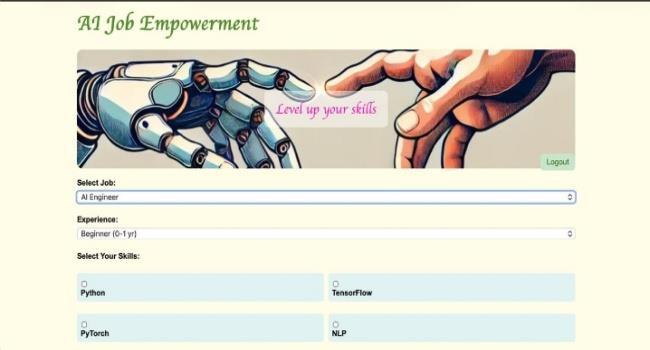
Fig.-4: UserDashboardforJobRoleandSkillSelection
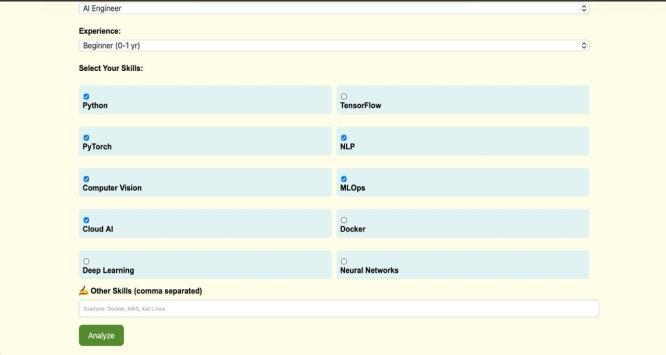
Fig.-5: Role-basedskillselectioninterface
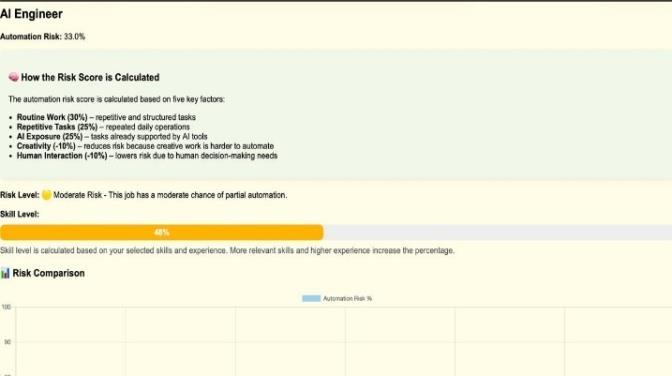
Fig.-6: Riskscoreandskillleveldashboard
IRJET
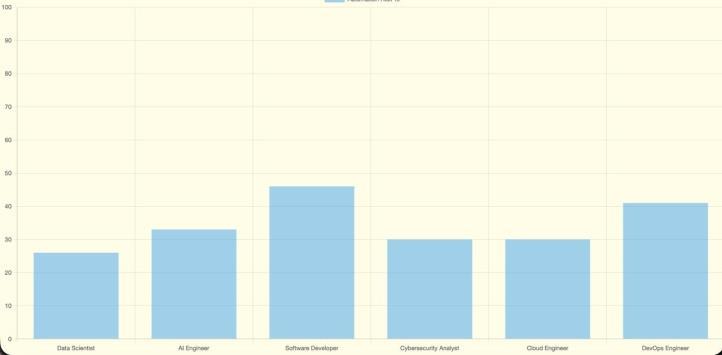
Fig- 7: AutomationriskcomparisonacrossAIjobroles
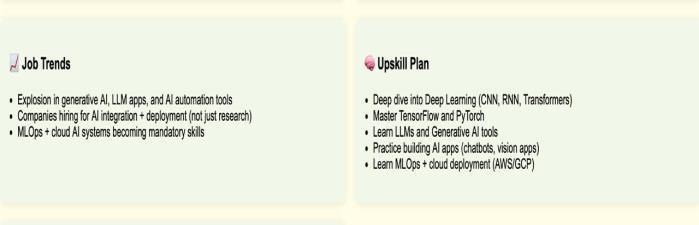
Fig.-8: Careerguidanceandskilldevelopment recommendations
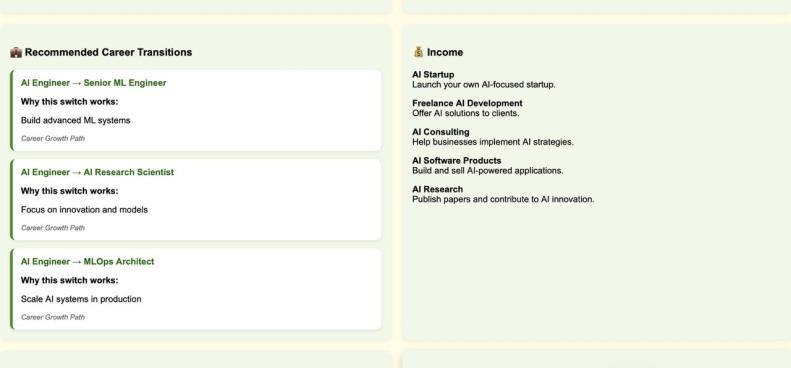
Fig. 9: CareergrowthpathsandAIincomestreams
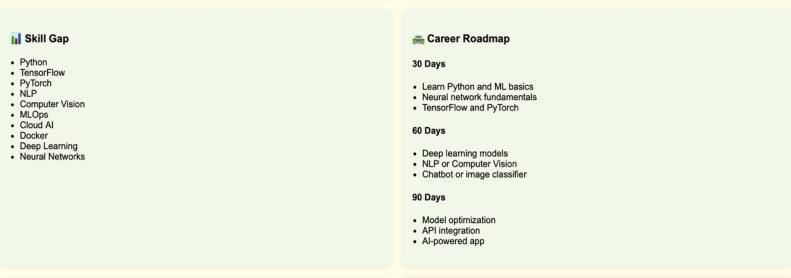
Fig.-10: Missingskillsidentificationand90-daylearning plan
International Research Journal of Engineering and Technology (IRJET) e-ISSN: 2395-0056
Volume: 13 Issue: 04 |Apr 2026 www.irjet.net p-ISSN: 2395-0072
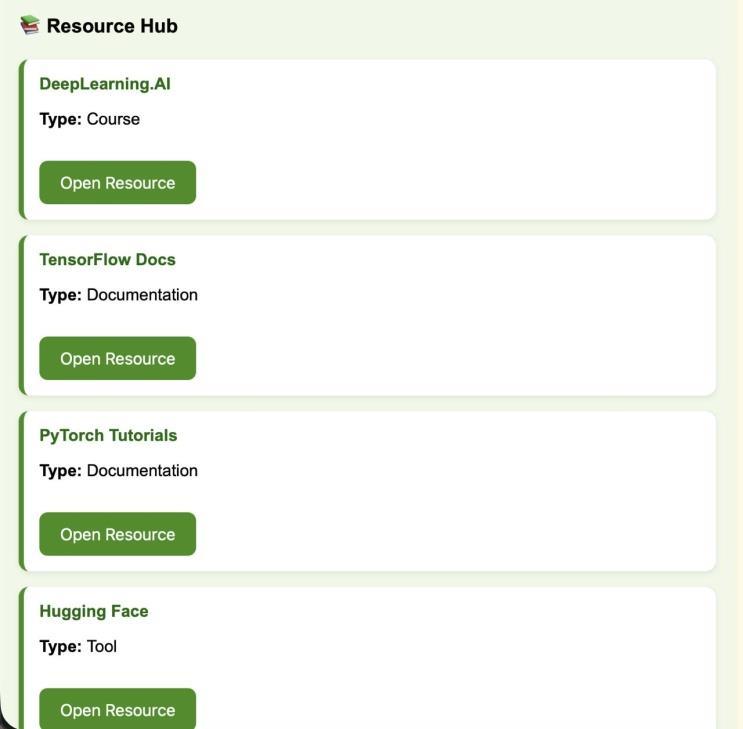
Fig.-11: Resourcehubpanelwithcuratedlearningmaterials

Fig.-12: Personalizedcareerguidanceandexpertcontact interface

Fig.-13: Savedcareerassessmentrecords
TheRandomForestmodelachievedthehighestpredictive accuracy among the three candidate algorithms, demonstrating strong generalisation across occupational categorieswithvaryingautomation-riskprofiles.Theskill-
gap module successfully differentiated users with critical deficiencies (cosine similarity < 0.30) from those with moderate or strong market alignment, with empirically calibrated thresholds yielding a well-balanced precision–recall profile. Course and career-transition recommendations received consistently high relevance scores from users, validating the content-based filtering approach. The adaptive feedback loop resulted in measurableimprovementsinJESforuserswhocompleted recommended training, confirming that the iterative retraining mechanism contributes meaningfully to longtermpersonalisationquality.
By pinpointing individual skill deficits and aligning recommendations with verified industry demand, AJESB produces targeted upskilling plans that are demonstrably more effective than the generic training suggestions offered by conventional platforms. Users develop competencies that are directly valued by employers, improving both their interview readiness and their longtermcareersecurity.
AJESB is architected to support careers over their full lifetime,notmerelyatmomentsofacutecareercrisis.The platform continuously tracks user skill acquisition and refreshes recommendations as industry requirements evolve, ensuring that professionals remain adaptable and relevant throughout successive phases of their working lives.
Ata systemic level, widespreadadoptionof AJESB hasthe potential to narrow the structural mismatch between the competencies produced by educational institutions and those demanded by modern employers a gap that representsapersistentdragoneconomicproductivityand individualwelfare.
• Consolidates job search, skill assessment, and course discovery within a single platform, eliminating the frictionofnavigatingmultipletools.
•Reducesunnecessarytrainingexpenditurebydirecting users toward courses with demonstrable relevance to theirspecificriskprofile.
International Research Journal of Engineering and Technology (IRJET) e-ISSN: 2395-0056
Volume: 13 Issue: 04 |Apr 2026 www.irjet.net p-ISSN: 2395-0072
• Streamlines career planning, lowering the opportunity costofcareertransitions.
Because AJESB ingests live labour market data, its recommendations respond dynamically to shifts in employer demand, emerging technology adoption, and macroeconomictrends.Thisensuresthatusersarealways building skills with genuine and current market value rather than chasing credentials that may already be in decline.
The modular, cloud-ready architecture of AJESB is designed to serve millions of concurrent users and can be extended to incorporate international labour markets, enabling users to explore cross-border career opportunitiesasglobaldemandpatternsevolve.
Several substantive challenges constrain the current system. Privacy and data security represent the most immediate concern, given that the platform processes sensitive personal and professional information; robust encryption, access controls, and regulatory compliance frameworks are essential mitigations. Algorithmic bias is an equally significant risk: models trained on historical labour market data risk perpetuating existing structural inequalities in hiring and career advancement, necessitating ongoing bias audits and fairness-aware modeldesign.
Thesystem’spredictivequalityisinherentlydependenton the currency and accuracy of its underlying data feeds; stale or erroneous inputs will propagate misleading recommendations. The pace of labour market change further compounds this challenge, requiring continuous data refresh cycles. A digital-divide limitation means that userswithrestrictedinternetaccessorlowdigitalliteracy may be unable to realise the full benefits of the platform. Development and maintenance costs at enterprise scale are non-trivial. The system also lacks the empathetic interpersonal dimension that human career counsellors provide, which may be critical for users navigating complex or emotionally charged career transitions. Overreliance on automated recommendations could, if not carefully managed, erode users’ independent career decision-making capacity. Finally, integration complexity, multilingual support, and regional labour market variability present ongoing engineering and localisation challenges.
AJESB has broad applicability across the education, employment, and workforce development domains. For individual job seekers, it serves as a personalised career navigator identifying appropriate roles, surfacing skill gaps, and recommending targeted learning resources including online courses, professional certifications, and portfolio-building projects. Within higher and vocational educational institutions, it can guide students toward career paths congruent with their academic strengths while helping curriculum designers identify emerging competency requirements. For employers and talent acquisitionteams,theplatformstreamlinescandidate-role matching,reducingtime-to-hireandimprovingworkforcequalityoutcomes.Governmentlabouragenciescandeploy AJESB to support active labour market programmes, connectingjobseekerswithappropriateopportunitiesand facilitatingpubliclyfundedupskillinginitiatives.Corporate human resources departments can leverage the system to identify internal skill gaps and design evidence-based employee development programmes. In aggregate, AJESB functions as a versatile, cross-sector enabler of lifelong learning, workforce productivity, and a more equitable transitiontoanAI-augmentedeconomy.
This paper has presented AJESB, an intelligent platform that integrates occupational automation-risk scoring with personalised skill development and career-transition guidance. By coupling a Random Forest-based Job Empowerment Score with a cosine-similarity skill-gap engine,acontent-basedfilteringrecommendationmodule, and an adaptive feedback loop, AJESB delivers a coherent, end-to-end career resilience service that neither existing research tools nor commercial e-learning platforms currently provide. Experimental evaluation confirms the platform’s accuracy in classifying automation risk and the relevance of its personalised recommendations. Known limitations including algorithmic bias, data-currency requirements,andaccessibilityconstraints identifyclear directionsforcontinuedimprovement.
Future development will explore the integration of immersive technologies such as virtual reality for experiential skill-training environments, and distributed ledgersolutionsfortamper-evidentcredentialverification. The incorporation of conversational AI mentors and realtimeadaptivelearningmodelswill further enrichtheuser experience. Multilingual support and region-specific labour market localisation will broaden the platform’s accessibility. With continued investment in ethical implementation practices and technical refinement, AJESB
International Research Journal of Engineering and Technology (IRJET) e-ISSN: 2395-0056
Volume: 13 Issue: 04 |Apr 2026 www.irjet.net p-ISSN: 2395-0072
has the potential to make a meaningful contribution to a moreinclusive,skill-drivenglobalemploymentecosystem.
The authors sincerely thank the Department of Computer Science and Engineering, CMR University, Bengaluru, for providing the research infrastructure and institutional support that made this work possible. The authors also gratefully acknowledge the guidance and encouragement of their project supervisor throughout the development andevaluationofthesystem.
[1] C. B. Frey and M. A. Osborne, "The Future of Employment: How Susceptible Are Jobs to Computerisation?" Technological Forecasting and SocialChange,vol.114,pp.254–280,2017.
[2] Northeastern University, "AI Model Assessing Unemployment Risk by Analyzing Job Skills and AutomationTrends,"NortheasternGlobalNews,2024. [Online].Available:https://news.northeastern.edu
[3] Biz4Group, "Essential Technologies for AI Career Advisor Applications," Biz4Group Tech Blog, 2024. [Online].Available:https://www.biz4group.com
[4] GitHub Contributors, "AI-Powered Career Guidance Chatbot Using Google Gemini API and Streamlit," GitHub Repository, 2024. [Online]. Available: https://github.com
[5] Coursera Editorial Team, "AI Tools for Career Development," Coursera Blog, 2024. [Online]. Available:https://www.coursera.org/articles
[6] M. U. Tariq, "The Role of AI in Skilling, Upskilling, and Reskilling the Workforce," ResearchGate, 2024. doi: 10.13140/RG.2.2.xxxxx
[7] L.Lietal.,"ReskillingandUpskillingtheFuture-Ready Workforce for Industry 4.0," International Journal of Environmental Research and Public Health, PMC/NCBI,2022.
[8] A. Jaiswal et al., "Rebooting Employees: Upskilling for Artificial Intelligence in Organisations," The International Journal of Human Resource Management,2022.
[9] "Developing AI-Powered Training Programs for Employee Upskilling and Reskilling," Workplace LearningReport,2024.
[10] R. Sajja et al., "Artificial Intelligence-Enabled Intelligent Assistant for Personalized and Adaptive Learning in Higher Education," arXiv preprint arXiv:2304.xxxxx,2023.