
International Research Journal of Engineering and Technology (IRJET) e-ISSN: 2395-0056
Volume: 12 Issue: 01 | Jan 2025 www.irjet.net p-ISSN: 2395-0072
International Research Journal of Engineering and Technology (IRJET) e-ISSN: 2395-0056
Volume: 12 Issue: 01 | Jan 2025 www.irjet.net p-ISSN: 2395-0072
Nupur Bodke1, Dr. Manoj Kavedia2
1 Student of Thadomal Shahani Engineering College, Mumbai, Maharashtra, India.
2Associate Professor of Thadomal Shahani Engineering College, Mumbai, Maharashtra, India.
Abstract The integration of Internet of Things (IoT) and big data technologies is revolutionizing various sectors, including healthcare, by addressing existing inefficiencies and improving service delivery. With the arrival of Industry 4.0, the manufacturing sector underwent an extreme transformation, leading to a new eraofsmart,interconnectedsystems.Similarly,healthcare is now entering a comparable phase of technological evolution,commonlyreferredtoasHealthCare4.0.
It relies on the Internet of Health Things (IoHT), medical Cyber-Physical Systems (CPS), cloud computing, fog computing, big data analytics, machine learning, blockchain, and intelligent algorithms. The healthcare providers would create more efficient, flexible, and responsive care environments with these technologies. In short,HealthCare4.0aimsatimprovinghealthoutcomes, as well as enhancing patient satisfaction in addition to performance.
Health care, over time, has been advancing through different eras, from traditional Health Care 1.0 to contemporary Health Care 4.0. In its oldest form, Health Care 1.0 relied on basic practices with very few technological aids in the delivery of health care services. Health care advanced to more structured and digitalized healthcarewithHealthCare2.0and3.0andnewtoolsand systemswerealsointroduced.Now,itistheageofHealth Care4.0wheresmartsystemsandadvanceddataanalytics take center stage in decision-making, patient monitoring, andpersonalizedtreatment.
Healthcare environments are dynamic, and thus the systems put in place must respond to changes as quickly as possible, whether that change is patient condition or a change in an external factor, such as regulatory requirements. Integration is also key for the full potential ofHealthCare4.0,whichencompassesthedevelopmentof connected platforms that ensure different technologies andsystemsworkharmoniously.
Key Words: Internet of things, big data, preventive healthcare, Health Care 4.0, Industry 4.0.
The application of IoT and big data analytics is radically changing many different industries, including healthcare, addressing long-standing inefficiencies and bettering
overall service delivery. Building on the revolutionary impact of Industry 4.0 on manufacturing through smart andconnectedsystems,healthcareiswitnessingthesame level of technological revolution, known as Health Care 4.0.Avisioninthisdirectionisforwardthinkingandfuses advancedtechnologiestocreateintelligentandconnected healthcareservices.
There are different stages in the history of health care, whichhavebeendescribedintermsofaseriesofmodels: Health Care 1.0 to the highly digitized and automated systemsofHealthCare4.0. Thetechnologicalengagement with health care services has been minimal since its beginning. Gradually, with tools and systems developed during Health Care 2.0 and 3.0, health care was transformed into digital health care. Currently, Health Care 4.0 focuses on smart systems, real-time data analytics,andpersonalizedpatientcare.
Still, Health Care 4.0 brings several challenges along with its implementation. The four major challenges will therefore include data management, model development, system adaptability, and integration complexities. This is because enormous data are produced through the connected healthcare devices. Data integrity, privacy, and security require sound management systems. Besides, building modelstointerpret andleverage thesedata is so complex, involving sophisticated algorithms and machine learningmethods.
Challenges that the healthcare industry faces include risingserviceprices,a lackofskilledpersonnel,increased demandforhigh-qualityhealthcare,andtheintricacyofits value chain. The intense competition and need for cooperation among various stakeholders add to the pressure.Suchchallengescallforthesearchforinnovative healthcare models that combine cutting-edge information andcommunicationtechnologies(ICT).Engineering-based healthcare has become increasingly popular in the global world and has been boosted by rapid strides in medical device engineering, clinical innovations, and information technologies.
The most recent digital health breakthroughs include electronic health records, wearable health monitors, and remote health management systems. All of these have significantly changed healthcare processes, which subsequently improved patient safety and care quality. Suchinnovationbringsimmensepotentialfortheredesign
International Research Journal of Engineering and Technology (IRJET) e-ISSN: 2395-0056
Volume: 12 Issue: 01 | Jan 2025 www.irjet.net p-ISSN: 2395-0072
of healthcare processes but introduces several challenges relatedtoimplementation,scalability,andoptimization of processes.
HealthCare4.0isreadytobeinspiredbytheprinciplesof Industry 4.0 to redefine the healthcare landscape. This new model promises high-quality, cost-effective care delivery through enhanced stakeholder collaboration, optimized infrastructure, and refined value chains. There is ample research opportunity in the healthcare industry of the future, including data-driven diagnostics, machine learning applications, secure data sharing through blockchain, and the development of adaptive, smart healthcare systems. Overcoming such challenges and making use of the opportunities will be of utmost importance in the successful uptake and implementation ofHealthCare4.0.
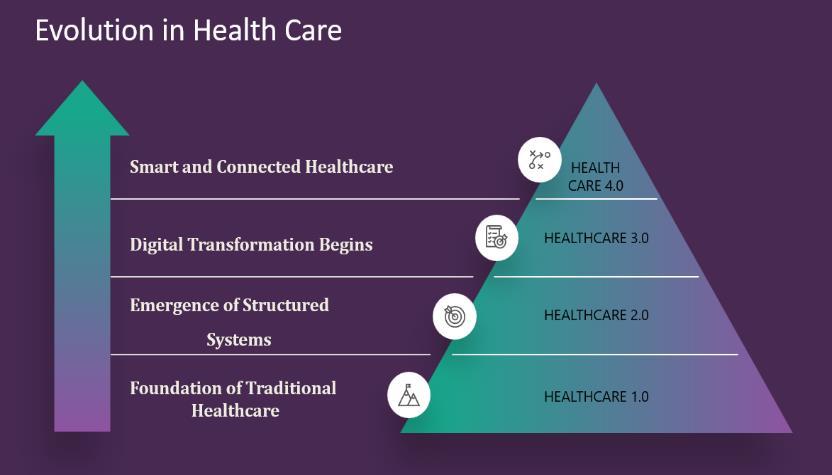
Healthcare has undergone a series of transformative phases, each marked by the integration of new technologiesandmethodologies:
Health Care 1.0: Health Care 1.0 was the first healthcare delivery model characterized by manual processing, minimal usage of technology and reactivecare.Inthosedays,doctorsprimarilyrelied on individual experiences and simple instruments for practice. Communication was at a minimum and nodatawasusedtotakedecisions.
Health Care 2.0: Health Care 2.0 transition led to a much better organized and structured healthcare environment.Duringthisstage,thehospitals,health organizations, and formalized medical practice emerged. Some of the important medical technologies as well as diagnostic instruments started appearing. The diagnostic and curative abilities were enhanced; however, health care remained largely reactive and had less preventive careoranalytics.
Health Care 3.0: The outset of the third phase of digitization came with the emergence of digital technologies. This marked the beginning of electronic health record (EHR) systems; digital imaging systems; and still pioneering, albeit primitive telemedicine. This grew data further in a rolethatwouldrevolutionizehealthcare:toimprove better management of patient's records, for improved diagnostics, and better treatment planning.. Healthcare providers began embracing information technology systems to smooth out operationsandimproveservicedelivery.
Health Care 4.0: HealthCare4.0isastepforwardin Health Care 3.0 by introducing advanced technologies like IoHT, medical Cyber-Physical Systems (CPS), cloud and fog computing, data analytics, artificial intelligence, block chain, and advanced algorithms. These all work together to provide healthcare providers with the opportunity to provide services that are more efficient, flexible, and responsive to patient needs and hence improve thepatient'soutcomesandsatisfaction.
Artificial Intelligence (AI) and Machine Learning (ML): AI is applied in the field of medicine for analyzing medical data, pattern recognition, and providing insights that can aid clinicians in their decision-making processes. Machine learning, a part of AI, allows systems to learn from extensive healthcare data like patient records and medical imaging in order to better diagnose and predict patient outcomes. AI algorithms in medical imaging are capable of detecting anomalies such as tumors or fractures through X-rays, MRIs, and CT scans often fasterandmoreaccuratelythanhumanclinicians.
Internet of Medical Things (IoMT): IoMT connects medical devices, wearables, and sensors to networks, with data being exchanged between healthcare providers and the patients in real-time. Devices, including heart rate monitors, glucose trackers, and wearables, continuously collect patient data and transmit it for monitoring or intervention purposes. IoMT augments chronic disease management, allows for remote health monitoring, and diminishes the needtovisithospitalsasfrequently.
Big Data Analytics: Huge amounts of data are producedinhealthcare, includingpatientrecordsand clinicaltrials.Suchinformationcanbeusedtopredict the outbreaks of certain diseases, optimize the
International Research Journal of Engineering and Technology (IRJET) e-ISSN: 2395-0056
Volume: 12 Issue: 01 | Jan 2025 www.irjet.net p-ISSN: 2395-0072
management of hospitals, and enhance the results of treatment. Predictive analytics can, for instance, forecast a patient's deterioration or a potential condition through historical data and enable interventionwellbeforethiscanoccur.
Blockchain Technology: Blockchain technology, in particular,providesadistributedandsecureplatform for the storing and sharing of medical data without compromising the data integrity and security. In healthcare4.0,tamper-proofingofpatientinformation throughblockchainallowsonlyauthorizedindividuals toaccesscriticalhealthinformation.
Cloud Computing: Cloud computing is an extensive technology to store and process data remotely in the healthcare industry through the internet. In Healthcare 4.0, EHRs are stored in cloud platforms, and telemedicine applications function by running on these platforms, while AI diagnostic tools aid in analyzingapatient'sdiagnostics.
Augmented Reality (AR) and Virtual Reality (VR): AR andVRareable toprojectdigital information into the real-world environment. They have a benefit for surgeryintheformof being able to present real-time data to the surgeons, including patient vitals or imaging. For training purposes, VR simulates a complete immersive experience and enables health care professionals to simulate the performance of proceduresinacontrolled,safesetting.
Telemedicine and Telehealth: Telemedicine, telehealth part of Health Care 4.0, which enables medical care to deliver through digital, telemedicine tools, and they enable patients in video calls through telemedicine while others are engaged in phone and online messaging-consultation means, which require minimal visits-are very relevant for patients on remote or disperse areas due to the potential of accessing medicinal expertise without trekking long miles.
4.
While the potential of Health care 4.0 is vast, several challenges lie in the technological, regulatory, financial, andsocialdomainsandneedtobeovercometorealizeall its capabilities fully. This will demand collaboration between health care providers, technology developers, policymakers,andpatients.
Data Privacy and Security: The largest concerns regarding adopting Health care 4.0 revolve around protecting patient data by means of their privacy and security.Sinceitutilizesthevastconnectivityofmore and more connected devices, platforms like clouds,
and IoT-based systems, data regarding health becomes very susceptible to hacking and other forms of unauthorized access through cyber-attacks. Protection in this sense needs strong encryption and safestorage.Theotherfactorsrelatetotheaspects of regulation or, for instance, compliance under HIPAA. But with the dynamic nature of digital health technologies, uniform security measures are hard to beimplementedacrossvarioussystemsanddevices.
High Costs and Financial Constraints:Theadoption of such advanced technologies, for example, AI, IoMT, robotics, and blockchain, may incur heavy infrastructure costs, software costs, and training requirements for healthcare professionals. Many of these healthcare organizations, particularly lowresource settings, might not be able to afford implementingsuchachange.Moreover,thesecondary cost of system maintenance, revision, and storage of data for a long time could prohibit small providers frominvestingintheHealthcare4.0service.
Ethical and Bias Concerns:Themostimportantissue relating to AI, big data, and genomics uses would be those relating to ethical bias in data, decision-making processes, and access to healthcare. Historical data may reflect societal biases, putting patients of certain groups at a disadvantage with regard to treatments recommendedbyAI.
Maintaining Human Element in Healthcare: Healthcare 4.0 technologies, which include AI and robotics, have a lot of applications in the process of automation; however, they should not totally eliminate the human element in health care. After all, health care is an inherently human-centered service, and more reliance on technology may make empathy and personalized care fade away. Achieving the right balance in developing technology while interaction with humans persists will ensure that patients are supported, understood, and valued rather than becoming data points or presenting as outputs on an algorithm.
1) Mobile Technologies for Mental Health: The everrising use of smart phones has spurred the development of many mobile applications that can contribute to better diagnosis, monitoring, and personalized intervention in mental health. These mobile applications have been found to provide several advantages: ease of use, daily integration, personalized monitoring, and large-scale data collection for more holistic research. Examples include eMoods, Bearable, and Moodfit, where an individual tracks his or her mood, health, and
International Research Journal of Engineering and Technology (IRJET) e-ISSN: 2395-0056
Volume: 12 Issue: 01 | Jan 2025 www.irjet.net p-ISSN: 2395-0072
symptoms, helping them or professionals involved in theirlives.AclassicexampleistheUniversidadCarlos IIIdeMadrideHealthsolutioneB2-MindCare.Forover a decade of research into its effectiveness, eB2MindCare offers psychiatric patients' continuous, automated objective assessments based on the ongoingbehavioraldatacollectionbythesmartphone. These features make it both valuable for the patient and cost-effective for the mental health provider. The basis of the high-level efficacy of such applications is well grounded in research. The apps, in general, are said to be the harbinger of the future revolution of mental health care due to their scalability, accessibility,andpersonalization.
2) Providing Digital Education Solutions for Ukrainian Children: Estonia has extended beyond borderstotouch190morecountries,havingextended its coverage on digital solutions to provide education digitally for children during this war as support is being stretched for Ukrainian teachers and children alike. So far, 34 EdTech firms through MTÜ EdTech Estonia offer their service for free-of-charge displacement by Ukrainian families as tools provide communicationsbetweenparents,school,andstudent anddigitallearningsolutionslanguage-based.Someof the key companies-ELIIS, Edumus, CoNurse, Triumf Health, Multikey-have offered their platforms to be translated in Ukrainian to serve education in the native language. Such efforts have also been supportedthroughtheEstoniangovernment,inwhich Minister Liina Kersna has been central to such cooperation, with this government placing significance on mental support and integration througheducationforthosefamiliesfromUkraine.
3) Early diagnosis of Autism in children and infants: Autism Spectrum Disorder (ASD) is a neurodevelopmental disorder affecting nearly 1% of the population worldwide, primarily characterized by impaired social skills and attention, mainly in children. ASD is categorized under a large group of disorders, with their severity graded under different criteria including social relatedness, emotional response,communication,andintellectuallevel,which are defined by the Childhood Autism Rating Scale (CARS). A child with autism disorder is mostly diagnosed between ages 3 to 5 though distinguishing the former with other neurodevelopmental disorder has been characterized with much of a period. At any rate,whereasASDgenerallytriggerssocialinteractive disorder, several have shown super qualities, especially on arts or even sciences; though eye tracking in ASD diagnosis increases precisely into the aspect under study related to social perceptiveness deficits. This technique trackseye movementthrough the observation of infrared light reflected from the
pupil position; this analysis explains how children with ASD process visual information. Eye-tracking goes from applications in marketing to biomedical research and in very specific terms applies to the identification and understanding of deficits in visual attention in children with ASD, thus helping in diagnosisandtreatment.
Such changes through Health Care 4.0 have enormous implications for delivery in healthcare by impacting people, processes, systems, and outcomes. Healthcare workers will have to adopt new tools and workflows requiringconstanttraining andupskilling.Processeshave to be redesigned to add data-driven decision-making and newer technologies. The system should consider scalability, interoperability, and resilience to facilitate dynamic healthcare settings. The ultimate objective is to enablebetterhealthresults throughimproved prevention of diseases, faster diagnosis, personalized treatment options,andheightenedpatientinvolvement.
HealthCare4.0,inspiredbytheprinciplesofIndustry4.0, isreadytorevolutionizethehealthcarescenario.Withthe enhancement of collaboration among stakeholders, optimizedinfrastructure,andrefinedvaluechain,thisnew model will deliver high-quality, cost-effective care delivery. In this dynamic health care scenario, ample opportunities are available for research in areas such as data-driven diagnostics, machine learning applications, secure data sharing through blockchain, and adaptive, smart healthcare systems. The success of Health Care 4.0 and its spread will depend on how it can efficiently overcome these challenges and succeed through those opportunities.
The future of Healthcare 4.0 is transformative in the manner in which modern medical services operate, and thus,itfollowstheintegrationwiththemosttechnological advancements in technology, including but not limited to artificial intelligence (AI), IoT, robotics, cloud computing, andbigdata.
It intends to make healthcare intelligent, efficient, and highly personalized. AI and advanced data analytics will help achieve precision medicine, providing the best treatment options according to individual genetic and lifestylefactors.IoE-enabled smartdevicesand wearables will enable constant monitoring of patients in order to havetimelyinterventionsandproactivehealthcare.Access to healthcare will increase, especially in remote areas, with telemedicine and virtual care, while patient data management through blockchain technology will be secure, transparent, and compatible. Robotics will be key
International Research Journal of Engineering and Technology (IRJET) e-ISSN: 2395-0056
Volume: 12 Issue: 01 | Jan 2025 www.irjet.net p-ISSN: 2395-0072
in performing more precise minimally invasive surgeries andhelpingwithroutinehospitaltasks.
Moreover,bigdata-driven predictive modelswill improve efficiency in hospitals, optimize resource use, and detect early cases of diseases. But much is required to be achieved in addressing issues about privacy of data, seamless interoperability across platforms, digital divides and discrimination, and ethics for AI-based decisions. Whenalltheseissuesaresurmounted,Healthcare4.0will not only raise the quality and accessibility of health care butalsoreducecostsandenhancepatientsatisfactionasa newbenchmarkforqualitymedicalcareworldwide.
Healthcare4.0representsarevolutionaryadvancementin thehealthsector,inspiredbythecomingtogetherofstateof-the-art technologies such as artificial intelligence, IoT, big data, robotics, and cloud computing. This helps bring carefrom reactiveto proactiveand promote personalized treatment, real-time monitoring, and decision-making throughdata.Themoreintelligentsystemswithincreased connectivity, as promised by Healthcare 4.0, will make a difference in terms of better patient outcomes, optimized operations, reduced healthcare costs, and enhanced accessibilityinareaswherethesystemisscarce.
Despite the potential it holds, the challenges it brings along are huge, including but not limited to robust data security, interoperability among various platforms, digital access gap, and ethical concerns relating to AI and automation. Therefore, all three parties-the health care providers, technology innovators, and policymakers-need tocometogether.
Healthcare 4.0 will open a lot of doors for more efficient, personalized,andpredictivehealthcaresystems,hence,its evolution holds enormous potential for such changes. Not only does it enhance clinical outcomes, but this approach alsoallowsforabetterfutureofthehealthecosystemwith respect to its distribution across the globe. Continuing to invest in innovation, Healthcare 4.0 will reshape care delivery and experience, enhancing health and well-being worldwide.
[1] B. Pradhan, S. Bhattacharyya, and K. Pal, “IoTBased Applications in Healthcare Devices,” J HealthcEng,vol.2021,no.1,p.6632599,Jan.2021, doi:10.1155/2021/6632599.
[2] G. Rong, A. Mendez, E. Bou Assi, B. Zhao, and M. Sawan, “Artificial Intelligence in Healthcare: Review and Prediction Case Studies,” Engineering, vol. 6, no. 3, pp. 291–301, Mar. 2020, doi: 10.1016/J.ENG.2019.08.015.
[3] M. M. Ahsan and Z. Siddique, “Industry 4.0 in Healthcare: A systematic review,” International Journal of Information Management Data Insights, vol. 2, no. 1, p. 100079, Apr. 2022, doi: 10.1016/J.JJIMEI.2022.100079.
[4] S. Paul et al., “Industry 4.0 Applications for Medical/Healthcare Services,” Journal of Sensor and Actuator Networks 2021, Vol. 10, Page 43, vol. 10, no. 3, p. 43, Jun. 2021, doi: 10.3390/JSAN10030043.
[5] V. Puri, A. Kataria, and V. Sharma, “Artificial intelligence-powered decentralized framework for Internet of Things in Healthcare 4.0,” Transactions onEmergingTelecommunicationsTechnologies,vol. 35, no. 4, p. e4245, Apr. 2024, doi: 10.1002/ETT.4245.
[6] E. M. Adere, “Blockchain in healthcare and IoT: A systematic literature review,” Array, vol. 14, p. 100139, Jul. 2022, doi: 10.1016/J.ARRAY.2022.100139.
[7] M. Haghi Kashani, M. Madanipour, M. Nikravan, P. Asghari,andE.Mahdipour,“Asystematicreviewof IoT in healthcare: Applications, techniques, and trends,” Journal of Network and Computer Applications, vol. 192, p. 103164, Oct. 2021, doi: 10.1016/J.JNCA.2021.103164.
[8] Cantemir Doru et al., “A set of case studies about Health 4.0,” Oct. 2023. [Online]. Available: https://www.researchgate.net/publication/37532 1528



Nupur Bodke is pursuing BE in Electronics and Tele-communication from Thadomal Shahani Engineering College,Mumbai,Maharashtra
Dr Manoj Kavedia is Associate Professor at Thadomal Shahani Engineering College, Mumbai, Maharashtra