
International Research Journal of Engineering and Technology (IRJET) e-ISSN: 2395-0056
Volume: 13 Issue: 01 | Jan 2026 www.irjet.net p-ISSN: 2395-0072
International Research Journal of Engineering and Technology (IRJET) e-ISSN: 2395-0056
Volume: 13 Issue: 01 | Jan 2026 www.irjet.net p-ISSN: 2395-0072
VISHVESHWAR GHAVTE1 , PRACHI GARODI2 , HARSH CHAVAN3 , SNEHAL GAIKWAD4 , PROF. ANIL
1,2,3,4 (Students, Department Of Computer Engineering), S.Y.P SHREEYASH COLLEGE OF ENGINEERINGAND TECHNOLOGY (POLYTECHNIC), CHH SAMBHAJINAGAR , India 5(HOD, Dept. Of Computer Engineering), S Y P SHREEYASH COLLEGE OF ENGINEERINGAND TECHNOLOGY (POLYTECHNIC), CHH SAMBHAJINAGAR , India ***
Abstract - The interview process is a critical stage in recruitment, where organizations assess the technical knowledge, communication skills, and overall suitability of candidates.However,traditionalinterviewmethodsarehighly dependent on human interviewers, making the process timeconsuming, inconsistent, and prone to bias. Conducting interviews for a large number of candidates requires significantmanpowerandoftenleadstofatigueandsubjective decision-making.
To overcome these challenges, this paper presents an AI InterviewAssistantthatautomatestheinterviewprocessusing Artificial Intelligence (AI) and Natural Language Processing (NLP). The system generates domain-specific technical and behavioural questions based on job requirements and difficulty levels. Candidates can respond to questions using either text-based chat or voice-based interaction. Voice responses are converted into text using speech-to-text technology for further analysis.
The system evaluates candidate responses by analysing technical correctness, language clarity, and confidence level. Sentimentanalysisandkeywordmatchingtechniquesareused to calculate performance scores. A summarized evaluation report is generated to assist recruiters in shortlisting candidatesefficiently.Theproposedsystemimprovesfairness, reducesrecruiterworkload,andenhancestheefficiencyofthe recruitment process.
Key Words: AI Interview Assistant, Recruitment Automation, Natural Language Processing, Machine Learning,SpeechRecognition,CandidateEvaluation
Intoday’scompetitivejobmarket,recruitmenthasbecome one of the most critical activities for organizations. Hiring the right candidate not only affects the productivity of a company but also influences its long-term growth and success.Amongallrecruitmentstages,theinterviewprocess playsavitalroleinevaluatingacandidate’stechnicalskills, communicationability,confidence,andoverallsuitabilityfor agivenrole.
Traditionally, interviews are conducted by human interviewers in a face-to-face or online environment. The interviewerpreparesquestions,interactswiththecandidate, andevaluatesperformancebasedonpersonaljudgmentand experience.Althoughthismethodhasbeenusedformany years,itpresentsseverallimitations,especiallyinmodern large-scale recruitment scenarios such as campus placements,masshiring,andremoterecruitment.
Oneofthemajorchallengesoftraditionalinterviewsystems is the amount of time and effort required. Recruiters are required to schedule interviews, prepare different sets of questions, take notes, and compare candidates manually. When hundreds of candidates apply for a single position, conductingindividualinterviewsbecomesextremelytimeconsumingandexhausting.Thisoftenleadstointerviewer fatigue, which can affect the quality and fairness of evaluation.
Another important issue is human bias. Even experienced interviewers mayunintentionallyintroduce bias based on factors such as first impressions, communication style, personalpreferences,orstresslevels.Differentinterviewers may evaluate the same candidate differently, leading to inconsistentresults.Suchsubjectivitycanresultindeserving candidatesbeingoverlookedwhilelesssuitablecandidates maybeselected.Maintaininguniformevaluationstandards across multiple interviewers and sessions is difficult in manualinterviewprocesses.
With the rapid advancement of technology, Artificial Intelligence (AI) and Natural Language Processing (NLP) haveemergedaspowerfultoolscapableofunderstanding, analysing, and processing human language. These technologies have already been successfully applied in various domains such as customer support, education, healthcare,andfinance.Inrecentyears,AIhasalsogained significantattentioninthefieldofrecruitmentandhuman resourcemanagement.
AI-based recruitment systems aim to automate repetitive tasks and assist recruiters in decision-making. Machine learning algorithms are commonly used for resume screening, skill matching, and candidate shortlisting. However,resume-basedevaluationaloneisnotsufficientto assessacandidate’srealcapabilities.Interviewsremainan
International Research Journal of Engineering and Technology (IRJET) e-ISSN: 2395-0056
Volume: 13 Issue: 01 | Jan 2026 www.irjet.net p-ISSN: 2395-0072
essentialcomponentofrecruitment,astheyallowevaluation of problem-solving skills, communication ability, and confidence.
Theneedforanintelligentandautomatedinterviewsystem has increased due to the rise of remote work and online hiring.Organizationsnowrequiresystemsthatcanconduct interviewswithoutphysicalpresencewhilestillmaintaining fairness and accuracy. Automated interview systems can helpstandardizetheinterviewprocessbyensuringthatall candidates are evaluated using the same criteria and questionsets.
The AI Interview Assistant proposed in this paper is designed to address these challenges by automating the interview process using Artificial Intelligence and Natural Language Processing techniques. The system conducts interviewsinastructuredandinteractivemanner,reducing dependency on human interviewers while maintaining evaluation quality. It provides a consistent interview experiencetoallcandidates,regardlessoftimeandlocation. Theproposedsystemallowsrecruiterstodefineinterview parameterssuchasjobdomainanddifficultylevel.Basedon theseinputs,thesystemautomaticallygeneratestechnical and behavioural interview questions. Candidates can participateininterviewsusingeitherchat-basedorvoicebasedinteraction.Thisflexibilityimprovesaccessibilityand userexperience,especiallyforremotecandidates.
Duringtheinterview,candidateresponsesarecollectedand analysed in real time. Text-based responses are directly processed using NLP techniques, while voice-based responses are converted into text using speech-to-text technology.Thesystemevaluatescandidateperformanceby analysing technical correctness, relevance of answers, communication clarity, and confidence level. Sentiment analysis techniques are used to identify hesitation and confidencepatternsincandidateresponses.
OneofthekeyadvantagesoftheAIInterviewAssistantisits abilitytoprovideobjectiveandconsistentevaluation.Unlike humaninterviewers,thesystemappliesthesameevaluation criteria to all candidates, thereby reducing bias and inconsistency.Thesystemgeneratesstructuredperformance scoresandsummarizedreportsthathelprecruitersquickly comparecandidatesandmakeinformeddecisions.
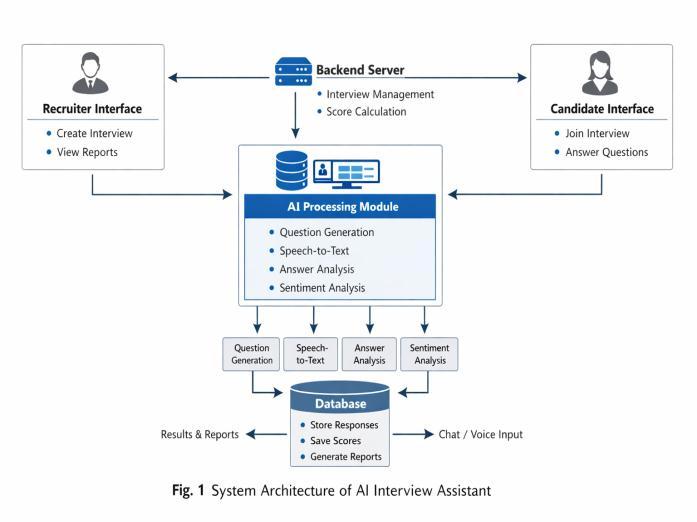
The overall design of the AI Interview Assistant follows a modularandscalablearchitecture.Thesystemconsistsofa frontendinterfaceforrecruitersandcandidates,abackend serverformanaginginterviewlogic,anAIprocessinglayer forquestiongenerationandevaluation,andadatabasefor secure data storage. This architecture ensures smooth interactionbetweendifferentcomponentsandallowsfuture enhancementswithoutmajorsystemchanges.
In recent years, the recruitment and hiring process has undergonesignificanttransformationduetoadvancements in Artificial Intelligence (AI) and Machine Learning (ML). Organizationsareincreasinglyadoptingautomatedsystems toimprovehiringefficiency,reducehumanbias,andhandle largevolumesofapplicants.TheliteraturerevealsthatAIbased recruitment systems primarily focus on resume screening, candidate shortlisting, and preliminary skill assessment,whileinterviewautomationisstillanevolving researcharea.
Early research in recruitment automation mainly concentrated on resume parsing and skill matching. Traditional keyword-based systems were used to extract relevantinformationfromresumesandcompareitwithjob descriptions.However,thesesystemsoftenfailedtocapture contextual meaning and deeper candidate capabilities. To overcometheselimitations,researchersintroducedNatural Language Processing (NLP) techniques, which improved semanticunderstandingandcontextualanalysisoftextual data.
SeveralstudieshaveexploredtheuseofNLPforanalysing textual interview responses. Techniques such as tokenization, part-of-speech tagging, named entity recognition, and semantic similarity analysis have been appliedtoevaluatecandidateanswers.Researchshowsthat NLP-based evaluation provides more consistent and objectiveresultscomparedtomanualassessment,especially in technical interviews where keyword relevance and conceptualaccuracyareimportant.
With the rise of online interviews, speech processing technologies have gained importance in recruitment systems.Speech-to-text(STT)modelssuchasDeepNeural Network (DNN) based systems have enabled accurate transcriptionofcandidateresponses.Studiesindicatethat converting spoken responses into text allows further
International Research Journal of Engineering and Technology (IRJET) e-ISSN: 2395-0056
Volume: 13 Issue: 01 | Jan 2026 www.irjet.net p-ISSN: 2395-0072
analysisusingNLPmodels,makingvoice-basedinterviews suitable for automated evaluation. Researchers have also analysed speech features such as pauses, hesitation, and speakingratetoassessconfidenceandcommunicationskills. Sentiment analysis has been widely studied for understanding emotional tone and attitude in human communication.Inrecruitment-relatedresearch,sentiment analysis has been used to identify candidate confidence, stress levels, and positivity during interviews. Machine learning classifiers and deep learning models have been applied to detect emotional patterns from textual and spokenresponses.Literaturesuggeststhatsentiment-based evaluation can complement technical assessment by providinginsightsintosoftskills.
Recent studies have focused on large language models (LLMs) such as GPT and T5 for question generation and answerevaluation.Thesemodelsarecapableofgenerating domain-specificinterviewquestionswithvaryingdifficulty levels.ResearchdemonstratesthatLLM-generatedquestions maintain contextual relevance and improve interview standardization. Automated question generation reduces interviewer dependency and ensures uniform assessment criteriaacrosscandidates.
Several researchers have proposed AI-driven interview platformsthatintegratemultipletechnologiessuchasNLP, speech recognition, and machine learning-based scoring systems. However, most existing systems are limited in scope, focusing either on technical evaluation or communication assessment. Few systems provide a complete end-to-end solution that includes question generation,liveinterviewinteraction,responseevaluation, scoring,andreporting.
Studies also highlight ethical concerns and challenges associated with AI-based interviews. Issues such as data privacy, transparency, and algorithmic bias have been discussed extensively. Researchers emphasize the importance of secure data storage, encrypted communication,andexplainableAImodelstoensuretrust andfairnessinrecruitmentsystems.
Fromtheliteraturereview,itisevidentthatAIhasstrong potential to enhance the interview process by improving efficiency, consistency, and scalability. However, there remains a gap in implementing a unified system that combines automated question generation, real-time interaction, speech analysis, sentiment detection, and structured performance reporting. The proposed AI InterviewAssistantaimstobridgethisgapbyprovidinga comprehensive and practical solution for automated candidateevaluation.
Counterfeitingofproductshasbecomeaseriousproblemin global supply chains, causing financial losses to manufacturers and reducing consumer trust. Traditional anti-counterfeiting methods such as barcodes, holograms, andserialnumbersareoftenvulnerabletoduplicationand manipulation. To overcome these limitations, blockchain technology offersa secure,transparent, and tamper-proof solutionforproductauthenticationandtraceability.
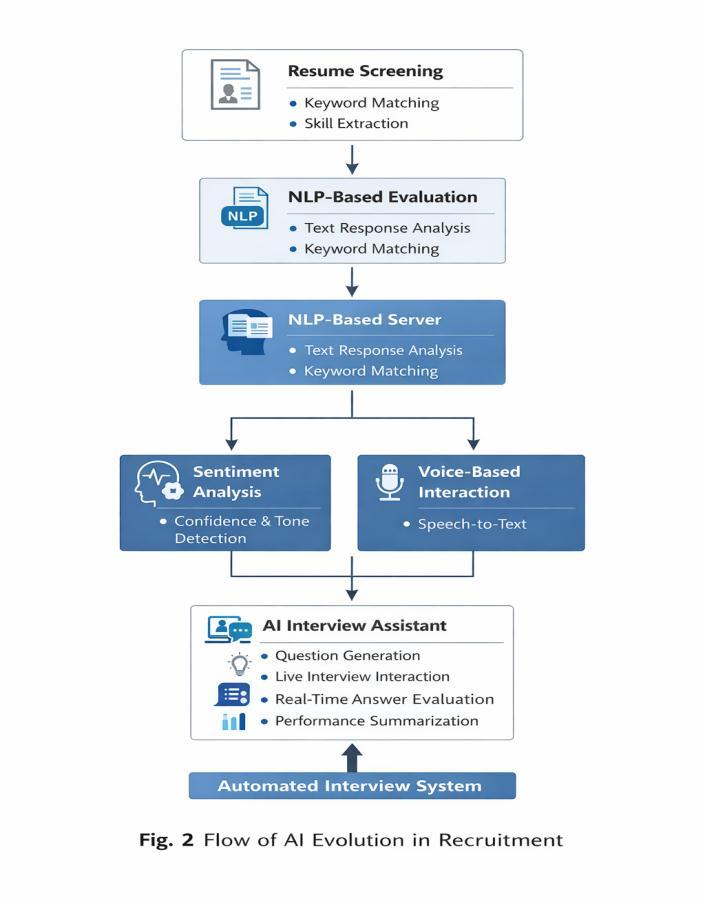
The proposed method uses blockchain technology combined with digital verification mechanisms to prevent product counterfeiting. The system ensures that everyproductisuniquelyidentified,securelyregistered,and transparently tracked throughout the supply chain. The overallflowoftheproposedsystemisillustratedin Fig. 2, whichexplainshowdatamovesfromproductregistrationto finalconsumerverification.
Initially, during the product registration phase, each genuineproductisassignedauniquedigitalidentitysuchas a QRcode orhashvalue. Thisidentity isgenerated bythe manufacturerandstoredontheblockchainnetwork.Once stored, the information becomes immutable, meaning it cannotbealteredordeletedbyunauthorizedparties.This ensures the originality of the product data from the manufacturingstageitself.
International Research Journal of Engineering and Technology (IRJET) e-ISSN: 2395-0056
Volume: 13 Issue: 01 | Jan 2026 www.irjet.net p-ISSN: 2395-0072
Inthenextphase,theregisteredproductdataisprocessed througha blockchain-based verification layer.Similarto theevaluationstageshownintheflowdiagram,thesystem validates product details using cryptographic techniques. Each transaction related to the product such as manufacturing,shipping,anddistribution isrecordedasa newblockintheblockchain.Thiscreatesatransparentand traceablehistoryoftheproduct.
The system then performs data validation and integrity checks, ensuring that the product information remains consistentacross thesupplychain.Anyattempttomodify productdetailsorintroducecounterfeititemscanbeeasily detected,asblockchainrecordsaredistributedandverified across multiple nodes. This stage ensures trust and reliabilityinthesystem.
Further, the proposed method supports consumer-level verification,whereenduserscanscantheQRcodeusinga mobile or web application. The scanned data is compared with blockchain records in real time. If the product information matches the original blockchain entry, the productisverifiedasgenuine.Otherwise,thesystemflagsit ascounterfeit.
Finally, the system generates verification results and reports,similartothefinaloutputstageintheflowdiagram. Manufacturers and regulatory authorities can monitor product movement, identify counterfeit sources, and take corrective action. This automated and decentralized approachsignificantlyimprovessupplychaintransparency andreducesdependencyoncentralizedauthorities.
Overall,theproposedblockchain-basedanti-counterfeiting methodensuresproductauthenticity,improvesconsumer trust, and enhances supply chain security. By leveraging blockchain’s immutability and transparency, the system provides an effective and scalable solution to combat productcounterfeiting.
Resume Screening / Product Registration
Each genuine product is registered by the manufacturer and assigned a unique digital identifiersuchasaQRcodeorhashvalue.
Data Evaluation Layer
Product details are verified and validated before beingstoredontheblockchain.
Block chain-Based Server
The blockchain network securely stores product information and transaction history in an immutablemanner.
Integrity and Sentiment Analysis Layer
System checks data consistency and detects any unauthorizedmodificationattempts.
End users scan the product code to verify authenticityusingawebormobileapplication.
The system confirms whether the product is genuine or counterfeit and provides verification results.
The AI Interview Assistant project presents a comprehensive and intelligent system designed to modernizeandstreamlinetherecruitmentandevaluation process. By integrating advanced Natural Language Processing(NLP)andmachinelearningtechniqueswithweb technologies, the system automates multiple stages of interviews, from question generation to candidate performanceevaluation,ensuringefficiency,objectivity,and scalability.Theprojectleveragesstate-of-the-artAImodels, includingGPTforquestiongeneration,Whisperforspeechto-text transcription, and BART/Pegasus for summary creation, allowing recruiters to conduct technical and behaviouralinterviewsinbothtextandvoicemodes.
The system successfully addresses several challenges inherent in traditional recruitment methods, such as subjectivity,timeconsumption,andinconsistentevaluation standards. The AI-driven scoring mechanism evaluates technical accuracy, communication skills, and confidence levels, providing a holistic and quantitative assessment of candidates. Real-time analysis, supported by WebSocket connections,ensuresinstantfeedback,whilesentimentand entity recognition enable deeper insights into candidate responses.Additionally,theintegrationofavisualizationand analytics dashboard, powered by Plotly.js and Grafana, providesrecruiterswithclearmetricsandtrends,enhancing data-drivendecision-making.
Securityandreliabilityhavebeengivendueconsideration throughoutthesystem’sdesign.FeaturessuchasJWT-based authentication,encryptedstorageofaudiorecordings,and robust error handling for model calls and network disruptionsensurethatsensitivecandidatedataisprotected, maintaining the integrity and trustworthiness of the platform. Furthermore, the modular architecture using React.jsforthefront-endandNode.js/FastAPIforthebackendallowsforfuturescalabilityandseamlessintegrationof additionalfeatures,suchasadvancedinterviewdomainsor AI-drivenpredictiveanalytics.
International Research Journal of Engineering and Technology (IRJET) e-ISSN: 2395-0056
Volume: 13 Issue: 01 | Jan 2026 www.irjet.net p-ISSN: 2395-0072
Inpracticalterms,thisAIInterviewAssistantreduceshuman workload, minimizes bias, and standardizes candidate assessmentacrossdifferentinterviewersandsessions.The platform provides recruiters with ranked candidate lists, detailedsummaries,anddomain-specificinsights,enabling fasterandmoreinformedhiringdecisions.Forcandidates, the system offers an interactive and adaptive experience, withclearfeedbackthatcanhelpimprovetheirskillsover time.
Overall, the successful implementation of this project demonstratesthepotentialofAI-assistedinterviewingasa transformative tool in human resource management. By combiningcutting-edgeAImodels,real-timeprocessing,and user-friendly interfaces, the system exemplifies how technology can enhance traditional recruitment practices, making the hiring process more objective, efficient, and transparent. The AI Interview Assistant thus represents a significantsteptowardintelligent,data-drivenrecruitment, withpotentialapplicationsacrosscorporate,academic,and technicalhiringcontexts.
1. Vaswani, A., Shazeer, N., Parmar, N., Uszkoreit, J., Jones, L., Gomez, A. N., Kaiser, Ł., & Polosukhin, I. (2017). Attention Is All You Need. Advances in NeuralInformationProcessingSystems,30.
2. Devlin, J., Chang, M.-W., Lee, K., & Toutanova, K. (2019). BERT: Pre-training of Deep Bidirectional TransformersforLanguageUnderstanding.NAACLHLT.
3. Raffel,C.,Shazeer,N.,Roberts,A.,Lee,K.,Narang,S., Matena, M., Zhou, Y., Li, W., & Liu, P. J. (2020). Exploring the Limits of Transfer Learning with a Unified Text-to-Text Transformer. Journal of MachineLearningResearch,21(140),1-67.
4. Radford,A.,Wu,J.,Child,R.,Luan,D.,Amodei,D.,& Sutskever, I. (2019). Language Models are UnsupervisedMultitaskLearners.OpenAI.
5. Brown,T.,Mann,B.,Ryder,N.,Subbiah,M.,Kaplan, J., Dhariwal, P., ... & Amodei, D. (2020). Language ModelsareFew-ShotLearners.AdvancesinNeural InformationProcessingSystems,33.
6. OpenAI. (2023). Whisper: Robust Speech RecognitionviaLarge-ScaleWeakSupervision.
7. Lewis, M., Liu, Y., Goyal, N., Ghazvininejad, M., Mohamed,A., &Levy,O. (2020). BART:Denoising Sequence-to-Sequence Pre-training for Natural Language Generation, Translation, and Comprehension.ACL.
8. AmazonWebServices.(2022).AmazonPolly–Textto-SpeechService.
9. PostgreSQL Global Development Group. (2023). PostgreSQLDocumentation.
10. Plotly Technologies Inc. (2023). Plotly.js Open SourceGraphingLibrary.
MR.VISHVESHWAR GHAVTE PursuingPoly(Co)
S.Y.P SHREEYASH COLLEGE OF ENGINEERINGANDTECHNOLOGY (POLYTECHNIC)
MR.PRACHI GARODI PursuingPoly(Co)
S.Y.P SHREEYASH COLLEGE OF ENGINEERINGANDTECHNOLOGY (POLYTECHNIC)
MR. HARSH CHAVAN
PursuingPoly(Co)
S.Y.P SHREEYASH COLLEGE OF ENGINEERINGANDTECHNOLOGY (POLYTECHNIC)
MR.SNEHAL GAIKWAD PursuingPoly(Co)
S.Y.P SHREEYASH COLLEGE OF ENGINEERINGANDTECHNOLOGY (POLYTECHNIC)
PROF. ANIL NAIK HOD,Dept.ofComputer Engineering
S.Y.PSHREEYASHCOLLEGE OFENGINEERINGAND TECHNOLOGY(POLYTECHNIC)