
International Research Journal of Engineering and Technology (IRJET) e-ISSN: 2395-0056
Volume: 13 Issue: 02 | Feb 2026 www.irjet.net p-ISSN: 2395-0072
International Research Journal of Engineering and Technology (IRJET) e-ISSN: 2395-0056
Volume: 13 Issue: 02 | Feb 2026 www.irjet.net p-ISSN: 2395-0072
1Aman S. Dhemare, 2Dhruv N. Vetal , 3 Rushikesh S. Kangane , 4th Pradnesh V. Phadtare 1,2,3,4 Electronics and telecommunication Jayawantrao Sawant polytechnic Pune, India
ABSTRACT -This paper presents the design and implementation of an AI enabled Smart Traffic Light Control System for a four-lane road junction using Raspberry Pi 4. The proposed system focuses on reducing traffic congestion, improving emergency response time, and enhancing pedestrian safety through automation. A single camera connected to the Raspberry Pi is used for real-time video monitoring and ambulance detection using image processing techniques. Traffic density is measured using ultrasonic and IR sensors installed on each lane, and green signal timing is adjusted dynamically based on vehicle flow. Emergency vehicle priority is provided using AI-based detection, V2I communication through ESP32 modules, and authorized manual override buttons. A Flask-based web dashboard displays live video feed, lane status, traffic density, and emergency alerts. The system reduces manual traffic control, minimizes waiting time, and improves overall traffic management efficiency. The proposed solution is cost-effective, scalable, and suitable for smart city applications and academic prototype demonstrations.
Traffic congestion has become a major problem in urban areas due to the rapid increase in the number of vehicles on roads. Traditional traffic signal systems mostly operate on fixed timing and do not consider the actual traffic density at intersections. This leads to longer waiting time, fuel wastage, and increased pollution. Emergency vehicles such as ambulances also face delays because there is no automatic priority system. Therefore, there is a need for an intelligent trafficcontrolsystemthatcanmanagesignalsbasedonreal-timeconditions.
The AI-enabled smart traffic light control system proposed in this project uses image processing and automation techniquestoimprovetrafficmanagement.Acameracapturestrafficimages,anda RaspberryPianalyzesvehicledensity toadjustsignaltimingdynamically.Thesystemalsoincludesemergencyvehicledetectionandaweb-baseddashboardfor monitoring.Thedevelopedprototypedemonstrateshowartificialintelligenceand embeddedsystemscanimprovetraffic flowefficiency.
Trafficmanagementatroadintersectionsisbecomingincreasinglydifficultduetothecontinuousgrowthinthenumberof vehicles.Mostoftheexistingtrafficlightsystemsoperateonfixedtimeintervalswithoutconsideringtheactualnumberof vehicles present on each lane. This results in inefficient signal control, longer waiting times, and unnecessary traffic congestion,especiallyduringpeakhours.Inaddition, emergencyvehiclessuchasambulancesandfirebrigadesoftenface delaysbecausethereisnoautomaticmechanismtoprovidesignalpriorityatintersections.
Manual traffic control by authorities is also not always practical, as it requires continuous human effort and monitoring. Thereisaneedforasmartandautomatedtrafficcontrolsystemthatcandetectreal-timevehicledensityandadjustsignal timingaccordingly.Therefore,themainproblemaddressedinthisprojectistodesignandimplementan intelligenttraffic lightcontrolsystemthatreducescongestion,improvestrafficflow,andprovidespriorityforemergencyvehiclesusingAIbasedtechniques.
ThemainobjectiveofthisprojectistodesignanddevelopanAI-enabledsmarttrafficlightcontrolsystemthatcanmanage traffic signals efficiently based on real-time vehicle density. The system aims to reduce traffic congestion at road intersections byautomaticallyadjustingsignal timingaccordingto the number ofvehiclespresenton eachlane. Another important objective is to minimize unnecessary waiting time and improve overall traffic flow efficiency compared to traditionalfixed-timetrafficsignalsystems.
International Research Journal of Engineering and Technology (IRJET) e-ISSN: 2395-0056
Volume: 13 Issue: 02 | Feb 2026 www.irjet.net p-ISSN: 2395-0072
Thisprojectalsofocusesondetectingemergencyvehiclessuchasambulancesandprovidingimmediatesignalpriorityto ensurefastermovementduringcriticalsituations.Additionally,thesystemincludesaweb-baseddashboardforreal-time monitoring and visualization of traffic conditions. The overall objective is to demonstrate how artificial intelligence and embeddedsystemscanbeusedtocreateanintelligent,automated,andcost-effectivetrafficmanagementsolutionsuitable forfuturesmartcityapplications.
Many researchers have worked on smart traffic management systems using image processing, sensors, and artificial intelligencetechniques.Somesystemsuseinfraredsensorsorinductiveloopstodetectvehiclepresence,whileothersuse camera-based detection for better accuracy. Studies show that adaptive traffic signal control based on real-time vehicle densitycansignificantlyreducetrafficcongestionandwaitingtimecomparedtofixed-timesystems.Recentdevelopments alsoincludeemergencyvehicledetectionmethodstoprovidesignalpriority.
However, many existing solutions require expensive hardware or complex infrastructure, which makes implementation difficult in developing regions. Therefore, there is a need for a cost-effective and efficient system that can perform realtimetrafficmonitoringand control. Theproposed projectfocuses on using affordablecomponentslikeRaspberryPi and cameramoduleswhileimplementingintelligentcontroltechniquesforbettertrafficmanagement.
The proposed systemis an AI-enabledsmart trafficlightcontrol systemdesigned tomanagetrafficsignalsautomatically basedonreal-timevehicledensity.Inthissystem,aRaspberryPiisusedasthemaincontroller,whichreceivesinputfrom ultrasonicsensorsand IRsensorsinstalledon eachlanetodetectvehiclepresence andmeasuretrafficdensity.Basedon the sensor data, the controller calculates the required green signal time for each lane and controls the traffic lights accordingly. A camera module is also connected to the Raspberry Pi to monitor the road continuously and detect emergency vehicles such as ambulances using image processing techniques. When an emergency vehicle is detected, the systemoverridesthenormaltrafficcycleandprovidesimmediateprioritytothecorrespondinglane.
Inadditiontoautomaticcontrol,thesystemalsoincludesESP32modulesforcommunicationandemergencypushbuttons forauthorizedmanualoverrideduringspecialsituations.AFlask-basedwebdashboardisdevelopedtodisplaylivevideo feed,lanestatus,trafficdensityvalues,andemergencyalertsinrealtime,whichhelpsinmonitoringandmanagement.The main aim of the proposed system is to reduce traffic congestion, minimize waiting time, and improve emergencyvehicle movementwithminimalhumanintervention.Thesystemisdesignedtobecost-effective,scalable,andsuitableforsmart cityapplicationsaswellasacademicprototypeimplementation.
International Research Journal of Engineering and Technology (IRJET) e-ISSN: 2395-0056
Volume: 13 Issue: 02 | Feb 2026 www.irjet.net p-ISSN: 2395-0072
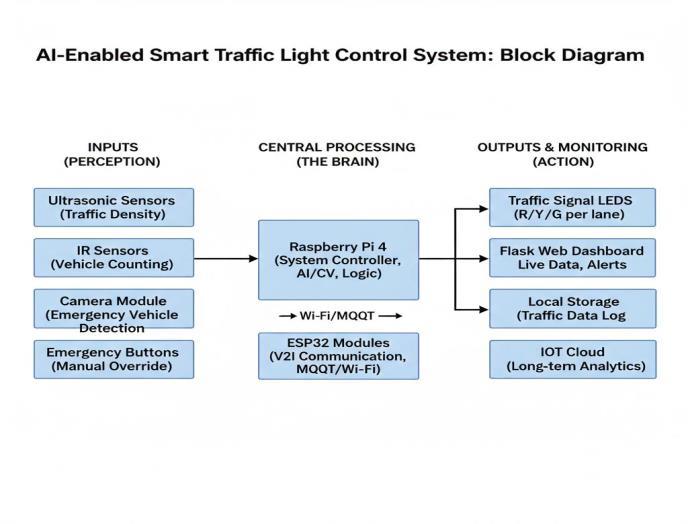
The block diagram of the AI-enabled smart traffic light control system consists of three main sections: input section, processingsection,andoutputsection.
1. Input Section
Ultrasonic sensors are used to measure the traffic density on each lane by calculating the distance between vehicles.
IRsensorsareusedforvehicledetectionandcountingnearthesignalarea.
Acameramoduleisconnectedtocapturelivevideoformonitoringandemergencyvehicledetection.
Emergency push buttons are provided forauthorized personsto manuallycontrol the signalsduring emergency situations.
Allinputdatafromsensorsandbuttonsissenttothemaincontrollerforprocessing.
2. Central Processing Section
RaspberryPi4actsasthemaincontrollerorbrainofthesystem.
Itreceivesdatafromsensorsandthecamera,processestheinformation,anddecidesthesignaltiming.
Imageprocessingalgorithmsareusedtodetectemergencyvehicleslikeambulances.
ESP32modulesareusedforcommunicationbetweenvehiclesandthesystemusingWi-FiorMQTTprotocols.
3. Output and Monitoring Section
TrafficsignalLEDs(Red,Yellow,Green)arecontrolledaccordingtothedecisionmadebythecontroller.
AFlask-basedwebdashboarddisplayslivetrafficdata,lanestatus,andemergencyalerts.
Trafficdatacanalsobestoredlocallyforrecordpurposes.
IoTcloudplatformscanbeusedforlong-termmonitoringandanalysis.
Overall, this block diagram shows how different components are connected together to make the system work automaticallyandefficientlywithminimumhumanintervention.
Hardware Requirements
ThefollowinghardwarecomponentsarerequiredtoimplementtheAI-enabledsmarttrafficlightcontrolsystem:
Raspberry Pi 4 Model B
Itactsasthemaincontrollerofthesystem.Itprocessesthesensordata,camerainput,andcontrolsthetrafficsignalLEDs basedonprogrammedlogic.
ESP32 Modules
These modules are used for wireless communication and vehicle-to-infrastructure (V2I) communication using Wi-Fi or MQTTprotocol.
Ultrasonic Sensors
Ultrasonicsensorsareusedtomeasurethedistancebetweenvehiclestoestimatetrafficdensityoneachlane.
IR Sensors
IRsensorshelpindetectingvehiclepresenceandcountingvehiclesnearthesignalpoint.
International Research Journal of Engineering and Technology (IRJET) e-ISSN: 2395-0056
Volume: 13 Issue: 02 | Feb 2026 www.irjet.net p-ISSN: 2395-0072
Camera Module / USB Camera
The camera is used for live traffic monitoring and detecting emergency vehicles such as ambulances using image processing.
Traffic Signal LEDs (Red, Yellow, Green)
LEDsrepresentthetrafficlightsforeachlaneandarecontrolledthroughRaspberryPiGPIOpins.
Push Buttons
Emergencypushbuttonsareprovidedformanualoverrideduringcriticalsituationsbyauthorizedpersonnel.
Power Supply Unit
AregulatedpowersupplyprovidesrequiredvoltagetoRaspberryPi,sensors,andothercomponents.
Connecting Wires and Breadboard
Usedformakingcircuitconnectionsduringprototypeimplementation.
Software Requirements
Thefollowingsoftwaretoolsareusedforprogrammingandsystemdevelopment:
Python Programming Language
Pythonisusedtowritethemaincontrolprogramfortrafficlogic,sensorprocessing,andcamerahandling.
Arduino IDE
ArduinoIDEisusedtoprogramtheESP32modulesforcommunicationpurposes.
Flask Framework
Flaskisusedtocreateawebdashboardforlivemonitoringoftrafficdata,lanestatus,andalerts.
OpenCV Library
OpenCVisusedforimageprocessingandemergencyvehicledetectionthroughthecamera.
RaspberryPiOS
TheoperatingsysteminstalledonRaspberryPitoruntheprogramsandmanagehardware.
MQTT/Wi-FiCommunicationProtocols
UsedforcommunicationbetweenESP32modulesandRaspberryPifordatatransfer.
© 2026, IRJET | Impact Factor value: 8.315 | ISO 9001:2008 Certified Journal | Page678
International Research Journal of Engineering and Technology (IRJET) e-ISSN: 2395-0056
Volume: 13 Issue: 02 | Feb 2026 www.irjet.net p-ISSN: 2395-0072
ThesystemarchitectureoftheAI-enabledsmarttrafficlightcontrol systemshowshowdifferenthardwareand software componentsareconnectedandworktogethertocontroltrafficautomatically.
TheRaspberryPi4actsasthemaincontrollerofthesystemandworksasthecentralprocessingunit.
Ultrasonic sensors and IR sensors are installed on each lane to detect vehicle presence and measure traffic density.
A camera module is connected to the Raspberry Pi to capture live video for traffic monitoring and emergency vehicledetection.
ESP32 modules are used for communication between vehicles and the traffic system using Wi-Fi or MQTT protocol.
TheRaspberryPiprocessesalltheinputdataanddecidesthesignaltimingbasedontrafficconditions.
TrafficsignalLEDsareconnectedtotheGPIOpinsoftheRaspberryPiandarecontrolledaccordingtothedecision takenbythesystem.
Emergencypushbuttonsareprovidedtomanuallyoverridethesystemduringspecialsituationsifrequired.
AFlask-basedwebdashboardisdevelopedtodisplaylivetrafficstatus,laneinformation,andemergencyalertsfor monitoring.
Trafficdatacanalsobestoredlocallyorsenttocloudplatformsforfutureanalysisandrecordkeeping.
The working principle of the AI-enabled smart traffic light control system is based on real-time traffic monitoring and automaticsignalcontrolusingsensorsandacontroller.
Whenvehiclesarrivenearthejunction,theultrasonicsensorsmeasurethedistancebetweenvehiclestoestimate trafficdensityoneachlane.
Atthesametime,IRsensorsdetectthepresenceofvehiclesnearthesignalareaandhelpincountingvehicles.
AllthesensordataissenttotheRaspberryPi,whichprocessestheinformationandcalculatestherequiredgreen signaltimeforeachlane.
Thesystemcomparestrafficdensityofalllanesandgivesprioritytothelanewithmorevehicles.
A camera module continuously monitors the road and checks for emergency vehicles such as ambulances using imageprocessing.
Ifan emergencyvehicle isdetected, thesystem immediatelyoverridesthe normal signal cycleand givesa green signaltothatparticularlane.
ESP32modulescanalsosendemergencysignalsthroughcommunicationifrequired.
TrafficsignalLEDsarecontrolledautomaticallybasedonthedecisiontakenbytheRaspberryPi.
AFlask-basedwebdashboarddisplayslivetrafficstatus,laneconditions,andemergencyalertsformonitoring.
The system keeps repeating this process continuously to maintain smooth traffic flow with minimum human intervention.
International Research Journal of Engineering and Technology (IRJET) e-ISSN: 2395-0056
Volume: 13 Issue: 02 | Feb 2026 www.irjet.net p-ISSN: 2395-0072
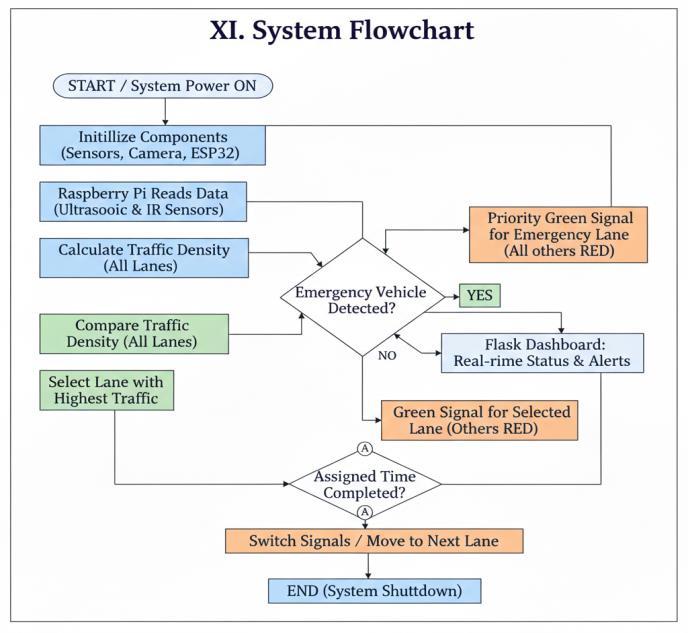
TheflowchartoftheAI-enabledsmarttrafficlightcontrolsystemexplainsthestep-by-stepworkingprocessofthesystem fromstartingtosignalcontrol.
First, the system is powered ON and all components such as sensors, camera, and communication modules are initialized.
TheRaspberryPistartsreadingdatafromultrasonicsensorsandIRsensorsinstalledoneachlane.
Thesystemcalculatesthetrafficdensitybasedonthesensorreadings.
After that, the controllerchecks whetherany emergencyvehicle isdetectedusingthecamera orcommunication module.
Ifanemergencyvehicleisdetected,thesystemimmediatelygivesprioritygreensignaltothatlane.
Ifnoemergencyvehicleisdetected,thesystemcomparestrafficdensityofalllanesandselectsthelanewiththe highesttraffic.
ThecontrollerthenturnsONthegreensignalfortheselectedlaneandkeepsotherlanesonred.
Aftertheassignedtimeiscompleted,thesystemswitchessignalsandrepeatstheprocessforthenextlane.
Atthesametime,theFlaskdashboardupdatesthetrafficstatusandalertsinrealtime.
Thiscyclecontinuescontinuouslytomaintainsmoothtrafficflow.
ThemethodologyoftheproposedAI-enabledsmarttrafficlightcontrolsystemmainlyfocusesondetectingvehicledensity andidentifying emergency vehiclesin real time sothat trafficsignalscan be controlledautomatically.The system uses a combinationofsensors,cameraprocessing,andcommunicationmodulestoimproveaccuracyandreliability.
Ultrasonicsensorsareinstalledoneachlanetomeasurethedistancebetweenvehicles.
Whentrafficincreases,thedistancemeasuredbythesensordecreases,whichindicateshighertrafficdensity.
IRsensorsareplacednearthesignalareatodetectthepresenceofvehiclesandhelpincountingvehicles.
ThedatafromultrasonicandIRsensorsissenttotheRaspberryPicontroller.
2026, IRJET | Impact Factor value: 8.315 | ISO 9001:2008 Certified Journal | Page680
International Research Journal of Engineering and Technology (IRJET) e-ISSN: 2395-0056
Volume: 13 Issue: 02 | Feb 2026 www.irjet.net p-ISSN: 2395-0072
Thecontrolleranalyzesthisdataandcalculatesthetrafficdensitylevelforeachlane.
Basedonthedensityvalue,thesystemdecideshowmuchgreensignaltimeshouldbeprovidedtoeachlane.
AcameramoduleisconnectedtotheRaspberryPitocontinuouslymonitortheroad.
Imageprocessingtechniquesareusedtodetectemergencyvehiclessuchasambulances.
ESP32 modules are used for communication, which can send emergency signals from vehicles to the system if required.
Emergencypushbuttonsarealsoprovidedformanualoverridebyauthorizedpersonnel.
Whenanemergencyvehicleisdetectedthroughanymethod,thesystemimmediatelyoverridesthenormaltraffic cycle.
Thecorrespondinglanereceivesagreensignalsothattheemergencyvehiclecanpasswithoutdelay.
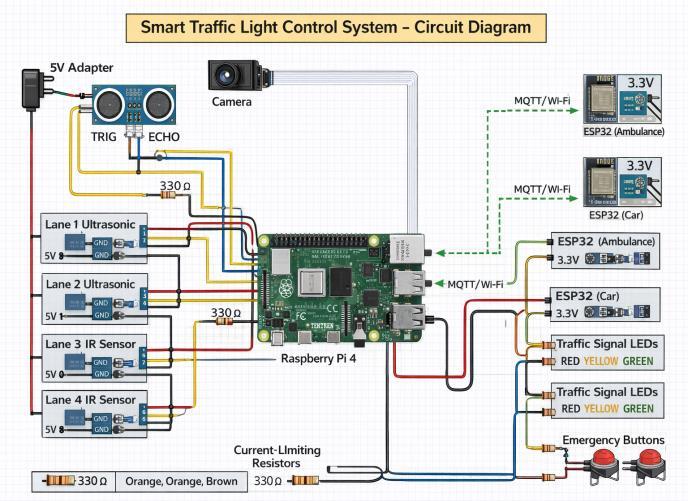
The circuit diagram of the AI-enabled smart traffic light control system shows how different hardware components are connectedtotheRaspberryPicontroller.TheRaspberryPiactsasthemaincontrolunitandallsensors andoutputdevices areconnectedthroughitsGPIOpins.
UltrasonicsensorsareconnectedtotheGPIOpinsoftheRaspberryPiformeasuringvehicledistanceoneachlane.
IRsensorsareconnectedasinputdevicestodetectvehiclepresencenearthesignalarea.
Traffic signal LEDs (Red, Yellow, Green) are connected to the output pins of the Raspberry Pi through current limitingresistors.
ThecameramoduleisconnectedusingtheUSBportorCSIinterfaceoftheRaspberryPiforlivevideomonitoring.
ESP32modulescommunicatewiththeRaspberryPiusingWi-Fiforsendingandreceivingdata.
EmergencypushbuttonsareconnectedtoGPIOinputpinstoprovidemanualoverridecontrolwhenrequired.
AregulatedpowersupplyisusedtoprovidestablevoltagetoRaspberryPiandothercomponents.
Allcomponentsshareacommongroundtoensurepropercircuitoperation.
International Research Journal of Engineering and Technology (IRJET) e-ISSN: 2395-0056
Volume: 13 Issue: 02 | Feb 2026 www.irjet.net p-ISSN: 2395-0072
XVII. Results and Observations
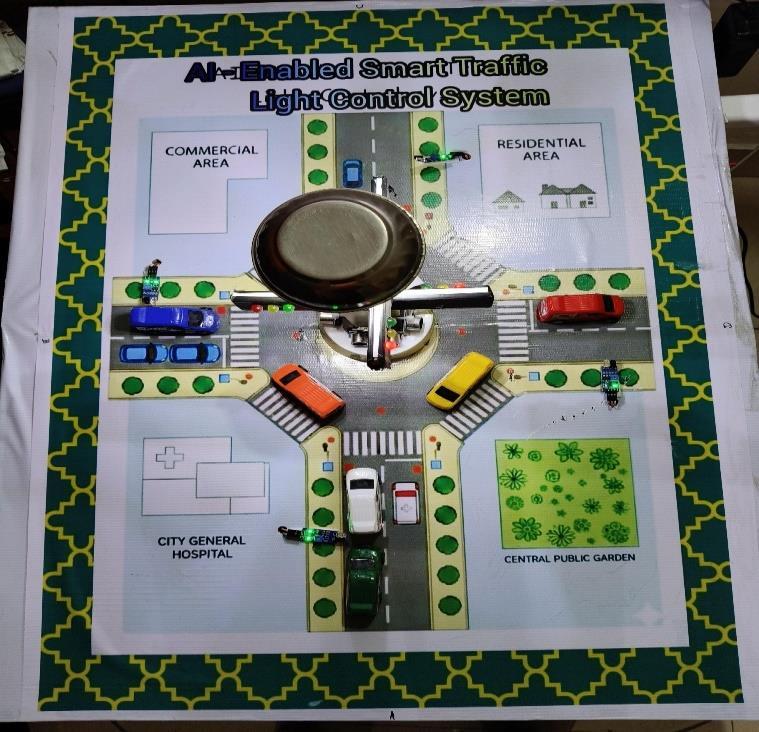
The AI-enabled smart traffic light control system was successfully implemented and tested for a four-lane intersection prototype. During testing, the sensors were able to detect vehicle presence and traffic density accurately, and the Raspberry Pi controller adjusted the signal timing basedon thetrafficconditions.It wasobserved that lanes withhigher vehicle density received longer green signal duration, which helped in reducing congestion compared to fixed timing systems.
The emergency vehicle detection feature also worked properly using the camera and communication modules. When an emergencyconditionwastriggered,thesystemimmediatelyprovidedprioritytotherespectivelanebyturningthesignal green.TheFlask-baseddashboarddisplayedreal-timetrafficdata,lanestatus,andalertscorrectly,whichmademonitoring easier. Overall, the system showed improved traffic flow, reduced waiting time, and better efficiency compared to traditionaltrafficcontrolmethods.
XVIII. Applications
The AI-enabled smart traffic light control system can be used in different areas where proper traffic management is required.Someoftheimportantapplicationsofthissystemare:
Urban Traffic Intersections
The system can be used at busy city junctions to reduce traffic congestion and waiting time by adjusting signal timing automatically.
Smart City Projects
Itcanbeintegratedintosmartcityinfrastructureforintelligenttrafficmonitoringandmanagement.
International Research Journal of Engineering and Technology (IRJET) e-ISSN: 2395-0056
Volume: 13 Issue: 02 | Feb 2026 www.irjet.net p-ISSN: 2395-0072
Emergency Vehicle Management
The system helps in providing priority to ambulances, fire vehicles, and police vehicles so that they can move quickly withoutdelay.
Parking Management Systems
Similartechnologycanbeusedforsmartparkingsystemstomonitorvehiclemovementandavailability.
Traffic Monitoring Centers
Thelivedashboardfeaturecanbeusedbytrafficauthoritiesforreal-timemonitoringanddecisionmaking.
XIX. Advantages
TheproposedAI-enabledsmarttrafficlightcontrolsystemprovidesseveralbenefitscomparedtotraditionaltrafficsignal systems:
Automatic Traffic Control
Thesystemworksautomaticallybasedonreal-timetrafficconditions,somanualcontrolisnotrequiredmostofthetime.
Reduced Traffic Congestion
Signaltimingisadjustedaccordingtovehicledensity,whichhelpsinreducingunnecessarywaitingtimeatintersections.
Emergency Vehicle Priority
Ambulancesandotheremergencyvehiclescangetimmediategreensignals,whichcanhelpinsavinglives.
Real-Time Monitoring
Thewebdashboardprovideslivetrafficstatus,laneinformation,andalertsforeasymonitoring.
Improved Traffic Flow Efficiency
Vehiclesmovemoresmoothlybecausesignalsarecontrolledbasedonactualroadconditionsinsteadoffixedtiming.
Cost-Effective Solution
ThesystemusesaffordablecomponentslikeRaspberryPiandsensors,makingitsuitableforpracticalimplementation.
Scalable System
Thesystemcanbeexpandedtomultipleintersectionsorintegratedwithsmartcityinfrastructure.
XX. Limitations
TheproposedAI-enabledsmarttrafficlightcontrolsystemhasafewlimitations:
© 2026, IRJET | Impact Factor value: 8.315 | ISO 9001:2008 Certified Journal | Page683
International Research Journal of Engineering and Technology (IRJET) e-ISSN: 2395-0056
Volume: 13 Issue: 02 | Feb 2026 www.irjet.net p-ISSN: 2395-0072
Environmental Dependency
The system performance may decrease during poor lighting conditions, rain, or fog because camera-based detection becomeslessaccurate.
Hardware Limitation
Since Raspberry Pi isused, the processingcapabilityis limitedcomparedtohigh-performance systems, which mayaffect performanceunderheavytrafficconditions.
Prototype Level System
The project is developed as a prototype model, so real-time implementation on large road networks will require further testingandimprovements.
XXI. Future Scope
TheproposedAI-enabledsmarttrafficlightcontrolsystemcanbefurtherimprovedinseveralwaysinthefuture:
Integration with Advanced AI Algorithms
More accurate vehicle detection can be achieved by using advanced deep learning models and high-performance processors.
Multiple Junction Implementation
The system can be expanded to control multiple traffic intersections simultaneously for better city-wide traffic management.
Cloud Connectivity and Data Analytics
Trafficdatacanbestoredonthecloudandanalyzedtopredicttrafficpatternsandimprovesignaltimingefficiency.
Smart City Integration
The system can be integrated with smart city infrastructure such as surveillance systems, GPS tracking, and emergency responsesystems.
Mobile Application Support
Amobileappcanbedevelopedforreal-timemonitoringandcontrolbytrafficauthorities.
XXII. Conclusion
In this project, an AI-enabled smart traffic light control system was successfully designed and implemented to improve traffic management efficiency at road intersections. The system uses real-time vehicle detection through a camera and processes the data using Raspberry Pi to control traffic signals dynamically based on vehicle density. The integration of emergencyvehicledetectionprovidesprioritypassage,whichcanhelpincriticalsituationssuchasambulancemovement.
Thedevelopedprototypedemonstratesthatintelligenttrafficcontrolcansignificantlyreducewaitingtime,improvetraffic flow,andminimizemanualintervention.Theweb-baseddashboardalsoenablesreal-timemonitoring,makingthesystem
© 2026, IRJET | Impact Factor value: 8.315 | ISO 9001:2008 Certified Journal | Page684
International Research Journal of Engineering and Technology (IRJET) e-ISSN: 2395-0056
Volume: 13 Issue: 02 | Feb 2026 www.irjet.net p-ISSN: 2395-0072
morepracticalanduser-friendly.Overall,theproposedsystemshowsgoodperformanceandhasstrongpotentialforfuture implementationinsmartcitytrafficmanagementapplicationswithfurtherimprovements.
XXIII.
1. Kumar and R. Patil, “IoT-Based Smart Traffic Management System Using ESP32,” International Journal of Engineering ResearchandTechnology,vol.12,no.5,pp.210–215,2024.
2.S.Sharma andP.Kulkarni,“AI-Enabled Emergency VehicleDetectionforTrafficControl,”IEEEInternational Conference onSmartSystems,pp.345–350,2024.
3. M. Joshi, A. Pawar, and R. Deshmukh, “Adaptive Traffic Light Control Using IoT and Sensors,” International Journal of SmartInfrastructure,vol.8,no.2,pp.55–60,2025.
We sincerely thank the Department of Electronics and Telecommunication Engineering at JSPM’s Jayawantrao Sawant Polytechnic,Pune,fortheirvaluableguidanceandsupportthroughoutthedevelopmentofthisproject.Theirexpertadvice andencouragementwereessentialinsuccessfullycompletingtheAI-enabledsmarttrafficlightcontrolsystem.