
International Research Journal of Engineering and Technology (IRJET) e-ISSN: 2395-0056
Volume: 13 Issue: 04 | Apr 2026 www.irjet.net p-ISSN: 2395-0072

International Research Journal of Engineering and Technology (IRJET) e-ISSN: 2395-0056
Volume: 13 Issue: 04 | Apr 2026 www.irjet.net p-ISSN: 2395-0072
Mahi Bhalani1, Rudra Donda2, Prof. Reena Desai3
1student, Department of Computer Application, Gyanmanjari Innovative University, Bhavnagar, Gujarat mahiibhalani@gmail.com
2student, Department of Computer Application, Gyanmanjari Innovative University, Bhavnagar, Gujarat rudradonda60@gmail.com
3Assistant professor, Department of Computer Application, Gyanmanjari Innovative University, Bhavnagar, Gujarat radesai@gmiu.edu.in
Abstract - Modern cities are under growing strain as populations shift from rural to urban settings at an unprecedented pace. Managing the resulting complexity in areas like traffic flow, energy demand, structural health of infrastructure, and environmental quality has pushed traditional governance methods to their limits. Over the past decade, smart city programmes have tried to bridge this gap by deploying sensor networks, cloud platforms, and AI-based analytics.Withinthisspace,theconceptofdigitaltwinning building dynamic, data-fed virtual counterparts of physical urban systems has attracted considerable scholarly attention. This paper reviews how digital twin technology, when augmented with artificial intelligence and IoT capabilities, is shaping the next generation of urban management. We examine research published between 2021 and 2025, covering deployments in traffic management, energygridmonitoring,disasterpreparedness,andstructural surveillance. Our synthesis reveals that AI-powered digital twins meaningfully improve prediction accuracy, shorten response times, and support data-driven policy decisions. At the same time, widespread adoption is held back by concerns around cost, fragmented data ecosystems, unclear security boundaries, and a shortage of common standards. The paper concludes by mapping out research avenues including generative AI in simulation enrichment, edge intelligence for latency-sensitive tasks, and federated learning as a privacyrespecting data strategy.
Key Words: Digital Twin, Smart City, Artificial Intelligence, IoT, Urban Infrastructure, Predictive Maintenance, Sustainable Cities, Edge Computing
1.
Urbangrowthhasbecomeoneofthedefiningtrendsof the twenty-first century. According to the United Nations, roughly 56 percent of the world's population resided in citiesasof2023,andprojectionsplacethatfigurecloserto 70 percent by 2050 [1]. While cities generate economic opportunity and cultural exchange, they also concentrate problems:roadnetworksbecomesaturated,energygridsare overtaxed,ageinginfrastructuregoesunmonitored,andair quality degrades. Dealing with these overlapping stresses simultaneously is beyond the reach of conventional
management approaches, which typically react to failures ratherthananticipatingthem.
Thesmartcityparadigmemergedasaresponsetothis complexity. By embedding sensors throughout the urban fabric and connecting them through communication networks, cities began generating real-time data streams thatcould,atleastinprinciple,giveplannersandoperatorsa live picture of what was happening on the ground. Early implementationsfocusedonisolatedusecases adaptive trafficlights,smartmetres,orenvironmentalsensors but lacked any unified framework that could bring these data streamstogetherforholisticdecision-making.
Digital twin technology offers exactly that kind of unifying layer. Rather than treating each sensor or subsysteminisolation,adigitaltwinconstructsacoherent, continuously refreshed model of an urban environment, grounded in real measurements but capable of running forward simulations. The idea traces back to product lifecycle management in manufacturing, where engineers built virtual copies of physical components to test them beforecommittingtoproduction.Urbanresearchersadapted this logic to entire districts and cities, leveraging the convergence of affordable IoT hardware, scalable cloud infrastructure,andmaturemachinelearninglibraries[2].
Whatgivesmodernurbandigitaltwinstheirdistinctive power is the integration of AI reasoning. When machine learning models for anomaly detection, demand forecasting, or scenario optimisation are embedded withinadigitaltwin,itshiftsfromapassivemonitoringtool intoanactivedecisionsupportenvironment.Cityoperators canpose'whatif'questions,exploredownstreameffectsofa proposed intervention, and receive ranked recommendationsbeforeanythingchangesinthephysical world[3].
Despitethetheoreticalappealofthisvision,real-world deploymentsfacesubstantial friction.Manycitieslack the baselinesensordensityneededtofeedareliabletwin.Data collected by different agencies often sits in incompatible formatsbehindorganisationalwalls.Buildingandrunninga city-scaletwindemandssignificantcapitalandspecialised
International Research Journal of Engineering and Technology (IRJET) e-ISSN: 2395-0056
Volume: 13 Issue: 04 | Apr 2026 www.irjet.net p-ISSN: 2395-0072
talentthatsmallermunicipalitiessimplydonothave.Andas urbansystemsbecomemoreconnected,theyalsobecome moreattractivetargetsforcyberdisruption[4].
1.2 Objectives of This Review
Thispapersetsoutto:
SynthesiseresearchonAI-enhanceddigitaltwinsystems published between 2021 and 2025 with relevance to smartcityapplications.
Compare the architectural approaches adopted in representativestudies.
Evaluatehowwellthesesystemsaddresscoredomains: mobility,energy,environment,andinfrastructuresafety.
Identify persistent technical and governance barriers thatlimitscale-up.
Proposeaforward-lookingresearchagendagroundedin theidentifiedgaps.
A growing body of work has examined digital twin deployments across various facets of smart city management.Thestudiesreviewedherewereselectedon thebasisofrecency,methodologicalclarity,andbreadthof applicationdomain.
2.1 Review of Key Studies
Sacoto-Cabrera et al. [5] carried out a systematic mappingoftheresearchlandscapeattheintersectionofIoT, AI, and digital twinning in urban environments. Covering publications from 2018 to 2024, they found that interoperabilityanddataheterogeneityfiguredasthetwo most frequently cited obstacles, while traffic and energy stood out as the domains with the most active research communities.
Xu et al. [6] focused on how generative AI models particularly large language models and diffusion-based architectures can be embedded within digital twin pipelines to overcome sparse or missing data problems. Theirexperimentsshowedthatgenerativepre-processing improved simulation fidelity in scenarios where direct sensorcoveragewasthin.
Grübeletal.[7]raisedthequestionofequitableaccess, arguing that most high-quality digital twin deployments concentrateinwealthycitiesandthatopen-sourceplatforms and shared data standards are prerequisites for broader adoption.
Hu[8]providedapracticallyorientedaccountofdigital twinimplementationsacrossthreemid-sizedChinesecities, documenting measurable improvements in infrastructure inspection cycles and energy consumption monitoring throughbefore-and-afterquantitativecomparisons.
El-Agamyetal.[9]appliedbibliometricmethodstoover 1,200digital-twin-relatedpublications,tracingcleargrowth trajectorieswithsmartcityapplicationsrisingsharplyfrom 2021 onward. Their keyword co-occurrence analysis revealed that predictive maintenance, sustainability, and resilience have emerged as dominant thematic clusters in recentyears.
Author(s) Year Primary Domain Notable Contribution
SacotoCabrera 2025 IoT+AI+DT Systematicreview; gapmap
Xuetal. 2024 GenerativeAI Sparse-data mitigation
El-Agamyet al. 2024 Bibliometrics Trendandcluster analysis
Hu 2023 Urban infrastructure Quantifiedfield outcomes
Kubasetal. 2023 Transportation Transittwin prototype
Adreanietal. 2023 DTframeworks Layered architecturedesign
Lietal. 2021 SmartCityDT Five-layer framework
Zhang&Chen 2021 DTconcepts Lifecyclecost considerations
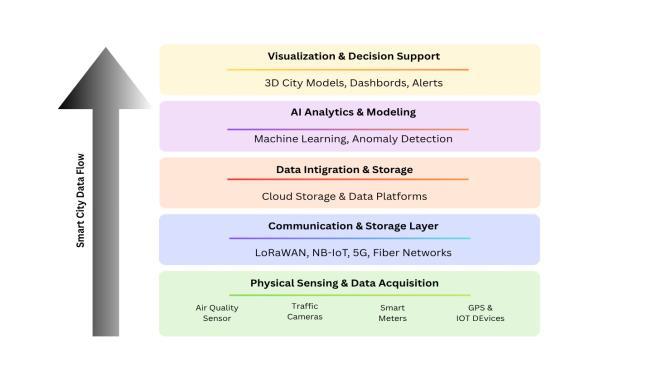
Fig
Althoughnosinglearchitecturehasbecomeauniversal standard,afive-layermodelappearsrecurrentlyacrossthe literatureandprovidesa useful organisingframework for understanding how data flows from the physical city into actionableinsights.
International Research Journal of Engineering and Technology (IRJET) e-ISSN: 2395-0056
Volume: 13 Issue: 04 | Apr 2026 www.irjet.net p-ISSN: 2395-0072
Thefoundationconsistsofinstrumentsembeddedinthe urban environment: fixed air-quality monitors, traffic inductionloops,structuralstraingaugesonbridges,smart energymetres,meteorologicalstations,CCTVcameraswith computer-visioncapabilities,andGPStranspondersinpublic transport fleets. Sensor placement involves spatial optimisationalgorithmstomaximisecoverageperunitcost [12].
Rawsensorreadingstraveltoprocessinginfrastructure througha mixture ofprotocols:LoRaWAN andNB-IoTfor long-range, low-bandwidth devices; 5G cellular links for high-throughput video feeds; and fibre backhaul for fixed infrastructure.Edgegatewaysoftenperforminitialfiltering andcompressionatthisstage,reducingthevolumeofdata thatmusttraversethenetwork[13].
Incomingstreamsfromheterogeneoussourcesmustbe normalisedintoa common data model beforetheycan be usedjointly.Semanticwebtechnologiesandontology-based schemas have been proposed for this purpose, as have middlewareplatformssuchasFIWARE,whichprovidesopen APIs for urban data exchange. Cloud object stores and distributed time-series databases provide the persistence layer[5].
This layer hosts the digital twin's intelligence. Distinct modeltypesservedifferentpurposes:
Short-horizonpredictionmodels(e.g.,LSTMnetworks fortrafficvolume,gradientboostingforenergydemand) supportoperationaldispatchingdecisions.
Anomaly detection models flag readings that deviate from expected patterns, triggering maintenance workflowsbeforefailuresoccur.
Agent-based or physics-informed simulations allow plannerstoexplorelonger-horizonscenariossuchasa newbusrouteorgridresilienceunderextremeheat[6].
Generativemodelscansynthesiserealisticscenariodata for situations that have never occurred historically, addressingakeylimitationinrare-eventcontexts[6].
Resultsaresurfacedthroughgeospatialdashboards,3D citymodelsrenderedinplatformssuchasCesiumJSorUnity, and alert management systems that route notifications to relevant operators. The usability of this layer has a direct bearingonwhetherthetwin'svalueisrealisedinpractice [7].
4. APPLICATION DOMAINS AND PERFORMANCE ANALYSIS
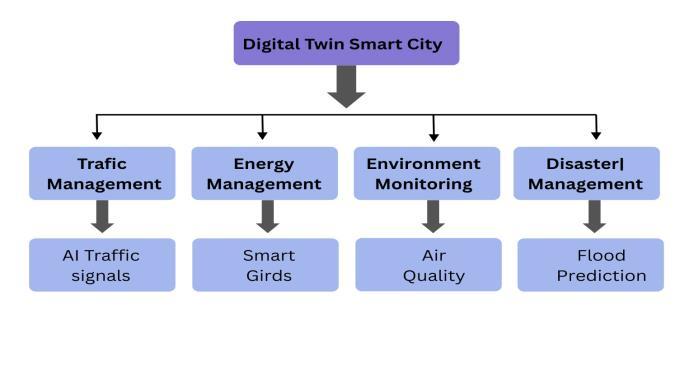
A city-scale twin continuously ingests GPS traces, loop detectorcounts,andsignalstatedatatomaintainadynamic modeloftrafficdensityacrosstheroadnetwork.Whenthe model detects conditions likely to produce congestion, it pushes revised signal timing plans to intersections before queues form [11]. Case evidence from Kubas et al. [14] suggeststhatadaptivesignalcontrolinformedbyadigital twinreducesaverageintersectiondelayby12–18percent comparedtofixed-timeplans,withlargergainsduringoutof-distributiondemandevents.
Smart grid digital twins integrate readings from householdmetres,substationsensors,andweatherforecasts tomodelsupplyanddemandacrossanelectricitynetwork. Alharbeyetal.[15]demonstratedaprototypeinwhichthe twin reduced peak-demand forecasting error by approximately 23 percent relative to a baseline autoregressive model, allowing grid operators to prepositionreservesmoreefficiently.Zhangetal.[16]reported averageenergysavingsof8–14percentacrossaportfolioof public buildings following twin-informed operational recommendations.
Urban digital twins sidestep the cost constraint of traditional air-quality monitoring by combining a sparse network of high-quality reference stations with a dense array of lower-cost indicative sensors and a dispersion model calibrated against reference data. This hybrid approachproducespollutionestimatesatresolutionsoftens of metres rather than several kilometres [8], enabling plannerstotailorlow-emissionzoneboundariestoachieve target air-quality improvements at minimum economic disruption.
International Research Journal of Engineering and Technology (IRJET) e-ISSN: 2395-0056
Volume: 13 Issue: 04 | Apr 2026 www.irjet.net p-ISSN: 2395-0072
Embedding digital twins with data from vibration sensors, strain gauges, and corrosion probes allows asset managerstoshiftfromcalendar-basedinspectioncyclesto condition-basedmaintenance,directingresourceswherethe model estimates risk is highest [10]. Temple et al. [17] describe a bridge twin where anomalous vibration signatures provided 72 hours of warning before a crack propagation event that would have required emergency closureunderconventionalinspectionregimes.
A flood model embedded in a city twin can project inundation extents under different rainfall intensities, allowing emergency managers to pre-position resources, identifybottleneckevacuationroutes,andcommunicaterisk to residents before an event arrives [3]. Post-event, the twin's accumulated sensor record provides a detailed reconstruction of how the city performed, feeding lessons learneddirectlybackintothenextplanningcycle.
5.1
Urbandataisproducedbymanydifferentdepartments andagencies,eachwithitsowncollectionprotocols,naming conventions,andupdatecadences.Mergingthese streams into a coherent data model is time-consuming and errorprone, and the resulting dataset still inherits the quality limitations of its worst-performing source [5]. Missing values, sensor drift, and clock misalignment are routine problemsrequiringrobustdataengineeringpractice.
5.2 Financial and Organisational Barriers
Standing up a city-scale digital twin requires upfront investment in sensor networks, communication infrastructure,compute,andtheskilledpersonneltobuild and maintain the models. Smaller municipalities often cannotabsorbthesecosts,andthereturnoninvestmentis difficult to quantify in advance, making the business case hardertopresentthanfortangiblephysicalinvestments[9].
Bringing together sensor data, operational control interfaces, and rich geospatial information about critical infrastructurecreatesa concentrated, high-value target. A compromiseofthetwin'sdataintegritycouldresultinfalse readingspropagatingthroughthedecisionsupportsystem, whileacompromiseofcontrolinterfacescouldhavedirect physicalconsequences[4].Securityarchitectureforurban digitaltwinsneedstobethreat-modelledexplicitly.
Detailed,real-timemodelsofurbanbehaviourinevitably captureinformationaboutindividuals theirmovements, patterns, and energy use. Without clear governance frameworksdefiningdataminimisationprinciples,retention limits, and meaningful consent mechanisms, digital twin programmes risk eroding public trust and creating new vectorsforsurveillance[7].
5.5
Intheabsenceofagreeddataexchangestandards,cities thatadoptoneplatformoftenfindthemselveslockedin,and cross-citycomparisonsorfederatedtwinnetworksbecome difficulttoestablish[11].BodiessuchasISOandOGChave begun work on relevant standards, but practical convergenceremainssomewayoff.
Largegenerativemodelsopenthepossibilityofsynthetic yet statistically realistic scenario data, addressing the sparse-history problem that constrains probabilistic risk assessment for rare urban events. Research is needed on validationmethodologiesthatestablishwhethergenerative outputsaresufficientlyreliableforoperationaluse[6].
Routingallsensordatatoacentralcloudincurslatency and bandwidth costs problematic for time-critical applications.AdvancesinedgeAIchipsmakeitincreasingly feasibletoruninferencemodelsongatewaydevicescloseto sensors, sending only anomaly flags or compressed summaries to the central twin [13]. Understanding which model classes perform well under tight edge resource constraintsisanactiveresearchquestion.
6.3
Federatedlearningallowsmultiplepartiestojointlytrain amodelwithoutsharingrawdata,makingitanaturalfitfor themulti-agencycontextofurbandigitaltwins.Earlyproofof-conceptstudiesexist,butengineeringthenecessarytrust infrastructure and handling statistical challenges of nonidentical data distributions across agencies remain open problems.
6.4
Operatorsandelectedofficialswhowillactonadigital twin'srecommendationsneedtounderstandnotjustwhat themodelsaysbutwhyitsaysit.IntegratingexplainableAI techniquesintourbantwindashboards,andconductinguser researchonhowdifferent explanationformatssupport or
International Research Journal of Engineering and Technology (IRJET) e-ISSN: 2395-0056
Volume: 13 Issue: 04 | Apr 2026 www.irjet.net p-ISSN: 2395-0072
hinderdecisionquality,representsanimportantbutunderstudieddimensionofthefield[7].
As more cities deploy digital twins, the opportunity growstocompareapproaches,sharemodels,andevaluate performance against common benchmarks. Establishing federated twin networks with standardised APIs would accelerate learning across the research community and reduce redundant effort currently invested in building similarsolutionsfromscratchindifferentcities.
Urbandigitaltwins,enrichedbyAIandsustainedbyIoT data pipelines, represent a genuinely transformative approachtocitymanagement.Theliteraturereviewedhere documents tangible benefits across traffic optimisation, energy efficiency, environmental monitoring, structural maintenance,andemergencyplanning.Ineachdomain,the core advantage is the same: the ability to reason about a city'sbehaviourinadvanceofreal-worldaction,informedby a continuously updated model rather than by intuition or historical averages alone. Yet the path from compelling prototype to routine city-scale deployment remains obstructed by familiar barriers fragmented data, constrained budgets, unresolved security risks, and insufficient standards. Public trust cannot be assumed; it mustbeearnedthroughtransparentdatagovernanceand demonstrableaccountability.Thisreviewsuggeststhatthe next phase of progress depends as much on institutional innovation as on algorithmic advances. Cities, technology providers,academicresearchers,andstandardsbodiesneed to co-create the governance scaffolding within which increasingly sophisticated urban twins can operate safely andsustainably.
Theauthorswouldliketothank[Guide/InstitutionName] fortheirguidanceandsupportthroughoutthepreparation ofthismanuscript.
[1] United Nations Department of Economic and Social Affairs, "World Urbanization Prospects: The 2022 Revision,"UNDESA,NewYork,2022.
[2] M.Batty,"DigitalTwins,"EnvironmentandPlanningB: UrbanAnalyticsandCityScience,vol.45,no.5,pp.817–820,2018.
[3] R. Kitchin, "The Real-Time City? Big Data and Smart Urbanism,"GeoJournal,vol.79,no.1,pp.1–14,2014.
[4] R.Alharbey,T.Alsubait,andH.Alhakami,"DigitalTwin TechnologyforSmartGridPerformance,"IEEEAccess, vol.12,2024.
[5] E.Sacoto-Cabrera,J.Muñoz-Romero,andL.ValenzuelaValdés, "IoT, AI, and Digital Twins in Smart Cities: A SystematicReview," Smart CitiesJournal,vol.8,no. 1, 2025.
[6] H.Xu,Y.Wang,andJ.Liu,"LeveragingGenerativeAIfor UrbanDigitalTwins:ScenariosandChallenges,"Urban Informatics,vol.3,no.2,2024.
[7] J. Grübel, T. Thrash, C. R. Hölscher, and V. Schinazi, "Access to Urban Digital Twins: Open Platforms and Collaborative Data Systems," arXiv preprint arXiv:2204.01747,2022.
[8] L. Hu, "Research on the Application of Digital Twin TechnologyinSmartCityInfrastructureManagement," JournalofUrbanTechnology,vol.30,no.3,pp.45–63, 2023.
[9] R. F. El-Agamy, M. H. Saleh, and A. Ibrahim, "ComprehensiveBibliometricAnalysisofDigitalTwins in Smart City Applications," Artificial Intelligence Review,vol.57,no.4,2024.
[10] D. Li, W. Yu, and Z. Shao, "Smart City Development Based on Digital Twin Technology: Framework and Practice,"ComputationalUrbanScience,vol.1,no.1,pp. 1–11,2021.
[11]X.ZhangandR.Chen,"DigitalTwinsforSmartCities: Concepts, Challenges, and Emerging Opportunities," IEEEAccess,vol.9,pp.110900–110915,2021.
[12]L.Temple,A.Moreira,andP.Costa,"DigitalTwinsfor Smart City Policy Making: From Monitoring to Simulation," Sustainable Cities and Society, vol. 102, 2024.
[13]L.Adreani,F.Paolucci,andM.Cerruti,"ALayeredSmart City Digital Twin Framework for Real-Time Urban Management,"SmartCities,vol.6,no.5,2023.
[14]J.Kubas,A.Zielińska,andK.Nowakowski,"DigitalTwin in Smart City Transportation: A Prototype Study," TransportationResearchProcedia,vol.64,pp.389–397, 2023.
[15]R.Alharbeyetal.,"DigitalTwinTechnologyforSmart Grid Energy Performance Optimisation," IEEE TransactionsonSmartGrid,2024.
[16] J. Zhang, X. Li, and H. Wang, "Smart City Platform Construction Technology Based on Digital Twins and IoT,"AppliedSciences,vol.14,no.3,2024.
International Research Journal of Engineering and Technology (IRJET) e-ISSN: 2395-0056
[17] L. Temple et al., "Structural Health Monitoring via UrbanDigitalTwinIntegration,"EngineeringStructures, vol.305,2024.
Volume: 13 Issue: 04 | Apr 2026 www.irjet.net p-ISSN: 2395-0072 © 2026, IRJET | Impact Factor value: 8.315 | ISO 9001:2008 Certified Journal | Page524