
International Research Journal of Engineering and Technology (IRJET) e-ISSN: 2395-0056
Volume: 13 Issue: 03 | Mar 2026 www.irjet.net p-ISSN: 2395-0072

International Research Journal of Engineering and Technology (IRJET) e-ISSN: 2395-0056
Volume: 13 Issue: 03 | Mar 2026 www.irjet.net p-ISSN: 2395-0072
Samna
K Bavutty1 , Archana M2 , Abhinaya K3 , Muhammed Saheer T P4, Nihal T U5
1Assistant Professor, Dept of Electronics and Communication Engineering, Al Ameen Engineering College, Palakkad, India
2345Student,Dept of Electronics and CommunicationEngineering, Al Ameen EngineeringCollege, Palakkad, India
Abstract - Pollination plays a crucial role in agricultural productivity, especially in vegetable crops such as tomato, cucumber, and brinjal. However, the decline in natural pollinators due to climate change, pesticide use, and habitat loss has created a need for alternative pollination methods. This paper presents an AI-based robotic system designed for automated pollination of vegetable crops. The system utilizes computer vision techniques, specifically the YOLO algorithm, to detect flowers and classify their maturity stages. A dataset consisting of bud, anther, and postanther stages of tomato flowers is used to train the model. Pollination is selectively performed only during the anther stage to ensure effective fertilization. The system integrates a Raspberry Pi for image processing, an Arduino Nano for control, and a robotic mechanism for precise pollen spraying. Environmental parameters such as temperature and humidity are monitored to optimize pollination conditions. Experimental results demonstrate that the proposed system improves pollination accuracy, reduces manual labor, and enhances crop yield, making it a promising solution for smart agriculture.
Key Words: Raspberry Pi, Arduino Nano, Temperature andHumiditysensor,
Agricultureplaysavitalroleinensuringfoodsecurityand economic stability across the globe. Among various agricultural processes, pollination is essential for the reproduction of flowering plants and directly affects crop yield and quality. Vegetable crops such as tomatoes depend heavily on proper pollination for fruit formation. Traditionally, pollination is carried out by natural agents like bees, butterflies, and other insects. However, the globalpopulationofnaturalpollinatorshasbeendeclining at an alarming rate due to factors such as climate change, environmental pollution, excessive pesticide use, and habitatloss
This decline has led to reduced crop productivity and increased dependence on manual pollination methods. Manual pollination, although effective, is labor-intensive, time-consuming,andnotsuitableforlarge-scalefarming. With advancements in artificial intelligence and robotics, there is a growing opportunity to develop automated solutions for agricultural applications. Computer vision techniques enable machines to analyze plant conditions, while roboticsystemscanperform preciseactions.Inthis context, the proposed system introduces an AI-based robotic solution capable of detecting flowers, identifying their maturitystage, and performingselectivepollination. TheintegrationofAI,embeddedsystems,andautomation in agriculture not only enhances efficiency but also supports sustainable farming practices. This project aims to address the limitations of traditional pollination methods by providing an intelligent, scalable, and costeffectivesolution.
Theproposedsystemoperatesusingcomputervisionand embedded control to perform automated pollination. A camera captures real-time images of plants, which are processedbytheRaspberryPiusingatrainedYOLOmodel todetectflowersandclassifytheirmaturitystagesasbud, anther, or post-anther. Based on this classification, the systemperformspollinationonlywhentheflowerisinthe anther stage, which is suitable for fertilization. The Raspberry Pi sends control signals to the Arduino Nano, which actuates the robotic arm and activates the pump mechanism.Thepollensolutionisthensprayedthrougha finenozzleontothetargetflower.Iftheflowerisnotinthe correct stage, the system skips it and moves to the next, ensuringefficientandselectivepollination.
The block diagram represents the overall architecture of theAI-basedroboticpollinationsystem.Thesystemusesa camera to capture images, which are processed by the Raspberry Pi using the YOLO algorithm to detect flowers.
International Research Journal of Engineering and Technology (IRJET) e-ISSN: 2395-0056
Volume: 13 Issue: 03 | Mar 2026 www.irjet.net p-ISSN: 2395-0072
Basedontheresult,theArduinoNanocontrolstherobotic arm and spray mechanism. When a suitable flower is detected, the pump sprays pollen solution through a nozzle.Sensorsmonitortemperatureandhumidity,andall
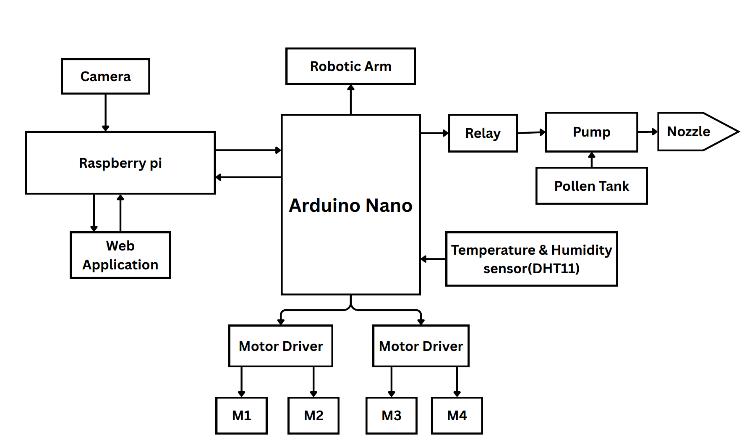
componentsarepoweredbyacommonsupply
3.1 Arduino Nano
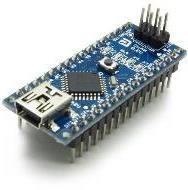
TheArduinoNanoisaminiaturemicrocontrollerboard.It usestheATmega328Pchip,similartotheUno.Itscompact size makes it perfect for projects with limited space. You can program it via USB. It has both digital and analogue input/output pins. Hobbyists and professionals use it for diverse electronic applications. Newer versions add featureslikeWi-FiandBluetooth.
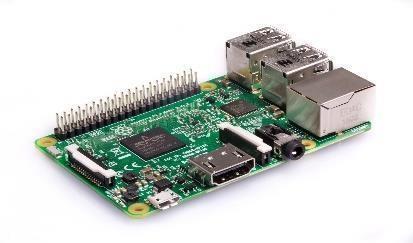
The Raspberry Pi is a tiny, single-board computer. It's designed to be affordable and versatile. It runs on Linux based operating systems. It has a processor, RAM, and various ports. You can connect it to a monitor, keyboard and mouse. It's used for education, hobby projects, and industrial applications. It has GPIO pins for connecting electronic components. It's popular for robotics, media centresandhomeautomation.Alargecommunityprovides supportandresources.
The camera is used to capture real-time images of the plantsand flowers in the field.Theseimages are essential for detecting and classifying the flower stages. It continuously streams visual data to the Raspberry Pi for processing. The quality of images directly affects the accuracy of detection. It enables the system to operate dynamically in real-time conditions. The camera is a
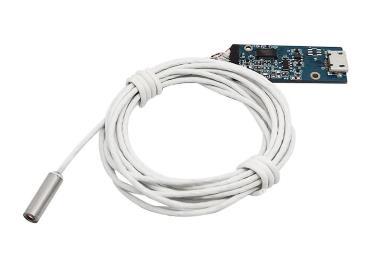
crucialinputdeviceforthecomputervisionsystem. Fig3.3EndoscopicCamera
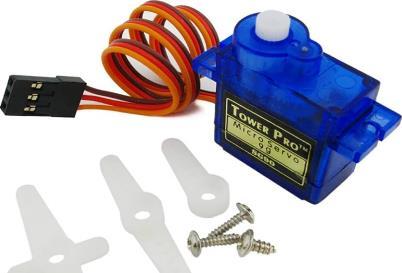
AServomotorsareusedtocontrolthemovementoftherobotic arm in precise directions. They provide accurate angular positioning required for targeting the flowers. These motors help in aligning the nozzle with the detected flower. They operatebasedonsignalsreceivedfromtheArduinoNano.The use of servo motors ensures smooth and controlled motion. Thisimprovestheaccuracyofthepollinationprocess.
3.5 Motor Driver
AThemotordriverisresponsibleforcontrollingthespeed anddirectionofDCmotorsusedinthesystem.Itactsasan interface between the Arduino Nano and the motors, allowing safe operation. Since motors require higher current than the controller can supply, the motor driver amplifies the signals. It enables forward, backward, and directional movement of the robotic platform. The driver also ensures smooth operation and prevents damage to electroniccomponents.Itplaysavitalroleinmobilityand motion control. Proper motor driving enhances system stabilityandperformance.
International Research Journal of Engineering and Technology (IRJET) e-ISSN: 2395-0056
Volume: 13 Issue: 03 | Mar 2026 www.irjet.net p-ISSN: 2395-0072
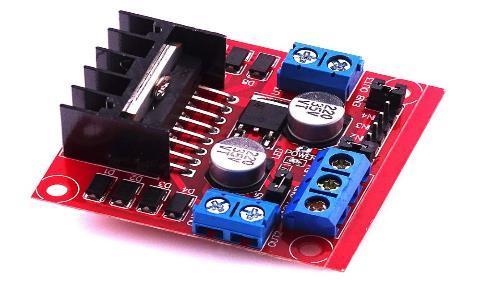
Fig3.5MotorDriver
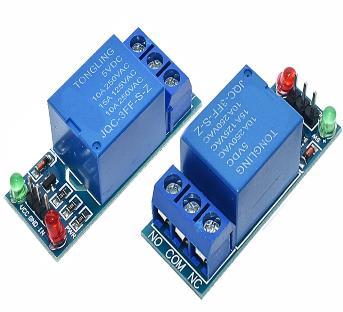
The relay module acts as a switching device that allows low-powersignalstocontrol high-powercomponentslike the pump. It operates by opening or closing the circuit based on signals from the Arduino Nano. When activated, it turns ON the pump to initiate spraying of the pollen solution. When deactivated, it stops the spraying process. Therelayprovideselectricalisolationbetweencontroland power circuits, ensuring safety. It also improves system reliability bypreventingoverloadconditions. Theuseof a relaysimplifiesthecontrol ofhigh-voltage components. It is crucial for the efficient functioning of the spraying mechanism. relay module acts as an electrically operated switch that allows low-power control signals to manage high-powerdevicessuchasthepump.Itprovidesisolation betweenthecontrolcircuit(ArduinoNano)andthepower circuit, ensuring safety and reliability. When the Arduino sendsasignaltotherelay,itactivatestheswitch,allowing currenttoflowandturningthepumpON.
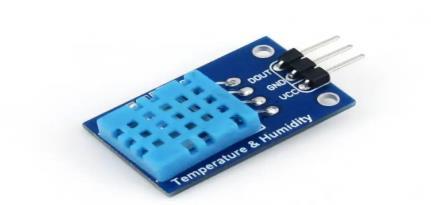
The temperature and humidity sensor is used to monitor environmental conditions that directly influence the pollination process. It continuously measures ambient temperature and relative humidity and provides this data to the control system. These environmental factors play a crucialroleindeterminingpollenviabilityandfertilization success. For tomato flowers, optimal pollination conditions typically range between 20–27°C temperature and60–70%humidity
The pump and nozzle assembly is responsible for delivering the pollen solution onto the flower in a controlledmanner.Thepumpdrawsthesolutionfromthe storage tank and forces it through the nozzle under pressure. The nozzle is designed to produce a fine mist spray, which ensures uniform distribution of pollen particles. A carefully selected nozzle size allows precise application without excessive wastage. The spraying action mimics natural pollination mechanisms such as windorinsectactivity.
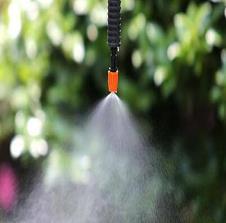
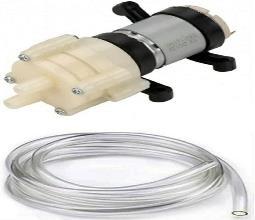
The power supply unit provides the necessary electrical energy required for the operation of all system components.Itensuresstableandregulatedvoltagelevels for devices such as Raspberry Pi, Arduino Nano, sensors, and motors. Since different components operate at differentvoltagelevels,the powersupplysystemincludes regulation and distribution mechanisms. A reliable power source is essential to maintain continuous operation and prevent system failure. It also protects components from voltage fluctuations and electrical noise. Proper power management improves system efficiency and longevity. The power supply acts as the backbone that supports the entiresystem’sfunctionality
The pollen tank is used to store the prepared pollen solution required for artificial pollination. It acts as a reservoir that supplies the solution to the pump during operation.Thetankisdesignedtomaintainthequalityand consistency of the solution by preventing contamination, evaporation.
International Research Journal of Engineering and Technology (IRJET) e-ISSN: 2395-0056
Volume: 13 Issue: 03 | Mar 2026 www.irjet.net p-ISSN: 2395-0072
4 CIRCUIT DIAGRAM
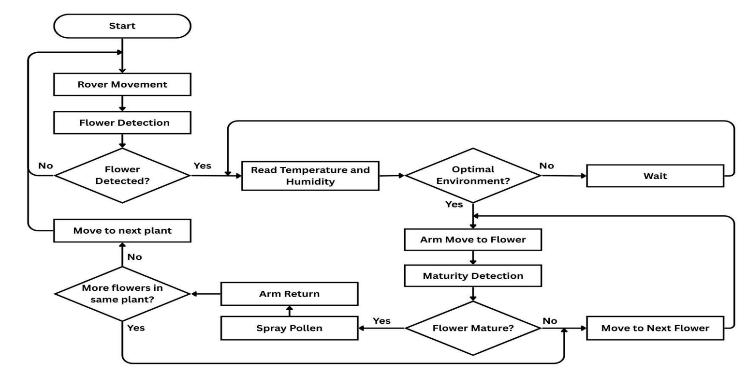
Fig4.1CircuitDiagramforPollinationSystem
The The proposed AI-based robotic pollination system was tested using tomato plants to evaluate its performance under controlled conditions. A dataset consisting of three distinct stages of tomato flower development bud,anther,andpost-anther wasusedto train and validate the YOLO-based detection model. The system demonstrated high accuracy in classifying flower stages and identifying the appropriate stage for pollination.The results show that the system effectively performs selective pollination by activating the spraying mechanism only when the flower is in the anther stage. This selective approach ensures that pollination occurs only during the biologically suitable phase, thereby improving fertilization efficiency. Flowers in the bud and post-anther stages were correctly identified and skipped, reducing unnecessary pollen usage. The robotic arm mechanism provided precise positioning of the nozzle, enabling accurate targeting of flowers. The controlled spray mechanism ensured uniform distribution of pollen solution, enhancing pollination effectiveness. The integration of environmental sensing allowed the system to operate under optimal temperature and humidity conditions, further improving performance.Overall, the system achieved reliable detection, efficient decisionmaking, and precise pollination. The results indicate a significant reduction in manual labor and pollen wastage, along with potential improvements in crop yield and quality. The discussion highlights that the system is scalable and can be adapted for other crops with appropriatetraining.
In proposed AI-based robotic pollination system presents an innovative and efficient solution to address the challenges associated with declining natural pollinators and manual pollination methods. By integrating computer
vision, robotics, and environmental sensing, the system enables accurate detection, intelligent decision-making, and precise pollination. The experimental results demonstrate its effectiveness in improving pollination efficiency, reducing labor requirements, and enhancing agricultural productivity. This system represents a significantadvancementtowardtheadoptionofsmartand sustainableagriculturaltechnologies.
[1] X. Li, Y. Chen, and Z. Zhang, “Deep Learning-Based Flower Detection for Precision Agriculture Applications,” Computers and Electronics in Agriculture, vol. 209, p. 107820,2023.
[2] M. A. Rahman, S. Islam, and M. R. Amin, “AI-Based Smart Agriculture System for Crop Monitoring and Yield Prediction,” IEEEAccess,vol.11,pp.45678–45689,2023.
[3] H. Zhao, L. Xu, and Y. Liu, “Real-Time Object Detection in Agricultural Fields Using YOLOv5,” Sensors, vol. 22, no. 15,p.5678,2022.
[4] S. R. Kannan and P. Balasubramanian, “IoT and Machine Learning-Based Smart Farming System,” International Journal of Agricultural and Biological Engineering,vol.15,no.4,pp.120–130,2022.
[5]J.Tian,B. Wang,andQ. Zhang,“Automated Pollination System Using Robotics and Computer Vision,” IEEE Robotics and Automation Letters, vol. 7, no. 2, pp. 3456–3463,2022.
[6] Y. Chen, X. Liu, and F. Wang, “Application of Deep Learning in Plant Flower Recognition,” Computers and ElectronicsinAgriculture,vol.190,p.106465,2021.
[7]A.KamilarisandF.X.Prenafeta-Boldú,“DeepLearning in Agriculture: A Survey,” Computers and Electronics in Agriculture,vol.147,pp.70–90,2018.
[8] K. G. Liakos, P. Busato, D. Moshou, S. Pearson, and D. Bochtis, “Machine Learning in Agriculture: A Review,” Sensors,vol.18,no.8,p.2674,2018.
[9] R. Barth, J. Ijsselmuiden, J. Hemming, and E. J. van Henten, “Data Synthesis Methods for Semantic Segmentation in Agriculture: A Tomato Flower Case Study,” Computers and Electronics in Agriculture, vol. 144, pp.325–334,2018.
[10] J. Redmon and A. Farhadi, “YOLOv3: An Incremental Improvement,” arXivpreprintarXiv:1804.02767,2018.