
International Research Journal of Engineering and Technology (IRJET) e-ISSN: 2395-0056
Volume: 13 Issue: 01 | Jan 2026 www.irjet.net p-ISSN: 2395-0072
International Research Journal of Engineering and Technology (IRJET) e-ISSN: 2395-0056
Volume: 13 Issue: 01 | Jan 2026 www.irjet.net p-ISSN: 2395-0072
Umesh Kailas Shingare1 , Om Balasaheb Taskar2 , Kalpesh Subhash Wagh3 , Saurav Anil Sultane4 , Om vishnu Autade5 , Prof D.S.Shingate6
Under the guidance Of Information Technology Met’s Institute Ofengineering,Nashik ***
Abstract- In today’s world, companies receive hundreds of resumes for every job opening, making it difficult and timeconsuming for HR teams to find the right candidates. To solve this problem, this project introduces an AI-Based Resume Shortlisting and Job Recommendation System that automates the recruitment process using artificial intelligence and machine learning. This system helps both candidates and HR (Admin) users. Candidates can register, upload their resumes, and instantly receive a resume score, skill improvement suggestions, and job recommendations based on their profile. They can also apply for jobs directly through the system. On the other hand, HR (Admin) can create job posts, view uploaded resumes, and use the machine learning model to automatically find the most suitable candidates for each job. The admin can also provide feedback to candidates who were not selected, helping them understand their skill gaps and improve. Developed using Python and Django, this project makes the recruitment process faster, more accurate, and smarter by combining automation with artificial intelligence to match the right people with the right jobs
Key Words: Artificial Intelligence, Machine Learning, Resume Screening, Job Recommendation, Recruitment Automation, Candidate Evaluation.
Intoday’scompetitivejobmarket,companiesreceivehundredsofresumesforeveryjobopening.Itbecomesadifficultand time-consumingtaskforHRteamstogothrougheachresumemanuallyandfindtherightcandidate.Atthesametime,job seekers often do not know which jobs best match their skills or how to improve their resumes to stand out. To address theseproblems,thisprojectintroducesanAI-BasedResumeShortlistingandJobRecommendationSystemdevelopedusing Python and Django. The system uses artificial intelligence and ma chineLearningtoautomaticallyanalyzeresumes andmatchthemwiththemostsuitablejobroles.Therearetwotypesofusersinthissystem:Admin(HR)andCandidate. Candidates can register, upload their resumes, and receive a resume score, skill improvement suggestions, and job recommendations based on their profile. The Admin (HR) can create job posts, view uploaded resumes, and use the AI model to shortlist the best candidates for a particular job. Admins canalsoprovide feedback tocandidates who are not selected, helping them identify skill gaps and improve. By using AI to automate resume analysis and job matching, this systemmakestherecruitmentprocessfaster,fairer,andmoreefficientforbothemployersandjobseekers.
A.AI-Based
Artificial Intelligence (AI) has reshaped recruitment workflows by automating the processes of resume evaluation, skill extraction, and candidate-job matching. Conventional manual screening is often slow, inconsistent, and susceptible to human bias, especially when organizations receive thousands of resumes for a single opening. AI-based systems address these inefficiencies by applying Natural Language Processing (NLP) and Machine Learning (ML) algorithms to analyze resumecontent,extractkeycompetencies,andevaluatecompatibilitywithavailablejobdescriptions.
Theseintelligentsystems transformunstructured text (PDForDOCXresumes)intostructured,comparable data formats. Using textual and semantic similarity measures, they can rank candidates, recommend suitable positions, and even identifymissingskillareas.Suchsystemsbenefitbothcandidates,whogaininsightsintojobfitandskillimprovement,and HR administrators, who can shortlist top applicants rapidly and objectively. By integrating automated scoring, recommendation engines,andfeedback loops,AI-drivenshortlisting enhancesefficiency, fairness,and data-driven hiring decisions.
Despite notable advancements, both conventional and modern AI recruitment approaches present several limitations. Traditional systems rely heavily on keyword matching or manual scanning, which leads to inconsistent outcomes, redundancy,andbias.Theyoftenfailtodetectcontext,synonyms,orimpliedcompetencieswithinresumes.Forexample,a
International Research Journal of Engineering and Technology (IRJET) e-ISSN: 2395-0056
Volume: 13 Issue: 01 | Jan 2026 www.irjet.net p-ISSN: 2395-0072
candidate listing “statistical modelling” may not be recognized for a role requiring “data analytics” because of lexical mismatch.
Early AI solutions improved automation but lacked contextual awareness and adaptability across industries. Their accuracy depended on dataset diversity and resume formatting consistency, which vary greatly among applicants. Furthermore, ethical concerns such as algorithmic bias, transparency, and data privacy remain critical challenges. A model trained on biased data may unintentionally Favor specific demographics or institutions, undermining fairness in candidateselection.
Hence, a robust resume-shortlisting system must balance accuracy, interpretability, and ethical integrity by integrating advancedNLParchitectures,transparentfeedbackmechanisms,andsecuredata-handlingprotocols.
Resume interpretation is inherently domain-sensitive. A technical resume emphasizing programming languages and frameworksdiffersvastlyfromoneforfinanceorhealthcare.Keywordssuchas“Python,”“budgeting,”or“patientcare”hold high value in their respective domains but may be irrelevant elsewhere. Additionally, the contextual weight of certain phraseschanges with job type for instance, “clientcommunication” is critical in marketing but Peripheralinsoftwareengineering.
Modelstrainedongenericcorporastruggletomaintainaccuracyacrossdomainsduetocontextdependencyandsemantic drift. Moreover, resumes often contain implicit indicators such as project descriptions or certifications that require contextual linking rather than surface-level matching. Therefore, advanced systems must integrate context-aware embeddings (e.g., BERT or Sentence Transformers) and domain-adaptation techniques to generalize effectively across multiplejobsectors.
TheproposedAI-BasedResumeShortlistingandJobRecommendationSystemaddressesthesechallengesthroughsemantic feature extraction, domain-tuned ML models, and contextual job mapping, ensuring precise, unbiased, and scalable recruitmentoutcomes
Recent advancements in Artificial Intelligence (AI) and Machine Learning (ML) have significantly enhanced recruitment automationbyenablingdata-drivendecision-makinginresumescreeningandjobmatching.Traditionalmanualscreening methods, which rely on subjective human judgment, are being replaced by intelligent systems capable of parsing, evaluating, and ranking candidate resumes with greater accuracyandefficiency. This sectionreviews several prominent studies relevant to AI-based resume shortlisting and job recommendation systems, analyzing their methodologies, strengths,andlimitation
AI-BasedResumeScreeningandRankingSystem(A. Kumar, P. Sharma, R. Gupta, 2023):Thisstudyproposedan AI-poweredframeworkusingNaturalLanguageProcessing(NLP)andMachineLearning(ML)techniquestoautomatically analyze and rank resumes. The system extracted key features such as skills, education, and experience to determine candidate suitability. Although the approach demonstrated efficient ranking performance, it relied on a limited dataset, leading to potential bias and underperformance in identifying soft skills. The authors suggested expanding training data diversitytoenhancemodelgeneralizationandaccuracy.
Job Recommendation System Using Machine Learning (M. Patel, S. Verma, and N. Mehta, 2022) This work introduced a personalizedjobrecommendationplatformleveragingMLmodelstopredictthebestjobmatchesforcandidatesbasedon profiledata. The systemutilizedcontent-based filtering andsimilarity metricsto recommend job rolesaligned withuser skillsandpastapplications.However,itlackedmechanismstohandlereal-timejobupdates,whichrestrictedadaptability in dynamic employment markets. The authors proposed integrating live data feeds and adaptive learning algorithms to addressthislimitation
AutomatedRecruitmentSystemUsingNaturalLanguageProcessing(R.Das,K.Sen,andT.Roy,2021)Thispaperpresented anautomatedrecruitment system utilizing NLP for extracting essential details from resumes and matching them against job descriptions. The model achieved notable efficiency improvements in candidate selection through automated information extraction. However, system performance was highly dependent on resume formatting, resulting in inconsistent parsingoutcomeswhenhandlingunstructuredorvisuallyvarieddocuments.Thestudyemphasizedtheneed forrobustpreprocessinganddatastandardizationmethods.
AIforHumanResourceManagement:AReview(S.Singh, J. Thomas, and V. Nair, 2020)Thiscomprehensive reviewexploredvariousAIapplicationsinhumanresourcemanagement,includingrecruitment,screening,andemployee
International Research Journal of Engineering and Technology (IRJET) e-ISSN: 2395-0056
Volume: 13 Issue: 01 | Jan 2026 www.irjet.net p-ISSN: 2395-0072
analytics. The authors highlighted the potential of AI to enhance transparency and reduce human intervention in earlystagehiring.Nevertheless,thepaperprovidedonlyaconceptualoverviewandlackedpracticalimplementationinsights.It alsounderscoredtheimportanceof ensuring ethical AI practices,focusingonfairness,explainability,and bias mitigation inautomateddecisionsystems.
A. Summary of Reviewed Studies
B. Summary of Reviewed Studies
1) Integration of NLP and ML in Recruitment Automation:
Most systems employ Natural Language Processing (NLP) for feature extraction and Machine Learning (ML) for resume rankingandjobprediction.Thesemodelseffectivelyidentifyrelevantkeywordsandskillsbutoftenlackdeepersemantic understanding,limitingtheirabilitytoevaluatecontextualorimplicitcompetencies.
2) Challenges in Data Diversity and Real-Time Adaptability:
Several studies emphasizelimitationsduetorestricted anddomain-specific datasets,which hindergeneralizationacross industries.Additionally,alackofreal-timedataintegrationrestrictsresponsivenesstodynamicjobmarketsandemerging skilldemands,highlightingtheneedforcontinuousdataupdatesandadaptivemodelretraining.
3) Ethical and Practical Constraints in AI Recruitment:
While automation increases efficiency, ethical concerns such as algorithmic bias, data privacy, and explainability remain underexplored. Few frameworks address fairness or provide interpretability mechanisms for HR professionals to understandAI-drivendecisions,posingrisksofunintentionaldiscrimination.
Summary: The reviewed literature reveals a steady transition from rule-based systems to intelligent, learning-driven models that incorporate natural language understanding and predictive analytics. However, persistent challenges includingdatasetbias,contextualambiguity,andtheabsenceofdomainadaptability limitsystemrobustness. The proposed AI-Based Resume Shortlisting and Job Recommendation System builds upon these foundations by integrating context-aware NLP techniques, domain-tuned machine learning models, and transparent feedback mechanisms. This design ensures both operational accuracy and ethical fairness, positioning the system as an advanced, scalablesolutionforintelligentrecruitmentautomation.
Thetheoreticalfoundation oftheproposedsystemisrootedintheconceptofautomatedinformationretrievalcombined with semantic text analysis. A typical resume-screening framework comprises multiple stages resume parsing, skill extraction,featureencoding,andcandidate–jobalignment.Eachresumeisfirsttransformedfromanunstructuredtextual documentinto a structured featurevector,representing professional attributes suchasskills,education,experience,and certifications.
Thesystemthencomputesaresumescoreandjob-fitindexbycomparingextractedcandidatefeatureswithjob-description vectors. This approach enables fine- grained ranking rather than binary selection, allowing recruiters to evaluate the suitability of multiple candidates simultaneously. By integrating contextual embedding models and recommendation algorithms,theframeworkbridgesthegapbetweencandidatequalifications andemployerexpectations,ensuringadatadrivenandunbiasedhiringpipeline.
The proposed model leverages advances in Transformer-based Natural Language Processing (NLP) architectures for feature extraction and semantic representation. Transformers, introduced by Vaswani et al., employ a self-attention mechanism that enables parallel processing and long-range dependency modeling within textual data. Unlike sequential models such as LSTM or GRU, Transformers capture bidirectional contextual relationships, making them ideal for analyzingresumetextwherecontextdeterminesmeaning.
Pre-trainedLanguageModels(PLMs)suchasBERT, RoBERTa, and Sentence Transformers form the semantic core of the system. They are fine-tuned on domain-specific corpora (e.g., technical, managerial, or healthcare resumes) to improve adaptability. Thesemodels generate dense vector embeddings that encode both syntactic and semantic nuances of
International Research Journal of Engineering and Technology (IRJET) e-ISSN: 2395-0056
Volume: 13 Issue: 01 | Jan 2026 www.irjet.net p-ISSN: 2395-0072
candidateresumesandjobdescriptions,enablingaccurateskill-to-rolemappingandpersonalizedrecommendations.
C. Syntactic and Semantic Encoding Mechanisms
WhilePLMseffectivelycapturesemanticcontext,explicitsyntacticstructureisequallyvitalforunderstandingresumetext. Jobprofilesoftencontainhierarchicalrelationships suchasroles,achievements,andtechnologies thatrequiresyntactic parsing to maintain logical associations. To address this, the system employs a hybrid encoding strategy that combines semanticembeddingsfromTransformerswithsyntacticdependencyfeaturesderivedfromparsingtoolssuchasspaCyor NLTK.
This dual-encoding approach enhances the model’s interpretability by linking job-related entities (e.g., “Developed ML model using Python”) through dependency relations while preserving contextual meaning. The integration of both encoding forms reduces ambiguity and improves matching precision, particularly in multi-domain or complex resumes containingdiverseskillclusters.
D. Summary
The theoretical design unites transformer-based contextual understanding with structured syntactic representation, forming a robust analytical backbone for AI-driven recruitment. Through layered encoding, the system not only learns lexical and semantic dependencies but also recognizes hierarchical resume organization, ensuring accurate, explainable, and scalable candidate evaluation. This theoretical integration establishes the foundation for the subsequent System OverviewandMethodologysections,wherethepracticalimplementationoftheseconceptsisdetailed
IV. SYSTEM OVERVIEW
TheproposedAI-BasedResumeShortlistingandJobRecommendation System is designed to automateandenhancethe recruitment processusing artificial intelligenceand machinelearning. It followsa modulararchitecture integratingNLPbased resume parsing, contextual feature extraction, candidate-job compatibility evaluation, and intelligent feedback generation.Thesystemconsistsofsixprimarycomponents InputResume,DataPreprocessingandTokenization,Feature ExtractionModule,ResumeMatchingandRecommendationEngine,RefiningModule,andTechnologyStack.
Each component performs a distinct role while collectively ensuring a seamless flow of data from resume submission to job recommendation. The overall framework is implemented using Python and Django, with AI components developed throughTransformer-basedmodelsandmachinelearningpipelines.
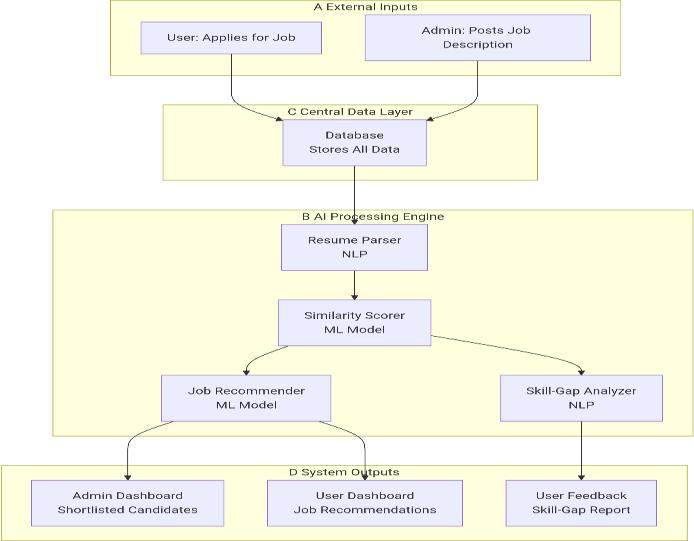
Fig:- 1 SystemArchitecture
A. Input Resume
Thisistheinitialstageofthesystemwherethecandidateuploadstheirresumethroughasecurewebinterface.Theinput canbeinformatssuchasPDForDOCX, which are automatically converted into textusingparsinglibrarieslikePyMuPDF
International Research Journal of Engineering and Technology (IRJET) e-ISSN: 2395-0056
Volume: 13 Issue: 01 | Jan 2026 www.irjet.net p-ISSN: 2395-0072
ordocx2txt.Theuploadeddataisthenstoredinacentralizeddatabaseforfurtherprocessing.
The system ensures file validation, checking for missing orunreadablecontent.Thisrawinputactsas the foundation for downstreammodules,initiatingtheworkflowofinformationextractionandanalysis.
B. Data Preprocessing and Tokenization
Once the resume text is extracted, it undergoes data preprocessing to remove unnecessary symbols, punctuation, and formattinginconsistencies.Commontechniquessuchaslowercasing,stop-wordremoval,andlemmatizationareappliedto normalizethedata.
After cleaning, the text istokenizedinto smallerlinguistic units(tokens)usinglibrarieslikeNLTKor spaCy.Thisprocess enables the system to interpret resumes at a granular level, breaking down sentences into identifiable entities such as skills,degrees,andprojectexperiences.
Tokenization and normalization ensure uniform input quality, improving the accuracy of subsequent NLP and ML operations.
C. Feature Extraction Module
TheFeatureExtractionModuletransformsthepreprocessedtextintonumericalvectorsusingembeddingmodelssuchas TF-IDF, Word2Vec, or BERT-based Sentence Transformers. These embeddings capture semantic relationships between words,ensuringthatsimilarconcepts(e.g.,“Python”and“Programming”)arerecognizedasrelated.
This module extracts key features including technical skills, experience years, educational qualifications, and project summaries,whicharecrucialfordeterminingcandidatesuitability.Eachfeaturevectorrepresentsthecandidateprofilein amulti-dimensionalspace,enablingprecisecomparisonwithjobdescriptions.
D. Resume Matching and Recommendation Engine
This is the core AI component of the system. It evaluates the similarity between the extracted candidate vectorsandjobdescriptionvectorsusingmethodssuchascosinesimilarityorsupervisedMLclassification.
Theenginegeneratestwokeyoutputs:
1. AResumeScore,reflectingtheoverallalignmentbetweenthecandidate’sskillsandjobrequirements.
2. AJobRecommendationList,rankingthemostsuitableopeningsfortheapplicant.
The system continuously improves through feedback loops from HR administrators, allowing model retraining and refinementbasedonreal-worldrecruitmentoutcomes
E. Refining Module
TheRefiningModuleperformspost-processingtoensureprecisionandclarityinthegeneratedresults.Itfiltersredundant data, resolves ambiguities, and optimizes the ranking order based on priority parameters such as required experience, skillimportance,androlerelevance.
This component also supports feedback integration where HR users can mark candidate outcomes (selected or rejected) whichthemodelusestofine-tuneitspredictionlogic.Therefininglayerensuresthesystemremainsadaptive, interpretable,andresponsivetoevolvingjobmarketpatterns.
Thesystemintegratesamodernandscalabletechnologystackforbothbackendintelligenceandfrontendusability:
BackendFramework:Django(Python)forweb-basedimplementationandAPIintegration.
AIComponents:NLPmodels(BERT,TF-IDF)andMLalgorithms(LogisticRegression,RandomForest).
Database:SQLiteorMySQLforstructuredstorageofresumes,joblistings,andfeedback.
Frontend:Bootstrap-basedresponsivewebinterfaceensuringintuitiveuserinteraction.
International Research Journal of Engineering and Technology (IRJET) e-ISSN: 2395-0056
Volume: 13 Issue: 01 | Jan 2026 www.irjet.net p-ISSN: 2395-0072
Security:DataencryptionusingHTTPSandhashedcredentialstoprotectuserinformation.
Thechosenstackensuresmodularity,scalability,andeasyintegrationwithexternalplatformssuchasLinkedInorcompany HRportalsfordataimportandsynchronization
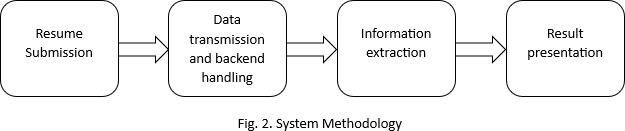
The first step is Resume submission. The user uploads their resume through a secure web form integrated into the system’sfrontendinterface.Thisallowsthesystemtocapturethecandidate’sinformationinastandardizedandaccessible formatforfurtherprocessing.
The second step is Data transmission and Backend handling. Once the resume is uploaded, the Django framework receives the file and sends it to the backend logic for processing. This ensures efficient communication between the frontendandbackendcomponentsofthesystem.
The third step is Information extraction. The backend extracts important sections from the resume, such as skills, education,andworkexperience,usingtext-processingtechniques.ThisstructureddatahelpstheAImodelunderstandthe candidate’squalificationsandstrengths.
The fourth step is AI-based evaluation The machine learning model analyses the extracted data and predicts a compatibility score or job fit percentage. This score indicates how well the candidate matches the job requirements and helpsHRprofessional’sshortlistcandidatesmoreeffectively.
The final step is Result presentation. The analyzed results, including the resume score and job recommendations, are displayed on the frontend in a clean and user-friendly interface. This allows both candidates and recruiters to easily interprettheoutcomes,makingtherecruitmentprocessfaster,smarter,andmoretransparent.
A. Input and Process Definition
LetthecompletesystemSberepresentedasatriplet:S={I,F,O} where,
��=Setofinputsprovidedtothesystem.
��=Setoffunctionsorprocessesappliedtotheinput.
��=Setofoutputsgeneratedbythesystem.
The input set (I) representsthedataprovidedbythecandidate: I={R,J} where,
��=CandidateResumeData(textextractedfromuploadedfiles).
��=JobDescriptionData(requirementsprovidedbyHRoradmin).
International Research Journal of Engineering and Technology (IRJET) e-ISSN: 2395-0056
Volume: 13 Issue: 01 | Jan 2026 www.irjet.net p-ISSN: 2395-0072
These two inputs form the foundation for the AIevaluationandjobmatchingprocesses.
B. Functional Mapping
The function set ��defines all the transformationsappliedtotheinputtogeneratemeaningfuloutput:
��2:FeatureExtractionandEmbeddingGeneration
��3:Resume–JobSimilarityComputation
��4:ResumeScoringandRanking
��5:JobRecommendationandFeedbackRefinement
Thus,theoverallfunctionaltransformationcanbemathematicallyexpressedas:
Andmorespecifically,
C. Output Representation
Theoutputset��representsthefinalresultsgeneratedbythesystem,definedas:
Where,
���� = Resume Score indicating candidatesuitabilityforspecificjobroles.
���� =ListofRecommendedJobsrankedaccordingtomatchpercentage.
Eachcandidate����receivesascore����calculatedusingsimilaritybetweencandidatefeaturevector��
andjobvector
Here, the numerator represents the dot product of the two vectors, while the denominator normalizes the similarity measure using vector magnitudes this is the cosine similarity metric commonly used in information retrieval and recommendationsystems.
Thesystemfinallyoutputsarankedlistofjobrecommendationsforeachcandidate,where:
whereeachfunctionrepresentsaprocessingstageinthesystemworkflow:
��1:ResumePreprocessingandTokenization
�� =Rank({(��
International Research Journal of Engineering and Technology (IRJET) e-ISSN: 2395-0056
Volume: 13 Issue: 01 | Jan 2026 www.irjet.net p-ISSN: 2395-0072
D. Use Case Diagram Explanation
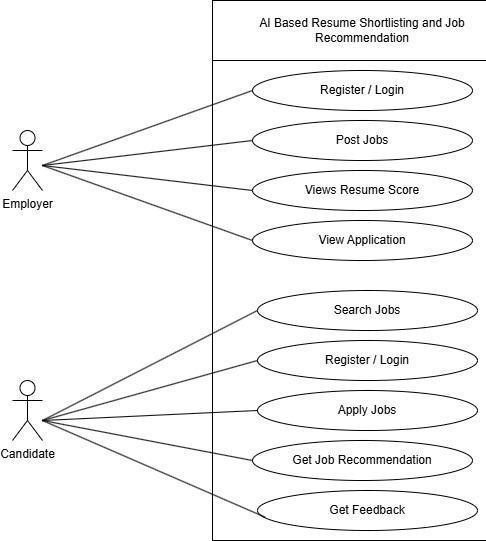
TheUseCaseDiagramillustratestheinteractionbetweendifferentusersandtherecruitmentsystem.The primaryactors include the Candidate, Recruiter, Web-to-Candidate, and Salesperson. Each actor performs specific actions within the systemtofacilitatetherecruitmentprocess.
The Candidate submits applications, views placement results, and engages in contract-related actions. The Recruiter is responsible for approving and reviewing candidate profiles, while the Salesperson manages client and contract information.TheWeb-to-Candidateactorenablesonlineapplicationsthroughthewebinterface.
Together, these interactions define the core functionalities of the system application submission, candidate approval, review, placement, and contract management ensuring seamless coordination between users and the recruitment platform
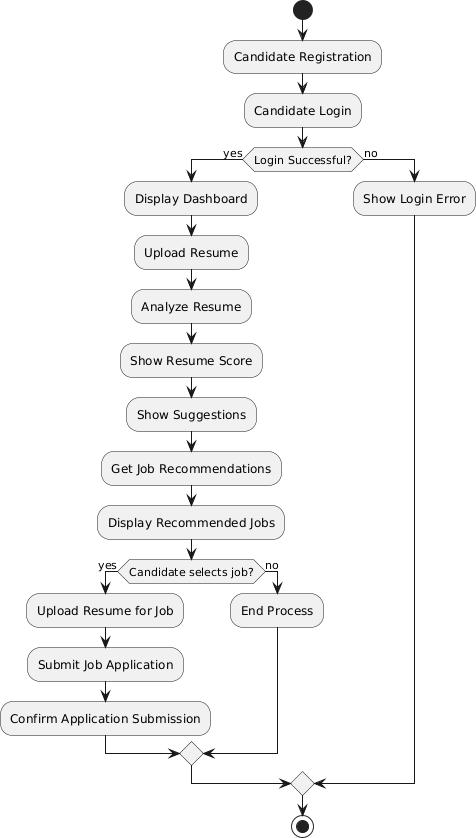
E. Activity Diagram Explanation
Theflowchartrepresentstheoperationalworkflowof the AI-Based Resume Shortlisting System. The process starts with readingresumesandcorrespondingjobdescriptions.Thesystemperformskeywordextraction,followedbystemmingand lemmatizationtonormalizetextdata.Therankedkeywords from both the resume and job descriptionarethenprocessed throughBERT,generatingfeaturevectorsforsemanticrepresentation.
Using cosine similarity, the system evaluates the match between candidate resumes and job requirements. Once all resumes are analyzed, they are arranged according to their similarity scores, and the employer is notified of the most suitablecandidates.Thisensuresaccurate,automated,andunbiasedshortlistingintherecruitmentprocess
International Research Journal of Engineering and Technology (IRJET) e-ISSN: 2395-0056
Volume: 13 Issue: 01 | Jan 2026 www.irjet.net p-ISSN: 2395-0072
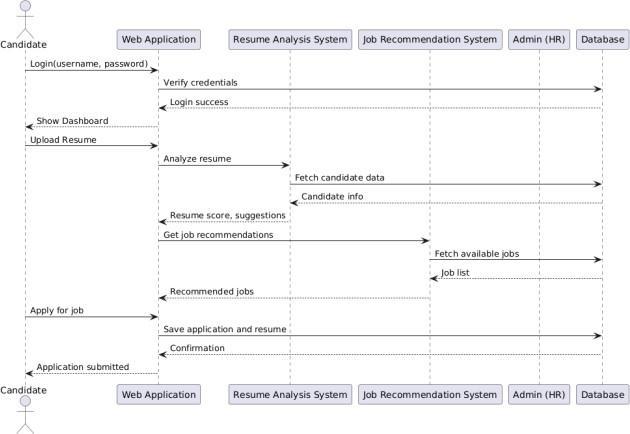
ThesequencediagramillustratestheinteractionbetweentheUser,ResumeBuilder,TemplateService,andExportService duringtheresumecreationprocess.ThesequencebeginswhentheUserselectsthe“CreateResume”option,promptingthe ResumeBuildertorequestavailabletemplatesfromtheTemplateService.Oncethelistoftemplatesisreturned,theuser selectsoneandinputspersonaldetails.
International Research Journal of Engineering and Technology (IRJET) e-ISSN: 2395-0056
Volume: 13 Issue: 01 | Jan 2026 www.irjet.net p-ISSN: 2395-0072
TheTemplateServicethenprocessesthesedetailsusingtheselectedtemplateandreturnsaresumepreviewfortheuser to review. After confirmation, the Export Service generates the final resume file, which is made available for the user to download. This sequence ensures a structured, automated, and user-friendly workflow for creating and exporting professionalresumesefficiently
In conclusion, the AI-Based Resume Shortlisting and Job Recommendation System provides an intelligent and efficient solutionfortherecruitmentprocess.ByusingPython,Django,andSQLite,thesystemautomatesresumeevaluationandjob matching based on candidates’ skills, experience, and job requirements. The platform helps employers save time by automaticallyshortlistingsuitablecandidates and providing job recommendations to applicants. It also ensures fair and accurate screening using AI- driven analysis, reducing human bias in hiring. The user-friendly interface built with Bootstrap allows both candidates and HR users to interact with the system easily. Overall, this system improves the recruitment process by combining artificial intelligence and web technology to make hiring faster, smarter, and more effective.
The authors would like to express their heartfelt gratitude to Prof. D.S.Shingate, Department of Information Technology, MET’s Institute of Engineering, Nashik, for his invaluable guidance, constant encouragement, and insightful suggestions throughoutthecourseof thisproject.His expertiseand support playeda crucial rolein thesuccessful completionof this researchwork.Theauthorsalsoextendtheirappreciationtothefacultymembersandpeersfortheirconstructivefeedback andcooperationduringthedevelopmentofthisstudy.
1. Rohit Jain, Neha Sharma, and Priya Verma. (2024). AI-Powered Recruitment: Enhancing Resume Screening Using Natural LanguageProcessing.FocusesonautomatingresumeshortlistingusingNLPtoextractcandidateskillsandmatch themwithjobdescriptions.
2. KaranPatel,DeepikaSingh,andRaviNair.(2023).AutomatedJobRecommendationSystemUsingMachineLearningand UserProfiling.Developsarecommendationenginethatsuggestsjobsbasedonresumedata, interests,andcandidateskill sets.
3. Ahmed Mohamed, Fatima Khan, and John Lewis. (2022). Intelligent Hiring System Using Django Framework and Machine Learning Algorithms. Integrates Django web framework with AI to streamline the recruitment and candidate evaluationprocess.
4. VikasKumar,SnehaJoshi,andArjunRao.(2024). A Study on Resume Classification Using Deep Learning Approaches. ComparesdeeplearningmodelslikeCNNandBERTforskillextraction,jobfitprediction,andautomatedshortlisting.
5. Aditi Singh and Meena Iyer. (2023). AI in Human Resource Management: An Overview of Recruitment Automation. ExploreshowartificialintelligencetransformsHRoperationsbyimprovingdecision-makinginhiring.
6. Rajesh Gupta and Harshita Malhotra. (2022). TextMining Techniques for Resume Screen ing: Challenges and Opportunities.AnalyzesNLP-basedresumeparsingtechniquesandtheirroleinautomatingcandidateevaluation.
7. Li Chen, Maria Santos, and David Park. (2024). Design and Implementation of a Job Matching Platform Using Python andSQLite.DescribesthebackenddevelopmentanddatabasestructureforAI-drivenjobrecommendationsystems.
8. George Thomas and Aishwarya Das. (2023). Skill Gap Analysis Using Machine Learning for Career Recommendation. ProposesanAImodelthatidentifiesmissingskillsincandidateprofilesandprovidespersonalizedimprovementadvice.
9. S. R. Raoand K .Ramesh.(2025). Django-Based Web Application for Automated Recruitment Process. Presents a fullstackimplementationforresumeupload,jobposting,andcandidaterankingusingAImodels.
10. A.Krizhevsky,I.Sutskever,andG.Hinton.(2017).ImageNetClassificationwithDeepConvolutionalNeuralNetworks. IntroducedfoundationaldeeplearningconceptslateradaptedforNLP-basedresumeclassificationsystems.