
International Research Journal of Engineering and Technology (IRJET) e-ISSN: 2395-0056
Volume: 13 Issue: 04 | Apr 2026 www.irjet.net p-ISSN: 2395-0072

International Research Journal of Engineering and Technology (IRJET) e-ISSN: 2395-0056
Volume: 13 Issue: 04 | Apr 2026 www.irjet.net p-ISSN: 2395-0072
Thanzeela Mol A1 , Anjana T J2 , Swathika Suresh S3 , Kiran Das K4 , Sangeeth P S5, Abhiram M6
1HOD, Dept of Electronics and Communication Engineering, Al Ameen Engineering College, Palakkad, India 23456Student, Dept of Electronics and Communication Engineering, Al Ameen Engineering College, Palakkad, *** -
Abstract - This project presents an AI-based image recognition vending machine for plastic waste that automatesidentification,sorting,anduserincentivization.
The system integrates an Arduino Uno for hardware control and a Raspberry Pi for image processing, where waste is detected using an ultrasonic sensor and classified using an OpenCV-based ONNX deep learning model into recyclable and non-recyclable categories. Based on the result, a servo motor directs the waste into the appropriate bin while a reward system assigns points to the user. A secure QR code containing the points and a unique transaction ID is generated and linked to a cloud database via a mobile application using Google Apps Script. This integrated approach combines embedded systems, artificial intelligence, and IoT to provide an efficient, user-friendly solution for promoting proper wastesegregationandenvironmentalsustainability.
Key Words: AI-based image recognition, plastic waste segregation, smart vending machine, Arduino Uno, Raspberry Pi, OpenCV, ONNX model, ultrasonic sensor, QR code system, cloud integration, sustainable waste management
Rapid urbanization and increased plastic consumption have led to a significant rise in solid waste, creating serious environmental challenges due to improper segregation and inefficient recycling practices. Manual waste sorting methods are often inconsistent, timeconsuming, and prone to human error, highlighting the need for an intelligent automated solution. This project proposes an AI-based image recognition vending machine for plastic waste that integrates embedded systems, computer vision, and IoT-based cloud connectivity to automate waste identification and sorting.
Using an Arduino Uno for hardware control and a Raspberry Pi for image processing, the system detects wastethroughanultrasonicsensorandclassifiesitusing an OpenCV-based ONNX deep learning model into recyclableandnon-recyclablecategories.
A servo mechanism directs the waste accordingly, while a reward-based system incentivizes users through QR
code verification and cloud data storage. This approach enhances recycling efficiency, reduces human intervention, and promotes sustainable waste managementpracticesinvariousenvironments.
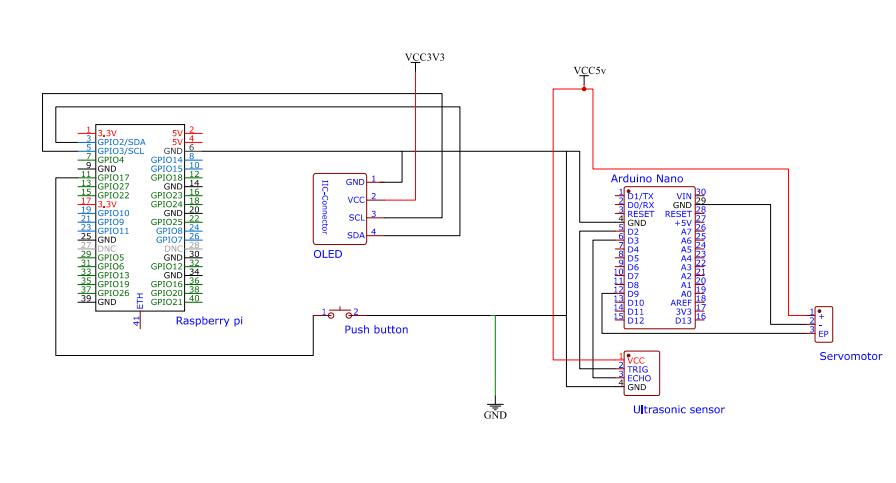
The working principle of the proposed system involves automated detection, image classification, and waste sorting with a reward mechanism. An ultrasonic sensor connected to the Arduino Uno detects the presence of waste and triggers the Raspberry Pi through serial communication. The Raspberry Pi captures the image using a camera and processes it with OpenCV and a trained ONNX deep learning model to classify the waste as recyclable or non-recyclable. Based on the result, a servomotorcontrolledbytheArduinodirectsthewaste into the appropriate bin. Simultaneously, points are assignedtotheuser,andasecureQRcodecontainingthe reward details is generated and stored in a cloud database via a mobile application, ensuring efficient wastemanagementanduserparticipation.
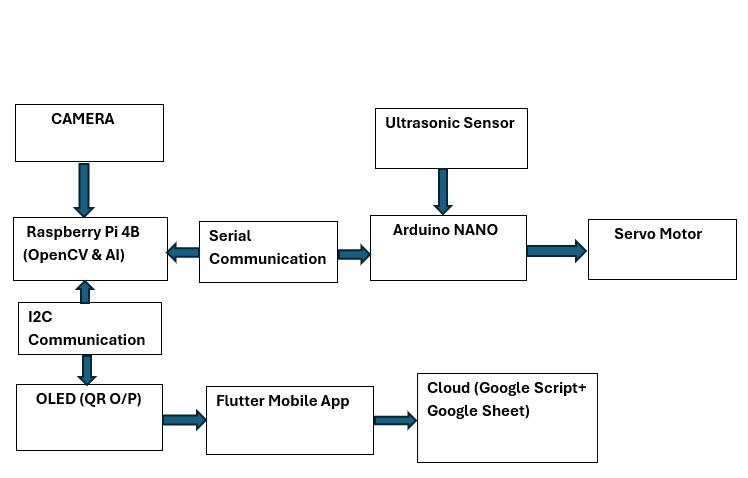
This block diagram represents the working of a smart plastic classification and reward system. Initially, an ultrasonic sensor detects the presence of waste and sends a signal to the Arduino Nano. Simultaneously, a camera captures the image of the waste and forwards it to the Raspberry Pi 4B, where OpenCV and an AI model areusedtoclassifythetypeofplastic.
Based on the classification result, the Raspberry Pi communicates with the Arduino Nano, which controls a servo motor to sort the waste into the appropriate category.Atthesametime,theresultandrewarddetails aredisplayedasaQRcodeonanOLEDdisplay.Thedata is also transmitted to a Flutter mobile application and storedin thecloudusingGoogleApps ScriptandGoogle Sheets for tracking and monitoring, enabling an automatedandefficientwastemanagementsystem.
International Research Journal of Engineering and Technology (IRJET) e-ISSN: 2395-0056
Volume: 13 Issue: 04 | Apr 2026 www.irjet.net p-ISSN: 2395-0072
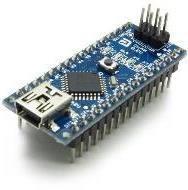
TheArduinoNanoisa miniaturemicrocontrollerboard. It uses the ATmega328P chip, similar to the Uno. Its compact size makes it perfect for projects with limited space.YoucanprogramitviaUSB.Ithasbothdigitaland analogueinput/outputpins.Hobbyistsandprofessionals useitfordiverseelectronicapplications.Newerversions addfeatureslikeWi-FiandBluetooth.
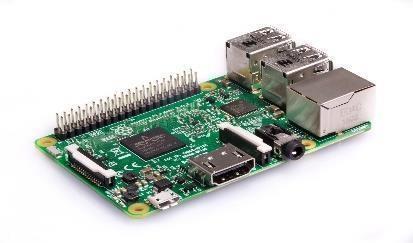
The Raspberry Pi is a tiny, single-board computer. It's designedtobeaffordableandversatile.ItrunsonLinux based operating systems. It has a processor, RAM, and variousports.Youcanconnectittoamonitor,keyboard and mouse. It's used for education, hobby projects, and industrial applications. It has GPIO pins for connecting electronic components. It's popular for robotics, media centers and home automation. A large community providessupportandresources.
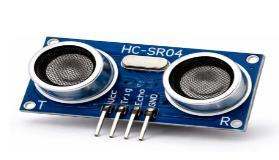
An Ultrasonic Sensor is an electronic device used to measure the distance between the sensor and an object using high-frequency sound waves (ultrasonic waves). These sound waves are above the range of human hearing.Thesensorworksontheechoprinciple.Itsends ultrasonic sound waves through the transmitter. When these waves hit an object, they reflect back to the receiver. The sensor measures the time taken for the echotoreturnandcalculatesthedistanceoftheobject.
3.3
A Servo Motor is a rotary actuator used to control the precisepositionandmovementofashaft.Itcanrotateto a specific angle based on the control signal it receives from a controller. Servo motors are commonly used in robotics and automation where accurate movement is required. A servo motor usually consists of a DC motor, control circuit, gears, and a feedback system. The controller sends a signal to the servo motor, and the internal feedback mechanism ensures that the motor movestotherequiredangle.
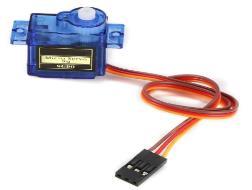
3.4
Volume: 13 Issue: 04 | Apr 2026 www.irjet.net p-ISSN: 2395-0072
AnOLEDDisplay(OrganicLightEmittingDiodedisplay)is a type of electronic display that produces light using organic compounds when electric current passes through them. Unlike traditional LCD displays, OLED screens do not require a backlight, which makes them thin, energyefficient,andcapableofproducingclearandbrightimages. OLED displays are commonly used in embedded systems to show text, graphics, and symbols. They usually communicate with controllers using protocols such as I²C orSPI.
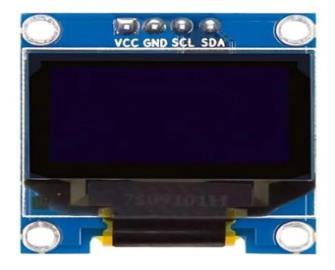
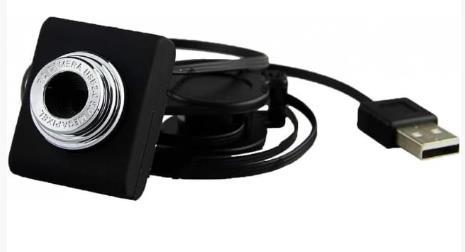
A Camera Module is an electronic device used to capture images and convert them into digital signals that can be processed bya computeror embeddedsystem.Itconsists of an image sensor, lens, and processing circuitry. The image sensor detects light from objects and converts it into electrical signals, which are then processed to produce a digital image. Camera modules are widely used in computer vision applications, surveillance systems, robotics,andautomationprojects.
They allow systems to visually analyze objects and make intelligentdecisionsbasedonthecapturedimages.
5.RESULT AND DISCUSSION
The developed system effectively performs automatic plastic waste detection, classification, and segregation by integrating artificial intelligence with embedded hardware. Using an ultrasonic sensor, camera, OpenCV, and an ONNX model, the system accurately identifies plastic types and separates them into recyclable and nonrecyclablecategoriesvia a servo mechanism.Additionally, the reward-based feature enhances user participation by generating QR-based points that are updated in a cloud databasethroughamobileapplication.
The results demonstrate improved efficiency and reduced manual effort in waste management. However, system performance is influenced by factors such as lighting conditions, image quality, and dataset accuracy. With further optimization and scalability, the system shows strong potential for smart city and large-scale recycling applications.
generating QR-based points that are updated in a cloud database through a mobile application. The results demonstrate improved efficiency and reduced manual effort in waste management. However, system performance is influenced by factors such as lighting conditions, image quality, and dataset accuracy. With further optimization and scalability, the system shows strongpotentialforsmartcityandlarge-scalerecycling
6.CONCLUSION
The developed system successfully demonstrates an AIbased smart waste segregation system that can
International Research Journal of Engineering and Technology (IRJET) e-ISSN: 2395-0056
Volume: 13 Issue: 04 | Apr 2026 www.irjet.net p-ISSN: 2395-0072
automatically detect, classify, and separate plastic waste. The system uses hardware components such as Arduino and Raspberry Pi along with image processing through OpenCV and a trained ONNX model to identify different types of plastic waste. Based on the classification result, the system automatically sorts the waste into recyclable and non-recyclable categories using a servo motor. The project also introduces a reward-based recycling mechanism, where users receive points for disposing of waste properly. These points are generated as a QR code and can be scanned using the Flutter mobile application, and the data is stored in Google Sheets through Google Apps Script. Overall, this project demonstrates how artificial intelligence, embedded systems, and cloud technology can be combined to create an efficient and user-friendly waste management solution. The system encourages responsible waste disposal and supports environmental sustainability by promoting recycling activities.
[1]Sushmitha1,Swathik2,SwathiNayak3,SwechaSJain4, BhavyaS5,2023
[2]N.H.A.RahimandA.N.H.M.Khatib,―Developmentof PET bottle shredder reverse vending machine, ‖International Journal of Advanced Technology and Engineering Exploration, vol. 8, no. 74, pp. 24–33, Jan. 2021,:10.19101/IJATEE.2020.S2762167
[3] H. Zia et al., ―Plastic Waste Management through the Development of a Low Cost and Light Weight Deep LearningBasedReverseVendingMachine,‖Recycling,vol. 7,no.5,p.70,Sep.2022,doi:10.3390/recycling7050070.
[4] Y. Tang et al., ―Seismic performance evaluation of recycled aggregate concrete-filled steel tubular columns with field strain detected via a novel mark-free vision method, ‖ Structures, vol. 37, pp. 426– 441, Mar. 2022, doi:10.1016/j.istruc.2021.12.055.
[5] Fadlil, R. Umar, Sunardi and A.S Nugroho, ―The Comparison of Machine Learning Approach for Waste bottle Engineering (EIConRus), Jan. 2018, pp. 1094–1098. doi:10.1109/EIConRus.2018.8317281
[6]W.G.P.Dumpayan,M.L.M.deMesa,N.D.F.Yucor,E.T. Gabion, J. D. Reynoso, and G. R. M. Geslani, ―Two-way powered microcontroller-based plastic bottles ‗drop-andtap‘ reverse vending machine with stored value system using radio frequency identification (RFID) scanner technology,‖in2017IEEE9thInternationalConferenceon Humanoid, Nanotechnology, Information Technology, Communication and Control, Environment and Management (HNICEM), Dec. 2017, pp. 1–8. doi:10.1109/HNICEM.2017.8269433.
[7] R. Tomari, A. A. Kadir, W. N. W. Zakaria, M. F. Zakaria, M.H.A.Wahab,andM.H.Jabbar,―DevelopmentofReverse Vending Machine (RVM) Framework for Implementation toa StandardRecycleBin,‖ ProcediaComput Sci,vol.105, pp.75–80,2017,doi:10.1016/j.procs.2017.01.202.
[8] M. F. Karin, K. S. Noor, and H. U. Zaman, ―Hardware based design and implementation of a bottle recycling machine using FPGA, ‖ in 2016 IEEE Conference on Systems, Process and Control (ICSPC), Dec. 2016, pp. 43–46.:10.1109/SPC.2016.7920701
[9] A. Monga, ―Finite State Machine based Vending Machine Controller with Auto-Billing Features, ‖ International Journal of VLSI Design & Communication Systems, vol. 3, no. 2, pp. 19–28, Apr. 2012, doi:10.5121/vlsic.2012.3202.
[10] S. B. Z. Azami and M. Tanabian, ―Automatic mobile payment on a non-connected vending machine, ‖ in Canadian Conference on Electrical and Computer Engineering 2004 (IEEE Cat. No.04CH37513), pp. 731–734.doi:10.1109/CCECE.2004.1345218.
© 2026, IRJET | Impact Factor value: 8.315 | ISO 9001:2008 Certified Journal | Page262