
International Research Journal of Engineering and Technology (IRJET) e-ISSN: 2395-0056
Volume: 13 Issue: 04 | Apr 2026 www.irjet.net p-ISSN: 2395-0072

International Research Journal of Engineering and Technology (IRJET) e-ISSN: 2395-0056
Volume: 13 Issue: 04 | Apr 2026 www.irjet.net p-ISSN: 2395-0072
Mohammed Hamza, Tameem Mansoor
Jain Deemed to be University, Bangalore, India
Abstract Recent progress in deepfake algorithms has allowed visually compelling deepfakes to be generated from raw pixels with limited visual artifacts. Their applications range from positive use cases such as media creation to nefarious uses such as misinformation and media-based frauds. With state-of-the-art image generation models becoming photorealistic, identifying synthetic media is also becoming more difficult [14]. We introduce a multi-stage deepfake detection framework that leverages deepfake detection using spatial domain representations, frequency-domain representations, and temporal modeling of frames to produce a more accurate and robust framework. We incorporate a multi-scale EfficientNet [1] backbone for spatial artifact detection, a frequency-domain branch that learns inconsistencies introduced during the synthesis process, and a temporal encoder that models’ relationships at the frame-level with a Transformer [2] backbone. Models were trained on FaceForensics++ [5] and tested on Celeb-DF v2 [3], DeepFake Detection Challenge (DFDC) [4] datasets to analyze cross dataset generalization. The proposed multi-branch framework reached 99.8% accuracy on Celeb-DF dataset and 97.6% on DFDC, outperforming CNN baseline and CNN–Transformer hybrid. Generalization was also measured with adversarial attacks created using Fast Gradient Sign Method (FGSM). Proposed architecture exhibited significantly higher accuracy when subjected to adversarial attacks An additional user awareness survey of 70 participants was performed to gauge public opinion on deepfakes and their trust in automated detection. Results show improvement in accuracy and robustness when combining spatial, frequency-domain and temporal representations of data for deepfake detection across datasets
Keywords Deepfake detection, Deepfake algorithms, Synthetic media, Photorealistic image generation ,Misinformation, Mediabased fraud
Deeplearninghasmadeitmucheasiertogenerateconvincingfakemedia.Newkindsofneuralrendering,likeGenerative AdversarialNetworks(GANs),allowustogeneratevideosandimagesthatlookveryrealistic.Theseadvancementsifused for good can provide substantial value to industries such as film production, virtual reality and digital content creation; however, they also provide an increased ability to generate maliciously manipulated content (known as Deepfakes) and propagatethiscontent,withtheintentionofcommittingidentitytheft,financialfraudand/orpoliticalmanipulation.This createsrealriskstotheintegrityofdigitalsecurityandtothetrustpeoplehaveintheaccuracyofcontentfoundonline.
Socialmediahasbeenusedtodisseminatemanipulatedmedia,resultinginongoingconcernssurroundingmisinformation, identity theft and political manipulation; thus, emphasizing the need to develop reliable automated deepfake detection systemsthatcanbeusedtoverifydigitalmedia.
Recentstudiesshowthatdeepfakegenerationmethodsarechangingreallyfast,makingithardertofinddeepfakes.Most detectiontechniquesinthebeginningfocusedonfindingvisualproblemsorotherinconsistentcomponentsinthemodified images.However,theimprovedqualityofgenerativemodelsmeansthatthosevisualproblemsarebecominglessobvious to see, and can't be spotted as easily with standard computer vision detection systems. Additionally, public datasets like FaceForensics++andCeleb-DFhavebeencreatedtohelpwithresearchandprovidelarge,pre-recordedvideosamplesof real and deepfake videos to allow for training and testing purposes [3], [4]. Overall, despite advancements made in the detectionofdeepfakes,manyofthedetectionmodelstrainedononedatasetstillstrugglewhentestedonanyotherdatasets orarestillsusceptibletoadversarialsmanipulatingthosemodelsaftertheyhavebeenbuilt.
Thethreefeaturesfordetectingdeepfakesarespatialartifactsinisolatedframes,temporaldifferencesinthesequences,and frequency domain characteristics from image synthesis. CNNs are used to detect spatial artifacts in manipulated frames, whileRNNsandothersequencelearningalgorithmsextracttemporaldifferencesinfacialmotionandblinkingpatterns[6]. Recently, Transformer-based architectures have been shown to be powerful for accurately modeling long-range dependencieswithinsequential information[8].Priorresearchindicatesthatmostdeepfake image synthetizersproduce fingerprintsinthefrequencydomainthatallowfordetectionbecauseoftheinconsistencycreatedduringtheimagecreation process[11].Bycombining andusing complementary featurerepresentations, there exists anopportunity for increasing thedependabilityofdeepfakedetectionsystems.
This paper's proposed multi-stage deepfake detection framework will improve the accuracy and robustness of deepfake detectionbyusingspatial,frequency-domainandtemporalrepresentations.Itusesamulti-scaleEfficientNetbackbonefor
International Research Journal of Engineering and Technology (IRJET) e-ISSN: 2395-0056
Volume: 13 Issue: 04 | Apr 2026 www.irjet.net p-ISSN: 2395-0072
a spatial feature extraction branch, frequency domain analysis branch for detecting spectral artifacts and Transformerbasedtemporalencoderformodelingtemporal(frame-level)dependenciesinvideos.Inadditiontotestinghowwellthis framework performs on benchmark datasets, the robustness of the proposed model is assessed utilizing adversarial perturbationscreatedwithFastGradientSignMethod(FGSM)[1].Inaddition,anonlinesurveywillbeconductedtogather information from the general public about their perceptions of deepfakes and their need for dependable automated detectiontools.
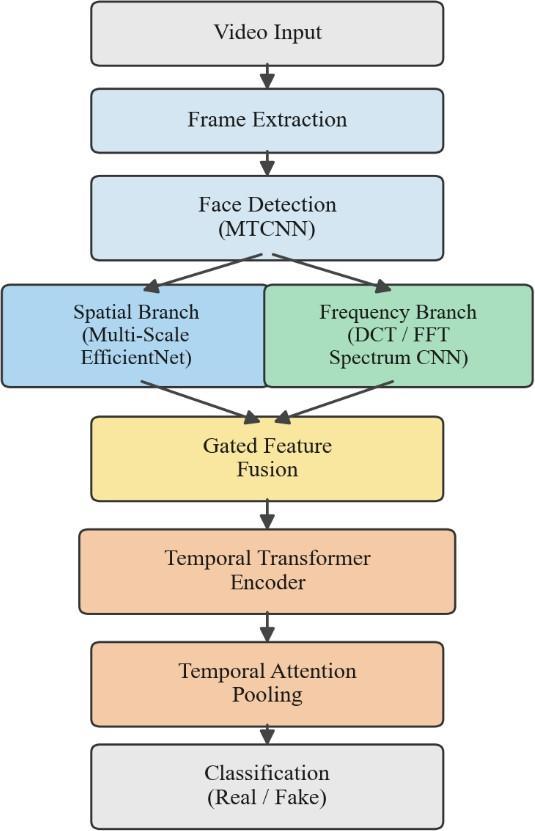
ThegeneralstructureoftheoverallproposeddeepfakedetectionframeworkisshowninFigure1,includingpreprocessing, both branchesof featureextraction spatial andfrequency andusinga Transformerencoderfortemporal modeling andfinaloutputclassification.
Theimportantthingsaboutthisstudyareasfollows:
1.Adeepfakedetectionframeworkthatismadeofmanythingsneededtofinddeepfakesbyusingdifferentmethods(spatial, frequencydomain,andtemporalfeaturerepresentation).
2.Astudyofothermethodsorhintstohelpfinddeepfakes(artifactsthatcanhelptellwhetherthepictureisreal;predicting disagreementsacrossdatasets;possiblyamplifyingorreducingtheartifacts).
3.Awaytoevaluatedeepfakeperformancebyputtingtogetherdatasetsthatcanassessorgeneralizehowwellanewdataset willperformwhentestedwithpreviousdatasets(usingthreedifferentdatasourcestoevaluatetheframeworksoutlinedin 1and2;howwelldoeseachofthethreedifferentproposedtechniquesworkwhenanewdatasetisintroduced).
4.AnevaluationoftheattacksagainsttheseframeworksbyconductingFGSMexperimentstoseehowwelltheycanresist sophisticatedattacksagainstthem(todeterminewhatimprovementscanbeemployedindevelopingnewframeworks).
5. A study involving individuals to understand their current mindset towards deepfake technologies and liability to use automateddetectiontechniques(i.e.,howdotheyviewdeepfaketechnologyandisitreliableenoughtomakethecorrect decision?).
This chapter is organised as follows: Chapter 2 reviews the literature on generating and detecting deepfakes. Chapter 3 presentstheproposedframeworkfordetectingdeepfakes.Chapter4describestheexperimentaldatausedforthisstudy andhowtheexperimentswillbecompleted.Chapter5containsareportoftheexperimentalresultsandanalysis.Chapter6 discussesthesubjectoftheuserawarenessstudy(thereportonuserperceptionofdeepfaketechnology).Finally,Chapter 7containstheconclusionsfromthestudyandoffersfuturerecommendations
International Research Journal of Engineering and Technology (IRJET) e-ISSN: 2395-0056
Volume: 13 Issue: 04 | Apr 2026 www.irjet.net p-ISSN: 2395-0072
Deeplearningcontinuestochangeatanexponentialrateanddevelopingrealisticsyntheticmediausinggenerativemodels is one of the most rapidly developing technologies. One of the most important of these technologies would be the use of GenerativeAdversarialNetworks(GANs)tocreateand/oridentifyvisuallyrealimagesandvideo.GANsareessentiallymade upoftwoNeuralNetworksknownasageneratorandadiscriminatorthatcompeteagainsteachotherinordertoproduce visuallyrealisticcontentthatcanpassasreal.Duetotherapidadvancementsofthetechnologybehindgenerativemodelling wearenowincreasinglyfindingitdifficulttoseparatedeepfakecontentfromlegitimatemedia.Legitimateusesofgenerative modellingtechnologyinclude face swapping,facial re-enactment,andneural rendering;however, the same technologyis also being used in the commission of malicious acts such as creating false news, impersonating someone’s identity, and digitalfinancialfraud.Therefore,theneedfor accuratemethodstodetectdeepfakecontentrepresentsanimportantnew areaofstudyinboththefieldsofcomputervisionanddigitalforensics.
In this domain there are numerous benchmark datasets available to assist in conducting research. The FaceForensics++ dataset contains many manipulated videos created with various deepfake methods which allow researchers to evaluate differentdetectionmodelsinacontrolledenvironment[3].TheCeleb-DFdatasetwascreatedtoprovidedetectiontasksthat arequitedifficultduetomorerealisticdeepfakesbeingproducedsincetheycontainfewervisualartifactscomparedtotheir counterparts[4].Inaddition,theDeepFakeDetectionChallenge(DFDC)datasetwasestablishedinordertocreatealargescalebenchmarkforevaluatingtheperformanceofdifferentdetectionapproachesagainstawiderangeofvideosources.
Over the years, various methods for detecting deepfake videos have been developed, with developments evolving from purelyidentifyingspatialanomaliesinsingleframestousingtemporal,ortime-based,approachesforidentifyinganomalies throughoutacompletevideo.
Historically,methodstodetectdeepfakesusedCNNs,whichareneuralnetworksthatcanlearntoidentifypatternsinimages, asthebaselineforidentifyingspatialanomaliesinavideo.CNNmodelsanalyzeallframesofavideoforinconsistenciesin facialtextures,lighting,andedges,especiallywheretheremaybesubtleindicatorsoftamperinginthemanipulateddata.
CNN modelsthathave beendesignedforthese tasks,suchasEfficientNet,have producedhighdetection rates while also beingcomputationallyefficientenoughtobeeffectivelyusedindeepfakedetectionsystems.
Sincespatialapproachesalonearenotveryaccurateatidentifyingdeepfakes,manyresearchershavealsousedtemporal approaches,suchasusingrecurrentneuralnetworksandsequentialmodels –whichareneuralnetworkdesignsthatcan identify temporal anomalies,suchasirregular motion patterns,unnatural blinking patterns, and imperfectlip-syncing in manipulatedvideos.
Recently,researchershavealsobeenexploringattention-basedmodelstoimprovedeepfakedetectionratesusingtemporal relationshipsinvideosequences.Becausetheattentionmechanismbuiltintothosemodelsallowsthemtoidentifytemporal inconsistenciesbetweendisassociatedframesinavideo,usingthemgreatlyenhancestheabilitytoidentifythepresenceof temporalinconsistencyinadeepfakevideo.
FurtherexplorationintoDeepfakeartifactdetection,researchershave investigatedfrequency-domainrepresentations,in addition to temporal and spatial attributes. Artifact creation via Generative Models frequently generates spectral inconsistenciesthroughtheirgenerativesynthesisprocess.Theseinconsistenciescanbedetectedbyanalysingimagedata inthefrequency-domain.Researchdatahaveestablishedthatdistinctivefrequency-basedsignaturesorfingerprintsexist forimagesandvideoscreatedwithdeepfakefrauds[11].Thesesignaturesareattributedtothecreationprocessandcan onlybeidentifiedthroughexaminationoffrequency-basedrepresentationofimagesusingeithertheFastFourierTransform (FFT)orDiscreteCosineTransform(DCT).
The use of spatial and frequency-based features together has been demonstrated to enhance the robustness of deepfake detection models. This is particularly evident when visual clues have diminished as a by-product of better quality being generatedfromthe generativemodel.Therefore,combiningbothspatialandfrequency-basedfeaturesprovidesthemost extensiveandcomprehensivetechniquefordetectingfalsemedia.
International Research Journal of Engineering and Technology (IRJET) e-ISSN: 2395-0056
Volume: 13 Issue: 04 | Apr 2026 www.irjet.net p-ISSN: 2395-0072
Deepfakedetectionalgorithmshavemadeconsiderableadvancesoverthelastfewyears;however,theyarestillsusceptible toattacksmadeusingadversarialexamples.Attackersmanipulateaninputsamplebyaddingslightmodificationtothedata and produce a false prediction by passing it through a machine learning model. One of the most common and earliest techniques used in generating adversarial examples is the Fast Gradient Sign Method (FGSM) [1]. The influence of adversarialmanipulationondeeplearningmodelsforimageclassificationanddetectiondemonstratehowcriticalitisto evaluatemodelrobustnesstodifferenttypesofadversarialattacks[12].
These vulnerabilities cause challenges when deploying deepfake detection systems in real-world environments where adversarieswilltrytoavoiddetectionusingautomateddetectionsystems.Assuch,assessingdetectionmodels'performance againstadversariallygenerateddatahasbecomeafundamentalpartofcurrentdeepfakedetectionresearch.
Eventhoughtherearecountlessdetectiontechniquesbasedonspatial,temporal,andfrequencyfeatures,manyofthemfail to achieve optimal performance when evaluated on various datasets and against various types of adversarial attacks. Therefore,thereexists a needforimproveddetectionstandardsthatimplementmultipletypesoffeaturesintodetection frameworksandevaluatetheirperformanceacrossallaspectsofexperimentations.
Wewillpresentanoutlineofthedeepfakedetectionsystem,whichincludesvideoanalysisofmanipulatedimagesthrough differentformsofrepresentationinthespatialfrequencydomainandtemporalfeatures.Theoverallframeworkismadeup ofmultipledetectioncomponentstoincreaseaccuracyandimprovetherobustnessofdetectionacrossmanydatasets.The frameworkconsistsofapreprocessingstepforvideosandfaceextraction;amulti-scalerepresentationofspatialfeatures throughfeaturelearning;adetectionfromfrequency-domainartefacts;andatemporalmodelforanalysingasequenceof imagesthroughatransformer-basedencoder.
Priortobeingprocessedbythedetectionframework,videodatamustgothrougha numberofpreprocessingsteps.Each videosequenceisfirstseparatedintoindividualframes.Eachframeisthenputthroughafacedetectionprocesswiththe Multi-taskCascadedConvolutionalNetwork(MTCNN)forfacedetectionfollowedbythecroppingofthedetectedfacesand resizingthemtoaconstantsizeof224×224pixels(thisisdonetohaveuniformityacrossallofthetrainingsamples).
To help improve the model's ability to generalize, a number of augmentation techniques will also be used during preprocessing.Augmentationtechniquescanincludehorizontalflips,Gaussiannoise,andJPEGcompressionartifactswhich all represent different types of distortion that can occur in real-world videos. The use of augmentations will provide an opportunityforthemodeltolearnrobustfeaturerepresentationsthatwillbeapplicableacrossawidevarietyofimaging conditions.
AnEfficientNet-basedconvolutionalbackboneisusedasthebasisforspatialartifactdetection.EfficientNethasbeenshown tobeaneffectivemethodforimageclassificationduetoitsabilitytobalancethescalingofdepth,widthandresolutionof thenetwork,whilebeingcomputationallyefficient[9].Aspartofthisframework,featureswillbeextractedfrommultiple intermediatelayersoftheEfficientNetarchitectureinordertocaptureartifactsatmultiplespatialscales.
Deepfake generation methods create subtle variations in facial texture, region of boundary, and illumination pattern. By aggregatingfeaturemapsfromdifferentlevelsoftheEfficientNetarchitecture,fine-grainedpixel-levelartifactsandlarger structure inconsistencies in the manipulated face region can both be identified. The multi-scale representation will be projectedtoacommonembeddingspaceandfusedtogetherbyattention.
Agrowingbodyofresearchsuggeststhatgenerativemodelstypicallyexhibitrecognizablecharacteristicsinthefrequency domain by producing images that contain artifacts that are not visible in the spatial domain but can be detected using spectralanalysismethods[11].
ThefrequencyanalysisbranchinthisstudyinvolvestheuseoftransformationssuchastheFastFourierTransform(FFT) orDiscreteCosineTransform(DCT),whichprovideaspectralrepresentationofframerepresentationsbyconvertingspatial imagerepresentationsintospectralimagerepresentations.
International Research Journal of Engineering and Technology (IRJET) e-ISSN: 2395-0056
Volume: 13 Issue: 04 | Apr 2026 www.irjet.net p-ISSN: 2395-0072
Spectralrepresentationshighlightperiodic patternsandfrequencyirregularitiesthatcanbeseeninimagesgeneratedby digital manipulation. The extracted frequency features from the convolutional features will then be combined with the spatialfeaturesbyutilizingafeaturefusionlayer.
Detecting deepfake videos requires analyzing relationships across frames rather than just the features in single frames. Whenanalyzingvideocontent,themostsignificantformofevidenceusedtodetectsuchmanipulationisbydeterminingthe temporal inconsistencies found throughout the video, such as facial motion not matching the video content or unnatural blinkingpatternsornotachievinglip synchronization.Previousworkindetectingdeepfakevideosusedrecurrentneural networks (RNNs) which attempted to understand how temporal dependencies were created [6]. Due to their limitations when attempting to model long-range dependencies in long video sequences using RNNs, the suggested framework will includeaTransformer-basedtemporalencoder,beinginspiredbytheself-attention mechanismintroducedbyVaswaniet al. in 2017 [8]. The Transformer processes multiple frame-level features embedding sequences and adds a positional encodingtomaintainthetemporalorder.Theself-attentionmechanismallowsthe modeltodeterminewhatrelationship existsbetweenframesthatarefurtherapartinthesequence,assistinginimprovingdetectioncapabilityforawidevariety ofsubtletemporaldiscrepancieswithinthevideosequence.
3.5
Theframeworkcombinesspatial,frequency,andtemporalfeaturesusingahybridfusionmethodaftertheyareextracted.A gatedfusionmodulecreatesaweightforhowimportantthespatialrepresentationprovidestothefrequencyrepresentation withineach dimension offeaturespace.The resultantfeaturesequence from the fusionmodule ispassedasinputto the temporalTransformerencoderwhichproducesacontextualizedfeatureembeddingfortheentirevideo.
Finally,a temporal attentionpoolinglayeraggregatesthe resultingsequence representationinto one final featurevalues thatwillbeinputtothebinaryclassificationlayer.Theclassificationlayerpredictswhethertheinput(source)videoisreal orfalsified(streamed).Theproposedframework'scombinationofspatialartifactdetectionwithfrequency-domainanalysis andtemporal modelingcreatesacomplete methodfordetectingmanipulatedmediaacrossvariousdatasetsandadverse environmentalconditions.
Additionaltothemaindetectionpipeline,thedeveloperofthisframeworkconductedsomebriefexplorations. investigationsoftheexploratorydetectionsignals.Thepurposeofthesesignalswastodetermineifnon-standardspatial and temporal representations of complementary signals could help to identify manipulated media. Signal 1, Artifact ConsistencyAnalysis(ACA),looksatthe"stability"acrossconsecutiveframesofthespectralartifactpatterns. Realvideos showahighdegreeofstabilityintheirspectralcharacteristics,whereasthedeepfakegenerationprocessmightintroduce subtletemporalinstabilityintothedistributionofthose artefacts.Signal2,Cross-DomainPredictionDisagreement,looks for variance among predictions from the spatial detection branch, frequency detection branch, and temporal detection branch.Largeamountsofdisagreementamongthethreeindependentdomainsmayindicateachangeinthecharacteristics of the manipulated media. Signal 3, Frequency Artifact Amplification (FAA), also uses high-frequency emphasis in the spectraldomaintomakesubtlegenerativeartefactsmoreprominentanddetectable,evenwhentheyarevisuallypresent buthardtodetectinthespatialdomain.Thesethreeexploratorysignalswereimplementedaslightweightauxiliaryanalyses duringthedeveloper'sinitialexperimentation.Preliminaryfindingsfromtheseinvestigationssuggestthattheymayprovide usefulcomplementaryinformationfordeepfakedetectionbutafullevaluationofanyofthesethreetechniquesisreserved foralaterstudy.
Thissectiondescribesthedatasets,trainingconfiguration,evaluationmetrics,andadversarialtestingproceduresusedto evaluate the proposeddeepfake detectionframework. The experiments were designedtoassessboth detection accuracy andmodelrobustnessacrossmultiplebenchmarkdatasets.
4.1
TheFaceForensics++datasetisalargescale,manipulatedfacialvideodatasetthathasbeengeneratedusingafewdifferent deepfakegenerationtechniques
International Research Journal of Engineering and Technology (IRJET) e-ISSN: 2395-0056
Volume: 13 Issue: 04 | Apr 2026 www.irjet.net p-ISSN: 2395-0072
suchasDeepFakes,FaceSwap,andNeuralTextures.Thedatasetcontainsmanipulatedandoriginalvideos,andisoftenused as a benchmark for both training and evaluating deepfake detection systems [3]. FaceForensics++ was selected as the primarytrainingdatasetduetoitsmultipledifferentmanipulationtechniques.
Celeb-DF v2 is a more difficult dataset which has been created specifically to improve upon the previous datasets, and includeshighqualitydeepfakevideoswithsignificantlyreducedvisibleartefacts[4].Thehighqualityofthevideosinthis datasetcreatesamuchmorechallengingtaskfordeepfakedetection,andthereforeamuchhigherqualitybenchmarkfor assessingmodelperformance.
TheDFDCdatasetisoneofthelargestpubliclyavailabledeepfake datasetsandcontainsthousandsofmanipulatedvideos thathavebeencreatedusingawiderangeofdifferentsynthesistechniques.TheDFDCdatasetwascreatedaspartofthe DeepFake Detection Challenge and is widely used to assess the generalization capabilities of deepfake detection models acrossmultiplevideoconditions.
Inthisexperimentalsetup,themodelsweretrainedontheFaceForensics++datasetandevaluatedontheCeleb-DFv2and DFDCdatasetstodeterminecross-datasetgeneralizationperformance.
4.2
Eachmodel wasbuiltusing thePytorchdeeplearningframework.Iutilizedthe Adamoptimizertotrainthemodels.The startinglearningratewas1×10[-4]withabatchsizeof32.Themodelsweretrainedover30epochsemployingbinarycross entropy(BCEwithLogitsLoss),alossfunctionmostoftenusedforbinaryclassificationproblems.
Using a learning rate scheduler and cosine annealing (a gradual decrease in the learning rate to provide more stable convergence),Iwasabletoreducetheamountoftimespentontrainingwhileincreasingthestabilityofthemodels.
Usingamixedprecisionapproachtotrainingandusinggradientclipping,Iimprovedontheefficiencyofmycomputation andtheamountofmemoryusedbymyGPUthroughefficientmodelarchitecturedesign.WhileIreviewedtheresultsofthe object detection models that I created, I also considered the computational efficiency of each architecture as well. By combiningaconvolution-basedEfficientNetnetworkbackbonewithaTransformernetworkfortemporalrepresentation,I achievedabalancebetweentherepresentationalcapacityofanobjectdetectorandcomputationalefficiency.
Mixed-precisiontrainingandoptimizeddatapreprocessinghavebeenemployedtoenhancecomputationalspeedoftraining stabilityandreducememoryfootprint.Therefore,otherfactorsimpactingtrainingcanprovidethenecessarycomputational efficiencywhileproducingappropriateresultswithhighdetectionperformanceoveravarietyofdatasets.
Besidesthe establishedmaintrainingpath,several explore signal extraction moduleswere developedtoexplore various alternative techniques for capturing additional cues that could assist in detecting deepfakes. However, these will not be includedinthefinalevaluationpath.
Tofullyexaminehowwelltheproposeddeepfakedetectionframeworkwouldwork,standardclassificationperformance metricsareemployed:accuracy,precision,recall,F1-scoreandareaunderthereceiveroperatingcharacteristiccurve(ROCAUC).
Accuracyisthetotalnumberofcorrectlyclassifiedsamples.Precisionisthetotalnumberofpredictedmanipulatedvideos thatwererecordedasmanipulated;recallisthetotalnumberofactualmanipulatedvideosthatwereidentifiedcorrectly. TheF1-scoreisaharmonicmeanofprecisionandrecallgivinganoverallbalancedassessmentofclassificationaccuracy.
TheROCcurveandcorrespondingareaunderthecurve(AUC)werealsousedtoassessthemodels’abilitytodifferentiate betweenrealandfakevideosacrossdifferentdecisionthresholds.
To assess the ability of the suggested detection framework to generalize, we ran experiments to train models using the FaceForensics++datasetthatcouldthenbetestedusingtheCeleb-DFv2andDFDCdatasets.
Cross-dataset evaluation is critical for determining how easily deepfake detection models created using one dataset will workonotherdatasetswheretheoriginaldatasethadneverbeentrainedwithanyofthemanipulatedimages.Further,by performing cross-dataset evaluation across multiple datasets with varying manipulation characteristics, we can evaluate howrobustlyandappropriatelythesuggestedsolutioncanbeusedinthereal-world.
International Research Journal of Engineering and Technology (IRJET) e-ISSN: 2395-0056
Volume: 13 Issue: 04 | Apr 2026 www.irjet.net p-ISSN: 2395-0072
Alongside evaluating standard performance, we also tested the robustness of our proposed detection framework to adversarialperturbations.Adversarialattacksareusedtocreatesmallperturbationsthatarecarefullydesignedtomislead modelsintomakingwrongpredictions.
We took multiple perturbation strengths and evaluated them to see how detection performance performs as adversarial noise increases.Thisevaluation will demonstrate ifour proposeddetectionframework isresilientenough not onlyinan adversarialenvironmentbutalsowhenmaliciousactorsmayhaveintentionallyattemptedtoavoidbeingdetectedbyour automateddetectionsystems.
Inthissection,wepresenttheexperimentalresultsproducedbytheproposeddeepfakedetectionframework.Theproposed models were evaluated using multiple datasets to determine their accuracy in detecting deepfakes, generalizing across multiple datasets and how well they resist adversarial perturbations. Three different configurations of the models were evaluated:anEfficientNet-basedConvolutionalNeuralNetwork(CNN)baselinemodel;ahybridCNN-Transformertemporal model;andanadvancedmulti-brancharchitecturethatintegratesspatial,frequency,andtemporalfeaturesusingmultiple deeplearningtechniques.
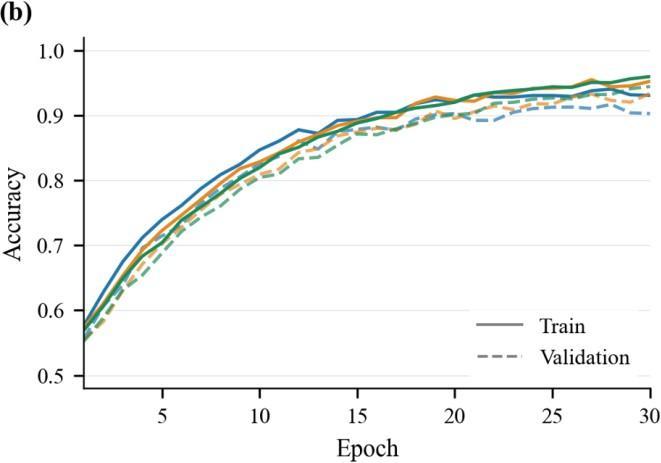
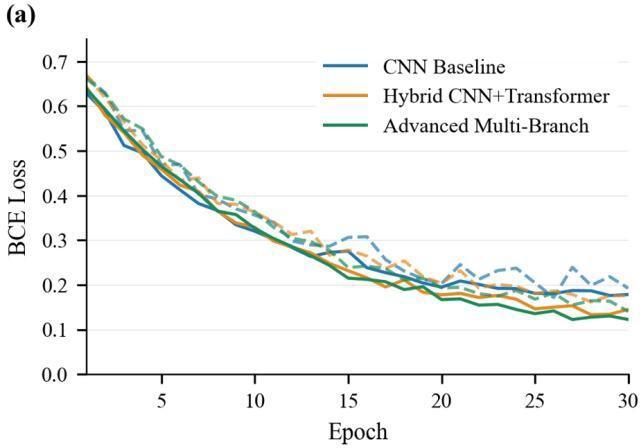
During training, we monitored each of the model’s using loss and accuracy curves to check for signs of convergence and learning stability throughout the training process. All of the models demonstrated consistent signs of convergence throughout their respective training runs, with the hybrid and advanced model architectures demonstrating faster convergencetimesandlowerfinaltraininglossescomparedtothebaselineCNNmodel.
Figure2showsthetraininglossandaccuracycurvesforthevariousarchitectedmodelsevaluatedduringtheirrespective trainingprocesses.
Tofullyunderstandhoweachpartoftheproposedarchitecturecontributed,someearlyexperimentationwasconductedto examineablationtestingofindividualprocessorsinthepipeline.Morespecifically,itwastounderstandhowspatialfeature extraction, frequencydomainprocessing,andtemporal modelingimpacteddetectionperformance by turningoffvarious processors (components) along the detection pipeline. The initial findings indicate that all three components provide complementaryinformationfordetectingmanipulatedmedia,andtheoverallmultibrancharchitectureprovidedthemost consistentandstabledetectionperformance.
International Research Journal of Engineering and Technology (IRJET) e-ISSN: 2395-0056
Volume: 13 Issue: 04 | Apr 2026 www.irjet.net
2395-0072
The first evaluation experiment assessed model performance on the Celeb-DF dataset after training on FaceForensics++. Celeb-DFisknowntocontainhigh-qualitydeepfakevideoswithminimalvisualartifacts,makingitachallengingbenchmark fordetectionsystems.
Theresultspresentedinthispapershowtheimportanceofeacharchitecturalcomponent.ThebaselineCNNarchitecture canmodel spatial artefacts, while the additionofa hybridCNN-Transformer network addsa temporal component to the modelwhichwillallowforbettertemporalmodeling.However,itistheadditionofthefrequencycomponentthatallows theproposedmulti-brancharchitecturetofurtherimprovetheperformanceofthemodelbytakingintoaccounttheartefacts thatareintroducedduringthecreationofdeepfakesinthefrequencydomain.
The baseline CNN Model produces a classification score of 97.08%, an improvement in the score of the Hybrid CNNTransformer Model brings this to a score of 99.08%. The proposed multi-branch has produced a score of 99.83% and illustratestheeffectivenessofintegratingspatial,frequency,andtemporalcomponentstogethertoimproveclassification accuracy.
5.3Cross-DatasetGeneralizationCross-datasetgeneralizationwasevaluatedbytestingmodelstrainedonFaceForensics++ withtheDFDCdataset.Cross-datasetevaluationisimportantbecausedeepfakedetectionsystemsintherealworldwillhave tooperateonpreviouslyunseenmanipulationtechniques.TheCNNbaselineprovideda89%accuracyontheDFDCdataset, whilethehybridCNN-Transformerimprovedthegeneralizationaccuracyto94%andtheproposedadvancedmulti-branch model achieved 97.58%, which was the best accuracy of any model tested. These results suggest integrating spatial, frequencyandtemporalrepresentationsgreatlyenhancescross-datasetgeneralization.However,therewereafewcasesof failureinthedatasetfromdeepfakevideoscontainingexcessivecompressionartifactingorverylow-lightsituationswhere the frequency-domain characteristics are not as easily distinguishable, and therefore, the detection confidence may be slightly lower. Future studies may benefit from examining adaptive weighting mechanisms for features in these types of degradedvideostoenhancerobustness.
5.4ReceiverOperatingCharacteristicCurveAnalysis
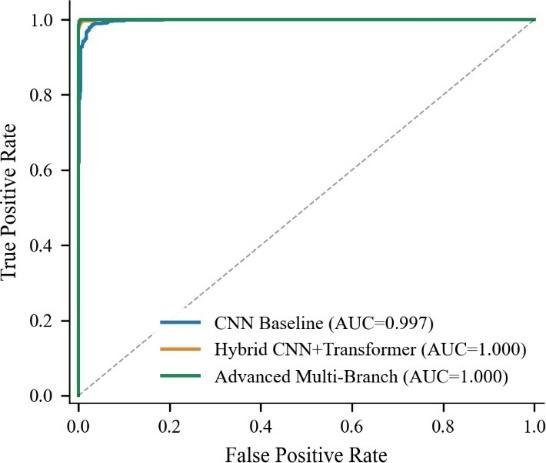
Asapartoffurtherevaluationofclassificationperformance,ROCcurvesweregeneratedfromalloftheevaluatedmodelsto presentthetradeoffbetweenthetruepositiveandfalsepositiveratesasafunctionofthevariedclassificationthreshold.
Figure 3 shows the ROC curves for the evaluated models and gives an illustration of each model's performance in distinguishingbetweenauthenticvs.manipulatedvideosbyprovidingvariousdecisionthresholdlevels.
International Research Journal of Engineering and Technology (IRJET) e-ISSN: 2395-0056
Volume: 13 Issue: 04 | Apr 2026 www.irjet.net p-ISSN: 2395-0072
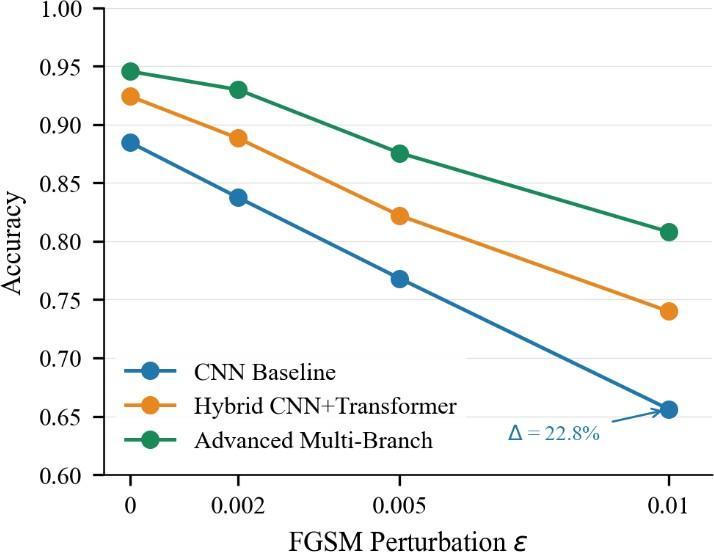
Adversarial robustness experiments with the Fast Gradient Sign Method (FGSM) [1] were included in the analysis of detection accuracy. With FGSM, small perturbations are added to the input samples to determine how the model's classificationperformance isimpacted byadversarial conditions. The baseline CNN had65.6%accuracyafter perturbing withFGSMatε=0.01,whilethehybridCNNhad73.9%accuracy.Therefore,theadvancedmultibranchCNNretained80.8% accuracyatε=0.01aswell,representingasignificantimprovementinadversarialrobustness.
Performanceofeachmodelwasevaluatedforalladversarialperturbations(fromtheFastGradientSignMethod[FGSM]). PerformanceisshowninFigure4.
WithinourinitialtrialswewereabletotestsomeauxiliarycuesasdetectionsignalsincludingArtifactConsistencyAnalysis, andCross-domainPredictionDisagreement;Alltheseinitialapproachesresultedinsomedegreeofpromiseforproviding additionalcomplementarycuestoidentifymanipulatedmedia.However,adetailedevaluationofthepotentialeffectiveness ofthesesystemswasnotpartofthescopeofthisstudy.
In general, the results from the experiments conducted indicate that there is a performance gain in both accuracy and robustnessthroughtheintegrationofspatial,frequencydomain,andtemporalrepresentations.Inaddition,theproposed multi-branch detection framework was shown to out- perform the baseline detection models that were tested against a seriesofstandardperformanceevaluationmetricsaswellasbeingtestedacrossseveraldatasetsandintermsofadversarial robustnessanalyses.
Along with testing the technical effectiveness of the suggested deepfake detection framework, there was also a user awareness survey to assess the general public's awareness of deepfake technology and opinions towards automated detectionmethods.
International Research Journal of Engineering and Technology (IRJET) e-ISSN: 2395-0056
Volume: 13 Issue: 04 | Apr 2026 www.irjet.net p-ISSN: 2395-0072
Public awareness of deepfake technology and the ability to evaluate digital media critically is increasingly becoming essentialasdeepfakecontentbecomesmoreabundantandhelpslessenthepotentialdangersassociatedwithmanipulated content.
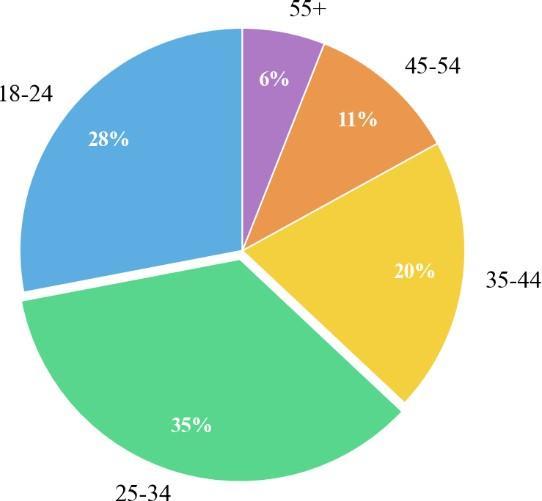
The survey was designed to assess participants’ knowledge of deepfake technology, recognition of manipulated digital media,andtheirtrustinautomateddeepfakedetectionsystems.Thesurveyconsistedof22questionswhichexploredthree kaupapa,namely:anunderstandingofdeepfaketechnology,experiencewithmanipulateddigitalcontent,andconfidencein developingdetectionmethods.
70 participants took part in the survey, and participants came from various educational and work backgrounds. All responses were recorded anonymously to allow participants to provide unbiased and truthful responses about their experienceswithdeepfakedigitalcontent.
6.2ParticipantDemographics
Most respondents participated in the study acknowledged having heard of deepfake technologies or fake media. When viewedwithgenuineexamplesofdeepfakecontent,manyrespondentswerestillunabletotellifthemediahadbeenaltered fromitsoriginalstate.Thissupportsearlierstudiesthathavedocumentedradicalgrowthinbothoverallrealismofdeepfake contentandacorrespondingincreaseinthedifficultyofidentifyingdeepfakesmanually[13].
Respondent'swerealsoaskediftheyhadeverseendeepfakemediapriortoparticipatinginthisstudyonsocialorother web-based sites. A high percentage of the respondents reported having seen both altered video and pictures, therefore confirmingthatdeepfakemediahasalreadyenteredintoandestablisheditselfasasignificantcomponentofcontemporary digitalinf6.4WhatParticipantsThinkAboutAutomatingDeepfakeDetection
Survey respondents had a variety of opinions about automated detection systems for deepfakes. Generally speaking, respondentswidelysupportanytechnologythatcanprovidehelpinidentifyingmediathathavebeenmodified.Asignificant percentageofrespondentsfeelcomfortablewithusingautomateddetectionsystemstoassistinidentifyingmodifiedmedia, whileanumberofrespondentshaveexpressedconcernsabouttheaccuracyofautomateddetectiontools.
This indicates that there is a real need for both robust and accessible automated detection systems for deepfakes. As deepfakesbecomeeasiertocreateusingnewandimprovedtechniques,itislikelythatautomateddetectiontechniqueswill bevitalforprovidingsupporttothecontentmoderation,digitalforensics,andmediaverificationcommunities[14].
For most survey respondents, the level of awareness of deepfake technology continues to increase. Many respondents reportedthattheycontinuetostrugglewithidentifyingmediathathasbeenmodifiedwithouthelpfromtechnology.This meansthatthereisaneedforreliableautomateddetectionsystemsthatwillprovideuserswithassistancewhenattempting toidentifydigitalcontentthathasbeenmodified.
The rapid progress in deep learning has paved the way to create synthetic media that are increasingly realistic, which constitutesa significant challenge interms of digital securityand mediaforensics – particularly with regard todetecting
International Research Journal of Engineering and Technology (IRJET) e-ISSN: 2395-0056
Volume: 13 Issue: 04 | Apr 2026 www.irjet.net p-ISSN: 2395-0072
deepfakes.Inthispaper,anovelmulti-stagedeepfakedetectionframeworkthatcombinesspatial,frequency-domain,and temporal representations has been introduced to enhance the accuracy and robustness of the results. A comprehensive process for identifying manipulated videos is now available using a combination of multi-scale convolutional feature extraction,frequency-domainartifactsextraction,andtransformer-basedtemporalmodelingtechniques.Theresultsofthe experimental evaluation demonstrate thatthisnewdetectionmethodology outperformsexisting methods acrossvarious benchmarkdatasets.Amulti-branchmodeltrainedontheFaceForensics++datasetandevaluatedonCeleb-DFv2achieved anaccuracyof99.8%,exceedingbothaCNNbaselineandahybridCNN/Transformermodel.Cross-datasetevaluationon DFDCdatasetdemonstratedexcellentgeneralizationcapabilitywithascoreof97.6%onpreviouslyunseendata.Therefore, theseresultsprovidestrongevidencetosupporttheuseofcomplementaryfeaturerepresentationsasaneffectivemeansto enhancedeepfakedetectionperformance(3,4).
Inadditiontoassessingdetectionaccuracy,researchersanalyzedtheresilienceoftheproposedarchitecturebyevaluating its response to adversarial perturbations created with the Fast Gradient Sign Method (FGSM) [1]. The findings show an increase in the accuracy of detection for the proposed multi-branch architecture when tested against adversarial perturbationscomparedtobaselinemethods.Theresultsofthisstudyindicatethattheuseofspatialfeatures,frequencydomainfeatures,andtemporalfeaturestogethercanincreasetheresilienceofthemodelagainstadversarialattacks.
[1] I. J. Goodfellow et al., “Explaining and Harnessing Adversarial Examples,” International Conference on Learning Representations(ICLR),2015.
[2]A.Rossler,D.Cozzolino,L.Verdoliva,C.Riess,J.Thies,andM.Nießner,“FaceForensics++:LearningtoDetectManipulated FacialImages,”IEEEInternationalConferenceonComputerVision(ICCV),2019.
[3] Y. Li, X. Yang, P. Sun, H. Qi, and S. Lyu, “Celeb-DF: A Large-Scale Challenging Dataset for DeepFake Forensics,” IEEE ConferenceonComputerVisionandPatternRecognition(CVPR),2020.
[4]B.Dolhanskyetal.,“TheDeepFakeDetectionChallengeDataset,”arXivpreprintarXiv:2006.07397,2020.
[5]M.TanandQ.Le,“EfficientNet:RethinkingModelScalingforConvolutionalNeuralNetworks,”InternationalConference onMachineLearning(ICML),2019.
[6]Y.LiandS.Lyu,“ExposingDeepFakeVideosbyDetectingFaceWarpingArtifacts,”IEEEConferenceonComputerVision andPatternRecognitionWorkshops,2019.
[7]H.Nguyen,F.Fang,J.Yamagishi,andI.Echizen,“Multi-TaskLearningforDetectingandSegmentingManipulatedFacial ImagesandVideos,”IEEEInternationalConferenceonBiometrics,2019.
[8]A.Vaswanietal.,“AttentionIsAllYouNeed,”AdvancesinNeuralInformationProcessingSystems(NeurIPS),2017.
[9]D.Cozzolino,G.Poggi,andL.Verdoliva,“RecastingResidual-BasedLocalDescriptorsasConvolutionalNeuralNetworks,” IEEEInternationalWorkshoponInformationForensicsandSecurity,2017.
[10]Y.Wangetal.,“CNNGeneratedImagesAreSurprisinglyEasytoSpot…forNow,”IEEEConferenceonComputerVision andPatternRecognition(CVPR),2020.
[11]H.Durall,M.Keuper,andJ.Keuper,“WatchYourUp-Convolution:CNNBasedGenerativeDeepNeuralNetworksAre FailingtoReproduceSpectralDistributions,”IEEEConferenceonComputerVisionandPatternRecognition(CVPR),2020.
[12]N.CarliniandD.Wagner,“TowardsEvaluatingtheRobustnessofNeuralNetworks,”IEEESymposiumonSecurityand Privacy,2017.
[13]J.ChesneyandD.Citron,“DeepfakesandtheNewDisinformationWar,”ForeignAffairs,2019.
[14]R. Tolosana et al., “DeepFakesandBeyond:A SurveyofFace Manipulationand Fake Detection,”InformationFusion, 2020.