
International Research Journal of Engineering and Technology (IRJET) e-ISSN: 2395-0056
Volume: 13 Issue: 02 | Feb 2026 www.irjet.net p-ISSN: 2395-0072
International Research Journal of Engineering and Technology (IRJET) e-ISSN: 2395-0056
Volume: 13 Issue: 02 | Feb 2026 www.irjet.net p-ISSN: 2395-0072
Priya Rathod1, Mantra Chavan2, Sarvesh Bhoir3, Piyush Rohra4, Swati Kulkarni5, Shubhangi Chintawar6
1, 2, 3, 4 Students, Department of Computer Engineering Vivekanand Education Society’s Polytechnic Mumbai, India
5, 6 Lecturer, Department of Computer Engineering Vivekanand Education Society’s Polytechnic Mumbai, India ***
Abstract - Traditional recruitment processes are often time-consuming, subjective, and inefficient due to manual shortlisting and synchronous interviews. With the increasing number of applicants for a single role, organizations face challenges in maintaining fairness, consistency, and efficiency during initial screening. This paper presents an AI-powered video interview screener designed to automate and streamline the recruitment process. The proposed system integrates aptitude testing, asynchronous browser-based video interviews and Natural Language Processing (NLP) techniques for transcript generation and response evaluation. Candidates can complete assessments and interviews at their convenience, while recruiters gain access to automatically generated scores, transcripts, and comparative insights through a centralized dashboard. The system is developed using Next.js for the frontend and Supabase for backend services, including authentication, database management, and secure cloud storage of video responses. By minimizing human intervention in early-stage screening, the platform reduces bias, eliminates scheduling conflicts, and improves scalability. The proposed solution enhances recruiter efficiency and candidate experience and engagement, making the recruitment process more transparent, flexible, and data-driven.
Key Words: AI Interview Screener, Recruitment Automation, Video Interview, Natural Language Processing, Cloud Computing, Supabase, Next.js.
Recruitment and candidate evaluation are critical processes for organizations and educational institutes, as they directly influencethequalityoftalentselection.Withtherapidgrowthinthenumberofapplicantsforasingleroleoropportunity, traditional recruitment methods such as manual shortlisting, written tests, and synchronous interviews have become inefficient, time-consuming, and difficult to scale. These methods often depend heavily on human judgment, which may introducebiasandinconsistenciesincandidateevaluation.
Inrecentyears,digitalrecruitmentplatformshaveattemptedtoaddressthese challengesthroughonlineassessmentsand virtualinterviews.However,manyexistingsystemsfocusonisolatedstagesofrecruitment,suchaseitheraptitudetesting or video interviews, without providing an integrated and automated workflow. Additionally, the lack of transparency in evaluationcriteria,limitedcustomization forinstitutes, andschedulingconstraints continue toaffect bothrecruiters and candidates.
To overcome these limitations, this paper proposes an AI-powered video interview screener that automates the early stages of the recruitment process. The system is designed to combine an initial quiz-based aptitude assessment with asynchronous video interviews, allowing candidates to participate at their convenience. The quiz section serves as the entry-level evaluation stage, enabling institutes to assess candidates’ subject knowledge and reasoning skills in a controlled and structured manner. The interview section further evaluates communication skills and response quality throughrecordedvideoanswers.
The proposedsystemleveragesmodern weband cloud technologies to ensure scalability,accessibility,and security. The frontend is developed using Next.js, enabling a responsive interface, while Supabase is used for authentication, database management, and secure cloud storage. An Artificial Intelligence layer based on Natural Language Processing (NLP) generates transcripts from video responses and performs objective analysis of candidate answers. By reducing manual interventionandintroducingstandardizedevaluationmechanisms,thesystemaimstominimizebias,eliminatescheduling conflicts,andimproverecruitmentefficiency.
International Research Journal of Engineering and Technology (IRJET) e-ISSN: 2395-0056
Volume: 13 Issue: 02 | Feb 2026 www.irjet.net p-ISSN: 2395-0072
Thisworkpresentsaunifiedrecruitmentscreeningplatformsuitableforbothorganizationsandeducationalinstitutes.By integrating quiz-based evaluation, AI-driven interview analysis, and cloud-based infrastructure, the proposed solution providesafair,flexible,andefficientalternativetotraditionalrecruitmentpractices.
With the advancement of artificial intelligence, recruitment processes have increasingly shifted toward automated and online screening methods. Several platforms have been developed to assist recruiters in evaluating candidates through onlineassessmentsandvideointerviews.
Hire Vue is an AI-based interview platform that uses recorded video responses and automated analysis to support recruiters.Whileitimprovesscreeningefficiency,concernsrelatedtoevaluationtransparencyandhighsubscriptioncosts limititsadoptionbysmallerorganizations.SparkHireprovidesone-wayvideointerviewfunctionality,enablingcandidates torecordresponsesasynchronously.However,itlacksintegratedaptitudetestingandreliesheavilyonmanualreview.
Talviewcombinesonlineassessments,videointerviews,andremoteproctoringwithinasinglesystem.Althoughitsupports large-scale recruitment, its complexity and operational cost make it less suitable for academic institutions. Similarly, My Interview focuses on asynchronous video interviews with limited AI-based insights and does not provide standardized scoringmechanisms.
Fromthestudyofexistingsystems,itisobservedthatmostplatformsemphasizeeitheraptitudetestingorvideointerviews, but rarely offer both in an integrated manner. Additionally, high costs, limited customization, and lack of transparency remainmajorchallenges.TheselimitationshighlighttheneedforanaffordableandintegratedAI-basedinterviewscreening systemthatcombinesquiz-basedevaluationwithautomatedinterviewanalysis.
3.1
Traditional recruitment and screening processes are time-consuming, inconsistent, and dependent on manual evaluation. Existingonlineinterviewplatformsoftenfocuseitheronaptitudetestingorvideointerviews,butfailtointegratebothina cost-effective system. Furthermore, issues such as limited transparency, insufficient customization for institutes, and inadequate proctoring mechanisms reduce the reliabilityof candidate evaluation. Hence, there isa need for an integrated AI-basedinterviewscreeningsystemthatensuresfair,efficient,andsecurecandidateassessment.
3.2
ThemainobjectivesoftheAIInterviewScreenerare:
ToautomateinitialcandidatescreeningusingquizzesandAI-assistedinterviews.
Tosupportinstitute-specificquizcreation,management,andevaluation.
Toensurefairnessandintegritythroughonlineproctoringmechanisms.
Togenerateautomatedscoringandanalyticsforeffectivedecision-making.
Toreducemanualeffortandimproveoverallrecruitmentefficiency.
TheAIInterviewScreenerisdesignedasamodularweb-basedsystemconsistingoffrontend,backendservices,database, AIevaluation,andproctoringmodules,asshowninFig-1.
Frontend: DevelopedusingNext.jswithTailwindCSS,providingaresponsiveuserinterface.
Backend: Supabase manages authentication, database operations, and secure storage, while Python-based APIs handleAIevaluationandprocessing.
Database: PostgreSQL(Supabase)storescandidatedata,quizresults,andanalytics.
AI Evaluation: NLP-basedmodelsgeneratetranscriptsandevaluateresponsesagainstpredefineddatasets.
Proctoring: Webcam monitoring and tab-switch detection using MediaPipe and OpenCV help maintain assessmentintegrity.
International Research Journal of Engineering and Technology (IRJET) e-ISSN: 2395-0056
Volume: 13 Issue: 02 | Feb 2026 www.irjet.net p-ISSN: 2395-0072
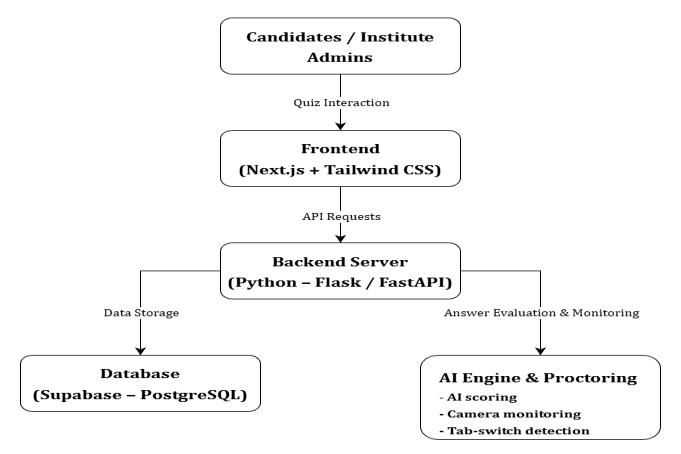
AsillustratedinFig-1,thesystemfollowsamodularclient–serverarchitectureinwhichthefrontendandbackendinteract withthedatabase,AIevaluation,andproctoringmodulestodeliveraunifiedrecruitmentscreeningplatform.
The AI Interview Screener is implemented using a layered and modular approach to ensure scalability, maintainability, and secure data handling. The frontend is built with Next.js and Tailwind CSS, providing a responsive, intuitive user interface for candidates and administrators. Authentication, database management, and file storage are handled by Supabase,ensuringsecureaccesscontrolandreliablecloudstorageforresumesandrecordedinterviewvideos.
The quiz module is implemented using time-bound MCQ logic with automatic submission and validation. Proctoring mechanisms such as tab-switch detection and webcam monitoring are integrated using browser APIs, Media Pipe, and OpenCV,enablingreal-timemonitoringofcandidatebehaviorduringassessments.
For interview evaluation, recorded video responses are processed using Natural Language Processing (NLP) techniques. Speech-to-text models generate transcripts, which are analyzed against predefined datasets and evaluation criteria. Automated scoring is generated based on keyword relevance, response completeness, and contextual similarity. All evaluationresultsarestoredinthePostgreSQLdatabaseandvisualizedthroughananalyticsdashboardforadministrative review.
The Candidate Module manages candidate registration, authentication, and participation in the recruitment process. Candidates register by submitting personal and professional details such as full name, email, password, phone number, LinkedIn URL, role, resume (PDF), and profile photo (JPG). Google authentication is enabled only for login after registrationandverification.Onceverified,candidatescanaccessassignedquizzes,attemptthemwithinatimelimit,and viewresultsbeforeproceedingtotheinterviewstage.
The Admin Module allows institutes to manage candidates and recruitment workflows efficiently. Admins can verify candidate registrations; manage candidate lists, and shortlist applicants through collaborative evaluation processes. The module also provides access to detailed candidate profiles, quiz results, and interview-related insights, supporting efficient,transparent,andinformeddecision-making.
International Research Journal of Engineering and Technology (IRJET) e-ISSN: 2395-0056
Volume: 13 Issue: 02 | Feb 2026 www.irjet.net p-ISSN: 2395-0072
TheQuizManagementModuleisresponsibleforthecreation,scheduling,andexecutionofquizzesacrosstheplatform.It manages question sets, quiz duration, navigation controls, and secures submission processes. Candidate responses are evaluatedusingAI-basedvalidationmodels,andscoresaregeneratedautomaticallyandstoredforreporting,review,and furtheranalysis.
The Proctoring Module maintains assessment integrity by employing webcam-based face tracking and real-time tabswitch detection. Candidate behavior is continuously monitored, and any suspicious activity exceeding predefined thresholdsresultsinautomaticterminationoftheassessmentsession.Allsuchincidentsarerecordedandmadeavailable foradministrativeanalysis.
5.5
The Evaluation and Analytics Module analyzes quiz results along with proctoring data to generate comprehensive performance reports. It evaluates candidate scores, behavior logs, and overall performance trends. These insights are presented through dashboards and visual summaries that help institutes assess candidates efficiently, consistently, and objectively.
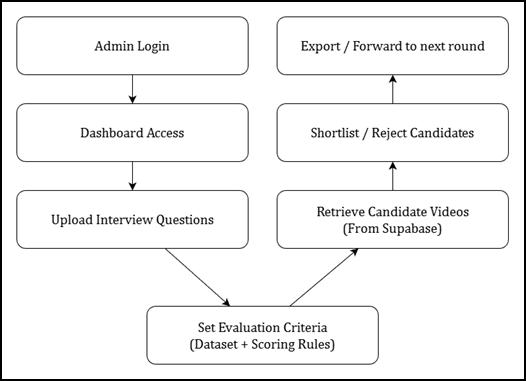
The admin workflow outlines the steps followed by organizational administrators to manage the interview process, as shown in Fig -2. The workflow starts with admin login and dashboard access. Admins upload interview questions and define evaluation criteria, including datasets and scoring rules. Candidate interview videos and transcripts are retrieved fromthedatabaseforreview.BasedonAI-generatedscoresandevaluationcriteria, adminsshortlistorrejectcandidates andexportresultsorforwardselectedcandidatestothenextrecruitmentround. and scoring rules. Candidate interview videos and transcripts are retrieved from the database for review. Based on AIgenerated scores and evaluation criteria, admins shortlist or reject candidates and export results or forward selected candidatestothenextrecruitmentround.
International Research Journal of Engineering and Technology (IRJET) e-ISSN: 2395-0056
Volume: 13 Issue: 02 | Feb 2026 www.irjet.net p-ISSN: 2395-0072
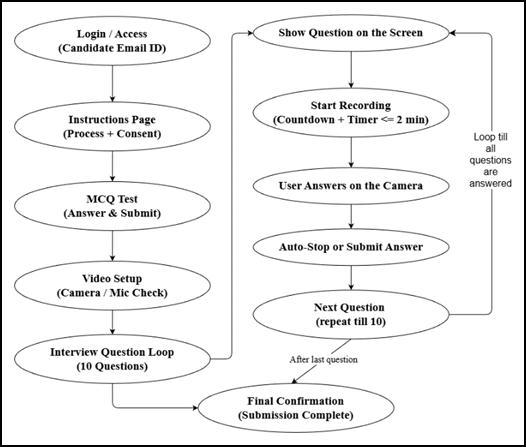
The candidate workflow illustrates the complete interview process from the candidate’s perspective, as shown in Fig -3. The workflow begins with candidate login or access through a unique ID or link, followed by instructions and a consent page. Candidates first attempt the MCQ-based quiz and submit their responses. After successful quiz completion, the camera and microphone setup is performed. The system then conducts an AI-based interview consisting of multiple questions,whereeachresponseisrecordedwithinafixedtimelimit.Afteransweringallquestions,theprocessendswith finalsubmissionconfirmation.
TheAIInterviewScreenerwassuccessfullyimplementedandevaluatedtoassessitseffectivenessinautomatingtheinitial stages of the recruitment process. The system integrates candidate registration, online assessment, proctoring, AI-based evaluation, and analytics into a single unified platform. Functional testing and observational analysis were conducted to examine system behavior, workflow accuracy, and usability. This section discusses the observed results and system outputswithreferencetokeyuserinterfacescreens,highlightinghowautomationandAIassistanceimproveconsistency, efficiency,andusabilityincandidatescreening.
7.1 Candidate Registration Page
International Research Journal of Engineering and Technology (IRJET) e-ISSN: 2395-0056
Volume: 13 Issue: 02 | Feb 2026 www.irjet.net p-ISSN: 2395-0072
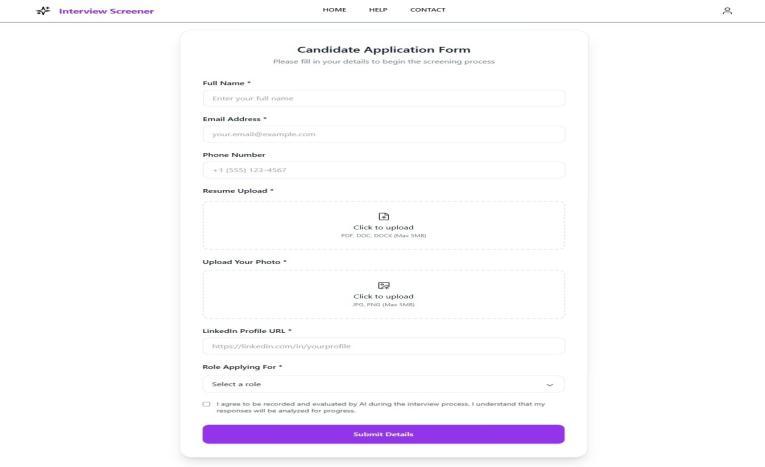
The candidate registration module enables structured and secure onboarding by collecting essential personal, academic, andprofessionalinformation,asshowninFig -4.Detailssuchasfullname,emailaddress,phonenumber,resume,profile photograph, LinkedIn URL, and role applied for are collected. Mandatory field validation ensures data completeness and reduces incorrect submissions. Google authentication is used exclusively for login, while registration is performed manuallytomaintainverificationintegrityandcontrolovercandidatedata.
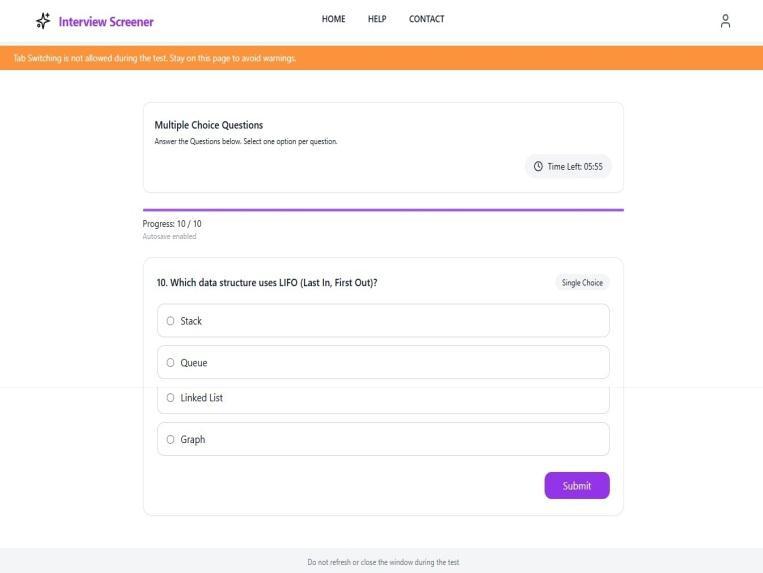
The quiz interface demonstrates the system’s capability to conduct time-bound online assessments with integrated proctoring mechanisms, as shown in Fig -5. Candidates attempt multiple-choice questions within a predefined duration, supported by a visible countdown timer and progress tracker. Candidate behavior is continuously monitored using tabswitch detection and gaze tracking. Any activity exceeding predefined thresholds results in automatic termination of the assessmentsession,andtheincidentisloggedforadministrativereview,ensuringfairnessandintegrity.
International Research Journal of Engineering and Technology (IRJET) e-ISSN: 2395-0056
Volume: 13 Issue: 02 | Feb 2026 www.irjet.net p-ISSN: 2395-0072
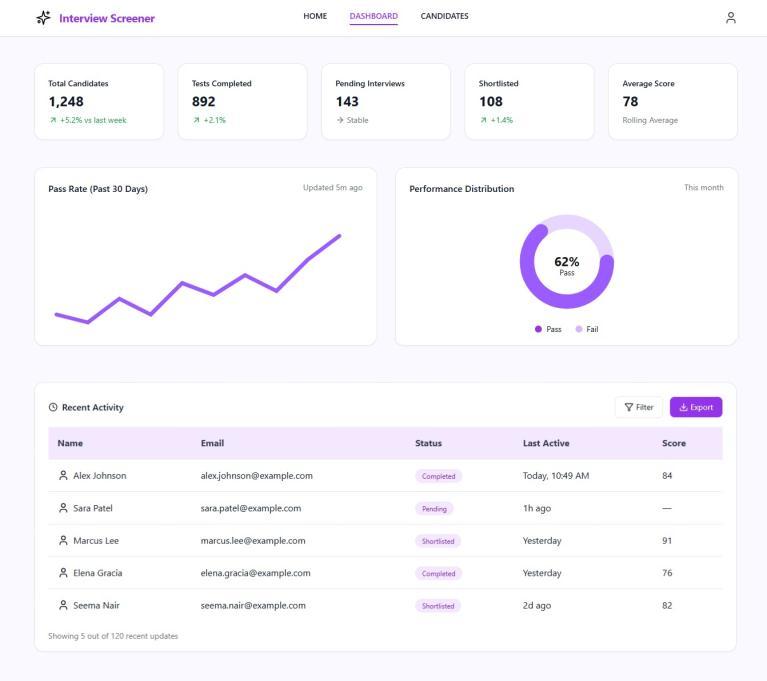
Theadmindashboardprovidesreal-timevisibilityintorecruitmentactivitiesandsystemperformance,asillustratedinFig -6.Itdisplayskeymetricssuchastotalregisteredcandidates,completedassessments,shortlistedapplicants,andaverage performancescores.Graphicalvisualizationshelpadministratorsidentifyperformancetrendsefficiently,reducingmanual trackingeffortsandenablingfaster,informeddecision-making.
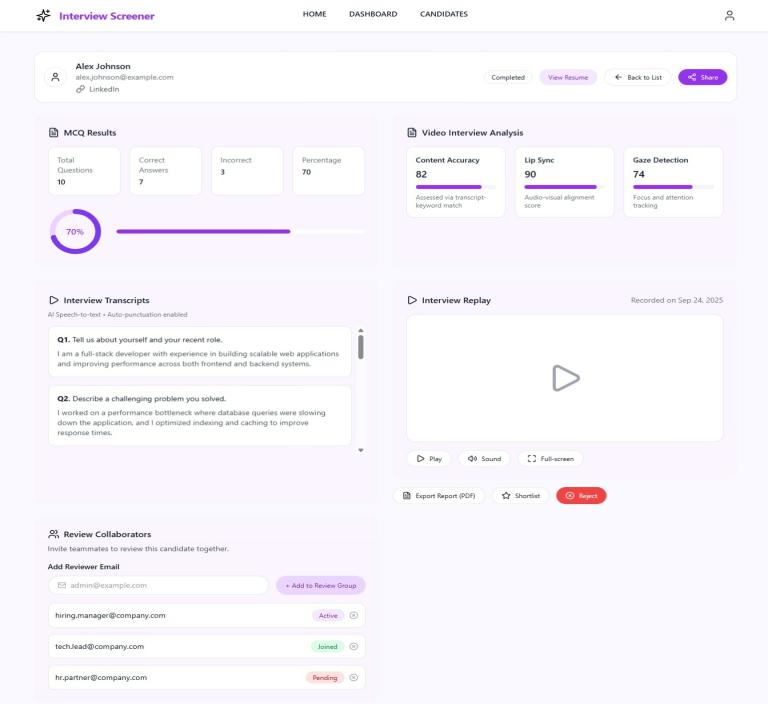
Thecandidate resultsandanalyticsinterfacepresentscomprehensiveevaluationdata inanorganizedmanner, asshown in Fig -7. It includes quiz scores, AI-generated interview metrics, behavioral logs, and summarized response insights. Recruiters can review interview recordings, transcripts, and compare candidate performance. Collaborative shortlisting featurespromotetransparency,consistency,andobjectivityinevaluation.
Overall, the observed results indicate that the proposed AI Interview Screener effectively reduces manual intervention duringearly-stagerecruitment.Theintegrationofautomatedassessments,AI-assistedevaluation,andanalyticsimproves consistencyandscalabilitywhileenhancingcandidateexperiencethroughasynchronousparticipation.Thesystemshows strongpotentialforadoptioninbothorganizationalandacademicrecruitmentenvironments.
ThispaperpresentedanAI-PoweredVideoInterviewScreenerdesignedtoautomateandenhancetheearlystagesofthe recruitment process. By integrating quiz-based aptitude assessment, asynchronous video interviews, AI-driven response evaluation, and online proctoring mechanisms, the proposed system addresses key limitations of traditional recruitment methods,includingmanualeffort,bias,andschedulingconstraints.
The system leverages modern web technologies and cloud-based infrastructure to provide a scalable, secure, and userfriendly platform for both candidates and institutes. Automated evaluation and analytics enable consistent and objective assessment, while asynchronous participation improves flexibility and accessibility. Experimental observations indicate thattheproposedsolutionreducesrecruiterworkloadandimprovesscreeningefficiencywithoutcompromisingfairness ortransparency.
Overall,theAIInterviewScreenerdemonstratesstrong potential asaneffectiveand practical alternativetoconventional recruitmentpractices,particularlyfororganizationsandeducationalinstitutionshandlinglargeapplicantvolumes.
International Research Journal of Engineering and Technology (IRJET) e-ISSN: 2395-0056
Volume: 13 Issue: 02 | Feb 2026 www.irjet.net p-ISSN: 2395-0072
Althoughtheproposedsystemachieveseffectiveautomationofearly-stagerecruitment,severalenhancementscanfurther improveitscapabilities:
Integration of advanced AI models for deeper interview analysis, including sentiment, emotion, and confidence detectionfromvideoresponses.
Implementationofadaptivequestiongeneration,wherequizandinterviewquestionsdynamicallyadjustbasedon candidateperformance.
Support for multilingual interviews and assessments to improve accessibility for candidates from diverse linguisticbackgrounds.
Integrationofpredictiveanalyticstosupportrecruitersinidentifyingpotentialcandidateperformanceandlongtermsuitabilitybasedonhistoricaldata.
These improvements would enhance the system’s reliability, scalability, and effectiveness in supporting data-driven recruitmentdecisions.
Theauthors wouldliketoacknowledgeAIBIStreetPvt. Ltd.forsponsoringandsupportingthisproject.Theauthorsalso thankthejournalforprovidinganopportunitytopublishthisresearch.
TheAI-Powered VideoInterviewScreenersystemissponsoredby,andthecopyrightandintellectual propertyrightsare heldby: AIBIStreetPvt.Ltd.
Website:https://www.aibistreet.com
Address:OfficeNo.1&2,ShivshankarTower,Sector20B,Airoli,NaviMumbai–400708,India.
1. S. T. Kim and J. J. Kim, “Revealing the influence of AI and its interfaces on job candidates’ impression managementinasynchronousvideointerviews,”TechnologicalForecastingandSocialChange,vol.196,2023. doi:10.1016/j.techfore.2023.122886.
2. L.Meijerink,S.Bondarouk,andE.Lepak,“Recruitmentandselectionprocessusingartificialintelligence:How docandidatesreact?”AdministrativeSciences,vol.14,no.7,2024.
3. Gupta and R. Singh, “Fairness in AI-driven recruitment: Challenges, metrics, methods, and future directions,” arXivpreprint,arXiv:2405.19699,2024.
4. E. Brown and T. Wilson, “Hi. I’m Molly, your virtual interviewer! Exploring the impact of race and gender in virtualinterviews,”arXivpreprint,arXiv:2408.14159,2024.
5. P. Sharma and K. Verma, “A general paper on AI based mock interview system,” International Journal of ScientificResearchinScience,EngineeringandTechnology,vol.12,no.3,2026.
6. R. Patel, A. Shah, and N. Desai, “AI based recruitment preparation system: An intelligent interview and assessment platform,” International Journal of Advanced Research in Computer and Communication Engineering,vol.12,no.5,2023.
7. M. Novak and L. Horvat, “The applicability of artificial intelligence in candidate interviews in the recruitment process,”2023.
8. Bogen and A. Rieke, “Help wanted: An examination of hiring algorithms, equity, and bias,” Upturn Research Report,2023.
9. T.BlackandH.Esch,“Automatedhiringsystemsandhumandecision-making,”HumanResourceManagement Review,vol.33,no.1,2023.doi:10.1016/j.hrmr.2022.100890.
International Research Journal of Engineering and Technology (IRJET) e-ISSN: 2395-0056
Volume: 13 Issue: 02 | Feb 2026 www.irjet.net p-ISSN: 2395-0072 © 2026, IRJET | Impact Factor value: 8.315 | ISO 9001:2008 Certified Journal | Page478
10. J. Allen, R. Guo, and K. White, “Automated Candidate Screening Using Natural Language Processing”, IEEE Access,vol.7,pp.12845–12856,2019.