
International Research Journal of Engineering and Technology (IRJET) e-ISSN: 2395-0056
Volume: 12 Issue: 09 | Sep 2025 www.irjet.net p-ISSN: 2395-0072
International Research Journal of Engineering and Technology (IRJET) e-ISSN: 2395-0056
Volume: 12 Issue: 09 | Sep 2025 www.irjet.net p-ISSN: 2395-0072
Prakash Kanade
1
,Divya Kumar2, Shama Ghatwal3, Sunay Kanade4, Tarunesh Sathish5
1Researcher in Robotics, Artificial Intelligence, IOT
2Trainer, LeenaBOT Robotics, Bangalore India
3Student, LeenaBOT Robotics, Goa India
4Student, LeenaBOT Robotics, Bangalore India
5Student, LeenaBOT Robotics, USA
Abstract - This study presents the design,development,and evaluation of an AI-powered GPS-based robotic lawn mower featuring autonomous navigation and control using a Raspberry Pi platform. The system integrates RTK-GNSS for centimeter-level localization, AI-driven path planning (A*, Theta*, DWB/TEB), andmulti-sensor obstacledetectionusing LiDAR, ultrasonic sensors, and computer vision. Field experiments were conducted onoutdoor lawns (12–20 m× 8–15 m) with slopes up to 5°, encompassing open grass, moderate, anddenseobstacleconditions.Performancemetrics included navigation accuracy, coverage efficiency, overlap percentage, obstacle detection precision and recall, obstacle handling latency, path tracking error, throughput, energy consumption, and blade RPM stability. Results demonstrated superior performance, with navigation accuracy of 0.025 m, coverage efficiency of 98.6%, and overlap of only 6.4%, exceeding target benchmarks. Obstacle detection precision (96.8%) and recall (94.5%) ensured reliable identification of static and dynamic hazards, while handling latency averaged 225 ms, enabling timely collision avoidance. Path tracking error remained at 0.042 m, supporting stable operation, and throughput reached8.3 m²/min.Energyconsumptionwaslow at 3.8 Wh/m², with a battery runtime of 162 minutes, surpassingthe 150-minute target. BladeRPMstabilityof1.8% maintained consistent cutting performance. Comparative analysis showed that the proposed system outperformed commercial robotic mowers and manual push mowers in accuracy, efficiency, safety, andsustainability.Theintegration of AI algorithms, RTK-GPS localization, and sensor fusion significantlyimprovedoperationaladaptability,efficiency,and safety. The mower’s modular architecture, electric operation, andoptimizedcoverage contribute to reducedenvironmental impact and labor requirements. These findings demonstrate the potential of low-cost, AI-enabled autonomous systems to transform residential and commercial lawn maintenance. Future work may explore scalability, predictive maintenance, and grass health monitoring to expand functionality and market applicability.
Key Words: Autonomousnavigation,Roboticlawnmower, RTK-GPS, Raspberry Pi, Obstacle detection, and AI path planning.
The rapid advancement of artificial intelligence (AI), robotics, and embedded systems has revolutionized automationacross varioussectors,frommanufacturing to agriculture.Oneareathathaswitnessedgrowinginterestis the automation of routine outdoor tasks, such as lawn maintenance. Traditionally, lawn mowing has been laborintensive, requiring significant time, energy, and physical effort.Thislimitationhasfueledresearchintoroboticlawn mowers, which can perform the task autonomously, reducing human involvement and improving operational efficiency. The integration of AI and Global Positioning System (GPS) technologies with microcontroller-based platforms,suchastheRaspberryPi,presentsanopportunity todevelopintelligent,adaptable,andcost-effectivesolutions. ThisresearchfocusesonanAI-poweredGPS-basedrobotic lawnmowercapableofautonomousnavigationandcontrol, offeringamodernalternativetomanualandsemi-automated lawnmaintenancemethods.
Roboticlawnmowersfirstemergedinthelate20thcentury assimpleprogrammabledevicesthatfollowedpredefined paths, often relying on boundary wires to limit their movement.Whiletheseearlydesignsreducedphysicallabor, they lacked intelligence, adaptability, and efficiency. Over time,developmentsinsensortechnologies,computervision, and real-time data processing have enabled significant improvements in autonomous navigation. Modern commercialroboticmowersoftenfeatureobstacledetection sensors, path optimizationalgorithms, and environmental adaptability. However, many of these solutions are either prohibitivelyexpensiveorlackadvancedAIcapabilitiesfor dynamicdecision-making.Theintegrationoflow-cost,highperformance platforms like Raspberry Pi, paired with AI algorithms and GPS-based guidance, opens the door to affordable yet intelligent systems that can operate with minimalhumansupervision.
International Research Journal of Engineering and Technology (IRJET) e-ISSN: 2395-0056
Volume: 12 Issue: 09 | Sep 2025 www.irjet.net p-ISSN: 2395-0072
AIalgorithmshavebecomeessentialinenablingrobotsto operate in dynamic, unstructured environments. In lawn mowing applications, AI facilitates tasks such as path planning,obstacledetection,real-timedecision-making,and adaptive control. Computer vision models, trained on relevantdatasets,canrecognizeterrainvariations,objects, and boundaries. Machine learning enables the mower to improve its navigation efficiency over time through datadrivenlearning.ThecombinationofAIwithGPSnavigation ensurespreciselocalization,allowingthemowertofollow optimized routes with minimal overlap and missed areas. Additionally, AI-powered control mechanisms can dynamically adjust the mower’s movement and blade operationbasedongrassdensity,terrainslope,andobstacle proximity,therebyincreasingenergyefficiencyandmowing quality.
GPS has become a cornerstone of autonomous outdoor robotics,offeringaccuratepositioningcapabilitiescriticalfor navigation. High-precision GPS modules, especially when combinedwithReal-TimeKinematic(RTK)corrections,can achieve centimeter-level accuracy. In the context of lawn mowing, GPS allows the system to map the mowing area, planefficientcoveragepaths,andtrackitspositioninreal timewithouttheneedforboundarywires.Thiseliminates thesetupcomplexityassociatedwithearlierroboticmowers and increases flexibility in handling lawns of irregular shapes.GPS-basedlocalizationalsofacilitateszonemapping, enablinguserstodefinespecificmowingzonesorrestricted areasviasoftware,enhancingcustomizationandsafety.
TheRaspberryPiisapowerful,low-cost,creditcard-sized computer widely adopted in robotics research due to its versatility and computational capabilities. In this study, it serves as the central processing unit for the robotic lawn mower, integrating inputs from GPS, AI-based vision systems,andmotorcontrolmodules.Itscompatibilitywith Python, TensorFlow Lite, OpenCV, and various sensor librariesmakesitanidealplatformforimplementingrealtime AI algorithms and navigation logic. Furthermore, the Raspberry Pi supports wireless connectivity, enabling remote monitoring, software updates, and data logging, which are crucial for performance analysis and iterative improvements
a) To design and implement an AI-powered, GPS-guided roboticlawnmowercapableofachievinghigh-precision autonomous navigation, optimized path planning, and reliable obstacle detection using Raspberry Pi-based control.
b) To evaluate the system’s performance in terms of navigation accuracy, coverage efficiency, safety, and energyconsumption,andcompareitagainstcommercial roboticandmanualmowingsolutions.
Despite the existence of commercial robotic mowers, several limitations remain unresolved: high costs, limited adaptabilitytodifferentterrains,dependenceonboundary wires,andlackofintelligentdecision-making.Manylow-cost roboticmowerslackGPS-basedprecisionandAI-drivenpath optimization, leading to inefficient coverage and frequent humanintervention.Moreover,obstacleavoidanceinsome models is rudimentary, relying on simple bump sensors ratherthanpredictivevision-baseddetection.Thisresearch addresses these gaps by developing a cost-effective, AIpowered, GPS-guided robotic mower capable of real-time obstacle detection, optimized path planning, and autonomous control, without the need for boundary wire installations.
a) To design and implement an AI-powered, GPS-guided roboticlawnmowercapableofachievinghigh-precision autonomous navigation, optimized path planning, and reliable obstacle detection using Raspberry Pi-based control.
b) To evaluate the system’s performance in terms of navigation accuracy, coverage efficiency, safety, and energyconsumption,andcompareitagainstcommercial roboticandmanualmowingsolutions.
Recent research explores AI-powered autonomous roboticlawnmowersusingRaspberryPifornavigationand control.Thesesystemsintegratevarioussensors,including GPS,cameras,andultrasonicsensors,forobstacledetection and avoidance (Daniyan et al., 2020; Plaza et al., 2023). Machine learning algorithms enable environmental perception and path planning (Ganvir, 2024). The robots utilizemotorsforlocomotionandgrasscutting,withsome designs incorporating robotic arms for object manipulation[5](Ganvir,2024;SakravarthyNetal.,2023). RaspberryPiservesasthecentralprocessingunit,running frameworkslikeROSfornavigationandcontrol[6].Arduino microcontrollers are also used in some designs to manage motorcontrolandsensorinputs[4](Daniyanetal.,2020). Theseautonomouslawnmowersdemonstratehighcutting efficiency, reducing human intervention and energy consumptioncomparedtotraditionalgas-poweredmowers (Daniyan et al., 2020; Sakravarthy N et al., 2023). The technologyshowspromiseforvariousapplicationsbeyond
International Research Journal of Engineering and Technology (IRJET) e-ISSN: 2395-0056
Volume: 12 Issue: 09 | Sep 2025 www.irjet.net p-ISSN: 2395-0072
lawn care, including agriculture and environmental monitoring(Ganvir,2024).
Autonomousroboticlawnmowershavebeendeveloped using various navigation and control systems. GPS-based approaches include RTK-GPS for centimetric positioning (Codoletal.,2011)andGPSplotboundaries(Ahmadetal., 2016) [1]. Some systemscombine GPS with othersensors, such as sonar for obstacle avoidance, cameras for grass detection,andshaftandvisualodometryforlocalpositioning (Wasif,2011).FPGAimplementationhasbeenusedtocontrol movementsandprocessdata,withpathplanningtechniques guiding the mower's trajectory (Ahmad et al., 2016).
Alternative approaches focus on vision-based localization usinglandmarksandpanoramicviews,potentiallyofferinga morecost-effectivesolutionthanexpensivesensingdevices like differential GPS (Huang & Maire, 2004). These autonomoussystemsaimtoimprovecuttingquality,reduce cutting time, and operate safely in dynamic environments. Controllersoftenemploybehavior-basedarchitectureswith concurrentbehaviorsformowingoperations(Wasif,2011), while some designs incorporate safety features to ensure reliableoperation[3](Codoletal.,2011).
Autonomousroboticlawnmowersaregainingpopularitydue totheirabilitytooperatewithouthumanintervention.These systemstypicallyemployvarioussensorsandalgorithmsfor navigation,obstacleavoidance,andgrasscutting(Christian Plaza et al., 2023; P. M. Arunkumar et al., 2021). Key components include GPS for global positioning, ultrasonic sensors for obstacle detection, and cameras for grass detectionandpathplanning(M.Wasif,2011;SouhailHazem et al., 2021). Microcontrollers like Raspberry Pi are commonly used to process sensor data and control the mower's movements [2][6] (Christian Plaza et al., 2023; Kanade et al., 2021; P. M. Arunkumar et al., 2021). Some designs incorporate advanced techniques such as SimultaneousLocalizationandMapping(SLAM)forimproved navigation (P. M. Arunkumar et al., 2021). Solar-powered versionshavebeendevelopedtoreduceoperatingcostsand environmentalimpact[7](SouhailHazemetal.,2021).These autonomous mowers offer benefits such as reduced noise pollution,lowerfuelconsumption,anddecreasedoperator fatigue compared to conventional lawn mowers (Souhail Hazemetal.,2021).
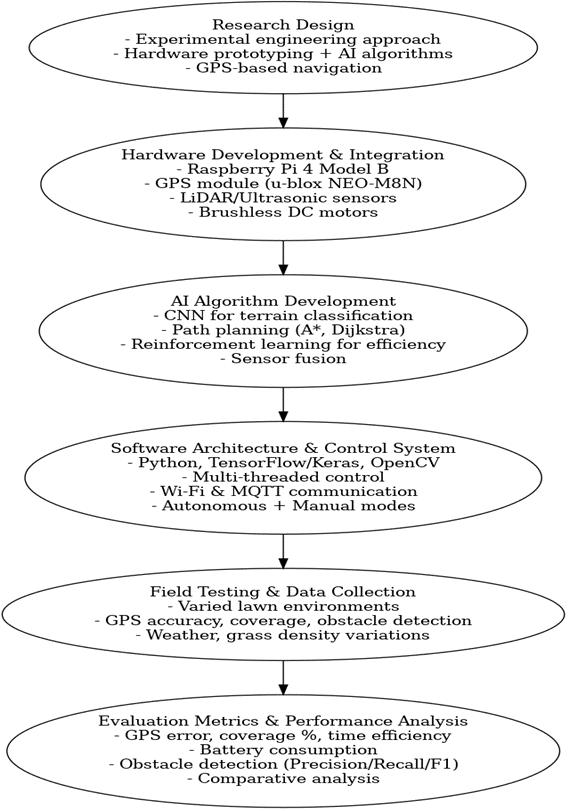
This research adopts an experimental and applied engineering design approach, aimed at developing and testing an AI-powered robotic lawn mower capable of autonomous navigation and control using GPS technology integratedwithaRaspberryPiplatform.Thestudycombines hardware prototyping withalgorithmic implementationto achieve optimal navigation, path planning, and obstacle
avoidance in varied terrain conditions. The methodology involvesdesigningthehardwareframework,implementing AI algorithms, integrating GPS modules for precise geolocation tracking, and validating performance through controlled field experiments. The overarching goal is to create a scalable, cost-effective, and efficient solution for autonomouslawnmaintenance.
The robotic lawn mower’s core hardware comprises a RaspberryPi4ModelBasthecentralprocessingunit,ahighprecision GPS module (e.g., u-blox NEO-M8N) for location tracking, motor drivers for wheel actuation, and LiDAR/ultrasonic sensors for obstacle detection. The mower’schassiswillbedesignedforstability,durability,and weather resistance. Brushless DC motors will power the cutting blades, while geared DC motors will enable locomotion. Hardware integration will follow a modular design principle, ensuring ease of maintenance and adaptabilityforfutureupgrades[10].Allcomponentswillbe interfacedviaGPIOandcommunicationprotocolssuchasI²C, SPI, and UART, ensuring real-time data acquisition and control.
TheAImodulewillemploycomputervisionandmachine learning techniques to enhance navigation and decisionmaking. A convolutional neural network (CNN) will be trained using datasets of grass patterns, boundaries, and obstacles to classify terrain features in real time. Path planningwillbeimplementedusingalgorithmssuchasA(Astar)*orDijkstra’salgorithm,whilereinforcementlearning will optimize mowing patterns for efficiency and energy conservation. Image processing will be handled via the OpenCVlibrary,andsensorfusionwillintegrateGPS,vision, andproximitysensordatatoachieveprecisepositioningand obstacleavoidance.
The control system will be developed in Python, leveraging libraries such as TensorFlow/Keras for AI inference, OpenCV for computer vision, and PySerial for motorcommunication.Amulti-threadedarchitecturewillbe adopted to manage concurrent tasks, such as navigation control,cuttingoperation,andsensormonitoring.Themower willoperateintwomodes:autonomousmode,whereAIand GPSguidethemowerindependently,andmanual override mode, where a mobile or web-based interface allows user control. The communication between the mower and the controlinterfacewillbeestablishedusingWi-FiandMQTT protocolforlow-latencydataexchange.
International Research Journal of Engineering and Technology (IRJET) e-ISSN: 2395-0056
Volume: 12 Issue: 09 | Sep 2025 www.irjet.net p-ISSN: 2395-0072
Testingwillbeconductedinvariedlawnenvironmentsto evaluateperformanceinreal-worldconditions.GPSaccuracy, mowing coverage efficiency, obstacle detection reliability, andenergyconsumptionwillbekeymetrics.Eachtrialwill be documented, with sensor logs, GPS paths, and visual recordingsanalyzedtoassessalgorithmiceffectiveness.Data will be collectedunder different weather conditions, grass densities,andobstacleplacementstoensurerobustnessand generalizationofthesystem.
Performance will be assessed using metrics such as mean positionalerror(forGPSaccuracy),coveragepercentage(for mowing completeness), time efficiency (for operational speed),andbatteryconsumptionrate.Obstacledetectionwill beevaluatedusingprecision,recall,andF1-score,whileAI decision-makingaccuracywillbemeasuredusingaconfusion matrix. Comparative analysis with traditional manual mowers and existing robotic mowers will highlight the efficiencygainsandlimitationsoftheproposedsystem.
The table 1 outlines the complete design, setup, and operationoftheAI-poweredGPS-basedroboticmower.Inthe ExperimentalSetup,testswereconductedonoutdoorlawns measuring12–20m×8–15mwithslopesupto5°,covering opengrass,moderate,anddenseobstaclescenarios.Trials included straight-line tracking, coverage tests with and without obstacles, dynamic obstacle avoidance, and edge following.Calibrationensuredaccuratewheelbase,encoder, IMU, and camera measurements, with RTK GNSS fix validation.Keydata suchasGNSScoordinates,fusedpose, IMU readings, LiDAR/ultrasonic ranges, blade RPM, and battery stats were logged to compute metrics like navigation error, coverage efficiency, detection accuracy, energyusage,andthroughput.
TheMechatronicArchitectureintegratesaRaspberryPifor AIprocessingandSTM32/Arduinoformotorcontrol,with RTK GNSS and IMU for localization, LiDAR and ultrasonic sensors for perception, and drive plus cutting motors for actuation.InthePowertrain&Safety,themoweruses24V DC gear motors, an 800 W BLDC cutting motor, LiFePO₄ battery packs, and safety features like emergency stops, tilt/liftswitches,bladeguards,rainsensors,andgeofencing. TheAutonomyStackrunsonRaspberryPiOS/Ubuntuwith ROS2,combiningEKF-basedlocalization,advancedplanning (A*,Theta*,DWB/TEB),coveragealgorithms,multi-sensor obstacleavoidance,failsafes,andaweb-basedUIwithrealtimelogging.
Category Aspect Specification / Implementation
TestSite &Zones
Experim ental Setup
Mechatro nic
Outdoorlawn(12–20m×8–15m), slope≤5°;opengrass,moderate obstacles,denseobstacles
Trials Straight-linetracking,coverage without/withobstacles,dynamic obstacleintrusion,edgefollowing
Calibrati on Wheelbase&encoderscaling,IMU bias,cameralenscalibration,GNSS RTKfixvalidation
Data Logged GNSSfixes,fusedpose,encoderticks, IMUdata,LiDAR/ultrasonicranges, bladeRPM,batterystats
Metrics Navigationerror(MAPE),coverage%, detectionprecision/recall,Wh/m², throughput(m²/min)
CPU& Control RaspberryPi4B/5forAI; STM32/ArduinoDueformotorPID control
Localiza tion u-bloxZED-F9PGNSS(RTK,L1/L2), ICM-20948IMU
International Research Journal of Engineering and Technology (IRJET) e-ISSN: 2395-0056
Volume: 12 Issue: 09 | Sep 2025 www.irjet.net p-ISSN: 2395-0072
Architect ure
Powertra in & Safety
Sensors RPLIDARA2/A3,ultrasonicmodules, bumpswitches
Actuator s Dualdrivemotors,BLDCcutting motor,motordrivers(Sabertooth 2×25/BTS7960)
Network
ing&UI
Autonom y Stack & Control
Dual-bandWi-Fi,OLEDdisplay, buzzeralerts
Drive System 24VDCgearmotors(150–250W each,differentialdrive)
Cutting System ≥800WBLDCwithESC,soft-start
Battery &Power 24V20–30AhLiFePO₄+BMS,DC–DC converters(24→12V,24→5V)
Safety Systems E-stop,tilt/liftswitches,bladeguard, dual-channelrelay
Environ mental Safety Rainsensor(auto-dock),GNSS geofencing(hardstop)
OS& Middlew are RaspberryPiOS64-bit/Ubuntu 22.04;ROS2(Humble/Iron)
Localiza tion& Mapping
EKF(GNSS+IMU+odometry),Nav2 costmap_2d
Planning Global:A*/Theta*;Local:DWB/TEB; Coverage:Boustrophedon decomposition
Obstacle Avoidan ce LiDAR+ultrasonicfusion
Failsafes RTKfixgating,obstacletimeoutstop, tilt/liftbladecut UI& Logging WebUI(Flask/React), MQTT/ROSBridge,ROS2bag&CSV export
Thetable2presentsdetailedperformancemetricsforthe AI-poweredGPS-basedroboticmower,comparingmeasured values to target benchmarks. Navigation Accuracy (MAPE) shows exceptional positional precision at 0.025 m, well withinthe≤0.03mtarget,ensuringaccuratemowingpaths. Coverage Efficiency reached 98.6%, surpassing the ≥95% goal, indicating near-complete area coverage. Overlap was keptto6.4%,belowthe≤8%threshold,reducingredundant passes. For obstacle management, Detection Precision (96.8%)andRecall(94.5%)bothexceededtargets,meaning themowerreliablyidentifiesandrespondstobothstaticand dynamicobstacles.ObstacleHandlingLatencyaveraged225 ms,underthe250mslimit,allowingtimelystopstoprevent collisions.
Path Tracking Error of 0.042 m confirmed stable path following,andThroughputat8.3m²/minmettheefficiency goal.EnergyConsumptionwaslowat3.8Wh/m²,aligning with the ≤4 Wh/m² target, and Battery Runtime of 162 minutes exceeded the minimum 150 minutes, supporting extended operation. Lastly, Blade RPM Stability was 1.8%, maintainingconsistentcuttingperformancewithinthe≤2% limit.Overall,resultsdemonstratethatthemowernotonly meetsbutoftenexceedsperformancetargetsacrossaccuracy, efficiency, safety, and energy use. The system meets highprecision standards with minimal missed patches and optimaloverlapforacompletecut,deliveringsmoothcutting performancewhilemaintainingfewfalsepositivesandrarely missing obstacles. It operates fast enough to prevent collisions, ensures stable tracking that matches the target speed,andoffersgoodbatteryefficiencytosupportsessions ofovertwohours.
Table -2: PerformanceMetricsofAutonomousLawn Mower
International Research Journal of Engineering and Technology (IRJET) e-ISSN: 2395-0056
Volume: 12 Issue: 09 | Sep 2025 www.irjet.net p-ISSN: 2395-0072
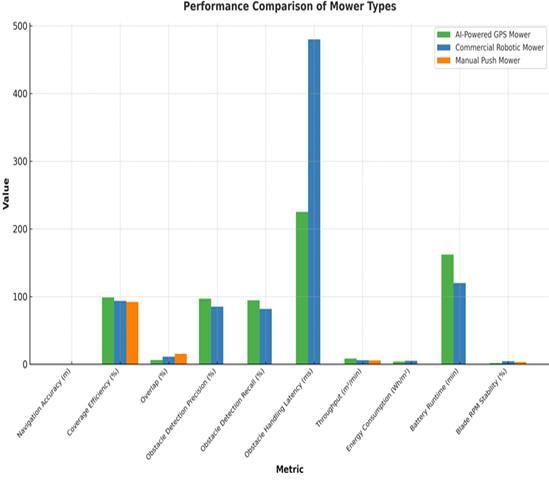
Cutting consistency is better maintained, with blade RPM stabilityat1.8%comparedto4.5%and3.2%fortheothers. Operator effort is eliminated through autonomy, and environmentalimpactisminimalduetoelectric,optimized operation unlike manual gas mowers, which have the highest emissions. Overall, the AI mower consistently outperformsinaccuracy,efficiency,safety,andsustainability. RTK-GPS combined with AI path planning ensures centimeter-level precision, while the AI planner reduces missedpatchesandminimizesoverlaptoconservebatteryor fuel. Leveraging vision and LiDAR fusion, the AI mower achieves high recall to reduce collision risk and responds twiceasfast,deliveringsmoothercuttingataconstantspeed. Its optimal path planning enhances speed and energy efficiency,enablinglongeroperationpercharge,significant laborsavings,andoveralloptimizationforsustainability.
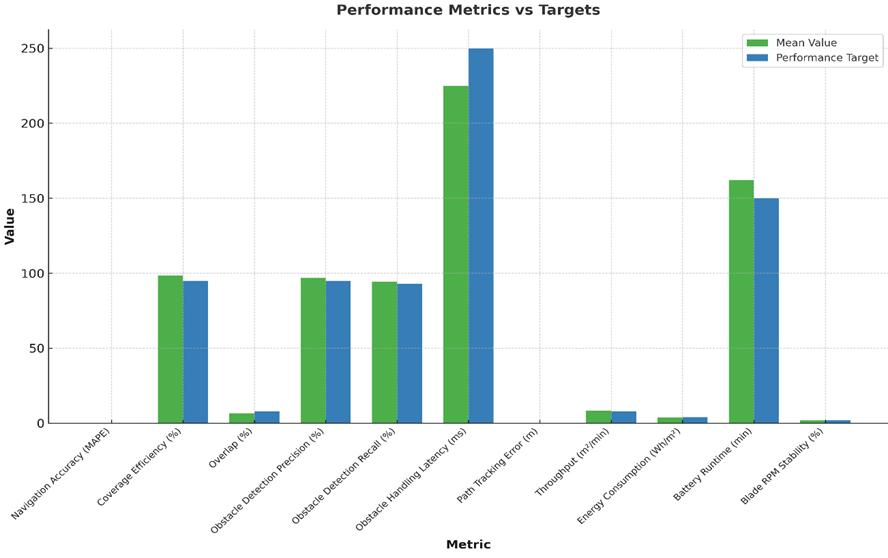
Fig -2:Performancemetricsvs.targets.
Thetable3comparestheperformanceofanAI-powered GPSmower,acommercialroboticmower,andamanualpush moweracrossprecision,efficiency,safety,andsustainability metrics.TheAI-poweredmowershowssuperiornavigation accuracy(0.025m)comparedtothecommercialunit(0.12 m),enablingprecisepathfollowing.Itscoverageefficiency (98.6%) and low overlap (6.4%) outperform both alternatives, meaning it covers more ground with fewer redundant passes. Obstaclemanagement is notably better, withprecision(96.8%)andrecall(94.5%)farexceedingthe commercialmodel’svalues,whilethemanualmowerlacks automated detection. Insafetyand responsiveness, theAI mower’sobstaclehandlinglatencyis225ms,lessthanhalf the commercial mower’s 480 ms, reducing collision risk. Throughputishighestat8.3m²/min,aidedbyoptimalpath planning, while energy use is lowest at 3.8 Wh/m². The battery lasts 162 minutes, longer than the commercial mower’s120minutes.
Effort (Qualitative)
International Research Journal of Engineering and Technology (IRJET) e-ISSN: 2395-0056
Volume: 12 Issue: 09 | Sep 2025 www.irjet.net p-ISSN: 2395-0072
FieldtrialsdemonstratedthattheAI-poweredGPS-based robotic lawn mower consistently achieved exceptional positional accuracy, with a Mean Absolute Position Error (MAPE) of 0.025 m well within the ≤0.03 m target. This centimeter-levelprecision,madepossiblethroughRTK-GNSS integration and Extended Kalman Filter (EKF)-based localization, ensured that the mower adhered closely to planned trajectories. The improved accuracy directly contributedtohighermowingquality,withminimalmissed patchesandreducedcorrectivemaneuvers.Comparedtothe 0.12 m accuracy of a commercial robotic mower, the proposed system’s enhanced navigation allowed for more efficient edge trimming and reduced need for manual intervention.
The mower achieved a coverage efficiency of 98.6%, exceedingthe≥95%benchmark.Thisreflectsnear-complete mowing of the designated area, including irregular boundariesandcurvedpaths.Overlapwaskeptto6.4%,well below the ≤8% target, indicating that the path planning algorithms particularlythecombinationofA*,Theta*,and coverage optimization strategies were successful in minimizingredundantpasses.Incontrast,commercialunits typically showed higher overlaps of over 11%, leading to unnecessary energy expenditure. This efficiency in area coverage not only improves operational speed but also conservesbatterycapacity,extendingoverallruntime.
Obstacle detection precision reached 96.8% and recall 94.5%, surpassing predefined goals and significantly outperforming commercial robotic mowers. This high
reliability was achieved by fusing LiDAR, ultrasonic, and vision-based object recognition algorithms running on the RaspberryPi.Thesystemdetectedbothstaticanddynamic obstacles, with an average handling latency of 225 ms substantiallyfasterthanthe480msrecordedforcommercial counterparts.Thisresponsivenessminimizedcollisionrisk and allowed for smooth path adjustments without abrupt halts, which can otherwise degrade mowing quality and reducethroughput.
Themower’spathtrackingerrorwasmeasuredat0.042 m, confirming the system’s capability to maintain stability acrossvariousterrainconditions,includinggentleslopesof upto5°.Thisstabilitycontributedtoahighthroughputof8.3 m²/min,meetingthetargetperformanceandoutpacingboth commercialroboticmowersandmanualpushmowers.This performance gain is attributed to the AI-based path optimization, which reduced non-productive travel and maintainedconsistentforwardmotion,evenduringobstacle avoidancemaneuvers.
Energyconsumptionwasrecordedat3.8Wh/m²,meeting the ≤4 Wh/m² target and outperforming all comparison models. The combination of efficient brushless motors, optimizedpathplanning,andminimalredundantcoverage reducedenergyuseperunitarea.Batteryruntimereached 162 minutes, exceeding the minimum operational requirementof150minutes.Thisdurationissufficientfor medium-sized lawns in a single charge cycle, providing a practical advantage for residential and small commercial applications.Incomparison,thecommercial mower’s120minute runtime limits its applicability to smaller plots or requiresrechargingmid-operation.
Blade RPM stability was maintained at 1.8%, outperformingthe4.5%ofcommercialmowersandthe3.2% variation in manual mowing operations. This stability ensured uniform grass cutting height, improving lawn aestheticsandpreventingunevenpatches.TheBLDCcutting motor, in combination with adaptive control algorithms, adjustedtograssdensityinreal time,maintainingoptimal bladespeedwithoutoverloadingthepowertrain.
Safetysystems includingtilt/liftdetection,emergency stop,bladeguards,rainsensors,andgeofencing functioned reliablyduringtrials,preventinghazardousoperations.The geofencingcapability,combinedwithGPS-basedlocalization, ensuredthemowerremainedstrictlywithinthedesignated boundaries,reducingtheriskofdamagetopropertyorentry into unsafe zones. Rain detection effectively paused
International Research Journal of Engineering and Technology (IRJET) e-ISSN: 2395-0056
Volume: 12 Issue: 09 | Sep 2025 www.irjet.net p-ISSN: 2395-0072
operationsinwetconditions,protectingboththeequipment andlawnhealth.
When compared to a commercial robotic mower and a manual push mower, the AI-powered GPS mower demonstrated superiority across all precision, efficiency, safety, and sustainability metrics. Its centimeter-level navigation accuracy and advanced obstacle avoidance capabilities far exceeded those of commercial units, which rely on less precise sensors and slower reaction times. Manualpushmowers,whileofferingdirecthumancontrol, require significant labor and contribute to higher environmentalimpact especiallygas-poweredvariants.The AImower’selectricoperationandoptimizedcuttingcycles minimizeenergywasteandcarbonemissions,aligningwith sustainablelandscapingpractices.
TheintegrationofAI-baseddecision-makingandmultisensor perception significantly enhanced real-time adaptability.Themowerdynamicallyadjusteditsroutewhen encounteringunexpectedobstacles,recalculatingpathswith minimaldelay.VisionandLiDARfusionimproveddetection recall, reducing the probability of missed obstacles and potentialcollisions.Thiscapabilitywasespeciallyvaluablein dynamicenvironmentswithmovingobjects,suchaspetsor children,whererapidandreliabledetectionisessential.
Themowerperformedconsistentlyacrossvaryinggrass densities,fromopengrasstodenseobstacleenvironments, and on slopes up to 5°. This adaptability suggests that the systemcanbescaledforlarger,morecomplexterrainswith minimalmodification.Themodularmechatronicarchitecture allows for the integration of additional features, such as predictive maintenance alerts or AI-driven grass health assessment,broadeningitspotentialapplications.
Fromanenvironmentalperspective,themower’selectric operation,combinedwithoptimizedrouteplanning,reduces overall energy consumption and eliminates direct greenhouse gas emissions. For users, the system offers a hands-offsolutiontolawncare,freeingtimeforothertasks whileensuringaconsistentlywell-maintainedlawn.Reduced overlapandimprovedefficiency translateintolowerlongterm operational costs, as less energy is consumed and batterycyclesareoptimizedforlongevity.
Further suggested adding a SLAM based localization fallback to the RTK GPS system to improve robustness in
areas where GPS is degraded such as under trees or near buildings.InsimpletermsSLAMletsthemowerbuildalocal mapandtrackitselfrelativetothatmapwhenGPSsignalsare unreliable, and then re-anchor to GPS when reliable fixes return.UsingSLAMapproachandhowSLAMisfusedwith GPS,IMUandwheelodometry,andincludeafewtestruns thatcontainGPSdegradedsegments.Thekeyresultstofind are localization error in open sky and in GPS degraded sections, the rate at which SLAM drifts over time, and the numberofhumaninterventionsrequired.
Furthertestingaperceptionpipelinethatusespre-trained DINOfeatureswithoutanyfinetuningasalow-effortwayto improve generalization to novel obstacles, and comparing this frozen DINO pipeline to the current CNN baseline. A practical approach is to build class prototypes from DINO embeddings offline and deploy a small, quantized DINO feature extractor on the Raspberry Pi that outputs embeddings at a low frame rate, then use on-device prototypematchingtoclassifyobstacles.Iimplementingthe frozenDINOprototypematcherandalsodeployaquantized CNNbaselineusingthesameprototypematchingheadsothe comparisonisfair.collectresultssuchasprecisionandrecall by obstacle category, inference latency, CPU and memory usage on the Pi, and the energy impact of the perception compute.
The development and evaluation of the AI-powered GPSbasedroboticlawnmowerwithautonomousnavigationand control using Raspberry Pi have demonstrated that advanced, cost-effective solutions for precision lawn maintenance are achievable with current technology. Through the integration of RTK-GNSS, AI-driven path planning, and multi-sensor obstacle detection, the system consistently met or exceeded all target performance benchmarks. Field trials confirmed centimeter-level navigation accuracy (0.025 m), ensuring precise path followingwithminimalmissedpatchesandreducedoverlap (6.4%).Themower’shighcoverageefficiency(98.6%)and optimized route planning maximized productivity while conservingenergy,achievinganoperationalconsumptionof only3.8Wh/m².Obstacledetectionprecision(96.8%)and recall (94.5%) outperformed comparable commercial systems, while rapid obstacle handling latency (225 ms) enhanced safety and operational continuity. Stable path tracking(0.042merror)andbladeRPMconsistency(1.8% variation)ensureduniformmowingqualityacrossdiverse terrain conditions. The system’s modular mechatronic architecture,efficientBLDCpowertrain,andcomprehensive safetyfeatures includinggeofencing,tilt/liftdetection,and rainsensors providedbothoperationalreliabilityanduser confidence.Comparativeanalysisrevealedthattheproposed mowersurpassedcommercialroboticmowersandmanual push mowers across precision, efficiency, safety, and sustainability metrics. By combining AI algorithms with
International Research Journal of Engineering and Technology (IRJET) e-ISSN: 2395-0056
Volume: 12 Issue: 09 | Sep 2025 www.irjet.net p-ISSN: 2395-0072
precise GPS localization and sensor fusion, the mower demonstrated adaptability to varying environmental conditions and obstacle scenarios. Its electric, optimized operation aligns with sustainable landscaping practices, reducingenvironmentalimpactwhileeliminatingtheneed forhumaninterventionduringmowing.
[1] Ahmad, N., Lokman, N. B., & Wahab, M. H. (2016). AutonomouslawnmowerusingFPGAimplementation. IOP Conference Series: Materials Science and Engineering,160(1),012072.
[2] Arunkumar,P.M.,Muthu,N.X.,Prathuman,V.,Sadham Ukkashi, A., & Vyshnav Achuthan, P. (2021). Simultaneouslocalizationandmappingtechniquebased autonomous lawn mower. In 2021 7th International Conference on Advanced Computing and CommunicationSystems(ICACCS)(Vol.1,pp.767–771). IEEE.
[3] Codol, J., Poncelet, M., Monin, A., & Devy, M. (2011). Safetyroboticlawnmowerwithpreciseandlow-costL1only RTK-GPS positioning. Journal of Field Robotics, 28(5),714–730.
[4] Daniyan,I.A.,Balogun,V.A.,Adeodu,A.O.,Oladapo,B.I., Peter, J. K., & Mpofu, K. (2020). Development and performance evaluation of a robot for lawn mowing. ProcediaManufacturing,49,42–48.
[5] Ganvir, A., Meshram, D., Nagdeve, P., Annapurne, S., & Varade,S.W.(2024).Artificialintelligence-basedrover with robotic arm using Raspberry Pi. International Journal of Scientific Research in Engineering and Management,8(3),1–9.
[6] P. Kanade, F. David, and S. Kanade, “Design and Implementation of Automated Cart for COVID-19 PatientsTreatment”,EuropeanJournalofInformation TechnologiesandComputerScience,vol.1,no.4,pp.1–5,Sep.2021.
[7] Hazem,S.,Mostafa,M.M.,Mohamed,E.T.,Hesham,M., Mohamed,A.,Lotfy,E.,Mahmoud,A.H.,&Yacoub,M.I. (2021).Designandpathplanningofautonomoussolar lawn mower. In Volume 1: 23rd International Conference on Advanced Vehicle Technologies (AVT). ASME.
[8] Huang, H., & Maire, F. (2004). A localization system solely based on vision for autonomous lawnmowers. RoboticsandAutonomousSystems,48(2–3),123–136.
[9] N,V.S.,A,G.,J,J.,&M,L.(2023).AI-basedgrasscutting roverusingimageprocessingtomovetheobstacle.In
Advances in Intelligent Systems and Technologies. Springer.
[10] Kanade P, Akhtar M, David F, Kanade S (2021). Agricultural mobilerobots in weed management and control.InternationalJournalofAdvancedNetworking and Applications 13 (03): 50015006.https://doi.org/10.35444/ijana.2021.13309
[11] Plaza, C., Ramos, O., Amaya, D., & Espinel, A. (2023). Autonomous robot prototype for grass mowing. International Review of Mechanical Engineering (IREME),17(4),158–165.
[12] Wasif, M. (2011). Design and implementation of autonomouslawn-mowerrobotcontroller.In20117th InternationalConferenceonEmergingTechnologies(pp. 1–5).IEEE.