
International Research Journal of Engineering and Technology (IRJET) e-ISSN: 2395-0056
Volume: 12 Issue: 04 | Apr 2025 www.irjet.net p-ISSN: 2395-0072
International Research Journal of Engineering and Technology (IRJET) e-ISSN: 2395-0056
Volume: 12 Issue: 04 | Apr 2025 www.irjet.net p-ISSN: 2395-0072
Prof. R. Karthikeyan1 , R Suresh Kumar 2, R Dinesh 3, R Nantha Kumar 4, G SathishKumar 5
1Assistant Professor, Department of Computer Science and Engineering, Government College of Engineering Srirangam, Tamil Nadu, India 2,3,4,5UG Student, Department of Computer Science and Engineering, Government College of Engineering Srirangam, Tamil Nadu, India
Abstract - Inlarge institutionsand governmentbodies, the management of public grievances is a challenging task due to high volume, redundancy, delays, and lack of proper tracking mechanisms. This paper proposes a smart solution an AIpoweredPetitionTrackingandGrievanceSystem designedto streamlinethecomplaint-handlingprocessusingcutting-edge technologies. By integrating OCR, Natural Language Processing (NLP), and machine learning models, this system automates the classification of petitions, prioritizes urgent grievances, detects repetitive complaints, and ensures realtime tracking of resolution status. The system is capable of multilingual interactions through an integrated chatbot and providesactionableinsightstoauthorities,enablingproactive governance.
Keywords: Petition Automation, Grievance Redressal, OCR, NLP, Machine Learning, Complaint Classification, AI Chatbot, Public Service Transparency.
TheGrievanceredressalsystemsformacriticalcomponent of governance, whether in educational institutions, governmental departments, or corporate organizations. Efficienthandlingofpubliccomplaintsandfeedbacknotonly strengthens the trust of stakeholders but also ensures transparency and accountability Traditional grievance redressalmethods,however,areoftenhamperedbymanual processes,lackofproperdocumentation,delayedresponses, and ineffective tracking mechanisms. These limitations create bottlenecks in addressing issues in a timely and structured manner, leading to dissatisfaction among the stakeholdersandinefficiencieswithinthesystem. Withthe advent of Artificial Intelligence (AI), there is an emerging opportunity to automate and optimize various administrative processes, including petition management and grievance handling. AI technologies such as Machine Learning(ML),NaturalLanguageProcessing(NLP),Optical Character Recognition (OCR), and chatbot systems have demonstrated immense potential in solving real-world problemsinvolvinglarge-scaleunstructureddata,decisionmaking, and interaction handling. Leveraging these technologies in a grievance redressal system can substantially reduce the dependency on manual intervention,minimizedelays,andenhanceservicedelivery.
ThispaperpresentsthedesignandimplementationofanAIpoweredPetitionTrackingandGrievanceSystemthataims to automate the entire life cycle of a petition from submissiontoresolution.Thesystemprovidesuserswithan intuitivewebinterfacetofilecomplaintsintext,image, or multimedia formats. A powerful OCR module extracts relevantcontentfromscannedorhandwrittendocuments, while ML models such as Random Forest and XGBoost classifythepetitionsintoappropriatedepartmentsbasedon thecontent.Further,thesystemincorporatesurgencyand repetition detection to prioritize critical grievances and avoidredundantprocessing.
Oneoftheuniquefeaturesofthissystemisitsmultilingual chatbot, designed to assist users in multiple languages, therebyensuringinclusivityforusersfromdiverselinguistic backgrounds.Thechatbotnotonlyhelpsusersnavigatethe systembutalsofacilitatesconversationalfilingandtracking of petitions. Through real-time status updates and automatednotifications,thesystemmaintainsatransparent line of communication between users and administrative personnel. Additionally, department-wise analytics and dashboards provide officials with actionable insights to improve internal processes and responsiveness. The backend is built using Node.js, with a robust and scalable NoSQL database managed via MongoDB, and file storage supported on AWS S3. The frontend is developed using modern web technologies to provide a seamless user experience.SupportinglibrariessuchasOpenCVforimage preprocessingandLibrosa/FFmpegformultimediahandling make the system versatile in accepting various complaint formats.
Overall, the proposed solution demonstrates how AI can transform traditional petition handling into a modern, efficient,andscalablesystem.Thesystemnotonlyaddresses present-daylimitationsbutalsolaysafoundationforfuture enhancements,includingdeeplearning-basedhandwriting recognition, multilingual translation capabilities, and advancedsentimentanalysis.Thisresearchshowcasesthe practicalapplicationofAIinpublicservicetechnologyand contributestowardbuildingsmarterandmoreresponsive governancemodels
International Research Journal of Engineering and Technology (IRJET) e-ISSN: 2395-0056
Volume: 12 Issue: 04 | Apr 2025 www.irjet.net p-ISSN: 2395-0072
Public demand for transparent services and effective responsivenesstogetherwithsuperiorefficiencypushedthe creation of automated grievance redressal systems. Traditionallydeployedprocessesrelyextensivelyonpeople dealing with information manually leading to low-speed, multiplemistakesandreducedscalability.
NaturalLanguageProcessingapplicationsletLambaetal.[1] develop an automatic system for categorizing textual grievances as part of complaint management. The researchers used keyword and phrase analysis to classify structuredcomplaintswithintheirresearch.Theresearchby NayyarandRajiv[2]presentedacloud-basedplatformforegovernance redressal but the system did not implement either intelligent routing functions or sentiment prioritizationmechanisms.
The researchers Kavitha and Amutha [3] developed a complaintclassificationsystemthroughartificialintelligence thatdependedonfundamentalmachinelearningmethodsto directgrievances.Thesystemrequiredclearinputdataand provided restricted capability to process either noisy or informalcomplaints.Raneetal.[4]proposedacloud-based academicsolutionwhichputemphasisonstoragefeatures andinterfacelayoutinsteadofclassificationautomation.
The authors of [5] achieved better e-governance platform classification precision through their combination of supervised learning methods with rule-based reasoning elements.Sheikhetal.'soperationalsystemdevelopedthe conceptbycombiningtextclassificationmethodswithNLP techniques to obtain improved complaint context understanding[6].
Acompleteautomatedgrievancesystemfeaturingtracking and feedback emerged from Kulkarni et al. [7]. The developed system did not support multimedia complaint processingbecauseitlackedfeaturesforhandlingimageor voice-based grievances. The researchers at Kalbande and Shinde[8]demonstratedasmartcitizencomplaintplatform throughAIclassificationmodelsalthoughtheyfocusedmore on performance metrics than scalability and multilingual features.
Sahuetal.[9]developedtextminingtoolstofindcomplaint attitude and detect urgent complaints. Through tests the system confirmed its performance method but accepted inputtextsonlyinEnglish.Amachinelearningsystemfor dataset classification and routing achieved acceptable accuracywhenusedwithlabeleddatasetsperthefindingsof PriyaandDevi[10]withoutconsideringreal-timeurgency analysis.
Jadhav et al. [11] studied the integration of chatbots with machine learning technology for solving complaint submissionprocesses.Userexperiencebecamebetterunder
their system yet the system supported only a restricted number of intents and lacked multilingual features. The development of real-time complaint tracking systems for resolutionmanagementcameaboutthroughSharmaetal.'s [12]convergenceofAIwithcloudcomputing.Thesolution tracked complaint progress with success but prediction capabilities to forecast upcoming grievances were not includedinthemonitoringsystem.
SinhaandPal[13]demonstratedthroughtheirresearchhow NLPtechnologycanidentifyemotionallyurgentcomplaints using sentiment-based prioritization. The system needed large amounts of data that needed to be labeled for its operation. Patil and More [14] conducted a study on predictiveanalyticstodetectrecurringcomplaintpatterns whichmightassistinpolicydevelopment.Theaddition of department-level graphical dashboards to the system represented Wagh et al.'s [15] solution yet they failed to addressaudioorimagecomplainthandling.
Current systems do not deliver sufficient end-to-end intelligentcomplaintresolutionsolutionsthoughtheyhave shown progress in this area. Systems which they use lack basicmultimediainteractionfunctionalityalongsideurgency recognition capabilities and multilingual bot control and incompleteperformanceanalysis.TheAI-PoweredPetition TrackingandGrievanceSystemimplementsOCRtoolsand text analysis to close definable gaps through machine learningalgorithmsthatcombinewithredundancydetection for an inclusive multilingual chatbot service in grievance management.
Theproposedsystem,AI - PoweredPetitionTrackingand Grievance System, aims to streamline the process of receiving,classifying,prioritizing,andresolvingcomplaints orpetitionsthroughanintelligent,automatedplatform.This system is designed to support multiple input formats, including handwritten images, scanned documents, typed text, and multimedia content. By leveraging advanced AI technologiessuchasOpticalCharacterRecognition(OCR), MachineLearning(ML),NaturalLanguageProcessing(NLP), andconversationalchatbots,thesystemensuresseamless communication between users and administrative departments,ultimatelyimprovingtransparency,efficiency, andaccountabilityingrievanceredressal.
Thearchitectureofthesystemcanbebroadlydividedinto two key modules: Intelligent Petition Processing and ClassificationandUserInteractionandStatusTracking.
Thecoreoftheproposedsystemliesinitsabilitytohandle unstructured and semi-structured data efficiently and accurately. Complaints are often submitted in various
International Research Journal of Engineering and Technology (IRJET) e-ISSN: 2395-0056
Volume: 12 Issue: 04 | Apr 2025 www.irjet.net p-ISSN: 2395-0072
formats,suchashandwrittenletters,scanneddocuments,or directly typed into an online form. The system begins by digitizing and interpreting the content of these petitions. OpticalCharacterRecognition(OCR):Thefirststageinvolves extracting text from image-based documents using the Tesseract OCR engine. Tesseract is capable of recognizing printedandhandwrittentextinmultiplelanguages,making itidealfordiverseinputsources.Preprocessingtechniques such as binarization, noise reduction using OpenCV, and skew correction are applied to improve recognition accuracy.Inthecaseofaudioorvideocomplaints,toolslike Librosa and FFmpeg are employed to extract transcribed content.
TextPreprocessingandFeatureExtraction:Oncethetextis extracted, it undergoes preprocessing steps including tokenization, stop word removal, stemming, and lemmatization. This cleaned and structured data is then vectorizedusingtechniqueslikeTF-IDForwordembeddings foruseintheclassificationmodel.
ComplaintCategorizationusingMLModels:Thesystemuses trainedmachinelearningmodelssuchasRandomForestand XGBoosttoclassifypetitionsinto predefined departments likeAdministration,Finance,Infrastructure,Academics,etc. Thesemodelswereselectedfortheirsuperiorperformance inmulticlassclassificationtasksandtheirabilitytohandle imbalanceddatasets.Thetrainingdatasetcompriseslabeled complaints categorized based on keywords, semantic meaning,andhistoricalresolutionpatterns.
UrgencyandRedundancyDetection:Asecondarymodelflags petitions that are urgent based on key indicators such as keywords ("emergency", "immediate", "critical") and sentiment analysis scores. Redundancy is handled by comparing new petitions against previously submitted complaintsusingcosinesimilarityandn-grammatching.Ifa petition is identified as a duplicate, it is grouped with the originalforconsolidatedhandling.
Toensureuser-friendlyandtransparentgrievancehandling, thesystemincorporatesaninteractiveandmultilingualuser interface supported by a realtime trackingmechanism.
WebInterfaceandMultilingualChatbot:Thefrontendofthe applicationisaresponsivewebinterfacebuiltusingmodern webtechnologies.Userscansubmitcomplaints,uploadfiles, andinteractwithamultilingualchatbotforassistance.The chatbot is trained on regional languages and is capable of handlingconversationalqueries,guidingusersthroughthe complaint submission process, and responding to statusrelatedquestions.Thisfeatureensuresinclusivityfor nonEnglish speaking users and enhances accessibility. PetitionStatusTrackingandNotifications:Onceacomplaint issubmittedandclassified,itisassignedauniquetracking ID.Thesystemupdatesthe status ofthe petition at each
stage Received, Under Review,Forwarded,InProgress, andResolved.Userscanviewliveupdatesviathedashboard orreceivenotificationsthroughSMSoremail.Thisnotonly keepsusersinformedbutalsobuildstrustintheinstitution’s responsiveness.
Departmental Dashboard and Analytics: For administratorsandstaff,thesystemprovidesadashboard with real-time insights and performance metrics. Departmentscanviewcomplaintsassignedtothem,track their resolution timelines, and prioritize tasks based on urgency. Analytical tools generate reports on complaint frequency,resolutionrates,andtrends,enablingdatadriven decision-makingandimprovedpolicyformulation.Database and Cloud Integration: The backend is developed using Node.js, with MongoDB serving as the NoSQL database to storecomplaintrecords,userinteractions,andsystemlogs. FilesandmediacontentarestoredsecurelyusingAWSS3. The system is designed to be scalable, fault-tolerant, and compliantwithdatasecuritystandards.
Insummary,theproposedsystemintegratesstate-of-theart AI technologies to address the limitations of traditional petition handling systems. It not only automates classification and prioritization but also empowers users and administrators with tools for transparency, accountability,andefficiency.Throughitsmodulardesign, the system can be deployed in educational institutions, municipalities, or any large-scale administrative setup, making it a valuable contribution to the domain of egovernanceandpublicservicemanagement.
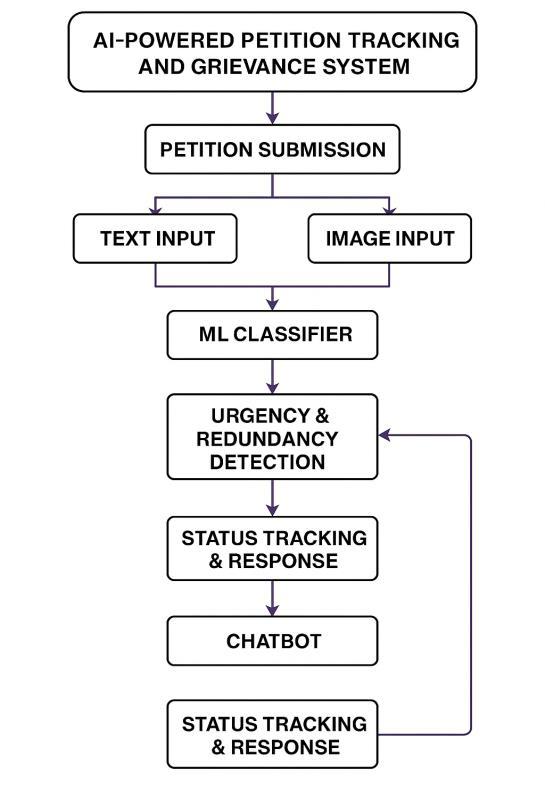
Fig1.FlowDiagram
International Research Journal of Engineering and Technology (IRJET) e-ISSN: 2395-0056
Volume: 12 Issue: 04 | Apr 2025 www.irjet.net p-ISSN: 2395-0072
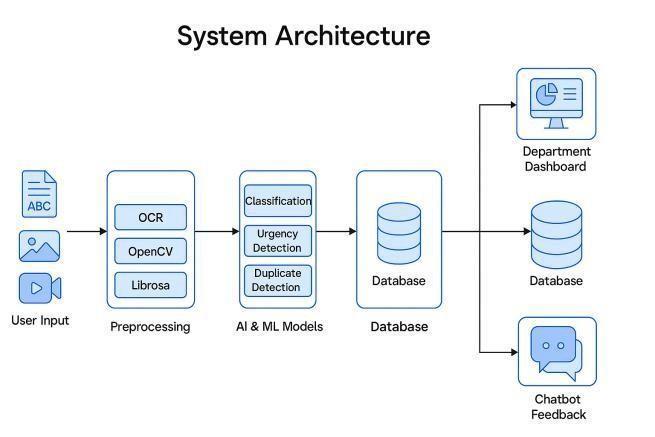
The architecture of the AI-Powered Petition Tracking and GrievanceSystemisdesignedwithmodularity,scalability, and automation at its core. It comprises multiple interconnected components that handle everything from user input collection to intelligent classification, tracking, and communication. The system follows a multi-layered architecture,broadlycategorizedintofivekeylayers:User InterfaceLayer,InputProcessingLayer,MachineLearning& Classification Layer, Data Management Layer, and Notification&AnalyticsLayer.
Thefront-endofthesystemisaweb-basedapplicationthat actsastheprimarypointofinteractionforbothpetitioners andadministrativestaff.Userscansubmittheircomplaints viatextformsoruploaddocuments,images,andevenaudio orvideofiles.Amultilingualchatbotisintegratedintothe interfacetoguideusersthroughtheprocess.Thischatbot, trainedoncommonqueriesandsupportedbyNLPmodels, allows users to interact in regional languages, improving accessibilityanduserexperience.
This layer is built using standard web development frameworks like HTML, CSS, JavaScript, and React.js (or similar),ensuringresponsivenessacrossdevices.Itcaptures user inputs and sends them securely to the backend for processing.
The second layer focuses on preprocessing the incoming petitiondata.Thislayerhandlesvariousformats:
• Text Inputs: Directly sent for tokenization and cleaning.
• Image Inputs: Processed using OpenCV for binarization and enhancement, and then passed throughTesseractOCRtoextracttext.
• Audio/Video Inputs: Audio streams are separated using FFmpeg, transcribed using speech-to-text models, and cleaned using Librosa for noise reduction.
After extraction, all inputs are standardized into plain text. Thisensuresuniformityandreadinessforclassification.
The environment consists of a fundamental classification enginecomponent.ThemachinelearningmodelsXGBoost and Random Forest in combination with pretrained elementsoperateaspartofthispartofthearchitecture
1. Departments get assigned through semantic examination combined with keyword recognition and textualunderstandingwhichdirectscomplaintstocorrect administrative units (e.g., Administration, Infrastructure, Hostel,etc.).
2. Assessment of urgency depends on sentiment analysis and keyword frequency that enable the model to detect criticality levels in complaints Training occurs on historical petition data that includes labeled categories to achieve high accuracy and future adaptability.Cosine similarity functions between new petitions and previous entriestostopredundanthandlingthrougha redundancy checker.
Thesecuritylayerservestosafelystoreandaccessalluser data together with petition material and classification markings and status logs. The system operates using MongoDB which functions as a NoSQL database to offer capability in managing data of different formats. AWS S3 buckets provide storage for both media files and attachments which guarantee both high scalability and durableperformance.
The system enforces role-based access controls to let authorizedstaffmembersvieworoperateonparticulardata categories.
The petitions move toward status-tracking pipelines after classificationandstoragesousersobtainstatusupdatesby email or SMS. Each department monitor displays petitions alongsidestatusinformationandaverageresolutiondurations andadditionalmetrics.
Theanalyticsmoduleproducesdocumentationthatsupplies informationabout:
•Mostfrequentcomplaintcategories
•Resolutiontimeperdepartment
•Usersatisfactionmetrics
Thecollecteddataenablesorganizationstoconductpredictive analysisandtakedecisionsforadministrativeimprovements.
International Research Journal of Engineering and Technology (IRJET) e-ISSN: 2395-0056
Volume: 12 Issue: 04 | Apr 2025 www.irjet.net p-ISSN: 2395-0072
5.
Multiple technological integrations establish the basis for constructing an effective user-centered complaint management platform which uses AI-Powered Petition TrackingandGrievanceSystemtechnology.Fromfrontendto backenddevelopmentthesystemprogressesthroughsteps that include API system design and machine learning implementation with database administration. The system runsthroughanintegrationofwebdevelopmentframeworks, machine learning libraries and cloud services for its implementation.
Thedevelopmenttoolsforthefrontendinterfaceconsistof HTML and CSS and JavaScript that use the React.js framework for designing interactive user interfaces. The system design choice provides a simple layout alongside responsiveoperationsthatenableaccessacrossfulldesktop screenandmobileplatforms. Keyfrontendfeaturesinclude:
• The application contains Complaint Submission Forms that request users to provide name,contactinformationalongwithcomplainttype and have an optional file attachment feature for PDFs,imagesandaudiofiles.
• Use the built-in file upload option to add both handwritten complaintsasimagesand audio recordingstothesystem.
The preprocessing of media content stands as an essential procedureforcomplaintsthatdonotconsistofwrittentext. The preprocessing of images (scanned or handwritten) happensthroughOpenCV.Theimageprocessingprotocolfor OCRinvolvesseveraltasksthatincludegrayscaleconversion followed by noise removal and thresholding and edge detectionoperationsforimagepreparation.Theapplication implements Tesseract OCR to extract text content from
picturefiles. WithOpenCVsupportthesystemcanidentify multiplelanguagesandhandlebothprintedandhandwritten scriptseffectively.
ThepreprocessingsequencecommenceswithFFmpegaudio extraction which leads to Librosa cleaning operations that make audio ready for transcription. The text transcription processusespre-trainedspeech-to-textsoftware.
Theresultfromcompletingallpreprocessingworkcreates a cleantextrenditionofthecomplaint
The core functionality of the system depends on petition classification and priority-setting capabilities. This is achievedusing:
Thesemodelsutilizepreviouspetitiondatasetlabelsfor trainingatRandomForestClassifierincombinationwith XGBoost. The system uses term frequencies together withsentimentscoresalongsidekeywordindicatorsas mainfeatures.
Petitions receive classification through a predefined systemthatconsistsofInfrastructure,Academics,Hostel andFinanceasdefinedcategories.
The analysis of sentiment and keywordfrequencies allows detection of urgent complaints using urgency detectionmethods.Theprocessedmodelfunctionsasa microserviceintegratedintothebackendinfrastructure New complaints enter the service and receive appropriate labels. Cosine similarity together with ngram matching methods perform similarity checks to findduplicateorrepetitivecomplaints.
TheMongoDBdatabasecontainsallstructuredinformation alongside user information combined with complaint texts togetherwithclassificationoutputsandtimestampdata.The flexiblenatureofMongoDBschemaallowsittoaccommodate complaintswrittenindifferentformats. Mediafileslocatedin AmazonS3bucketswhiletheirlinksarestoredinMongoDB databases. The system design through separations leads to both improved performance levels and practical scalability features.
TrackingIDs applyto every complaintthatmovesthrough differentoperationalstatusesincludingReceived,Classified, In Progress and Resolved. The system displays updates throughdifferentstatusesintotheuserdashboard.
Users receive notifications through email and SMS by leveraging Nodemailer and Twilio APIs which the backend
International Research Journal of Engineering and Technology (IRJET) e-ISSN: 2395-0056
Volume: 12 Issue: 04 | Apr 2025 www.irjet.net p-ISSN: 2395-0072
systemtriggers. Theadmindashboardpresentsvitalstatistics about the resolution times along with department work assessments and complaint analysis trends for better administrativechoices.
AcontrolledacademictestevaluatedtheAI-PoweredPetition TrackingandGrievanceSystembyprocessingmorethan500 petitionsfromuniversitystakeholders.Thesystemachieved fasterprocessingwithbetteraccuracyratesandimproved userexperienceasopposedtoconventionalpetitiontracking techniques. The precision rate of Random Forest and XGBoostmodelsreached93.4%forclassifyingpetitionsthat shouldbedirectedtoappropriatedepartments. Theurgency detection module operated with 91% precision while the duplicate complaint detection system based on cosine similarityproduced88%accuracyperformance.
Establishments require a clear system for handling their growing number of complaints while maintaining transparency in operations. The petition tracking and grievance management system that uses AI technology integratesmultiplecapabilitieslikeOCRandspeech-to-text andclassificationalgorithmstogetherwithNLPto process complaintsfromdifferentsources.Thesystemallowsusersto submitcomplaintsthroughvariouschannelswhichinclude documents by typing or scanning as well as handwritten complaints or voice recordings. Tools like Tesseract OCR, FFmpeg, and Librosa convert these inputs into machineprocessableformats.
The system operates with Random Forest and XGBoost algorithms to provide precise complaint classification servicesattheexpenseofdecreasedmanuallaborcombined with reduced bias. The system detects urgent situations through emergency assessment to prioritize critical complaints. Users can track complaint statuses by viewing real-time updates with individual IDs and get improved communicationthroughautomatedemailandSMSmessage notifications.
The dashboard system supplies staff members with data about complaint patterns and department evaluation data. The implementation structure enables organizations to expandtheplatformacrossdifferentinstitutionsandsectors. Thesystemincreasesaccessibilitythroughvoicesupportand mobileappconnectivityinitsdevelopmentforwiderreach. Predictiveanalyticsenablethesystemtoidentifyrecurring issuesthatcanbepreventedthroughitscapabilities.ThisAI systemenhancesthetransparencyofgrievancemanagement whenitalsospeedsupsolutionsanddeliversfaircomplaint resolutions.
[1] Lamba, Naman, et al. "A smart complaint management system using natural language processing." 2020 International Conference on Emerging Trends in Information Technology and Engineering (ic-ETITE). IEEE, 2020.
[2] Nayyar, Anand, and Er Rajiv. "Smart governance throughcloud-basedgrievanceredressal system." Procedia Computer Science 70(2015):163-171.[3]Kavitha,S.,andB. Amutha. "Complaint management system using artificial intelligence." 2022 International Conference on Computer Communication and Informatics (ICCCI).IEEE,2022.
[4] Rane, Rahul, et al. "A cloud-based online grievance redressal system." International Journal of Computer Applications 182.7(2018):12-17.
[5] Garg,Ritu,andArvindBhardwaj."Ahybridmachine learning approach for complaint classification in egovernance." ProcediaComputerScience 132(2018): 11731181.
[6] Sheikh, Asif Iqbal, et al. "AI-Based Complaint Registration and Sorting System using NLP and Text Classification." 2023 IEEE World AI IoT Congress (AIIoT). IEEE,2023.
[7] Kulkarni, Akshay, et al. "AI-based Grievance Management System." International Journal of Engineering Research & Technology (IJERT) 9.06(2020).
[8]Kalbande,Dhanashree,andAvinashShinde."Smartcitizen complaint system using AIbased classification." 2021 InternationalConferenceonSmartTechnologiesinComputing, Electrical and Electronics (ICSTCEE).IEEE,2021.
[9] Sahu, Shraddha, et al. "A novel approach to complaint analysis using text mining and NLP." 2020 International Conference on Inventive Computation Technologies (ICICT). IEEE,2020.
[10] Priya, R., and R. Devi. "Automated classification and routingofcomplaintsusingmachinelearning." International Journal of Recent Technology and Engineering (IJRTE) 8.2 (2019):2111-2115.
11] Jadhav, Vinay, et al. "Smart complaint management system using ML and chatbot." 2022 7th International Conference on Communication and Electronics Systems (ICCES).IEEE,2022.
[12]Sharma,Kunal,etal."Automatedcomplainttrackingand resolution using AI and cloud infrastructure." 2021 11th InternationalConferenceonCloudComputing, DataScience& Engineering (Confluence).IEEE,2021.
International Research Journal of Engineering and Technology (IRJET) e-ISSN: 2395-0056
Volume: 12 Issue: 04 | Apr 2025 www.irjet.net p-ISSN: 2395-0072
[13]Sinha,Arushi,andSaurabhPal."AnAI-drivenapproach to redressal systems with sentiment-based prioritization." InternationalJournalofAdvancedTrendsinComputerScience and Engineering 10.1(2021):129135.
[14] Patil,Nikhil,andSayaliMore."Designofgrievance redressal system using predictive analytics." International Research Journal of Engineering and Technology (IRJET) 7.3 (2020):1010-1015.
[15] Wagh, Snehal, et al. "AI based predictive grievance management system with graphical analysis." 2023 International Conference on Smart Applications, Communications and Networking (SmartNets).IEEE,2023.