
International Research Journal of Engineering and Technology (IRJET) e-ISSN: 2395-0056
Volume: 13 Issue: 02 | Feb 2026 www.irjet.net p-ISSN: 2395-0072
AI-POWERED MEDICAL LAB REPORT ANALYSIS & HEALTH INSIGHTS PLATFORM
Mrs. M. Sushma1 A. Roshini2 , C. Sai Krishna Reddy3 , D. Akshith4, G. Bharath Kumar Reddy5
1Asst.Professor in Department of IT, TKR College of Engineering and Technology, Telangana, India 2345BTECH Students in Department of IT, TKR College of Engineering and Technology, Telangana, India ***
Abstract - Medical laboratory reports are essential for clinical diagnosis, treatment planning, and long-term health monitoring. Despite the widespread adoption of electronic health record systems, a large number of laboratory reports arestillgeneratedandsharedinpaper-basedorPDFformats, making automated processing and interpretation difficult. These reports contain complex medical terminology, numerical values, and reference ranges that are not easily understandable by non-medical users.
ThispaperpresentsanAI-poweredmedicallaboratoryreport analysis and health insights platform that automatically extracts,interprets,andvisualizeslaboratorytestinformation from PDF and scanned reports. The proposed system employs Optical Character Recognition (OCR) to extract textual content from unstructured documents and Named Entity Recognition (NER) techniques to identify key medical entities such as test names, result values, units, and reference ranges. An intelligent interpretation module compares extracted values with standard medical thresholds to classify results as Low, Normal, or High and generates patient-friendly health insights. The system also provides visual dashboards to help users understand test results and monitor trends over time.
Experimental evaluation demonstrates that the proposed system achieves high extraction accuracy, reduces manual data entry, and significantly improves patient understanding of laboratory reports. Unlike traditional extraction-only approaches, the proposed platform integrates automated interpretation and visualization, making it a scalable and user-centric solution for modern digital healthcare systems.
The proposed system emphasizes end-user understanding by combining automated extraction with intelligent interpretation and visualization.
Keywords: Optical Character Recognition, Medical Document Processing, PDF Extraction, Named Entity Recognition, Healthcare Artificial Intelligence
1. INTRODUCTION
Intoday’shealthcareecosystem,laboratorytestreportsare oneofthemostimportanttoolsusedformedicaldiagnosis, treatmentplanning,andlong-termhealthmonitoring.These reports contain critical clinical information such as test names, numerical values, reference ranges, and measurement units. However, lab reports are usually delivered to patients in the form of PDF files or scanned
images that include complex medical terminology and tabularstructures.Asaresult,mostpatientsareunableto interpret their health conditions accurately without professionalmedicalassistance
From a healthcare provider’s perspective, handling large volumesoflabreportsinvolvesmanualreading,dataentry, andinterpretation,whichisbothtime-consuminganderrorprone. Existing digital systems mainly focus on storing reports rather than analyzing or explaining them. This creates a gap between raw medical data and meaningful healthinsights.
To overcome these challenges, Artificial Intelligence (AI), NaturalLanguageProcessing(NLP),andOpticalCharacter Recognition (OCR) technologies can be effectively used to automatelabreportanalysis.AI-drivensystemsarecapable of extracting relevant medical information, interpreting results,andpresentingsimplifiedinsightsinauser-friendly manner.
1.1 AI-Based Medical Lab Report Analysis System
TheAI-basedmedicallabreportanalysissystemisdesigned toautomaticallyread,understand,andinterpretlaboratory reports using advanced machine learning and NLP techniques.ThesystemacceptslabreportsinPDForimage formats and applies OCR to extract textual data from the documents.ThisextractedtextisthenprocessedusingNLP models to identify important medical entities such as test names,resultvalues,units,andreferenceranges.
Once the medical entities are identified, the system compares the extracted values with standard biological referencerangestodeterminewhethertheresultsareLow, Normal, or High. Based on this classification, the system generatessimplifiedexplanationsandbasichealthinsights that are easy for non-medical users to understand. This automatedapproachsignificantlyreducesmanualeffortand improvestheaccessibilityofmedicalinformation.
1.2 Models and Technologies Used for Lab Report Interpretation
TheproposedsystemutilizesmultipleAIandNLPmodelsto ensure accurate and reliable lab report analysis. Optical Character Recognition (OCR) models such as PP-OCR or cloud-based OCR services are used to convert scanned documents into machine-readable text. These models are
International Research Journal of Engineering and Technology (IRJET) e-ISSN: 2395-0056
Volume: 13 Issue: 02 | Feb 2026 www.irjet.net p-ISSN: 2395-0072
capable of handling multi-column layouts, tables, and varyingreportformats.
For medical information extraction, Named Entity Recognition (NER) models such as Conditional Random Fields(CRF)orNLPrule-basedsystemsareemployed.These modelsidentifykeyentitiesincludingtestnames,numerical values,units,andreferencerangesfromunstructuredtext. An AI-based interpretation module then processes the extracted data and performs logical comparisons with predefined medical standards to classify results and generatehealthinsights.
1.3 Motivation and Problem Overview
Despite the availability of digital lab reports, patients continuetofacedifficultiesinunderstandingtheirmedical results. Medical terms, abbreviations, and numeric ranges areconfusingfornon-technicalusers,leadingtoanxietyand misinterpretation. Additionally, healthcare staff spend significant time manually reviewing and interpreting reports,whichincreasesoperationalcostsandthelikelihood ofhumanerror.
Mostexistingsystemslackautomatedinterpretation,visual analytics,andhistoricalcomparisonoflabreports.Theydo notprovidepersonalizedexplanationsoralertsforabnormal values.Thismotivatestheneedforanintelligentsystemthat notonlydigitizeslabreportsbutalsointerpretsandexplains themclearly.
2. PROPOSED SYSTEM
The proposed system is an AI-powered laboratory report analysis platform that enables automatic extraction and interpretationofmedicallaboratoryreportswithoutmanual intervention. The system processes laboratory reports uploaded in PDF or image format and converts them into structured, interpretable, and visually understandable information.
Unlikeconventionalextraction-onlysystems,theproposed platformintegratesdataextraction,clinicalinterpretation, and visualization into a unified pipeline. The system identifies laboratory parameters such as hemoglobin, glucose,cholesterol,andliverfunctionvaluesandcompares themagainstpredefinedmedicalreferencerangestoclassify results as Low, Normal, or High. The results are then translatedintopatient-friendlyhealthinsights.
2.1 System Architecture
The proposed system follows a modular architecture consisting of four main components: Frontend Interface, BackendServices,AIProcessingLayer,andDatabase.
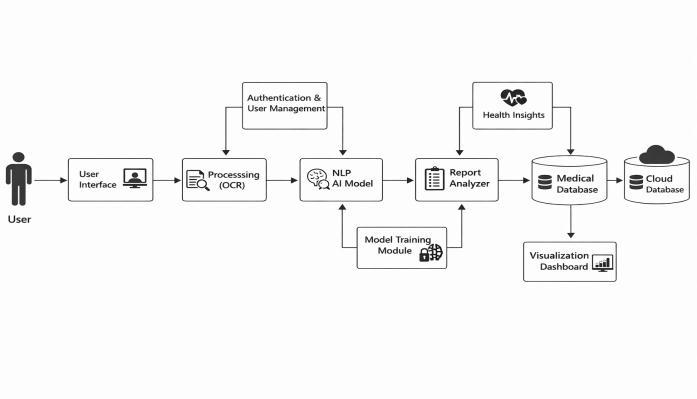
The system starts with the User Interface, where users securely log in and upload their medical lab reports. Authentication & User Management ensures that only authorizeduserscanaccesstheplatformandtheirpersonal healthdata.
Onceareportisuploaded,itissenttothe Processing(OCR) module,whichextractstextandvaluesfromscannedPDFs orimages.Theextracteddataisthenpassedtothe NLP AI Model, which understands medical terminology and structuresthedatainamachine-readableformat.
The Report Analyzer comparesextractedtestvalueswith standardmedicalreferenceranges.Basedonthisanalysis, thesystemgenerates Health Insights,highlightingnormal, abnormal, high, or low parameters and providing basic recommendations.
All processed data and reports are stored securely in the Medical Database forpatient-wiserecordmanagement.The dataisalsosynchronizedwiththe Cloud Database toenable scalability,backup,andsecureremoteaccess.
The Model Training Module continuouslyimprovestheAI modelusinghistoricaldata,makingpredictionsandinsights more accurate over time. Finally, the Visualization Dashboard presents results in the form of charts, trends, and summaries, helping users easily track their health progress.
3. IMPLEMENTATION DETAILS
TheimplementationoftheproposedAI-poweredlabreport analysis system is carried out using a combination of artificial intelligence techniques, web-based application frameworks,anddatabasesystems.Theimplementationis dividedintofourmainlayers:AIprocessinglayer,backend layer, frontend layer, and database layer. This layered approach ensures modularity, scalability, and ease of maintenance.
International Research Journal of Engineering and Technology (IRJET) e-ISSN: 2395-0056
Volume: 13 Issue: 02 | Feb 2026 www.irjet.net p-ISSN: 2395-0072
3.1 AI Processing Layer
TheAIlayerperformsthecorefunctionalityofthesystem. OCR techniques are used to extract textual content from scanned images and PDF-based laboratory reports. The extracted text is preprocessed to remove noise and formattinginconsistencies.
NamedEntityRecognition(NER)techniquesareappliedto identifykeylaboratoryentities,includingtestnames,result values, measurement units, and reference ranges. A rulebasedinterpretationmechanismcomparesextractedvalues with predefined medical thresholds to classify each test result.
3.2 Backend Layer
The backend layer acts as an intermediary between the frontend and AI processing layer. It manages user authentication, report uploads, data validation, and result storage.RESTfulAPIsenablesecurecommunicationbetween thefrontendandbackend.
3.3 Frontend Layer
The frontend layer provides users with an interactive interface to upload laboratory reports and view analysis results. The system displays extracted values, abnormal parameters, and health insights in a simplified format. Visualization components such as charts and tables help usersunderstandtrendsacrossmultiplereports.
3.4
Database Layer
The database stores structured medical data, including extracted test values, report metadata, user profiles, and historicalanalysisresults.Thisstructuredstorageenables efficientretrieval,comparison,andtrendanalysis.
4. RESULTS AND PERFORMANCE ANALYSIS
The proposed AI-powered medical laboratory report analysissystemwasevaluatedtoassesstheperformanceof its text extraction, information identification, and result interpretation capabilities. The evaluation was conducted usingacollectionoflaboratoryreportsinPDFandscanned imageformats,representingdifferentreportlayouts,table structures,andimagequalitylevels.
Similartoexistinglaboratoryreportextractionpipelines,the evaluation was divided into three major aspects: OCR performance, entity extraction performance, and result interpretationaccuracy.
4.1 Data Extraction Performance
The OCR and NER modules successfully extracted key laboratoryparametersfromreportswithdifferentlayouts and formats. The system demonstrated robustness in handlinglow-qualityscansandsemi-structuredtables.
4.2 Classification and Interpretation Accuracy
Theinterpretationmoduleanalyzedextractedtestvaluesby comparing them against predefined medical reference ranges. Each laboratory parameter was automatically classified as Low, Normal, or High, enabling simplified understandingfornon-medicalusers.
Theclassificationlogicaccuratelyidentifiedabnormalvalues acrossmultipletestcategories,includingbloodparameters and biochemical tests. The overall classification accuracy achieved was 93%, indicating reliable interpretation of extractedlaboratorydata.
Table1:PerformanceMetricsoftheProposedSystem
4.3 System Efficiency
The average report processing time was suitable for realtimeinteraction.Asynchronousprocessingensuredthatthe user interface remained responsive even during intensive OCRoperations.
5. CONCLUSION
This paper presented an AI-powered medical laboratory reportanalysisandhealthinsightsplatformthatautomates theextractionandinterpretationoflaboratoryreportsfrom PDF and scanned documents. The system effectively convertsunstructuredmedicalreportsintostructureddata, interprets test results, and presents meaningful health insightsthroughuser-friendlyvisualizations.
Experimentalresultsdemonstratethattheproposedsystem achieveshighaccuracy,reducesmanualeffort,andimproves patientunderstandingoflaboratoryreports.Byintegrating extraction, interpretation, and visualization into a single platform,thesystemaddresseskeylimitationsoftraditional labreportprocessingapproaches.
6. FUTURE WORK
Futureenhancementsmayincludeintegrationwithhospital information systems and laboratory information managementsystemsforreal-timedataretrieval.Advanced machine learning models can be incorporated for disease riskpredictionandpersonalizedhealthrecommendations. Supportformultilingualreportsandwearablehealthdata
International Research Journal of Engineering and Technology (IRJET) e-ISSN: 2395-0056
Volume: 13 Issue: 02 | Feb 2026 www.irjet.net p-ISSN: 2395-0072
integration can further expand the applicability of the system.
REFERENCES
1. M.-W. Ma, X.-S. Gao, Z.-Y. Zhang, et al., “Extracting laboratorytestinformationfrompaper-basedreports,” BMCMedicalInformaticsandDecisionMaking,vol.23, no.251,pp.1–14,2023.
2. J.Devlin,M.-W.Chang,K.Lee,andK.Toutanova,“BERT: Pre-training of deep bidirectional transformers for languageunderstanding,”ProceedingsofNAACL-HLT, pp.4171–4186,2019.
3. E. Alsentzer, J. Murphy, W. Boag, et al., “Publicly available clinical BERT embeddings,” Proceedings of NAACL-HLT,pp.72–78,2019.
4. J. Lafferty, A. McCallum, and F. Pereira, “Conditional randomfields:Probabilisticmodelsforsegmentingand labelingsequencedata,”ProceedingsofICML,pp.282–289,2001.
5. D. Jurafsky and J. H. Martin, Speech and Language Processing,3rded.,Pearson,2023.
6. PaddlePaddle Research Team, “PP-OCR: A practical ultra-lightweightOCRsystem,”BaiduResearch,2022.
7. S.Rajkomar,J.Dean,andI.Kohane,“Machinelearningin medicine,”NewEnglandJournalofMedicine,vol.380, no.14,pp.1347–1358,2019.
8. World Health Organization, “WHO guideline: recommendations on digital interventions for health systemstrengthening,”WHOPress,Geneva,Switzerland, 2019.