
International Research Journal of Engineering and Technology (IRJET) e-ISSN: 2395-0056
Volume: 13 Issue: 04 | Apr 2026 www.irjet.net p-ISSN: 2395-0072

International Research Journal of Engineering and Technology (IRJET) e-ISSN: 2395-0056
Volume: 13 Issue: 04 | Apr 2026 www.irjet.net p-ISSN: 2395-0072
Maithili Kamble1 , Garv Balgi2 , Urja Mali3 , Prof. Sachin Chavan4
1,2,3Student at Mahatma Gandhi Missions College of Engineering and Technology, Mumbai, Maharashtra, India. 4Professor at Mahatma Gandhi Missions College of Engineering and Technology, Mumbai, Maharashtra, India.
Abstract - There was a great shift in the usage of digital meeting applications like Zoom and Google Meet, where the usage surged over 300% post 2020. However, it did solve long distance communication problem, the problem related to multilingualcommunicationsthathindersnon-nativeorcrosscultural speakers and exclusion of the Deaf and Hard-to-Hear (D/HH) community due to no accessible-feature for these problems. This paper proposes VaaniMeet, a platform that integrates Speech-to-Speech Translation (S2ST) and Speechto-Sign Language Translation (S2SLT), a solution for multilingual virtual meetings. An AI-based model for lowlatency translation, VaaniMeet employs a synchronised 3D avatar to convey translated speech and sign language gestures, ensuring a smooth and seamless interaction across multiple languages. The core technical challenge- achieve a real-time synchronisation of audio translation with dynamic 3D avatar animations-is addressed through optimised edge computing and predictive rendering pipelines.
Key Words: Speech-to-Speech Translation (S2ST); Speechto-Sign Language Translation (S2SLT); Deaf and Hard-ofHearing (D/HH), Automatic Speech Recognition (ASR), Machine Translation (MT), and Speech Synthesis (TTS), end-to-end speech (E2E).
During the pandemic of COVID-19 in 2020, the use of digital meetings became frequent due to lockdown, which openedupalong-distanceworkrelief.Famousapplications like Zoom Meeting and Google Meet are the most trusted applications by many organisations. Lectures, office meetings,andevenfamilymeetingsweretheprimaryand frequentreasonsforuse.
While this created a chance for long-distance work opportunities but made us realise a major drawback of multilingualmeetings,wherecommunicationbecomeshard asbothpartiesarenotcomfortablewithacommonlanguage. ButonecommunitythatwasmajorlyleftoutwasDeafand Hard-of-Hearing (D/HH). To overcome both the language barrier and provide equal and fair opportunities for everyone,regardlessofdisability,toprovetheirpotential.
This paper introduces us to a second-generation direct Speech-to-SpeechTranslation(S2ST)model,whichskipsthe needforintermediatetextrepresentation,whichreducesthe “voiceleaking”effectfoundinfirst-generationmodels[1].Its primarycontributioninVaaniMeetisitsabilitytopreserve theoriginalspeaker’svocalidentity(pitchandtone)inthe translatedoutputwhileremainingrobustagainstnoise.
Thispaperexploresthe“textless”approachtotranslateby utilisingdiscretespeechunits.Bymappingaudiodirectlyto these units, the researchers proved that systems can translate smoothly even for languages that do not have a writtenscript[2].ThisisvitalforVaaniMeetwhenhandling vernacular or informal spoken communication, where standardtexttranslationmightfail.
Thestudyinthispaperaddressesthecommonproblemsof “data paucity”in trainingAI.The researchersdeveloped a methodtousestupendousamountsofunlabeleddata,which isintextform,topre-trainthesetranslationmodels,which areresponsibleforimprovingthesemanticaccuracyofthe system[3].AsforVaaniMeet,thisresearchprovidesthelogic neededtoensurethehighaccuracytranslationevenwhen parallelaudiodataarescarceforaspecificlanguagepair.
The “Unity” model focuses on escalating the translation process by training the AI with multiple Text-to-Speech (TTS)targets.Thismultitaskingapproachallowsthemodel togenerateaudiomuch faster than the traditional system [4].ThisisacorerequirementofVaaniMeettoensurethat the time pause between the live audio, which is a person speakingandthetranslatedaudio,whichisbeingheard,is minimal.
Thispaperisforcoincidenttranslation.Itproposesamodel thatcantranslatespeechinreal time whilethespeakeris stillengagedinconversation[5].Byusingthe“multi-tasking learning” framework, it balances the trade-off between waitingforenoughcontentandthenpredictingthenextand translatingthehalf-sentencebeforethespeakercompletes thesentenceandthenstartsworkingontheremaininghalfsentence.Whichincreasesthespeedoftranslationandstill triestokeepthegrammarofthelanguagetobetranslated.
International Research Journal of Engineering and Technology (IRJET) e-ISSN: 2395-0056
Volume: 13 Issue: 04 | Apr 2026 www.irjet.net p-ISSN: 2395-0072
Whichallowsthemodeltokeeptheconversationasnatural andsmoothaspossible.
This research focuses on “on-device” S2ST translation. It discusseshowtocondenselargeAImodelssothattheycan runonmobiledeviceslikelaptopsorevensmartphones[6]. AsforVaaniMeet,thisencouragesthegoalofdataprivacy,as sensitive business meetings can be translated without sendingtheaudiodatatotheexternalcloudservers.
The “Hibiki” system focuses on high-fidelity simultaneous translation.Itensuresthatthegeneratedvoicecombination isnotroboticbutmaintainsahuman-likeaccentbykeeping ahuman-likeflowandemotionalreverberations[7].Thisis censoriousforVaaniMeet’susers,makingitfeellesslikean AIinteractionandmorelikearealconversation.
This research paper explores the idea of how a single AI modelcanmanagemultiplelanguagesatonce,e.g.,Englishto Hindi and English to Marathi simultaneously [8]. This research is the backbone of VaaniMeet’s ability to handle translationofonelanguagetomultiplelanguagesinasingle meeting e.g., Speaker is English and listeners are Spanish, Hindi etc. A single AI model manages to translate into multiplelanguagesonmultipledevicesatsingletime.
This study introduces us to a more efficient processing architecture called “Latent Perceivers” [9]. Traditional AI models consume a lot of memory when processing long sentences;however,thisarchitectureallowsVaaniMeetto handle long professional lectures or meetings without slowingdownorcrashingthesystem.
Thisresearchmeasuresandcomparestheuseof2Dvideo clipsversus3Davatarsforsignlanguage[10].Theresearch suggeststhat3Davatarsprovidemuchbetterclarity,which isnecessaryforcertainsignsthatrequirehand-to-chestor hand-to-facemovements.Thisjustifiesourchoiceofusing 3DavatarsinVaaniMeetforS2SLT.
Thisresearchprovidesthetechnicalmappingframeworkfor VaaniMeet’s avatar [11]. It uses “1D-CNN” to analyze the auditory features of the speaker’s voice and an “LSTM” networkforpredictingthesequenceofhandgestures.This ensures that the avatar moments are right and logically connected,andgrammaticallycorrectinsignlanguage.
Thisisoneofthemostcrucialmulti-modeldatasetsinthe world.Itcontainsover80hoursofhigh-qualityvideodata where speech, sign language, and 3D depth data are all positioned[12].VaaniMeetwillutilizethisdatasettotrain theavatartorecogniseandrecreatethousandsofdifferent complexgesturesaccurately.
Thispaperproposesa“compact”LargeVisionModeldesign specificallyfor“edge”ormobiledevices[13].Itensuresthat
the3Davatars'animationishighqualityandsmooth,even on devices without a high-end graphics card, which is necessaryfortheaccessibilityofVaaniMeet.
This research explores how to operate an avatar’s movements using only audio input [14]. By analyzing the voicepitchandenergyofthespeaker’svoice,theavatarcan justadjustthespeedand“weight”ofitssigns,bymakingthe gestural output feel more emotionally aligned with the speaker'sintentionsoremotions.
ThisstudyfocusesspecificallyonIndianSignLanguage(ISL). It provides the Natural Language Processing (NLP) rules which are required to convert English or Hindi Grammar (Subject-Verb-Object) into ISL grammar (Subject-ObjectVerb)[15].ThisiscriticalformakingVaaniMeetusefulinthe Indian Regional Context, as we are creating VaaniMeet mainlyconsideringIndianusers
This research uses “fuzzy logic” to handle the ambiguity withinhumanlanguage[16].Sinceinhumanlanguage,there are words with multiple meanings, the neuro-fuzzy converterhelpstheavatartochoosethemostaccuratesign basedonthesentimentofthesentence,whichreducesthe translationerrors.
This paper highlights a major gap in existing technology: “Non-ManualSignals”[17].Itprovesthatanavatarcannot fullyunderstandunlessitincludesfacialexpressions,head tilts,andeyegaze.VaaniMeetincorporatesthesefindingsby ensuringtheavatar’sfacemovesalongwithitshands.
This introduces a specific metric to measure “latency” in continuous translation.The “wait-k”logicdeterminesthat the system should wait for ‘k’ numbers of words before startingtheoutput[18].ThisisusedinVaaniMeettoensure that the avatar doesn’t start moving before it has enough datatobeaccurate.
Thissurveyanalysesthecurrentmeetingtoolsinthemarket. ItidentifiedthatwhileappslikeZoomandMeetprovidetext captions,noneofthemofferanintegrated3Dsignlanguage translation[19].ThisresearchprovesVaaniMeetneedsthe market.
Thispaperlooksatthefutureoftwo-waycommunication.It discussesusingneuralnetworksforthetranslationofsign language gestures back into translated audio [20]. This providesuswiththefuturescopeforVaaniMeet,wherewe can make a two-way communication bridge for the Deaf community. Where the user can use sign language to express,andtheAImodelwillanalysethesignsignalsand translatethemintothetargetedlanguage.
International Research Journal of Engineering and Technology (IRJET) e-ISSN: 2395-0056
Volume: 13 Issue: 04 | Apr 2026 www.irjet.net p-ISSN: 2395-0072
Digitalcollaborationisfrequentlyhinderedby2obstacles: the linguistic barrier between global speakers and the accessibility gap for Deaf and hard to hear (D/HH) community. Standard digital meeting platforms often lack integrated, real-time tools with support multilingual dialogueorprovideimmediatesignlanguageinterpretation fordeafandhard-to-hearusers,oftenrequiringexpensive external services or human interpreters for translation. VaaniMeet addressed these issues by unifying S2ST and S2SLT into a single seamless prototype. By converting spokenlanguageintotranslatedneuralvoiceinaudioform andkeyword-triggeredsign-languageusinggifs,theproject provides an inclusive, real-time differences or hearing ability.
Imagineattendingameetingonlineusingadigitalmeeting platform with foreigners and being able to speak in a languagewithoutanyproblemandstillabletokeeppoint. That’s VaaniMeet- a platform built to make global communication efficient and smooth, and give a good experiencetoallparticipanteitherspeakerorlisteners.It's likeanyotherdigitalmeetingplatform,butwith2important features which translate audio to any other language for listenersandtranslateaudiofortheD/HHcommunityinto signlanguages.
Themeetinglobbyhas2extrabuttons S2ST, whichdetects speakers language and translate it into the selected language.Thismakesthespeakercomfortabletokeepthe point even if the speaker is not an expert in the listener's language, and also for the listener, as they do not get confusedinunderstandingtheaccentorpronunciation,as everyaccentpronounceswordsdifferentlyandcanmislead themeaningofwords.
The other button is S2SLT, which detects the language spoken by the speaker and translates it into English and translates English language shows sign language gifs on screeninacontainerinthecornerforparticipantswhohave issueshearing.ThisisespeciallyfortheD/HHcommunity,as just audio or captions are not enough for smooth understanding, as some participants might not be good readers;hence,captionssometimesmightnotbehelpful.
Inthisfeature,2stepsarecommon:speech-to-textandtextto-texttranslation.Itworkslikethis:audioisdetectedbythe primarytool,faster-whisper,mainlyknownforSpeech-toText. It includes a built-in Language Identification (LID) model.AndthesecondstepisText-to-Textsecondarytool Googletrans ifthereisanyexternalextranoise,thenithelps asatext-basedbackup.Thenittranslatesbasedontheuser's
clickedbutton.Ifs2stisclickedafterTTT,Text-to-Speechis doneandifs2sltisclicked,Text-to-Signlanguage.
Alook athowVaaniMeet is built,howitpassesaudioand generatesoutputinaudioandsignlanguageforms.Builtfor smooth and flexible communication between multiple participants without any language barrier. Parts fit like puzzle pieces, shifting only when needed. Communication happenscleanlyacrosslayers,avoidingclutteroroverload. AsmentionedinFig.1andFig.2,twostepsareverycommon which are speech-to-text and text-to-text translation. This steps are very crucial as this steps are basic steps in this features
1. LanguageIdentification(LID): LID used faster-whisper to identify speakers language. It is mainly used to detect speaker language which from audio files. It detects the language from initial 30ms of audio input by speakers
2. Speech-To-Text(STT): faster-whisper is used again in STT for transcribingaudiointorawtextstringthistextisin speakers’languagewhichislaterpasstoTTT.
3. Text-To-Text(TTT): TTT uses googletrans for translating text from source which is passed on by STT into targeted languagetextusingallNLPrulesincludingsemantic and syntactic analysis and many more which in helps in grammar and analyze sentiments within thetext.
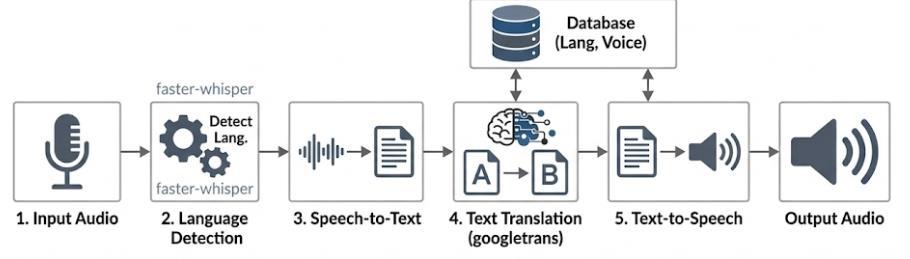
4. Text-To-Speech: It used edge-tts which is Microsoft Edge Neural TTS used to convert translated text into high quality,humanlikeneuralvoicein.mp3fileformat for playback. This translated audio pickup native accentoflanguagewhichmakesitmorelikehaving communication with human rather than with ai. Fig.1showshowstep1to4worksinflowandgive audiooutput
International Research Journal of Engineering and Technology (IRJET) e-ISSN: 2395-0056
Volume: 13 Issue: 04 | Apr 2026 www.irjet.net p-ISSN: 2395-0072
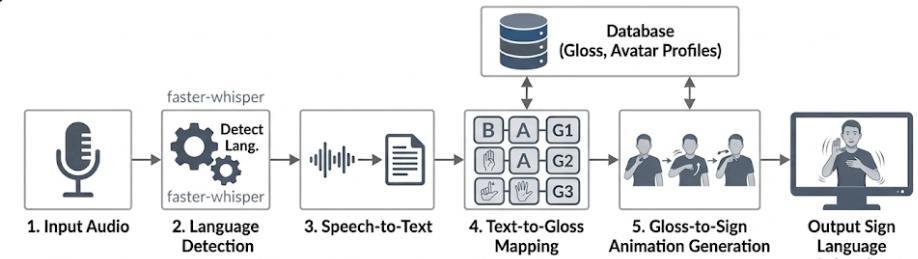
5. Text-to-GlossMapping:
LogicusedbehindthisiskeywordbasedNLP.After TTTitsplitseachwordandfindsthewordsincode ifmentionedlikeinsentence-“hello,GoodMorning toall”,hereitsplitsthesentenceto- ‘hello’,goodmorning’,‘toall’.
6. Gloss-to-SignAnimationGeneration:
Then it finds the keywords from code which is a predefinedpartincodeandcombineitintoalong sentence.
7. OutputRendering:
In output it shows the gifs in sequences like a sentence
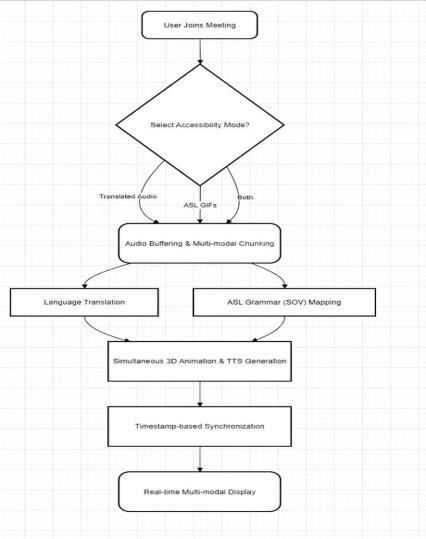
Fig.3givesthelayoutofhowfeaturesworkthroughoutthe system.Astructurepathisfollowedinthisplatformforboth features. Using S2ST & S2SLT as main highlight the fig.3 indicates the flow of steps when user opt for speech translationorsignlanguagetranslationorboth.Theflowis simplepredictableofhowwhenuserclickonbuttonshowit startstakinginputandpassitthroughlayersinbackendand provideaflowlessoutput.
WhousesVaaniMeet?Someonewhoneedstranslationbutis notfamiliarwithextensionsoradd-onservices.Wherethis platformdoesn’tneedextensionsoradd-onservicesasits defaultpresent.
When user login in user can join meeting using link, or unique id or even by creating a new meeting, additional optionisschedulingmeeting.Aftercreatingameetinguser/ hostcansendlinktootherparticipantsforjoining.Ithasall other basic features which are very common in other platforms, like mic, camera, share screen, chat, list of participants.
Additionalbuttonsare S2ST & S2SLT, whichareforspeechto-speech translation and speech-to-sign language translation,whichtranslatesinputaudiointoeitheraudioin thelanguageselected bytheparticipant or translatesinto signlanguageinGIFform.
A test checked whether all features within meeting lobby works and creates p2p connection within multiple participants joined in same meeting. This ensures the translationsaresmoothandvisibleandaudibleforlisteners inthemeetinglobby.
When tested, meeting was created and can be joined via unique id or link, and even schedule meetings. Details of schedulemeetingsarevisibleonhomescreenofplatform. Multipleusersjoinmeetingusingsamelinkwithoutlagging andp2pconnectwasvisiblewhenchatboxwastested.And listofparticipantsgetupdatedasparticipantjoinsorleaves toallpresentparticipants.
Themainfeatureswhicharehighlightofthisplatformwhich ares2stthetranslatedaudioisaudibleforotherparticipants who are listeners in current meeting where as in s2slt is clicked it shows a container in corner of meeting screen which displays interpretation of audio. It translates audio intoAmericansignlanguageliveforallparticipants.
Onethingisclearthatbothtranslationsworkwellandp2p connectionwhichisthemainfortestingcausebothspeaker andlistenersareimportanthere.Ashifthappenswhenitai replaces human, not discarding completely but lessen the cost of meeting when either speech translation or sign language translation is needed. It isn’t any high end platform-itslikeaprototypewhichismeldinideaofmaking communicationsmoothregardlessofobstacles.
International Research Journal of Engineering and Technology (IRJET) e-ISSN: 2395-0056
Volume: 13 Issue: 04 | Apr 2026 www.irjet.net p-ISSN: 2395-0072
Lobby viaunique ID/Link. established;lobby remainedlag-free.
Scheduler Meetingcreation andscheduling.
UI Dynamic Participantlist updateson join/leave.
Scheduledetails correctlyvisibleon homescreen.
Real-timetracking withzeronoticeable latency.
Table 2. Translation And Integration Performance
Feature Testing Scenario Observed Outcome
S2ST Real-timeaudio translationfor listeners. Translatedaudio wasclearand synchronized.
S2SLT Activationofvisual signcontainer. LiveASLrendered accuratelyinUI cornerpane.
Integration Chatandtranslation active simultaneously. P2Pstable;no conflictbetween datastreams.
8. CONCLUSION AND FUTURE
Aplatformthathelpsinsmoothcommunicationregardless oflanguagebarrierofdisability.Andovercominglanguage borderhelpingpeopleofdifferentculturetocollaborateand helping people of D/HH community to join and feel welcomedwithoutanybarrierandabletounderstandthe speakersmoothly.UsingVaaniMeetitjustnottranslatedlive audiobutalsogivesaconfidencetoexpresswithoutfeeling they might be says something wrong or misplace words instead of trying communicating in weak language experiencetryingVaaniMeet’ss2stands2sltfeaturewhich alsocountergrammarandexpresscorrectsentiments.
Onedaymaybesign-to-speechtranslationbuttonbevisible in meeting lobby, which will translate sign language into audiogivingchancewithD/HHcommunitytobespeakerin meetingwhichwillagainsolveonemorerealtimeproblem. Andovercometheissueofopportunitiesforallpeopleand cutthebarrieregardlessofabilityofspeakinglanguageor expressemotionsorpointtokeep.
[1]T.Fukudaetal.,“High-FidelitySimultaneousSpeech-ToSpeechTranslation(“Hibiki”)withHead-StartDecodingand Text-To-Speech Pre-Training,” arXiv preprint arXiv:2403.01836,2024.
[2]A.N.Al-Mala'aandM.A.H.Al-Qaraawi,“SignEdgeLVM transformermodelforenhancedsignlanguagetranslation onedgedevices,” NeuralComputingandApplications,vol. 36,no.1,pp.581–600,2024.
[3] M. H. El-kholy, M. B. E. Mohamed, and A. Mohamed, “Efficient Speech Translation with Dynamic Latent Perceivers,”inProc.ICASSP2023-2023IEEEInt.Conf.on Acoustics, Speech and Signal Processing (ICASSP), Rhodes Island,Greece,2023,pp.1–5.
[4]D.V.Ilyin,“IntelligentSystemforAutomaticBidirectional Sign Language Translation Based on Recognition and SynthesisofAudiovisualandSignSpeech,”TheInt.Archives of the Photogrammetry, Remote Sensing and Spatial InformationSciences,vol.XLVIII-2/W2-2023,pp.325–331, 2023.
[5] A. D. Nguyen et al., “Textless Direct Speech-to-Speech TranslationwithDiscreteSpeechRepresentation,”inProc. ICASSP2022-2022IEEEInt.Conf.onAcoustics,Speechand SignalProcessing(ICASSP),Singapore,2022,pp.6427–6431.
[6] H. Inaguma, P. von Platen, K. Duh, and S. Watanabe, “EnhancingSpeech-to-SpeechTranslationwithMultipleTTS Targets,” in Proc. ICASSP 2022 - 2022 IEEE Int. Conf. on Acoustics,SpeechandSignalProcessing(ICASSP),Singapore, 2022,pp.7837–7841.
[7] Y. Han, C. Wang, and J. Pino, “StreamSpeech: SimultaneousSpeech-to-SpeechTranslationwithMulti-task Learning,”inProc.2022Conf.oftheNorthAmericanChapter of the Association for Computational Linguistics: Human LanguageTechnologies,Seattle,WA,USA,2022,pp.4930–4941.
[8]P.Singh,A.Kumar,A.Singh,andS.S.Solanki,“Speechto IndianSignLanguageUsingNaturalLanguageProcessing,” FutureInternet,vol.14,no.12,p.370,2022.
[9]M.Elbayad,A.Bérard,L.Besacier,andJ.Niehues,“How ‘Real’ Is Your Real-Time Simultaneous Speech-to-Text Translation System?,” Transactions of the Association for ComputationalLinguistics,vol.10,pp.496–512,2022.
[10]N.S.Kamble,M.K.Thounaojam,andS.R.Nirmale,“Sign languageinterpretationusingmachinelearningandartificial intelligence,”inArtificialIntelligenceandMachineLearning forEDGEComputing,AcademicPress,2022,pp.241–260.
[11]Y.Jiaetal.,“Translatotron2:High-qualitydirectspeechto-speech translation with voice preservation,” arXiv preprintarXiv:2107.08661,2021.
[12]C.Liu,Q.Liu,Y.Wu,andM.Zhou,“ImprovingSpeech-toSpeechTranslationThroughUnlabeledText,”inProc.ICASSP 2021-2021IEEEInt.Conf.onAcoustics,SpeechandSignal
© 2026, IRJET | Impact Factor value: 8.315 | ISO 9001:2008 Certified Journal | Page1421
International Research Journal of Engineering and Technology (IRJET) e-ISSN: 2395-0056
Volume: 13 Issue: 04 | Apr 2026 www.irjet.net p-ISSN: 2395-0072
Processing(ICASSP),Toronto,ON,Canada,2021,pp.6563–6567.
[13] M. Le, A. Chaudhary, A. Sarin, and D. Agrawal, “SimulTron: On-Device Simultaneous Speech to Speech Translation,”arXivpreprintarXiv:2106.01242,2021.
[14] B. Li, P. Koehn, R. Sennrich, B. Chen, and J. Ma, “Joint Training And Decoding for Multilingual End-to-End SimultaneousSpeechTranslation,”in2021IEEEAutomatic SpeechRecognitionandUnderstandingWorkshop(ASRU), Cartagena,Colombia,2021,pp.919–926.
[15]A.Duarte,K.D.D.C.Santos,T.Braga,andS.Escalera, “Cross-modal neural sign language translation,” Ph.D. dissertation, Dept. Comput. Sci., Univ. Politècnica de Catalunya,Barcelona,2021.
[16] H. Liang, S. Wang, and Z. Liu, “Research on Speech Information to Sign Language Translation Based on 1DGoogLeNetandLSTM,”inProc.20204thInt.Conf.onDigital SignalProcessing,Chengdu,China,2020,pp.110–114.
[17]S.Kumar,S.K.Singh,andA.K.Singh,“SpeechtoSign Language Conversion Using Neuro Fuzzy Classifier,” in Computational Intelligence: Theories, Applications and FutureDirections-VolumeI,2019,pp.165–177.
[18]S.A.G.RizviandA.R.Khan,“EffortstoImproveAvatar Technology for Sign Language Synthesis,” in Proc. 3rd Int. Conf. on Information and Communication Technology for CompetitiveStrategies,Udaipur,India,2018,pp.1–6.
[19] A. Chaturvedi, V. P. Shukla, A. Tiwari, and R. Kala, “A Speech-drivenSignLanguageAvatarAnimationSystemfor HearingImpairedApplications,”inProc.24thInt.JointConf. on Artificial Intelligence (IJCAI 2015), Buenos Aires, Argentina,2015,pp.4230–4231.
[20]M.Hu,W.Li,andX.He,“Applicationofvirtualhuman signlanguagetranslationbasedonspeechrecognition,”in Proc. 2014 Int. Conf. on Virtual Reality and Visualization, Shenyang,China,2014,pp.195–199.
BIOGRAPHIES

MAITHILIKAMBLE
Student,ComputerEngineeringMGM College of Engineering and Technology, Navi Mumbai, Maharashtra


GARVBALGI
Student,ComputerEngineeringMGM College of Engineering and Technology, Navi Mumbai, Maharashtra
URJAMALI
Student,ComputerEngineeringMGM College of Engineering and Technology, Navi Mumbai, Maharashtra
PROF. SACHIN CHAVAN Professor, Computer Engineering, MGM College of Engineering and Technology, Navi Mumbai, Maharashtra
© 2026, IRJET | Impact Factor value: 8.315 | ISO 9001:2008 Certified Journal | Page1422