
International Research Journal of Engineering and Technology (IRJET) e-ISSN: 2395-0056
Volume: 13 Issue: 02 | Feb 2026 www.irjet.net p-ISSN: 2395-0072
International Research Journal of Engineering and Technology (IRJET) e-ISSN: 2395-0056
Volume: 13 Issue: 02 | Feb 2026 www.irjet.net p-ISSN: 2395-0072
Shravani .B. Dumbre1, Bandla Laxmi Prasanna2, Swati .S. Dhande3, prof Sangita Bhoyar4
1,2,3, Student Computer Engineering Department,V. E. S. Polytechnic, Mumbai, India
4 Professor, , Computer Engineering Department, V. E. S. Polytechnic Mumbai, India
Abstract - This paper introduces Querion, an AI-powered conversational assistant designed for complex and secure database interaction coupled with intelligent backend monitoringforapplicationservices.Organizationsandusers face challenges in accessing enterprise data and observing backend behavior, with existing solutions often requiring technical expertise or lacking integrated security and realtime observability. The proposed system addresses these by leveraging Large Language Models (LLMs) via the Groq API for fast inference and LangChain for secure NL→SQL chaining, translating natural language queries into accurate SQL commands while enforcing Role-Based Access Control (RBAC), query sandboxing, end-to-end encryption, NVIDIA NeMo Guardrails for prompt injection prevention, and LLM Guardfor real-time input/output scanning against OWASP LLM Top 10 threats. Additionally, the intelligent backendmonitoringmodule enables real-time connectionto user backend applications or projects through IDE extensions(e.g.,VSCode)orWebSockets,capturingterminal output, console errors, API endpoint usage, runtime exceptions, and application logs. These events are visualized via interactive dashboards and charts, with AI-powered analysis using Groq API and LangChain providing natural language explanations of errors, highlighting efficient patterns (e.g., optimal API responses), and suggesting corrective code prompts to support rapid debugging, troubleshooting, performance optimization, and learning across diverse user scenarios. This unified approach delivers secure, transparent, and efficient data access alongside comprehensive backend observability, empowering nontechnical users, developers, students, and organizations toward advanced AI-driven database management and applicationmaintenance.
Key Words: AI-powered conversational assistant, natural language to SQL (NL→SQL), large language models(LLMs),enterprisedatabasesecurity,role-based access control (RBAC), prompt injection prevention, intelligentbackendmonitoring,real-timeobservability, runtime error analysis, IDE integration, WebSocket streaming, visual analytics dashboards, developer debugging, Groq API, LangChain, NVIDIA NeMo Guardrails, LLM Guard, FastAPI, Chainlit, VS Code extension.
Modern organizations rely on diverse and large-scale datasources,yettraditionaldatabaseinteractionmethods such as manual SQL querying remain inaccessible to nontechnical users and prone to inefficiencies and security risks. The growing demand for data democratization and self-service business intelligence (BI) necessitates secure, scalable,anduser-friendlysolutions[24].
Conversational AI systems powered by NLP and Large Language Models (LLMs) enable natural language to SQL translation, improving accessibility and accuracy through advanced text-to-SQL techniques [1], [3], [4], [7], [26]–[28]. However, LLM-integrated systems face security threats such as prompt injection and guardrail bypass attacks [9]–[13], requiring robust defenses including RBAC, encryption, parameterized queries, and NeMo Guardrails aligned with OWASP protections [5], [25]. Additionally, real-time backend observability is essential for application reliability [14]–[17], with WebSocketbased monitoring [18], [19] and AI-driven log analysis enhancinganomalydetectionanddebugging[2],[6],[29].
This research proposes Querion, an AI-powered conversationalassistantthatintegratessecuretext-to-SQL translation with intelligent backend monitoring. By combining automated query generation [1], [7], comprehensive LLM security [5], [13], and AI-enhanced runtime analysis [6], [29], Querion enables secure, efficient, and accessible data-driven decision-making and applicationmaintenance.
Conversational AI for databases has evolved from rulebased SQL templates [1] to ML-based translation models [2], improving accuracy but often struggling with multiturndialoguesandcross-domainqueries.Recentadvances in LLMs, using platforms like Groq API and LangChain, enable low-latency NL→SQL translation with models such as LLaMA 3, Mixtral, and GPT-4o [3][4]. Tools like SQLDatabaseChainallowquerygeneration,execution,and summarization in a single pipeline, supporting contextaware interactions. Benchmark datasets like Spider, WikiSQL, and CoSQL assess performance across complex,
International Research Journal of Engineering and Technology (IRJET) e-ISSN: 2395-0056
Volume: 13 Issue: 02 | Feb 2026 www.irjet.net p-ISSN: 2395-0072
cross-domain scenarios [5][6][7]. However, integrated securityandreal-timemonitoringarestilllimited[8][9].
Secure database access requires RBAC, query sandboxing, encryption, and differential privacy to protect sensitive data [10][12]. LLM-specific threats, including prompt injections and jailbreaks [13][14], necessitate advanced defenses such as NVIDIA NeMo Guardrails [15], LLM Guard[16],andparameterizedqueries[17].Mostsystems, however, do not fully integrate these measures, emphasizing the need for multi-layered security combining RBAC, sandboxing, guardrails, and runtime scanning[18][20].
Backend monitoring ensures system reliability. Modern approaches use structured logging, WebSocket streaming, and IDE-integrated tools to capture terminal output, console errors, API metrics, and runtime events [21][23]. AI-powered analysis adds natural language log queries, automated error explanations, and actionable code suggestions [24][25]. Tools like OpenTelemetry, Prometheus, and Grafana enable interactive dashboards, while IDE extensions (e.g., VS Code) provide real-time, contextualinsights[26][28].
1. Incomplete security integration: Isolated safeguardswithoutunifiedenforcement.
2. Limited real-time observability: Lack of AI monitoringforuser-specificbackendprojects.
3. Minimal IDE integration: Fewplatformssupport live log streaming and automated debugging [29][30].
4. Model limitations: LLMscanhallucinatequeries, introduce latency, or struggle with large schemas [31][32].
These gaps highlight the need for a unified framework combining accurate NL→SQL translation, robust security, andintelligentbackendmonitoring
3. COMPARATIVE STUDY OF MARKET
4. PROPOSED SOLUTION: AI-POWERED CONVERSATIONAL ASSISTANT FOR COMPLEX & SECURE DATABASE INTERACTION AND INTELLIGENT BACKEND MONITORING
4.1 Core Philosophy and Approach
Querion addresses the challenges of complex database access and backend observability by combining AI-driven naturallanguageinteractionwithrobustsecurityandrealtime monitoring. Leveraging NLP and LLMs (Groq API, Llama 3.3,LangChain),itconvertsmultilingual textinputs into precise SQL queries, supports multi-turn dialogues, resolves ambiguities, and enables non-technical users to performsophisticatedqueriesandanalytics.
Securityis foundational:RBAC,query sandboxing, end-toend encryption, input validation, parameterized queries, NVIDIA NeMo Guardrails, and LLM Guard protect against SQL injection, prompt injection, jailbreaks, and OWASP LLMthreats.Comprehensiveauditingensurestraceability
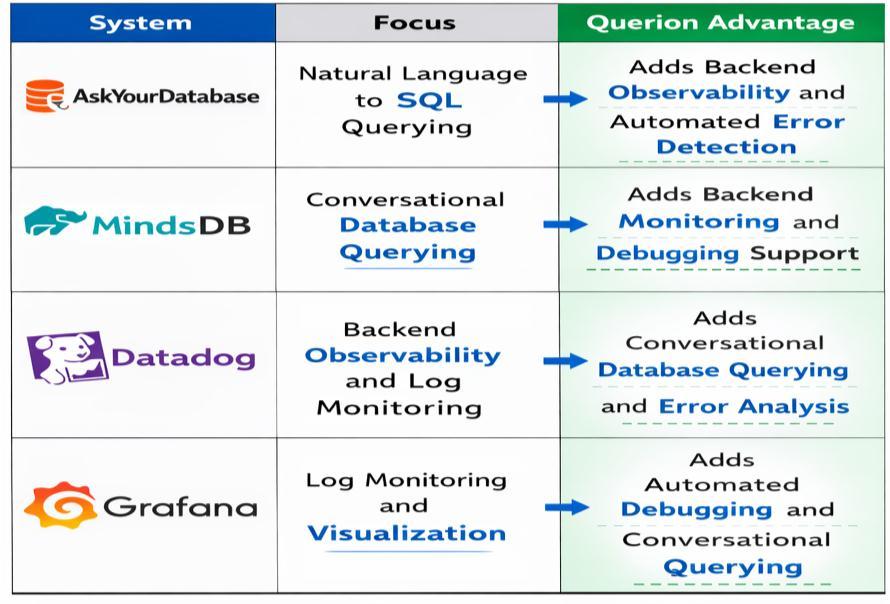
Fig -1:ComparisonofQuerionwithExisting ConversationalDatabaseandObservabilitySystems
5. PROPOSED SOLUTION: AI-POWERED CONVERSATIONAL ASSISTANT FOR COMPLEX & SECURE DATABASE INTERACTION AND INTELLIGENT BACKEND MONITORING
Querion addresses the challenges of complex database access and backend observability by combining AI-driven naturallanguageinteractionwithrobustsecurityandreal time monitoring. Leveraging NLP and LLMs (Groq API,
International Research Journal of Engineering and Technology (IRJET) e-ISSN: 2395-0056
Volume: 13 Issue: 02 | Feb 2026 www.irjet.net p-ISSN: 2395-0072
Llama 3.3,LangChain),itconvertsmultilingual textinputs into precise SQL queries, supports multi-turn dialogues, resolves ambiguities, and enables non-technical users to performsophisticatedqueriesandanalytics.
Security is foundational: RBAC, query sandboxing, end-to end encryption, input validation, parameterized queries, NVIDIA NeMo Guardrails, and LLM Guard protect against SQL injection, prompt injection, jailbreaks, and OWASP LLM threats. Comprehensive auditing ensures traceability andcomplianceforsensitivedatahandling.
For backend monitoring, users connect their projects via IDE extensions (e.g., VS Code, Cursor, Antigravity) or WebSockets, enabling the system to capture terminal output, console logs, runtime exceptions, API activity, and application traces. AI-driven analysis interprets errors in natural language, highlights optimal performance patterns, and suggests corrective actions. All events are visualized through interactive dashboards and charts, supporting rapid debugging, performance optimization, andlearningacrossindividualandorganizationalprojects.
Conversational AI Interface: Chainlit-based chat supports multi-turn, multilingual queries and potential voice input. Users can ask natural language questions like “Why did this runtime error occur?” or “Suggest a fix for endpoint failure.”
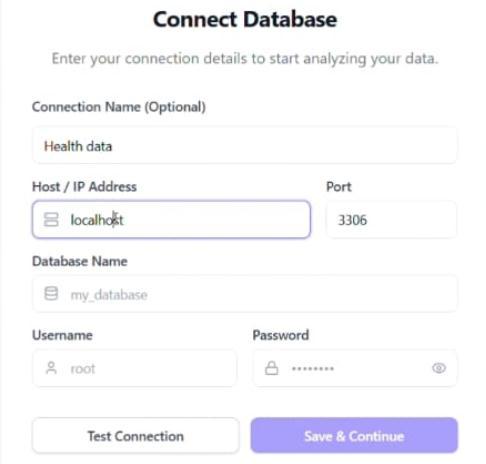
Database Compatibility: Optimized SQL execution via SQLAlchemy, supporting SQLite, MySQL, PostgreSQL, and Oracle.
Security & Compliance: RBAC, sandboxing, encryption, auditing, and differential privacy protect sensitive data throughout.
Intelligent Backend Monitoring: Real-timevisibilityinto backend processes, logs, API flows, runtime errors, and performance metrics, all displayed in interactive dashboards.
Integration & Accessibility: Web-based PWA interface, Slack/MicrosoftTeamsintegrationviaRESTAPIs,modular architectureusingFastAPI,WebSockets,structlog,Docker, andKubernetesforscalabledeployment.
Developer Productivity: Reduces debugging time, enhances transparency, explains backend behavior in natural language, andcombines databaseinteraction with full-stackmonitoring.
Querion provides a unified, secure, and scalable platform that empowers developers and users to query databases naturally while monitoring backend systems in real time,
delivering actionable insights and improving overall productivity.
Querion integrates a comprehensive set of intelligent modulestoprovidesecure,real-timedatabaseinteraction, developer-friendly backend monitoring, and enhanced usability for diverse users. The Natural Language Interaction Module combines a Chainlit-based conversational UI with prompt-based access, supporting multi-turn dialogues, context preservation, ambiguity clarification, and natural language reasoning. It leverages LangChain and Groq API to translate simple, multilingual prompts into optimized SQL queries, enabling seamless dataretrievalwithoutrequiringSQLexpertise. The Clarification and Failed Query Handling Module automatically detects ambiguous or misunderstood prompts and requests clear confirmation from the user (e.g., "Did you mean sales by region or product?"). For failed queries, it generates a concise summary of the intended question, the actual database result (or lack thereof), and a clear explanation of the failure reason such as insufficient access rights, missing data in the database, or invalid query structure helping users quicklyunderstandandcorrecttheirrequests.
The Historical Query Replay Module allows users to reexecuteanypastpromptfromconversationhistorywitha single selection. The system automatically re-runs the query against the current (real-time updated) database state, ensuring results reflect the latest data without retypingtheprompt.
TheScheduledQueryandReportingModuleenablesusers to schedule recurring or time-specific data retrieval tasks (e.g., daily sales summary at 9 AM or weekly patient risk report). The system executes scheduled queries automatically and delivers results via the interface, email, or integrated tools, with options for continuous monitoringofparticularmetrics
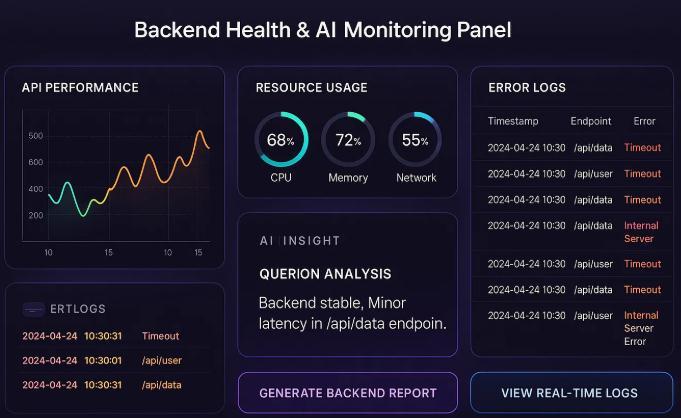
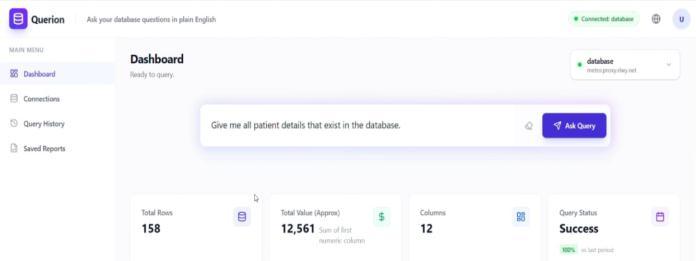
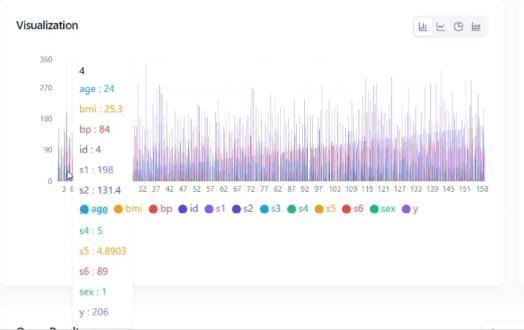
The Tabular Output and Data Dashboard Module formats database query results in clear tabular views and interactive visualizations (charts, graphs, dashboards) using embedded tools like Dash, providing intuitive interpretation of both query outcomes and backend monitoringinsights.
The AI-Based Prompt Enhancement Suggestions Module analyzesuserinputsandoffersimprovedormoreprecise prompt alternatives in real time (e.g., "Try: 'Show top 10 patients with highest glucose levels by age group'"), helping users achieve better accuracy and discover effectivequerypatterns.
The Smart Data Summaries Module simplifies complex database results into concise, meaningful insights,
International Research Journal of Engineering and Technology (IRJET) e-ISSN: 2395-0056
Volume: 13 Issue: 02 | Feb 2026 www.irjet.net p-ISSN: 2395-0072
highlightingkeytrends,aggregates,andanomaliesinplain language.
TheSecureAccessControlModuleenforceshigh-leveldata security through Role-Based Access Control (RBAC) via FastAPI-Users and JWT authentication, query sandboxing, parameterized execution with SQLAlchemy, end-to-end encryption, NVIDIA NeMo Guardrails for prompt injection prevention,andLLMGuardforreal-timescanningagainst OWASPLLMTop10threats,ensuringrobustprotectionof sensitivedata.
The Official Formatted Report Generation Module automatically produces professional, structured reports (PDF/HTML) from query results or monitoring insights, suitable for documentation, compliance, and decisionmaking.
The Backend Project Connection Module enables users to connecttheirapplicationprojectsvia IDE extensions(e.g., VSCode)orWebSocketAPIs,streamingreal-timeterminal output,consolelogs,runtimeexceptions,andAPIendpoint activity. The Runtime Error Analysis Module uses Groq APIandLangChaintodetectissues,convertcomplexerror logs into simplified, easy-to-understand explanations, and provide backend reports, UI-level insights, and step-bystep guidance for resolution. The Visual Backend Observability Module aggregates streamed events into interactive dashboards showing error trends, API flows, performancetimelines,andresourceutilization.
The AI-Driven Backend Guidance Module allows developers to ask natural language questions about backend issues (e.g., "What should I do about this 500 error?"), receiving detailed reports, actionable insights, and resolution recommendations directly in the conversationalinterface.
Collectively, these modules create a unified, secure, and intelligent platform that empowers non-technical users with intuitive database access, supports developers and students with real-time debugging and guidance, and provides organizations with transparent, compliant, and efficientdataandapplicationmanagement.
Querion is designed as a modular and scalable platform that integrates AI-powered natural language processing, secure database interaction, and intelligent backend monitoring. The architecture consists of three primary layers:
User Interface Layer – A conversational chat interface that captures multilingual inputs and displays query results,backendlogs,dashboards,andvisualanalytics.
AI & Processing Layer – Powered by Groq API and LangChain, this layer converts natural language into secure SQL queries, performs backend error analysis, and maintainsmulti-turnconversationalcontext.
Database & Monitoring Layer – Executes sandboxed queries on connected databases and captures real-time backend data (logs, terminal output, API activity) via secureAPIsandWebSockets.
Each component operates independently but communicates securely, ensuring modularity, maintainability,andscalability.
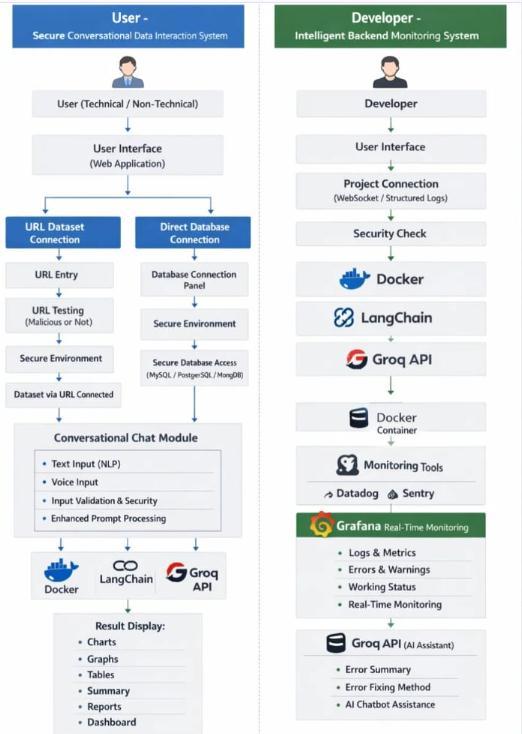
Fig -2:UserFlowDiagram
Volume: 13 Issue: 02 | Feb 2026 www.irjet.net p-ISSN: 2395-0072
The frontend uses Chainlit toprovidea responsive,crossplatform conversational interface supporting contextual dialogues and real-time dashboards for database results, logs,errortrends,andperformancemetrics.
The backend is built with FastAPI, enabling secure REST APIs and asynchronous WebSocket communication. LangChain integrates with Groq’s LLM models to handle NL→SQL translation, ambiguity resolution, and AI-driven backend analysis. Queries are executed in sandboxed environments, while connected user projects stream monitoringdataforliveanalysis.
The database layer utilizes SQLAlchemy for databaseagnosticconnectivity(SQLite,MySQL,PostgreSQL),storing user data and logs with encryption. Security mechanisms such as RBAC, input validation, parameterized queries, and auditing protect against injection attacks and unauthorizedaccess.
ThesystemsupportsintegrationwithplatformslikeSlack and Microsoft Teams through REST APIs, and is containerizedusingDocker(scalablewithKubernetes)for reliability,faulttolerance,andfutureextensibility
The methodology covers input processing, secure execution, and real-time monitoring. User text inputs are tokenized and analyzed via LangChain pipelines, with Groq-hosted Llama models generating optimized SQL queries or backend analyses, incorporating database schema or project context. Queries execute in sandboxed environments under RBAC, authentication, encryption, anddifferentialprivacyforaggregates.
Backend monitoring streams data from user projects connected via IDE extensions (e.g., VS Code) or WebSockets, capturing terminal output, console logs, runtime exceptions, and API events using structlog. AI agents analyze these for anomalies, providing natural language explanations and corrective suggestions. The workflow input to processing, secure execution/analysis, visualization, and response includes comprehensive logging for auditing. Validation was performedona real-worlddiabetesdataset(publichealth records with patient features), demonstrating effective NL→SQL and debugging on practical data. This ensures accurate, secure, and observable interactions for reliable performance.
5.3.1
The frontend employs Chainlit for a fast, responsive conversational UI with progressive web app support for cross-platform access (web and mobile). It handles text
inputs, multi-turn queries, and contextual reasoning, displaying results, dashboards for query history, backend logs, error visualizations, and performance metrics to enableeffortlessunderstandingforallusers.
5.3.2
The backend uses FastAPI for secure APIs and WebSockets, integrating LangChain with Groq API for NL→SQL translation,multi-turncontextmanagement,and backend error analysis with automated explanations. It supports query optimization, sandboxed execution, and real-timestreamingfromuserprojectsforobservability.
5.3.3 Database Layer
SQLAlchemyprovidesdatabase-agnosticconnections(e.g., SQLiteforPoC,MySQL/PostgreSQL),securelystoringlogs, metadata, and permissions with encryption. RBAC, input validation, and sandboxing ensure traceability and preventbreaches.
5.3.4 AI & NLP Layer
Thislayerhandlesnatural languageunderstanding,multiturn conversation state, ambiguity resolution, and intent detection via LangChain and Groq API, generating SQL or backend insights with context-aware, domain-adaptable responses.
5.3.5 Monitoring Layer
The monitoring layer utilizes structlog for structured logging, WebSockets for real-time project streaming, and embedded visualizations (e.g., Dash charts) for API flows, error timelines, and performance metrics. AI modules detect anomalies and generate explanatory responses for proactivetroubleshooting.
5.3.6 Security Layer
Security employs TLS for transport, encryption at rest, RBAC via FastAPI-Users, parameterized queries, NVIDIA NeMoGuardrailsforpromptrejection,andLLMGuardfor scanningagainstinjection, jailbreaks,and OWASP threats, withauditingforcompliance.
5.3.7 Scalability and Integration
Docker containerization (with Kubernetes orchestration) enables scaling and fault tolerance, alongside pythondotenv for config management. REST APIs and WebSocketssupportintegrationswithcollaborationtools, ensuringmodularupgradesandadaptability.
International Research Journal of Engineering and Technology (IRJET) e-ISSN: 2395-0056
Volume: 13 Issue: 02 | Feb 2026 www.irjet.net p-ISSN: 2395-0072
This work presented Querion, a unified platform combining LLM-based NL→SQL generation with policyenforced query execution and real-time backend observability. Powered by Groq API and LangChain, it enables context-aware SQL synthesis and secure interaction through RBAC, parameterized execution, NVIDIA NeMo Guardrails, and LLM Guard, effectively mitigating prompt injection, jailbreaks, and OWASP LLM Top 10 threats. IDE-integrated log streaming and AIdriven runtime analysis extend the system to support intelligent debugging, error explanation,and performance monitoring, delivering transparent and developer-centric databaseandapplicationmanagement.
Future enhancements include self-hosted LLMs to eliminate API dependency, broader IDE and NoSQL support, automated code patching, predictive anomaly resolutionvia AIagents,andadvancedvisualizationswith tools like Grafana. Long-term extensions may incorporate quantum-acceleratedqueryoptimizationandautonomous agents for multi-database federation, positioning Querion as a scalable, future-ready solution for AI-driven data managementandenterpriseobservability.
The authors would like to express their sincere gratitude to the faculty and management of V. E. S. Polytechnic for providing the guidance, academic environment, and resources necessary to carry out this work. We are especially thankful to our mentor for valuable suggestions, technical direction, and continuous encouragement throughout the development of this project and preparation of this paper. We also acknowledgethe classicalauthorsandresearcherswhose published literature and documentation provided the theoreticalandtechnicalfoundation forthisstudy.Finally, we appreciate the support of our peers and well-wishers who contributed directly or indirectly to the successful completionofthiswork.
International Research Journal of Engineering and Technology (IRJET) e-ISSN: 2395-0056
Volume: 13 Issue: 02 | Feb 2026 www.irjet.net p-ISSN: 2395-0072
[1] A. Jha, N. Anand, and H. Karthikeyan, “Conversion of natural language text to SQL queries using generative AI,” in Hybrid and Advanced Technologies, CRC Press, 2025, pp.25–32.
[2] J. Leinonen, A. Hellas, S. Sarsa, B. Reeves, P. Denny, J. Prather,andB.A.Becker,“Usinglargelanguagemodelsto enhance programming error messages,” in Proceedings of the54thACMTechnical Symposium onComputerScience Education(SIGCSE),2023,pp.563–569.
[3] D. Gao et al., “Text-to-SQL empowered by large languagemodels:Abenchmarkevaluation,”arXivpreprint arXiv:2308.15363,2023.
[4]B.Wang,R.Shin,X.Liu,O.Polozov,andM.Richardson, “RAT-SQL: Relation-aware schema encoding and linking fortext-to-SQLparsers,”inProceedingsofthe58thAnnual Meeting of the Association for Computational Linguistics (ACL),2020,pp.7567–7578.
[5]M.Fashaetal.,“MitigatingtheOWASPtop10forlarge language models applications using intelligent agents,” in 2024 2nd International Conference on Cyber Resilience (ICCR),IEEE,2024,pp.1–9.
[6] M. Du, F. Li, G. Zheng, and V. Srikumar, “DeepLog: Anomaly detection and diagnosis from system logs through deep learning,” in Proceedings of the 2017 ACM SIGSAC Conference on Computer and Communications Security(CCS),2017,pp.1285–1298.
[7]X.Liuetal.,“Asurveyoftext-to-SQLintheeraofLLMs: Where are we, and where are we going?,” IEEE TransactionsonKnowledgeandDataEngineering,2025.
[8] Y. Luo, G. Li, J. Fan, C. Chai, and N. Tang, “Natural language to SQL: State of the art and open problems,” Proceedings of the VLDB Endowment, vol. 18, no. 12, pp. 5466–5471,2025.
[9]M.A.Ferragetal.,“Frompromptinjectionstoprotocol exploits: Threats in LLM-powered AI agents workflows,” arXivpreprintarXiv:2506.23260,2025.
[10] S. Gulyamov et al., “Prompt injection attacks in large language models and AI agent systems: A comprehensive review of vulnerabilities, attack vectors, and defense mechanisms,”2025.
[11] W. Hackett et al., “Bypassing LLM guardrails: An empirical analysis of evasion attacks,” in Proceedings of the First Workshop on LLM Security (LLMSEC), 2025, pp. 101–114.
[12] Y. Liu et al., “Prompt injection attack against LLMintegratedapplications,”arXivpreprintarXiv:2306.05499, 2023.
[13]Y.Dongetal.,“Safeguardinglargelanguagemodels:A survey,” Artificial Intelligence Review, vol. 58, no. 12, 2025.
[14] P. S. Dodd and C. V. Ravishankar, “Monitoring and debugging distributed real-time programs,” Software: Practice and Experience, vol. 22, no. 10, pp. 863–877, 1992.
[15] H. Liu et al., “Real-time application monitoring and diagnosis for service hosting platforms of black boxes,” in 10th IFIP/IEEE International Symposium on Integrated NetworkManagement,2007,pp.216–225.
[16] B. Plattner, “Real-time execution monitoring,” IEEE TransactionsonSoftwareEngineering,no.6,pp.756–764, 2009.
[17]F.MuellerandD.B.Whalley,“Ondebuggingreal-time applications,” in ACM SIGPLAN Workshop on Language, Compiler,andToolSupportforReal-TimeSystems,1994.
[18] L. Zhang and X. Shen, “Research and development of real-time monitoring system based on WebSocket technology,” in International Conference on Mechatronic Sciences, Electric Engineering and Computer (MEC), IEEE, 2013,pp.1955–1958.
[19] G. L. Muller, “HTML5 WebSocket protocol and its application to distributed computing,” arXiv preprint arXiv:1409.3367,2014.
[20]S.Edirimannageetal., “Developersarevictimstoo: A comprehensive analysis of the VS Code extension ecosystem,”arXivpreprintarXiv:2411.07479,2024.
[21] A. Cohen, “JavaSith: A client-side framework for analyzingpotentiallymaliciousextensions,”arXivpreprint arXiv:2505.21263,2025.
[22] I. Korontanis et al., “Real-time monitoring and analysis of edge and cloud resources,” in Proceedings of the 3rd Workshop on Flexible Resource and Application ManagementontheEdge,2023,pp.13–18.
[23] U. Chindalia et al., “Real time application and CPU utilisation monitoring tool,” in 2019 3rd International ConferenceonElectronics,CommunicationandAerospace Technology(ICECA),IEEE,2019,pp.1136–1140.
[24] D. Orlovskyi and A. Kopp, “A business intelligence dashboarddesignapproachtoimprovedataanalyticsand decisionmaking,”inIT&I,2020,pp.48–59.
[25] T. Rebedea et al., “NeMo Guardrails: A toolkit for controllable and safe LLM applications with
International Research Journal of Engineering and Technology (IRJET) e-ISSN: 2395-0056
Volume: 13 Issue: 02 | Feb 2026 www.irjet.net p-ISSN: 2395-0072
programmable rails,” in EMNLP 2023: System Demonstrations,2023,pp.431–445.
[26] T. Yu et al., “Spider: A large-scale human-labeled dataset for complex and cross-domain semantic parsing and text-to-SQL task,” arXiv preprint arXiv:1809.08887, 2018.
[27] T. Scholak, N. Schucher, and D. Bahdanau, “PICARD: Parsing incrementally for constrained auto-regressive decoding from language models,” arXiv preprint arXiv:2109.05093,2021.
[28] R. Sun et al., “SQL-PaLM: Improved large language model adaptation for text-to-SQL,” arXiv preprint arXiv:2306.00739,2023.
[29] X. Han, S. Yuan, and M. Trabelsi, “LogGPT: Log anomaly detection via GPT,” in IEEE International ConferenceonBigData,2023,pp.1117–1122.
2026, IRJET | Impact Factor value: 8.315 |