
International Research Journal of Engineering and Technology (IRJET) e-ISSN: 2395-0056
Volume: 13 Issue: 04 | Apr 2026 www.irjet.net p-ISSN: 2395-0072

International Research Journal of Engineering and Technology (IRJET) e-ISSN: 2395-0056
Volume: 13 Issue: 04 | Apr 2026 www.irjet.net p-ISSN: 2395-0072
¹²³Department of Electronics and Computer Science Engineering
Padmabhooshan Vasantraodada Patil Institute of Technology, Maharashtra, India
Guide: Prof. Dr. J.A. Shaikh
Abstract - Timely access to blood is critical in emergency healthcare, yet many existing systems still rely on manual coordination or outdated records, which often leads to delays. This project presents an AI-based blood donor finder that improves response time using location-based filtering techniques. The system allows users to search donors based on blood group while prioritizing nearby donors using geographic data. A request mechanism notifies multiple donors through web and mobile platforms, and once a donor confirms, further notifications are controlled. The system is developed using React.js, Node.js, and MySQL, providing an efficient solution for connecting donors and recipients during emergencies.
KeyWords - Blood Donation System, GeolocationBased Matching, Real-Time Donor Search, Web and Mobile Application, Notification System, Emergency Response
1. INTRODUCTION
Blood plays a vital role in healthcare, and its timely availability is essential in emergency situations. However, findingasuitabledonorquicklyremainsachallenge.Many people still depend on personal contacts or social media, which may not provide reliable results when immediate actionisrequired.
With the advancement of technology, digital systems can improve how donors and recipients are connected. However, many existing solutions focus mainly on storing donor information rather than helping users find nearby donorsinrealtime.
To overcome this issue, the proposed system provides a webandmobile-basedplatformthatuseslocationdataand filtering techniques to identify suitable donors quickly. It alsoincludesa notification mechanism to contact multiple donors and manage responses efficiently, making it useful duringemergencies
2. ProblemStatement:
In emergency situations, finding a suitable blood donor quickly is often difficult. Existing methods depend on manual communication such as phone calls or social media, which are time-consuming and unreliable. Blood banks may store information, but they do not always
providereal-timeaccessto nearbydonorsthroughweb or mobileplatforms.
Another issue is the absence of proper location-based filtering,makingithardtoidentifydonorswhoareclosest and available at that moment. This leads to delays and confusion.
Therefore, there is a need for a system that can quickly identify nearby donors, filter them based on blood group and availability, and manage communication efficiently usingmoderntechnologies
Themainobjectiveofthisprojectistodevelopanefficient system that simplifies the process of finding blood donors during emergency situations. The system is designed to reduce delays and improve communication between donors and recipients through both web and mobile platforms.The specific objectives of the proposed system areasfollows:
• To develop a web and mobile-based blood donor findersystem
• To identify donors based on blood group and location
• Toprovidereal-timenotificationstodonors
• Toreduceresponsetimeinemergencysituations
• Tomanagedonorresponsesefficiently
• To maintain an updated and organized donor database
• To ensure accurate and real-time availability of donors
• Toprovideasimpleanduser-friendlyinterfacefor easyaccess
Several systems have been developed to improve the management of blood donation and availability. Early approaches mainly focused on maintaining records of blood donors and blood banks using database systems. Whilethesesystemshelpedinorganizingdata,theylacked real-timecommunicationandefficientsearchcapabilities.
Later, web-based applications were introduced to allow users to check blood availability and register as donors.
International Research Journal of Engineering and Technology (IRJET) e-ISSN: 2395-0056
Volume: 13 Issue: 04 | Apr 2026 www.irjet.net p-ISSN: 2395-0072
Although these systems improved accessibility, they did not consider the location of donors, making it difficult to findnearbydonorsquickly.
Recent research has explored mobile applications and notification-based systems to improve communication. However, many of these systems do not effectively prioritize donors based on proximity or manage multiple responsesefficiently.
The proposed system addresses these limitations by combining location-based filtering, real-time notifications, and controlled request handling through both web and mobile platforms. This approach improves response time and provides a more practical solution for emergency situations.
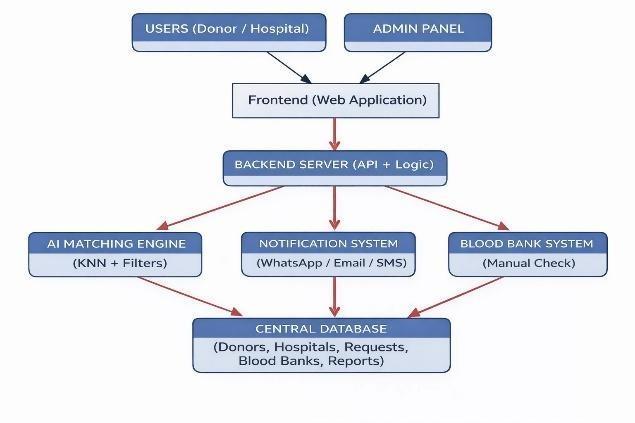
The proposed system provides a fast and efficient way of connectingblooddonorswithrecipientsduringemergency situations. It works on both web and mobile platforms to helpusersfindsuitabledonorsinrealtime.
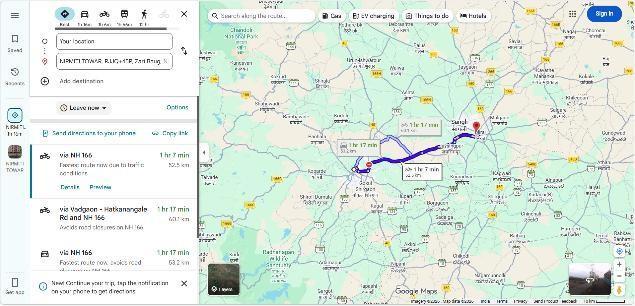
When a user searches for a specific blood group, the system filters donors based on blood typeandavailability, and uses location data to identify nearby donors. This helps in reducing the time required to arrange blood and improvesresponseefficiency.
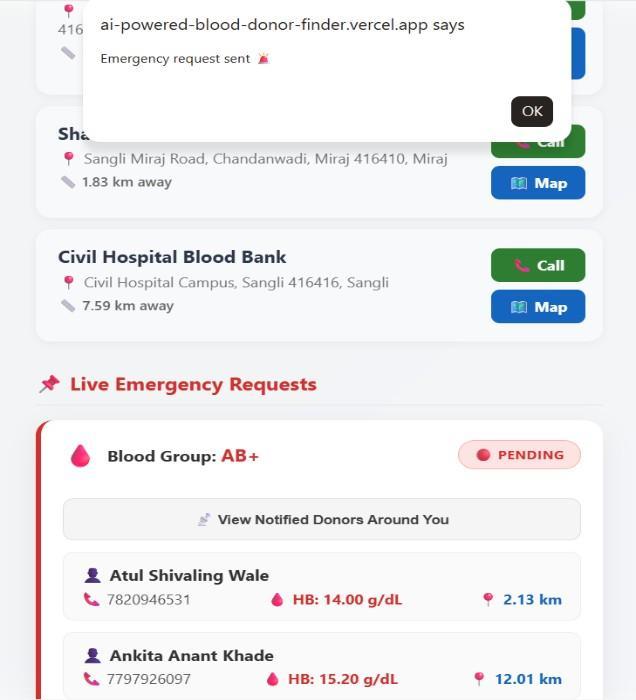
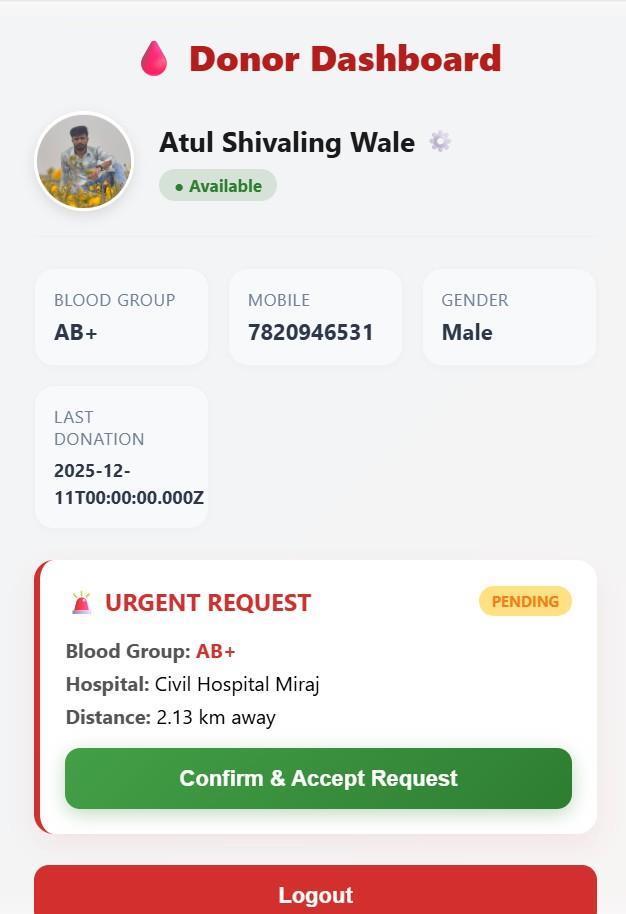
A request mechanism is used to notify multiple donors simultaneously. Once a donor accepts the request, the systemupdatesthestatus andpreventsfurtherresponses, makingtheprocessmoreorganizedandreliable.



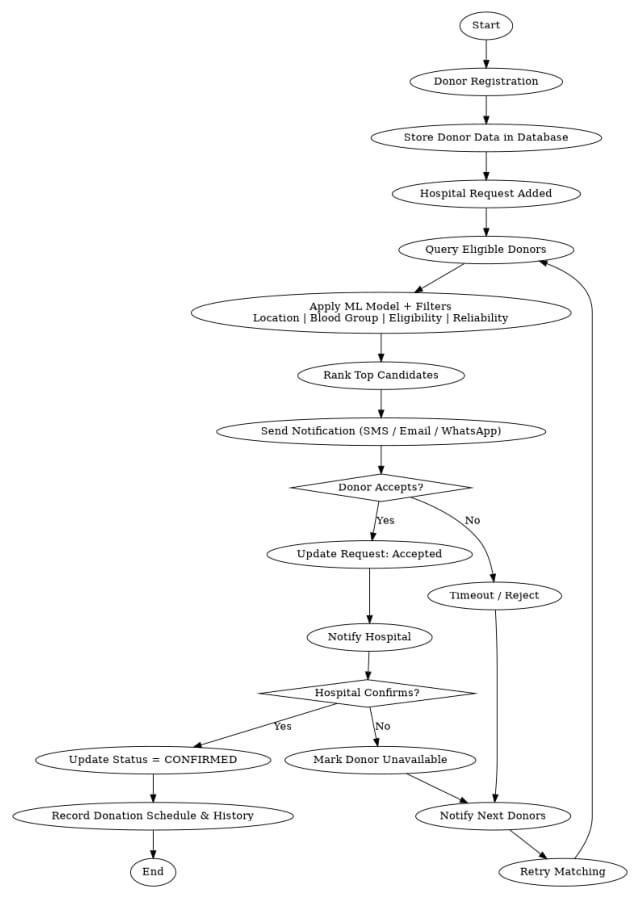
The proposed system follows a structured workflow for identifying and connecting suitable blood donors. The
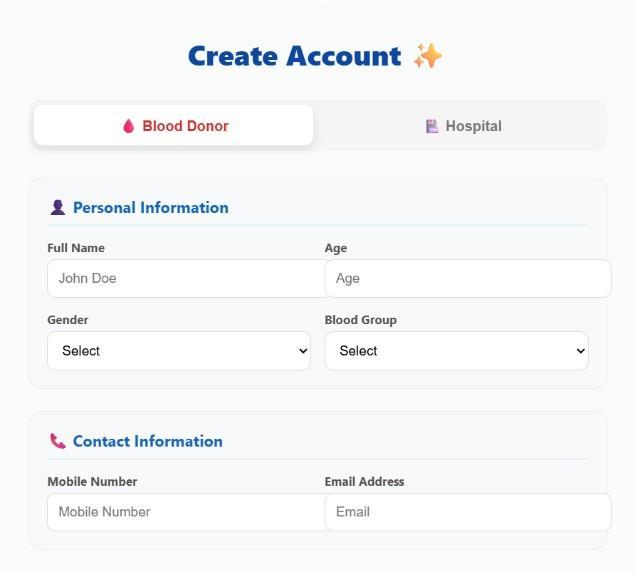
processbeginswithdonorregistration,whereuserdetails suchasbloodgroup,contactinformation,andlocation are storedinthedatabase.
Whenahospitaloruserplacesabloodrequest,thesystem queries the database to identify eligible donors. The selection process applies filtering based on blood group, availability, and location. Additionally, ranking is performedtoprioritizethemostsuitabledonorsbasedon proximityandreliability.
After identifying top candidates, notifications are sent through web and mobile platforms such as SMS, email, or application alerts. If a donor accepts the request, the systemupdatestherequeststatusandnotifiesthehospital forconfirmation.
If the request is confirmed, the system records the donation details and updates donor history. In case of rejection or timeout, the system automatically notifies the nextsetofdonorsandrepeatsthematchingprocess.
Thismethodologyensuresefficientdonorselection,proper response handling, and continuous processing until a successfulmatchisachieved.
International Research Journal of Engineering and Technology (IRJET) e-ISSN: 2395-0056
Volume: 13 Issue: 04 | Apr 2026 www.irjet.net p-ISSN: 2395-0072



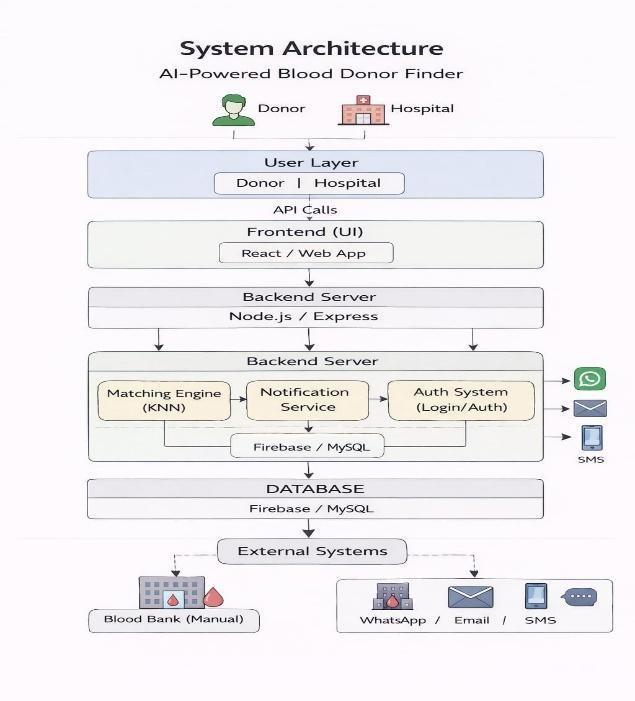
The proposed system follows a layered architecture that supports both web and mobile platforms for efficient accessandcommunication.
At the top level, donors and hospitals interact with the system through the user layer. The frontend, developed usingReact,providestheinterfaceandcommunicateswith thebackendthroughAPIcalls.
The backend is implemented using Node.js and Express.js, which processes requests and manages key modules such as the matching engine, notification service, and
authentication system. The matching engine identifies suitable donors based on blood group, location, and availability.
The system uses a MySQL database to store donor and request data, while external services like SMS, email, and WhatsAppareusedforsendingnotifications.
This architecture ensures smooth data flow, real-time communication,andefficientdonormatching.
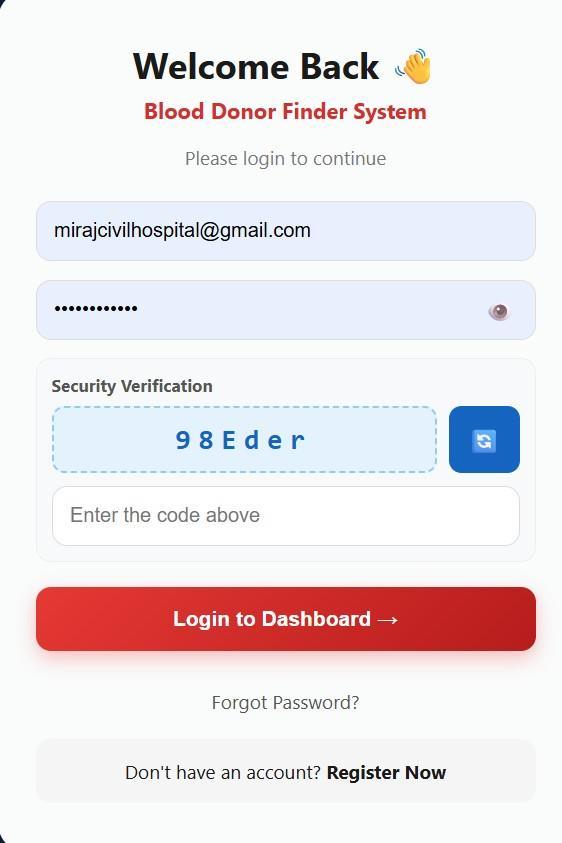
The proposed system is implemented as both a web and mobile-accessible application using modern technologies. ThefrontendisdevelopedusingReact.js,whichprovidesa user-friendly interface for donor registration, login, and bloodsearch.
The backend is built using Node.js and Express.js, which handlerequestprocessing,donorfiltering,andnotification management. The system uses MySQL as the database to store donor details, request information, and response data.
International Research Journal of Engineering and Technology (IRJET) e-ISSN: 2395-0056
Volume: 13 Issue: 04 | Apr 2026 www.irjet.net p-ISSN: 2395-0072




Theapplicationincludesmodulessuchasregistration, and authentication, search, request handling, notification.Mobileaccessallowsuserstoreceive instantalertsandrespondquicklyduringemergency situations.


Overall,theimplementationfocusesonsimplicity, speed,andreliabilityforreal-timeusage.













International Research Journal of Engineering and Technology (IRJET) e-ISSN: 2395-0056
Volume: 13 Issue: 04 | Apr 2026 www.irjet.net p-ISSN: 2395-0072
9. Results and Discussion
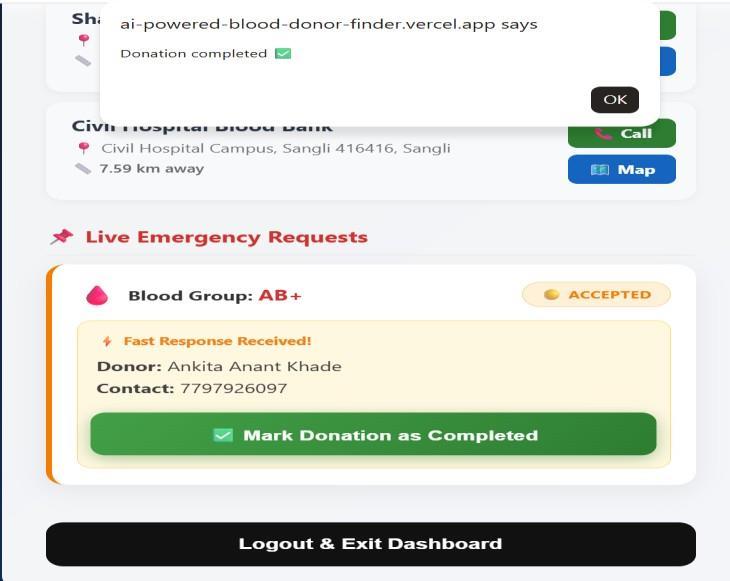
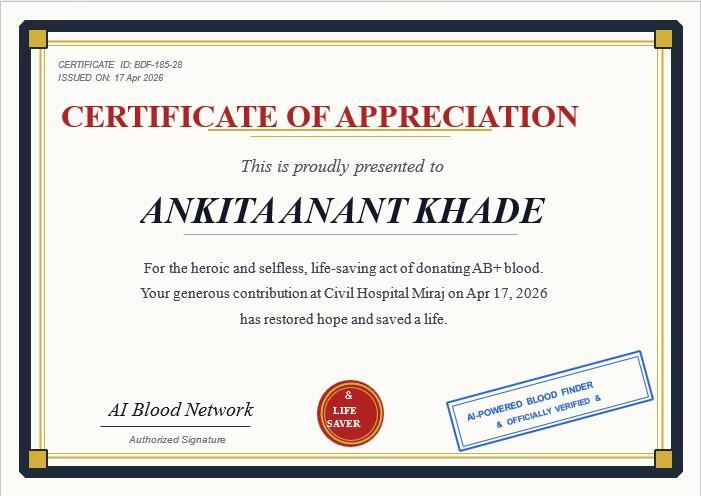
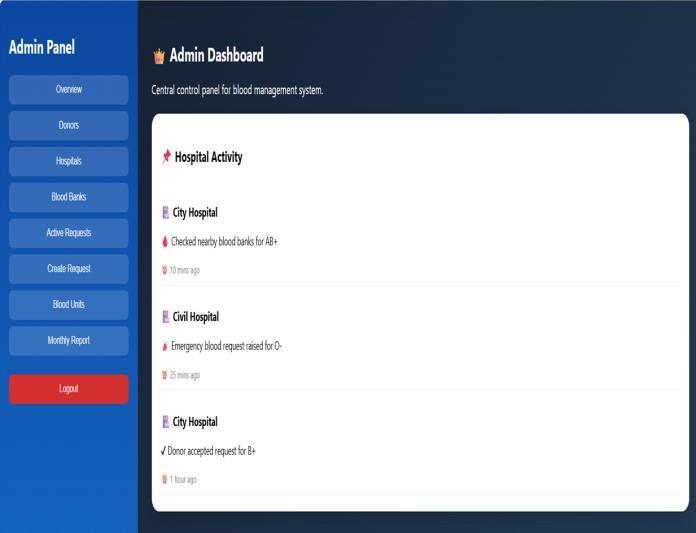
The system was tested under different scenarios to evaluate its performance in identifying suitable blood donors.Theresultsshowthatthesystemcanquicklyfilter donors based on blood group and location, reducing the time required to find a match compared to traditional methods.
Location-basedfilteringimprovesefficiencybyprioritizing nearby donors, while real-time notifications increase the chances of faster responses. The request handling mechanism ensures that once a donor accepts, further responsesarecontrolled,avoidingconfusion.
The system iseasy to use and performs efficiently, making itsuitableforreal-worldemergencysituations.


10. Conclusion:



The AI-based blood donor finder system provides an effective solution for connecting donors and recipients during emergency situations. By using location-based filteringandreal-timecommunication,thesystemreduces thetimerequiredtoidentifysuitabledonorsandimproves overallresponseefficiency.
The integration of both web and mobile platforms enhancesaccessibilityandallowsuserstosendandreceive requests quickly. The system is simple, reliable, and suitableforreal-worlduse.
In conclusion, the proposed system improves the process of blood donor search and can be further expanded for large-scalehealthcareapplications.
International Research Journal of Engineering and Technology (IRJET) e-ISSN: 2395-0056
Volume: 13 Issue: 04 | Apr 2026 www.irjet.net p-ISSN: 2395-0072
[1] World Health Organization, Blood Donor Selection: Guidelines on Assessing Donor Suitability, WHO Press, 2012.
[2]React.js,“ReactDocumentation.” Available: https://reactjs.org
[3]Node.js,“Node.jsDocumentation.”Available: https://nodejs.org
[4]MySQL,“MySQLDocumentation.” Available: https://dev.mysql.com
[5]“AdvancementsinBloodTransfusionSystems,” WileyOnlineLibrary.Available: https://onlinelibrary.wiley.com/doi/10.1111/vox.70141
[6]“Recent Developments in Transfusion Science,” Transfusion Science Journal. Available: https://www.trasci.com/article/S14730502(25)000904/abstract
[7]“Blood Bank Management System Using Web Technology,” International Journal of Engineering Development and Research (IJEDR). Available: https://rjwave.org/ijedr/papers/IJEDR2502151.pdf
[8] “Online Blood Bank System,” International Journal of Creative Research Thoughts (IJCRT). Available: https://ijcrt.org/papers/IJCRT2105420.pdf
2026, IRJET | Impact Factor value: 8.315 | ISO 9001:2008