
International Research Journal of Engineering and Technology (IRJET) e-ISSN: 2395-0056
Volume: 13 Issue: 04 | Apr 2026 www.irjet.net p-ISSN: 2395-0072

International Research Journal of Engineering and Technology (IRJET) e-ISSN: 2395-0056
Volume: 13 Issue: 04 | Apr 2026 www.irjet.net p-ISSN: 2395-0072
Vighnesh Ankolkar1 , Vaishnavi Gharge1 , Akash Wagdhare1 , Sarin Nair1, Prof. Uma K S2
1Final-year students of Pillai College of Engineering, New Panvel, and the department of Electronics and Computer Science
2Assistant Professor, Dept. Of Electronics Engineering, Pillai College of Engineering, New Panvel ***
Abstract - This project undertakes the AI-Powered Face Recognition Attendance System leverages advancedmachine learning algorithms and computer vision technologies toautomatetheprocessoftrackingattendance in educational institutions, workplaces, and other organizational settings. Traditional methods of attendance, such as manual entry or card-based systems, are often time-consuming,pronetoerrors,andsusceptibletofraud.This system utilizes a deep learning model trained on facial recognitiontechnologytoaccurately identifyindividualsand record their attendance in real-time. Overall, this project demonstrates how artificial intelligence can revolutionize biometric authentication, offering a fast, efficient, and reliablesolution for face recognition. Future improvements may include 3D face recognition, emotion detection, and enhanced privacy protection mechanisms
Attendancemanagementservesasafundamentalaspectof organizational functioning across various sectors, encompassingeducation,corporategovernance,andevent management. Traditional methods of tracking attendance, primarilyreliantonmanualprocedures,havelonggrappled withinherentchallengessuchasinaccuracies,inefficiencies in time management, and susceptibility to fraudulent activities. However, with the emergence of cutting-edge technologieslikefacialrecognitionandartificialintelligence (AI), a transformative opportunity arises to reshape the landscapeofattendancemanagement.TheintroductionofAI based face recognition attendance systems marks a significant shift in attendance tracking, offering a sophisticatedsolutionthatcombinesthecapabilitiesoffacial recognition technology with advanced machine learning algorithms. This system represents a departure from the traditional approach by automating the identification and recording of individuals; Real-time visibility, thereby addressing the limitations of manual processes and increasing operational efficiency. In today's dynamic organizational environments characterized by evolving workflowsandtechnologicaladvancements,thedemandfor streamlinedandaccurateattendancemanagementhasnever beenmore.
Furthermore,theintegrationofAI-drivenmachinelearning algorithms enhances the system capabilities by enabling real-time data processing, trend analysis, and predictive modelling.Thisempowersorganizationalstakeholderswith
actionable insights derived from attendance analytics, therebyfacilitatinginformeddecision-makingandstrategic planning.
Research in the field of AI-based face recognition has demonstratedsignificantadvancements.CNN-basedmodels haveimprovedaccuracyindetectingandrecognizingfaces, even in varying lighting conditions and angles. Studies highlight the efficiency of deep learning techniques in handlinglargedatasetswhileminimizingfalsepositivesand negatives. However, challenges such as privacy concerns, computationalrequirements,andreal-timeprocessingspeed needtobeaddressedforeffectivedeployment. The review suggests that AI-driven attendance systems outperform traditional methods in terms of accuracy, security, and efficiency. The need for robust, scalable solutions is evident, emphasizing the importance of continuous advancements in deep learning and image processingtechniques.
Developing an AI-powered face recognition attendance systeminvolvesseveralkeystages,includingdatacollection, pre-processing,modeltraining,deployment,andfullsystem integration. The aim is to design a precise and efficient solutionthatautomatesattendancetrackingbyrecognizing individualsthroughfacialfeatures.Theprocessbeginswith collecting a diverse and high-quality set of facial images, ensuringthedatasetisbalancedtosupporteffectivelearning and reduce bias. Pre-processing techniques such as normalization, alignment, and feature extraction are applied to enhance the quality of input data and improve recognitionaccuracy.Adeeplearningmodel,oftenbasedon architectureslikeConvolutionalNeuralNetworks(CNNs)or pre-trained systems such as FaceNet, is then trained to distinguish and verify faces with high precision. Once the model performs reliably, it is deployed in a real-time environmentandintegratedwithhardwarecomponentslike camerasandsoftwaresystemssuchasattendancedatabases. To safeguard user information, the system incorporates robust security measures, including data encryption and authenticationprotocols,ensuringcompliancewithprivacy standards while maintaining accurate and real-time attendancetracking.
International Research Journal of Engineering and Technology (IRJET) e-ISSN: 2395-0056
Volume: 13 Issue: 04 | Apr 2026 www.irjet.net p-ISSN: 2395-0072
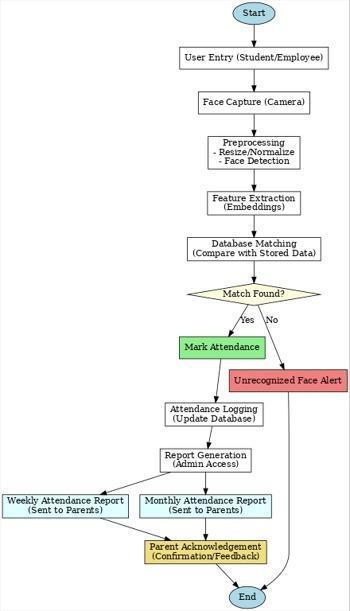
The performance of the AI-powered face recognition attendancesystemisevaluatedusingseveralkeymetricsto ensure accuracy, efficiency, and reliability. The primary evaluation criteria include accuracy, precision, recall, and F1-score, which assess the system’s ability to correctly recognizeanddifferentiateindividuals.Accuracymeasures the overall correctness of the system by comparing the numberofcorrectlyidentifiedfacestothetotalnumberof recognitionattempts.Precisionevaluateshowmanyofthe detected faces actually belong to the correct individuals, minimizingfalsepositives.Recalldetermineshowwellthe systemidentifiesregisteredusers,reducingfalsenegatives. F1-score provides a balanced assessment by considering bothprecisionandrecall,makingitusefulwhenthereisan uneven class distribution. In addition to these standard metrics,processingspeedisacrucialfactorinassessingrealtime performance. The system is expected to operate efficiently,ensuringquickfacialrecognitionwithoutdelays.
C. Table1 Sr.No. Description 1 OperatingSystem Windows10/11 2 IDE VSCode 3 Programming Language Python,SQL 4 ScriptingLanguage JavaScript 5 MarkupLanguage HTML
6 StylingLanguage CSS,Bootstrap
7 Communication Protocol API
● x8664-bitCPU(Intel/AMDarchitecture)
● 4GBRAM
● 4GBfreediskspace
● Webcamera
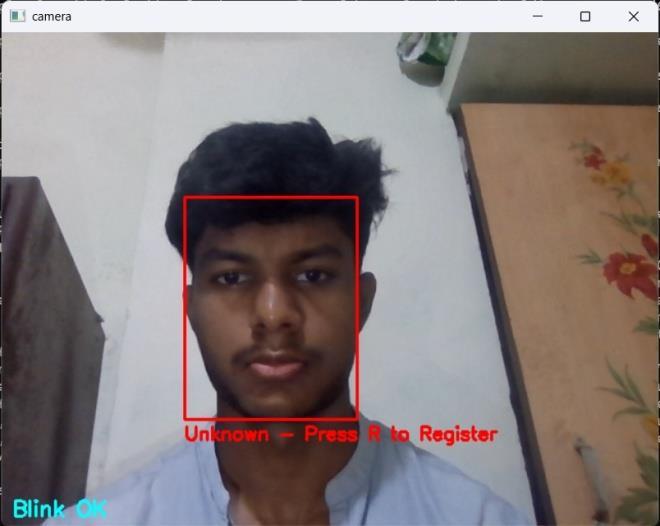
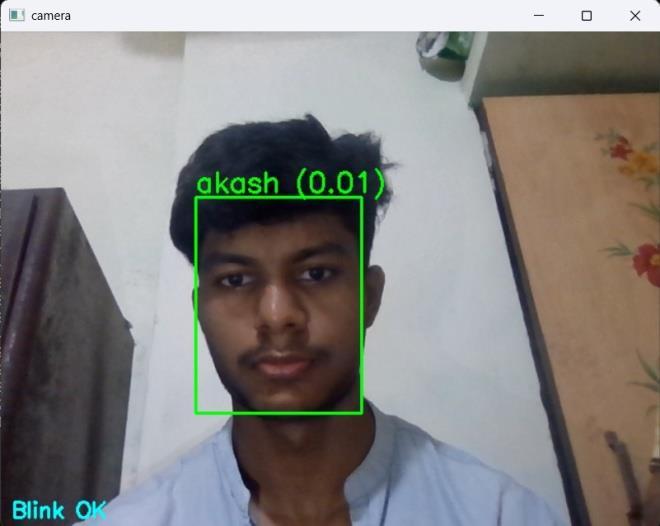
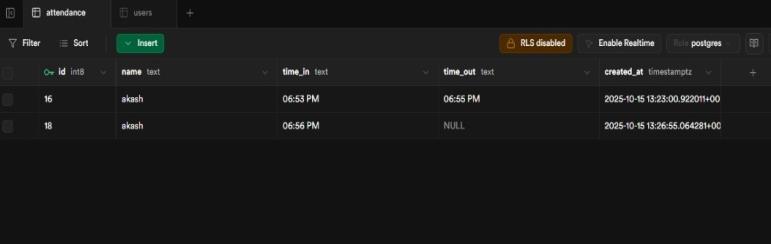
During implementation, the system captures 15 real-time imagesofindividualsastheyenterapredefinedarea,suchas aclassroomorworkplace.Theseimagesareprocessedusing computer vision algorithms to detect and identify faces, whicharethenmatchedagainstapre-registereddatabase. Upon successful recognition, attendance is automatically markedandloggedwithtimestamps.Thefollowingimages illustratevariousstagesoftheattendancecaptureprocess, includingfacedetection,recognition,andconfirmation.
International Research Journal of Engineering and Technology (IRJET) e-ISSN: 2395-0056
Volume: 13 Issue: 04 | Apr 2026 www.irjet.net p-ISSN: 2395-0072

Thesystemisapplicableindomainssuchasbusiness intelligence,healthcare,education,andgovernment
5.1
Educational Institutions: Enhancesattendancetrackingin schools,colleges,anduniversitiesbyautomatingtheprocess, reducing proxy attendance, and improving administrative efficiency.
Workplaces: Ensures accurate employee attendance monitoring, preventing time fraud and streamlining HR operations.
Public Events & Conferences: Helps in managing participant attendance efficiently without the need for manualsign-ins.
Healthcare Facilities: Enables touchless attendance tracking for doctors, nurses, and hospital staff, ensuring a hygienicandefficientsystem.
5.2
HR & Payroll Integration: Automates attendance data collection, reducing manual errors and seamlessly integrating with payroll systems for accurate salary processing.
Multi-Factor Authentication: Enhances security by combiningfacialrecognitionwith other authentication methods, such as ID verification or accesscontrolsystems.
Smart Surveillance: Supports security systems by identifyingunauthorizedindividualsandprovidingreal-time alertsforrestrictedareas.
Cloud-Based Accessibility: Enables remote attendance tracking and data management by integrating with cloud storageandenterprisesoftware.
IoT & Smart Office Integration: Connectswithsmartoffice environments, automating doors, lights, and workspace accessbasedonrecognizedattendance.
TheAI-poweredattendancesystemisdesignedtoprovidean efficient, contactless, and secure solution for automated attendance tracking. It consists of multiple integrated components, including real-time image capture, face
International Research Journal of Engineering and Technology (IRJET) e-ISSN: 2395-0056
Volume: 13 Issue: 04 | Apr 2026 www.irjet.net p-ISSN: 2395-0072
detection,deeplearning-basedrecognition,andcentralized datastorage.
Thesystemutilizescamerasplacedatentrypointstocapture real-timefacialimagesofindividuals.OpenCV,awidelyused computer vision library, is employed for face detection, ensuringaccuratelocalizationoffaceswithinthecaptured frames. Once detected, the facial features are processed usingdeeplearningmodels,suchasConvolutional Neural Networks(CNNs)orpre-trainedframeworkslikeFaceNetor DeepFace, to verify and recognize individuals with high accuracy.
Inconclusion,theAI-PoweredFaceRecognitionAttendance System projectsuccessfullyachieved itsstatedpurpose of developingasystemusingmachinelearningAlgorithms.The project builds the foundation for further research and development.Datacollectionandsystemintegrationensure efficiency, while testing and optimization guarantee performance. User support and ongoing maintenance are essentialforusability and sustainability. Iterative enhancement ensures adaptability to evolving trends, making the AI-powered Attendance management system a reliable solution for users.
WearedeeplythankfultoProf.UmaKS,ourprojectguide, and Prof. Ajit Saraf, our Project Coordinator for their invaluableguidance,mentorship,andunwaveringsupport. Their expertise, encouragement, and insightful feedback have been instrumental in shaping this project and navigatingthroughitscomplexities.
WeextendmysincereappreciationtoDr.MonikaBhagwat, Head of the Department, for their encouragement and supportthroughoutthedurationofthisproject.Wearealso grateful to Dr. Sandeep Joshi, Principal of Pillai College of Engineering,fortheirconstantencouragement,support,and motivation.
[1] H.Sultan,M.U.Zafar,S.Anwer,A.Waris,H.Ijaz,& M. Sarwar, “Real Time Face Recognition Based AttendanceSystemForUniversityClassroom”,20222nd InternationalConferenceonArtificialIntelligence(ICAI), Mar.2022https://doi.org/10.1109/icai55435.2022.977 3650
[2] K. L. Bhatti, L. Mughal, F. Y. Khuhawar, & S. Memon, “Smart Attendance Management System using face recognition”, EAI Endorsed Transactions on Creative Technologies,vol.5,no.17
[3] R.A.Asmara,M.Ridwan,&G.Budiprasetyo,“Haar Cascade and Convolution Neural Network Face Detection in Client-Side for Cloud Computing Face Recognition”, International Conference on Paper Id: 230598 (IEIT), Sep. 2021. https://doi.org/10.1109/ieit53149.2021.9587388
[4] Hati,A.,Saha,S.,Mandal,A.,Saha,P.,Sahana,S.,&Singh, D. (2021). “Face recognition and AI based smart attendancemonitoringsystem”,InternationalJournalof Computer Sciences and Engineering, 9(5), 15–21. https://doi.org/10.26438/ijcse/v9i5.1521
[5] Pradyumna,J.,Khan,T.,&Kumar,K.(2023).“Smart Attendance System using Face Recognition”, International Journal for Multidisciplinary Research, 5(4).https://doi.org/10.36948/ijfmr.2023.v05i04.4583