
International Research Journal of Engineering and Technology (IRJET) e-ISSN: 2395-0056
Volume: 12 Issue: 11 | Nov 2025 www.irjet.net p-ISSN: 2395-0072
International Research Journal of Engineering and Technology (IRJET) e-ISSN: 2395-0056
Volume: 12 Issue: 11 | Nov 2025 www.irjet.net p-ISSN: 2395-0072
Ishu M1 , Mr Sathish Kumar M2
1Pg Student, Department Of Computer Applications, Jaya College Of Arts and Science, Thiruninravur, Tamilnadu,India
2Assistant Professor,Department Of Computer Applications, Jaya College Of Arts and Science, Thiruninravur, Tamilnadu,India ***
Abstract - The development of an advanced autonomous military robot that employs artificial intelligence (AI) and deep learning(DL)techniques for mine detectionandthreat identification. The machine learning model, trained to recognize mine patterns, allows the robot to identify potential threats through image analysis. Upon detection, the system provides precise latitude and longitude coordinates of the mine's location. Utilizing its trained deep learning model, the robot can identify and capture images of individuals displaying threatening behavior.This project introduces an AI-enhanced autonomous military robot designed for mine detection and threat identification. Using artificial intelligence, sensors, and computer vision, the robot can navigate, detect, and identify threats with high accuracy. It reduces human risk, improves mission safety, and provides a smart, reliable solution for military operationsinhazardousareas.
Key Words: Autonomous mine detection robot, AI mine detection, explosive ordnance detection, threat identification robot, autonomous EOD system
The rapid advancement of Artificial Intelligence (AI) and robotics has revolutionized modern defense technologies, enabling the development of intelligent and autonomous systems for critical military operations. One of the most significant applications of such technology is in mine detection and threat identification, where human involvementoftenposessevererisks.Traditionalmethods of landmine and explosive detection rely heavily on manual operations or remotely controlled vehicles, which are both time-consuming and hazardous.The AI-enhanced autonomous military robot is developed to perform mine detection and threat identification in dangerous areas. By combining artificial intelligence, sensors, and computer vision,itcandetectlandminesandidentifythreatswithout human risk. This technology improves safety, accuracy, andefficiencyinmodernmilitaryoperations.
Tittle: Mine Detection using a Swarm of Robots
Year Published: 2020
Journal Name: IEEE
Author Name: Luca Bossi, Pierluigi Falorni, Gennadiy Pochanin,Timothy Bechtel, Jack Sinton,Fronefield CrawfordProposedMethodinthepaper:Inthispaperthey have only used the sensors to detect the landmines while ysing the Sensor there will be a list of Problems like Accuracy,range etc...so we have Integrated the camera withthat.
Advantage:I this paper we have worked to improve the Accuracy of the detection of the landmines in the war fields.
Recent studies show that AI and robotics are increasingly used for mine detection and threat identification in military operations. Existing systems use sensors and machine learning for detection but struggle in complex terrains. This project improves these methods by integratingAI,sensorfusion,andcomputervisionforsafer andmoreaccuratethreatdetection.
The robot uses AI algorithms, sensors, and camera modulestodetectobjectsandobstacles.Itemployssensor fusion for minedetectionand image processing for threat identification. The robot’s microcontroller processes data andenablesautonomousmovementanddecision-making.
Metal Sensor: The existing system mainly relies on metal sensors to detect landmines. However, this method is not highly efficient as it can produce false alarms due to the presenceofmetallicdebris.
Manual or Semi-Autonomous Control: Movement and detection are often manually operated or semiautonomous, requiring human supervision for navigation anddecision-making.
International Research Journal of Engineering and Technology (IRJET) e-ISSN: 2395-0056
Volume: 12 Issue: 11 | Nov 2025 www.irjet.net p-ISSN: 2395-0072
Arduino Controller: Most existing systems use Arduino as the main controller to process sensor data and control robot movement. However, it has limited processing powerandlackssupportforadvancedimageprocessing.
Limited Communication and GPS: Some systems include GPS to mark detected locations, but real-time data transmission and precise positioning are often limited or lessreliable.
Metal Sensor:
We have used to use the Meatal Sensor to detect the land mines even though this is no the efficient way we have usedthisasasourcetodetectthelandmines
Deep Learning:
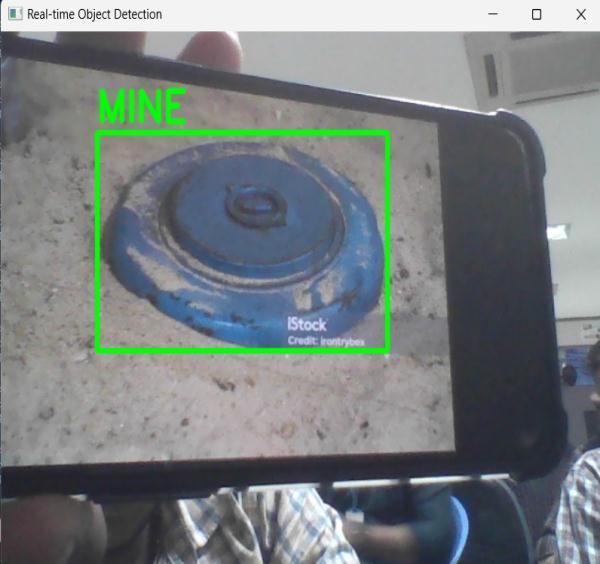
We have Already discussed that detecting the landmines byusingthesensorisnotthough efficientinthiswehave integratedtheDeeplearningMethodsandopenCVtoFine thelandmines.
Raspberry Pi:
Raspberrypiisourmaincontroller.Raspberrypiisknown as a minicomputer by using this we can able to process what are the things we can do in our PC. In the existing systemmostofthemhaveusedtheArduinothereasonfor choosing the raspberry is they have a good processing speed compared to the Arduino. As well as the Arduino has Noinbuiltcamera port toconnect thecamera but our raspberry pi has a inbuilt camera port to connect the camerasoitisanaddedadvantageinthis.
GPS:
ByusingtheGPSmodulewearegoingtosendthelocation ofthemines.
Motor Driver:
Motor driver is a device by using this we are going to controlourmotordirections.
DC motor:
ByusingthisDCmotorswearegoingtomovethe robot
Pi Camera:
Usingthispicamerawearegoingtodetectthosemines.
6.ARCHITECTURE DIAGRAM
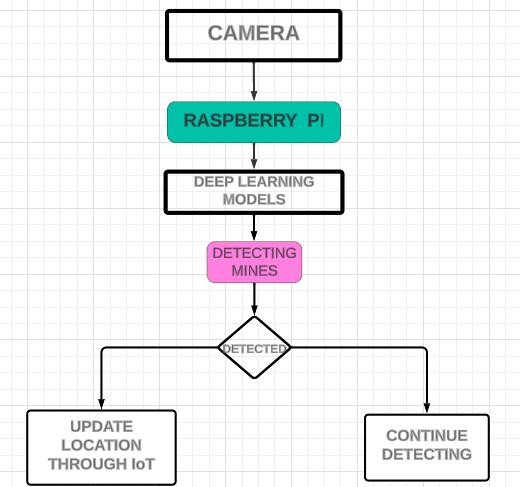
Fig-1:ArchitectureDiagram
7.UML DIAGRAM
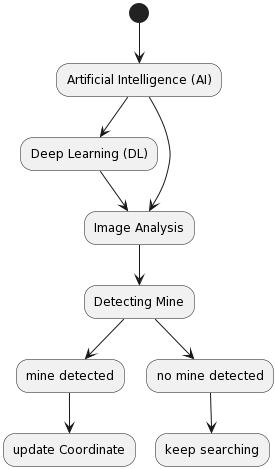
Fig-2: UMLDiagram
International Research Journal of Engineering and Technology (IRJET) e-ISSN: 2395-0056
Volume: 12 Issue: 11 | Nov 2025 www.irjet.net p-ISSN: 2395-0072
1.Accurate Mine Detection: Detecting deeply buried or non-metallic mines remains difficult due to varying soil andterrainconditions.
2.Sensor Limitations: Sensorsmaygive falsereadingsdue to environmental factors like humidity, temperature, or metallicinterference.
3.Real-Time Processing: Implementing AI algorithms for quick and precise decision-making requires high processingpower.
Inconclusion,creatinganadvancedmilitaryrobotwithAI and deep learning is a big step forward for finding mines and spotting threats. The robot learns to recognize mine patterns and quickly finds potential dangers using pictures. It can also give exact locations of mines so they canberemovedsafely.
This robot can do more than find mines - it can take pictures of people acting suspiciously, helping soldiers stay aware in dangerous situations. By using AI and deep learningtogether,thisrobotmakesitsaferforsoldiersand civiliansinwarzones.
In the future, we'll likely see even better robots thanks to more research. These robots will be smarter and able to handlemoretasksinthemilitaryandmaybeevenbeyond. But it's important to be careful, making sure these robots are used ethically, with people overseeing them, and following international laws as they become more commoninthemilitary.
[1] Seung Jae Moon,Jinsol Kim,Hongsik Yim, Yeeun Kim,Hyouk Ryeol Choi “Real-Time Obstacle Avoidance Using Dual-Type Proximity Sensor for Safe Human-Robot Interaction”06August2021.
[2] Ajay Yadav, Amit Prakash, Ajay Kumar, Sahadev Roy “Design of remote-controlled land mine detection troops safetyrobot”Volume56,Part1,2022.
[3] E Amareswar; G Shiva Sai Kumar Goud; K Maheshwari”Multi purpose military service robot”18 December2017.
[4] LI. A. Hameed, "Motion planning for autonomous landmine detection and clearance robots", 2016 International Workshop on Recent Advances in Robotics and Sensor Technology for Humanitarian Demining and Counter-IEDs(RST),pp.1-5,2016.
[5] B. Kim, J. Kang, D. Kim, J. Yun, S. Choi and I. Paek, "Dual-sensor landmine detection system utilizing gpr and metal detector", 2018 International Symposium on AntennasandPropagation(ISAP),pp.1-2,2018.
[6] V. Abilash and J. P. C. Kumar, "Ardunio controlled landmine detection robot", 2017 Third International Conference on Science Technology Engineering & Management(ICONSTEM),pp.1077-1082,2017.