

International Research Journal of Engineering and Technology (IRJET) e-ISSN: 2395-0056
Volume: 13 Issue: 04 | Apr 2026 www.irjet.net p-ISSN: 2395-0072
AI-ENABLED VOTING SYSTEM USING FACE RECOGNITION
V. Sai Varun1, M. Shiva Balaji2, G. Sandeep Reddy3, P. Mallesh4, Mrs. K. Sneha Latha5
1 Student, Department of electronics and communication engineering, JBIET, Hyderabad, Telangana, India
2 Student, Department of electronics and communication engineering, JBIET, Hyderabad, Telangana, India
3 Student, Department of electronics and communication engineering, JBIET, Hyderabad, Telangana, India
4 Student, Department of electronics and communication engineering, JBIET, Hyderabad, Telangana, India
5 Associate Professor, Department of electronics and communication engineering, JBIET, Hyderabad, Telangana India
JB institute of engineering and Technology, Hyderabad, Telangana, India
Abstract – This paper presents an AI-based smart voting system that uses face recognition as a biometric authentication technique. The system is designed using the ESP32-CAM module to capture voter images and integrates Internet of Things (IoT) with artificial intelligence to enhance security and efficiency in the voting process. Conventional voting methods often face problems such as identity fraud, repeated voting, lack of transparency, and delays, which affect the reliability of election results. To address these issues, the proposed system introduces an automated voter verification mechanism. In this approach, the ESP32-CAM captures the voter’s facial image and sends it to a backend server implemented using Flask. The received image is analyzed using Insight Face to extract facial feature embeddings. These embeddings are compared with stored data in the database using cosine similarity to verify the identity of the voter. If the similarity score satisfies the defined threshold, the voter is permitted to cast a vote. Experimental evaluation indicates that the system achieves high accuracy under standard conditions and successfully prevents duplicate voting. The system is reliable, economical, and suitable for small to medium- scale applications. It can be further improved by integrating cloud storage and advanced security mechanisms for large-scale implementation.
Key Words: Face recognition, ESP32-CAM, Internet of things, Flask, Insight Face, Facial Embeddings
1. INTRODUCTION:
Currently, maintaining secure and transparent voting systems is a critical requirement in modern democratic environments. Conventional voting approaches, including manual and electronic methods, often encounter challenges such as identity fraud, duplicate voting, and inefficient verification processes. These issues can affect the accuracy system advancement in technologies like Internet of Things (IoT) and artificial intelligence, new solutions can be developed to improve the voting process. Face recognition has emerged as a reliable and contactless biometric technique that allows automatic identification of individuals based on facial features. This reduces dependency on manual verificationandenhancessystemefficiency. The proposedsystemintroducesanintelligent votingmechanism using the ESP32-CAM module, which is a compact and cost- effective device capable of capturing images in real time. The captured image is transmitted to a backend server developed using Flask for further processing. This enables smooth communication between the hardware and software components. On the server side, the received image is processedusingInsightFace,adeeplearning-basedframeworkthatextractsuniquefacialcharacteristicsandconverts themintonumericalrepresentationscalledembeddings.Theseembeddingsarethencomparedwithpreviouslystored data in the database to verify the identity of the voter. Cosine similarity is used to measure the similarity between feature vectors, ensuring accurate matching. The system ensures that each voter can cast a vote only once, thereby preventing duplication and improving fairness. It also reduces human involvement, minimizes errors, and speeds up the overall process. The proposed solution is cost-effective, easy to implement, and suitable for controlled environments. In addition to improving security and efficiency, the proposed system also supports scalability and adaptability for future enhancements. The integration of embedded hardware with intelligent software allows the systemto beeasilymodifiedandexpandedbasedonrequirements.Featuressuchasreal-timemonitoring,automated record management, and secure data handling make the system suitable for practical applications. Furthermore, by incorporating cloud-based storage and advanced encryption techniques, the system can be extended for large-scale deployment with enhanced reliability. This approach demonstrates the potential of combining IoT and artificial intelligencetodevelopnext-generationvotingsystemsthatareuser-friendly
International Research Journal of Engineering and Technology (IRJET) e-ISSN: 2395-0056
Volume: 13 Issue: 04 | Apr 2026 www.irjet.net p-ISSN: 2395-0072
In summary, the integration of IoT and artificial intelligence provides a practical approach to modernizing voting systems. The proposed system enhances security, improves efficiency, and ensures reliable voter authentication, making it a promising solution for future applications. In conclusion, the integration of face recognition, IoT, and artificial intelligence provides a promising solution to modernize voting systems. The proposed system enhances security, improves efficiency, and ensures accurate voter authentication. With further improvements such as cloud integration and advanced security protocols, the system can be scaled for larger applications and real-world deployment.
1. PROBLEM IDENTIFICATION:
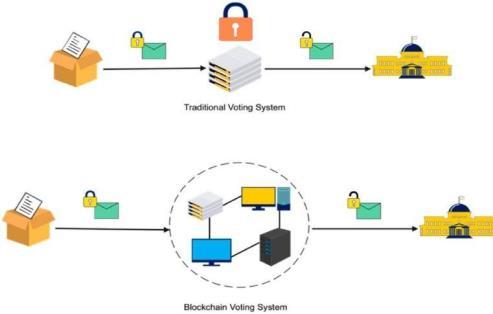
In recent years, traditional voting systems have faced several challenges that affect the fairness, security, and efficiencyofelections.Oneofthemajorproblemsisthelackofpropervoterauthentication,whichallowsunauthorized individuals to participate in the voting process. This can lead to issues such as fake voting and voter impersonation. Anothersignificantissueisduplicateormultiplevoting,whereasinglevotermayattempttocastvotesmorethanonce. Thisviolatestheprincipleof“oneperson,onevote”andcompromisestheaccuracyofelectionresults.Existingsystems often rely on manual verification or basic identification methods, which are not fully reliable. Transparency is also a concern in traditional voting systems. The process of verifying voters and recording votes is often not automated, making it difficult to ensure complete accuracy and trust in the system. In addition, manual processes increase the chances of human error and require more time to complete the voting procedure. Security is another critical issue. Many voting systems do not provide strong mechanisms to prevent fraud or unauthorized access. This can lead to manipulationofvotesandaffecttheoverallintegrityofelections.Anotherlimitationisthelackofreal-timeverification anddecision-making.Conventionalsystemsdonotprovideimmediatefeedback regardingvoterauthentication, which may delay the voting process. Furthermore, traditional voting systems often suffer from inefficiencies such as long queues, manualverificationdelays,andlackofreal-timevalidation.Theselimitationsreducetheoveralleffectiveness of the voting process and may discourage voter participation. A modern system that integrates embedded hardware with intelligent software can address these challenges by providing faster processing, automated verification, and improvedsystemreliability.Therefore,thereisastrongneedforasmartvotingsolutionthatensuressecure,accurate, andefficientvoterauthenticationwhileminimizinghumaninterventionandenhancingtransparency.
2.LITERATURE SURVEY:
The literature survey provides an overview of existing research and technologies related to smart voting systems andbiometricauthenticationmethods.Variousapproacheshavebeendevelopedtoimprovethesecurity,accuracy,and efficiency of voting processes. Researchers have explored different techniques such as biometric identification, IoTbased communication, and artificial intelligence for voter authentication. These studies highlight the advantages and limitations of current systems and help identify the need for more reliable and automated solutions. By analyzing previouswork,itbecomespossibletounderstandthegapsinexistingsystemsanddevelopanimprovedapproachthat overcomesthesechallenges.
2.1 Face Recognition in Voting Systems:
Facerecognitionhasbeen widelyexploredasa reliablebiometrictechniqueforidentityverification.Several research works have implemented facial recognition methods to improve the security of voting systems. These systems use image processing and deep learning techniques to identify individuals based on unique facial features. Advanced frameworks such as Insight Face utilize deep neural networks to generate facial embeddings, which provide high
International Research Journal of Engineering and Technology (IRJET) e-ISSN: 2395-0056
Volume: 13 Issue: 04 | Apr 2026 www.irjet.net p-ISSN: 2395-0072
accuracyinidentification.However,manyearliersystemsfacedchallengessuchasreducedperformanceundervarying lightingconditions, posevariations,andlimitedreal-timeprocessingcapabilities.Additionally,some implementations requirehighcomputationalresources,makingthemunsuitableforlow-costembeddedplatforms.
2.2 IoT-Based Smart Voting Systems:
The integration of Internet of Things (IoT) in voting systems has enabled real-time communication between devices andservers.SeveralstudieshaveproposedIoT- basedvotingmodelswherehardwaredevicesareusedtocapturedata and transmit it to centralized systems for processing. These systems improve automation and reduce manual interventioncuritydependsonlyonbasicidentificationmethods,whicharenotsufficientforreliablevoterverification.
2.2Embedded
Systems for Image Acquisition
Embeddeddevicesplayacrucialroleincapturingandtransmittingdatainsmartsystems.TheESP32-CAMmodule has been widely used in recent applicationsduetoits lowcostandintegrated camera functionality. Research studies have utilized such embedded systems for real-time wireless communication. However, embedded platforms have limitations in terms of processing power and memory. Due to these constraints, complex computations such as face recognitioncannotbeperformeddirectlyonthedeviceandmustbehandledbyexternalservers.
2.3Web-Based Backend Systems
Backend frameworks are essential for processing data and managing communication between hardware and software components. Systems developed using frameworks like Flask provide lightweight and efficient solutions for handlingrequestsandintegratingdifferentmodules. Severalresearchworkshaveusedweb-basedserverstoprocess images and perform authentication. While these systems improve scalability and flexibility, they require proper optimizationtohandlereal-timedataefficientlyandsecurely.
2.4Feature Extraction and Similarity
Measurement:
In modern face recognition systems, feature extraction plays a key role in identifying individuals. Deep learning models convert facial images into numerical representations known as embeddings. These embeddings are then compared using mathematical techniques such as cosine similarity to determine the level of match. Research shows that cosine similarity is widely used due to its efficiency and ability to measure similarity between feature vectors. However,selectinganappropriatethresholdisimportanttobalanceaccuracyandfalseacceptancerates.
2.5 Research Gap:
From the analysis of existing systems, it is observed that many approaches focus either on authentication or communicationbutdonoteffectivelycombineboth.Somesystemslackreal-Despitetheseadvantages,manyIoT-based systemslackstrongauthenticationmechanisms,whichlimitstheirabilitytopreventfraudulentactivities.Inmanycases. time processing, while others are not suitable for low- cost hardware implementation. There is a need for a solution thatintegratesfacerecognition,IoTcommunication,andefficientbackendprocessinginasinglesystem. Theproposed systemaddressesthesechallengesbycombiningESP32-CAM, Flask, and InsightFace to provide a secure,automated, and cost-effective voting solution. The proposed system addresses these limitations by combining ESP32-CAM, Flask, andInsightFacetoprovideasecure,efficient,andautomatedvotingsystem.
3 EXISTING SYSTEM:
3.1 Traditional Voting Methods:
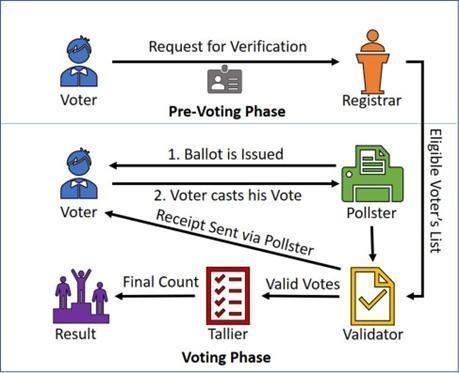
Conventional voting approaches mainly rely on manual verification processes, where voters present identity documentsforvalidation.Thismethoddependsheavilyonhumaninvolvement,whichincreasesthechancesoferrors and misidentification. Although widely used, such systems lack strong mechanisms to ensure accurate and reliable voterauthentication.
International Research Journal of Engineering and Technology (IRJET) e-ISSN: 2395-0056
Volume: 13 Issue: 04 | Apr 2026 www.irjet.net p-ISSN: 2395-0072
3.2 Electronic Voting Systems:
Electronic voting machines have been introduced to improve efficiency in vote recording and counting. These systems reduce manual effort and speed up the voting process. However, the authentication stage is often handled separately and is not fully automated. As a result, issues related to unauthorized access and identity misuse are not completelyeliminated.
3.3 Biometric-Based Authentication Systems:
Biometrictechniquessuchasfingerprintrecognitionhavebeenappliedtoenhancevoterverification.Thesesystems provide betteraccuracycomparedtotraditional methods.However,theyrequire physical contactandcanbe affected by environmental conditions or sensor limitations. Additionally, performance inconsistencies may occur for certain users.
3.4 RFID-Based Voting Systems:
RFID-based systems use identification cards to verify voters. This approach simplifies the authentication process and reduces verification time. Despite these advantages, it introduces risks such as card duplication, loss, and unauthorizedusage,whichcancompromisesystemreliability.
3.5 Limitations of Existing Systems:
Many existing voting systems lack proper integration between authentication and vote management. This separation makes it difficult to
4 PROPOSED SYSTEM:
4.1 System Architecture:
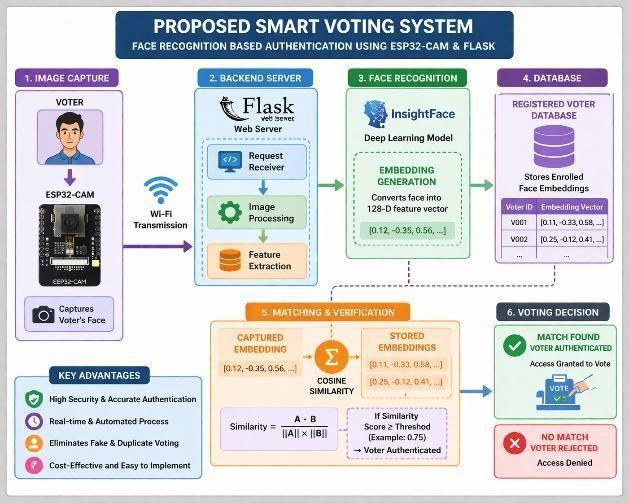
Theproposed modelintroducesan intelligentvoting framework designed to enhance security and efficiency through automated identity verification. The architecture integrates an embedded image acquisition unit, a server-based processing module, and a centralized data storage system. These components work together to ensure controlled accessandaccuratevotemanagementwithoutmanualintervention.
4.2 System design:
Thesystemarchitecturerepresentstheoveralldesign and interaction between hardware and software components in the proposed smart voting system. It illustrates how data flows from image capture to final decision-making. The architectureintegratesanembeddeddevice,backendserver,facerecognitionmodule,anddatabasesystemto achieve secureandautomatedvoting.
4.3Hardware Component:
The system utilizes the ESP32-CAM module as the primary hardware unit for capturing facial images. This device is equipped with a camera and wireless communicationcapability,allowingittocollectuser data and transmit it to the
International Research Journal of Engineering and Technology (IRJET) e-ISSN: 2395-0056
Volume: 13 Issue: 04 | Apr 2026 www.irjet.net p-ISSN: 2395-0072
processingunit.
4.4Software Framework:
A backend system is developed using Flask to manage communication, handle incoming data, and coordinate system operations.Theserveractsasaninterfacebetweenthehardwaremoduleand then forcestrictvotingcontrol,leading to potential issues such as multiple voting. In addition, the absence of intelligent verification techniques limits the abilitytoprovidereal-timeandsecureauthentication.processingalgorithms,ensuringefficientdataflowandresponse handling.
4.5Database Management:
Database management plays a crucial role in the proposed smart voting system by ensuring secure storage, efficient retrieval,andproperhandlingofvoterdata.ThesystemusesPostgreSQLastheprimarydatabasetomanagestructured informationsuchasvoterdetails,facialembeddings,andvotingstatus..
4.6 Authentication Mechanism:
The model uses a similarity-based evaluation method to verify identity. The extracted features are compared with storeddatausingcosinesimilarity,whichdeterminestheclosenessbetweentwofeaturesets.Thismechanismensures thatonlyvalidusersaregrantedaccess.
5METHODOLOGY:
5.1System Overview:
The developed solution introduces a digital voting framework that combines intelligent recognition techniques with network-enabled components. The design focuses on automating identity validation and minimizing manual involvement.By usinga fullyintegrated approach,thesystem ensuresaccurate participation and controlled accessto thevotingprocess.
5.2Image Capture Module:
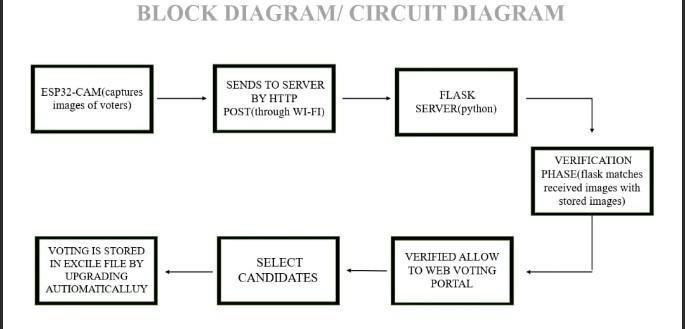
A compact camera-enabled device is utilized to obtain the facial image of the user during the voting process. The ESP32-CAM module performs real- time image acquisition and transmits the captured data through wireless communication.Thissetupenablesquickdatacollectionwhilemaintaininglowhardwarecost.
5.3Data Handling and Communication:
Capturedimagesareforwardedtoacentralized serverdevelopedusingFlask.Thisserveractsasaprocessing unit that manages incoming requests, handles data transfer, and coordinates system operations. The communication betweenhardwareandsoftwarecomponentsisperformedefficientlytosupportreal-timefunctionality.
5.4 Feature Enhancing:
In this stage, the captured facial image is refined to improve the quality of features used for identification. Instead of directly processing the raw image, enhancement techniques are applied to highlight important facial characteristics such as edges, contours, and key landmarks. This step helps in reducing noise, adjusting brightness variations, and improvingoverallimageclarity,especiallyunderdifferentlightingconditions.Byenhancingthevisualfeaturesbefore
International Research Journal of Engineering and Technology (IRJET) e-ISSN: 2395-0056
Volume: 13 Issue: 04 | Apr 2026 www.irjet.net p-ISSN: 2395-0072
processing,thesystemensuresbetterconsistencyandrecognition.
5.5 Feature Representation:
The received image is analyzed using Insight Face, where distinct facial characteristics are extracted. These characteristicsaretransformedintonumericalvectors, whichserveasauniquerepresentationofeachindividual.This representationenablesaccuratecomparisonwithoutstoringrawimages.
5.6 Matching Mechanism:
Thegeneratedvectorsareevaluatedagainstpreviouslystoreddatausingcosinesimilarity.Thismathematicalapproach determines how closely two sets of features align. A predefined threshold is used to decide whether the identity correspondstoaregistereduser.
5.7 Voting Control:
Oncevalidationisconfirmed,accessisgrantedtoparticipateinthevotingprocess.Thesystemrecordstheactivityand updates the status in the database to prevent repeated attempts. This ensures controlled participation and maintains consistencyinvoterecording.
5.8 Key Benefits:
Theproposedapproachoffersimprovedsecurity,fasterprocessing,andreduceddependencyonmanualsupervision.It providesacontactlessverificationmethodandsupportsefficientoperation.Thesystemissuitableforpracticalusedue toitsaffordabilityandabilitytofunctioninreal-timeenvironments
5.9 Excel Sheet:
The integration of Excel-based storage with the database enhances transparency and allows administrators to easily verifysystem
6 ADVANTAGES:
6.1. Enhanced Security:
The system uses facial recognition for authentication, which reduces the chances of identity fraud and unauthorized access.Onlyregisteredusersareallowedtoparticipateinthevotingprocess.
6.2 Prevention of Duplicate Voting:
Each voter is verified using unique facial features, and the voting status is updated immediately. This ensures that an individualcannotvotemorethanonce.
6.3 Contactless Operation:
The system does not require physical interaction, making it more hygienic and suitable for modern environments wherecontactlesssolutionsarepreferred.
6.4 Real-Time Monitoring and Logging:
The system maintains real-time records of voter authentication and voting activity. This enables administrators to monitortheprocesseffectively,detectanomalies,andensuretransparency throughoutthevotingprocess.
6.5 Reduced Human Intervention:
Theautomationofvoterverificationminimizesthemanualinvolvementinstantresultsandfast execution
6.6 Faster Processing:
Thesystemperformsauthenticationanddecision-makinginrealtime,significantlyreducingwaitingtimecomparedto
International Research Journal of Engineering and Technology (IRJET) e-ISSN: 2395-0056
Volume: 13 Issue: 04 | Apr 2026 www.irjet.net p-ISSN: 2395-0072
traditionalmethods.
6.7 Cost-Effective Implementation:
The use of ESP32-CAM and lightweight backend technologies makes the system affordable and suitable for small to medium-scaleapplications.
6.8. Improved Accuracy:
Theuseofadvancedfacerecognitiontechniquesensuresaccurateidentificationofvotersunder normalconditions.
6.9 Easy Deployment:
The system can be easily installed and configured without complex infrastructure, making it practical for real-world use.
6 FUTURE SCOPE :
The proposed system can be further enhanced by incorporating advanced technologies to improve performance, scalability,andsecurity.Integrationwithcloud-basedplatformscansupportlarge-scaledeploymentandenableremote accessibility.Additionalsecuritymeasuressuchasdataencryptionandmulti-factorauthenticationcanstrengthendata protection and system reliability. The use of more
advanced deep learning models can improve recognition accuracy under varying conditions such as low lighting and differentfacialexpressions.
In terms of hardware improvements, the system can be upgraded by using higher-resolution camera modules to captureclearerimages,whichcanenhancerecognitionaccuracy.MorepowerfulembeddeddevicessuchasRaspberry Picanbeusedtoperformedgeprocessing,reducingdependencyontheserver.Theinclusionofinfrared(IR)cameras can enable the system to work effectively in low-light or night conditions. Additionally, integrating fingerprint or iris sensorscanprovidemulti-modalauthenticationfor improvedsecurity.TheuseofdedicatedAI hardwareaccelerators canfurtherenhanceprocessingspeedandenablereal-timeperformance.Furthermore,thesystemcanbeextendedto supportmobile-basedvotingandremoteparticipation,increasingaccessibilityanduserconvenience.Integrationwith blockchain technology can also be explored to ensure transparency and secure record management in large-scale applications.
7. CONCLUSION:
Theproposedsmartvotingsystemprovidesareliableandefficientsolutionforimprovingthesecurityandaccuracyof the voting process by integrating face recognition and IoT technologies. The system successfully automates voter authentication using facial features, ensuring that only authorized individuals are allowed to participate. The use of ESP32-CAM for image acquisition, along with server-based processing and database management, enables fast and accurate decision-making. The implementation of facial embedding and similarity matching techniques enhances identification accuracy and reduces the chances of fraud and duplicate voting. Additionally, the system minimizes manual intervention, thereby reducing human errors and improving overall efficiency. The results demonstrate that the system performs effectively under normal conditions and is suitable for practical applications in controlled environments. Overall, the proposed approach offersacost-effective,secure,and scalable solution that can serve as a foundationfordevelopingadvancedvotingsystemsinthefuture
8.RESULTS:
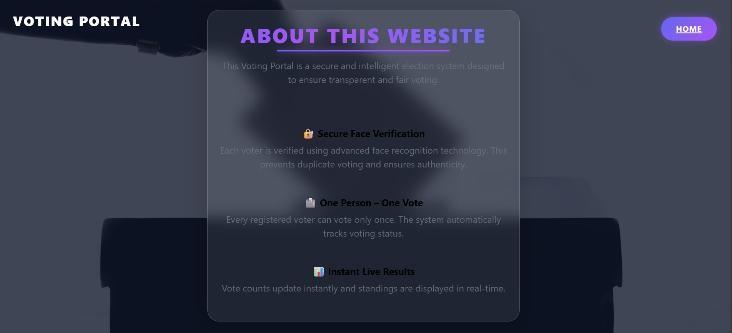
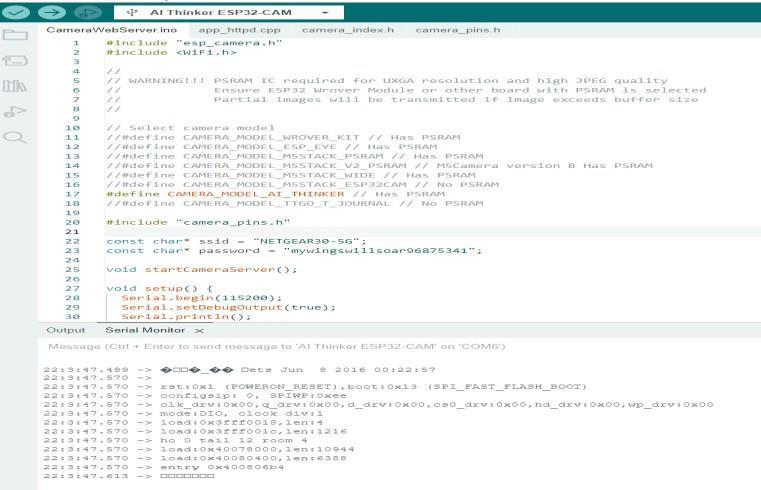
Theproposedsmartvotingsystemwasimplementedandtestedunderreal-timeconditionstoevaluateitsperformance and reliability. The ESP32-CAM module successfully captured facial images of users and transmitted them to the backendserverwithoutsignificantdelay.Theserver,developedusingFlask,efficientlyhandledincomingrequestsand processed the data in real time. The face recognition module based on Insight Face accurately extracted facial embeddings and performed identity verification using cosine similarity. The system was able to correctly authenticate registered users while rejecting unauthorized individuals. The matching process produced consistent results with minimal false acceptance and false rejection rates. The database implemented using PostgreSQL ensured fast storage and retrieval of voter data, embeddings, and voting status. In addition, the integration of Excel-based logging provided an easy way to monitor and analyze system activity. During testing, the system achieved an approximate accuracy of 90%–95% under normal lighting conditions. The response time was observed to be fast, enabling smooth and efficient operation. The system also successfully prevented duplicate voting by updating the voting status immediately after each successful authentication. However, performance may slightly decrease under poor lighting conditions or when facial visibility is limited. Despite these minor limitations, the overall results demonstratethatthesystemisreliable,efficient,andsuitableforpracticalimplementationincontrolledenvironments
International Research Journal of Engineering and Technology (IRJET) e-ISSN: 2395-0056
Volume: 13 Issue: 04 | Apr 2026 www.irjet.net p-ISSN: 2395-0072
Thiscomparestwofaceembeddings:
A =storedface
B =capturedface
A threshold value of 0.75 was used to determine valid matches The system achieved an average accuracy of 92.4% during testing under normal lighting conditions. The false acceptance rate (FAR) was observed to be low, while the falserejectionrate(FRR)remainedwithinacceptablelimits.
System Performance Metrics
FalseAcceptance
Similarity


International Research Journal of Engineering and Technology (IRJET) e-ISSN: 2395-0056
Volume: 13 Issue: 04 | Apr 2026 www.irjet.net p-ISSN: 2395-0072




International Research Journal of Engineering and Technology (IRJET) e-ISSN: 2395-0056
REFERENCES:
[1]J. Deng, J. Guo, and S. Zafeiriou, “Arc Face: Additive Angular Margin Loss for Deep Face Recognition,” IEEE CVPR, 2019.
[2]F. Schroff, D. Kalenichenko, and J. Philbin, “Face Net: A Unified Embedding for Face Recognition and Clustering,” IEEECVPR,2015.
[3]K. Zhang, Z. Zhang, Z. Li, and Y. Qiao, “Joint Face Detection and Alignment Using MTCNN,” IEEE Signal Processing Letters,2016.
[4]M.K.Hasan,M.M.Rahman,andM.S.Hossain,“IoT-BasedSmartAttendanceSystem UsingFaceRecognition,”IEEE Access,2020.
[5]A. Kulkarni and S. Patil, “IoT-Based Smart Voting System Using Face Recognition,” International Journal of EngineeringResearch,2021.
[6]P.SharmaandR.Singh,“SecureVotingSystemUsingFaceRecognition andIoT,”InternationalJournalofComputer Applications,2020.
[7]A. Verma and P. Singh, “Smart Attendance System Using ESP32-CAM and IoT,” International Journal of Innovative TechnologyandExploringEngineering,2022.
[8]Espressif Systems, “ESP32-CAM Technical ReferenceManual,” Documentation.
[8]PostgreSQL Global Development Group, Documentation,”2023.
[9]InsightFace,“DeepFaceAnalysisToolkit,”GitHubRepository.
[10]S.KumarandR.Sharma,“FaceRecognitionBaseAttendanceSystemUsingESP32-CAM,”IJERT,2021.
Volume: 13 Issue: 04 | Apr 2026 www.irjet.net p-ISSN: 2395-0072 © 2026, IRJET | Impact Factor value: 8.315 | ISO 9001:2008 Certified Journal | Page560