
International Research Journal of Engineering and Technology (IRJET) e-ISSN: 2395-0056
Volume: 13 Issue: 04 | Apr 2026 www.irjet.net p-ISSN: 2395-0072

International Research Journal of Engineering and Technology (IRJET) e-ISSN: 2395-0056
Volume: 13 Issue: 04 | Apr 2026 www.irjet.net p-ISSN: 2395-0072
Thanzeela Mol A1, Anandhu V k2, Muhammed Sajad K D3, Deepak Krishna K V4, Risla pk K5
1HOD, Dept of Electronics and Communication Engineering, Al Ameen Engineering College, Palakkad, India 2345Student, Dept of Electronics and Communication Engineering, Al Ameen Engineering College, Palakkad,India
Abstract - Beach pollution, especially due to plastic waste, has become a major environmental concern affecting marine life and coastal ecosystems. This project presents the design and development of an AIbased Beach Cleaning Robot that automates the process of waste detection, collection, and segregation. The system integrates a Raspberry Pi 4 Model B, Arduino Uno , USB camera, and motor control mechanisms to perform intelligent cleaning operations. The camera captures real-time images of the beach surface, and the system uses ONNX Runtime to detect both plastic and metal waste using a trained machine learning model. The robot classifies waste into recyclable plastic and non-recyclable categories, where metal and other non-recyclable waste are deposited together .The Arduino controls motors and actuators, enabling movement and waste collection. The system is designed to reduce human effort, improve cleaning efficiency, and support environmental sustainability. This project demonstrates the effective use of artificial intelligence, embedded systems, and robotics for smart waste management in coastal areas.
Key Words: Raspberry Pi, Arduino Uno, ONNX Runtime, Beach Cleaning Robot, AI, Plastic Detection.
Plastic pollution on beaches has become a serious environmentalissue,affectingmarineecosystems,tourism, and human health. Traditional beach cleaning methods rely heavily on manual labor, which is time-consuming, inefficient, and labor-intensive. To overcome these limitations, this project proposes an automated beach cleaning robot that uses artificial intelligence and embeddedsystemsforefficientwastemanagement ThesystemcombinesRaspberryPi4ModelBandArduino Unotocreateahybridcontrolarchitecture.TheRaspberry Pi acts as the main processing unit, handling image processing and AI-based waste detection using ONNX Runtime, while the Arduino controls motors, sensors, and mechanicalcomponents.AUSBcameracapturesimagesof the beach, and the system identifies plastic waste objects such as bottles and wrappers. The system uses a USB camera along with ONNX Runtime to detect both plastic
andmetal wastethroughimageprocessing,enablingbasic wastesegregation.TherobotmovesonthebeachusingDC gear motors and collects waste using a mechanical conveyor system. Recyclable plastic waste is directed to a shredding mechanism, while non-recyclable waste is separated into a different bin. This integrated system enhances cleaning efficiency, reduces human effort, and supports sustainable waste management practices. The project highlights the importance of combining robotics andAIforenvironmentalprotection
The working of the beach cleaning robot is based on the integrationof artificial intelligence,andembeddedcontrol systems. When the system is powered ON, the Raspberry Pi4ModelBandArduinoUnoareinitialized,andtherobot starts moving forward using DC motors. A USB camera capturesimagesofthewastepresentonthebeachsurface, which are processed using ONNX Runtime to identify plastic and metal objects. Based on the classification results,thesystemactivatesthecollectionmechanismand separateswasteintotwocategories:recyclableplasticand non-recyclable waste including metal. The Arduino controls the motors and actuators, while the Raspberry Pi handles image processing and decision-making. The robot continuously performs detection, classification, and collection, ensuring efficient and automated beach cleaning.
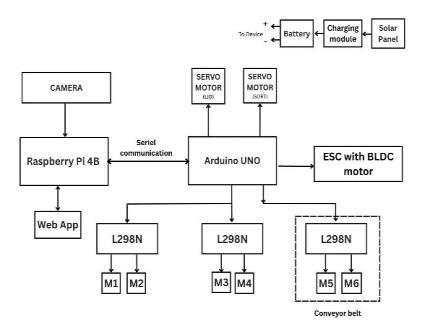
The USB camera collect information about the beach environment and the waste present on the surface. This information is sent to the Arduino Uno for initial processing. The Arduino Uno processes this data and may also send it to the Raspberry Pi 4 Model B for more complex processing such as image analysis. Based on the processed information, the Arduino Uno controls the motor drivers to move the robot and operates the servo motor for waste segregation. It also controls the conveyor belt and shredding mechanism for waste collection and processing.Thesystemcanalsosendinformationtoaweb applicationformonitoringandcontrol.
International Research Journal of Engineering and Technology (IRJET) e-ISSN: 2395-0056
Volume: 13 Issue: 04 | Apr 2026 www.irjet.net p-ISSN: 2395-0072
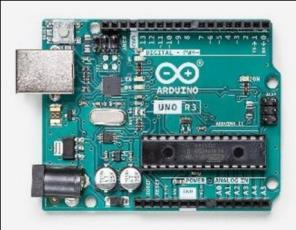
The Arduino Uno acts as the main controller for sensors and actuators. It receives input from sensors, processes basic data, and controls motors, servo mechanisms, and other hardware components for robot movement and wastecollection..
3.2
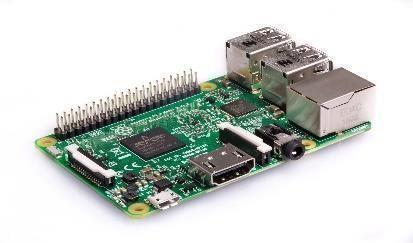
TheRaspberryPi4ModelBisusedasthemainprocessing unit of the system. It performs image processing and runs theAImodel using ONNXRuntimeto detect plasticwaste. ItalsocommunicateswiththeArduinoUnoforcontrolling hardware components and supports web-based monitoring.
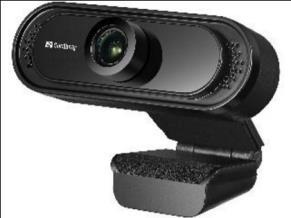
TheUSBcameraisusedtocapturereal-timeimagesofthe beach surface. These images are sent to the Raspberry Pi for processing and detection of plastic waste using AI techniques.
3.4
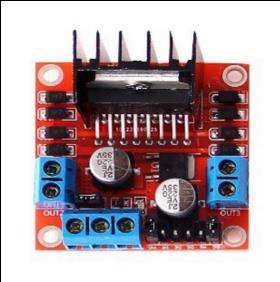
TheL298N MotorDriverModuleisusedtocontrol the DC motors. It allows the Arduino to control the speed and direction of motors used for robot movement and conveyoroperation.
3.5
Servo motors are used for controlling the direction of wasteflow.Theyhelpindivertingwasteintodifferentbins suchasmetal,recyclable,andnon-recyclablecategories.
The DC gear motors are used for the movement of the robot.Theyprovidesufficienttorquetomovetheroboton sandybeachsurfaces.
International Research Journal of Engineering and Technology (IRJET) e-ISSN: 2395-0056
Volume: 13 Issue: 04 | Apr 2026 www.irjet.net p-ISSN: 2395-0072
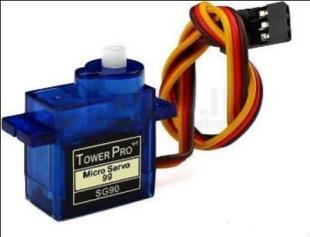
Fig 3.5 servo motor
3.6 ESC (Electronic Speed Controller)
The Electronic Speed Controller (ESC) is used to control the speedof the BLDCmotor.It ensuressmooth operation ofthe shreddingmechanism.
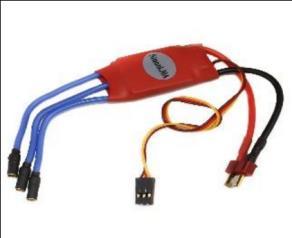
Fig3.6ElectronicSpeedController
3.7 Bldc motor
The BLDC motor is used in the shredding system to crush collectedplasticwasteintosmallerpiecesforeasierrecycling.
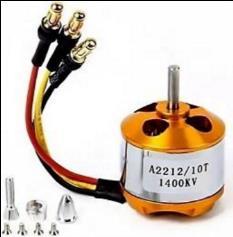
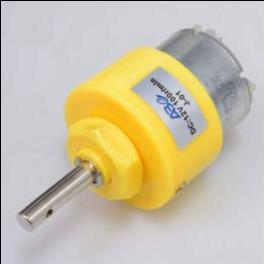
gearmotors
3.9 Solar panel
A solar panel is used as a power source to supply energytothesystem,which isstoredina batteryand distributed
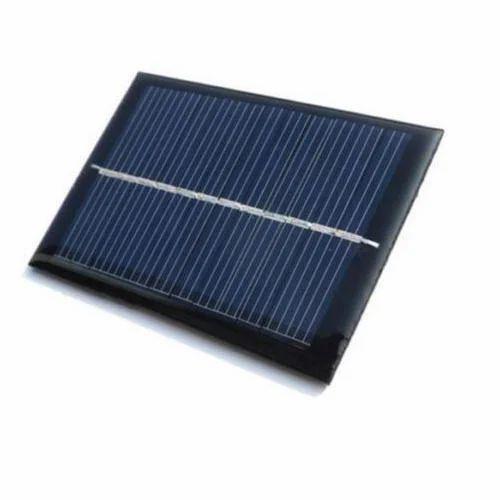
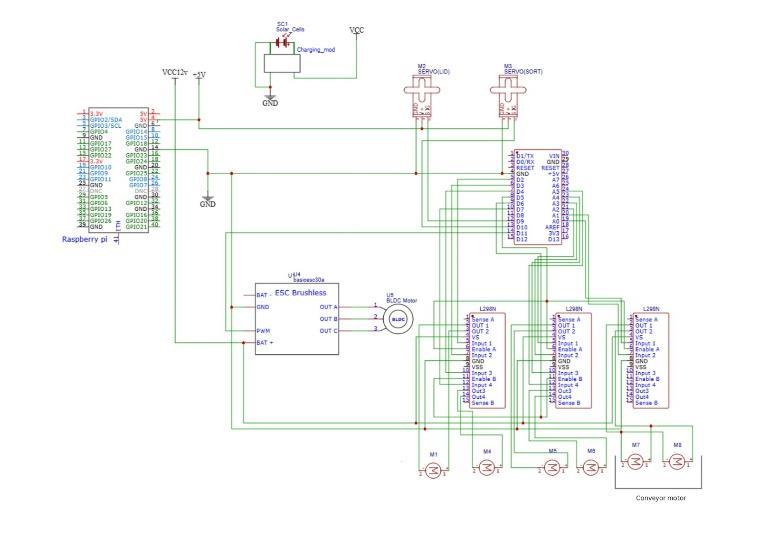
Fig4.1CircuitDiagram
5 RESULT AND DISCUSSIONS
The developed beach cleaning robot was successfully tested for its ability to detect and collect waste from the beach environment. The system was able to identify both plastic and metal waste using the USB camera and ONNX Runtime, providing satisfactory detection results under normal lighting conditions. The coordinated operation between the Raspberry Pi 4 Model B and Arduino Uno ensured smooth functioning of both processing and control tasks .The robotdemonstratedefficientmovementusingDCgear motors and successful operation of the conveyor and shredding mechanisms. However, the system performance was affected by factors such as uneven sandy surfaces, varying lighting conditions, and limited processing speed during real-time image analysis. Despite these limitations, the overall performanceofthesystemwaseffective,anditproved
International Research Journal of Engineering and Technology (IRJET) e-ISSN: 2395-0056
Volume: 13 Issue: 04 | Apr 2026 www.irjet.net p-ISSN: 2395-0072
to be a reliable solution for automated beach cleaning and wastemanagementapplications.
In conclusion, this project successfully demonstrated the potential of a beach cleaning robot incorporating AI-based waste detection and automated collection, highlighting the feasibility of integrating Raspberry Pi 4 Model B, Arduino Uno, camera-based sensing and ONNX Runtime, while also identifying areas for future improvement in detection accuracy,systemefficiency,andreal-timeperformance.
[1]Sivasankar et al., “Autonomous Trash Collecting Robot,” 2017.Wolpaw, J. R., Birbaumer, N., McFarland, D. J., Pfurtscheller, G., & Vaughan, T. M. (2002). Brain–computer interfacesforcommunicationandcontrol
[2]Thiagarajan and S. Satheesh Kumar, “Machine Learning Model for Beach Litter Detection,” 2018.J. Arnil, Y. Punsawad and Y. Wongsawat 2011 Wireless Sensor Network based Smart System for Healthcare Monitoring international conferenceonroboticsandbiomimetics,pp.2073-2076.
[3]N. Bano and A. Amin, “Radio-Controlled Beach Cleaning Bot,”2019
[4]Narayanan et al., “Plastic Waste Profiling System Using DeepLearning,”2020.
[5]Kong et al., “IWSCR: Intelligent Water Surface Cleaner RobotforFloatingGarbageCollection,”2021.