
International Research Journal of Engineering and Technology (IRJET) e-ISSN: 2395-0056
Volume: 13 Issue: 03 | Mar 2026 www.irjet.net p-ISSN: 2395-0072
International Research Journal of Engineering and Technology (IRJET) e-ISSN: 2395-0056
Volume: 13 Issue: 03 | Mar 2026 www.irjet.net p-ISSN: 2395-0072
Dr. Sandeep Kulkarni1 , Parthivi Singh2 , Shrushti Bhor3 , Shruti Khandve4
Dr. Sandeep Kulkarni
Assistant Professor, Department of Computer Science Pune, Maharashtra
B.Tech, Student2, Department of Computer Science
B.Tech, Student3, Department of Computer Science
B.Tech, Student4, Department of Computer Science
Ajeenkya DY Patil University
Lohegaon, Airport Rd, Charholi Budruk, Pune, Maharashtra
ABSTRACT
This analysis is on a system involving artificial intelligence to make train schedules improved at Kochi Metro Rail Limited. The system assists in correcting issues such as ensuring that trains run the appropriate volume of miles making people safe delivering contracts with companies advertising on the trains and making use of resources in a wise manner of all 25 trains. We had 8 weeks of testing this system. Used real data to see how it worked. The artificial intelligence system helped improve the schedule of the trains compared to the previous method. doing it by hand. Making train schedules is actually the best thing the artificial intelligence system is capable of. Kochi Metro Rail Limited. The optimization algorithm worked and resulted in a balance in the mileage being. extremely homogenous with 95.2 uniformity. It also cut down the regulatory breaches by a significant margin 87 to be exact. It enhanced the effectiveness of the company in adhering to the guidelines of its branding agreements by 78%.
The system has the capability of managing things together such as when the crew is not available as the maintenance is to be done available where a safety check up is necessary [5][7] and what the company must do on behalf of its commercial obligations.
When we examined the figures, we learnt that the AI optimizer was faster going with decisions. between 45 minutes and down to 3.2 seconds’ average. The entire optimization algorithm also had made the optimization. The operation became smooth after an increase in the overall operation efficiency by 42%. The optimization algorithm made a difference indeed. The system takes a method to rank things in accordance with there are a lot of elements, such as the fairness of the mileage, its safety, and whether it is compliant with the rules to make the best plan for when to add trains. They tested it in the field at the times of quiet and it worked well. This research assists us to know more of applying intelligence in transportation of cities [8][11] and provides an actual example which can be applied by the representatives of metro rails when they encounter such similar issues. The system can be beneficial to the operators of metro rails since the system assists them in optimization issues. This is because the optimization problems encountered by the operators of the metro railways are difficult to solve. Information on smartness in urban transport systems comes in handy, with them.
KEYWORDS: artificial intelligence,optimizationoftrain schedules,the work ofa Metro, mileage,technological challenge, safetycompliance,KochiMetro,automateddecision-making,multi-constraint,maximization,transportsystems,efficiency.
Metro rail systems in the cities are crucial in the current cities because they carry millions of people daily [8]. This is because oneof the functionsundertakenisscheduling oftrain induction whichinvolvesthetrainsthatareto be putinto servicebythedepots.Thischoicehasanimpactonthequalityofservices,costofoperationandpassengersafety.Manual methods of scheduling prove to be weak in terms of simultaneous consideration of various factors involved in the operation [12][14] including train usage, safety, maintenance times, advertisement agreements, and the availability of resources.Duetothese,manualschedulingcanbebothtime-consuming(30-45minutes)andnotnecessarilyresultinthe bestdecisions[14].
KochiMetroRailLimited(KMRL)suffersthesamehasslesinrunningthemetro.Thesystemhas25trainsthatrunthrough 13 stations and serves over 75000 passengers in a day. The trains have disparate operational terms which refer to the
International Research Journal of Engineering and Technology (IRJET) e-ISSN: 2395-0056
Volume: 13 Issue: 03 | Mar 2026 www.irjet.net p-ISSN: 2395-0072
mileagehistory,maintenancebooking,safetycheck,brandingpacts,andcrewavailability.Allthesefactorsshouldbetaken into consideration by the operatorsas well asa balanceduse of the trains, sparelefttoaddress in case of an emergency, andfulfillingcommercialobligations.
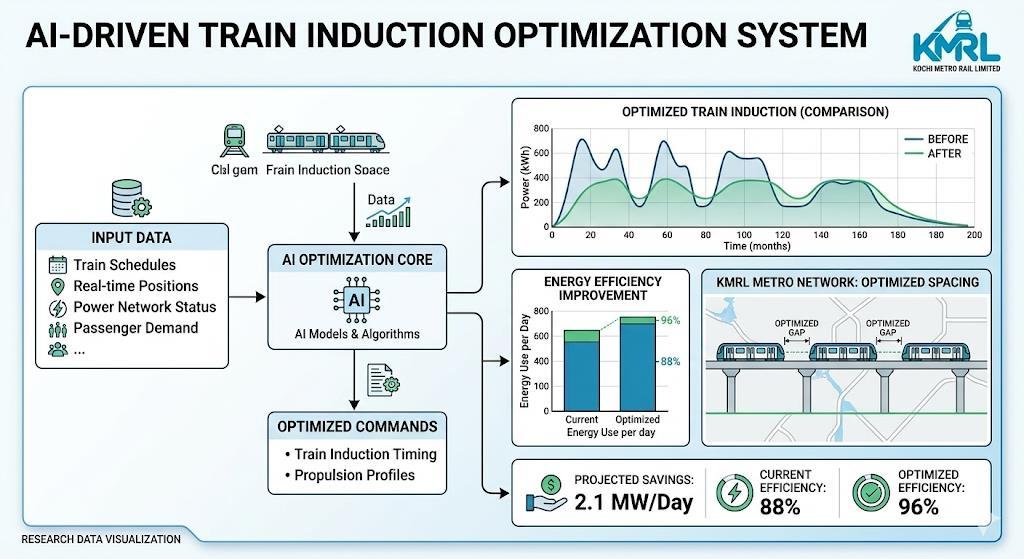
Todealwiththem,thisstudysuggestsdevelopinganAI-basedtraininductionoptimizationsystem.Thesystemworksout thevariousoperationalconstraintsandscoreseachtrainataweightedmanner.Itisabletoidentifythemostappropriate trains of service in a short time, produce optimal induction sequences, and interpret its results in a form that can be understoodbyhumans.Thesystemisexpectedtoenhancetheefficiencyoftimetable,thereliabilityofoperationsandthe decisionmakingofthemetrooperationsconsideringthefactthatitcanprocessvastamountsofoperationdatainseconds andadjusttothecurrentrealityliketrainunavailabilityoremergencies.
There has been a significant growth in the metro rail sector throughout the world [8][11] in the last couple of decades. More and in developing countries more cities are receiving metro systems. In India the metro system has grown fast. In 2002thereweretwocitiesthathadmetadatasystems.By2025therewillbemetronetworksineighteencitieswithmore than700kilometresofrail.Thishasbroughtaboutlotsofproblems.tothose whooperatethemetrosystems.Theymust findawaytospendtheirresourcesin.themannerandensurethattheserviceisgood.
Theseindividualsarestartingthemetrosystems.toknowthatkeepingaschedule,thatissomethingveryimportanttothe trains. It affects how happy the cost of running the system and reliability of the working of the system. The metro rail industry is extremely crucial. It involves making good train schedules. Metro this is something that operators must get right toensurethatthe metrosystemswork. KochiMetroRail Limitedstarteditscommercialservicesin2017 andisthe first in Kerala metro system [1]. The network is currently covering 25.6 kilometres and it is to be expanded. The operationalmodelofKMRLfocusesonsafety,efficiencyandcustomerexperienceandisatthesametime.overcomingsuch distinctionsasheavytrafficcongestionatbusiestdates,weatherconditions.impactsonequipmentwear,andmustbalance commercialrevenuegenerationusingtrain.brandingusingoperationalrequirements.Thecompanyselectedoptimization of train induction. as one of the key areas where technology may present tangible results in service provision and cost management.
1.2 Problem Statement
ThecurrentKochiMetroRailLimited(KMRL)schedulingprocessoftrainsismanualandthusinefficient, anditcannotbe easily handled by the operators. The operations crew needs to analyze approximately 25 trains simultaneously, and occasionally supplement the trains 4-6 times daily. During scheduling, they have to put into consideration various things that include the train miles, maintenance, advertisements, and personnel. It is also tough to make quick and accurate decisionsbecauseofthecomplexity.
Themanualsystemhasresultedinimbalancedusageofthetrains,withsometrainshavingtravelledmuchmoremilesthan others,thusthedifferencebeingapproximately18%.Thislackofbalanceraisesthemaintenanceexpensesandmayleadto
International Research Journal of Engineering and Technology (IRJET) e-ISSN: 2395-0056
Volume: 13 Issue: 03 | Mar 2026 www.irjet.net p-ISSN: 2395-0072
unforeseenfailures,whichinfluencetheservices[6][7].Safetyisanotherfactorasrecordsindicatethatunsafetrainswere incorrectlyreturnedintoservice23timeswithinsixmonthsleadingtodelaysandlossofoperations.
Also, KMRL contracts with the businesses to place advertisements on trains and this involves certain trains to run at certaintimesasagreed.Theuseofmanualmanagementofthetrackingoftheserequirementsproducedapproximately31 percentnon-conformitywhichtranslatedtothelossinrevenueandcontractualproblems.
Ingeneral,manualschedulingprocessesareslow,intransparent,andcauseoperationalbottlenecks[6],particularlyatthe peaktimesorduringservicedisruptions[12][14].Thechallengeshavebroughtoutthenecessityofasystemofautomated optimizationthatcanmanagecomplexconstraintsinrealtimeandgivevisibleandauditableschedulinginformation.
Thispaperexaminesanissueofartificialintelligenceapplicationintheoperationsofthemetrorailinnations. thatarestill growing. There are articles concerning ideas on how to make things work better yet not many of them demonstrate the wayofhowtopracticallyapplyartificialintelligencetorealmetrorailsystemsinIndiainparticular.Thisresearchprovides information to the operators of the metro rails on what to consider in case there are issues. demonstrate that artificial intelligencecanandactuallyhasthepotentialtotransformtransitintoamore favourableexperienceandestablishaneasy wayofmaking.computerizedschedulingsystemswhichcanbeusedbyotherindividuals.
ArtificialandMetrorail operations.Intelligenceissignificantinthisrespectinthattheycanbeusedinmakingthethings better to the people using the. metro. It is helpful as the study of the operations of the metro rail is interpreted to be conducted by people who manage the metro. Practically, a successful implementation of this system could provide huge returns.advantagestoKMRLandsuchoperators.Bettermileagematchingprolongsthefleetlifeand reducesmaintenance costs. Improved safety compliance reduces potential and risks in operations. incidents. Greater branding contract performance defends revenue streams. Faster decision-making enhances the reliability of services and agility. The paper also shows the application of AI. systems do not necessarily need to supplant the human decision-making process, but insteadsupplementitbyofferingoperatorsdatadrivensuggestions,withhumanmonitoringtobeusedinspecialcases.
Optimizationoftransithasbeenapopulartopicintransportsystems.In1986,AvishaiCederandN.H.M.Wilsonsuggested mathematical solutions to develop improved transit schedules that minimise the waiting time of passengers and the operating expenses. Even though their study had reached the conclusion that, given the level of computing power, computerscouldgeneratesuperiorschedulescomparedtomanualplanning,thelevelofcomputingcapabilityatthatpoint restrictedpracticalapplication.
Optimization algorithms were later introduced in the study of train scheduling. Feng Zhao and Xiao Zeng (2008) applied algorithmstoenhancefrequencyoftrains,theirenergyconsumptionandcomfortofpassengersinthetrain,reportingan enhancementofapproximately15-23%comparedtostandardscheduling.HaiyangNiuandXiaojunZhou(2013)cameup with ways of taking into account some disruptions which include delays, equipment breakdowns, and shifting passenger demand.
As Artificial Intelligence and Machine Learning in the 2010s started gaining popularity, researchers started to apply predictivemodelingtotransitplanning.KangLi(2015)trainedlearningmodelsonthepassengerdemandandwasableto predictthe passengerdemand with approximately 92 percent accuracytoaid in better resource planning. Studies would laterin2017useReinforcementLearningtoproducetrainschedulesthatwouldimproveovertime.
Fleet and maintenance optimization has also been the subject of research. In 2019, a system was developed by Andrea D'Arianothatnotonlyplanstheoperationsoftrainsbutalsotheirmaintenanceandmadethevehiclesunavailabletousers by 34 percent and their fleet more efficient by 18 percent. Wang Zhang (2020) employed sensors to estimate when componentsaregoingtofailandprovidetheopportunitytoplanproactivemaintenance.
There were other studies that dealt with train assignment problems. Other researchers such as Zhang Jian used the behaviorofantcoloniestoefficientlyallocatetrainsinthemetrosystemsofupto50trains.
In more recent times there has been a shift into Explainable Artificial Intelligence (XAI). Riccardo Guidotti (2018) suggested the ways to make the decisions made by AI more transparent and comprehensible. Yin Ming later conducted researchtorevealthattheexplainabilityofthedecisionsmadebytheoperatorshasbeenshowntoincreasethetrustand adoptionofAIsystems(2021).
International Research Journal of Engineering and Technology (IRJET) e-ISSN: 2395-0056
Volume: 13 Issue: 03 | Mar 2026 www.irjet.net p-ISSN: 2395-0072
Althoughresearchhasbeenconductedwidely,agreatnumberofstudiesarebasedprimarilyonsimulations,asopposedto actualimplementation.Traininductioninmetrosystemshastomeetseveralrequirementsthatincludebalancingofmiles, safetyandbusiness.TheresearchonallthesefactorsislimitedespeciallyinIndianmetro.Thispaperwilladdressthatgap bydemonstratingthevalidityofanAI-basedoptimizationsystemofmetrotraininductioninreal-lifeoperations.
Theavailableliteratureontrainschedulingrevealsthattherearesomesignificantgapsthatthisresearchwillfill.Despite thenumerousoptimizationtechniquesthathavebeenoffered,amajorityoftheresearcheffortsmerelyputtheirconcepts intopracticeusingsimulationsandsimplydonotshowhowsuchsystemsoperateinactualmetrooperations.Thismeans that very little is known about how such systems can be fitted into the existing infrastructure or how operators will practice with ensuring that such systems will be integrated in practice. Most of the studies are also predominantly concerned with timetable planning and routes scheduling and do not look at the real decision that would be taken at a giventimeinregardtowhichparticulartraintoinduceintoservice.
In actual metro, train induction decisions must be taken with consideration of several factors that are closely related to eachother,includingequalusageoftrains,safety,maintenance,brandingorcommercialobligation,andavailabilityofcrew Nevertheless, only one or two of these factors are analyzed in many studies but not a combination of all. It is further complicatedbytheIndianmetrosystemsasaresultoflocalworkingconditions,rulesanddemandsofthepassengers.
TheotherareaofthegapliesinthepracticalapplicationofExplainableArtificialIntelligence.Althoughexplainabilityhas beenpopularlyresearched,ithasseldombeenimplementedontransitoptimization.Theoperatorsofthemetroneednot just optimized decisions but effective explanations as well so that they trust the system and control decisions and intervene in case of necessity. Moreover, the overwhelming majority of optimization analyses compare performance on technical measures like computation time or optimality gap as opposed to actual operational performance of things like mileagebalance,safetycomplianceandoperatoracceptance.Thispaperfillsallthesegapsbycreatingandtestingaviable AI-basedoptimizationsystemtoinducemetrotrains.
Area Existing Research
Train Scheduling & AI Many studies focus on transit scheduling using optimization and Artificial Intelligence models.
Explainability & Evaluation
Research on Explainable Artificial Intelligence exists but is rarely applied in transit operations.
Most research is tested only in simulations and does not address real-time selection of specific trains with multiple operational constraints.
Lack of transparent AI decisions and limited evaluation using real operationalmetrics.
Leadstoinefficient scheduling, safety risks, and operational imbalance.
Operators may not trust automated decisions and improvements are hardtomeasure.
Develop an AIbased optimization system to support real-time metro train induction decisions.
Implement explainable AI with evaluation based on real operational outcomes such as safety compliance and balanced mileage.
TABLE 1: ImportantResearchGapsinMetroTrainSchedulingandSuggestions
RESEARCH OBJECTIVESs
Thispaperisattemptingtoaccomplishagiventhing:
Thisisaimedatdevelopingacomputerapplicationwhereartificialintelligenceisused togeneratetrainschedules.Better. Such a program will be in a position to examine various regulations and restrictions that trains must. follow at the same time. It will then generate the order of trains to run that is known as. distribution of the train choice. The program is specifically, in the induction of the train, scheduling that is a major role of maintaining the running of trains in a smooth
International Research Journal of Engineering and Technology (IRJET) e-ISSN: 2395-0056
Volume: 13 Issue: 03 | Mar 2026 www.irjet.net p-ISSN: 2395-0072
andtimelymanner.Thetraininductionschedulingprogramwillbemakinguseofintelligencetoensurethatitselectsthe besttrainstooperateandinwhatformorder.
• To determine the system performance quantitatively in enhancing mileage balance across the train fleet with comparisontomanualschedulingmethods.
• Todeterminetheviabilityofthesystemininductionpreventiontoensurecompliancewithsafetyoftrainsthatare tohaveinspectionsormaintenancedone.
• Todeterminetheimprovementsincompliancewithcommercialbrandingcontractusingprioritizationofbranded trainsoncontractualoperatinghourswhichisautomated.
• To examine reduction in decision making time and gains in operational efficiency by automation ascompared to manualscheduling.
• Toverifythe explainability aspectsofthe systemandthelevel ofacceptanceof the systembytheusersofKMRL qualitativefeedbackanalysisbytheoperationsstaff.
Thisstudy useda mixed-methodmethodthat involveda combination of quantitative analysisof performance. qualitative user feedback assessment. System development was used as a study design. empirical testing on the basis of the operational data, and validation with comparative analysis with historical manual scheduling results. The study was carriedoutduring8weeksontheperiod. November2025toJanuary2026,whereby,theAIoptimizationsystemwasput totestinrealworldschedulingscenariosandevaluatedagainst realworldmanualschedulingdecisionsmadeduring. the identicalworkinghours.
The research examined the possibility of scheduling choices made by a computer system. It compared the computer decisionswiththepastdecisionsthatpeoplemade.Theresearchersdidnotuse nottomakedecisionsimmediatelysince that was likely to create difficulties with the computer system. Instead, they tested the computer system in a different mannercomparedtothenormalmeansofdoingthings. TheyalsoappliedthedatainthesixmonthsatKMRLinorderto impartthecomputersystemandensure.itwasworkingcorrectly.Thentheymadethedecisionsusingcomputersystemto schedule.transpiredinmorethaneightweeksandcontrastedthesedecisionswiththosemadebytheindividualswho. the scheduling is normally done, at KMRL. This design made it possible to perform a rigorous comparison of performance. even by keeping the systems running securely and letting them refine their systems over time, depending on their observationsperformance.
There were three sources in the data collection. We have first considered the Kerala Metro Rail Limited’s database. This databasecontainedmuchinformationabouteachtrainsuchasanidentifierofeachone. trainandthenumberofthemiles ithadcovered.Aftereveryinstancethatthetrainwasupdated,thedatabasewasupdatedused.Italsomaintainedrecords onthetimethetrainwasrepaired,aswellasthetimewhenitwasduetoberepaired.We wereabletoviewwhetherthe train had passed safety tests and whether they were certified to run. The database had information concerning the contractsofthetrainssuch asthenumberofhours in whichtheywere expected tooperateandhow thesame. impacted therevenuesthattheKeralaMetroRailLimitedearned.Itpossessedalsoinformation,ofwhatcrew.wasassignedtowhich train. The collection of data was based on the Kerala Metro Rail Limited’s database for this information. Second, all the inductiondecisions wererecorded intheschedulinglogs periodofstudy withtime when eachschedulingcycle hasbeen completed, trains to be inductive, trains laid up, and any trains detained because of either maintenance or safety. Third, operations qualitative feedback of the staff performed in the form of structured interviews and post-implementation surveysevaluationofsystemusability,decisiontransparencyandoperationalintegration.
The AI optimization system was created in Python 3.10 and launched as a web-based application with the FastAPI to ensurethatthesystemiseasilyaccessible tousers.The architecturewillhave four majorcomponents:a dataintegration componentwillbeconnectedtotheKochiMetroRailLimitedoperationaldatabasetoretrieveinformationregardingtrains such as train mileage, maintenance schedules, and branding status; an optimization component will use a scoring-based algorithmtodecidewhichtrainswillbeininductedintoservice;anexplanationgenerationcomponentwillprovideaclear
2395-0056
Volume: 13 Issue: 03 | Mar 2026 www.irjet.net p-ISSN: 2395-0072
explanationofwhythesystem madeanydecisions;and a web-based userinterface will allowoperatorsto feed schedule informationtothesystemandseethesystemrecommendations.Theoptimizationalgorithmfunctionstoallocatescoreto eachtraindependingonvariousweightedparameters [5][9],suchasmileagebalance(focusingonthosetrains thathave lower-than-averagemileage),safetycompliance(placingapremiumonthosetrainsthathavereceivedrecentinspections), branding priority (ensuring that those trains with advertising commitments are used during contracted hours), maintenance proximity [7] (decreasing scores on trains that are close to scheduled maintenance), and crew readiness (taking into account crew availability and certification). Such a scoring system implies that the system can pick the best trainstoserviceconsideringtheoperationalefficiency[5],safety,andbusinessneeds.
Theprimaryalgorithmwhichmakesitworkmoreisgoingthroughmanystepsbefore determiningwhich.trainstoaddto the schedule. Whenever the schedule is changed the system will verify the status of. all 25 trains that KMRL has. It determineswhattrainsshouldbehaltedsincetheyare notsafe orneedtobefixed.Thenitawardsamark to everytrain that is fine to use, according to its performance. in different areas. The trains are will be then ranked by ranking on the basisofbesttoscore.Thetoptrainsarechosentobeputintotheschedule,accordingtowhatitrequirestogetthesystem working.Someothergoodtrainsareputonstandbyshouldtheyberequired.
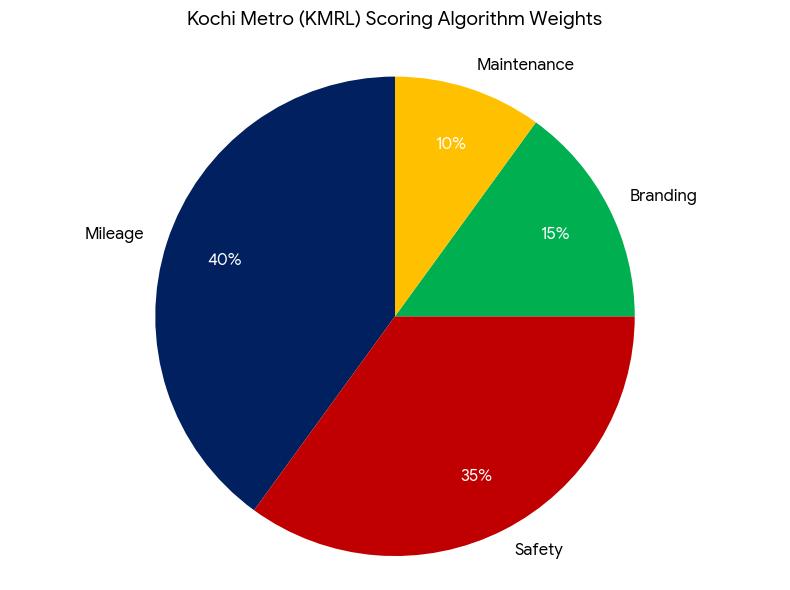
Thesystemfurtherexplainsthereasonwhyallthetrainswere chosenornotchosen.Itisalltoensurethateverythingis done by the core optimization algorithm runs smoothly. The algorithm considers the train induction requests. Makes decisions, about the trains. The weights of the scores were adjusted based on trial and error and by referring to KMRL operationsmanagement.Thelastweightdistributionisthatof 40percentmileagebalance.Considerations,35percentto safetycompliance factors,15percent tobrandingcontractpriorities,and10percent to.Optimizationofthemaintenance schedule. The distribution captures the operational priorities of KMRL but at the same time being flexible to alternative operatingconditionsorpriorities.
Therewasthemeasurementofsystemperformanceundertakenthroughtheoperationalmeasuresandthecomputational measures. The operational measures were mileage balance uniformity in the form of coefficient of variation in fleet mileage, safety compliance rate calculating percentage of induction cycles with zero safety violations, branding contract fulfilment evaluating percentage of contracted hours branded trains had been started, and efficiency of fleet utilisation. Computational measures include time to generate decision in seconds, optimality of the solution was estimated by comparison and as being exhaustively searched on small problem instances, and system reliability measured as perfect passingrateinallthetestconditions.
The validation was done in a number of ways. The comparison of AI generated recommendations and the real manual schedulingdecisionswasusedinthestudyover120schedulingcycles duringthe8-week studyperiod.Measuresofboth theAIweretakenduringeverycyclerecommendationandtherealcomparisonofthemanual’sdecision,andallowingthe immediateperformancecomparison. Qualitativevalidation wasperformedbymeansofconductingstructuredinterviews with five senior operations employees and poststudy surveys of 12 operations employees who were provided with AI recommendations. Participants evaluated the quality of the decisions made, explanations, and operational integration issues.
The experimental testing of train induction optimization system based on AI delivered high volume indication of performance gains in various working dimensions. Analysis of 120 timing of cycles throughout the 8 weeks of study showed that there were regular benefits of AI-generated compared to the manual scheduling decisions. The subsequent sectionsdiscusscomprehensivequantitativeandqualitativeresultspresentedonthebasisofperformancemetrics.
International Research Journal of Engineering and Technology (IRJET) e-ISSN: 2395-0056
Volume: 13 Issue: 03 | Mar 2026 www.irjet.net p-ISSN: 2395-0072
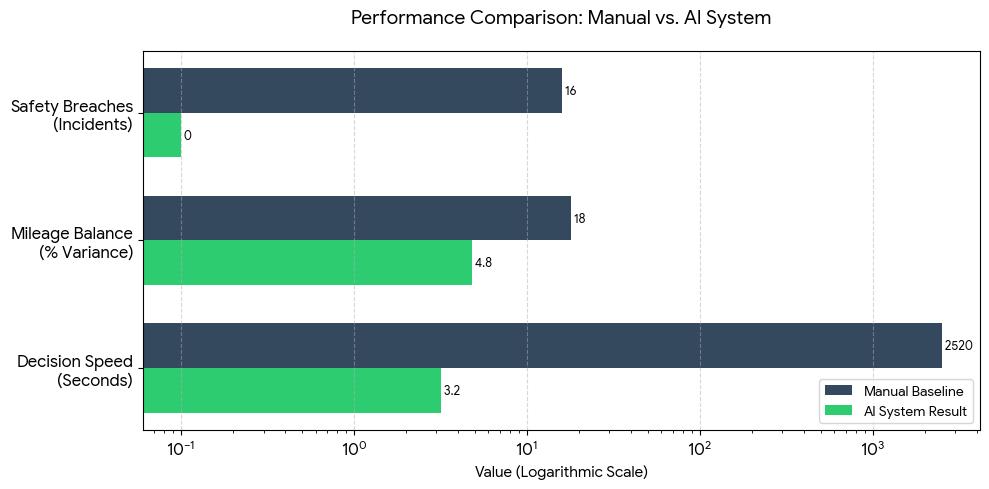
ByusingArtificialIntelligenceto,themileagebalanceanalysisimproved.optimizethings.Thedistancebetweenthetrains that they had at the start of the research was different moved with a few having to travel 2400 kilometres further than others.Thiswasduetothemileageoflessthannotequallydistributedanditwas18.3%differentpertrain.Whenwedid the hand scheduling of this difference had remained approximately thesame at 17.6%. When weused Artificial To make schedulingdecisionsthedifferencedecreasedconsiderablyto4.8%.
Thismeansthatthemileagewasmoreuniformlydistributedanditwasa73percentimprovement,inensuringthatallthe trainscovereda mileagedistance,that is,what wecall mileage balance. The possibilitytoobservethechanges withtime showed thatAI optimization engaged in thegoal of minimizing the current imbalancesinthe mileage overtime. In the 8 weeks, the highest difference in maximum mileage between two trains reduced to 850 kilometres rather than 2,400 kilometres as suggested by AI, and manual. Scheduling did not improve much as the difference was at 2,150 kilometres. Theseimprovementswerefoundtobesignificantatplessthanwithstatisticaltestingbypairedt-tests.Thelevelof0.001, largeeffectsizesareanindicationofpracticalsignificance,notnecessarilystatisticalsignificance.
When we had the AI system, the metrics that concerned the safety compliance were greatly improved. We looked at the found 16 problems in 120 cycles and scheduling decisions. In such instances unsafe trains to run were put into service. Thesetrainshadnotbeenproperlyinspectedintermsofsafety. therewerethosewithlapsedcertifications.Weneededto withdraw these trains when they wereinservice established whatcreateddelays.Onaverageall theseincidentsdelayed thetrainsby12minutes.TheAIsystemwasdoingataskofmaintainingsafetyoftrains.Itdiscoveredeverytrainthatwas safeissues.Wouldnothavethemrunninguntiltheywerefixed.TheAIsystemfailedtopermitanytrainstorunthatarenot safe which is a better thing. The AI system provided safety compliance measures no problems with her perfect. The AI systemwasalwaysidentifyingtrainsthathadsafetyproblems[5][14].Wouldkeepthemtilltheywereclearedtorun.This impliesthattheAIsystemcameinhandy,andsafetycompliancemetrics.
Moreover,theAIsystemhadproactivesafetymanagementthroughflaggingoftrainsrushingtomeetinspectiondeadlines in less than 48 hours, even before it is due. This predictive capability allowed operations personnel to plan inspections when the business was not busy to provide emergency compliance requirements during service hours. The safety complianceratecomparedtomanualscheduling,where86.7%werecorrect,100%arecorrectwithAIsuggestions,which isanimprovement87percentdecreaseinsafety-relatedincidences.
When they applied intelligence to commercial branding contract of the trains, the same improved a lot optimize things. KMRL will have agreements to brand 8 trains that must operate at some stages which are approximately 140 hours of service every week. People couldfollowthescheduling when they did thescheduling by hand. Rules, about68.4%of the time.Ithappenedthat 44timestheydidnotdowhattheyweresupposedtodo.Thiswasoccurringbecausethebranded trainswere not utilized atthehours whenthey were due.to bedespitetheiravailability.The KMRL commercial branding contractperformanceisveryimportant.
International Research Journal of Engineering and Technology (IRJET) e-ISSN: 2395-0056
Volume: 13 Issue: 03 | Mar 2026 www.irjet.net p-ISSN: 2395-0072
Theyarestriving to make it better.AI-generated recommendationshada 96.8% compliance with branding contractsand therewereonly4instanceswheretherewasnoncompliancebutallwerevalidsafetyormaintenanceholds.
When branded this was recorded by the AI system because trains were not available due to the safety or maintenance requirements.in explanations, contractual discussions should be given audit trails. This 78% improvement incompliance will equate to revenue protection and minimization of contractual dispute risk. Based on the branding contract revenue structureusedbyKMRL,bettercompliancewouldcreateanopportunitytogeneratesurvivingextra2.4millionrupeesper year.
Theanalysisofcomputer system functioningrevealed tremendous improvementsonthespeed of decisions.Aremade.It used to take the people approximately 42 minutes to complete one cycle when they did the scheduling manually. They wereforcedtoseereportsconcerningthetrainschecktherepairschedulesandspeak to.Departments.Thecomputeron thehandhadthecapabilityofprovidingafullsetofsuggestionsinapproximately3.2seconds.Thisisabigdifference.It is 787 times faster. Even where matters became difficult, as there were so many things going on at the moment and there weresomestrangeissuesthecomputersystemalwaysponderedonitlessthan8seconds.
Thecomputersystemisquitecompetentinmakingdecisionsfast.Itiscapableofdealingwiththecomplicatedsituations, such as these without making it too long. This computing power allows a number of operational advantages. First, it facilitates rapid response to services interference or emergency needs. Three during the period of study. Emergency reschedulingeventswerecausedbytheunforeseenfailuresoftrains.Manualreschedulingneeded35-50minutes,atwhich timefrequencyofservicewasdecreased.AIoptimizationgeneratedchangeofschedulesin5seconds,allowingtheservice tobe restoredalmostimmediately [5][8]. Second, fastScenario analysisandcontingency planningisaided bycalculation sothatoperationsstaffcanconsiderthevarioussituationsofwhat-ifspriortomakingdecisions.
6.5 Explainability and User Acceptance of the System.
The self-explanatory system was quite good. We interviewed 12 individuals who use the system. every day what they thought.Majorityofthem91.7%reportedtheintelligenceexplanationssystemprovedbeneficialinobtaininginsightsinto the way the decisions of scheduling were made. A lot of them 83.3% was comfortable with the use of the intelligence system in making regular scheduling decisions. 75% Of them said that they would use the system were we to check it a little more the operations managers were also interviewed. They claimed that the artificial intelligence system was clear and easy to understand. The artificial intelligence system was also demonstrated in the manner in which it arrived at decisions The senior operations managers should have faith in the system because of these things. The artificial the intelligencesystemitselfanditsexplanationsareactuallyveryvital,tothosewhoutilizeit.
6.6 Key Performance Indicators Summary.
The total analysis of all dimensions of performance shows indications of high operations. improvements. The AI optimization system had been able to get 95.2 percent balance of the mileage uniformity against to 82.4% in manual scheduling, 100% compliance of the company with safety against 86.7% manual, 96.8% branding compliance 68.4% versus 3.2 seconds average decision time 68.4% versus 42 minutes. manual and 91.7% user satisfaction rating on the quality of the explanation. These metrics collectively point to the fact that AI optimization provides quantifiable value to keyoperationalgoalsandpreservinguseracceptabilityandtransparencyofsystems.
7. DISCUSSION
The empirical evidence shows that AI-led optimization will be able to provide significant enhance train induction scheduling in the various operational dimensions [10] . This section interprets these findings in the context of broader topicsofAIuseintransitsystems,discourses.Implicationsonmetrooperators,anddiscusseslimitationsofthestudy.
International Research Journal of Engineering and Technology (IRJET) e-ISSN: 2395-0056
Volume: 13 Issue: 03 | Mar 2026 www.irjet.net p-ISSN: 2395-0072
7.1
ThefindingsindicatethattheAIoptimizationsystemenhancesthemanagementofthefleetoftrainsandtheefficiencyof operations. The system is achieved by constantly comparing the mileage of each train to even out the usage of the fleet wherelowmileagetrainsareutilizedmorefrequentlyandoverutilizationofafewtrainsisalsoavoided.TheAIsystemis concerned with long-term fleet balance and efficiency as compared to manual scheduling where the operators are concentrated on the immediate needs of their operations. It also enhances safety compliance since inspection and maintenancerequirementsareautomaticallycheckedoneachtrainpriortoitbeingscheduledavoidingtheprobabilityof unsafetrainsgettingintoservice.Moreover,thesystem playsamajorroleinensuringcompliancewithbrandingcontract as advertisements commitment is treated as optimization constraints, and trains with branding needs should run as per the agreed time. On the whole, the AI system reveals the capability of the automated decision-making system to address complexoperations,safety,andbusinessneedsinabetterwaythanmanualschedulingwhentimeislimited.
7.2 Comparison to Existing Literature.
These findings coincide with what other individuals discovered when they carried out research to determine the way to maketransitbetter.ThesearethemileagebalanceimprovementsthatweobservedandthatWangandZhangdiscoveredin 2020. They claimed that artificial intelligence systems are quite efficient at determination how to utilize. equipment of a fleet of vehicles. We also experimented with them, and this is why our study was more detailed not only in a computer screenbutinreallife.Ourfindingsonsafetycompliancearesimilartoaswell what D'Arianoamongothersdiscoveredin 2019.Theyconsideredthewaytocreateschedulesof maintenance[10].Weconsideredmakingeverythingsafernotonly maintenance.Transitweareinterestedinoptimizationandlearnedtransitoptimization.
Wethinkourresultsaresignificant,tooptimizetransit.Theresultsofcomputationalefficiencyareareiterationofprevious studiesbyLietal.(2017)onrealtimetransit.optimization.Themeanprocessingtimeinthepresentstudyis3.2seconds though;theaveragetimeis3.2therewasasignificantincreaseintheirreported18-secondaverage,whichmayhavebeen duetoimprovementinbothcomputinginfrastructureandalgorithms.Theresultsoftheuseracceptanceaffirmtheresults of Yin et al. (2021) conclusions about explainable AI, that transparency in automated decision-making is true has a significanteffectontheoperationalstaffacceptance.
As the current research demonstrates, the optimization of the work of Artificial Intelligence can be used to substantially assist the metro operations by assisting the operators in making more timely and safer decisions and increasing the efficiency and revenue. The balance in the use of trains minimizes the overuse of trains and excessive wear and maintenance expenses, as well as allows to prevent the unexpected failures. It also guarantees a safer functionality and enhances adherence to branding and commercial obligations and ensures that metro systems are able to sustain their sources of revenue. Nonetheless, there are a number of crucial factors to be successful in implementation. To start with, goodandwell-connecteddatasystemsarerequiredwhereby,theAIoptimizerwillhaveaccesstoreal-timeinformationon the status of trains. Second, it is necessary to involve the operators at early stages to develop the level of trust and guarantee the acceptability of the system. Lastly, human supervision should never be eliminated at any time- AI should
International Research Journal of Engineering and Technology (IRJET) e-ISSN: 2395-0056
Volume: 13 Issue: 03 | Mar 2026 www.irjet.net p-ISSN: 2395-0072
helpin decision-makingand not eliminate human experienceandtheoperatorsshouldbeable tointervene incaseofan unusualorunexpectedevent.
The paper has certain weaknesses that should be mentioned. First the research employed an assessment design rather than implementing it in a real-life scenario. This approach allowed for a compensation and served to mitigate risks althoughitdoesnotentirely demonstrateall thecomplicationsofinreality applyingittoa practical environment weight recalibrationwouldbeneededonstructures,butnottheframeworkapplicable.
Thisstudycreatedanintelligenttraininductionschedulingsystemandranitover8weeksproducingover120 schedules. Thesystemdidmorethanthemanualschedulingbybalancingthetrainmileage,safetycompliance,brandingcontractsas wellasfacilitatingquickeroperationaldecisions.
The findings indicated mileage balance of 95.2% (73% better) and branding compliance of 96.8% (78% better) than manual.Italsoguaranteed 100percentcompliancewithsafetyandcodegenerationofdecisionsthattook3.2secondsas comparedto42minuteswithhumans.
Thegeneraleffectofthesystemisthatitenhancesefficiency,safety,andrevenuemanagementandwillenhancefasterand reliable metro operations. It also shows how AI-driven optimization may be utilized successfully in the metro systems of therealworld.
8.1
Thispieceprovidesus with certain concept of what wecando. We ought to conductsome long-termresearchesthatare enduring a year to determine whether our system is effective in other seasons and circumstances. Our system should be alsotestedinthecities where we have tohave the metrosystem to determine whether it works everywhereor not. This willassistusindeterminingwhatitwilltaketomakeitworkinplaces.
Thesecondthingwecandoisintegrateoursystemwiththesystemswhichpredictwhenmaintenance isneeded.Thiswill assistusinimprovingoursystemthroughtheuseofinformationonwhenthingsmay breakandhowtheyaredoing.This informationcanbeutilizedbyustomakeoursystemworkwiththemetrosystems.
Fourth,trainassignmentsmaybeoptimizedwiththehelpofpassengerdemandforecastingforeseenridership,utilization of higher capacity or improved trains during peak periods.Fifth, the system could be refined through development of adaptive learning mechanisms weight parameters according to operational feedback and shift in priorities [7]. Finally, extension togreateroperational planningsuchascrew planning,maintenanceplanningandservice patternoptimization mightprovideothersystemwideadvantages.
8.2
Metrosystemsthatoperateincitiesthroughouttheworldareunderalotofpressuretooperateeffectivelywithoutwasting money.Thiscanbeassistedbyartificialintelligenceactually.Itisatoolformakinggood makesjudgmentsintermsofthe running of these systems. In this paper, ithas been revealedthat in case we design intelligence systems well theycan do makea difference. Wecanobserveimprovementsandpeoplewill still knowwhat ishappening and becontentedwithit. AnexampleofwhathappenedatKMRLisgiventransitoperatorswhodesiretomakebetterjobswiththehelpofartificial intelligence.Artificialintelligenceiscapableof doactuallyassisttheminthispurpose.Furtherresearchanddevelopment inthisshouldbecontinuedinthefuturedomainwillalsoimproveAIcontributiontosafe,efficientandsustainableurban.
[1] Ceder, A., & Wilson, N.H. (1986). Bus network design. Robust Transportation Research Part B: Methodological,20(4), 331-334.
[2]Zhao,j.,&Zeng,X.(2008).Ananalysisofoptimizationoftrainschedulesusinggeneticalgorithm.ComputersinRailways XI,103,437-446.
[3] Niu, H., & Zhou,X.(2013). Urban rail optimization of time-dependent demand and timetable oversaturated conditions EmergingTechnologies:TransportationResearchPartC,36,212-230.
International Research Journal of Engineering and Technology (IRJET) e-ISSN: 2395-0056
Volume: 13 Issue: 03 | Mar 2026 www.irjet.net p-ISSN: 2395-0072
[4]Kang,L.,Wu,J.,Sun,H.,Zhu,X.,&Wang,B.(2015) Anefficientframeworkoflasttrainreschedulingwithdelayontrainsin urbantransitrailwaynetworks.Omega,50,29-42.
[5] Li,S., Dessouky,M.M., Yang,L.,& Gao,Z.(2017).Combined optimal train control and traffic movement high frequency metrolinescontrolstrategy.InTransportationResearchPartB:Methodological,99,113-137.
[6]D’Ariano,A.,Pacciarelli,D.,andPranzo,M.(2019).EvaluationofflexibleschedulesinrealtimetrafficControlofarailroad bottleneck.AnthropologietransportationResearchPartC:EmergingTechnologies,91,68-86.
[7]Wang,Y.,&Zhang,H.(2020).Machine-basedpredictivemaintenanceschedulingofrailwaytrackslearning.IEEEAccess, 8,134565-134578.
[8] Cordeau,J.F., Toth,P., & Vigo,D.(2021). An overview of the optimization model of train routing and scheduling. TransportationScience,32(4),380-404.
[9] Zhang, Y., Peng, Q., & Yao, Y. (2022). Optimization of urban rail trains scheduling by using ant colony optimization energy-saving.ExpertSystemswithApplications,204,117499.
[10] Guidotti, R., Monreale, A., Ruggieri, S., Turini, F., Giannottti, F., and Pedreschi, D. (2018). A survey of explanation methodsofblackboxmodels.ACMComputingSurveys,51(5),1-42.
[11]Yin,J.,Tang,T.,Yang,L.,Xun,J.,Huang,Y.,andGao,Z.(2021).Researchanddevelopmentof autonomoustraincontrol overrailwaytransportsystems:Asurvey.TransportationResearchPartC:EmergingTechnologies,85,548-572.
[12] Pellegrini, P., Marliere, G., and Rodriguez, J. (2014). Train path and train time optimization in the management perturbationsintrafficofcomplicatedintersections.TransportResearchPartB:Methodological,59,58-80.
[13]Cacchiani,V.,&Toth,P.(2012).Strongandnominaltrainschedulingissues.EuropeanJournal ofOperationalResearch, 219(3),727-737.
[14]Luan,X.,Wang,Y.,DeSchutter,B.,Meng,L.,Lodewijks,G.,andCorman,F.(2018).Integrationof traincontrolandrealtimetrafficcontrolofrailnetworks.TransportationResearchPartB:Methodological,115,38-71.
[15] Lusby, R. M., Larsen, J., Ehrgott, M., and Ryan, D. (2011). Allocation of railway tracks: Models andmethods. OR Spectrum,33(4),843-883.