
International Research Journal of Engineering and Technology (IRJET) e-ISSN: 2395-0056 p-ISSN: 2395-0072

Volume: 12 Issue: 10 | Oct 2025 www.irjet.net

International Research Journal of Engineering and Technology (IRJET) e-ISSN: 2395-0056 p-ISSN: 2395-0072
Volume: 12 Issue: 10 | Oct 2025 www.irjet.net
Manish Khodaskar1, Adesh Gajare2 , Chetan Bochare3 , Shailesh Patil4
1Professor, Dept. of IT, Pune Institute of Computer Technology, Pune, Maharashtra, India.
2Student, Dept. of IT, Pune Institute of Computer Technology, Pune, Maharashtra, India.
3Student, Dept. of IT, Pune Institute of Computer Technology, Pune, Maharashtra, India.
4Student, Dept. of IT, Pune Institute of Computer Technology, Pune, Maharashtra, India.
Abstract -Campus placements are one of the most important milestones in a student’s academic journey. However,theprocessisoftenuncertainandmanystudents lack the right guidance to meet industry expectations. Companieslookforstrongtechnicalskills,problem-solving ability,andconsistentacademicperformance,butstudents areoftenunawareoftheserequirements.Tobridgethisgap, we propose an AI-driven placement prediction and recommendation system that helps students understand theirplacementchancesandimprovetheirpreparation.The systempredictsboththelikelihoodofastudentbeingplaced and the expected salary package using features such as CGPA, aptitude test scores, coding profiles, and backlog status. In addition to prediction, the system integrates a Generative AI module that provides personalized recommendations, including suitable job roles, skill-gap analysis, and focused preparation strategies. To ensure transparency, explainable AI methods high light the key factors influencing the predictions. A user-friendly dashboardbuiltwithStreamlitallowsstudentstoviewtheir placement chances in real time and receive actionable suggestionsforimprovement.Thisprojectaimstosupport studentsinachievingbetterplacementoutcomeswhilealso helping institutions strengthen their overall placement performance.
Key Words: CampusPlacement,PlacementPrediction,Ma chine Learning, Regression, Classification, Generative AI, ExplainableAI,RecommendationSystem,
1.INTRODUCTION
Campusplacementshavebecomeoneofthemost significantturningpointsin astudent’sacademicjourney. Whilemanyengineeringgraduatesentertheworkforceeach year, only a small percentage are able to meet the expectations of employers. Since the IT sector is continuouslyevolving,organizationslookforstudentswith strongfoundationalknowledge,problem-solvingskills,and relevant technical expertise. However, a gap often exists betweenacademicperformanceandindustryreadiness,as manystudentsareunawareoftheseindustryrequirements.
Placement statistics also play a crucial role in defining a college’s reputation and attracting new

admissions.Therefore,itistheresponsibilityofeducational
institutionsandplacementcellstoguidestudentseffectively and provide them with better opportunities. Traditional placement preparation methods may not always be sufficient,astheyoftenfailtoprovidepersonalizedinsights intoastudent’sstrengthsandweaknesses.
To address this issue, we propose an AI-driven placementpredictionandrecommendationsystemforPICT students.Thesystemanalyzeshistoricalplacementrecords along with student data such as CGPA, AMCAT scores, subjectgrades,codingprofiles,andbacklogstatustopredict boththeexpectedplacementpackageandthelikelihoodofa student being placed. Students are classified into three categories:Low,Average,andStrongplacementchances.In additiontoprediction,thesystemincorporatesGenerative AI to provide tailored recommendations, helping students enhance their technical and academic skills for improved careeroutcomes.
This project not only assists students in understanding their placement readiness but also helps institutions strengthen their placement outcomes. By combiningdata-drivenpredictionwithactionableguidance, the proposed model bridges the gap between student preparationandindustrydemands,therebyimprovingboth theefficiencyandtransparencyoftheplacementprocess.
Inthissection,wereviewpreviousresearchstudies thatappliedsupervisedmachinelearninganddeeplearning techniquesforcampusplacementprediction.Theseworks demonstrate different datasets, features, and algorithms, highlightingtheirstrengthsandlimitations.
In[1],theauthorsdevelopedacampusplacement predictionsystemusinglogisticregressiontoestimatethe probabilityofastudentbeingplaced.Thedatasetincluded academicfeaturessuchasCGPA,attendance,andtestresults from the placement management system. Historical data frompaststudentswereusedtotrainthemodel.Thework emphasizeshowlogisticregression,withproperlyselected training tuples, can provide reliable predictions, helping bothstudentsandfacultytoidentifyskillgapsandimprove academicplanning.

Volume: 12 Issue: 10 | Oct 2025 www.irjet.net
True Positive, False Positive, True Negative, and False Negative values. Results showed that different algorithms performed differently on the dataset, with some offering higher accuracy than others. The comparative approach provides useful insights into selecting the most suitable classifierforplacementpredictiontasks.
In[3],theauthorsproposedaplacementprediction model using deep learning. The system was aimed at prefinalyearstudentstohelpthemunderstandtheirplacement chances and prepare accordingly. By analyzing previous years’datasetsandapplyingadeeplearningframework,the modelcouldcapturecomplexrelationshipsamongstudent features. The study high lights how deep learning can go beyondtraditionalmodelsbyidentifyinghiddenpatternsin largedatasets,althoughatthecostofhighercomputational resources.
In[4],placementpredictionwasperformedusing KNN,AdaBoost,andRandomForestalgorithms.Thedataset considered not only academic scores but also aptitude, technical, and communication skills, providing a more holistic evaluation of student readiness. The authors comparedtheperformanceoftheseclassifiersandshowed howsuchmodelscanhelpplacementcellsidentifypotential students,improveskilldevelopment,andguideadmission planningforfutureyears.
Overall, these studies illustrate that a variety of machine learning methods can be applied to placement prediction, ranging from classical models like logistic regressionandKNNtoadvancedapproachessuchasdeep learning.However,mostworksfocusmainlyonprediction accuracy and do not provide personalized guidance or explainability. Our proposed system extends this line of researchbycombiningregressionandclassificationmodels with a Generative AI recommendation engine, while also incorporating explainable AI techniques to provide actionableinsightsforstudentsandinstitutions.
Themethodologyofthisprojectisdesignedtobuild a complete placement prediction and recommendation system by combining machine learning models with Generative AI. The workflow can be divided into the followingphases:
A. DataCollectionandPreprocessing:-
Historical placement records from PICT
p-ISSN: 2395-0072
B. ExploratoryDataAnalysis(EDA):-
Statistical analysisanddatavisualization were carried out to study relationships between different features, such as CGPA vs. package and codingscoresvs.placementstatus.EDAhelpedin identifying the most influential attributes and checkingformulticollinearity,whichimprovedboth modelinterpretabilityandperformance.
C. ModelDevelopment:-
Twocategoriesofmodelsweredeveloped:
• Regression Model: Used to predict the expected placement package (in LPA). Algorithms such as Linear Regression, Random Forest, and Gradient BoostingweretrainedandcomparedbasedonMAE, RMSE,andR2score.•ClassificationModel:Usedto categorizestudentsintoplacement-chancegroups: Low,Average,andStrong.ModelssuchasLogistic Regression,RandomForest,XGBoost,andSVMwere trained and evaluated using accuracy, precision, recall,F1-score,andconfusionmatrices.
D. GenerativeAIRecommendationEngine:-
A recommendation system powered by Generative AI was developed to provide personalized feedback. The engine analyzes a student’s profile and suggests actionable improvements such as enhancing coding performance,focusingonspecificcoresubjects,or improving AMCAT scores. This helps students bridge skill gaps and align better with industry requirements.
E. UserInterfaceandDeployment:
Aweb-basedinterfacewasdesignedusing Streamlit.Thedashboardallowsstudentstoenter theirdetailsandviewpredictionsinrealtime,along withAI-generatedrecommendations.Thesystemis deployedoncloudplatformslikeStreamlitCloudor AWSforeasyaccessibility.
F. ValidationandIteration:
Themodelswerevalidatedusingstandard performancemetricsandtestedwithunseendata. Pilottestingwasalsocarriedoutwithstudentsand Training & Placement officers. Based on the feedback, models and recommendation prompts werefine-tunedtoimproveaccuracyandrelevance. Overall, this methodology combines supervised machinelearning with Generative AI to provide a dual solution of prediction and personalized guidance, making the placement process more effective and transparent for both students and institutions
In [2], a placement predictor was designed and evaluated using multiple supervised learning algorithms were collected, including academic scores (10th, 12th/diploma,andCGPA),backlogstatus,AMCAT results, and coding profiles from platforms like LeetCode and Codeforces. The data was preprocessed by handling missing values, normalizing numerical features, encoding categoricalattributessuchasbranch,andremoving outliers. This step ensured that the dataset was clean and suitable for training machine learning models.
e-ISSN: 2395-0056 p-ISSN: 2395-0072 Volume: 12 Issue: 10 | Oct 2025 www.irjet.net
The proposed system focuses on predicting placement chances and recommending personalized improvementstrategiesforstudentsatPICT.Theworkflow begins with data collection, where historical placement records and student performance details such as CGPA, AMCATscores,subjectgrades,backloghistory,andcoding profilesaregatheredfrominstitutionalrecords.Afterdata collection, preprocessing steps are performed, including handling missing values, normalization of numerical attributes, encoding categorical variables, and removal of outliers. The cleaned dataset is then divided into training andtestingsubsets.
A. ModelTrainingandEvaluation:
For the prediction tasks, two types of machine learning models are developed: regression and classification. The regression model is used to predictthelikelysalarypackage(inLPA),whilethe classification model categorizes students into placement-chancegroupssuchasLow,Average,and Strong. Algorithms including Logistic Regression, RandomForest,GradientBoosting,andXGBoostare appliedandcompared.Thebest-performingmodels areselectedbasedonmetricssuchasMAE,RMSE, accuracy,precision,recall,andF1score.Toensure transparencyinprediction,ExplainableAImethods are employed to highlight the most influential featuresimpactingplacementoutcomes.
B. RecommendationEngine:
Inadditiontoprediction,thesystemincorporatesa GenerativeAI-basedrecommendationengine.This engineanalyzesthefeaturevectorofeachstudent and generates personalized suggestions such as improving problem-solving skills, strengthening subject knowledge, or enhancing performance on coding platforms like LeetCode. These recommendations help students close their skill gaps and prepare more effectively for campus recruitmentdrives.
C. UserInterfaceandDeployment:
Finally, a user-friendly dashboard is developed usingStreamlit.Throughthisinterface,studentscan inputtheiracademicandskill-relateddetails,view their predicted placement category and package, and receive actionable guidance in real time. The system is deployed on cloud platforms for easy access and is continuously refined based on feedbackfromstudentsandplacementofficers.
Overall, this combination of machine learning predictionandAI-drivenrecommendationsmakes the system an effective tool for improving both
student readiness and institutional placement outcomes.
The system architecture of the proposed model integrates multiple modules to achieve both placement predictionandpersonalizedrecommendation.Theworkflow begins with data collection from academic and placement records,followedbypreprocessingandfeatureengineering. Machinelearningmodelsarethentrainedforregressionand classificationtasks,whileaGenerativeAIengineisusedto provide skill-gap analysis and personalized suggestions. Finally, a user-friendly dashboard built with Streamlit presentsthepredictionsandrecommendationstostudents inrealtime.
As shown in Fig. 1, the architecture is divided into five layers:
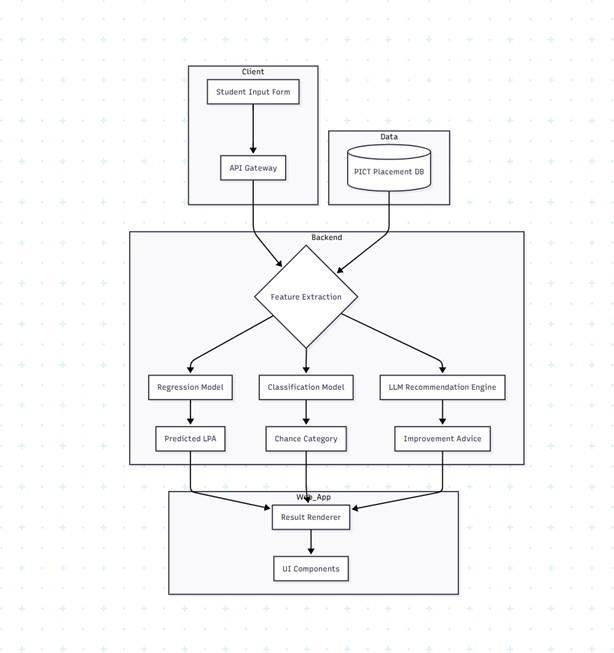
Fig -1:SystemArchitectureofAI-DrivenPlacement Prediction&RecommendationSystem
1) DataCollectionLayer:Historicalacademicrecords, placement statistics, aptitude scores, and coding profiles
2) Preprocessing Layer: Cleaning, normalization, encoding,andoutlierhandling.
3) Modeling Layer: Regression model for package prediction and classification model for placement category.
4) RecommendationLayer:GenerativeAImodulepro viding personalized guidance and skill-gap feedback.
5) Interface Layer:Streamlitdashboardforstudents and institutions to view predictions and recommendations.
International Research Journal of Engineering and Technology (IRJET) e-ISSN: 2395-0056 p-ISSN: 2395-0072
Volume: 12 Issue: 10 | Oct 2025 www.irjet.net
This project, AI-Driven Placement Prediction & Recommendation System for PICT Students, successfully demonstrateshowmachinelearningandGenAIcanbeused toguidestudentsintheirplacementjourney.Byanalyzing historical placement data, academic records, and coding profiles,thesystempredictsboththelikelysalarypackage and the chances of placement. More importantly, the recommendationengineprovidespersonalizedadvicethat helps students identify and work on their skill gaps. The developed models, tested with various regression and classificationtechniques,showthatdata-drivenapproaches canbringmoreclarityandconfidencetostudentspreparing for placements. The web interface ensures accessibility, making it simple for students to enter their details and instantly receive predictions along with meaningful suggestionsforimprovement.
Overall, this work not only supports students in settingrealisticexpectationsbutalsoencouragescontinuous self-improvement, aligning with global goals of quality education, decent work, and innovation. With further refinement and feedback, this system can evolve into a reliableplacementsupporttoolforinstitutions,ultimately bridging the gap between students’ skills and industry requirements
WethankPICTT&PCellandstudentvolunteersfor dataaccessandfeedback.
[1]S.S.Kashid,A.Badgujar,V. Khairnar,A.Sagane,andN. Ahire,“Campusplacementpredictionsystemusingmachine learning,” International Research Journal of Modernizationin Engineering Technology and Science, vol. 5, no. 4, pp. 1–7, Apr.2023,doi:10.56726/IRJMETS36827.
[2] I. T. Jose, D. Raju, J. A. Aniyankunju, J. James, and M. T. Vadakkel, “Placement prediction using various machine learning models and their efficiency comparison,” Department of CSE, SJCET Palai, Kerala, India.
[3]J.Samatha,D.Manjusha,B.Pooja,andA.Usha,“Student placement chance prediction,” Journal of Emerging Technologies and Innovative Research (JETIR),vol.7,no.5, May2020.
[4] P. Khamkar, R. Lagad, P. Shinde, S. Londhe, and S. S. Bhosle, “Students placement prediction system,” International Journal for Research in Applied Science & EngineeringTechnology(IJRASET),vol.10,no.11,Nov.2022
[5] Y. Dai, “Students use or not use generative AI: Student conceptions, concerns, and implications for engineeringeducation,”DigitalEngineering,vol.4,100019, 2025.doi:10.1016/j.digen.2025.100019.
[6] U. Mittal, S. Sai, V. Chamola, and Devika, “A comprehensive review on generative AI for education,” IEEE Access,doi:10.1109/ACCESS.2017.DOI.
[7] S.Jawad,R.P.Uhlig,P.P.Dey,andM.N.Amin,“Using artificial intelligence in academia to help students choose their engineering program,” National University, USA.
[8] G. M. Spandana and L. Pallavi, “Student placement predictionsystemusingmachinelearningalgorithms,”in Proc. 2023 2nd Int. Conf. Edge Comput. Appl. (ICECAA), Namakkal, India, Jul. 2023, pp. 1–6. doi: 10.1109/ICECAA58104.2023.10212409.