
International Research Journal of Engineering and Technology (IRJET) e-ISSN: 2395-0056
Volume: 12 Issue: 10 | Oct 2025 www.irjet.net p-ISSN: 2395-0072
International Research Journal of Engineering and Technology (IRJET) e-ISSN: 2395-0056
Volume: 12 Issue: 10 | Oct 2025 www.irjet.net p-ISSN: 2395-0072
Yuktha N S1 , Dr. Suresh D S2
1PG Scholar, Department of ECE, Channabasaveshwara Institute of Technology, Gubbi-572216, India
2Professor, , Department of ECE, Channabasaveshwara Institute of Technology, Gubbi-572216, India
Abstract - Leveraging artificial intelligence (AI), we proposeanadvancedinsectrecognitionsystemdesignedto revolutionizefieldcropmanagementandboostsustainable pest control. This initiative employs deep learning and computer vision techniques, utilizing models extensively trained on diverse agricultural pest datasets, to achieve rapidandpreciseidentificationofinsectspeciesfromon-site imagesorlivevideo.Theprimarygoalistodeliverreal-time field surveillance and early detection capabilities, empowering farmers to implement prompt, targeted pest managementstrategies.Thisapproachminimizestheuseof conventional, broad-spectrum chemical treatments, effectivelyreducescroplosses,andfostersbothincreased productivityandecologicalresponsibilityinagriculture
Key Words: CNNs-Convolutional Neural Network, Deep Learning, CNN Architecture, Train-Val Split.
1.INTRODUCTION
Agriculture contributes significantly to food security, livelihood, and economy in most parts of the globe, especiallyindevelopingnations.Ofthevariouscrops,rice serves as a primary staple food to more than half of the global population. Its productivity is, however, adversely affected by various insect pests attacking at more than a singledevelopmentstage,fromseedlingtoharvestingstages. Visual assessment and human recognition by skilled entomologists or field specialists have constituted the traditional means of pest management, but they are timeconsuming and may be ineffective and subjective, even in commercial production. The incorporation of prevailing technology trends, more so artificial intelligence (AI), and machine learning (ML), offers potential solutions to the autonomousrecognitionandcategorizationofinsectpests underagriculturalscenarios.
Over the past few years, DL approaches, and more importantly, CNNs have shown outstanding effectiveness recognition of data patternsand image classification applications. These approaches have the capacity to learn autonomouslycomplexvisualpatternsfromimageswithout thesignificanceforhand-craftingoffeatures.Forthetaskof pestdetection,CNNshavethepotentialtodistinguishinsect species from subtle dissimilarity of shape, colour, texture, andposture.Theproposedsystemisaimingtoimplementa system of classifying pests using CNNs and train them to learnandrecognizefourkeypestsofrice.Allthepestsare
significant threats to rice plants. The Brown Planthopper does damage by feeding on phloem sap and by vectoring viral infections like ragged stunt and grassy stunt. Its infestationscaninduceanincidenceof"hopperburn"such thattheentireplantturnsbrownanddiesprematurely.The RiceEarBug,whichoccursduringtheperiodofgrainfilling, feeds on ripening grains and produces unfilled or discoloured grains, thereby affecting the quality of grains. TheRiceLeafFolderlarvaerolltheleavesandfeedsinside, masking the plant's photosynthetic potential and causing losses of yield. The Rice Stem Borer, probably the most feared pest, enters the stem and cuts off the supply of nutrients, producing dead hearts (in seedlings) and whiteheads(inmatureplantations).
Accurate and timely detection of insect pests is critical to successful integrated pest management of rice crops. At present,however,integratedpestmanagementreliesheavily onthefieldexperts'eye,throughtraining,whichislaborious andsubjecttohumanfailure.Sincemostpestspecies,suchas BrownPlanthopper,RiceEarBug,RiceLeafFolder,andRice Stem Borer, are morphologically related, even seasoned expertsarelikelytomistakethem,moresounderharshfield situations. Additional environmental elements such as changing light sources, overlapping of insects, and even naturalcoverhinderthevisualizationofinsectsandleadto lateorincorrectresponses,thuscausingextensivedamageto thecrops.
In addition, traditional machine learning approaches employed in pest classification rely significantly on handcraftedfeaturesandtendtoperformpoorlyinpractical fieldsituationswithsophisticatedbackgrounds.Furthermore, large,balanced,andannotateddatasetsofspecificricepests arefew,withstillfewerresourcesaccessibleforless-studied speciessuchastheRiceEarBug.Furthermore,amajorityof these deep learning models require costly computational laboratories, limiting their use in field applications where hand-heldorembeddeddevicesareofchoice.Forthisreason, creatinganefficient,semi-automatedsystemofclassification consisting of CNN, which are in a position to learn from realisticagriculturalobservationsandgiveaccurate,online pestrecognitionstraightfromimagesacquiredinthefield, continuestobeofutmostsignificance.
International Research Journal of Engineering and Technology (IRJET) e-ISSN: 2395-0056
Volume: 12 Issue: 10 | Oct 2025 www.irjet.net p-ISSN: 2395-0072
Thisprojectaimstodesignanintelligentandautomated systemcapable ofdetecting andclassifyingkeyricepests, including the Brown Planthopper, Rice Ear Bug, and Rice LeafFolder,andRiceStemBorer,using C N Ns.Thesystem aims to accurately identify each pest species from digital imagescapturedunderreal-world agricultural conditions. Thisencompassesovercomingobstaclessuchasbackground complexity, insect pose variation, and low inter-class distinction.Theprojectfurtherseekstoimplementeffective image preprocessing and augmentation techniques to enhancedatasetqualityandimprovemodelgeneralization. Anothergoalistointegratesegmentationmethodstoisolate pest regions from cluttered backgrounds, enabling more precisedetection.Ultimately,theobjectiveofthesystemisto provide a robust, scalable solution that can assist farmers and agronomists in early pest identification, reduce dependencyonmanualsurveillance,andcontributetomore efficientand sustainabletomanagementpracticesinrice cultivation.
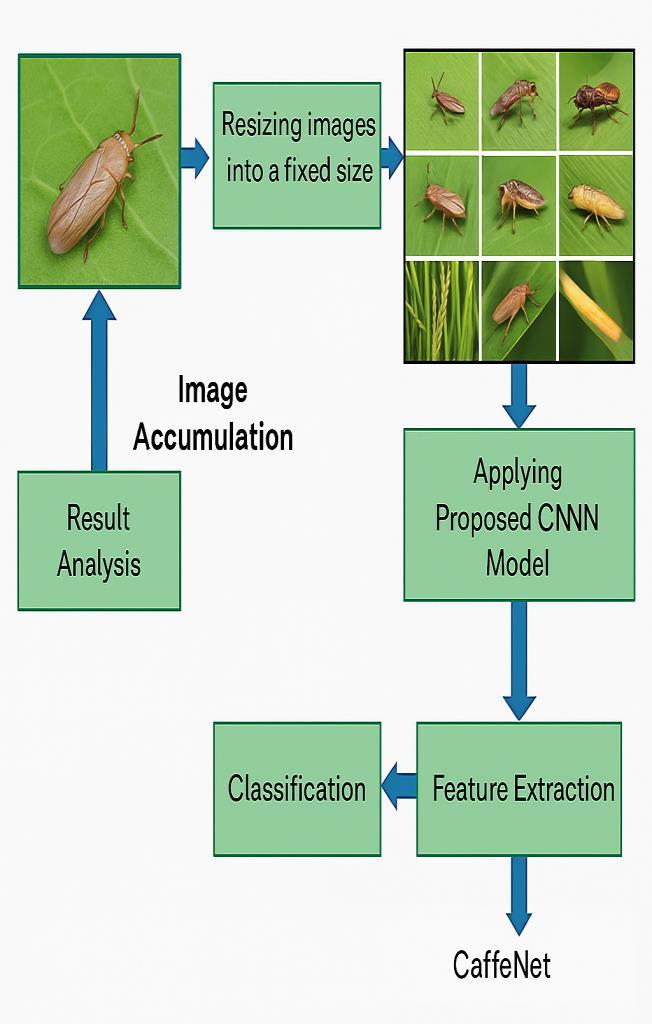
The block diagram illustrates a systematic approach for classifyingricepestsusingaCNN-basedmodel,specifically CaffeNet.Theprocedurecommenceswiththeacquisitionof data, where insect images of pests such as the Brown Planthopper,RiceEarBug,RiceLeafFolder,andRiceStem Borer are gathered from the field. These images undergo preprocessing steps where they are resized to a fixed dimensionsuitableforinputintotheCNN.Oncestandardized, theimagesarepassedthroughaproposedCNNmodelthat performs feature extraction, identifying critical visual attributes such as body shape, wing patterns, and texture. Thefeaturesextractedinthissteparesubsequentlyrefined andanalyzedforfurtheruse,throughaclassificationmodule thatcategorizeseachinputintoitsrespectivepestclass.The finaloutputisanalyzedtoevaluateperformanceandensure accurate identification. This closed-loop system effectively combines image preprocessing, deep learning, and result validationtosupportautomatedpestdetectioninagricultural fields.
TheimplementationandtrainingoftheTheCNN-basedrice pest classification system was evaluated on a standard computingsetupconfiguredfordeeplearningapplications. Thesystemwasdevelopedusingacomputerequippedwith an Intel Core i5 processor (2.3 GHz) and 16 GB of RAM, providingsufficientprocessingcapabilityformoderate-sized datasets.AdedicatedNVIDIAGPUsuchastheGeForceGTX 1050Ti(4GB)wasutilizedtoacceleratethetrainingofthe CaffeNet model, significantly reducing computation time duringconvolutionalandbackpropagationoperations.The software environment included Python language with TensorFlow, Keras, and OpenCV libraries for building, training, and validating the neural network model. All experiments,includingimagepreprocessing,augmentation, model training, and testing, were conducted on this hardware setup to ensure efficient and reproducible performancesuitableforacademicresearchandprototype development.
International Research Journal of Engineering and Technology (IRJET) e-ISSN: 2395-0056
Volume: 12 Issue: 10 | Oct 2025 www.irjet.net p-ISSN: 2395-0072
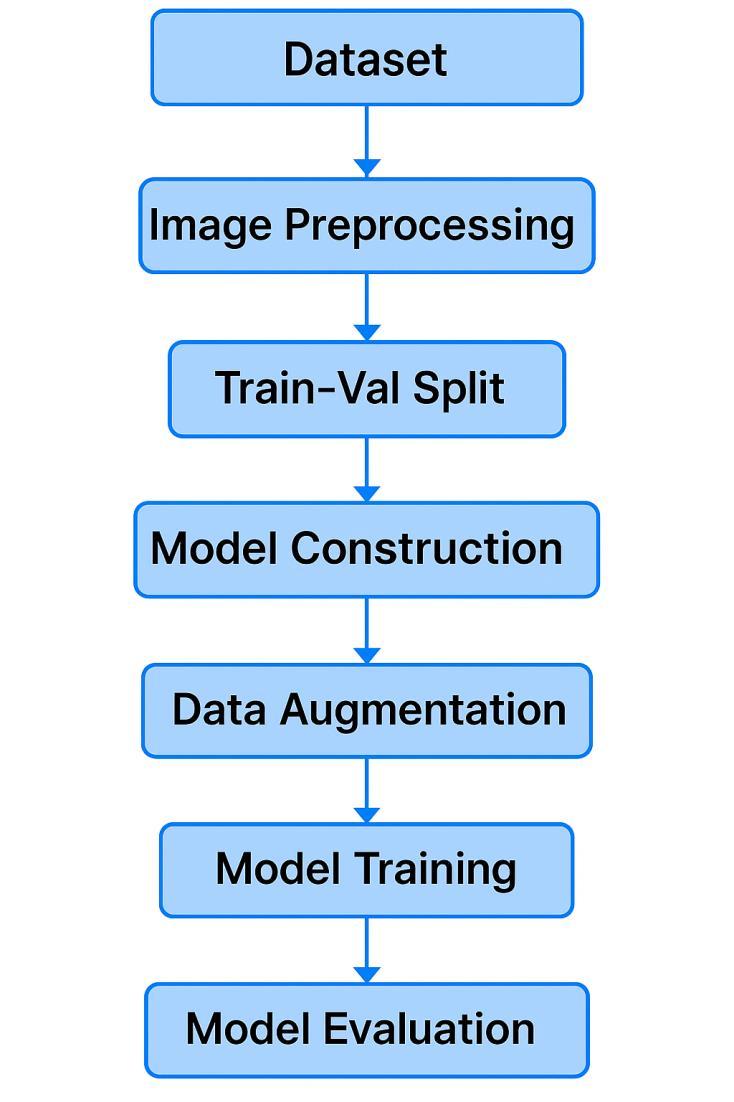
Fig-2: Flow Chart
Thedevelopmentandexecutionofthericepestclassification systemweresupportedbya combinationofpowerfuland widelyusedsoftwaretoolsintheareaofmachinelearning, deep learning, and image processing. The entire implementation was primarily done using the Python programming language (version 3.7+),recognizedforits flexibilityandextensivelibrarysupport. Tensor Flow and Keras used as the core deep learning frameworks. Kerasxwas used for building the Caffe Net-inspired CNN architectureduetoitsuser-friendlyAPI,whileTensorFlow served as the backend engine to perform tensor computationsandoptimizethetrainingprocess.Forimage manipulation tasks such as resizing, augmentation, and contourdetection.
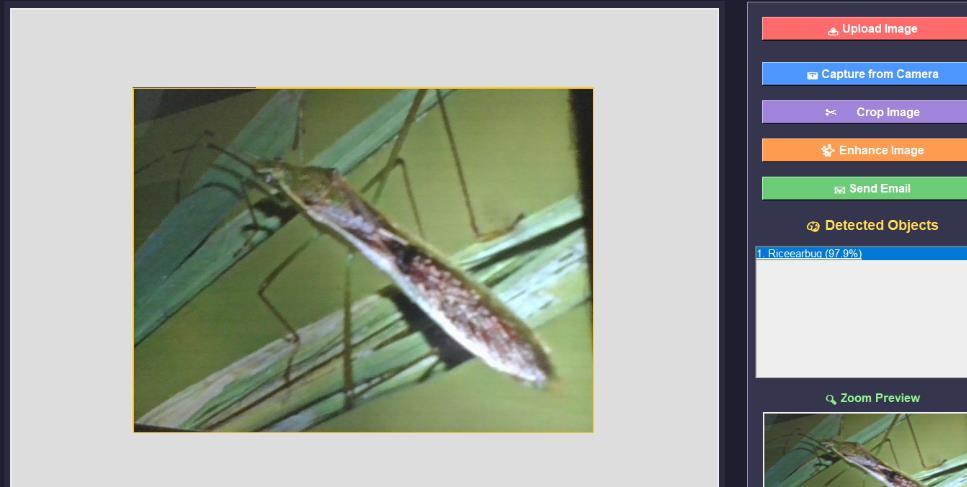
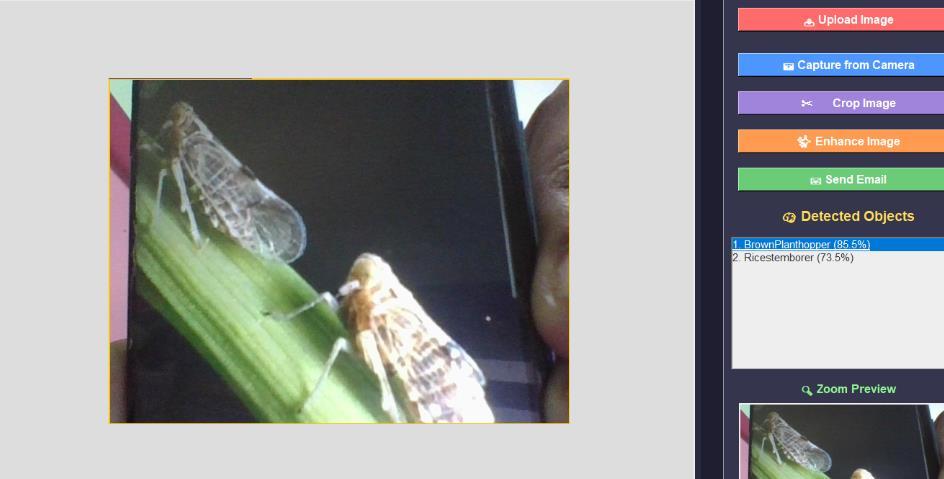
The performance of the developed pest the classification systemunderwentevaluationusingareal-timeimage-based testingenvironment,asshowninthedetectiondashboard. Thesystemsuccessfullyidentifiedmultiplepestclasseswith
highaccuracy.Forinstance,theRiceEarBugwasdetected witha confidenceof 97.9%, whiletheBrownPlanthopper andRiceStemBorerwereclassifiedwith85.5%and73.5% accuracy respectively. These strong accuracy results demonstrate the model's capability to effectively identify distinguishingfeatures,eveninnaturallightingandcomplex backgrounds.
TheuseoftheCaffeNet-basedCNNarchitecture,combined with appropriate image preprocessing and augmentation, Played a key role in enhancing the prediction accuracy. Furthermore, the inclusion of multiple object detection capabilityallowsthemodeltoidentifymorethanonepestin a single frame, adding to its practical utility in real field conditions.Theachievedaccuracyofupto97%confirmsthe robustness of the trained model and its suitability for deploymentinpestsurveillancesystemsforricecultivation.
International Research Journal of Engineering and Technology (IRJET) e-ISSN: 2395-0056
Volume: 12 Issue: 10 | Oct 2025 www.irjet.net p-ISSN: 2395-0072
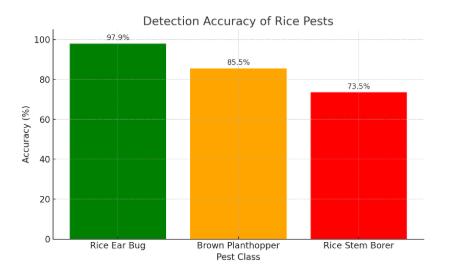
Chart-1: Result Comparison Chart
Hereisthebargraphshowingdetectionaccuracyforeach ricepestclass:
RiceEarBug:97.9%
BrownPlanthopper:85.5%
RiceStemBorer:73.5%
TheproposedpestclassificationsystemusingaCNN-based model has demonstrated its effectiveness in accurately identifyingmajorricepestssuchasBrownPlanthopper,Rice Ear Bug, and Rice Stem Borer from real-time images. By incorporatingDLmethodslikeCaffeNetarchitecture,image preprocessing,andfeature extraction,themodel achieved highclassificationaccuracy upto97.9%insomecases.The GUI-basedapplicationallowsuserstoupload,capture,and process pest images efficiently, making it applicable for practical agricultural use. The results confirm that automated pest detection using DL methods not only reduceshumandependencyanderrorbutalsoenhancesthe decision-makingprocessinpestmanagement,contributing tomoresustainableandtimelycropprotectionstrategies.
Iacknowledgeandexpressmysincerethankstoourbeloved Guide,Director&PrincipalDr.SureshDS,forhisvaluable suggestionandcontinuedencouragementbysupportingme inmyacademicendeavors.
IthanktheentireteachingandnonteachingfacultyofDept. ofECEChannabasaveshwaraInstituteofTechnology,Gubbi, fortheirkindco-operationduringthispaperwork.
[1] Y. Chen, Z. Jiang and J. Zhou, "Automatic Insect Pest Recognition Based on Deep Learning," Frontiers in Plant Science,vol.12,pp.1–9,2021.
[2] L.Fu,C.Zhang,X.Zheng,Y.SongandY.Lin,"CNNBasedDetectionforMulti-ClassPlantDiseaseand Pest Identification Using Real-Field Images," Sensors,vol.21,no.2,p.479,2021.
[3] K. Ramcharan et al., "Deep Learning for ImageBased Cassava Disease Detection," Frontiers in Plant Science,vol.8,p.1852,2017.
[4] X.Zhang,Y.Qiao,T.Meng,C.ZhangandC.Fan,"A DeepLearning-BasedSystemforRecognitionand Classification of Rice Leaf Diseases," Computers andElectronics inAgriculture,vol.179,p.105824, 2020.
[5] K.Sudars,R.Paulus,K.Plukis,A.JakovelsandJ. Greitans,"AutomaticDetectionofInsectPestsin Greenhouse Environment Using CNNs," in Proceedings of the 2020 27th International Conference on Mixed Design of Integrated Circuits and Systems (MIXDES),Wroclaw,2020,pp.346–350.