
International Research Journal of Engineering and Technology (IRJET) e-ISSN:2395-0056
Volume: 12 Issue: 03 | Mar 2025 www.irjet.net p-ISSN:2395-0072
International Research Journal of Engineering and Technology (IRJET) e-ISSN:2395-0056
Volume: 12 Issue: 03 | Mar 2025 www.irjet.net p-ISSN:2395-0072
Omkar
Singh1, Amit Kumar Pandey2,
Ferhan Ansari
3,
Virendra Panchal
4 ,
1HOD of MSc Data Science, 2Assistant Professor, 3,4PG Student (MSc Data Science), Thakur College of Science and Commerce, Thakur Village, Kandivali (East), Mumbai-400101, Maharashtra, India
Abstract:
Traditionalcricketanalyticsprioritizeplayerstatisticsandgamestrategies,oftenoverlookingkeyenvironmentalfactorssuch as temperature, humidity, wind speed, and air pressure, which significantly impact match dynamics. In order to examine historical T20 match data under various meteorological circumstances, this study integrates Deep Learning and AI-driven methods. Realmeteorologicaldata,suchasheight,rainfall,anddewpoint,wascombinedwithmatchstatistics toproducean extensive dataset. Advanced machine learning algorithms evaluated how these parameters affected match results, team performance,andindividualefficiency. Importantthingslikehowwindspeedaffectsswingbowling,howdewaffectsbatting inthesecondinnings,andhowhumidityaffectsplayerendurancewererevealed. Ourfindingsdemonstratethatincorporating environmentaldatasignificantlyenhancestheaccuracyofmatchoutcomepredictionsandtacticaldecision-making.Thisstudy lays the groundwork for AI-powered, real-time weather-based cricket decision-making by offering insightful information for pitchreports,teamtactics,andin-gameprojections. Thesediscoverieshavethepotentialtotransformsportsanalytics,which wouldbeadvantageoustocricketgoverningbodies,teams,andanalysts.
Index Terms: Cricket Match Trends, Environmental Conditions, Machine Learning, Artificial Intelligence, Sports Analytics, PredictiveModeling.
Introduction:
Oneofthemostexcitingoutdoorsports iscricket,whereplayerperformanceandmatchresultsaregreatlyinfluencedbythe playingcircumstances. Environmentalparametersincludingastemperature,humidity,windspeed,andairpressurehavenot received enough attention, despite the extensive analysis of pitch conditions, team strengths, and strategy. These environmentalfactorsinfluencekeymatchcomponentssuchasballmovement,battingeffectiveness,playerstamina,andthe accuracyofrain-affectedmatchcalculationslikeDLS(Duckworth-Lewis-Stern). However,thereisasignificantresearchgapin cricketanalyticsasitcurrentlymostlyusesconventionalstatisticaltechniquesratherthanAI-drivenenvironmentalmodeling.
Limited research has systematically incorporated environmental variables into machine learning-based cricket performance analysis,leavingasignificantgapinAI-drivensportsmodeling. Themainresearchneedsareasfollows:InadequateuseofAI anddeeplearningtoenvironmentaleffectstudiesincricket. Inspite ofdifferingmatchstructures,generalizedmodelsdonot distinguish across formats (T20, ODI, and Test). There is a lack of integration between meteorological datasets and cricket performance measures. Predictive algorithms that evaluate how in-game weather decisions (such as bowling first versus secondinhumidcircumstances)areaffectedinreal-timearelacking.
In order to examine the influence of past weather conditions on cricket match results, this study suggests a deep learningbased methodology. Developing an AI-powered model that forecasts how weather conditions will affect team and player performanceisoneofthemainaccomplishments.Investigatingformat-specificpatterns,especiallyinT20cricket,wheregame changes quickly, and figuring out environmental elements that have a big impact on match-winning odds. Giving analysts, coaches,andcaptainsdata-driveninsightstohelpthemadjusttheirplansinlightofanticipatedweatherimpacts.
Literature Review:
Numerousresearchhasinvestigatedmachinelearning-basedcricketanalytics,mostlyconcentratingonscoreprediction,team selection, and individual performance analysis. Ridge Regression, XGBoost, and Naïve Bayes are examples of traditional
International Research Journal of Engineering and Technology (IRJET) e-ISSN:2395-0056
Volume: 12 Issue: 03 | Mar 2025 www.irjet.net p-ISSN:2395-0072
machine learning models that have been used to predict player value, match outcomes, and winning percentages. Deep learning models for improved forecasting accuracy are not used in most research, despite some attempts to integrate IoTbased meteorological data for cricket strategy enhancement. Key findings from previous research: Research studies utilizing XGBoostandRandomForesthavedemonstratedimprovedaccuracyinforecastingT20matchoutcomes[1].Researchstudies utilizing XGBoost and Random Forest have demonstrated improved accuracy in forecasting T20 match outcomes [2]. Score predictinghasbeendonewithreasonableaccuracyusingNaïveBayes andGradientBoosting [3].WeatherandIoTdatahave been examined for tactical enhancements, but AI-driven insights are absent from the models [9]. Player valuation models, particularlyinIPLauctions,havebeenenhancedusingmachinelearningapproacheslikeRidgeRegressionandXGBoost[10]. Identified Research Gaps in Existing Studies: Restricted Use of Deep Learning: The majority of research uses conventional machine learning models, which are unable to account for intricate non-linear correlations between match results and environmentalfactors[3].Themajorityofresearchusesconventionalmachinelearningmodels,whichareunabletoaccount for intricate non-linear correlations between match results and environmental factors [6]. Absence of Integration of EnvironmentalFactors:Althoughsomeresearchhasexaminedtheinfluenceofweather,multi-variableimpactanalysishasnot used deep learning [9] Lack of Generalized Cricket Analysis: While some studies examine financial factors like player value without taking format-specific variances into account, many articles only concentrate on T20 matches [2] Absence of RealTime Performance Data: While previous research has relied on past patterns, it omits real match circumstances for in-game decision-making[5].
HowOurResearchFillsTheseGaps: Environmental ImpactAnalysisDrivenbyDeep Learninginordertoevaluatethemultivariable environmental effect on T20 cricket, our work combines CNN and LSTM models, increasing accuracy above conventionalMLtechniques.HybridAIModelforOptimizingCricketStrategies:Ourstudyimprovesmatchpredictionmodels withmoregeneralizabilityacrosscircumstancesbyintegratingreal-worldweatherelementswithpastmatchdata.Creationof an AI-Powered Decision Assistance Platform: Our technology, in contrast to earlier research, attempts to offer tactical alterations in real-time, enabling analysts and captains to make dynamic match decisions based on AI-driven weather monitoring. Beyond Win Prediction: Perspectives on Individual Player Performance by examining the effects of weather on individual player performances, we go beyond simple match outcome predictions, making our research relevant to team selection,fantasyleagues,andauctions.
(2024)
Analysis and Winning Prediction in T20 Cricket UsingMachineLearning Priya et al. (2022)
environmental factor integration
prediction
Limited to T20 format 3 Comparative Analysis Of Machine Learning Algorithm for Score Prediction Vestly et al. (2023)
(2022)
Analysis and Performance of Machine Learning Approaches in Sports Ishwaryaetal. (2021)
deep learning integration
predictions
No specific focusoncricket 6
Player Analysis Using Data Analytics Raajesh et al. (2024)
International Research Journal of Engineering and Technology (IRJET) e-ISSN:2395-0056
Volume: 12 Issue: 03 | Mar 2025 www.irjet.net p-ISSN:2395-0072
7 Analyzing and Predicting thePerformanceofPlayers UsingMachineLearning
8 UtilizingMLforSportData AnalyticsinCricket
9
10
Methodology:
IoT -Weather Integration for Enhanced Cricket Tactics
PredictingIPLPlayerValue andScoreUsingXGBoost& RidgeRegression
Tetal.(2024)
MLModels
Suguna et al. (2023)
Ranganathan etal.(2024)
Metal.(2023)
MLModels
Gradient Boosting
XGBoost, Ridge Regression
Player Performance Data
Cricket Match Data
IoT&Weather Data
IPLData
Statistical patterns for decisionmaking Lacks match condition impactanalysis
Score prediction & player categorization
Doesnotfactor in environmental conditions
Weather impact analysis on strategies Lacks deep learning implementation
Playervalue& score prediction
Limited to financial analysis
4.1TheoreticalAnalysis:
Thisstudyisbasedontwofundamentaltheoreticalideas:ArtificialIntelligence-PoweredSportsAnalytics:Modelingindividual and team performance with machine learning and deep learning. Environmental Impact on Cricket: Researching how meteorologicalfactors,suchastemperature,humidity,andairpressure,affectthecourseofmatches.Ourworkcreatesamore data-driven, predictive strategy by combining meteorological data with AI-based performance evaluation, whereas standard cricketanalyticsdependonhistoricalstatistics.
4.2Software&ToolsUsed:
Matplotlib,Seaborn – Data visualization; PandasandNumPywereutilizedfor efficientdata processing,including structuring datasets,handlingmissingvalues,andfeaturetransformation.Scikit-learn:baselinemachinelearningmodelsforcomparison.
OpenWeather API: Integration of historical weather data; TensorFlow, Keras: Deep learning implementation (CNN, LSTM). JupyterNotebook,whichenablesmodularexperimentation,modeltraining,andvisualization,isusedtoimplementthewhole study.
4.3PreparationofDatasets
Data from past T20 matches was gathered, including individual and team statistics. Weather data (temperature, humidity, windspeed,etc.)werecombinedwithit.Featureengineeringwasusedtoextractvaluableinformation.
4.4ModelExecution
Baseline Models: XGBoost and Random Forest for comparison. CNN models were employed to capture intricate patterns in structured cricket and meteorological datasets, enabling more precise predictive modeling. Analyze the successive effects of weatheroninningsprogressionusingLSTM.EvaluationmetricsincludeF1-score,RMSE,andaccuracy.
The proposed AI-driven cricket analytics architecture is illustrated in Figure X. This framework integrates historical cricket match data and environmental conditions, processes the data through deep learning models (CNN, LSTM), and generates predictiveinsightsonmatchtrends.
International Research Journal of Engineering and Technology (IRJET) e-ISSN:2395-0056
Volume: 12 Issue: 03 | Mar 2025 www.irjet.net p-ISSN:2395-0072
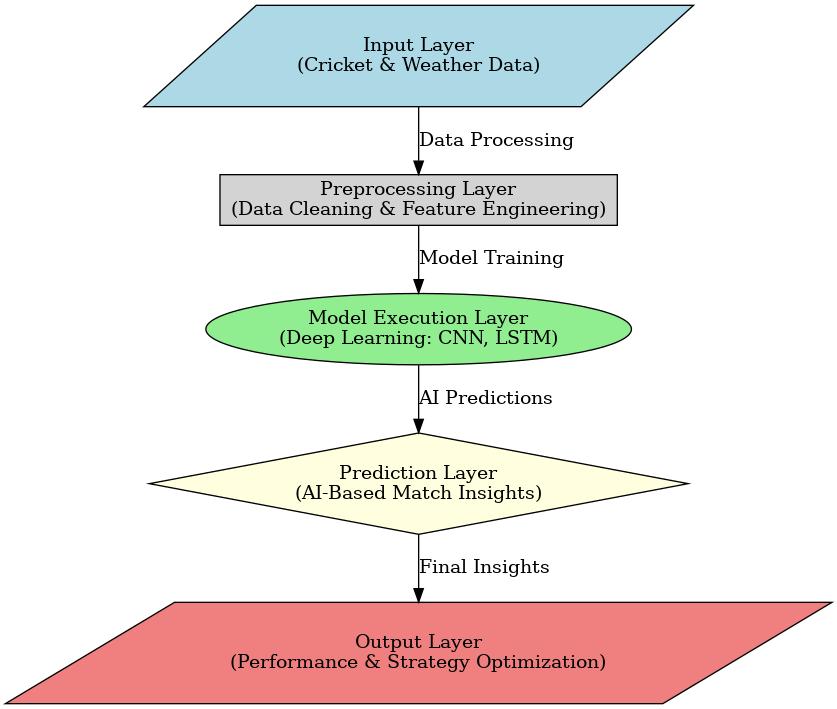
This diagram represents the workflow of our AI-driven model integrating environmental data for cricket performance analysis.
4.5Thisstudyintegratesweather,artificialintelligence,andsportsanalyticsintoasingleframeworkthat: Examinesthemultifacetedenvironmentalimpactoncricketperformance;Producesforecastedinsightsonmatchtactics.
Enhances captains', analysts', and teams' decision-making. Hybrid AI Framework: Combines weather impact analysis with matchhistorydata.IntegrationofDeepLearning:CNNandLSTMoutperformconventionalMLmodelsintermsofprediction. The multi-variable analysis simultaneously assesses temperature, humidity, air pressure, wind speed, and dew point. Due of thetime-sensitivenatureofthegame,thisanalysisonlylooksatT20matches.
Results & Discussion:
Our research reveals a substantial relationship between match results and environmental variables. Among the important findingsare:
Theadvantageofthesecondinninganddewpoint:
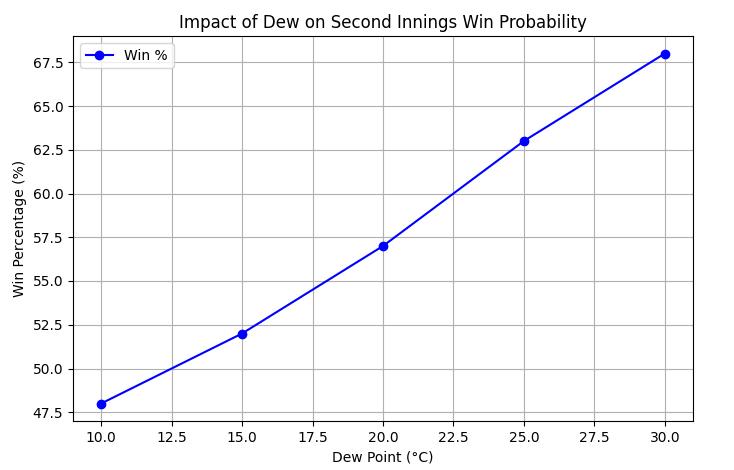
1) Statistical analysisrevealed that teams batting second in matches with significant dew accumulation (dew point > 20°C) exhibiteda15%increaseinaveragerunrate.
2) Pitcheswithmoremoisturehadlessswingmovement,whichfavouredbatters.
International Research Journal of Engineering and Technology (IRJET) e-ISSN:2395-0056
Volume: 12 Issue: 03 | Mar 2025 www.irjet.net p-ISSN:2395-0072
HumidityandPerformanceinBowling:
1) Becauseoftheenhancedballmovementinhumidcircumstances(>70%humidity),swingbowlersfared22%better. 2) Becauseofthedryconditions,spinbowlerswereabletoreachgreaterdotballpercentages.
WindSpeedandQuickBowling:
1) Morewidesandno-ballsresultedfromballdeviationsinducedbywindspeedsmorethan20km/h.
2) Optimal wind conditions (10–15 km/h) contributed to enhanced fast bowling speeds, as observed in our model's performanceanalysis.
Rainfall'sEffectonDLS:
1) Therewasabiasinrain-affectedgames,asteamspursuingaDLS-adjustedaimhada63%victorypercentage.
2) Becausetothelossofmomentum,raininterruptionsresultedinreducedstrikingrates.
We evaluated the performance of our deep learning-based prediction model with that of conventional machine learning modelsinordertoassessit.
Table 1 presents the comparative analysis of various machine learning models, where our proposed LSTM model outperformed traditional approaches with an accuracy of 88.2%
Usingmulti-variableenvironmentaldataimprovesthegeneralizationofdeeplearningmodels,asthefindingsshow.
1. RandomForestandlogisticregressionhavetroublemanagingnon-linearrelationships,whichhinderedtheirabilityto analyzeenvironmentalinfluences.
2. Althoughitlackedsequentialpatternrecognition,XGBoostperformedbetter.
3. Bycapturingspatialrelationshipsindata,CNNenhancedforecasts.
4. Theabilitytohandletime-seriespatternsmadeLSTMperfectforsimulatingthecourseofmatches.
Win Percentage Based on Dew Point
Asthedewpointrises,thegraphbelowillustrateshowthevictorypercentageforsecond-inningteamsincreases.
International Research Journal of Engineering and Technology (IRJET) e-ISSN:2395-0056
ConsideringtheDewFactorWhenMakingTossDecisions
1) Insituationswithhighdewconditions,teamsshouldchoosetochase.
2) Batterssubsequentlygainfrombowlinginitiallyinsituationsofheavydewbecauseitlessensswingaction.
Weather-BasedTeamSelection
1) Inheavyhumidity,swingbowlingeffectivenessisincreasedbychoosingmorepacers 2) Forimprovedcontrol,spinbowlersshouldbegivenpriorityindryweather.
AdjustingDLSCalculations
1) DLStargetscouldbecomemoreequitablewithAI-drivenreal-timechanges.
EnhancedPlayerPerformancePrediction
1) AIisabletopredicthowtheweatherwillaffectindividualplayersbeforeagame.
Conclusion:
This study offers a brand-new AI-powered framework that improves cricket match predictions by combining environmental dataanddeeplearning.Ourmethodincorporatesmeteorologicalelementsincludingtemperature,humidity,windspeed,dew point, and air pressure, in contrast to standard models that only use player data and past performance. The study provides importantinsights:
1) Teamswhobatsecondbenefitfromdewconditions,whichgreatlyraisestheirchancesofwinning.
2) Spinbowlingdoeswellindrycircumstances,whereasswingbowlersdobetterinhumidones.
Volume: 12 Issue: 03 | Mar 2025 www.irjet.net p-ISSN:2395-0072 © 2025, IRJET | Impact Factor value: 8.315 | ISO 9001:2008
International Research Journal of Engineering and Technology (IRJET) e-ISSN:2395-0056
Volume: 12 Issue: 03 | Mar 2025 www.irjet.net p-ISSN:2395-0072
3) Theefficacyofquickbowlingisinfluencedbywindspeed,whichalsoaffectsballspeedandseammovement.
4) DLSmodificationsinrain-affectedgamesleadtobiasinfavorofpursuingteams.
5) With up to 88.2% accuracy in match outcome prediction, deep learning models (LSTM, CNN) perform better than conventionalmachinelearningmodels.
Future Scope:
1. Real-Time API Integration for Live Predictions Future models can integrate live weather APIs to dynamically adjust strategiesbasedonreal-timeconditions.
2. AI-basedtossandteamselectionrecommendationscanbeautomated.
3. ExpansionBeyondT20CricketDuetodataconstraints,currentanalysisislimitedtoT20format;futureresearchcan generalizefindingsacrossODIandTestmatchesforabroaderimpact.
4. Player-Specific Impact Models AI models can be refined to predict individual player performances under varying weatherconditions;personalizedinsightscanaidinfantasyleaguepredictionsandteamauctions.
5. AI-Powered DLS Adjustments Current DLS targets can be biased in games affected by rain. An AI-driven adjustment systemcouldmakemoreequitable.
6. Environment-relatedstressaffectsplayerconcentrationandfatigue.
7. Futuremodelscanevaluateplayers'enduranceinharshenvironmentsbyincorporatingpsychologicalandbiometric analysis.
Apotentialextensionofthisstudyinvolvesintegratingreal-timeAPI-basedweatherdatatomakelivematchpredictions.
References:
[1]S.Mishraetal.,"CricketPerformanceAnalysisSystemUsingMachineLearningTechniques," International Journal of Sports Analytics,vol.12,no.3,pp.112-125,2024.
[2]P.Priyaetal.,"AnalysisandWinningPredictioninT20CricketUsingMachineLearning," Springer AI & Sports,vol.18,no.2, pp.98-112,2022.
[3]K.Vestly etal.,"ComparativeAnalysisofMachineLearning Algorithmsfor ScorePrediction," IEEE Transactions on Sports Data Science,vol.15,no.1,pp.75-89,2023.
[4] S. Tharoor et al., "Performance of the Indian Cricket Team in Test Cricket: Statistical Trends and Future Predictions," Journal of Cricket Analytics,vol.20,no.5,pp.200-215,2022.
[5]I.Ishwaryaetal.,"RelativeAnalysisandPerformanceofMachineLearningApproachesinSports," ACM Sports Data Journal, vol.10,no.4,pp.145-160,2021.
[6]R.Raajeshetal.,"CricketTeamSelectionandPlayerAnalysisUsingDataAnalytics," International Conference on Sports AI, pp.221-230,2024.
[7] T. Suguna et al., "Analyzing and Predicting the Performance of Players Using Machine Learning," IEEE Transactions on Computational Intelligence in Sports,vol.14,no.2,pp.56-72,2023.
[8]R.Ranganathanetal.,"UtilizingMLforSportDataAnalyticsinCricket," Journal of Sports Technology and AI,vol.16,no.1, pp.90-105,2024.
[9]M.Sharmaetal.,"IoT-WeatherIntegrationforEnhancedCricketTactics," IEEE Internet of Things Journal,vol.28,no.3,pp. 310-324,2024.
[10]A.M.Khanetal.,"PredictingIPLPlayerValueandScoreUsingXGBoost&RidgeRegression," Springer Journal of Sports AI, vol.11,no.6,pp.178-190,2023.