
International Research Journal of Engineering and Technology (IRJET) e-ISSN: 2395-0056
Volume: 12 Issue: 12 | Dec 2025 www.irjet.net p-ISSN: 2395-0072
International Research Journal of Engineering and Technology (IRJET) e-ISSN: 2395-0056
Volume: 12 Issue: 12 | Dec 2025 www.irjet.net p-ISSN: 2395-0072
Dhananjay Gupta1 , Bhuvnesh Verma2 , Shivam Kanaujiya3, Armaan Khan4
1,2,3,4
MCA, Babu Banarasi Das Univeristy, Lucknow, Uttrar Praddesh, India
Abstract - Artificial Intelligence (AI), the marvel of human history, a technology that is reshaping the world in nearly every field, like Healthcare, Finance, Industry, Transportation, Robotics, etc. This paper explores every potential impact of increasing use of Artificial Intelligence in employment. How an AI is shifting the way industries operate by the automating tasks and streaming processes.
AI is blessing or curse for human and job industries, this study is look at that paradox. It explores which industries face the most risk, which sector are growing, how public attitudes and skill needs are shifting, what other policies need to make the balance between AI and employment. By reviewing recent studies and datasets, the research compares projected job losses with emerging opportunities and provides guidance on the skills and policies needed to thrive in an AI-driven economy. The finding empathize that AI should not be view solely as threat to employment, but as a new opportunity towards more creativity, analytical and technical oriented role.
This research paper expected discover the key findings which are the major responsible for the difference between new job opportunity and job losses, and give some logical andpractical solution, which can change the perspective on employment. The outcomes will help to prepare the workforce for AI-driven industry by providing some valuable insights for, educators policymakers, and industry-leaders. Ultimately, the study aims to provide latest ongoing discourse on sustainable collaboration between human and AI.
Key Words: Artificial Intelligence, Employment, Automation, AI-driven system, Job Displacement, Skill Gap, Technical Skill.
1. INTRODUCTION
1.1 Background
Artificial Intelligence (AI) is emerging as one of the most revolutionarytechnologiesin21stcentury.Originatedfrom small research lab, where research is going on machine reasoningandsymboliclogic.AIhasevolvedsosophisticated set of technique that are capable of perform tasks that requires human intelligence, which involves machine mimickingcognitivefunctionlikeperception,reasoning,and language understanding. In the early 1950s with the DartmouthworkshopwhereJohnnMcCarthyfirstcoinedthe term“ArtificialIntelligence”[1],developedinresearchlabto mimichumanintelligence.
The continuous advancement of machine learning, deeplearning, data-driven system has acerated AI day-to-day business function. Large scale dataset analysis, administrative process automation, strategic decision assistance,andthereplacementofrepetitivecognitivetask are now possible with modern AI systems. As a result, industries are achieving different level of efficiency, scalability,andcostreduction.
But this acceptance of AI also sparked a global discussion about how it will affect employment in long run. The replacement of daily routine task by automation raised seriousconcernaboutjobdisplacementandworkforce.
AI has been moved from research labs into everyday businessindustryatanextraordinarypace.Whatusedtobe simple, rule-based automation can now process huge amount of data, support complex decision making and perform task, previously reserved for professionals. Companies use AI to optimize supply chains, personalize customer experience, automate finance, and speed up productdevelopment.
TherapidadoptionofAIhasraisedtheconcernaboutits potential impact on employment. According to McKinsey Global Institute“AIandautomationcoulddisplacearound 8000millionto900milliontill2030”[2].
Theseadvancementscreatemajorbenefit,buttheyalso raisebigquestion:
WillAIreallyreplacehumanwithautomation?
HowmanyjobsAIwillreplace?
Whichjobwillsurviveorchange?
Whatnewrolewillemerge?
Many enterprises are now adopting AI-driven tools to manage cost, and increase productivity, yet these developmentsreshapethefutureemployment.
ThisdualimpactofAIformstheparadoxoftheAI-driven economy.
AI is like double-edge sword (Curse and Blessing), contributingmajorbenefitswhileparallellycreatingrisk. Curse:Recently,GoldmanSachsresearchreportthatby the end of 2025, around 300 million full-time jobs will
International Research Journal of Engineering and Technology (IRJET) e-ISSN: 2395-0056
Volume: 12 Issue: 12 | Dec 2025 www.irjet.net p-ISSN: 2395-0072
replacebyAIandmachinelearning[3].Entryleveljobsare moreaffectedbyAIcomparethenothers.In1997,oneofthe greatest chess players in history was lost By a Super computer-Deep Blue.Healways says “Perhapshe wasthe firstknowledgeemployee,whosejobwashauntedbyanAI machine” [4]. According to google, no sector is remains completely untouched with AI and its pervasive transformativeforce.IndustriesadaptingAIforcostcutting, which may be benefit for their business, but it ultimately affectedtheemployeesandfreshers.Especially whitecollar andadministrativeroles,suchascomputerprogrammers, servicerepresentatives,accountants.
Blessing:Thereisafamousquote–Everydisasterisan opportunity. AI may be the disaster which may bring unemployment, but it also brings some new opportunity, new categories beside traditional jobs. Jobs like AI developer, analyst, AI trainer, and many more. AI is projectedtoincreaserevenuewithAIexposerinindustries. TheincreasingofAI,thedemandofskilledworkersisalso increasing with significant wage premium for those who possess AI skills. Recent report suggests that nearly 97 million new job roles may create by 2025. Similarly, NITI Aayogreportsthat,Indiacouldseeupto4millionnewjobs innext5yearsinwhicharound2.3millioncanbeAI-related jobs[5].
Thisresearchpaperoffersa structured,evidence-based loot,forAIandtheirnetimpactonemployment.andaimsto help policymakers, educators, and employers to make informeddecision,byfocusingonskillsandsectoralimpacts, thatwillbegiveninthefuturechapter.
The increasing adoption of AI presents several challenges:
Manyworkerslackthedigitalcompetencerequired forAI-drivenworkplaces.
Educationalsystemsarenotadequatelyalignedwith AI-basedindustrydemands.
CompaniesoftenadoptAIforcostreduction,leading tosuddenlayoffs.
Policymakers face difficulty predicting the scale of disruption.
PublicanxietyaboutAIreplacingjobscontinuesto grow.
These gaps reveal the urgent need to study:
1. Whichsectorsaremostatrisk?
2. WhichnewsectorsareexpandingduetoAI?
3. Whattypesofskillsarebecomingessential?
4. Whatpoliciesandstrategiesareneededtobalance AIandemployment?
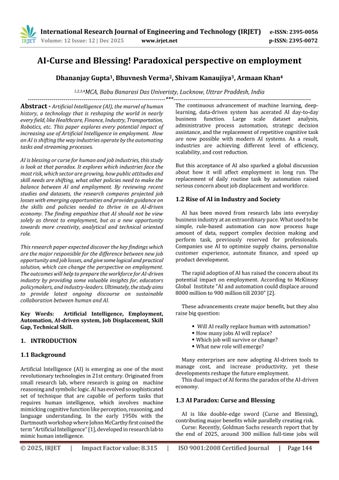
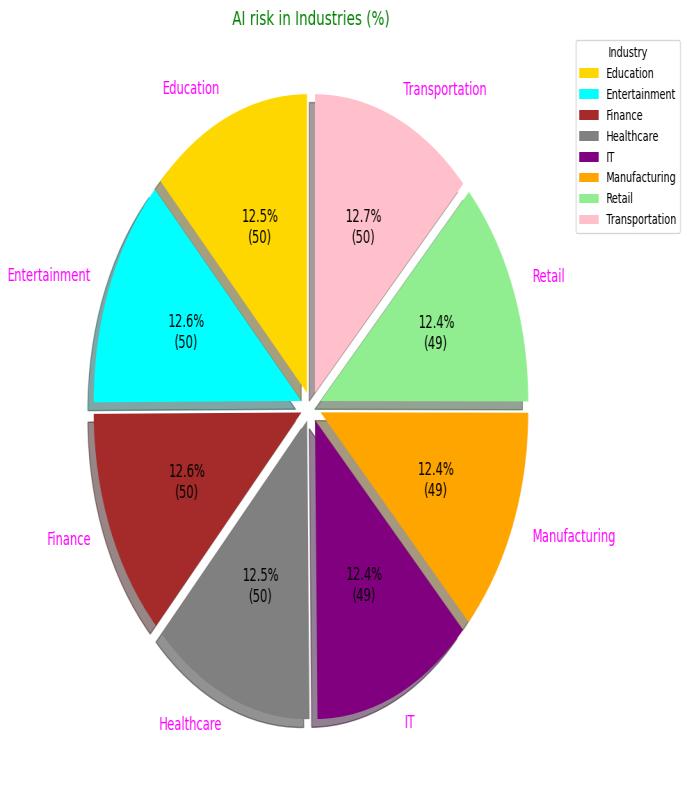
Thefollowinggraph(Fig1.1)illustrateshowmanypercentAI isgoingtoinfluencebyAIinupcomingyears.Asyoucansee almost every sector will going to influence by Artificial Intelligence.
2.1 Literature survey
ArtificialIntelligence,asimplewordbuttheimpactisvery large,anditshistoryisevenolder.Before1956,itwasthe erawhere,computingmachineessentiallyfunctionedmostly aslarge-scalecalculatingmachine,butinyear1956,asmall groupofresearchersfromvariousdisciplinesparticipatedin a summer-long workshop in Dartmouth College, where ProfessorJohnMcCarthy,foundedtheresearchonthefield ofArtificialIntelligence(AI).
Thenafterfewmajor incidentshappenedlike, ELIZAwidely consideredasfirstchatbotintendedtosimulatetherapyby answering that is prompted to it. After few decades, a GermanscientistnamedErnstDickmanns,inventedthefirst self-driving car in 1986, the major drawback of this AI is that,thevehiclecouldonlydriveonemptyroadandmaybe it was beyond that time, people couldn’t think about autonomousvehicle(AI-drivencar).
But the major incident occurred in 1997 when Garry Kasparov, a famous world chess champion, was lost the gamebyanAI(DeepBlue),inventedbyIBM.Hebecamethe firsteverhumanwholostbyanArtificialIntelligence.
International Research Journal of Engineering and Technology (IRJET) e-ISSN: 2395-0056
Volume: 12 Issue: 12 | Dec 2025 www.irjet.net p-ISSN: 2395-0072
Thereafter,thegrowthinAIwassignificantlyincreases.And themajortrendofAIbecamepopularwhenin2012,when Geoffrey Hinton, the computer scientist began the idea of DeepLearningandneuralnetwork,anAIbuiltsystemthat are able to mimic human thinking. He joined google and make a big boom in Artificial Intelligence field by making research on Deep Neural network. This was the time multiple industries are giving interest in Artificial IntelligenceandmachineLearning.
Then, in 2022, OpenAI releases the AI chatbot called ChatGPT, which can interact with their users far more realistic than ever, and became very popular. So popular, that in 2025 it becomes 4th most visited website globally behind Google, YouTube and Facebook [6]. From here the popularity of Artificial Intelligence became everyone’s favourite,companiesstartedexploringmorepotentialofAI, integratingwithothermachinesanddevelopingnewideas. Year2023,about3900 layoffs,duetoAI.itwasthefirsttime whensomanyemployeesarelosttheirjobduetoArtificial IntelligenceandthenthebalancebetweenAIandjobbecame unbalance.
Sr. No. Year
1. 1956
2. 1965
3. 1986
4. 1997
5. 2012
6. 2022
7. 2023
Key points
ThefieldofAIresearchwasfounded inDarthmouthWorkshop
Thefirst"expertsystem,"DENDRAL, isdevelopedtoanalyzechemical compounds
aGermanscientistnamedErnst Dickmanns,inventedthefirstselfdrivingcar
WorldchesschampionGarry Kasparov,thefirstpersonwhowas defeatedbyAI(IBM’sDeepBlue)
BigboominAIfield,Researchersat StanfordandGoogleadvancedeep neuralnetworkresearch
OpenAIreleasestheAIchatbotcalled ChatGPT
About3900layoffs,duetoAIforthe firsttime
SomeofthepastresearchofAIandemploymentgivesa complexinteractionbetweenadvancementoftechnologies, employees demand and job transformation. Most of the previous studies highlighted the risk of automation that displacing the routine and manual jobs. An estimation by
Frey and Osborne report that, around 47% of U.S. occupations is at high risk by AI, which sparks the global concernaboutjoblossandAI-drivensystem[7].
Later research paper, underlined that AI not just only replaceshumanlabor,oftencomplementsthem.Inastudyby BrynjolfssonandMcAfeearguedthatAIboostproductivityby enabling workers to focus on analytical, creative and interpersonalresponsibilitybytakingcognitivetask[8].
Some experimental studiesalsoshownthatcompanies adopting AI, experiences both job displacement and job creation.Arntz,M.,T.GregoryandU.Zierahnarguedthatthe true impact of automation is often fewer than early prediction,hesuggeststhatAIautomatedtasks,nottheentire job,leavingspaceforhumaninteraction[9].Recentresearch further giving warning about skill polarization, wage inequality,inshort,low-skilledworkersaremorevulnerable todisplacefromincreasingdemandinAIindustries.
Overall, the research paper agrees that, AI will neither causemajorjoblossnotitguaranteesemploymentgrowth. Instead,theimpactdependsuponworkforceskills,industries adoptionplan,andgovernment-ledupskillinginitiatives.
ManyresearchersarguethatAIisamajordriverofstructural unemployment.
FreyandOsborne(2013)estimatedthat47%ofU.S.jobs wereathighriskofautomationbasedonoccupational susceptibilitytocomputerization.Theirstudyiswidely cited as one of the earliestwarnings oflarge-scale job loss.
BrynjolfssonandMcAfee(2014)inducedtheconceptof the“SecondMachineAge”,arguingthatAIwouldreplace middle-skilljobswhileexpandinghigh-skilldemand.
McKinsey Global institute (2017 – 2023) published severalreportspredicting800million–900millionjobs couldbeautomatedby2030.
GoldmanSachs(2023)predictedthataround300million full-timejobsmaybereplacedbyAI.
These studies highlight a consistent prediction, that traditionalroutinejobsandadministrativerolesarehighly vulnerable.
Beside from the fear of mass unemployment, there are manyresearchershighlightpositiveemploymenteffects:
The World Economic Forum (WEF) forecast nearly 97 millionnewjobrolesareemerging,especiallyindatacentricandcreativedomains.
The report from PwC reports that around AI may contribute$15.7trilliontotheglobaleconomybyyear 2030, which can create new jobs across technology, finance,servicesandothersectors.
International Research Journal of Engineering and Technology (IRJET) e-ISSN: 2395-0056
Volume: 12 Issue: 12 | Dec 2025 www.irjet.net p-ISSN: 2395-0072
OECD suggests that AI augments human capabilities ratherthan,displacingthementirely.
Job Creation and Skill Transformation
Beside from the fear of mass unemployment, there are manyresearchershighlightpositiveemploymenteffects:
TheWorldEconomicForum(WEF)forecastnearly 97millionnewjobrolesareemerging,especiallyin data-centricandcreativedomains.
The report from PwC reports that around AI may contribute $15.7 trillion to the global economy by year 2030 that can create new jobs across technology,finance,servicesandothersectors.
OECDsuggeststhatAIaugmentshumancapabilities ratherthan,displacingthementirely.
Fig2.1showsthegraphicalrepresentationhowAIcancreate newopportunitiesnoteveninITsectorbutalsoindifferent sectorsaswell.
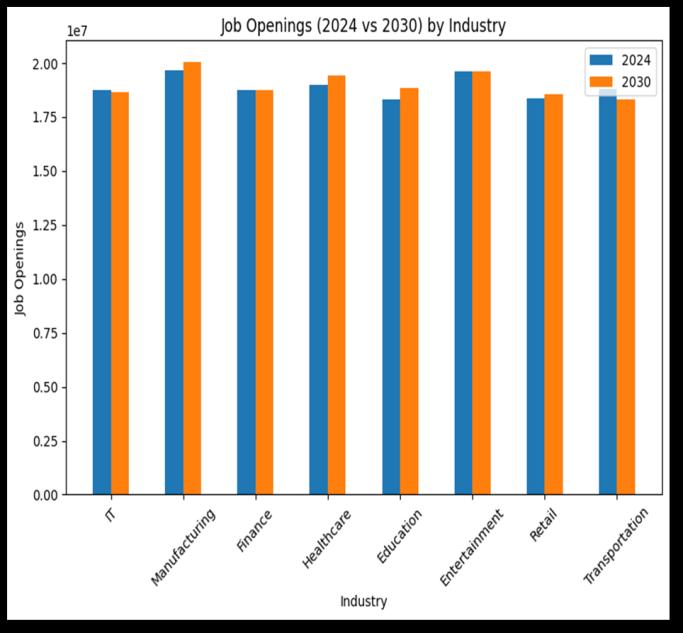
These key findings suggest that AI does not eliminate work,ratherittransformsit.
With rapidly acquiring industries through automation, decision-makingandprocessoptimization.AIraisescritical concern regarding employment displacement and skill transformation.Companieslayingofftheiremployeeswith hugeamount,justbecauseofAI,thiscreatesincreasedrateof employmentby6-7%,andpeopledon’thaveenoughskills requiredtoadaptthecurrenttrend.
MeasuresandPreventivestrategy:
Adaptandintegrate–PeoplearetryingtoresistAIand automation, but it very difficult to stand against AI, instead they should learn to use Artificial Intelligence skilltoenhancetheirproductivity,adaptthenewtrend.
Constantskill development– AIcontinuouslyevolving withtimetotime,andso,employeealsoneedtodevelop theirskillswiththistechnology.Theyneedtofocuson digital literacy, analytical thinking, increase problemsolvingskill,andcreativity,sothattheyarestayrelevant.
AI in education – AI is everywhere, it can be in Healthcare, Finance, Transportation, and so on, and peoplearenowadaptingitintheirlife,sowhynotthey learn from the beginning. In a survey by Stanford University,suggestthatnearlytwo-thirdofthecountry offering k-12 education in 2019. But less than half qualifiedtoteachit[10].Anarticleavailablethatreview andtellsfulldetailhoweducatorsandinstitutesneedto teachandtrainthemforAI[11].
Government support and reskilling program –Government needs to make some rules. Rules like; policymakers must invest in training schemes, apprenticeships,andworkforcetransitionsupport
4.1 Data Collection and Sampling technique
Thedataiscollectedthrough:
1. Research articles from IEEE, Mendeley, springs, SCM.
2. Reports from organizations such as WEF, OECD, NITIAayog
3. Publicemploymentdatasets
4. Policydocumentsandgovernmentpublications.
These are some sources provide the insights of global employmenttrendandAI-drivenchanges.
A targeted sampling technique is employed for expert interviews,concentratingonpeopledirectlyengagedinAI implementationandworkforcestrategy.
Randomsamplingisutilizedforquestionnaireresponsesto guarantee varied representation across sectors like IT, manufacturing,education,andservices.
The size of the sample is established using statistical confidencemetricstoguaranteevalidity.
ToolslikeMendeley,MS-word,IEEEXplore,andsomeother third-partyresourcingtoolsareused.TheuseofMendeley softwareinthispaperusedasaccessandeasytoreference
International Research Journal of Engineering and Technology (IRJET) e-ISSN: 2395-0056
Volume: 12 Issue: 12 | Dec 2025 www.irjet.net p-ISSN: 2395-0072
different research papers and articles, where MS-Word is usedtowriteandorganizetheseresearchpapercontentina proper form, and IEEE Xplore and other third-party tools wereusedtoprovidecontentandhelpmetomakeresearch ondifferentresearches,articles.
Inthelast,butnotleastGoogle,andChatGPTalsobeusedto provideclarificationofmydoubts.Thesetoolsensuremea structuredandreviewofthetopics.
This paper follows a mixed-method research design, meaning it integrated both qualitative and quantitative approachtoprovidecompleteunderstandingofAIandAIdrivenemploymentdynamics.Thismixedapproachallows triangulation of data, decreasing bias and increasing the robustnessofAIanditsadoption.
QualitativeComponent:
Research review, expert’s opinions, and case studies are evaluated to understand the AI trends, pattern of job displacement,andadaptionofworkforce.
QuantitativeComponent:
Another dataset from industry reports, surveys on employment, and research institutions are examined to identifyevidenceofmovesinemploymentbyAIadoption.
5.1
Thedatafromglobalemploymentreportsrevealssomekey trends:
Industries such as manufacturing, retail, and customer serviceshowasignificantreductioninroutinemanualand clericalrolesdurtoAI-enabledautomation.
Rolesrelatedtodatascience,AIdevelopment,cybersecurity, and cloud computing have shown a consistent rise from 2018to2024.
The share of jobs requiring advanced digital skills has increasedbyapproximately25%inthelastfiveyears.This supports predictionmade byglobal institutions regarding AI-drivenupskillingneed[12].
Asurveyfromemployeesandstudentsindicatethat65%are concernedaboutjoblossduetoAIautomation;around72% believe AI will create new job opportunity to advanced technicalsectors.While,50%to60%feelunpreparedforAIdriven roles due to limited training resources, and approximately 80% people are agreeing that companies should invest more in digital literacy and reskilling programs.
TheseQuantitativeresultsillustrateadualperception:fear ofjobdisplacementyetoptimismaboutfutureopportunities. Anotherqualitativefindingfromexpertinterviewshighlights severalkeythemes:
AI augments rather than replaces, meaning, most experts agree that AI complements human work rather than fully replacing workers in most sectors, companies struggle to find talent skilled in machine learning (ML), cloud computing,dataanalytics,etc.
Futureworkplacewillrelyonhybridsystemswherehumans handle judgment-based tasks and AI manages repetitive operations.
ThesequalitativefindingsalignwithreportsbytheWorld EconomicForum(WEF)andOECD.
The above findings are from either experts or nonexperts like students, and public. This paper also conducted some industrylevelcasestudyfromIT,manufacturing,andfinance sectors.Andtheyrevealthat,Financesector:AIchatbotand automated risk analysis systems have reduced administrativeworkloadsbutincreasedemandforanalyst andcybersecurityexperts.Manufacturingsector:Robotics hasautomatedassemblylines,butnewroleshaveemerged inrobotmaintenance,automationengineering,andsystem monitoring.Educationsector:AI-poweredplatformsassist teachers in content personalization but do not replace teachingroles.
The resultshows thatAIprimarilytransformsjobsrather thaneliminatingthementirely.Low-skilljobsfaceahigher displacement risk, while high-skill digital roles are expandingrapidly.Thisfindingsupportsglobalpredictions on future employment [13]. The majority of survey participants believe that reskilling programs are crucial. Without proper training, the workforce may face severe adaptabilitychallenges. Fromthesocio-economicimpact,it identifiespotentialwideningoftheskillgap,whichmaylead tosocio-economicdisparitiesifproactivemeasuresarenot taken.
Thus, the research supports the ongoing shift towards a knowledge-driveneconomy.Theresultsclearlyindicatethat AIhasamixedimpactonemployment.itislikeaparadox; somefindAIathreatandsomefinditasnewopportunity. Thesefindingsestablishafoundationfortheconclusionsand recommendationswhicharepresentedinthefuturechapter.
After findings and surveys from different sources, this research paper makes conclusion that. The integration of Artificial Intelligence into various sectors has initiated a major transformation in global employment patterns. The findings reveals that AI act as both dual-impact force: disruptor(Curse)andenabler(Blessing),itdisruptsthelow skilledandrepetitivejobrolethroughautomation,whereas, it also enables the creation of high demand roles in AI development, like data analytics, robotics, cybersecurity, cloud computing, etc. Thus, instead of narrating that “Ai
International Research Journal of Engineering and Technology (IRJET) e-ISSN: 2395-0056
Volume: 12 Issue: 12 | Dec 2025 www.irjet.net p-ISSN: 2395-0072
destroys jobs” is incomplete: instead, AI reshapes and reallocatesjobswithintheeconomy,endemploymentsector. Thestudy concludethatthefutureworkforcemustpossess somenewskills,whicharedemandinginthemarket,skills like:
Digitalliteracy
Analyticalandcriticalthinking
Creativityandproblem-solving
AI-assisteddecision-makingskills
Thefindingofthisstudyhighlight thatArtificialintelligence isnotmerelyatechnologyshitbutatransformationalforce reshapinghowindividualswork,learnandgrow.Industries continuetointegrateAI-drivensystems;themosteffective strategy for minimizing job displacement is to empower individualswiththepracticalabilitytouseAImeaningfully in their daily tasks. The following insights illustrate how both office employees and students can adapt proactively andconvertAIintoanadvantageratherthanathreat.
AsanOfficeEmployees AIenablesemployeestoreducethe burden of repetitive work such as data entry, meeting coordination,formprocessing,andemailclassification.By automatingtheseroutineactivities,workerscanfocusmore onstrategicandvalue-drivenresponsibilities.
Example:AnHR professional candeployAI-basedresume screeningtoolstofilterthousandsofapplicationsinminutes, allowing them to dedicate more time to interviewing, employeeengagement,anddecision-making.
EnhancingDataAnalysisandDecision-Making
ModernanalyticalplatformssuchasPowerBI,Tableau,and Excel nowincludeAI-based predictivemodellingfeatures. Thesetoolshelpemployeesunderstandcomplexdatasets, identify trends, and make evidence-based decisions much fasterthanmanualanalysisalone.
Example: A marketing analyst can use AI predictions to understand customer behavior, forecast sales, or identify whichcampaignsarelikelytosucceed,ultimatelyimproving productivityandaccuracy.
ImprovingContentCreationandDocumentation
AI-drivenwritingtoolsassistemployeesindraftingemails, preparing presentations, generating reports, and creating summariesmoreefficiently.Insteadofstartingfromscratch, employeescanuseAItocreateinitialdraftsandthenrefine them.
Example: A project manager can use an AI assistant to generateastructuredoutlineforaclientproposalandthen personalizethecontentbasedonspecificrequirements Asastudent
AIasaResearchPartner StudentscanuseAItooltoenhance their learning and research process. AI can summarize
academic papers, help understand difficult topics, and generate research outlines, enabling students to focus on deeperunderstandingratherthanspendingexcessivetime collectinginformation.
Example: Instead of reading multiple lengthy research papersonebyone,a studentcanask AItosummarizethe keyfindingsandthenstudythosepointstogainclarity.
Writing,Editing,andPresentationImprovement
AI-poweredwritingassistantshelpstudentswritebetterby correcting grammar, suggesting improved phrasing, and helping maintain academic tone. This not only improves writing quality but also teaches students how to express ideasmoreeffectively.
Example:AstudentcandraftaseminarreportanduseAIto refine it into a more formal, structured, and concise academicdocument.
AISupportforCodingandTechnicalLearning
For students in computer science and IT fields, AI-based coding assistants such as GitHub Copilot, Google Gemini CodeAssist,orChatGPTCodeInterpreterserveasreal-time programming tutors. They help with writing functions, debugging, and explaining complex algorithms in simpler terms.
Example:WhilewritingaPythonprogram,astudentcanuse Copilot to suggest logical improvements, detect errors, or auto-generaterepetitivecodeblocks.
Despitethecomprehensive analysis,thestudyhascertain limits:
1 Dependence on Secondary Data: Some employment statisticsandAIadoptionratesrelyonpublicdatasets thatmayhavereportingdelays.
2 LimitedSampleSize:Thesurveysamplemaynotfully representglobalworkforcedemographics.
3 RapidTechnologicalChanges: AIevolvesquickly;therefore,employmentpatternsmay shiftfasterthancurrentpredictionssuggest.
4 Industry-Specific Variations: Impacts differ by sector, and this study focuses on general trends rather than deepdomain-specificanalysis.
The work presented in this thesis would not have been possible without the close association with many peoples whowerealwaystherewhenweneededthemthemost.we owethiswonderfulopportunitytoacknowledgethemand extend my sincere gratitude for helping us to make this thesisapossibility.
Weembracetheopportunitytoexpressourdeepsenseof gratitude to our supervisor Mrs. Divya Singh, assistant professor forherconstantguidance,valuablesuggestions
International Research Journal of Engineering and Technology (IRJET) e-ISSN: 2395-0056
Volume: 12 Issue: 12 | Dec 2025 www.irjet.net p-ISSN: 2395-0072
andkindencouragementduringmyresearchjourney.Her encouragement,constantsupport,intellectualstimulation, perceptiveguidance,andsuggestionsfromtheinitialtothe final level enabled us to develop an understanding of the subject.Herscholarlysuggestions,prudentadmonitionsand immensely valuable ideas, have always been a source of inspirationforus.
We would like to express our sincere and whole hearted gratitudeto Prof. Dr. Reena Srivasyava,HonorableDeanof thedepartmentforhercontinuedsupportandkindguidance duringmyresearchperiod.
Iamindeedobligedandcordiallythankfulto Dr. Prabhash ChandraPathak,ouresteemedHeadofthedepartment,for his valuable suggestions, guidance, support and providing metheresourcestopursuethesuccessfulcompletionofthe assignedresearchwork.
I would also like to thank all the faculty members of the department whose vast wisdom and wealth of experience haveinspiredmethroughoutmystudies.
To conclude, I’d like to thank God, my parents, and my friends. It would have been impossible to finish my dissertationworkwithouttheirunwaveringsupport.
[1] “DanielCrevier.AI:Thetumultuoushistoryofthe searchforartificialintelligence.NY:BasicBooks,1993.432 pp.(ReviewedbyCharlesFair),”JHistBehavSci,vol.31,no. 3, 1995, doi: 10.1002/1520-6696(199507)31:3<273::aidjhbs2300310314>3.0.co;2-1.
[2] J.Bughin,J.Seong,J.Manyika,M.Chui,andR.Joshi, “McKinseyGlobalInstitute,”Modelingtheglobaleconomic impactofAI|McKinsey,no.September,2018.
[3] J.Kelly,“GoldmanSachs Predicts300MillionJobs WillBeLostOrDegradedByArtificialIntelligence,”Forbes, 2023.
[4] B. Zhao, “Analysis on the Negative Impact of AI Development on Employment and Its Countermeasures”, doi:10.1051/shsconf/202315403022.
[5] “NITIAayogsaysAIcouldgenerate4millionjobsby 2030:WhatjobscanAIactuallycreate?-TheTimesofIndia.” Accessed: Nov. 12, 2025. [Online]. Available: https://timesofindia.indiatimes.com/education/news/nitiaayog-says-ai-could-create-4-million-jobs-by-2030-whatjobs-can-ai-actually-create/articleshow/124499699.cms
[6] “Most Visited Websites in Worldwide 2025 | Trending Websites.” Accessed: Nov. 13, 2025. [Online]. Available:https://www.semrush.com/trendingwebsites/global/all
[7] C. B. Frey and M. A. Osborne, “The future of employment:Howsusceptiblearejobstocomputerisation?,” Technol Forecast Soc Change, vol. 114, 2017, doi: 10.1016/j.techfore.2016.08.019.
[8] X. Dong and S. H. McIntyre, “The Second Machine Age: Work, Progress, and Prosperity in a Time of Brilliant Technologies,” Quant Finance, vol. 14, no. 11, 2014, doi: 10.1080/14697688.2014.946440.
[9] M. Arntz, T. Gregory, and U. Zierahn, “The Risk of Automation for Jobs in OECD Countries,” 2016. [Online]. Available:https://doi.org/10.1787/5jlz9h56dvq7-en
[10] “The 2025 AI Index Report | Stanford HAI.” Accessed: Nov. 13, 2025. [Online]. Available: https://hai.stanford.edu/ai-index/2025-ai-index-report
[11] S. J. Lee and K. Kwon, “A systematic review of AI education in K-12 classrooms from 2018 to 2023: Topics, strategies, and learning outcomes,” Computers and Education: Artificial Intelligence, vol. 6, 2024, doi: 10.1016/j.caeai.2024.100211.
[12] WEF,Futureofjobsreport2023,no.January.2023.
[13] C.BenediktFreyandM.A.Osborne,“TheFutureof Employment:Howsusceptiblearejobstocomputerisation?| Publications|OxfordMartinSchool,”Technol.Forecast.Soc. Change,vol.114,2013.