
International Research Journal of Engineering and Technology (IRJET) e-ISSN: 2395-0056
Volume: 13 Issue: 04 | Apr 2026 www.irjet.net p-ISSN: 2395-0072

International Research Journal of Engineering and Technology (IRJET) e-ISSN: 2395-0056
Volume: 13 Issue: 04 | Apr 2026 www.irjet.net p-ISSN: 2395-0072
Tejaswini Pabbathi1, Naga Pranika Valaboju2, Megavath Tejashwini3, R. Preethi Rathod4, M. Vishwa Vikas5, Dr. Kiran B.M6
1,2,3,4,5 UG Students, Dept. of Computer Science and Engineering, Sphoorthy Engineering College, Hyderabad, Telangana, India
6Professor & Head of the Department, Dept. of Computer Science and Engineering, Sphoorthy Engineering College, Hyderabad, Telangana, India ***
Abstract - Abstract - The rapid growth of e-commerce has created a strong demand for systems that allow users to visualize clothing on themselves before making a purchase. However, most online shopping platforms still do not provide a realistic garment fitting experience, which often leads to high product return rates, typically ranging between 20 to 40 percent in the fashion retail segment.
This paper presents an AI-Based Virtual Try-On System that combines real-time human pose estimation with a segmentation-aware garment overlay pipeline to enable virtual clothing visualization directly within a web browser. The system operates in two modes: a real-time webcam mode for live and interactive garment preview, and a high-quality static image mode for image-based try-on.
MediaPipe Pose is used to detect 33 anatomical body landmarks in real time, which are then utilized to perform perspective-based geometric warping of the garment image onto the detected body region. In addition, a HumanParser-based semantic segmentation module classifies body pixels into multiple categories, including upper clothing, torso skin, face, hair, left arm, right arm, and lower body. This allows the system to place garments more accurately while preserving important features such as the face and limbs.
To further improve visual realism, a luminance transfer technique based on the CIE LAB color space is applied. This helps in capturing the shading and fold characteristics of the original clothing and transferring them onto the garment texture. A GrabCut-based background removal method is also used to process garment images, eliminating the need for pre-masked transparent inputs.
The complete pipeline is implemented as a Flask-based web application, which includes an integrated e-commerce catalog, user authentication, MJPEG-based webcam streaming, and REST API support for static image processing. The system is developed using Python 3.8+, OpenCV 4.11.0, MediaPipe 0.10.9, PyTorch 2.1.0, and CP-VTON+, with cloud-based IDM-VTON available as an optional fallback.
The system achieves real-time performance exceeding 20 frames per second on standard consumer hardware without requiring a dedicated GPU. Experimental results show that the
combination of geometric warping, segmentation-aware clipping, luminance transfer, and alpha blending produces visually consistent and realistic garment overlays, making it a practical solution for virtual try-on applications in online retail.
Theglobalfashione-commerceindustryhasgrownrapidly overthepastdecade,withmarketvaluationsexceedingUSD 700billionin2023andexpectedtosurpassUSD1.2trillion by2030.Despitethissignificantgrowth,oneofthekeychallengesinonlineclothingretailisthatcustomersareunable tophysicallytryongarmentsbeforemakingapurchase.This limitationoftencreatesuncertaintyregardinghowaproduct willfitorlook,whichinturnleadstoahighrateofproduct returns.Itisestimatedthatclothingitemsalonecontribute tonearly30–40%oftotalreturnsinthee-commercesector.
Toaddressthisissue,virtualtry-onsystemshavebeenintroducedasapotentialsolution.Thesesystemsrelyoncomputervisionandartificialintelligencetechniquestosimulate howagarmentwouldappearonaperson.Earlyapproaches mainlyusedbasicimagetransformationtechniques,which were simple but struggled to handle variations in body shape, pose, and garment structure. Although more advanceddeeplearning-basedmethodssuchasVITONandCPVTONimprovedthevisualqualityofresults,theygenerally require high computational resources, large training datasets,andGPUsupport,whichlimitstheirpracticalusein real-worldapplications.
In recent years, lightweight pose estimation frameworks, especiallyMediaPipePose,havemadeitpossibletoperform real-timehumanbodytrackingevenonstandardCPU-based systems.Whencombinedwithsemanticsegmentationand efficientimageprocessingtechniques,thesemethodsmakeit feasibletobuildvirtualtry-onsystemsthatarebothpracticalandaccessible.
Inthiswork,anAI-basedvirtualtry-onsystemisdeveloped withafocusonefficiencyandusabilityonconsumer-grade hardware,whilestillmaintainingvisuallyconsistentresults. Thesystemintegratesposeestimation,segmentation-aware garment placement, geometric warping, and image enhancement techniques into a single pipeline. Unlike many
International Research Journal of Engineering and Technology (IRJET) e-ISSN: 2395-0056
Volume: 13 Issue: 04 | Apr 2026 www.irjet.net p-ISSN: 2395-0072
existingapproaches,thesystemisimplementedasa webbased application, allowing users to access it directly throughabrowserwithoutrequiringanyspecializedhardwareoradditionalsoftwareinstallation.
The system supports two modes of operation: a real-time webcammodethatenablesinteractivevisualization,anda staticimagemodethatproduceshigher-qualityoutputs.By combining accuracy, efficiency, and accessibility, the proposedapproachaimstoprovideapracticalsolutionforvirtualfittinginmodernonlineretailenvironments.
The problem of virtual try-on has been widely studied in recentyears,especiallyintheareaofimage-basedgarment transfer.Earlyapproachesmainlyreliedongeometrictransformationssuchasthin-platespline(TPS)toalignclothing imageswiththetargetbody.Whilethesemethodswererelativelysimplefromacomputationalperspective,theyoften struggledtohandlevariationsinpose,bodyshape,andgarmentstructureeffectively.
Asignificantadvancementinthisfieldwasintroducedwith VITONbyHanetal.[1],whichproposedatwo-stageframeworkthatcombinesacoarsepersonrepresentationwitha refinementnetworktogeneratethefinaloutput.Although thisapproachproducedpromisingresults,itfrequentlyresultedinblurryoutputsandwasnotalwaysabletopreserve finegarmentdetails.
Toovercometheselimitations,Wangetal.[2]proposedCPVTON, which focused on better preservation of garment characteristics using a geometric matching module. This methodimprovedtextureretentionbyestimatingtransformation parameters based on appearance flow. Later, CPVTON+[5]furtherenhancedtheperformancebyintroducing improvedlossfunctionsthatcapturedbothperceptualand structuralinformationmoreeffectively,resultinginclearer andmoredetailedoutputs.
High-resolutionapproachessuchasHR-VITON[3]aimedto furtherimprovevisualqualitybyaddressingissuesrelated to misalignment and occlusion. While these methods achievedsharperandmorevisuallyappealingresults,they required significant computational resources, including high-endGPUs,whichlimitstheiruseinreal-timeorlargescaleapplications.
Anotherimportantaspectofvirtualtry-onsystemsisaccuratebodysegmentation.Lietal.[6]showedthatprecisepixel-levelclassificationofbodypartscangreatlyimprovegarmentplacement.Theirworkemphasizedtheimportanceof separatingregionssuchastheface,hair,andarmstoavoid unrealistic overlay artifacts. This idea has been widely adopted in more recent systems that use segmentationawareplacementstrategies.
Humanposeestimationalsoplaysacrucialroleinaligning garmentswiththebody.EarliersystemssuchasOpenPose [7]providedreliablemulti-personposedetection,butthey requiredGPUaccelerationforreal-timeperformance.More recently,MediaPipePose[4]hasprovidedalightweightalternative that can run efficiently on CPU-based systems while still maintaining good accuracy. This makes it more suitableforpractical,real-worldapplicationswherecomputationalresourcesmaybelimited.
Recentworkhasalsoexploredgenerativemodels,particularly diffusion-based approaches such as IDM-VTON [9], which are capable of producing highly realistic outputs. However,thesemethodsgenerallyrequiresubstantialcomputationalpowerandarenotalwayssuitableforreal-time use.
Inadditiontoposeestimationandgarmentalignment,preprocessing of garment images is another key component. Techniques such as GrabCut [10] are commonly used for backgroundremoval,allowinggarmentimagestobeextractedfromstandardproductphotoswithouttheneedformanualeditingorpre-processeddatasets.
Overall, existing research highlights a clear trade-off between visual quality and computational efficiency. While deeplearning-basedmethodsprovidehigh-qualityresults, they often come with increased complexity and resource requirements.Thesystemproposedinthisworkattemptsto balancethesefactorsbycombininglightweightposeestimation, segmentation-aware placement, and efficient image processingtechniquestoprovideapracticalandaccessible virtualtry-onsolution.
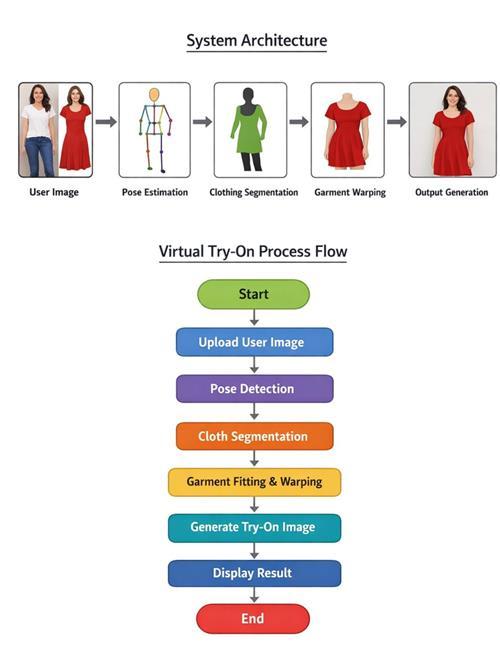
TheproposedAI-BasedVirtualTry-OnSystemisdesigned usingamodulararchitecturethatconsistsofsixmaincom-
International Research Journal of Engineering and Technology (IRJET) e-ISSN: 2395-0056
Volume: 13 Issue: 04 | Apr 2026 www.irjet.net p-ISSN: 2395-0072
ponents,allconnectedthroughaFlask-basedwebapplication layer. Figure 1 shows the overall system architecture alongwiththeprocessflow.Thedesignsupportsbothrealtimewebcamprocessingandhigh-qualitystaticimagetry-on usingthesamecorepipeline,withminoroptimizationsapplieddependingonthemodeofoperation.
ThePoseDetectionModule(pose_detection.py)isbuilton topoftheMediaPipePoseAPIandfollowsastatefuldetector-tracker approach. When operating in webcam mode (static_image_mode=False), the system first performs an initialposedetectionandthentracksthelandmarksacross subsequent frames using the region of interest predicted fromthepreviousframe.Thishelpsinreducingthecomputationalloadperframe.
The module provides several utility functions, including a detect(frame) method to process input frames, a get_landmarks_dict()methodthatreturnslandmarkcoordinates in the form of (x, y, z, visibility), and an is_pose_detected() method to verify detection status. A draw_landmarks(frame)functionisalsoavailableforvisualization.Thekeylandmarksusedforgarmentplacementincludetheleftandrightshoulders(indices11and12)andthe leftandrighthips(indices23and24).Additionallandmarks
suchaselbowsandwristsarealsoavailableandcanbeused forfutureextensionslikesleevealignment.
TheGarmentProcessingModule(garment_manager.py)is responsibleforloading,preprocessing,andcachinggarment images.Sincemoste-commerceimagesareprovidedwithout transparency, the system applies an automatic backgroundremovalpipeline.
For images with light backgrounds, adaptive thresholding combinedwithHSVsaturationmaskingisusedtocapture bothwhiteandcoloredgarmentregions.Fordarkerbackgrounds,inversethresholdingisapplied.Incaseswherethe backgroundismorecomplex,theGrabCutalgorithmisused forsegmentation.
Afterbackgroundremoval,thebinarymaskisrefinedusing morphological operations such as closing and opening to removenoiseandfillgaps.Thelargestconnectedcomponent is retained as the garment region, and the edges are smoothedusingGaussianblurring.Thefinaloutputisstored asafour-channelBGRAimageforfurtherprocessing.
The Body Segmentation Module (segmentation.py) uses a HumanParserneuralnetworktoperformpixel-levelclassificationofbodyregions.Themoduledefinesmultiplelabels correspondingtodifferentanatomicalregions,includingupperclothing,torsoskin,face,hair,arms,andlowerbody.
Theparse(image,pose_detector)methodgeneratesalabel mapthatmatchesthedimensionsofthe inputimage.This labelmapislaterusedtocreateaplacementmask,ensuring thatthegarmentisappliedonlytoappropriateregions.To maintain real-time performance, segmentation is applied only in static image mode, while webcam mode skips this step.
The Garment Overlay Engine (garment_overlay.py) is responsibleforaligningandplacingthegarmentontotheperson’s body. The overlay_garment(frame, garment, landmarks_dict,scale_factor)functioncomputesabodyquadrilateralusingthedetectedshoulderandhiplandmarks.
Thegarmentimageisthen warpedto fitthis regionusing perspective transformation. A configurable scale factor is usedtoslightlyexpandthetargetregionforbettercoverage. Themodulealsosupportsalphablendingandoptionaltemporal smoothing using an exponential moving average to reduceflickeringinreal-timemode.Adebugmodeisavailable to visualize landmark positions and alignment during development.
International Research Journal of Engineering and Technology (IRJET) e-ISSN: 2395-0056
Volume: 13 Issue: 04 | Apr 2026 www.irjet.net p-ISSN: 2395-0072
The Luminance Transfer Engine implements the shading mechanismthatimprovesvisualrealism.Theoriginalimage isfirstconvertedtotheCIELABcolorspace,andtheluminance(L)channelisextracted.
Ashademapiscomputedbycomparinglocalluminancevalueswiththemeanluminance,andthismapisclippedand smoothedtoavoidextremevariations.Theresultingshading informationisappliedtothegarmentimageinHSVcolour space,allowingittoadapttothelightingconditionsofthe originalimage.
Additionally,acolourharmonizationstepslightlyadjuststhe garment’scolourtomatchthescene.Thishelpsinreducing theflatappearanceofthegarmentandimprovestheperceptionofdepthandrealism.
TheWebApplicationLayer(app.py)integratesallmodules intoa singleuser-facingsystem.ItisbuiltusingFlaskand providesmultipleroutesforuserinteraction,includingpagesforlogin,registration,productbrowsing,webcamtry-on, andstaticimageupload.
TheapplicationalsoincludesAPIendpointsforprocessing images and streaming webcam data. All machine learning components are initialized lazily to optimize performance andensurethreadsafety.Uploadedfilesaremanagedonthe server,andresultsareservedthroughauthenticatedroutes.
Overall,thearchitectureisdesignedtoensureefficientprocessing,modulardesign,andeaseofuse,makingthesystem suitablefordeploymentonstandardhardwarewithoutrequiringspecializedresources.
Thecompletevirtualtry-onpipelineforstaticimagemode consists of six sequential processing stages. For real-time webcammode,asimplifiedversionusingonlythreestages (Stages1,2,and4)isexecutedinordertomaintainperformanceabove20FPS.Inaddition,thesystemfollowsacloudfirst strategy where it attempts IDM-VTON processing throughtheHuggingFaceSpacesAPIbeforefallingbackto thelocalpipeline,ensuringthebestavailableoutputquality.
The input person image is loaded using OpenCV (cv2.imread)andpassedtotheMediaPipePosedetectorconfigured with static_image_mode=True, model_complexity=1,smooth_landmarks=True,min_detection_co nfidence=0.5,andmin_tracking_confidence=0.5.Thesystem checks whether the four primary upper-body landmarks (indices11,12,23,and24)aredetectedwithvisibilityvaluesgreaterthan0.5.Iftheseconditionsarenotmet,thein-
putisrejectedandtheuserispromptedtouploadaclearer image.
Thedetectedlandmarkcoordinatesareinitiallyinnormalizedformwithintherange[0,1]andareconvertedtoabsolutepixelcoordinatesbymultiplyingthemwiththeimage widthandheight.
Thegarment image is loaded using cv2.IMREAD_UNCHANGED to preserve any existing alpha channel.Iftheimagedoesnotincludeanalphachannel(i.e., itisa3-channelBGRimage),theautomaticbackgroundremovalpipelinedescribedearlierisapplied.
Theprocessedgarmentimageisthencroppedtotheboundingboxofnon-transparentpixels(alpha>10)withasmall marginof5pixels.Iftheimageexceeds800pixelsineither dimension,itisresizedproportionallywhilemaintainingits aspectratio.AGarmentobjectisthencreatedusingtheprocessedimagealongwithitssizemetadata.
The HumanParser model is used to generate a pixel-wise labelmapforthepersonimage.Aclothingmaskisinitialized andassignedvaluesof255forpixelscorrespondingtoLABEL_UPPERandLABEL_TORSO_SKIN.
Toimproveboundaryhandling,themaskisdilatedusinga 15×15ellipticalkernelfortwoiterations.Aproximityzoneis then created by further dilation, which defines a region wheregarmentpixelsareallowedneartheclothingarea.
Aprotectionmaskiscreatedbymarkingpixelscorresponding to LABEL_FACE, LABEL_HAIR, LABEL_ARM_LEFT, and LABEL_ARM_RIGHT.Thefinalplacementmaskiscomputed bycombiningthesemasksusinglogicaloperations,ensuring thatgarmentplacementisrestrictedtoappropriateregions whileexcludingprotectedareas.
The resulting mask is smoothed using a Gaussian filter to producesoftedgesforblending.
The garment is aligned with the body using perspective transformation.Aquadrilateralisdefinedusingthefourkey landmarks:leftshoulder,rightshoulder,righthip,andleft hip.
Ascalefactor(1.15)isappliedtoslightlyexpandthetarget region. The garment image is treated as a rectangle and mapped to the body quadrilateral using cv2.getPerspectiveTransform.Thewarpedgarmentisgeneratedusingcv2.warpPerspectivewithbilinearinterpolation.
International Research Journal of Engineering and Technology (IRJET) e-ISSN: 2395-0056
Volume: 13 Issue: 04 | Apr 2026 www.irjet.net p-ISSN: 2395-0072
Atthesametime,awarpedgarmentmaskiscreatedbyapplyingthesametransformationtoabinarycanvasandextractingtherelevantregionthroughthresholding.
The luminance transfer step enhances visual realism by adaptingthegarment’sshadingtomatchtheoriginalimage. The person image is first converted to the CIE LAB color space,andtheluminance(L)channelisextracted.
Ashademapiscomputedastheratiooflocalluminanceto the mean luminance. This map is clipped to a predefined rangeandsmoothedusingaGaussianfiltertoreducenoise.
TheresultingshademapisappliedtotheValuechannelof thegarmentimageinHSVcolorspace.Additionally,acolor harmonizationstepadjuststhegarment’scolorslightlytowardtheoriginalimage’scolordistribution,improvingoverallconsistency.
The final output is generated by blending the shaded garmentwiththeoriginalimageusingasoftalphamask.The alpha mask is obtained by applying morphological operations followed by Gaussian smoothing to create gradual transitions.
Thecompositeimageiscalculatedusingweightedblending betweenthegarmentandtheoriginalimage.Tofurtherimprovevisualquality,anedgerefinementstepisappliednear the garment boundaries using a bilateral filter. This helps smooth out color differences while preserving important edgedetails.
Thefinalresultisavisuallyconsistentimagewherethegarmentappearsnaturallyfittedontotheperson.
ThesystemisimplementedentirelyinPython3.8+anddoes notrequireadedicatedGPUforexecutingtheprimarylocal pipeline.Thefullsetofdependenciesusedinthesystemis listedinTable2.Allmachinelearningcomponentsareinitializedlazilyduringthefirstrequestusingashareddictionary protected by a threading.Lock, which ensures thread safetywhenhandlingmultipleuserssimultaneously.
Table -2: Technology Stack and Dependencies
Component Library Version / Role
PoseEstimation MediaPipe 0.10.9 / 33 landmarks
Computer Vi- OpenCV 4.11.0 / Warp,
Component Library Version / Role sion blend
DeepLearning PyTorch 2.1.0 / Model backend
Image Processing Pillow 10.1.0/I/Osupport
Try-OnModel CP-VTON+ Geometric matching
Web Framework Flask 3.1.3 / Web server
CloudTry-On IDM-VTON HFSpacesAPI
HFClient gradio_client 2.2.0/APIclient
NumericalOps NumPy 1.24.3 / Array ops
Language Python 3.8+ / Primary lang.
The application is designed to run on standard consumer hardware with a minimum requirement of 4GB RAM, although8GBisrecommendedforstableperformancewhenall componentsareloadedtogether.
The project is organized into modular Python source files within the src/ directory. The main modules include pose_detection.pyforhandlingMediaPipe-basedlandmark detection and caching, garment_manager.py for garment loadingandpreprocessing,garment_overlay.pyforperspectivetransformationandoverlayoperations,segmentation.py forHumanParser-basedsegmentation,cpvton_adapter.pyfor integrating CP-VTON+, and cloud_tryon.py for accessing IDM-VTONthroughtheHuggingFaceAPI.
Additionalmodulesincludebody_measurements.py,which performs pixel-to-centimeter calibration using detected landmarks,andsize_recommender.py,whichprovidesgarment size suggestions based on shoulder and torso measurements.
For the webcam mode, the application uses an MJPEG streamingapproach.The/api/video-feedroutegeneratesa multipartresponsewhereframesareencodedasJPEGimagesat80%quality.Eachframeisprocessedthroughthepose detectionandoverlaypipelineinrealtime,andtheresultis storedinasharedstatedictionaryforcapturerequests.
International
Volume: 13 Issue: 04 | Apr 2026 www.irjet.net p-ISSN: 2395-0072
The/api/process-staticendpointhandlesstaticimageprocessing by accepting multipart form data containing both person and garment images. These files are saved using uniquefilenamestoavoidconflicts,processedthroughthe fullpipeline,andtheoutputimageisreturnedasaURL.
User authentication is implemented using Flask sessions. Theapplicationsupportslogin,logout,andregistrationfeatures,alongwithafewpredefinedtestaccounts.Uploaded images and generated results are stored securely and accessedonlythroughauthenticatedroutestoensureprivacy andcontrolledaccess.
TheproposedsystemwastestedonastandarddesktopconfigurationconsistingofanIntelCorei5processor,8GBRAM, andintegratedgraphicswithoutadedicatedGPU.Thissetup waschosentodemonstratethatthesystemcanperformeffectivelyoncommonlyavailablehardware.
In webcam mode, the system consistently achieved frame ratesabove20framespersecondduringcontinuousoperation. The MediaPipe Pose module required approximately 15–25millisecondsperframeforlandmarkdetection,while the perspective warping step added around 3–5 milliseconds. The blending operations contributed minimal additionallatency.
Overall,thetotalprocessingtimeperframewasaround25–35milliseconds,correspondingtoapproximately28–40FPS. Thisperformancelevelissufficientforsmoothandinteractivevisualization.
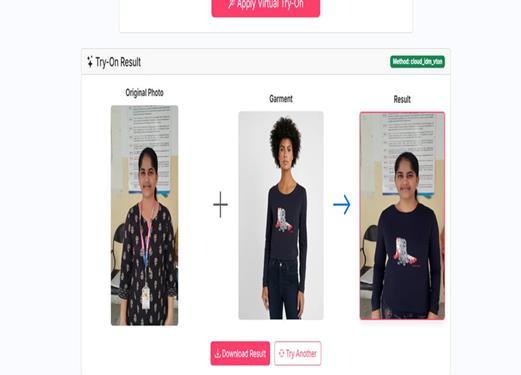
For static image processing, the system produced highquality outputs using the full six-stage pipeline. The processingtimerangedbetween2.1and4.3secondsdepending onimagecomplexityandsegmentationprocessingtime.
Thesegmentation-awareplacementensuredthatgarments were applied only to appropriate regions, effectively preservingfeaturessuchastheface,hair,andarms.Theluminancetransferstepimprovedrealismbyadaptingshading andfoldpatternsfromtheoriginalclothing.

The background removal module performed effectively acrossdifferenttypesofgarmentimages.Imageswithsimple backgrounds were processed quickly using thresholding techniques,while morecompleximagesrequiredGrabCut processing. In both cases, the system produced clean garmentsilhouetteswithminimalnoise.
Volume: 13 Issue: 04 | Apr 2026 www.irjet.net
Table -3: Performance Summary
Segmentation
6.4 Discussion
The use of segmentation-aware placement provided clear improvementsoverbasicoverlaytechniquesbypreventing unrealistic artifactssuchas garmentscovering theface or floating above the body. Similarly, the luminance transfer mechanismhelpedaddressthecommonissueofflat-looking garmenttextures.
However,certainlimitationswereobserved.Thesegmentation module occasionally faced challenges with loose or complex clothing boundaries. In addition, the perspective warping approach does not fully capture fabric behavior, whichmayresultinminordistortionsforcertaingarment types.
Despitetheselimitations,thesystemoffersapracticaland efficient solution. The web-based implementation further improvesaccessibilitybyallowinguserstointeractwiththe systemdirectlythroughabrowserwithoutrequiringspecializedhardwareorinstallation.
7.
Inthiswork,anAI-BasedVirtualTry-OnSystemwasdevelopedthatcombinesposeestimation,segmentation,andimageprocessingtechniquestoprovidearealisticvirtualclothing experience. The system is capable of operating in real timewithoutrequiringGPUsupport,makingitaccessibleon standardconsumerhardware.
The integration of segmentation-aware placement, luminance transfer, and geometric warping contributes to improvedvisualqualityandaccurategarmentalignment.The
useofaweb-basedinterfacefurtherenhancesusabilityby allowingeasyaccessthroughabrowser.
Theresultsdemonstratethatthesystemiseffectiveforpracticalvirtualtry-onapplicationsandcanhelpimproveuser experienceinonlineshoppingplatforms.
Future work canfocusonextendingsupporttoadditional clothingtypes,improvinggarmentfittingaccuracy,andincorporatingmoreadvancedtechniquessuchasclothsimulationandmulti-layergarmenthandling.
TheauthorssincerelythankDr.KiranB.M.,Professor&Head of the Department, Department of Computer Science and Engineering,SphoorthyEngineeringCollege,Hyderabad,for invaluable guidance, technical mentorship, and consistent support throughout this project. The authors also acknowledgetheDepartmentofComputerScienceandEngineering, Sphoorthy Engineering College, Hyderabad, Telangana,forprovidingtheinfrastructureandcomputational resourcesnecessarytocarryoutthisresearch.
[1]X.Han,Z.Wu,Z.Wu,R.Yu,andL.S.Davis,"VITON:An image-basedvirtualtry-onnetwork,"inProc.IEEE/CVF Conf. Comput. Vis. Pattern Recognit. (CVPR), Salt Lake City,USA,2018,pp.7543-7552.
[2]B.Wang,H.Zheng,X.Liang,Y.Chen,L.Lin,andM.Yang, "Towardcharacteristic-preservingimage-basedvirtual try-onnetwork,"inProc.Eur.Conf.Comput.Vis.(ECCV), Munich,Germany,2018,pp.589-604.
[3]S.Lee,G.Gu,S.Park,S.Choi,andJ.Choo,"High-resolution virtualtry-onwithmisalignmentandocclusion-handled conditions,"inProc.Eur.Conf.Comput.Vis.(ECCV),Tel Aviv,Israel,2022,pp.440-456.
[4]V.Bazarevsky,I.Grishchenko,K.Raveendran,T.Zhu,F. Zhang,andM.Grundmann,"BlazePose:On-devicerealtime body pose tracking," arXiv preprint arXiv:2006.10204,2020.
[5]M.Minar,T.T.Thi,H.Ahn,P.Herghelegiu,andH.Rothkrantz,"CP-VTON+:Clothingshapeandtexturepreservingimage-basedvirtualtry-on,"inProc.IEEE/CVFCVPR Workshops(CVPRW),2020.
[6]P.Li,Y.Xu,Y.Wei,andY.Yang,"Self-correctionforhumanparsing,"IEEETrans.PatternAnal.Mach.Intell.,vol. 44,no.6,pp.3260-3271,Jun.2022.
[7] Z. Cao, G. Hidalgo, T. Simon, S.-E. Wei, and Y. Sheikh, "OpenPose:Realtimemulti-person2Dposeestimation using part affinity fields," IEEE Trans. Pattern Anal. Mach.Intell.,vol.43,no.1,pp.172-186,Jan.2021.
International Research Journal of Engineering and Technology (IRJET) e-ISSN: 2395-0056
Volume: 13 Issue: 04 | Apr 2026 www.irjet.net p-ISSN: 2395-0072
[8]A.Raj,P.Sangkloy,H.Chang,J.Lu,D.Ceylan,andJ.Hays, "SwapNet:Imagebasedgarmenttransfer,"inProc.Eur. Conf.Comput.Vis.(ECCV),Munich,Germany,2018,pp. 666-682.
[9]Y.Choi,S.Kwak,K.Lee,H.Kim,andJ.Choo,"Improving diffusion models for virtual try-on," arXiv preprint arXiv:2403.05139,2024.
[10]C.Rother,V.Kolmogorov,andA.Blake,"GrabCut:Interactiveforegroundextractionusingiteratedgraphcuts," ACMTrans.Graph.,vol.23,no.3,pp.309-314,Aug.2004.
2026, IRJET | Impact Factor value: 8.315 | ISO 9001:2008