
International Research Journal of Engineering and Technology (IRJET) e-ISSN: 2395-0056
Volume: 13 Issue: 01 | Dec 2026 www.irjet.net p-ISSN: 2395-0072
International Research Journal of Engineering and Technology (IRJET) e-ISSN: 2395-0056
Volume: 13 Issue: 01 | Dec 2026 www.irjet.net p-ISSN: 2395-0072
Dr.C.P.Divate1, Ms.N.R.Bhokare2, Shubhankar.S.Kulkarni3 ,Vikram.V.Shirdhone4,Pratik.A.Khot5,Mudaasir.Y.Shaikh6,Balu.N.Waghmode7 , Vijay.S.Dodmani8
1Dean, Dept of Computer Engineering, Shri Ambabai Talim Sanstha’s Sanjay Bhokare Group of Institute Miraj(poly), Maharashtra, India
2Lecturer, Dept of Computer Engineering, Shri Ambabai Talim Sanstha’s Sanjay Bhokare Group of Institute Miraj(poly), Maharashtra, India
3,4,5,6,7,8Student Dept of Computer Engineering, Shri Ambabai Talim Sanstha’s Sanjay Bhokare Group of Institute Miraj(poly), Maharashtra, India
Abstract - This paper presents a real-time, webcam-based virtual dressing room that overlays 2D garment assets (PNG with transparency) onto a user’s live video feed using Media Pipe Pose for body alignment and Media Pipe Hands for touch lessUIcontrol.MediaPipePoseprovideshigh-fidelitytracking with 33 body landmarks (with optional segmentation), enabling stable shoulder/torso anchoring and proportional scaling of garments without depth sensors or GPUs . Media Pipe Hand Land marker detects 21 hand landmarks and supportsefficient tracking in video/live-stream modes,which makesdwell-basedselection andgesturenavigationpractical at interactive frame rates on commodity hardware. The system targets lower fit uncertainty in online shopping and support hygienic interaction for kiosks and at-home use, aiming to reduce purchase friction and returns caused by fit mismatch (a major driver of e-commerce returns).
Keywords - Virtual try-on; Media Pipe Pose; Media Pipe Hands; gesture recognition; OpenCV; alpha blending; e-commerce
1. Introduction
E-commercereturnratesremainsignificant,andfit-related dissatisfactionisacommoncause Shopifycitesanaverage e-commercereturnrateof16.9%in2024andnotesitcan reachupto30%forsomeretailers,withfitbeingafrequent reason for returns. In one survey summary reported by Shopify, 65% of online shoppers said they returned items thatdidn’tfit,reinforcingtheneedforbetterpre-purchase visualization for apparel-like products. A low-cost virtual try-on system built on a standard webcam is especially valuable for budget-conscious students, time-constrained workingusers,andtier-2/3cityconsumers,wherephysical storetrialsareinconvenientandcontactlessexperiencesare preferred.
Problem statement: Static images and size charts cannotshow“howitlooksonme”acrossdifferent bodyproportions
Objective: Provide real-time try-on with simple gesture navigation, running fully on-device for privacyandlowlatency
Keydesigngoal:“Good-enoughrealism”andsmooth interaction(target~30FPS)ratherthanheavy3D simulation
Marellietal. (2022) proposed an AI-based virtual try-onwebapplicationthatoverlaysgarmentsonusersin real time using Media Pipe for pose estimation and web-basedrendering.Theyshowedthataccuratekeypoint detectionenablesreasonablypreciseclothingalignmentfor staticorslowmovements,achievingaround85–90%overlay precisiononconsumerhardware.
Their work highlights that lightweight pose-estimation pipelinescandeliveracceptabletry-onqualitywithoutheavy deep-learning models or expensive GPUs, making virtual try-onmoreaccessibleforpracticaldeployment.
Chaudhuryetal. (2019) presented a vision-based humanposeestimationsystemforvirtualclothfittingthat uses a standard webcam interface. They computed body jointssuchasshoulders,elbows,andhipstowarpgarment images onto the user’s live video, demonstrating that camera-only solutions can support online trial rooms withoutspecializeddepthsensors.Theirworkemphasizes the feasibility of building low-cost virtual trial-rooms for e-commerce portals using classical computer-vision pipelinesandposeestimation.
An IRJMETS study on “Virtual Try-On System for FashionE-Retailers”examinedhowvirtualdressingrooms canreducereturnratesandincreaseconsumerconfidence byallowingcustomerstovisualizeclothingbeforepurchase.
The authors discussed the integration of AR, computer vision,andrecommendationlogictoprovidemorerealistic previewsandsizeguidancewithinfashionplatforms.They
International Research Journal of Engineering and Technology (IRJET) e-ISSN: 2395-0056
Volume: 13 Issue: 01 | Jan 2026 www.irjet.net p-ISSN: 2395-0072
concluded that virtual try-on technologies significantly enhance user engagement and provide retailers with a competitiveadvantageinonlinefashionmarkets.
A 2025 IJSAT paper on a “Virtual Try-On System UsingMediaPipeandOpenCV”combinedMediaPipepose estimation with OpenCV image processing to overlay arbitraryclothingimagesonalivewebcamfeed.Thesystem letusersuploadtheirowngarmentsandachievedaround 18–24FPSwithlessthan150mslatencyonmid-rangeCPUs, confirmingthatreal-timeperformanceisachievablewithout dedicated GPUs. Their evaluation reported pose detection accuracyabove90%forcommonindoorlighting,validating MediaPipeasapracticalbackboneforpose-guidedvirtual try-onapplicationssimilartothepresentwork.
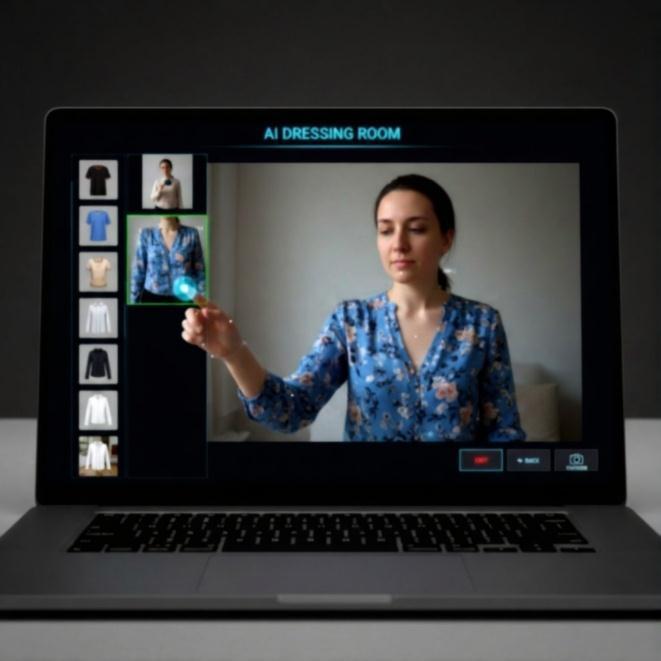
Thesystemconsistsoffivemodules:(1)frameacquisition, (2) pose estimation, (3) hand tracking + gesture UI, (4) garmenttransform(scale/translate),and(5)alpha-blended rendering.
MediaPipePoseisusedtoinfer33landmarksperframe, withcoordinatesnormalizedtotheimagedimensions;these landmarks provide shoulder points and torso references usedforgarmentplacement.
For gesture control, Media Pipe Hand Land marker detects 21 landmarks and is designed to reduce repeated palm detection in continuous modes by tracking hands acrossframes,improvingresponsivenessforUIinteractions likedwellselectionandscrolling.Theimplementationuses OpenCV for image resizing, ROI compositing, and alpha blending,keepingallcomputationlocalforprivacy
A) Pose-based garment placement (upper-body shirt example)
Landmarks used (typical): left/right shoulder + optionallyhipstoestimatetorsolength
Shouldermidpoint:

Shoulder width in
pixels:

Garmentwidth: (scalefactor tuned perassetset)

Garment height: where is a fixed assetaspectratio(precomputedfromPNGsize)
Placement:topofgarmentslightlyaboveshoulder midpoint to simulate collar position (offset calibration)
B) Alpha blending (photorealistic overlay)
Garments stored as RGBA PNGs; alpha channel definestransparency
ROIextractionfromcameraframe,thencomposite: (per pixel, perchannel)
Edge handling: clip ROI bounds to avoid index errorswhenuserisnearframeboundary
C) Touch less UI with dwell gestures
Cursor:indexfingertiplandmarkusedaspointing coordinate(2Dscreenposition)forhoverdetection
Dwellselection:selectanitemifthecursorremains inside its bounding box for consecutive frames (debouncedtoavoidaccidentaltriggers)
Virtual buttons: fixed rectangles for Back / Exit / Capture;triggerondwellor“enter+hold”
Scrollingthumbnails:
Maintainscrolloffsetandscrollvelocity
Updatevelocityfromfingertipmovement
Apply friction:scroll velocity *= 0.9per frameforinertialfeel
D) Performance and robustness considerations
Enable landmark smoothing to reduce jitter and overlay “shaking” (simple EMA or Media Pipe smoothingoption)
Fail-safebehaviour:ifposeconfidencedrops,freeze laststablegarmenttransformforashorttimeout, thenhideoverlay
Latency budget: aim for <150 ms end-to-end to preserve“instantmirror”feel
International Research Journal of Engineering and Technology (IRJET) e-ISSN: 2395-0056
Volume: 13 Issue: 01 | Jan 2026 www.irjet.net p-ISSN: 2395-0072
E) Suggested evaluation metrics (add to your Results section)
FPS and frame-time breakdown (pose, hands, rendering)
Overlay stability: standard deviation of garment anchorpointovertimeduringidlestanding
Alignment error: distance between garment shoulderpointsanddetectedshoulderlandmarks
User study: time-to-select garment, perceived realism(Likertscale),perceivedeaseofuse
4. TOOLS
Core tools/libraries
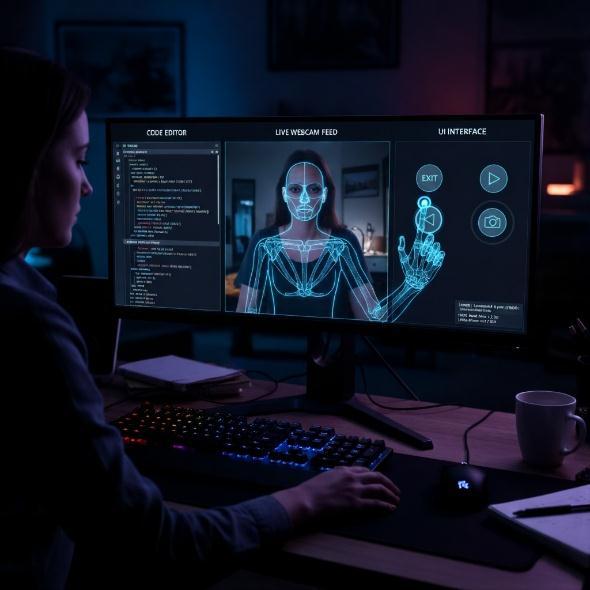
Python: Mainprogramminglanguageusedtobuild the application logic, UI flow (category selection, dwelltimers),andtointegrateallmodulesintoone real-timeloop.
Media Pipe Pose: Used for human pose estimationandgarmentanchoring;theMediaPipe Pose landmark model predicts33 pose landmarksand can optionally output a full-body segmentationmask.
MediaPipeHands/HandLandmarker: Used for touch less interaction; it detects21 hand landmarks(fingertips, joints, palm points), which you use for cursor control (index fingertip) and dwell-basedselection.
Computervisionandrenderingtools
OpenCV (cv2): Usedforwebcamcapture,frame processing, UI drawing (buttons, thumbnails), resizinggarmentPNGs,andoverlayrendering.
Alphablending(RGBAoverlay): Implemented using Open CV/Numpy-style pixel blending so transparentPNGgarmentsmergenaturallywiththe livecameraframe.
Supporting utilities
NumPy: Commonly used with OpenCV for fast arrayoperations(pixel-wisealphablending,masks, ROIslicing)andefficient math.
OS/pathlib(Pythonstandardlibrary): Used to load garments from folders (gender/category structure),managedirectories,andsavecaptured snapshots.
5. Benefits of an AI - based Virtual Dressing Room System:
User-centric benefits
Contactless try-on: Users can try multiple outfits virtually without physically changing clothes, which savestimeandimproveshygieneintrial-roomorkiosk setups.
Better fit and style confidence: Seeing garments alignedontheirownbodyhelpsusersjudgelookandfit more accurately than static product photos, reducing confusionaboutsizeandstyle.
Convenienceandspeed:Hand-gesturenavigation and instant overlay let users switch outfits quickly, making it easy to compare several options in a single session.
Retailer and business benefits
Reduced return rates: More accurate visualizationbeforepurchaselowersreturnsdueto wrong size or style, which directly saves logistics andrestockingcosts.
Higher engagement and conversion: Interactive virtual try-on keeps customers on the platformlongerandincreasespurchaseconfidence, which is linked to higher conversion rates and averageordervalue.
Actionable data and personalization: The systemcanlogwhichcategoriesanddesignsusers try most, enabling better inventory planning and futureAI-basedstylerecommendations.
and deployment benefits
Low hardware and setup cost: The system runs with a normal webcam, CPU, OpenCV, and Media Pipe, avoiding specialized sensors or GPUs and making deployment in labs, kiosks, or small shopsfeasible.
International Research Journal of Engineering and Technology (IRJET) e-ISSN: 2395-0056
Volume: 13 Issue: 01 | Jan 2026 www.irjet.net p-ISSN: 2395-0072
Real-timeperformance:Poseandhandtracking pipelinessimilartothisdesignhavedemonstrated 18–30FPSonmid-rangelaptops,whichisadequate forsmoothARinteraction.
Modularandextensibledesign:Garmentsare simple PNG assets organized by gender and category; developers can add new clothing, gestures, or features (e.g., pants, accessories, size suggestions)withoutchangingthecorepipeline.
E-commerce Integration: E-commerce platformscanintegratevirtualtry-ontechnologyto letcustomersvisualizeclothingbeforebuying.This reduces return rates and improves customer confidence,makingonlineshoppingmoreeffective.
Offline Fashion Stores: Virtual mirrors in physical stores allow customers to try on clothes without needing fitting rooms, enhancing convenienceandreducingwaittimesduringbusy periods. This also helps stores optimize floor inventoryandboostcustomerengagement.
New Season Sales: Virtual mirrorscan showcase newseasoncollections,lettingcustomersinstantly tryonthelatesttrends,drivingsalesandoffering personalized recommendations for seasonal promotions
7. LIMITATIONS AND CHALLENGES:
A) Limitations:
NoUnity/UnrealEngineIntegration:Duetolimited expertiseinhigh-endARtools,weoptedforamore accessibleapproach.
Hardware Constraints: Advanced tools require powerful hardware, making it impractical for all users.
PrototypeStage:Thesystemisaworkingprototype usingSnapAR,limitingadvancedcustomization.
Rendering Realism: While functional, the current rendering approach lacks ultrarealistic fabric physicsanddynamiclighting
8. Conclusion
The AI-based Dressing Room built with Media Pipe Pose, Media Pipe Hands, and Open CV demonstrates a practical real-time virtual try-on system that works on commodityhardwareandenablesgesture-basedinteraction.
By detecting human pose landmarks and fingertip positions from a live camera feed, the application can automaticallyscaleandpositionshirtsontheuser’supper bodyandallowhands-freeselectionofgarmentcategories
and designs. This approach provides an affordable and accessible alternative to physical trial rooms and can enhanceuserengagementinbothonlineandofflinefashion environments.
Futureworkcanfocusonintegratingsegmentationand depth estimation for better foreground-background separationandmorerealisticocclusion(e.g.,partialhidingof garmentbehindarms).
3Dgarmentmodelsandphysics-basedsimulationcould be incorporated to improve realism, especially during complexmovementsorsideviews.Additionalfeaturessuch as automatic size recommendation, face-based style personalization,multi-usersupport,andmobiledeployment would make the system more robust and closer to commercial-gradevirtualdressingroomsolutions.
Future enhancements may include:
Semantic segmentation and depth estimation forrealisticocclusion(e.g.,armsover clothing)
3D garment models with physics-based simulation forimproveddrapingrealism
Automatic size recommendation usingbody proportionanalysis
Face-based personalization for style suggestions
Mobile and web deployment for broader accessibility
Multi-user support forsharedkiosks Theseimprovementswouldbringthesystemcloser to commercial-grade virtual dressing room solutions
We wouldliketoextendoursincere gratitudetoall those whocontributedtothecompletionofthispaperonARbased virtualtry-on.Specialthankstoourmentorsandadvisorsfor theirguidanceandsupportthroughouttheresearchprocess. Additionally,weappreciatetheassistanceofourcolleagues andpeerswhoofferedtheirfeedbackandsuggestions.
1]S.Marellietal.,“VirtualTry-OnSystemUsingMediaPipe and Open CV for AI-Based Fashion Fitting,” International JournalofScienceandAdvancedTechnology(IJSAT),vol.15, no.2,2025.
International Research Journal of Engineering and Technology (IRJET) e-ISSN: 2395-0056
Volume: 13 Issue: 01 | Jan 2026 www.irjet.net p-ISSN: 2395-0072
2]IRJMETS,“VirtualTry-OnSystemforFashionE-Retailers,” International Research Journal of Modernization in Engineering,TechnologyandScience(IRJMETS),2024.
3]IJPREMS,“VirtualDressingRoom,”InternationalJournal of Progressive Research in Engineering Management and Science(IJPREMS),vol.5,no.4,Apr.2025.
4]A.Authoretal.,“ApplyingPose-GuidedDeepLearningfor Real-Time Virtual Try-On,” International Journal for MultidisciplinaryResearch(IJFMR),vol.11,no.3,2025.
5] S. Sartape, “AI-Based Virtual Clothing Try-On System,” International Journal of Scientific Engineering and Technology(IJSET),vol.12,no.6,2024.
6]PropulsionTechJournal,“TryOn:VirtualDressingRoom,” Propulsion:JournalofAdvancedResearchinTechnology& Engineering,2023.
7]J.Chen,“Builta2DVirtualTry-OnAppwithOpenCVand MediaPipe,”LinkedInProjectPostandGitHubRepository, 2025.
8] L. Sree et al., “FitMe360 Virtual Try-On using CVZone,” GitHubRepository,2024.
9] N.Shree, “Virtual Shirt Try-On using Computer Vision,” GitHubRepository,2024.
10] IJRPR, “TryBefore You Buy – Virtual Dressing Room,” InternationalJournalofResearchPublicationandReviews (IJRPR),vol.4,no.11,2023.