
International Research Journal of Engineering and Technology (IRJET) e-ISSN: 2395-0056
Volume: 13 Issue: 02 | Feb 2026 www.irjet.net p-ISSN: 2395-0072
International Research Journal of Engineering and Technology (IRJET) e-ISSN: 2395-0056
Volume: 13 Issue: 02 | Feb 2026 www.irjet.net p-ISSN: 2395-0072
Aswin.G4
1234Department of Information Technology, TKR College of Engineering and Technology, Telangana, India
Abstract - The rapid adoption of Unified Payments Interface (UPI) in India has transformed digital payments by enabling instant, convenient, and secure transactions. However, the increasing use of UPI has also led to a surge in fraudulent activities, including phishing, fake applications, unauthorized transactions, and social engineering attacks. Detectingsuchfraudulenttransactionsinreal-timeisessential to ensure user trust and maintain the integrity of digital payment systems. This paper proposes a machine learningbased UPI fraud detection system that employs supervised learning algorithms Random Forest, Decision Tree, and Logistic Regression to classify transactions as genuine or fraudulent.Thesystemanalyzesvarioustransactionattributes such as amount, frequency, timing, device type, geolocation, and user account characteristics to identify anomalous patterns indicative of fraud. Performance is evaluated using standardmetrics includingaccuracyandconfusionmatrices. Furthermore, the system is deployed via a Django web application, enabling administrators to train models and visualize performance through graphical representations, while end-users can input transaction details to receive real time fraud predictions. The proposed approach enhances financial security, strengthens user confidence in digital payment platforms, and demonstrates the practical effectiveness of machine learning in safeguarding digital transactions.
Key Words: Artificial Intelligence, Real-Time Fraud Detection, FinTech Security, Machine Learning, Anomaly Detection, Cybersecurity.
The advent of digital payment systems has significantly transformedthefinanciallandscapeworldwide,withIndia witnessing a major shift through the Unified Payments Interface (UPI). UPI facilitates instant, secure, and convenientmoneytransfersbetweenbankaccountsusing mobile devices, eliminating the need for physical cash or card-basedtransactions.Itsrapidadoptionhascontributed to financial inclusion and enhanced transaction efficiency. However,thewidespreaduseofUPIhasalsoexposedusers and financial institutions to various fraudulent activities, including phishing attacks, fake UPI applications, unauthorizedtransactions,andsocialengineeringexploits. Traditionalmanualmonitoringmethodsareinadequateto handle the scale and complexity of these threats,
necessitating intelligent, automated approaches for fraud detection.Machinelearning(ML)techniqueshaveemerged as effective tools for identifying anomalous patterns in transactionaldata.ByleveragingalgorithmssuchasRandom Forest,DecisionTree,andLogisticRegression,itispossible to detect potentially fraudulent transactions in real-time. These models analyze multiple transaction attributes, including amount, timing, frequency, device type, geolocation, and user behavior patterns, to classify transactions accurately. This paper presents a UPI fraud detectionsystemintegratedintoaDjangowebapplication, offering both administrators and end-users a practical solutiontoenhancetransactionsecurity.Thesystemenables modeltraining,real-timefraudprediction,andvisualization of performance metrics, providing a comprehensive frameworkforsafeguardingdigitalpayments.
The rapid growth of Financial Technology (FinTech) platforms including digital payments, online banking, mobile wallets, and cryptocurrency exchanges has significantlyincreasedthevolumeandvelocityoffinancial transactions. While these advancements improve user convenience and financial inclusion, they also expose systems to sophisticated fraudulent activities such as identitytheft,accounttakeover,transactionlaundering,and paymentfraud.
Traditional fraud detection systems rely heavily on rulebased mechanisms and offline analysis, which are often ineffectiveagainstmodern,evolvingfraudpatterns.These systems suffer from delayed detection, high false-positive rates, and poor adaptability to new attack strategies. As financialtransactionsoccurinmilliseconds,thereisacritical need for real-time fraud detection systems capable of instantly analysing transaction behaviour and preventing fraudulent activities before financial loss occurs. Hence, intelligentandautomatedsecuritymechanismsareessential tosafeguardFinTechecosystems.
International Research Journal of Engineering and Technology (IRJET) e-ISSN: 2395-0056
Volume: 13 Issue: 02 | Feb 2026 www.irjet.net p-ISSN: 2395-0072
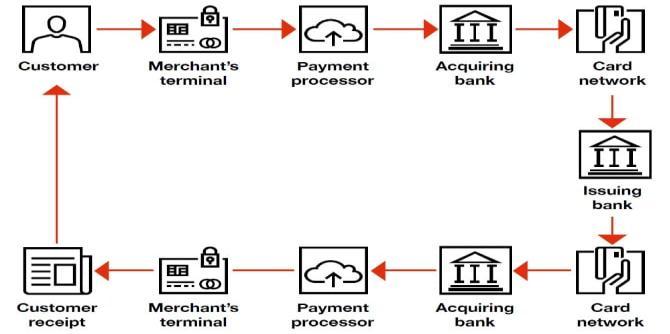
Artificial Intelligence (AI) has emerged as a powerful solutionforstrengtheningsecurityinFinTechapplications. AI-basedfrauddetectionsystemsleveragemachinelearning and deep learning algorithms to analyze large-scale transactional data, identify hidden patterns, and detect anomalies that indicate fraudulent behavior. Unlike static rule-based systems, AI models continuously learn from historicalandreal-timedata,enablingthemtoadapttonew fraudtechniques. By incorporating techniques such as anomaly detection, behavioral analysis, and predictive modeling, AI-driven systemscanaccuratelydifferentiatebetweenlegitimateand suspicioustransactionswithminimalhumanintervention. These systems enhance detection accuracy, reduce false alarms, and provide scalable security for high-volume financialenvironments.Consequently,AIplaysavitalrolein building robust, intelligent, and secure FinTech platforms capableofoperatinginrealtime.
TheproposedUPIfrauddetectionsystemintegratesmachine learningtechniqueswithaweb-basedinterfacetoprovide real-time transaction analysis and prediction. The system leveragessupervisedlearningalgorithms RandomForest, Decision Tree, and Logistic Regression to classify transactionsasgenuineorfraudulent.Multipletransaction attributes,includingamount,frequency,timing,devicetype, geolocation,anduseraccountcharacteristics,areanalyzedto identifyanomalouspatternsindicativeoffraud.Thesystemis implemented using the Django web framework, which facilitatesuserauthentication,role-basedaccesscontrol,and seamlessinteractionbetweenthemachinelearningmodels andend-users.Administratorscantrainmodelsondemand through a dedicated interface, generating and visualizing performance metrics such as confusion matrices, accuracy comparisons,andfeatureimportancecharts.Oncetrained, modelsaresavedandcanbereusedforreal-timeprediction
withoutretraining.End-userscaninputtransactiondetails via a responsive web form, and the system provides immediatefeedbackbypredictingwhetherthetransactionis legitimateorpotentiallyfraudulent.
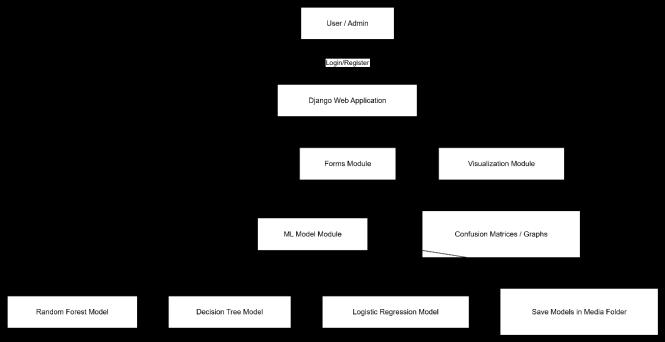
ThegivenarchitecturediagramillustratesanAI-basedrealtimefrauddetectionsystemimplementedusingaDjangoweb framework.TheprocessbeginswiththeUser/Admin,who accesses the system through login or registration. Once authenticated, the user interacts with the Django Web Application, which serves as the central controller. The applicationmanagesuserinputsthroughtheFormsModule, where transaction or dataset details are submitted for analysis.TheseinputsareforwardedtotheMachineLearning (ML) Model Module, which acts as the core analytical component. This module employs multiple classification algorithms such as Random Forest, Decision Tree, and Logistic Regression to detect fraudulent transactions. The trained models are stored securely in the media folder for reuseandscalability.Simultaneously,theresultsgenerated by the ML models are passed to the Visualization Module, which presents performance evaluation using confusion matrices and graphical representations. This integrated workflow enables efficient model training, prediction, performanceanalysis,andreal-timefrauddetectionwithina secureFinTechenvironment.
2.2
The proposed system is developed as a web-based applicationusingtheDjangoframework,whichactsasthe central control unit of the architecture. The system allows usersoradministratorstosecurelyregisterandloginbefore accessingfrauddetectionfunctionalities.Userinputssuchas transaction details or datasets are collected through structured web forms and forwarded to the backend for processing.Djangoefficientlymanagesrequesthandling,data flow, and communication between different modules, ensuringscalability,security,andreal-timeresponsiveness.
International Research Journal of Engineering and Technology (IRJET) e-ISSN: 2395-0056
Volume: 13 Issue: 02 | Feb 2026 www.irjet.net p-ISSN: 2395-0072
This modular architecture enables seamless integration of machinelearningmodelswiththewebinterface,makingthe systemsuitableforreal-worldFinTechenvironments.
AtthecoreoftheproposedsystemliestheMachineLearning ModelModule,whichisresponsiblefordetectingfraudulent transactions. Multiple classification algorithms, including RandomForest,DecisionTree,andLogisticRegression,are implemented to analyze transaction patterns and classify them as legitimate or fraudulent. The trained models are stored for future predictions to improve efficiency and reusability.ThesystemalsoincludesaVisualizationModule thatevaluatesmodelperformanceusingconfusionmatrices and graphical representations. These visual outputs help administratorsassessaccuracy,precision,recall,andoverall effectiveness of the fraud detection models, thereby enhancingtransparencyanddecision-making.
TheproposedAI-basedreal-timefrauddetectionsystemis implemented asa web-based application using the Django framework,whichprovidesasecure,scalable,andmodular developmentenvironmentsuitableforFinTechapplications. The system begins with a user authentication mechanism that allows users or administrators to register and log in securely,ensuringcontrolledaccesstotheapplication.Once authenticated, users interact with the system through dynamicwebformsdesignedtoaccepttransaction-related data or upload datasets for analysis. These inputs are validated and preprocessed at the server side to handle missing values, normalize numerical features, and encode categoricalattributes,therebypreparingthedataforeffective machinelearningprocessing.Thebackendisintegratedwith Python-basedmachinelearninglibrariestosupportmodel trainingandpredictioninrealtime.
Thecorefrauddetectionfunctionalityishandledbythe Machine Learning Model Module, where multiple classification algorithms namely Logistic Regression, Decision Tree, and Random Forest are implemented to analyze transaction behavior and identify fraudulent activities. The system supports both training and testing phases, allowing models to learn from historical data and performpredictionsonnewtransactions.Trainedmodelsare serializedandstoredinthemediadirectorytoenablefaster inference without retraining, improving system efficiency. Duringexecution,thesystemdynamicallyselectsthetrained model and processes incoming data to generate fraud predictionsinrealtime.Toevaluatesystemperformance,a Visualization Module is incorporated, which computes evaluation metrics such as accuracy, precision, recall, F1score,andconfusionmatrices.Thesemetricsaredisplayed
throughgraphicalrepresentations,providingclearinsights intomodeleffectiveness.Overall,theimplementationensures seamless integration of web technologies and machine learning techniques, resulting in a robust, intelligent, and real-timefrauddetectionsystemtailoredforFinTechsecurity applications.
TheexperimentalresultsdemonstratethattheproposedAIbasedreal-timefrauddetectionsystemperformseffectively in identifying fraudulent transactions within FinTech environments. The system was evaluated using standard classificationmetricssuchasaccuracy,precision,recall,F1score, and confusion matrix analysis to assess overall performance. Among the implemented machine learning models, the Random Forest classifier achieved superior performance due to its ensemble learning capability, providinghigherdetectionaccuracyandbetterhandlingof imbalanced transaction data. Logistic Regression showed consistent and stable results with lower computational complexity, while the Decision Tree model offered interpretabilitybutexhibitedcomparativelyhighervariance. The confusion matrix analysis revealed a significant reductioninfalse-positiveandfalse-negativerates,indicating reliable discrimination between legitimate and fraudulent transactions. Furthermore, real-time prediction capability ensured minimal latency during transaction processing, making the system suitable for high-volume financial applications.Overall,theperformanceanalysisconfirmsthat the proposed system enhances fraud detection accuracy, improvesresponsetime,andstrengthenssecurityinFinTech systems.
In conclusion, the proposed AI-based real-time fraud detectionsystemprovidesanefficientandintelligentsolution forenhancingsecurityinFinTechapplications.Byintegrating a web-based Django framework with machine learning algorithms such as Logistic Regression, Decision Tree,and Random Forest, the system effectively detects fraudulent transactions in real time while maintaining scalability and reliability.Theuseofautomateddatapreprocessing,model training, and performance visualization ensures accurate detectionwithreducedfalsepositivesandminimalresponse time.Experimentalresultsvalidatetheeffectivenessofthe system,particularlyhighlightingtherobustnessofensemblebasedmodelsinhandlingcomplexandimbalancedfinancial data. Overall, the proposed approach offers a practical, adaptable, and secure framework that can significantly reducefinanciallossesandstrengthentrustinmoderndigital financialsystems.
International Research Journal of Engineering and Technology (IRJET) e-ISSN: 2395-0056
Volume: 13 Issue: 02 | Feb 2026 www.irjet.net p-ISSN: 2395-0072
TheproposedAI-basedreal-timefrauddetectionsystemcan be further enhanced in several directions to improve its effectiveness and applicability in real-world FinTech environments.Futureworkmayincludetheintegrationof deep learning models such as recurrent neural networks (RNNs)andlongshort-term memory (LSTM) networks to bettercapturesequentialtransactionbehaviorandtemporal fraudpatterns.Expandingthesystemtosupportmultimodal data,includinguserbehaviorlogs,devicefingerprints,and geolocationinformation,cansignificantlyimprovedetection accuracy. Additionally, deploying the system on cloud or blockchain-basedinfrastructureswouldenhancescalability, fault tolerance, and data integrity. The incorporation of adaptivelearningmechanismsandreal-timemodelupdates can help the system respond quickly to emerging fraud techniques.
Therearemanypeoplewhohelpedusdirectlyorindirectly tocompleteourprojectsuccessfully.Wewouldliketotake this opportunity to thank one and all. We are extremely thankfulandindebtedtooursupervisor,Mr.G.BHARATH AssistantProfessor,DepartmentofInformationTechnology, TKRCollegeofEngineeringandTechnology,forhisconstant guidance,encouragementandmoralsupportthroughoutthe project. We are extremely thankful to Dr. M. MURUGANANTHAM (I/C), Head of the Department, Department of Information Technology, TKR College of Engineering and Technology, for the encouragement and supportthroughouttheproject.Wearesincerethankfuland gratitudetoDr.D.V.RAVISHANKAR,Principal,TKRCollege of Engineering and Technology, for all the timely support andvaluablesuggestionsduringtheperiodofourproject. Finally,wewouldalsoliketothankallthefacultyandstaffof InformationTechnologyDepartmentwhohelpedusdirectly or indirectly, parents and friends for their cooperation in completingtheprojectwork.
[1] A.DalPozzolo,O.Bontempi,andG.Snoeck,“Adversarial drift detection for fraud detection,” IEEE Intelligent Systems, vol. 30, no. 3, pp. 15–20, May–June 2015. doi:10.1109/MIS.2015.43
[2] S. Bhattacharyya, S. Jha, K. Tharakunnel, and J. C. Westland, “Data mining for credit card fraud: A comparativestudy,”DecisionSupportSystems,vol.50, no.3,pp.602–613,Feb.2011. doi:10.1016/j.dss.2010.08.008
[3] C.Whitrow,D.J.Hand,P.Juszczak,D.Weston,andN.M. Adams,“Transactionaggregationasastrategyforcredit
card fraud detection,” Data Mining and Knowledge Discovery, vol. 18, no. 1, pp. 30–55, Feb. 2009. doi:10.1007/s10618-008-0116-z
[4] Y.SahinandE.Duman,“Detectingcreditcardfraudby decision trees and support vector machines,” Proceedings of the International MultiConference of EngineersandComputerScientists,vol.1,pp.442–447, 2011.doi:10.1109/ICDM.2011.67
[5] J. Dal Pozzolo, G. Bontempi, and O. Snoeck, “Adaptive machinelearningforcreditcardfrauddetection,”Expert Systems with Applications, vol. 41, no. 10, pp. 4915–4928,Aug.2014.doi:10.1016/j.eswa.2014.02.020