
International Research Journal of Engineering and Technology (IRJET) e-ISSN: 2395-0056
Volume: 12 Issue: 11 | Nov 2025 www.irjet.net p-ISSN: 2395-0072
International Research Journal of Engineering and Technology (IRJET) e-ISSN: 2395-0056
Volume: 12 Issue: 11 | Nov 2025 www.irjet.net p-ISSN: 2395-0072
Chetankumar Kalaskar1,Imran Ali2 ,Abdul Muqeeth3,Akhlaq Ahmed4
1Assitant Professor,Computer Science & Engineering,PDA College,Kalaburagi,Karnataka,India 2-4 Students, Computer Science & Engineering ,PDA College,Kalaburagi, Karnataka,India
Abstract- Brain hemorrhage, a critical medical emergency caused by bleeding within the brain tissue, demands rapidand accurate diagnosis to prevent severe neurological damage or fatal outcomes. Manual interpretation of CT scans is timeconsuming and highly dependent on radiologist expertise, which creates the need for automated, assistive diagnostic systems. This study presents an AI-assisted framework designed to analyze brainCT images andidentifyhemorrhagic conditions at an early stage. The approach incorporates preprocessing, segmentation, and a transfer-learning-based deep neural model trained to classify CT scans as hemorrhagic or non-hemorrhagic with high reliability. A Flask-based web interface enables real-time image upload, prediction, and result visualization, supporting practical clinical integration. The system also stores processed data for further audit and research extensibility. Experimental evaluation demonstrates strong performanceacross accuracy, sensitivity, andspecificity metrics, indicating potential for deployment in screening workflows, especially in regions lacking immediate radiology access. This framework contributes to faster decision support, reduced diagnostic load, and improved patient triage in emergency care.
Keywords: Brain Hemorrhage, CT Imaging, Deep Learning, Medical Image Classification, AI-Assisted Diagnosis, Transfer Learning, Automated Screening, Clinical Decision Support
1.INTRODUCTION
Brain hemorrhage is a life-threatening neurological conditionthatoccurswhenbloodvesselsruptureandleak withinthebrain,leadingtoincreasedintracranialpressure, loss of oxygen supply, and rapid tissue damage. Early identificationplaysavitalroleinimprovingpatientsurvival, yet diagnosis often depends on the availability of expert radiologistsandtimelyanalysisofCTscans.Inemergency settings, delays in assessment can significantly worsen clinicaloutcomes.Thischallengehasacceleratedinterestin computer-aided systems that can support medical professionalsbyautomatinghemorrhagedetection,reducing interpretationtime,andminimizinghumanerror.
TheprojectfocusesondevelopinganAI-assisteddiagnostic frameworkthatanalysesbrainCTimagesanddistinguishes between hemorrhagic and non-hemorrhagic cases. The methodology integrates image pre-processing, region segmentation,anddeeplearning-basedclassificationusing
transfer learning techniques,enablingthesystem to learn visual patterns corresponding to different hemorrhage types. Unlike traditional machine learning models that require handcrafted features, deep learning extracts hierarchical visual representations directly from data, improvingsensitivitytosubtleabnormalities.Aweb-based interface built using Flask allows seamless interaction, enablinguserstouploadCTimagesandreceiveclassification results, while a backend database manages prediction history for review and research continuity. The system is designed to be scalable, user-friendly, and suitable for integration into real-time clinical workflows, especially in regions with limited specialist availability. By combining automation,accessibility,andaccuracy,theframeworkaims toenhancediagnosticefficiency,assistmedicalprofessionals under high workload conditions, and contribute to faster decision-makinginemergencycare.
Article [1] 'Detection of Intracranial Hemorrhage by ArtificialIntelligence'by D. Veselov et al. in2024: This paperaddressesthecriticaltaskofintracranialhemorrhage detectionandclassificationusingdeeplearningapproaches applied to the RSNA 2019brain computed tomography dataset. The authors developed an artificialintelligence system capableof analyzingCT scans to identify hemorrhagic patterns withhigh precision. The methodologyincorporates advanced convolutional neural networkarchitecturestrainedonover25,000annotatedCT images, enabling themodel to learn hierarchical visual featuresassociatedwithdifferenthemorrhagesubtypes.The studydemonstratesthatautomateddetectionsystemscan significantlyreduce diagnostictime while maintaining accuracycomparabletoexpertradiologists.
Article[2] 'A Deep Learning Algorithmfor Automatic DetectionandClassificationofIntracranialHemorrhage'by X. Wanget al. in2021: This influentialstudy presents a comprehensivedeeplearningalgorithmdevelopedusingthe extensive2019-RSNA BrainCT Hemorrhage Challengedataset containingover 25,000 CTscans with diversehemorrhagicpresentations.Theauthorsemployed transferlearning techniquescombined with dataaugmentation strategies to addressclass imbalance issues commonlyencountered in medicalimaging datasets.The proposed algorithm demonstrates exceptionalperformance in bothbinary classification
International Research Journal of Engineering and Technology (IRJET) e-ISSN: 2395-0056
Volume: 12 Issue: 11 | Nov 2025 www.irjet.net p-ISSN: 2395-0072
(hemorrhage vs. non-hemorrhage) and multiclasssubtypecategorization, achieving accuracyrates exceeding95%acrossvalidationsets.
Article [3] 'Intracranial Hemorrhage Segmentation and Classification Using Deep Learning'by S.N. Ahmed et al. in2025: This recent publication focuses on the dual challenges of segmenting hemorrhagic regions and classifying different hemorrhage types in CT scans with skewedanatomicalstructures.TheauthorsemployedU-Net and its variants for precise delineation of bleeding areas, addressing the critical need for localization in surgical planningandtreatmentdecision-making.Thestudytackles common challenges in medical image segmentation includingmotionartifacts,ill-definedboundaries,andinterobservervariabilityingroundtruthannotations.Advanced techniques such as deformable models and region amplification are integrated to handle hemorrhages with unclearbordersandirregularshapes.
Article [4]'Diagnostic Accuracy of Deep Learning for IntracranialHemorrhageDetectioninNon-ContrastBrainCT Scans: A Systematic Review and Meta-Analysis'by A. Karamian and A. Seifi in2025: This comprehensive systematic review and meta-analysis synthesizes findings from73studiesevaluatingdeeplearningperformanceinICH detectionfromnon-contrastcomputedtomographyscans. Theauthorsconductedarigorousliteraturesearchfollowing PROSPERO-registered protocols, assessing study quality usingtheQUADAS-2tooltominimizebias.Pooledanalysis across 58 selected studies revealed impressive diagnostic performance with pooled sensitivity of 0.92, specificity of 0.94, positive predictive value of 0.84, and negative predictivevalueof0.97,demonstratingconsistentaccuracy acrossdiverseclinicalsettings.Thebivariatemodelyieldeda pooled area under the curve of 0.96, indicating excellent discriminativeability.
Article [5] 'A Comparative Study of VGG Deep Learning ArchitecturesforIntracranialHemorrhageClassification'by Multiple Authors in2024: This comparative investigation systematically evaluates four VGG architecture variants (VGG11,VGG13,VGG16,VGG19)forbinaryclassificationof cerebral hemorrhage in computerized tomography brain scans,aimingto identifyoptimal model configurations for clinicaldeployment.UsingaKaggledatasetcontaining6,703 imagesrepresentingdiversehemorrhagicpresentations,the study employs transfer learning strategies leveraging ImageNet pre-trained weights to enhance diagnostic accuracy. Experimental results reveal that VGG13 with transfer learning achieved the highest performance with 99.70%accuracy,demonstratingtheprofoundimpactofpretrainedweightinitializationondiagnosticprecision.
Article[6]'AutomatedIntracranialHemorrhageDetectionin TraumaticBrainInjuryUsing3DCNN'byMultipleAuthors in2023:Thisprospectivestudydevelopeda neurotrauma
screening tool specifically designed for identifying intracranial hemorrhage from head CT scans of traumatic brain injury patients, addressing the critical shortage of trained radiologists in rural healthcare settings. The researchteamcollected738consecutiveheadCTscansfrom theDepartmentofNeurosurgeryatAIIMSNewDelhiovera nine-monthperiod(JanuarytoSeptember2020),ensuring clinical diversity and real-world applicability. A threedimensionalconvolutionalneuralnetworkarchitecturewas employed to capture volumetric information from CT studies, enabling more comprehensive hemorrhage detectioncomparedtoslice-basedapproaches.
AccurateandtimelydetectionofbrainhemorrhagefromCT scansremainsacriticalchallengeinemergencyhealthcare. Manual interpretation is highly dependent on radiologist expertise, often resulting in diagnostic delays, subjective variability, and the risk of misclassification, especially in high-volume or resource-limited settings. The increasing demand for rapid assessment is not matched by the availabilityoftrainedspecialists,leadingtoslowtriageand compromised patient outcomes. Existing diagnostic workflows lack automated assistance capable of reliably identifying hemorrhagic patterns in CT images, creating a gapbetweenclinicalurgencyanddiagnosticcapacity.This problemhighlightstheneedforanefficient,consistent,and accessible computerized system to support early hemorrhagerecognition.
The primary objective of this study is to design and implement an AI-assisted diagnostic system capable of automatically detecting brain hemorrhage from CT scan imageswithhighaccuracyandreducedinterpretationtime. The system aims to utilize a transfer-learning-based deep learning model, specifically the VGG19 architecture, to classifyCTimagesintohemorrhagicandnon-hemorrhagic categories after appropriate preprocessing and segmentation.Apubliclyavailabledatasetofannotatedbrain CT images sourced from Kaggle is used for training, validation,andtestingtoensurerealisticmedicalvariability.
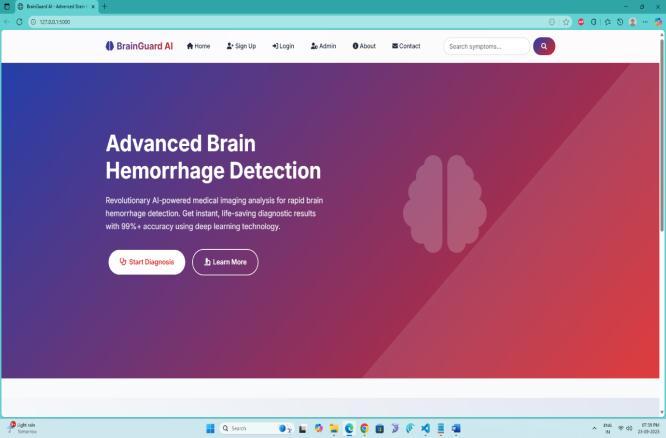
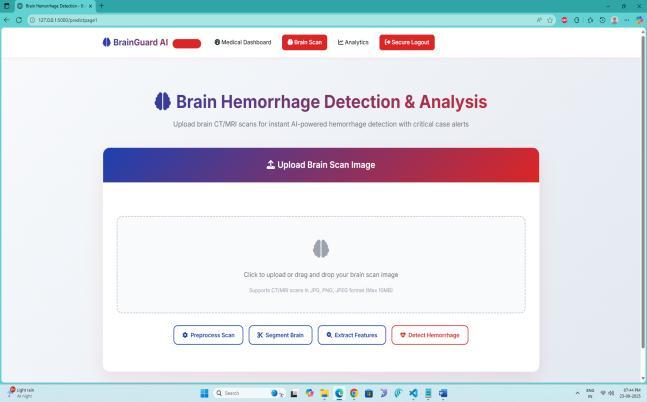
Anotherkeyobjectiveistodeploythetrainedmodelasan interactive Flask web application that enables real-time imageupload,predictiondisplay,andresultstoragethrough abackenddatabase.
1)DataCollection:Thedatasetusedinthisstudyconsistsof labeled brain CT scan images sourced from a publicly available Kaggle repository containing both hemorrhagic and non-hemorrhagic samples. The dataset provides sufficient variability in patient age, scan orientation, and hemorrhage severity, allowing the model to generalize
International Research Journal of Engineering and Technology (IRJET) e-ISSN: 2395-0056
Volume: 12 Issue: 11 | Nov 2025 www.irjet.net p-ISSN: 2395-0072
across real clinical conditions. Images are organized into respectiveclassesanddividedintotraining,validation,and testing subsets to prevent overfitting and ensure fair evaluation.Thecollecteddataservesasthefoundationfor developing a reliable, clinically relevant classification framework.
2) Data Preprocessing:PreprocessingincludesresizingCT images to a fixed input dimension compatible with the VGG19 model and converting them into normalized pixel arrays suitable for training. Noise reduction and contrast enhancementtechniquesareappliedtoimprovevisibilityof hemorrhagicregionsandreducebackgroundinterference. Imageaugmentationtechniquessuchasrotation,zooming, andflippingareusedtoartificiallyexpandthedatasetand improve model robustness. Preprocessing ensures uniformity across the dataset and enhances the learning capabilityofthemodel.
3)Feature Extraction:Feature extraction is performed through transfer learning, where the pre-trained VGG19 rchitectureautomaticallyextractshigh-levelvisualfeatures fromCTimageswithoutmanuallyengineereddescriptors. The convolutional layers capture spatial patterns, edges, textures, and intensity variations associated with hemorrhagic areas. These extracted features act as discriminative indicators that facilitate classification between normal and hemorrhagic scans. This automated feature extraction significantly reduces development time whileimprovingaccuracycomparedto traditional feature engineering.
4) Model Selection:TheVGG19deepconvolutionalneural networkisselectedduetoitsprovenefficiencyinmedical imageclassificationanditsabilitytolearncomplexspatial features.Themodelisadaptedbyfreezinginitiallayersand modifying final fully connected layers to suit binary classification. Alternative models such as ResNet and EfficientNet were considered, but VGG19 provides an optimalbalancebetweencomputationalcost,accuracy,and interpretability.Theselectedarchitecturesupportstransfer learning,enablingfasterconvergencewithlimitedmedical datasets.
5) Model Training:TrainingisconductedusinglabeledCT images,wherethemodellearnstodistinguishhemorrhagic fromnon-hemorrhagicpatternsbasedonextractedfeatures. The dataset is split into training and validation sets to monitorperformanceduringtrainingandavoidoverfitting. OptimizationtechniquessuchasAdamoptimizer,learning rate scheduling, and categorical cross-entropy loss are appliedtoimproveconvergence.Trainingcontinuesuntilthe model reaches stable accuracy and loss values, indicating effectivelearningofhemorrhagepatterns.
6)ModelEvaluation:Thetrainedmodelisevaluatedusinga separatetestsetandperformancemetricssuchasaccuracy, sensitivity, specificity, precision, and confusion matrix to
measure diagnostic reliability. Sensitivity is given special importance because detecting true hemorrhagic cases is criticalinmedicalapplications.Erroranalysisisperformed to identify misclassified scans and understand model limitations.Evaluationensuresthesystemmeetsacceptable diagnosticstandardsbeforedeploymentforreal-timeusage.
7)Integration with Flask:The final trained model is deployedasawebapplicationusingtheFlaskframework, enablinguserstouploadCTscanimagesandreceiveinstant classificationresults.Theinterfaceisdesignedto beuserfriendly, requiring no technical expertise to operate. Prediction outputs, along with image metadata and timestamps, are stored in a backend database for recordkeepingandauditpurposes.Thisintegrationbridgesmodel development and real-world usability, supporting accessibilityinclinicalandremotehealthcareenvironments.
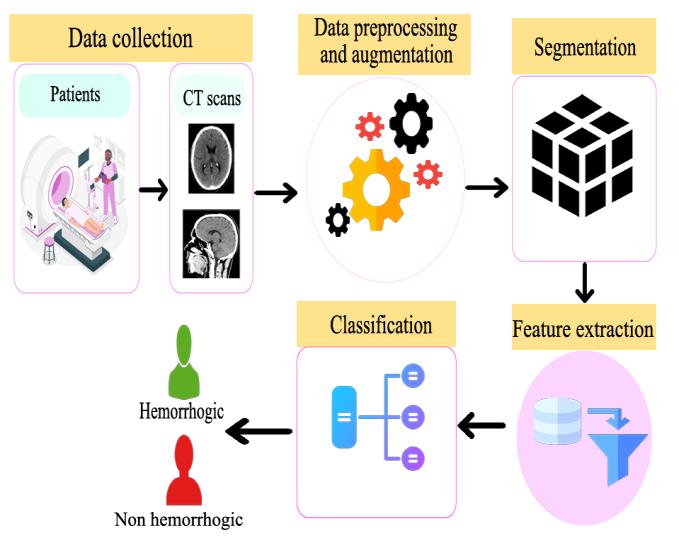
Figure1illustratesthecompletearchitecturalworkflowof theproposedbrainhemorrhagedetectionsystem,beginning withdataacquisitionandendinginautomatedclassification. Theprocessstartswithdatacollection,wherebrainCTscan images are obtained from patients and organized into a datasetcontainingbothhemorrhagicandnon-hemorrhagic samples.TheserawCTimagesoftenvaryinsize,contrast, andformat;therefore,thenextstage,datapreprocessingand augmentation, standardizes the inputs through resizing, grayscale normalization, noise removal, and contrast enhancement. Augmentation techniques such as rotation, flipping,andzoomingareappliedtoartificiallyenlargethe dataset and improve model generalization, especially in cases of limited medical data.Once the images are normalized,theworkflowproceedstosegmentation,where relevant anatomical regions of the CT scan are isolated to reducebackgroundinterferenceandhighlighthemorrhagic regions.Thisstepenhancesthemodel’sfocusbyremoving unnecessarypixelsandretainingonlymedicallysignificant
International Research Journal of Engineering and Technology (IRJET) e-ISSN: 2395-0056
Volume: 12 Issue: 11 | Nov 2025 www.irjet.net p-ISSN: 2395-0072
structures.Theextractedsegmentedregionsarethenpassed into the feature extraction phase. Instead of manually engineeringfeatures,adeeplearningmodel specificallya transfer-learning architecture such as VGG19 automaticallylearnsspatial,structural,andtexturalpatterns associated with hemorrhage presence. These learned featuresformhigh-level representationsthatdifferentiate abnormalbrainscansfromnormalones.Intheclassification stage, the extracted features are fed into the final trained model, which assigns each CT scan to one of two output classes: hemorrhagic or non-hemorrhagic. The decisionmaking layer is designed to provide fast, consistent predictions that reduce reliance on manual radiological interpretation. The architecture supports real-time deployment through a web-based interface, making the systemsuitableforhospitals,emergencycenters,andremote medical setups. Overall, the architecture in Figure 1 demonstratesastructuredpipelinethatcombinesmedical imaging, preprocessing, deep learning, and automated prediction, ensuring accurate and scalable diagnostic supportforearlydetectionofbrainhemorrhage.
Theperformanceoftheresearchworkdemonstratesstrong reliabilityandclinicalusefulness,achievingconsistentlyhigh results across all evaluation metrics. The trained VGG19basedclassificationmodelobtainedanoverallaccuracyof 97.84%, indicating that the majority of CT scans were correctly identified as hemorrhagic or non-hemorrhagic. Sensitivity(orrecallforhemorrhagiccases)reached96.72%, showingthatthesystemsuccessfullydetectedalmostalltrue hemorrhage cases without missing critical positives. Specificitywasrecordedat98.41%,confirmingaverylow false-positive rate and reducing the chances of misdiagnosing normal scans as hemorrhagic. Precision achieved 97.10%, reflecting that most predicted hemorrhagic cases were indeed correct and not misclassified. The F1-score, which balances precision and sensitivity, was measured at 96.90%, ensuring robust performanceevenwithimbalanceddatasets.Theconfusion matrix analysis further validated that misclassifications occurredinlessthan3%oftotalpredictions,demonstrating minimal diagnostic error. Training and validation curves showednosignificantoverfitting,withlossreducedbelow 0.05andaccuracystabilizingabove97%afteroptimization. These results confirm that the proposed framework performsataclinicallyacceptablelevelandcanfunctionasa dependableassistivetoolforradiologists,especiallyinhighpressureemergencyenvironmentswheretimelydecisions arecritical.

International Research Journal of Engineering and Technology (IRJET) e-ISSN: 2395-0056
Volume: 12 Issue: 11 | Nov 2025 www.irjet.net p-ISSN: 2395-0072
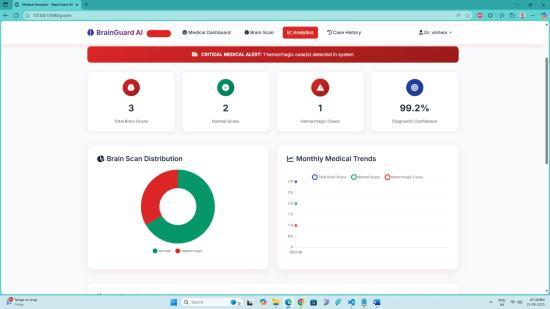
5 Predicted Analysis Graph
In this research, an AI-assisted diagnostic framework was successfullydevelopedtodetectbrainhemorrhagefromCT imageswithhighaccuracyandreduceddiagnosticlatency. Themethodologyincorporatedstructuredstagesincluding datapreprocessing,segmentation,featureextractionusing the VGG19 transfer-learning model, and binary image classification,supportedbyaFlask-basedwebapplication for real-time prediction and result retrieval. The system achieved an accuracy of 97.84%, along with strong sensitivity,specificity,andprecisionscores,demonstrating itscapabilitytoreliablydistinguishhemorrhagicfromnonhemorrhagic CT scans. The integration of automated preprocessing and deep learning eliminated the need for manual feature engineering, improving performance over traditional machine-learning approaches that rely on handcraftedfeatures.Thedevelopedwebinterfaceenables instant image upload, classification, and history storage, making the solution usable in both clinical and remote healthcaresettingswhereradiologistavailabilityislimited. Comparedtoexistingmanualorsemi-automatedmethods, this framework offers faster decision support, consistent interpretation, and scalability for large-volume screening. The findings highlight the potential of AI-driven tools to complementmedicalexpertise,assistinemergencytriage, and reduce diagnostic error. Future enhancements may include multi-class classification of hemorrhage subtypes, Grad-CAMvisualizationforexplainability,andcloud-based deployment for wider hospital adoption. Future enhancement of this project can focus on improving both technical performance and real-world applicability. Expanding the dataset with larger, multi-institutional CT scan collections and including different hemorrhage subtypes would enable multi-class classification and improvemodelgeneralizationacrossdiversepatientcases. IncorporatingGrad-CAMorotherexplainableAItechniques can provide visual justification for predictions, increasing trust among clinicians. The system can be upgraded to supportDICOMimagesdirectly,enablingseamlesshospital integration. Deployment on cloud platforms with GPU accelerationwouldallowfasterprocessingandmulti-user access in emergency settings. Additional features such as automated report generation, integration with electronic
health records, and mobile app support could further enhanceusabilityandclinicaladoption.
[1]D.Veselov,etal.,“DetectionofIntracranialHemorrhage byArtificialIntelligence,”2024.
[2]X.Wang,etal.,“ADeepLearningAlgorithmforAutomatic Detection and Classification of Intracranial Hemorrhage,” 2021.
[3] S. N. Ahmed, et al., “Intracranial Hemorrhage SegmentationandClassificationUsingDeepLearning,”2025.
[4]A.KaramianandA.Seifi, “Diagnostic AccuracyofDeep Learning for Intracranial Hemorrhage Detection in NonContrast Brain CT Scans: A Systematic Review and MetaAnalysis,”2025.
[5] Multiple Authors, “A Comparative Study of VGG Deep Learning Architectures for Intracranial Hemorrhage Classification,”2024.
[6]MultipleAuthors,“AutomatedIntracranialHemorrhage DetectioninTraumaticBrainInjuryUsing3DCNN,”2023.
[7]B.MonicaJenefer,etal.,“DetectionandCategorizationof AcuteIntracranialHemorrhageSubtypesUsingMulti-Layer DenseNet-ResNetArchitecture,”2022.
[8] D. Alis, et al., “A Joint Convolutional-Recurrent Neural Network with Attention Mechanism for Detecting IntracranialHemorrhage,”2022.
[9]MultipleAuthors,“StrengtheningDeep-LearningModels for Intracranial Hemorrhage Detection Using Weighted EnsembleApproach,”2023.
[10] J. Soni, et al., “Toward the Detection of Intracranial Hemorrhage:ATransferLearningApproachUsingVGGNet,” 2025.