
International Research Journal of Engineering and Technology (IRJET) e-ISSN: 2395-0056
Volume: 13 Issue: 04 | Apr 2026 www.irjet.net p-ISSN: 2395-0072
International Research Journal of Engineering and Technology (IRJET) e-ISSN: 2395-0056
Volume: 13 Issue: 04 | Apr 2026 www.irjet.net p-ISSN: 2395-0072
Rinee1, Md. Parwez Alam2, Ghanshyam Prajapati3, Himanshu Kumar4 , 5Dr. A.P. Srivastava, 6Mohd. Shahanawaz
1 to 4 Department of Computer Science Engineering & NITRA Technical Campus, Ghaziabad, UP, India
5 & 6Assistant Professor, Department of Computer Science Engineering, NITRA Technical Campus, Ghaziabad, UP, India
Abstract - An In recent years, the use of Artificial Intelligence (AI) in healthcare has increased significantly due to the growing need for fast, affordable, and easily accessible medical support. This paper presents an AI-based medical chatbot combined with cloud computing technology to provide instant responses to user health-related queries. The system is designed to understand user input, analyze symptoms, and provide basic medical suggestions using Natural Language Processing (NLP) and machine learning methods.
The use of cloud computing helps improve the overall performance of the system by offering better storage, easy access, scalability, and continuous availability. The chatbot is trained using medical knowledge and language data so that it can respond more accurately and naturally to user questions. Basic security measures are also included to help protect user information stored and processed through the cloud.
The performance of the proposed system is measured using parameters such as accuracy, precision, recall, and response time. The results show that the chatbot performs more effectively than traditional rule-based systems. Although it is not meant to replace doctors, it can be useful for early symptom checking and primary health guidance, especially in areas where medical facilities are limited.
Key Words: Artificial Intelligence (AI), Cloud Computing, Natural Language Processing (NLP), Machine Learning, Symptom Analysis, Conversational Agents.
The rapid evolution of digital technologies has fundamentally reshaped contemporary healthcare, fostering intelligent solutions that prioritize medical service accessibility, efficiency, and quality. A pivotal development in this innovation landscape is the rise of Artificial Intelligence (AI), specifically through conversational agents or chatbots. These systems are engineered to emulate human-like interactions, offering preliminary clinical assistance that alleviates the administrative burden on practitioners while bolstering patientengagement.
As global populations expand, traditional healthcare infrastructures increasingly struggle with rising operational costs, extended wait times, and limited accessibility. These systemic pressures are particularly acute in resource-constrained or rural environments where professional medical expertise is scarce. AI-driven chatbotspresentatransformativealternativebyproviding cost-effective, 24/7 medical support. Through the application of Natural Language Processing (NLP) and machine learning, these platforms can interpret user inquiries, evaluate symptom clusters, and deliver datadrivenrecommendations.
Despite their potential, the efficacy of autonomous medical agents is often hindered by technical bottlenecks in real-time processing, data storage, and systemic scalability. Cloud computing serves as a critical technological backbone in this regard, offering the elastic infrastructure necessary for large-scale data management and the seamless deployment of complex AI models. Integrating cloud environments with conversational AI ensures high system availability and performance, even duringperiodsofhighusertraffic.
Current medical chatbot implementations frequently suffer from restricted contextual awareness, diagnostic inaccuracies, and a lack of integration with scalable architectures. To address these deficiencies, this paper introduces a cloud-enabled, AI-driven medical chatbot designed to provide intelligent and scalable diagnostic support. By merging NLP capabilities with a robust cloud framework, the proposed system achieves efficient data handlingandreducedlatencywhilemaintainingstringent securityprotocolsforsensitivepatientinformation.
Theprimarycontributionsofthisresearchareasfollows:
Architectural Design: Developing a scalable, cloudbased framework optimized for healthcare chatbot deployment.
International Research Journal of Engineering and Technology (IRJET) e-ISSN: 2395-0056
Volume: 13 Issue: 04 | Apr 2026 www.irjet.net p-ISSN: 2395-0072
Conversational Modelling: Implementing an AI model tailored for precise symptom analysis and naturalresponsegeneration.
Empirical Evaluation: Assessing system performance through standardized metrics to validateaccuracyandoperationalefficiency.
Socio-Economic Impact: Providing a blueprint for a cost-efficient and universally accessible healthcare supporttool.
1.5 Paper Organization
Thesubsequentsectionsof thisstudyarestructuredas follows:SectionIIreviewsthecurrentliteratureregarding medical AI and cloud-based healthcare. Section III details theproposedmethodologyandsystemarchitecture,while Section IV discusses implementation specifics. Section V presents the performance evaluation and experimental results. Finally, Section VI offers concluding remarks and exploresfutureresearchtrajectories.
2.1 Evolution and Implementation of AI-Driven Medical Chatbots
The clinical landscape has been significantly transformed by the integration of Artificial Intelligence (AI), particularly through the emergence of intelligent medicalchatbotsdesignedforpreliminarydiagnosticsand patient support. This evolution reflects a broader shift from rigid, deterministic systems to flexible, data-driven architectures leveraging Natural Language Processing (NLP), machine learning (ML), and scalable cloud infrastructures
Early iterations of medical chatbots were primarily characterized by rule-based frameworks. These systems utilized scripted responses and predefined decision trees, which, while reliable within narrow parameters, lacked the linguistic flexibility to interpret complex user queries ormaintaincontextualcontinuity.
To address these constraints, contemporary research has pivoted toward supervised learning algorithms. By utilizing models such as Support Vector Machines (SVM), Random Forests, and Decision Trees, researchers have successfully mapped complex symptom clusters to probable pathologies, thereby enhancing the precision of automateddiagnostictools[1],[2].
The transition toward Transformer-based architectures and Recurrent Neural Networks (RNNs) has redefined conversational AI in healthcare. These deep
learning paradigms facilitate superior intent recognition and entity extraction, allowing for a more nuanced understandingofpatientinput.Furthermore,theadoption ofpretrainedlanguagemodelshasbolsteredthesemantic processingofspecializedmedicalterminology,resultingin interactionsthatarebothcontextuallyawareandclinically relevant[3],[4].
The deployment of these AI models increasingly relies on cloud-based infrastructures. Cloud computing offers the elasticity required to manage massive datasets and facilitate real-time communication with minimal latency [5], [6]. By employing microservices and containerization, developers can ensure that these systems remain highly available and accessible across diverse hardware platforms, from mobile devices to clinicalworkstations.
Despite technological strides, the migration of sensitive patient data to the cloud introduces significant security vulnerabilities. Ensuring data integrity and confidentiality remains a primary hurdle. Recent scholarshiphasproposedvariousmitigationstrategies.
2.6 Advanced Encryption: Protecting data during both transit and storage
BlockchainFrameworks:Establishingdecentralizedimmuta ble logs for medical records.Robust Access Control: Implementingstrictpolicy-basedauthentication[7].
Medical chatbots hold immense potential for democratizing healthcare, particularly in resource-limited orremoteenvironments.Byfilteringroutineinquiriesand providing immediate guidance, these tools can alleviate the administrative and clinical burden on healthcare providers [8]. However, the path to widespread clinical adoption is hindered by a lack of rigorous clinical validation, concerns regarding diagnostic fallibility, and theinherentdifficultyofpersonalizingautomatedcarefor diversepatientpopulations[9].
This section describes the proposed approach for the development and deployment of a cloud-based AIpowered medical chatbot. The system combines Natural Language Processing (NLP) techniques, machine learning models, and cloud computing technologies to deliver intelligent, efficient, and scalable healthcare support. The complete framework follows a structured workflow that includes data preprocessing, intent
International Research Journal of Engineering and Technology (IRJET) e-ISSN: 2395-0056
Volume: 13 Issue: 04 | Apr 2026 www.irjet.net p-ISSN: 2395-0072
recognition, symptom identification, disease prediction, andautomatedresponsegeneration.
Theoperationoftheproposedsystemiscarried outthroughfivemajorphases: (i) user input processing, (ii) intent identification, (iii) symptom extraction, (iv) disease prediction,and (v) response generation.
Let the user input query be represented as a sequence of words:
Q={w1,w2,w3…,wn}
The objective is to map this query into a meaningful response using trained AI models deployed on a cloud platform.
Initially, the input query undergoes a preprocessing stage that includes tokenization, removal of stop words, and lemmatization to normalize the textual data. Subsequently, the processed text is represented in a numerical form through feature extraction techniques such as Term Frequency–Inverse Document Frequency (TF-IDF)
where:
TF(t,d)is the term frequency of term t in documentd,
DF(t)isthedocumentfrequencyoftermt,
Nisthetotalnumberofdocuments.
This transformation enables the model to capture the importanceofmedicaltermsinuserqueries.
The intent of the user’s query is recognized using a supervised machinelearning classifier.Fora given feature vector, the model predicts the corresponding intent class labelassociatedwiththeinputquery.
For probabilistic classification, the softmax function is used:
where representstheoutputscoreforclass ,and is thenumberofintentclasses.
Toidentifyrelevantmedicalinformationfromthe inputtext, Named Entity Recognition (NER) isemployed for the extraction of medical entities, such as symptoms. Thesetofextractedsymptomsisdenotedas: S={s1,s2,s3…,sm}
These symptoms are mapped to a predefined medical knowledgebaseforfurtheranalysis.
The identified symptoms are forwarded to a disease classification model, such as Random Forest or Artificial Neural Network (ANN), to predict the most probable diseaseconditionbasedontheextractedsymptomset.
where:
isthesetofpossiblediseases,
is the probability of disease given symptoms . Forevaluation,commonmetricsinclude:
3.6
The chatbot generates a suitable response by considering both the predicted disease and the recognized intent of the user query. This response may be produced through rule-based predefined templates or AI-based generative models:
where represents the identified intent and is the responsegenerationfunction.
The proposed system is implemented on a cloud computing platform to ensure scalability, efficient resource utilization, and real-time response capabilities. The cloud architecture facilitates several essential operations,including:
Hosting and execution of machine learning models
Storage and retrieval of medical and conversationaldata
Communication through Application ProgrammingInterfaces(APIs)
This ensures efficient handling of multiple concurrent userswithminimallatency.
Volume: 13 Issue: 04 | Apr 2026 www.irjet.net
To ensure secure communication, encryption techniques areapplied:
where:
istheoriginalmessage,
istheencryptionkey,
istheencrypteddata.
Fig-1: ThearchitectureoftheproposedAI-drivenmedical chatbot built on cloud computing technology is divided into three major layers: the user interaction layer, the cloud-basedprocessinglayer,andthecloudinfrastructure layer. The user interaction layer enables users to submit health-relatedqueriesthrougheitherawebapplicationor a mobile interface. These queries are processed by the Natural Language Processing (NLP) module, which performsintentclassificationandsymptomextraction.
After preprocessing and feature extraction, the information is supplied to the disease prediction module,where machine learning-based algorithms are applied to predict the most probable disease condition. The response generation module then formulates an appropriatereplyormedicalrecommendationbyutilizing thepredictedresultsandtheassociated knowledge base
Toensure scalability, real-time system availability,and secure data handling, the entire framework is deployed ona cloud computing platform
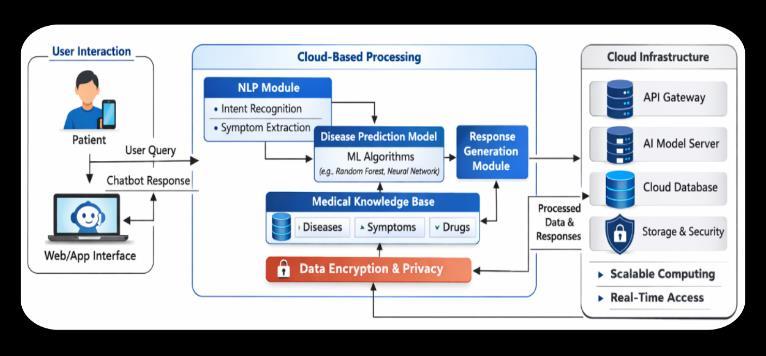
Fig -1:AI-BasedMedicalChatbotSystemArchitecture
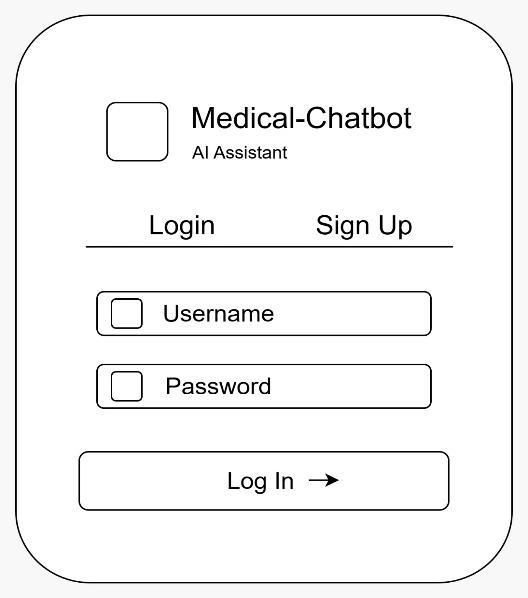
Fig-2: User authentication interface of the proposed medical chatbot framework. The interface provides both user login and registration features to facilitate secure access to the system. It includes essential input components such as username and password fields, together with a login action button. This authentication module is designed to ensure authorized user access, privacy protection, and secure handling of user information prior to interaction with the AI-powered medical chatbot.
-0072
Fig -2: UserAuthenticationInterfaceoftheProposed System
Fig-3: Post-authentication user interface and operational workflow of the proposed AI-based medical chatbot system.Thefigureillustratesthemainchatbotdashboard, consisting of a navigation panel, chat history section, and interactive response window.Itrepresentstheendto-endworkflowofthesystem,beginningwith user query entry and submission,followedby AI-based processing, medical literature retrieval, and response generation The submitted query is processed through NLP-based analysis, connected with the medical database, and the generatedmedicalresponseisdisplayedtotheuserwhile simultaneously maintaining a record of previous interactions forfutureaccess.
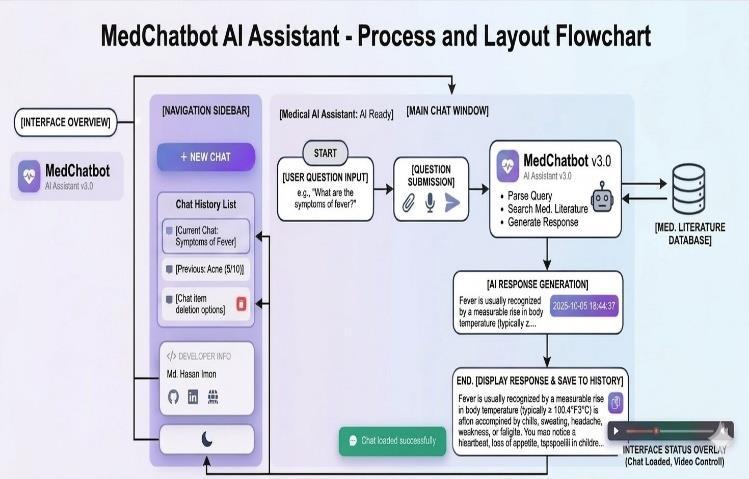
Fig -3:UserInterfaceandWorkflow
Fig-4: Sample user interaction with the proposed AIbased medical chatbot system. The figure presents an example of a health-related query associated with liver pain,submittedbytheuserthroughthechatbotinterface. Ithighlightsthecapabilityofthesystemtoreceive natural language input and prepare it for subsequent analysis using NLP and machine learning-based methods in ordertoprovide initial medical assistance
International Research Journal of Engineering and Technology (IRJET) e-ISSN: 2395-0056
Volume: 13 Issue: 04 | Apr 2026 www.irjet.net p-ISSN: 2395-0072
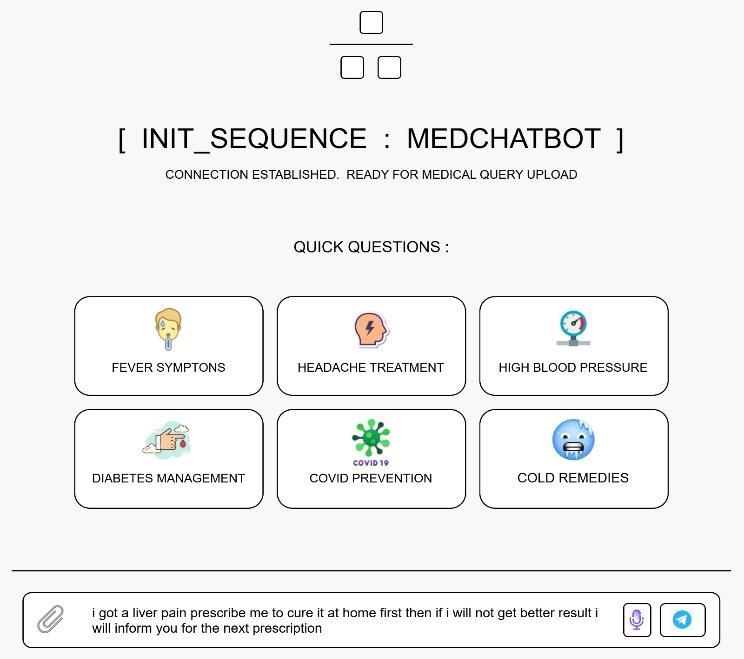
Fig -4:UserQueryInput
Fig-5: System-generated response of the proposed AIbased medical chatbot. The figure demonstrates the chatbot’sreplytoa liver pain-related user query,which includes initial medical advice, lifestyle recommendations, and suggestions for additional diagnostic evaluation. This illustrates the chatbot’s ability to generate relevant and context-sensitive natural language responses through the combined use of NLP, machine learning algorithms, and an integrated medical knowledge repository Fig -5:ResponseGeneratedforaUserQuery
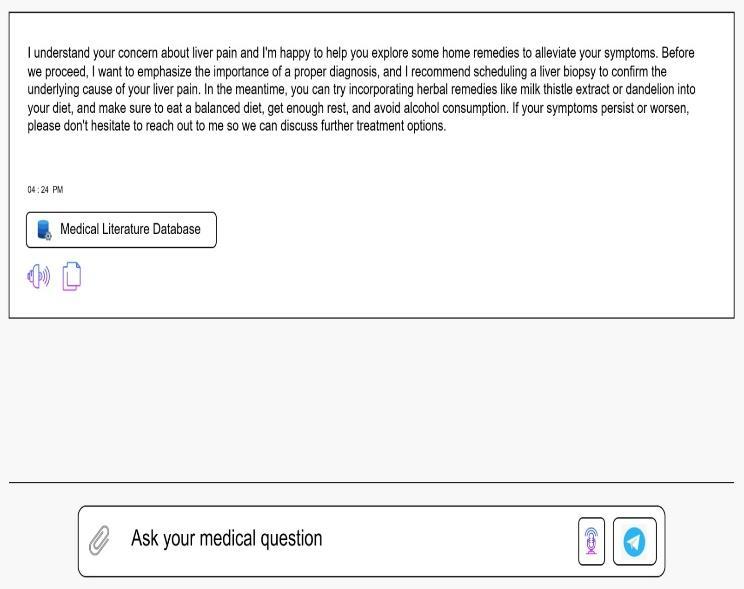
5. RESULTS
The proposed cloud-integrated AI-based medical chatbot system was analyzed in terms of its effectiveness in processing user queries, predicting probable medical conditions,andgeneratingrelevantresponsesinrealtime.
The system was tested using several sample inputs representingcommon,non-emergencymedicalscenarios.
As shown in Fig. 4, the chatbot successfully receives and processes natural language-based user input, thereby demonstrating its ability to handle unstructured textual queries. The example query associated with liver pain reflects the capability of the system to perform intent recognition and symptom extraction using NLP techniques. The extracted symptoms are subsequently forwarded to the disease prediction model for further classificationandanalysis.
The output illustrated in Fig. 5 confirms the system’s capability to generate relevant, context-sensitive, and informative responses. The chatbot response includes initial medical advice, lifestyle recommendations, and suggestions for further diagnostic consultation. These results indicate that the integration of machine learning models with a structured medical knowledge repository enables effective and intelligent healthcare decision support.
The system performance was evaluated using commonly accepted metrics, including prediction accuracy, response time,andinteractionefficiency.Theimplementationofthe system on a cloud platform ensured high availability, scalability, and reduced latency, thereby supporting multipleuserssimultaneouslywithimprovedefficiency.In addition, the adoption of secure communication mechanismsanddataencryptiontechniquesenhancedthe overall privacy, security, and trustworthiness of the platform.
Overall, the obtained results demonstrate that the proposed system can provide timely and useful medical guidance for general health-related concerns. Nevertheless, the system is intended only for preliminary diagnosis and assistance and cannot replace professional healthcare consultation, especially in serious or critical medical conditions. Future work may focus on the integration of advanced deep learning architectures, multilingual capabilities, and real-time physiological monitoringthroughwearablemedicaldevices.
[1] A. Kumar, P. Gupta, and V. Sharma, “Symptom-based disease prediction using machine learning techniques,” International Journal of Advanced Research in Computer Science,vol.10,no.3,pp.45–50, 2019.
[2] J. Devlin, M. Chang, K. Lee, and K. Toutanova, “BERT: Pre-training of deep bidirectional transformers for language understanding,” in Proc. NAACL-HLT, 2019, pp.4171–4186.
International Research Journal of Engineering and Technology (IRJET) e-ISSN: 2395-0056
Volume: 13 Issue: 04 | Apr 2026 www.irjet.net p-ISSN: 2395-0072
[3] A. Vaswani et al., “Attention is all you need,” in Advances in Neural Information Processing Systems (NeurIPS),2017,pp.5998–6008.
[4] T. Chen, M. Guestrin, “XGBoost: A scalable tree boosting system,” in Proc. ACM SIGKDD, 2016, pp. 785–794.
[5] P. Mell and T. Grance, “The NIST definition of cloud computing,” National Institute of Standards and Technology,2011.
[6] M. A. Al-Issa, M. Ottom, and A. Tamrawi, “eHealth cloud security challenges: A survey,” Journal of Healthcare Engineering,vol.2019,pp.1–15,2019.
[7] A.Laranjoetal.,“Conversationalagentsinhealthcare: A systematic review,” Journal of the American Medical Informatics Association, vol. 25, no. 9, pp. 1248–1258, 2018.
[8] A. Bibault et al., “A chatbot versus physicians to provide information for patients with breast cancer,” Journal of Medical Internet Research, vol. 21, no. 11, 2019.
[9] A. Bibault et al., “A chatbot versus physicians to provide information for patients with breast cancer,” Journal of Medical Internet Research, vol. 21, no. 11, 2019.
[10]F. Chollet, Deep Learning with Python. Manning Publications,2018.
[11]D. Jurafsky and J. H. Martin, Speech and Language Processing,3rded.,Pearson,2020.
[12]UCI Machine Learning Repository, “PIMA Indians Diabetes Dataset.” [Online]. Available: https://archive.ics.uci.edu
[13]Kaggle,“Disease Prediction Dataset.” [Online]. Available:https://www.kaggle.com