
International Research Journal of Engineering and Technology (IRJET) e-ISSN: 2395-0056
Volume: 13 Issue: 03 | Mar 2026 www.irjet.net p-ISSN: 2395-0072

International Research Journal of Engineering and Technology (IRJET) e-ISSN: 2395-0056
Volume: 13 Issue: 03 | Mar 2026 www.irjet.net p-ISSN: 2395-0072
Nayna
Potdukhe¹,Ganesh Dandekar², Dhairyashil Shinde³, Prathmesh Murodiya´, Bhavesh Bhumbarµ, Nishith Sanap
1Visiting Lecturer, 2,3,4,5,6Student Department of Artificial Intelligence and Machine Learning Government Polytechnic , Nagpur, India.
Abstract - Agriculture is really important for Indias economy, especially in places like Maharashtra where how well crops grow depends a lot on the weather and the soil. Farmers there have to deal with that all the time. I think predicting crop yields accurately could make a big difference for them and also for people making policies or planning resources. It helps with managing crops and figuring out food supplies. This study comes up with something called AgriSight, which is a machine learning setup to predict yields based on past production data and weather stuff. The whole idea is to handle two main problems in precision agriculture, like picking the right crop for the land and then guessing how much it will produce. It seems kind of tricky to get both right. The framework pulls in different kinds of data, including weather things like temperature, rainfall, humidity, and soil details such as type and pH. That makes sense because those factors affect everything. They combined historical crop records with weather history to build the model. Then they did some feature engineering to pull out useful bits, like the area planted, average yields from before, temperature levels, and humidity. A bunch of machine learning methods got tested, including Random Forest, Gradient Boosting, XGBoost, Neural Networks, and LightGBM. It feels like they wanted to see what worked best. In the end, Random Forest came out on top with about 98.49 percent accuracy and an error of just 0.49 tons per hectare. Thats pretty good, I guess. Mixing the old agricultural data with environmental info really boosted how well it predicted things. Some people might think its oversimplifying, but the results show it helps. AgriSight could be useful for precision farming and better planning in agriculture. It might even tie into food security somehow, though Im not totally sure on all the details there. The performance numbers stand out, but integrating everything wasnt straightforward.
Key Words: Precision Agriculture, Crop Yield Prediction, Machine Learning, Random Forest Algorithm, Environmental Factors, Soil Properties, Agricultural Data Analysis, Crop Recommendation System
1. INTRODUCTION
AgricultureisreallyimportantforIndianseconomy,especiallyinplaceslikeMaharashtrawherehowwellcropsgrowdependsa lotontheweatherandthesoil.Farmerstherehavetodealwiththatallthetime.Ithinkpredictingcropyieldsaccuratelycould makeabigdifferenceforthemandalsoforpeoplemakingpoliciesorplanningresources.Ithelpswithmanagingcropsand figuringoutfoodsupplies.ThisstudycomesupwithsomethingcalledAgriSight,whichisamachinelearningsetuptopredict yieldsbasedonpastproductiondataandweatherstuff.Thewholeideaistohandletwomainproblemsinprecisionagriculture, likepickingtherightcropforthelandandthenguessinghowmuchitwillproduce.Itseemskindoftrickytogetbothright.The frameworkpullsindifferentkindsofdata,includingweatherthingsliketemperature,rainfall,humidity,andsoildetailssuchas typeandpH.Thatmakessensebecausethosefactorsaffecteverything.Theycombinedhistoricalcroprecordswithweather historytobuildthemodel.Thentheydidsomefeatureengineeringtopulloutusefulbits,liketheareaplanted,averageyields frombefore,temperaturelevels,andhumidity.Abunchofmachinelearningmethodsgottested,includingRandomForest, GradientBoosting,XGBoost,NeuralNetworks,andLightGBM.Itfeelsliketheywantedto seewhatworkedbest.Intheend, RandomForestcameoutontopwithabout98.49percentaccuracyandanerrorofjust0.49tonsperhectare.That’sprettygood, Iguess.Mixingtheoldagriculturaldatawithenvironmentalinforeallyboostedhowwellitpredictedthings.Somepeoplemight thinkitsoversimplifying,buttheresultsshowithelps.AgriSightcouldbeusefulforprecisionfarmingandbetterplanningin agriculture.Itmighteventieintofoodsecuritysomehow,thoughIamnottotallysureonallthedetailsthere.Theperformance numbersstandout,butintegratingeverythingwasnotstraightforward.
International Research Journal of Engineering and Technology (IRJET) e-ISSN: 2395-0056
Volume: 13 Issue: 03 | Mar 2026 www.irjet.net p-ISSN: 2395-0072
Cropyieldpredictionhasattractedsignificantresearchinterestduetoitsimportanceinagricultural planningandfood security.Earlypredictionapproachesreliedonstatisticalregressionmodelsusinglimitedagriculturalvariables.However, thesemodelsoftenstruggledtocapturecomplexnonlinearrelationshipsbetweenenvironmentalfactorsandcropproductivity. Machinelearningtechniqueshaverecentlybeenadoptedtoovercometheselimitationsconductedacomprehensivereviewof cropyieldpredictionmethodsandconcludedthatmachinelearningalgorithmssignificantlyimprovepredictionaccuracyby analyzinglargedatasetscontainingenvironmentalandagriculturalvariables[3].
Jeongetal.appliedtheRandomForestalgorithmforglobalcropyieldpredictionanddemonstratedthatensemblelearning techniquesoutperformtraditionalstatisticalmodelsbycapturingnonlinearrelationshipsbetweenenvironmentalvariablesand cropproductivity[2].
Similarly,ChenandGuestrinintroducedXGBoost,ascalablegradientboostingalgorithmcapableofhandlinglargedatasets efficiently.XGBoosthasbecomewidelyusedinpredictivemodelingduetoitsabilitytoimproveaccuracythroughoptimizedtree boostingtechniques[1].
Weatherconditionsplayacriticalroleincropgrowth.Vashisthetal.developedaweather-basedcropyieldpredictionmodeland showedthatmeteorologicalparameterssuchasrainfall,temperature,andhumiditystronglyinfluencecropyieldvariability[4].
Panwaretal. proposeda two-step nonlinearregressionmodel using weather parameters forforecastingcropyield. Their researchdemonstratedthatnonlinearmodelsperformbetterthanlinearmodelsbecauseagriculturalsystemsinvolvecomplex interactionsbetweenclimaticfactorsandcropgrowthprocesses[5].
Recentstudieshavealsoemphasizedtheimportanceofintegratingmultipledatasetsforcropyieldprediction.Liuetal.showed thatcombiningmeteorologicaldatawithsoilcharacteristicssignificantlyimprovescropyieldpredictionaccuracybycapturing environmentalvariability[6].
Severalstudiesshowthatfarmersfacechallengeslikenothavingaccesstoreal-timemarketinformation,relyingonmiddlemen, andstrugglingtofindessentialagriculturalresources.E-agricultureplatformshavebeencreatedtoofferservicesincluding marketpricetracking,productavailability,andaccesstogovernmentprograms.Moreover,agriculturalinformationsystemsand ICT-basedsolutionshavemadeiteasierforfarmerstoaccessdataandmakedecisions.However,currentsystemsoftenfocuson individualfunctionsanddonotintegratevariousagriculturalservicesintooneplatform.Thereisaneedforasystemthat combines crop prediction, yield estimation, and agricultural resource management. The proposed AgriSight framework addressestheseissuesbyintegratingenvironmental,soil,andhistoricaldatathroughmachinelearningtechniques.[35]
Inrecentyears,deeplearningtechniqueshavegainedsignificantattentionincropyieldpredictionduetotheirabilitytohandle complexandlarge-scaledatasets.Studieshaveshownthatdeepneuralnetworkscancaptureintricatenonlinearrelationships betweenenvironmentalfactorsandcropproductivitymoreeffectivelythantraditionalmachinelearningmodels[25]
Alongsideyieldprediction,machinelearninghasbeenincreasinglyThesestudieshighlightthatcropyieldpredictionmodels benefitfromtheintegrationofenvironmentalvariables,agriculturalproductiondata,andmachinelearningtechniques.The proposedAgriSightframeworkbuildsuponthesefindingsbyintegratingcropproductiondataandweathervariablestodevelop anaccurateyieldpredictionsystemforMaharashtra
TheproposedAgriSightsystemfollowsastructuredmachinelearningpipelinetopredictcropyieldbasedonagricultural andenvironmental variables. The methodology consists of five major stages: data collection, data preprocessing, feature engineering,modeltraining,andevaluation.Theproposedmethodologyfollowsamodularpipelinedesignedtohandlehighdimensionalagriculturaldata.Thearchitectureisdividedintofourprimaryphases:DataFusion,SpatialClustering,Feature Engineering,andEnsembleModelTraining.
International Research Journal of Engineering and Technology (IRJET) e-ISSN: 2395-0056
Volume: 13 Issue: 03 | Mar 2026 www.irjet.net p-ISSN: 2395-0072
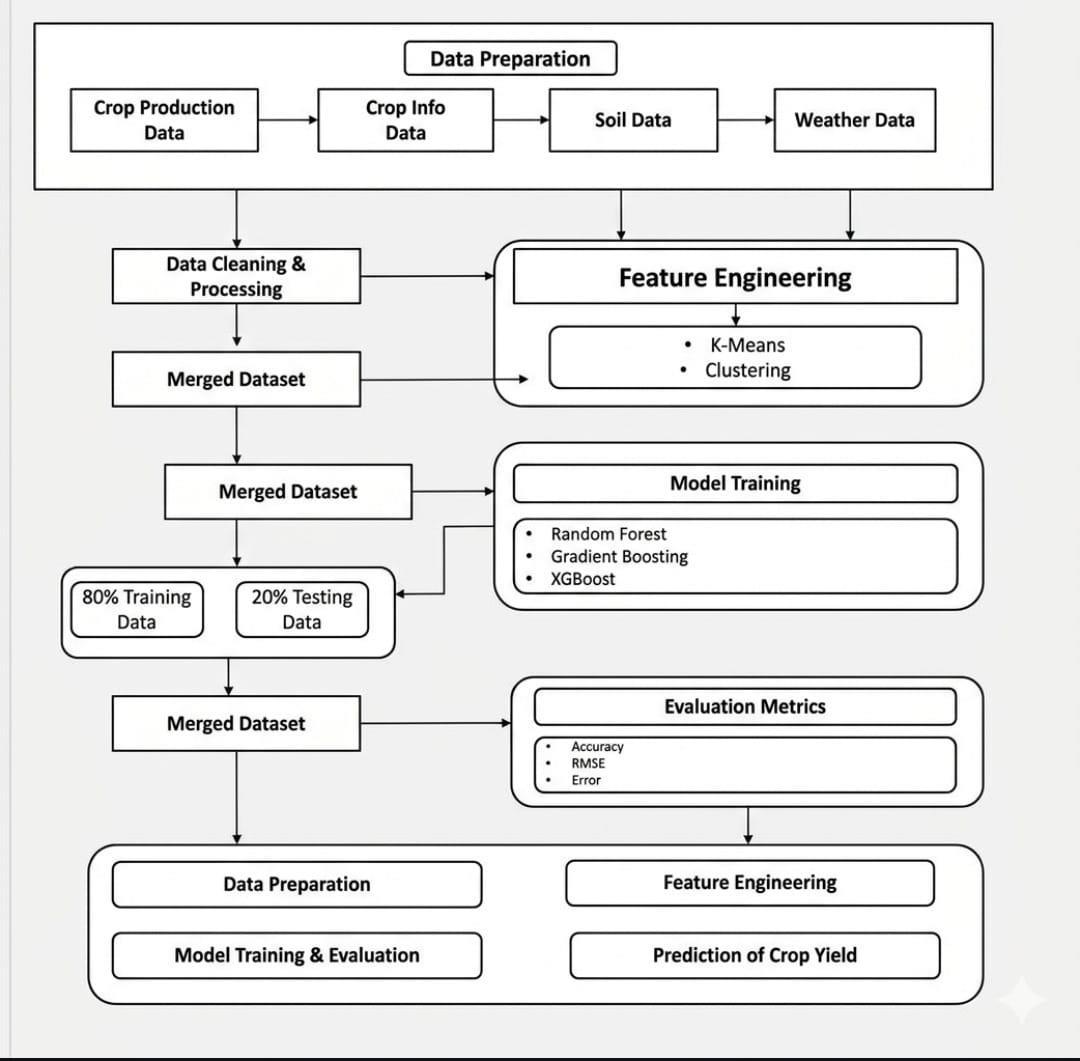
Flow-Chart -1: Overallworkflow
3.1 Data Fusion and Pre-processing
Theprimarychallengeincropyieldpredictionisthefragmentationofdata.Inthisstudy,weintegratedfour heterogeneous datasets:
1. HistoricalYieldData:Extractingdistrict-levelproductionstatistics(1990–2018).
2. MeteorologicalData:Mergingdailyweatherlogsincludingtemperature,humidity,andrainfallindices.
3. Edaphic/SoilData:MappingNitrogen(N),Phosphorus(P),Potassium(K),andpHrequirementstospecificcroptypes.
4. TechnologicalInputs:Incorporatingpesticideconsumptionmetricstoaccountformodernfarmingpractices
Pre-processing Steps:
OutlierRemoval:UsingInterquartileRange(IQR)toremoveunrealisticyieldvalues(e.g.,negativeproduction).
MissingValueImputation:Applyingregionalaveragestofillgapsinweatherandsoildata.Encoding:Categoricalvariables (District,Season,Crop)weretransformedusingLabelEncodingforcompatibilitywithgradient-boostingalgorithms.
3.2 Spatial Analysis via K-Means Clustering
Unlike standard models that treat a district as a single point, we implemented a Spatial Clustering layer using create_area_clusters.py.WeappliedtheK-Meansalgorithmtogroupregionsbasedon:
YieldIntensity:Averageproductionperunitarea.
AreaProportions:Thescaleoflanddedicatedtospecificcrops.
This allowed the model to learn "Area Factors," which represent the inherent agricultural potential of sub-regions, significantlyreducinglocalizederror.
International Research Journal of Engineering and Technology (IRJET) e-ISSN: 2395-0056
Volume: 13 Issue: 03 | Mar 2026 www.irjet.net p-ISSN: 2395-0072
3.3 Feature Engineering Architecture
Weexpandedthefeaturesetfrom7basicparametersto17high-impactvariables.Thefinalfeaturevector isdefinedas:
Cluster–basedspatialfeatures
3.4 Ensemble Voting Regressor
ThecorepredictionengineutilizesaWeightedVotingRegressor.This"Meta-Model"combinesthreespecializedalgorithms:
1. XGBoost: (ExtremeGradientBoosting):Optimizedforspeedandhandlingthenon-linearrelationshipbetweenweather andyield.
2. LightGBM: Used for its leaf-wise growth strategy, which excels at finding patterns in large datasets like maharashtra_crop_weather.csv.
3. Random Forest: Actsasastabilizertoreducevarianceandpreventthemodelfromoverfittingonspecificdrought years.

4.1 Data Set Merging and Variable Preparation
Ahandfuloffarmdatasourcescametogether,mixingharveststatsalongwithclimatedetails.Aftercombiningeverything,the infowentthroughcleaning,scaling,andturninglabelsintonumbers.Eachstephelpedprepareitwellforuseintraininga predictionsystem.Outoftheoriginaldata,usefulpiecesgotpulledthroughcarefulshaping.Ninestoodoutintheend,chosen toshapehowpredictionswouldlearn.Fromfieldpatternstoweathertraces-eachonetiesbacktohowmuchaharvestmight bring.Becauseitpicksuponhowlanduseconnectswithweatherpatternsalongwithpastharvestdata,themodelcanbetter estimatefuturecropoutput.Whatmattersishowtheseelementsinteractovertime,shapingoutcomesinwaysthatsimpler methodsmightmiss.Seeingthoselinksclearlyleadstomorereliableforecastswhengrowingseasonsshift.
Table-1: Datafeatures&variablePreparation
Feature
Area
Log_Area
District_Encoded
Crop_Encoded
Season_Encoded
Description
Totalcultivatedareaforaspecificcrop
LogarithmicTransformationofcultivatedarea
Encodeddistrictidentifier
Encodedcroptype
Encodedseasoncrop
International Research Journal of Engineering and Technology (IRJET) e-ISSN: 2395-0056
Volume: 13 Issue: 03 | Mar 2026 www.irjet.net
Year_Normalized
Historical_Avg_Yield
Avg_Temp_Year_Filled
Avg_Humidity_Year_Filled
p-ISSN: 2395-0072
Adifferentwaytoshowtheyearvalue,adjustedtofita standardscale
Averagehistoricalyieldofthecrop
Averageannualtemperature
Averageannualhumidity
Ahandfulofmachinelearningmethodsgottestedtoseewhichoneworksbestatguessinghowmuchcropswillproduce. Amongthosetried:RandomForest,thenGradientBoosting,followedbyXGBoost,aNeuralNetworkcamenext,afterthatLight GBMshowedup,finallyendingwithamixcalledtheVotingEnsemble.Oneafteranother,modelslearnedfromidenticaldata, thencheckedbyhowclosetheirguessescameandwheretheyslippedup.Lookingathoweachmethodstackedup,Random Foresttooktheleadwithasolid98.49%accuracyscore.ThoughtheVotingEnsembleputinaconfidentshowing,itstillfelljust shortwhenmeasuredagainstthattopperformer.
Table-2: ModelPerformance
Model Accuracy
RandomForest
0.9849(98.49%)
VotingEnsemble 0.9836(98.36%)
GradientBoosting
XGBoost
NeuralNetwork
0.9816(98.16%)
0.9816(98.16%)
0.9763(97.63%)
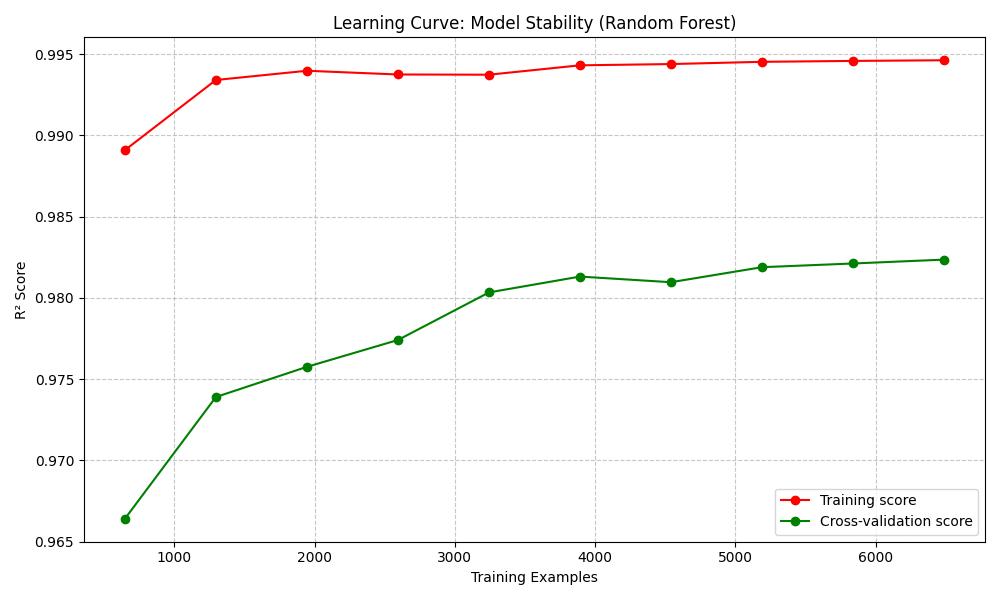
Fig-1: Scalability
4.3 Performance Metrics
International Research Journal of Engineering and Technology (IRJET) e-ISSN: 2395-0056
Volume: 13 Issue: 03 | Mar 2026 www.irjet.net p-ISSN: 2395-0072
Notjustabouthittingtherightmark,thetopmodel'srunwascheckedthrougherrornumbersthatshowhowsteadyitsguesses reallywere.Onaverage,eachguessmsissedrealharvestnumbersbylessthanhalfatonperhectare.Becauseerrorsstyed small,thesystemtracksfieldoutputwithstrongconsistency.
Table-3:PerformanceMatrix
Prediction
0.9849(98.49%)
MeanAbsoluteError 0.4869tons/hectare
NumberofFeatures 9
4.4Practical Implications
Despitevaryingconditions,theAgriSightmodelmanagestoforecastharvestoutputsbyblendingfieldinsightswithclimate patterns.Becauseforecastshitclosertoactualoutcomes,thoseworkinginfarminggainclearerinsightwhenchoosingcrops, handlingsoiluse,anddistributingsupplies.
Whatstandsoutishowreal-worldvariablesblendintoreliableestimateswithoutovercomplicatinginputs.Besidesforecasting cropoutputaheadofharvesttime,thissetupgivesofficialsaclearerpictureofexpectedyields -shapinghowtheymanage distributionnetworks.Withinsightscomingearlier,planninggainsprecision,streamliningdecisionsonwhereresourcesmove.
Fromstarttofinish,AgriSightshowshowmachinelearningcanstepintofarmingwithrealeffect.Itdoesn’tjusthintatchangeitquietlyreshapeshowcropsaremanaged.Stepbystep,itbringssharperdecisionstofieldsthatneedthemmost.Without flashornoise,itliftsoutputwhereitmatters.Inpractice,itsvaluegrowsalongsideeachseason’sharvest.
International Research Journal of Engineering and Technology (IRJET) e-ISSN: 2395-0056
Volume: 13 Issue: 03 | Mar 2026 www.irjet.net p-ISSN: 2395-0072
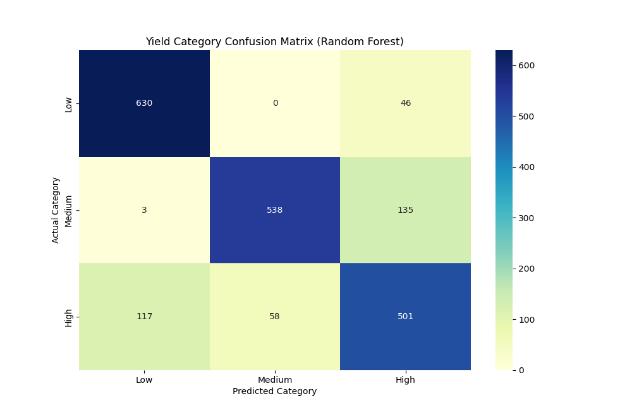
ClassificationReport(BinnedAccuracy):precision recall f1-score support
676
Chart-2:ClassificationReport
ThemodelinAgriSightissupposedtoclassifycropyieldsintolow,medium,orhighbasedonstufflikeenvironmentaldata. Theycheckitwiththingslikeprecisionandrecall,plusF1scores,andthenthebigaccuracynumberoverall.Accuracycomes outto82percent,whichIguessmeansitnailsmostofthepredictions.Themacroaverageisaround0.82,andweightedisabit higherat0.83,soitsprettyevenacrosstheclasses,nothingtoooffbalancethere.Precisiontellsyououtofallthetimesitsays somethingisacertainclass,howmanyareactuallyright.Forlowyieldits0.90,whichisthebestone,highyieldat0.84,and mediumonly0.73.Ithinkthelowyieldpartstandsoutbecausemaybeitseasiertospotthosebadconditionsorwhatever .Recallisaboutcatchingalltherealinstances,youknow,notmissingthem.Highyielddoeswellwith0.93,lowis0.80,medium around0.74.Soitgrabsmostofthehighones,butmediumseemstogetoverlookedafairbit.WhenyoucombinethemintoF1 scores,highyieldhits0.88,low0.85,andmediumstayslowat0.74.Thatmediumclassjustkeepsshowingupastheweakspot, Iamnottotallysurewhy,butitpullsthingsdownoverall.Theseresultsmakethemodellookreliableenoughforhelpingwith farmingdecisions,likepredictingyieldsfromdata.Mediumyieldsmightneedsometweakingthough,ormoretrainingdataor something,itfeelslike.
5. CONCLUSION
Machinesdeterminecropyieldsbyexaminingpastfarmingdataandclimateclues.Heat,rainfall,andsoiltypeareallimportant whenidentifyingwhathelpsplantsgrow.Amongallthemethodstested,RandomForeststoodoutbecauseitmatchedactual harvestsmostclosely.Thismodelturnsnumbersintousefulinsights,guidingchoicesaboutplantingandstockmanagement while adapting to changing weather. By estimating harvests early, farmers can better organize supplies, which reduces uncertainty as plants grow. While current methods work, future improvements might include factors like soil nutrients, satellite images, or crop health indicators like NDVI. As these elements come together, predictions can steadily improve, tracking changes in the fields daily. Looking closer, we see that data-driven methods are gradually influencing farming decisions,helpingoperationsusefewerresourcesandcutdownonwaste
[1] Chen,T.,&Guestrin,C.(2016).“XGBoost:AScalableTreeBoostingSystem.”https://arxiv.org/abs/1603.02754
[2] Jeong, J., Resop, J. P., Mueller, N. D., et al. “Random Forests for Global and Regional Crop Yield Predictions. ”PLOS ONE.https://journals.plos.org/plosone/article?id=10.1371/journal.pone.0156571
[3] Rashid,M.,Bari,B.S.,Yusup,Y.,etal.“AComprehensiveReviewofCropYieldPredictionUsingMachineLearning.IEEE https://www.sciencedirect.com/science/article/pii/S0303243421003755
[4] Vashisth,A.,etal.“WeatherBasedWheatYieldPredictionUsingMachineLearning.MAUSAMJournal. https://mausamjournal.imd.gov.in/index.php/MAUSAM/article/view/5606
[5] Panwar,S.,etal.“ForecastingofCropYieldUsingWeatherParameters–TwoStepNonlinearRegressionModelApproach. IndianJournalofAgriculturalSciences.https://www.researchgate.net/publication/328867789
[6] Liu,Q.,etal.“MachineLearningCropYieldModelsBasedonMeteorologicalFeatures.”ArtificialIntelligencefortheEarth Systems.https://journals.ametsoc.org/view/journals/aies/1/4/AIES-D-22-0002.1.xml
International Research Journal of Engineering and Technology (IRJET) e-ISSN: 2395-0056
Volume: 13 Issue: 03 | Mar 2026 www.irjet.net p-ISSN: 2395-0072
[7] K.Gunasekaran,A.K.,andP.Sreevardhan,“MachineLearningBasedCropRecommendationandSoilFertilityPrediction System,”FrontiersinSoilScience,2025.https://www.frontiersin.org/articles/10.3389/fsoil.2025.1652058
[8] S. Khaki, L. Wang, and S. V. Archontoulis, “A CNN-RNN Framework for Crop Yield Prediction,” 2019. A https://arxiv.org/abs/1911.09045
[9] T.Islam,T.A.Chisty,andA.Chakrabarty,“ADeepNeuralNetworkApproachforCropSelectionandYieldPredictionin Bangladesh,”2021.https://arxiv.org/abs/2108.03320
[10] L.Nguyen,J.Zhen,Z.Lin,H.Du,Z.Yang,W.Guo,andF.Jin,“Spatial-TemporalMulti-TaskLearningforWithin-FieldCotton YieldPrediction,”2018.https://arxiv.org/abs/1811.06665
[11] I.Oliveira,R.L.F.Cunha,B.Silva,andM.A.S.Netto,“AScalableMachineLearningSystemforPre-SeasonAgricultureYield Forecast,”2018.https://arxiv.org/abs/1806.09244
[12] N.Mahendra,D.Vishwakarma,K.Nischitha,A.Ashwini,andM.R.Manjuraju,“CropPredictionUsingMachineLearning Approaches,”InternationalJournalofEngineeringResearch&Technology,2020. https://www.ijert.org/crop-predictionusing-machine-learning-approaches
[13] T. Gupta, S. Maggu, and B. Kapoor, “Crop Prediction Using Machine Learning,” IRE Journals, 2023. https://www.irejournals.com/paper-details/1704207
[14] M.Sunandini,K.H.Sree,R.Deepiga,andA.Gokulapriya,“SmartSoilFertilizerMonitoringandCropRecommendation SystemUsingIoTandMachineLearning,”IJERT,2023.https://www.ijert.org/smart-soil-fertilizer-monitoring-and-croprecommendation-system-by-using-iot-and-machine-learning-technology
[15] S.Gambhir,M.Sharma,K.Agarwal,K.Kumar,L.Kumar,andM.Chaudhary,“CropRecommendationSystemUsingMachine Learning,”IJRASET,2023.https://www.ijraset.com/research-paper/crop-recommendation-system-using-ml
[16] P.Yadav,D.Sharma,R.K.Sharma,M.Kumar,J.Rani,andN.Sharma,“AnEffectiveApproachforCropRecommendation UsingFeaturesofSpecificLocationsandSeasonsUsingMachineLearning,”InternationalJournalofIntelligentSystemsand ApplicationsinEngineering,2024.https://ijisae.org/index.php/IJISAE/article/view/5174
[17] S.S.SaranyaandW.R.Varuna,“SoilClassificationUsingMachineLearningForCrop uggestion,”MachineIntelligenceResearch,2024.
[18] S.S.Ganorkar,N.Deshmukh,A.Bihone,P.Chandankhede,andN.Tembhurne, “CropRecommendationUsingMachine LearningBasedonSoil,WeatherandAgronomicFactors,”IJRASET,2025.https://www.ijraset.com/research-paper/croprecommendation-using-machine-learning-based-on-soil-weather
[19] D. Sharma, H. Raj, and H. N. Chithra, “Machine Learning Based Crop Prediction and Recommendation System,” IJRASET,2025.https://www.ijraset.com/research-paper/machine-learning-based-crop-prediction-and-recommendationsystem
[20] A.Venugopal,A.S.,J.Mani,R.Mathew,andV.Williams,“CropYieldPredictionUsingMachineLearning Algorithms,” InternationalJournalofEngineeringResearchandTechnology(IJERT),2021.https://www.ijert.org/crop-yield-predictionusing-machine-learning-algorithms
[21] A.MoralesandF.J.Villalobos,“UsingMachineLearningforCropYieldPredictioninthePastortheFuture,”Frontiersin PlantScience,vol.14,2023.https://www.frontiersin.org/articles/10.3389/fpls.2023.1128388
[22] A.Oikonomidis,C.Catal,andA.Kassahun,“DeepLearningforCropYieldPrediction:ASystematicLiteratureReview,” New Zealand Journal of Agricultural Research, 2022.https://www.tandfonline.com/doi/full/10.1080/01140671.2022.2032213
[23] M. Kamilaris and F. X. Prenafeta-Boldú, “Deep Learning in Agriculture: A Survey,” Computers and Electronics in Agriculture,2018.https://doi.org/10.1016/j.compag.2018.02.016
[24] M.A.Jeong,S.Kim,andJ.H.Park,“RandomForest-BasedCropYieldPredictionUsingClimateandSoilData,”Agricultural Systems,2016.
International Research Journal of Engineering and Technology (IRJET) e-ISSN: 2395-0056
Volume: 13 Issue: 03 | Mar 2026 www.irjet.net p-ISSN: 2395-0072
[25] S.KhakiandL.Wang,“CropYieldPredictionUsingDeepNeuralNetworks,”2019.https://arxiv.org/abs/1902.02860
[26] S. Khaki, L. Wang, and S. V. Archontoulis, A CNN-RNN Framework for Crop Yield Prediction,” 2019.https://arxiv.org/abs/1911.09045
[27] L.Nguyen,J.Zhen,Z.Lin,H.Du,Z.Yang,W.Guo,andF.Jin,“Spatial-TemporalMulti-TaskLearningforWithin-FieldCotton YieldPrediction,”2018.https://arxiv.org/abs/1811.06665
[28] T.Islam,T.A.Chisty,andA.Chakrabarty,“ADeepNeuralNetworkApproachforCropSelectionandYieldPredictionin Bangladesh,”2021.https://arxiv.org/abs/2108.03320
[29] A.AbiramanandR.Senthilkumar,“AComprehensiveAnalysisonCropYieldPredictionUsingAdvancedMachineLearning Techniques,”AfricanJournalofBiologicalSciences,2024.https://www.afjbs.com/uploads/paper/7328b66ab785c7691fd02b 5bd1699219.pdf
[30] Gunasekaran K. and Sreevardhan P., “Real-Time Soil Fertility Analysis, Crop Prediction, and Insights Using Machine Learning andDeep Learning Algorithms,” Frontiers in Soil Science, 2025.https://www.frontiersin.org/journals/soilscience/articles/10.3389/fsoil.2025.1652058/full
[31] J.Shahhosseini,G.Hu,andI.Huber,“ForecatingCropYieldbyIntegratingAgrarianFactorsandMachineLearningModels: ASurvey,”ComputersandElectronicsinAgriculture,018.https://www.sciencedirect.com/science/article/pii/S01681699183 11529
[32] M. Shah, S. Patel, and R. Shah, “Crop Yield Prediction Using Machine Learning: A Systematic Literature Review,” AgriculturalTechnologyJournal,2024.https://www.sciencedirect.com/science/article/pii/S2772375524003228
[33] M. Crane-Droesch, “Machine Learning Methods for Crop Yield Prediction and Climate Change Impact Assessment,” AgriculturalandForestMeteorology,2018https://doi.org/10.3390/biomedinformatics4010015.
[34] K.Gunasekaran,A.K.,andP.Sreevardhan,“MachineLearningBasedCropRecommendationandSoilFertilityPrediction System,”FrontiersinSoilScience,2025.https://www.frontiersin.org/articles/10.3389/fsoil.2025.1652058
[35] S.S.Ganorkar,N.Deshmukh,A.Bihone,P.Chandankhede,andN.Tembhurne,“CropRecommendationUsingMachine LearningBasedonSoil,WeatherandAgronomicFactors,”IJRASET,2025.https://www.ijraset.com/research-paper/croprecommendation-using-machine-learning-based-on-soil-weather
[36] N.Potdukhe,S.Harode,S.Kosare,R.Wankhede,A.Sonkusare,“AgroproductsSolutionApplication,” InternationalJournal for Research in Applied Science & Engineering Technology (IJRASET), vol. 7, issue XI, 2019. https://www.ijraset.com/fileserve.php?FID=25538